The thought of an interview can be nerve-wracking, but the right preparation can make all the difference. Explore this comprehensive guide to Curriculum Development and Management interview questions and gain the confidence you need to showcase your abilities and secure the role.
Questions Asked in Curriculum Development and Management Interview
Q 1. Describe your experience in needs analysis for curriculum development.
Needs analysis is the cornerstone of effective curriculum development. It’s essentially a systematic process of identifying the gap between the current state of learners’ knowledge and skills and the desired future state. This involves understanding learners’ existing competencies, their learning needs, and the context in which they learn.
My approach involves a multi-faceted strategy. I begin with gathering data through various methods: surveys, interviews with stakeholders (learners, instructors, employers), focus groups, document review (existing curricula, performance data), and observations of learning environments. For example, when developing a curriculum for a new software program, I’d interview potential users to understand their prior experience, their job roles and the specific tasks they need to perform with the software. I’d also analyze the software’s features to identify key skills required for proficiency. This data is then analyzed to identify learning needs, prioritizing those which are most critical for learner success and organizational goals. The outcome is a clear understanding of what learners need to know and be able to do, informing the design of a relevant and effective curriculum.
Q 2. Explain your process for selecting appropriate learning objectives.
Selecting appropriate learning objectives is crucial for guiding the entire curriculum development process. Effective learning objectives are SMART: Specific, Measurable, Achievable, Relevant, and Time-bound. They clearly define what learners should know, understand, and be able to do upon completion of the learning experience.
My process begins with aligning objectives to the overall curriculum goals and the needs identified in the needs analysis. For example, if the overall goal is to improve employees’ proficiency in data analysis, a specific learning objective might be: “By the end of the module, learners will be able to create and interpret data visualizations using Excel, accurately representing at least 90% of the data provided, as demonstrated through a practical assessment.” This objective is SMART because it specifies the skill (creating and interpreting visualizations), quantifies the level of accuracy (90%), sets a realistic expectation, is relevant to data analysis, and sets a timeframe (end of the module). I use a taxonomy like Bloom’s Revised Taxonomy to ensure objectives encompass different cognitive levels, moving beyond simple recall to higher-order thinking skills such as analysis and evaluation.
Q 3. How do you ensure alignment between learning objectives, assessments, and instructional activities?
Alignment between learning objectives, assessments, and instructional activities is paramount. Without this alignment, learners may not be assessed on what they’ve been taught, and instructors may be teaching irrelevant content. This alignment is achieved through careful planning and iterative review.
My approach involves designing assessments first, based on the learning objectives. This ensures that the assessments directly measure whether learners have achieved the objectives. For instance, if the objective is to “analyze case studies and develop appropriate solutions”, the assessment might involve a case study analysis assignment. Instructional activities are then designed to equip learners with the knowledge and skills needed to perform well on these assessments. This backward design approach ensures that everything works in concert. Throughout the process, I conduct regular reviews to ensure continued alignment and make adjustments as needed. A mismatch, such as an assessment testing knowledge not covered in instruction, indicates a need for revision.
Q 4. What are some common instructional design models you utilize?
Several instructional design models guide my work, each offering a unique framework for structuring learning experiences. These models are not mutually exclusive and I often adapt and integrate aspects of several models depending on the specific learning context and needs.
- ADDIE Model: (Analysis, Design, Development, Implementation, Evaluation) This is a classic, linear model useful for its structured approach, particularly in large-scale curriculum development. I appreciate its systematic nature for project management.
- Agile Model: This iterative model is suitable for projects requiring flexibility and adaptation. It allows for feedback loops and adjustments throughout the design process, which is especially valuable in dynamic learning environments.
- SAM (Successive Approximation Model): This is a rapid prototyping model ideal for testing and refining learning materials iteratively. It allows for early and continuous feedback from learners and stakeholders.
The choice of model depends heavily on project constraints, learner needs, and the availability of resources. For example, a rapid prototyping approach might be best for a small, experimental online course, whereas a more structured ADDIE approach might be preferred for a large-scale corporate training program.
Q 5. Discuss your experience with developing online or blended learning curricula.
I have extensive experience developing both fully online and blended learning curricula. The key to success in online learning is to create engaging and interactive experiences that cater to the unique challenges and opportunities of the digital environment.
In designing online curricula, I prioritize clear navigation, multimedia elements (videos, animations, interactive simulations), opportunities for collaboration (forums, group projects), and regular feedback mechanisms. For blended learning, I carefully integrate online and face-to-face components, leveraging the strengths of each modality. For example, a blended learning course might use online modules for delivering content, supplemented by in-person workshops for interactive activities and collaborative learning. I utilize Learning Management Systems (LMS) such as Moodle or Canvas to manage course content, track learner progress, and facilitate communication. Careful consideration is given to accessibility for all learners, ensuring compatibility across devices and utilizing appropriate assistive technologies. Designing effective online assessments is also crucial, leveraging a variety of methods to ensure authenticity and prevent academic dishonesty.
Q 6. How do you incorporate diverse learning styles into your curriculum design?
Incorporating diverse learning styles is crucial for ensuring that all learners have the opportunity to succeed. I acknowledge that learners process and retain information differently; some prefer visual aids, others auditory learning, and some kinesthetic learning. My approach involves designing learning experiences that cater to a range of styles.
I avoid relying solely on one teaching method. I incorporate various methods: visual presentations with diagrams and infographics, audio lectures and podcasts, hands-on activities and simulations, group discussions and collaborative projects, and written assignments. Furthermore, I provide learners with choices in how they engage with the material, offering diverse formats for accessing information and completing assignments. For example, learners might be given the option of completing a written report, creating a video presentation, or designing an infographic to demonstrate their understanding of a topic. Providing varied modes of engagement and assessment allows all learners to demonstrate their knowledge and skills in ways that suit their preferred learning styles.
Q 7. Describe your approach to evaluating the effectiveness of a curriculum.
Evaluating curriculum effectiveness is an ongoing process, not a one-time event. My approach uses a mixed-methods approach, combining quantitative and qualitative data to gain a comprehensive understanding of the curriculum’s impact.
Quantitative data might include learner performance on assessments (exam scores, project grades), completion rates, and feedback surveys measuring learner satisfaction. Qualitative data can be gathered through focus groups, interviews with learners and instructors, and observations of classroom or online interactions. Analysis of these data points helps to identify areas of strength and weakness in the curriculum. For example, consistently low scores on a specific assessment module could indicate a need to revise the instructional materials or teaching methods related to that module. Learner feedback can reveal areas where the curriculum is engaging or where improvements are needed to enhance clarity or relevance. Regular review and revision based on this data ensures that the curriculum remains relevant, effective, and responsive to the needs of the learners.
Q 8. How do you manage multiple projects and deadlines simultaneously in curriculum development?
Managing multiple curriculum development projects and deadlines effectively requires a structured approach. Think of it like conducting an orchestra – each instrument (project) needs its own part, but they must all harmonize to create a beautiful symphony (successful curriculum launch). My strategy relies on several key components:
- Prioritization: I utilize project management tools (like Trello or Asana) to clearly define tasks, deadlines, and dependencies across all projects. I then prioritize based on urgency and impact, focusing on the most critical tasks first. This ensures that even with competing deadlines, the most important elements are addressed.
- Time Blocking: I dedicate specific time blocks in my day for working on particular projects. This prevents context switching and improves focus, resulting in greater efficiency. For example, I might dedicate Monday mornings to a specific K-12 curriculum, and Tuesday afternoons to a corporate training program.
- Regular Review & Adjustment: Weekly progress reviews are essential. This involves checking on my progress against the planned schedule, identifying potential roadblocks, and adjusting the timeline as needed. Flexibility is crucial in curriculum development; unexpected challenges are common.
- Delegation (when applicable): If possible, I delegate tasks to team members based on their expertise and availability. Clear communication and defined roles are essential for successful delegation.
This multifaceted approach helps me juggle multiple projects and meet all deadlines effectively, minimizing stress and maximizing productivity.
Q 9. What software or tools are you proficient in for curriculum development?
Proficiency in various software and tools is crucial for efficient curriculum development. I am adept at using a range of platforms, including:
- Microsoft Office Suite (Word, Excel, PowerPoint): Essential for creating documents, managing data, and presenting curriculum materials.
- Google Workspace (Docs, Sheets, Slides): Facilitates collaborative work and real-time editing, especially useful when working with distributed teams.
- Learning Management Systems (LMS) like Moodle, Canvas, or Blackboard: I’m experienced in using these platforms to upload and manage curriculum content, track student progress, and facilitate online learning.
- Graphic Design Software (Canva, Adobe Photoshop): Essential for creating visually appealing and engaging learning materials.
- Project Management Software (Trello, Asana, Monday.com): Helps with task management, collaboration, and tracking project progress.
My proficiency extends beyond simple usage; I understand how to leverage the features of these tools to optimize workflow and create effective learning experiences.
Q 10. Explain your experience with curriculum mapping and sequencing.
Curriculum mapping and sequencing are fundamental to creating a cohesive and effective learning experience. Mapping involves outlining the overall curriculum structure and identifying the key concepts and skills to be taught. Sequencing determines the order in which these concepts and skills are presented.
My experience includes creating both backward and forward designed curricula. Backward design starts with identifying the desired learning outcomes and then working backward to design the assessments and learning activities. Forward design starts with the content and then progresses towards defining the objectives. I have designed curricula for various subjects and levels by:
- Analyzing learning objectives: Breaking down broader objectives into smaller, manageable learning outcomes.
- Identifying key concepts: Determining the core ideas and principles to be covered.
- Selecting appropriate learning activities: Choosing activities that align with the learning objectives and engage students.
- Developing assessments: Creating formative and summative assessments to measure student learning and progress.
- Using mapping tools: Employing visual tools, such as concept maps or flowcharts, to represent the relationships between different concepts and learning activities.
For example, in designing a high school history curriculum, I would map the key historical periods and themes, ensuring a logical sequencing that builds upon prior knowledge and fosters deeper understanding. Each unit would then be sequenced with consideration given to the complexity of the subject matter, building foundational knowledge before delving into more nuanced topics.
Q 11. How do you stay updated on current trends and best practices in curriculum development?
Staying updated on current trends and best practices in curriculum development is an ongoing process. It’s not a one-time event, but rather a continuous effort. I approach this in several ways:
- Professional Development: I actively participate in workshops, conferences, and webinars related to curriculum development and educational technology. This allows me to learn about new methodologies, tools, and research findings.
- Reading Academic Journals and Publications: I regularly read peer-reviewed journals, educational publications, and research reports to stay abreast of the latest developments in the field. This helps me stay grounded in evidence-based practices.
- Networking: I maintain a professional network through connections with educators, curriculum designers, and researchers. Engaging in discussions and sharing experiences with others expands my knowledge base.
- Online Courses and Resources: I utilize online platforms like Coursera, edX, and FutureLearn to access high-quality professional development resources.
- Following Educational Organizations and Thought Leaders: Following leading educational organizations and prominent figures in the field on social media and through their publications provides me with valuable insights.
This multi-faceted approach ensures that my curriculum design practices remain current, relevant, and effective.
Q 12. Describe a time you had to adapt a curriculum due to unexpected challenges.
During the development of a new online professional development course, unexpected challenges arose when the chosen LMS platform experienced significant downtime just two weeks before the launch date. This presented a substantial obstacle, as the entire curriculum was designed to be delivered through that platform.
My immediate response involved a swift assessment of the situation. We explored alternative solutions, evaluating the feasibility and compatibility of other LMS platforms. Simultaneously, we contacted the original LMS provider to understand the extent and potential resolution timeline of the downtime. Ultimately, we decided to temporarily migrate the course content to a readily available alternative LMS, while also working closely with the original provider to expedite their resolution.
This required the entire team to work extended hours to transition the content efficiently. Although stressful, we successfully launched the course on time with minimal disruption to the participants. This experience highlighted the importance of contingency planning and adaptability in curriculum development. We learned to diversify our technological dependence and to always have a backup plan in place for unforeseen circumstances.
Q 13. How do you collaborate with subject matter experts (SMEs) in curriculum development?
Collaboration with subject matter experts (SMEs) is critical for the accuracy and relevance of any curriculum. I approach this collaboration strategically, aiming for a synergistic partnership rather than a hierarchical relationship.
My process typically involves:
- Clear Communication of Objectives: Before engaging SMEs, I clearly communicate the overall goals of the curriculum, the intended learning outcomes, and the specific areas where their expertise is needed.
- Structured Input Sessions: I schedule formal meetings and workshops to gather input from SMEs. These sessions are structured to ensure focused discussion and effective capture of their insights.
- Iterative Feedback Loops: I integrate SME feedback into the curriculum iteratively, incorporating their suggestions and ensuring alignment with their expertise. This creates a cyclical process of review and refinement.
- Respectful Dialogue and Open Communication: I foster a collaborative environment where SMEs feel comfortable sharing their expertise and providing constructive criticism. Respect for their knowledge and experience is paramount.
- Appropriate Recognition and Acknowledgement: I always acknowledge the contributions of SMEs in the final curriculum materials and documentation.
For example, when developing a curriculum on advanced physics, I would consult with practicing physicists to ensure the accuracy and relevance of the content. This interactive approach ensures that the curriculum is not only comprehensive but also reflects current best practices and research in the field.
Q 14. What is your approach to ensuring accessibility in curriculum design?
Accessibility is paramount in curriculum design. It ensures that all learners, regardless of their abilities or disabilities, have equal opportunities to access and succeed in the learning environment. My approach incorporates several key strategies:
- Universal Design for Learning (UDL) Principles: I apply the principles of UDL, which emphasizes providing multiple means of representation, action and expression, and engagement. This ensures flexibility in how information is presented and how learners can demonstrate their understanding.
- Accessible Content Creation: All materials are created with accessibility in mind. This includes using clear and concise language, providing alternative text for images, creating captions for videos, and using appropriate font sizes and color contrasts.
- Assistive Technology Considerations: I consider how learners might utilize assistive technologies (such as screen readers or text-to-speech software) and design the curriculum accordingly. This may involve providing alternative formats of materials or adjusting the design to accommodate specific technologies.
- Collaboration with Accessibility Experts: When needed, I collaborate with accessibility experts to review and refine curriculum materials to ensure compliance with accessibility standards, such as WCAG (Web Content Accessibility Guidelines).
- Regular Review and Updates: The curriculum’s accessibility is regularly reviewed and updated to ensure ongoing compliance with best practices and emerging technologies.
Ultimately, I strive to create a learning environment that is inclusive and equitable, allowing all learners to reach their full potential.
Q 15. Explain your understanding of Bloom’s Taxonomy and its application in curriculum design.
Bloom’s Taxonomy is a hierarchical classification system that categorizes cognitive skills into six levels of complexity: Remembering, Understanding, Applying, Analyzing, Evaluating, and Creating. In curriculum design, it’s crucial for ensuring that learning objectives are progressively challenging and cover a range of cognitive processes. It helps educators design learning activities and assessments that target specific cognitive levels, promoting deeper understanding and higher-order thinking.
For example, a curriculum on ‘Climate Change’ might include:
- Remembering: Students list the greenhouse gases.
- Understanding: Students explain the greenhouse effect.
- Applying: Students calculate carbon footprints based on provided data.
- Analyzing: Students compare and contrast different climate change mitigation strategies.
- Evaluating: Students critique the effectiveness of a proposed climate policy.
- Creating: Students design a sustainable community plan to reduce carbon emissions.
By aligning learning activities and assessments with Bloom’s Taxonomy, we ensure that students are not just passively receiving information but actively engaging with it at increasingly sophisticated levels.
Career Expert Tips:
- Ace those interviews! Prepare effectively by reviewing the Top 50 Most Common Interview Questions on ResumeGemini.
- Navigate your job search with confidence! Explore a wide range of Career Tips on ResumeGemini. Learn about common challenges and recommendations to overcome them.
- Craft the perfect resume! Master the Art of Resume Writing with ResumeGemini’s guide. Showcase your unique qualifications and achievements effectively.
- Don’t miss out on holiday savings! Build your dream resume with ResumeGemini’s ATS optimized templates.
Q 16. How do you incorporate formative and summative assessments into your curriculum?
Formative and summative assessments are integral to effective curriculum design. Formative assessments are ongoing, low-stakes checks for understanding that provide feedback throughout the learning process. They help identify areas where students need additional support, allowing for timely adjustments to instruction. Summative assessments, on the other hand, are high-stakes evaluations conducted at the end of a unit or course to measure overall learning and mastery of objectives.
In a science curriculum, formative assessments might include:
- Quick quizzes: Short, informal quizzes to check comprehension of key concepts.
- Think-pair-share activities: Students discuss concepts in small groups.
- Observation of lab work: Direct observation of student performance during experiments.
Summative assessments might include:
- Unit tests: Comprehensive tests covering the main concepts of a unit.
- Projects: Larger projects requiring application of knowledge and skills.
- Final exams: Exams assessing overall mastery of the course content.
The interplay between formative and summative assessments creates a continuous feedback loop, allowing for refinement of instruction and improved student outcomes. For example, data from formative quizzes might reveal a common misunderstanding, leading to a focused review session before the summative unit test.
Q 17. What strategies do you use to motivate learners and enhance engagement?
Motivating learners and enhancing engagement requires a multifaceted approach. I employ various strategies, including:
- Real-world connections: Linking learning to students’ lives and interests makes the material relevant and meaningful. For example, in a math class, I might use real-life scenarios involving budgeting or calculating discounts.
- Collaborative learning: Group work and peer learning foster interaction and support among students. Peer teaching and group projects can increase engagement and allow for different learning styles.
- Gamification: Incorporating game elements, such as points, badges, and leaderboards, can increase motivation and create a more enjoyable learning experience. This can be as simple as using a point system for participation.
- Choice and autonomy: Providing students with some level of choice in their learning activities gives them a sense of ownership and control. This could include allowing students to choose projects or presentation formats.
- Positive feedback and encouragement: Frequent and constructive feedback fosters a growth mindset and helps students build confidence. Providing regular positive reinforcement keeps students engaged and motivated.
A key to success is understanding individual learning styles and adapting strategies accordingly. What works for one student may not work for another; therefore, flexibility and a variety of methods are crucial.
Q 18. Describe your experience with developing curriculum for specific learner populations (e.g., adults, children, etc.).
I have extensive experience developing curricula for diverse learner populations. For example, when designing a curriculum for adult learners, I focus on:
- Relevance and practicality: Adult learners often seek immediate application of knowledge to their professional lives or personal interests.
- Flexibility and self-paced learning: Recognizing the diverse schedules and commitments of adult learners, I often incorporate flexible online learning modules or self-paced learning options.
- Experiential learning: Adult learners frequently bring a wealth of prior experience to the learning environment. I design activities that leverage this prior knowledge, encouraging sharing and collaboration.
In contrast, when designing curricula for children, I prioritize:
- Play-based learning: Young learners are naturally curious and playful. I use games and activities to make learning fun and engaging.
- Visual aids and hands-on activities: Visual learners benefit from diagrams, illustrations, and manipulative materials. Hands-on activities make the learning more concrete.
- Differentiation: Recognizing the wide range of developmental levels in a classroom, I provide differentiated instruction to meet the needs of individual students.
Adapting my approach based on the specific needs and characteristics of the target audience is key to creating effective and engaging learning experiences.
Q 19. How do you manage stakeholder expectations in curriculum development projects?
Managing stakeholder expectations is critical for successful curriculum development. My approach involves:
- Clearly defined goals and objectives: From the outset, I work with stakeholders to establish clear, measurable goals and objectives for the curriculum. This ensures everyone is on the same page regarding the intended outcomes.
- Regular communication and feedback: I maintain open and transparent communication with stakeholders throughout the development process, providing regular updates and seeking their input at key milestones. This might involve regular meetings, progress reports, and surveys.
- Collaboration and consensus-building: I actively involve stakeholders in the design and review process, fostering a collaborative environment where diverse perspectives are valued and integrated. This ensures buy-in and reduces potential conflicts.
- Addressing concerns and managing expectations: I proactively address any concerns or objections that stakeholders might raise, providing rationale for decisions and finding common ground. Sometimes, it is necessary to explain limitations due to budget or time constraints.
- Documentation and transparency: Thorough documentation of the development process, including decisions made and rationale behind them, helps build trust and transparency with stakeholders.
This proactive approach ensures that the final curriculum meets the needs and expectations of all stakeholders, leading to a more successful implementation.
Q 20. What is your experience with using learning analytics to improve curriculum effectiveness?
Learning analytics plays a significant role in improving curriculum effectiveness. I utilize learning analytics to:
- Track student progress and identify areas of difficulty: Analyzing student performance data from assessments and learning activities helps identify areas where students are struggling and requires adjustments to instruction. For example, if many students miss the same question on a test, it indicates a need for additional explanation or practice.
- Measure the effectiveness of different instructional strategies: By comparing student outcomes across different groups or instructional methods, we can determine which strategies are most effective and refine our teaching practices accordingly.
- Personalize learning experiences: Learning analytics can help identify individual student needs and tailor instruction to meet those needs. Adaptive learning platforms can dynamically adjust the level of difficulty based on individual student performance.
- Identify at-risk students: Early identification of students who are struggling allows for timely intervention and support, preventing them from falling behind.
However, it’s important to use learning analytics responsibly and ethically, ensuring student privacy and data security. I always prioritize using data to enhance learning, not to judge or label students.
Q 21. Describe your process for revising and updating existing curricula.
Revising and updating existing curricula is an ongoing process aimed at maintaining relevance and effectiveness. My process typically includes:
- Review of learning outcomes and alignment with standards: I begin by reviewing the existing curriculum’s learning outcomes and aligning them with current standards and best practices. This ensures the curriculum remains current and relevant.
- Gathering feedback from stakeholders: I solicit feedback from teachers, students, administrators, and other stakeholders to identify areas for improvement and address any shortcomings in the existing curriculum. This might involve surveys, focus groups, or interviews.
- Analysis of student performance data: I examine student performance data from assessments and other learning activities to identify areas where students are struggling or exceeding expectations. This helps pinpoint areas that require revision or enhancement.
- Research and review of current best practices: I conduct research to stay abreast of new developments, pedagogical approaches, and technological advancements that could improve the curriculum. This involves reading professional journals, attending conferences, and networking with colleagues.
- Pilot testing and revision: Before full implementation, I pilot test any revised or updated curriculum components to gather feedback and make further adjustments as needed. This ensures that any changes are effective and well-received.
The goal is to create a cyclical process of continuous improvement, ensuring the curriculum remains effective and responsive to the needs of learners and stakeholders.
Q 22. How do you ensure the quality and consistency of your curriculum materials?
Ensuring quality and consistency in curriculum materials is paramount. It’s a multifaceted process that begins with a clearly defined scope and learning objectives. I employ a rigorous quality assurance process involving multiple stages.
- Content Review: Subject matter experts (SMEs) meticulously review the content for accuracy, clarity, relevance, and alignment with learning objectives. This often involves multiple rounds of feedback and revision.
- Peer Review: Other curriculum developers or educators review the materials for pedagogical soundness, instructional design principles, and accessibility. This helps identify potential biases or areas needing improvement.
- Pilot Testing: Before full implementation, I conduct pilot tests with a representative sample of learners. This allows for real-world feedback on clarity, engagement, and effectiveness. Data gathered from pilot testing informs necessary revisions.
- Style Guide and Templates: Using a consistent style guide and templates for all materials ensures uniformity in terms of formatting, tone, and language. This enhances readability and professionalism.
- Version Control: Using a version control system (like Git) allows for tracking changes, collaboration, and easy rollback to previous versions if needed. This is crucial for maintaining a clean and auditable record of the curriculum’s development.
For example, in a recent project developing a curriculum for online coding, we used a three-stage review process involving SMEs, peer educators, and a pilot test with 50 students. Their feedback led to significant improvements in the clarity of instructions and the overall user experience.
Q 23. How do you measure the return on investment (ROI) of a curriculum?
Measuring the ROI of a curriculum requires a multifaceted approach that goes beyond simply looking at immediate test scores. It involves tracking both short-term and long-term impacts on learners and the organization.
- Learner Outcomes: Assessing improvements in knowledge, skills, and attitudes through pre- and post-tests, performance assessments, and projects. This could also include qualitative data like learner feedback surveys.
- Business Impact: Measuring the impact on key performance indicators (KPIs) relevant to the organization. This might involve quantifying improvements in employee productivity, customer satisfaction, or reduced error rates, all directly attributable to the curriculum.
- Cost-Benefit Analysis: Comparing the costs of developing and implementing the curriculum against the benefits achieved. This includes factoring in the cost of training, materials, instructor time, and any indirect costs.
- Long-Term Impact: Tracking the sustained impact of the curriculum over time. This could involve follow-up surveys or monitoring employee performance several months or years after completing the training.
For instance, in a leadership development program, we measured ROI by tracking promotion rates, employee retention, and overall team performance after the program’s completion. The data clearly demonstrated a positive return on the investment.
Q 24. Describe your experience with budget management in curriculum development.
Budget management in curriculum development is crucial for successful project completion. My approach involves a detailed, phased budget that considers all aspects of the project, from initial research to final deployment.
- Needs Assessment: The budget starts with a thorough needs assessment to define scope and resource requirements.
- Detailed Breakdown: The total budget is broken down into categories like content development, instructional design, media production, technology, training, and evaluation.
- Contingency Planning: A contingency buffer is included to address unforeseen costs or changes in scope.
- Regular Monitoring: I regularly monitor expenses against the budget and make adjustments as needed. This involves close collaboration with stakeholders and transparent communication about any deviations from the planned budget.
- Value Engineering: I actively seek opportunities for cost savings without compromising quality. This might involve exploring alternative technologies or resource allocation strategies.
In a previous project, I successfully managed a $150,000 budget for a large-scale online learning platform by leveraging open-source tools, negotiating favorable contracts with vendors, and rigorously tracking expenses. We completed the project on time and under budget.
Q 25. What is your experience with developing and implementing a curriculum rollout plan?
Developing and implementing a curriculum rollout plan requires meticulous planning and execution. My experience involves a phased approach, ensuring smooth implementation and minimizing disruptions.
- Communication Plan: A detailed communication plan outlining how information will be disseminated to all stakeholders – learners, instructors, and administrators.
- Training for Instructors: Providing thorough training to instructors on how to use the new curriculum materials and effectively deliver the content.
- Pilot Program: Implementing a pilot program to identify and address any implementation challenges before full-scale rollout.
- Technical Support: Ensuring adequate technical support is available to address any technical issues that may arise.
- Evaluation and Feedback: Establishing mechanisms for collecting feedback throughout the rollout process to make necessary adjustments and improvements.
For instance, during a recent rollout of a new competency-based curriculum, we initiated a phased approach, starting with a pilot in one department. This allowed us to gather valuable feedback before the larger-scale deployment across the organization. We also conducted training sessions for instructors to ensure everyone was comfortable with the new materials and approach.
Q 26. How do you handle feedback and criticism on your curriculum designs?
Feedback and criticism are vital components of curriculum development. I view them not as attacks but as opportunities for growth and improvement.
- Open Communication Channels: I create open communication channels for feedback, such as surveys, focus groups, and informal discussions.
- Constructive Analysis: I analyze feedback systematically, separating constructive criticism from personal opinions. I focus on identifying patterns and trends in the feedback.
- Data-Driven Decisions: I use data from feedback to make informed decisions about revisions and improvements to the curriculum.
- Transparency and Communication: I communicate my plans for addressing the feedback to all stakeholders.
In one instance, after receiving negative feedback on the engagement level of a particular module, I used the data to redesign the module, incorporating more interactive elements and real-world case studies. This resulted in a significant improvement in learner satisfaction and performance.
Q 27. What are your salary expectations for this role?
My salary expectations for this role are commensurate with my experience and qualifications, and the specific responsibilities and compensation structure of this position. I am open to discussing a competitive salary range based on the details of the job offer.
Q 28. Do you have any questions for me?
Yes, I have several questions. I’d be interested in learning more about the specific challenges facing the curriculum team currently, the opportunities for professional development within the organization, and the team’s collaborative approach to curriculum development. I would also like to understand the organization’s technology infrastructure and how it supports curriculum delivery and management.
Key Topics to Learn for Curriculum Development and Management Interview
- Curriculum Design Principles: Understanding various learning theories (e.g., constructivism, cognitivism) and their application in curriculum design. Practical application: Designing a curriculum that caters to diverse learning styles and needs.
- Instructional Strategies & Assessment Methods: Exploring different teaching methodologies (e.g., project-based learning, inquiry-based learning) and aligning them with assessment strategies to measure learning outcomes effectively. Practical application: Developing rubrics and assessment tools to evaluate student performance accurately.
- Curriculum Mapping & Sequencing: Mastering the process of mapping curriculum content across grade levels or modules, ensuring logical sequencing and coherence. Practical application: Creating a comprehensive curriculum map that demonstrates progression and articulation of learning.
- Technology Integration in Curriculum: Exploring the effective use of technology to enhance learning experiences and improve student engagement. Practical application: Integrating educational technology tools and platforms into a curriculum for optimal learning outcomes.
- Curriculum Implementation & Evaluation: Understanding the process of putting a curriculum into practice and evaluating its effectiveness through data analysis and feedback mechanisms. Practical application: Analyzing student performance data to identify areas for curriculum improvement.
- Stakeholder Collaboration & Communication: Effectively communicating and collaborating with teachers, administrators, parents, and other stakeholders throughout the curriculum development process. Practical application: Leading meetings and workshops to gather feedback and build consensus.
- Legal and Ethical Considerations in Curriculum Development: Understanding relevant educational policies, regulations, and ethical considerations that influence curriculum decisions. Practical application: Ensuring the curriculum aligns with state standards and ethical guidelines.
Next Steps
Mastering Curriculum Development and Management is crucial for career advancement in education and related fields. It demonstrates your ability to create impactful learning experiences and manage educational programs effectively. To maximize your job prospects, focus on building an ATS-friendly resume that highlights your skills and achievements. ResumeGemini is a trusted resource to help you craft a compelling and professional resume. We provide examples of resumes tailored to Curriculum Development and Management to guide you in building your own. Take this opportunity to showcase your expertise and secure your dream role!
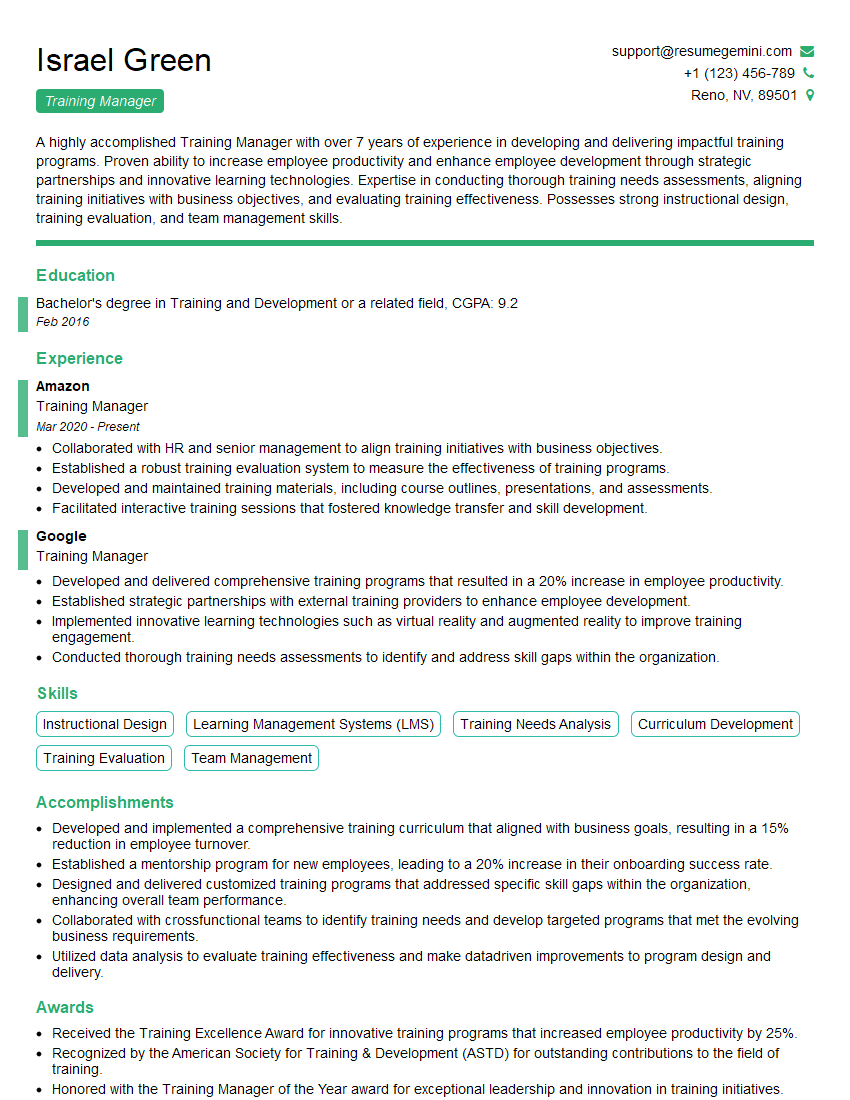
Training Manager Resume Sample
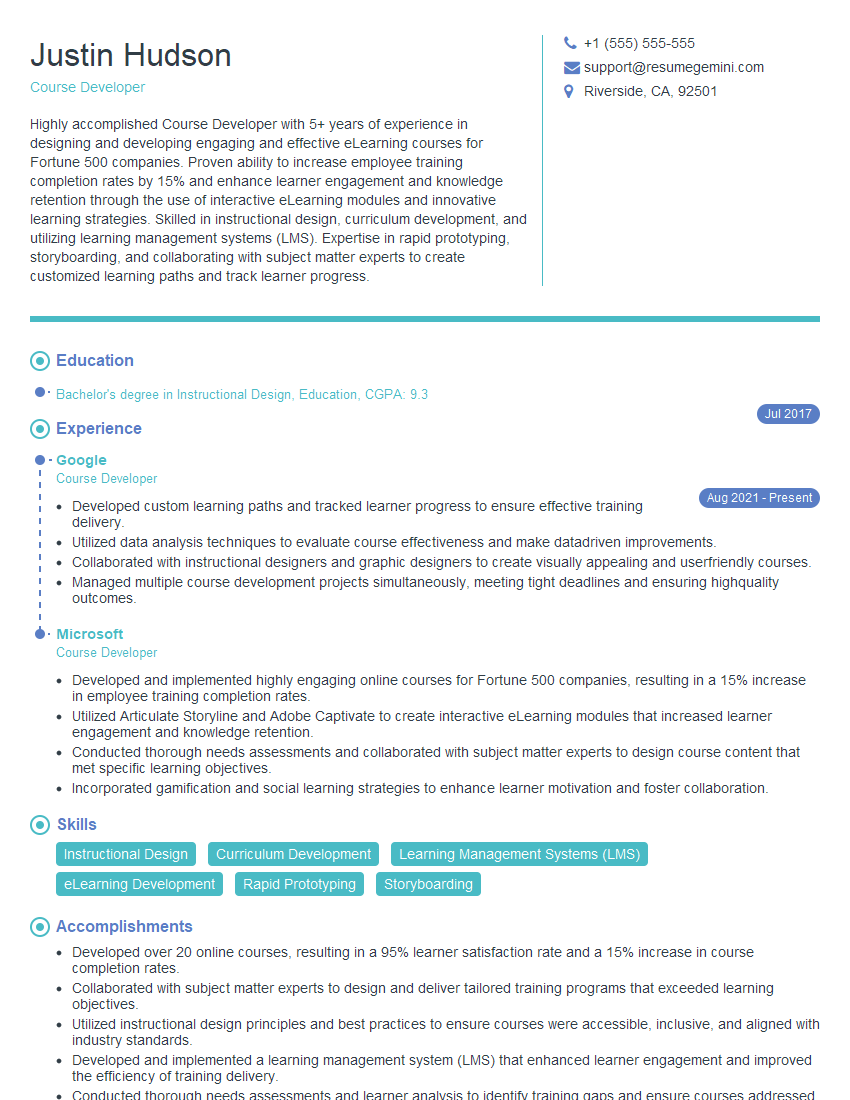
Course Developer Resume Sample

Curriculum Developer Resume Sample

Training Specialist Resume Sample
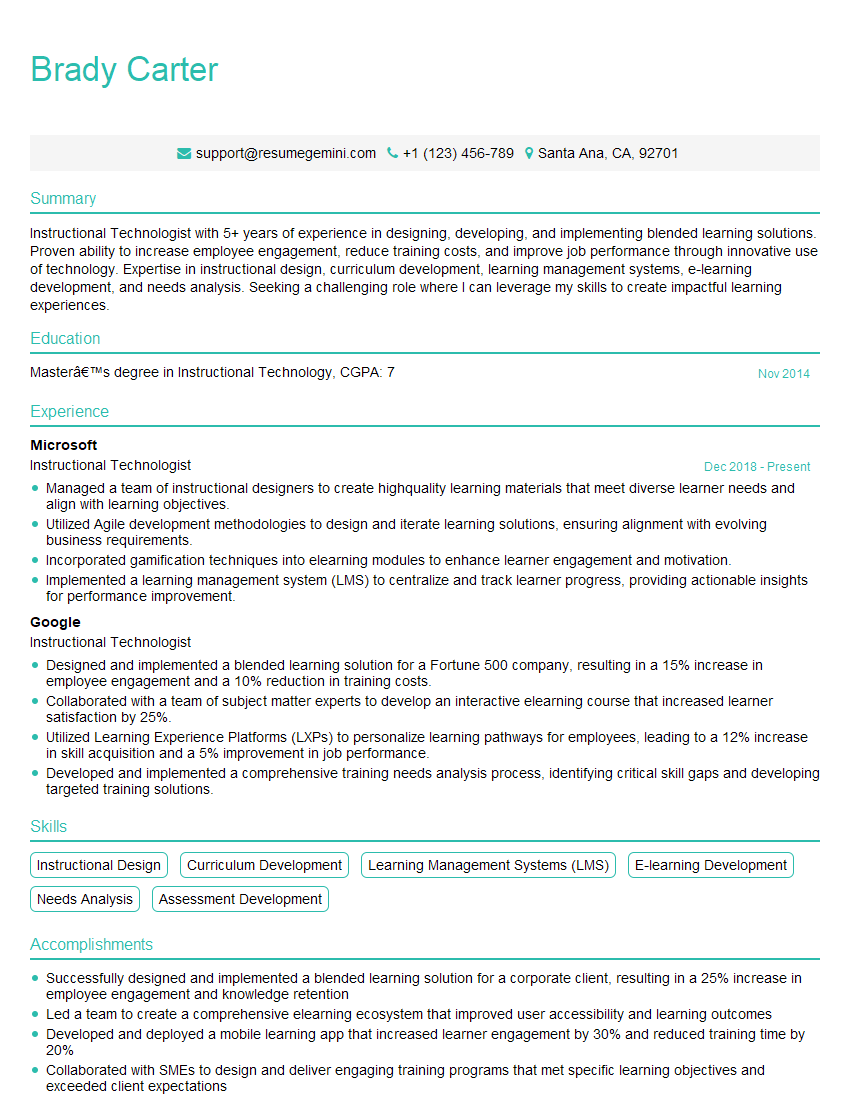
Instructional Technologist Resume Sample
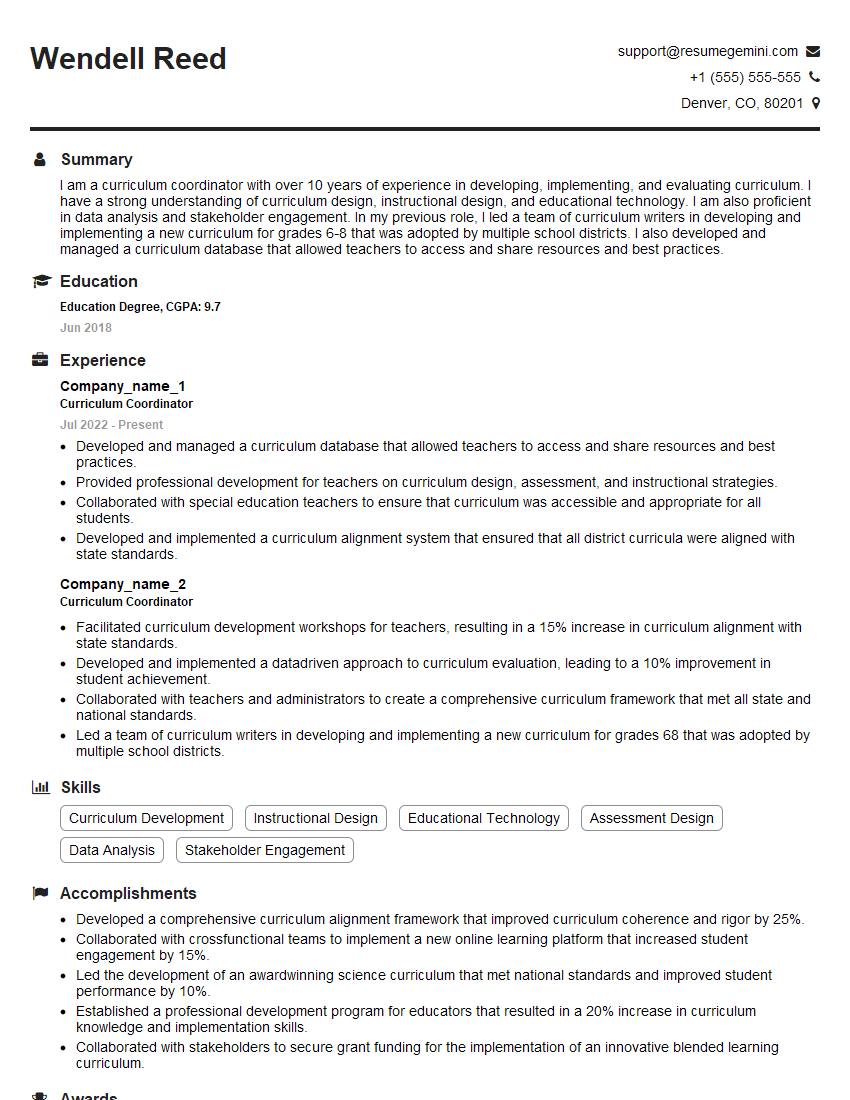
Curriculum Coordinator Resume Sample
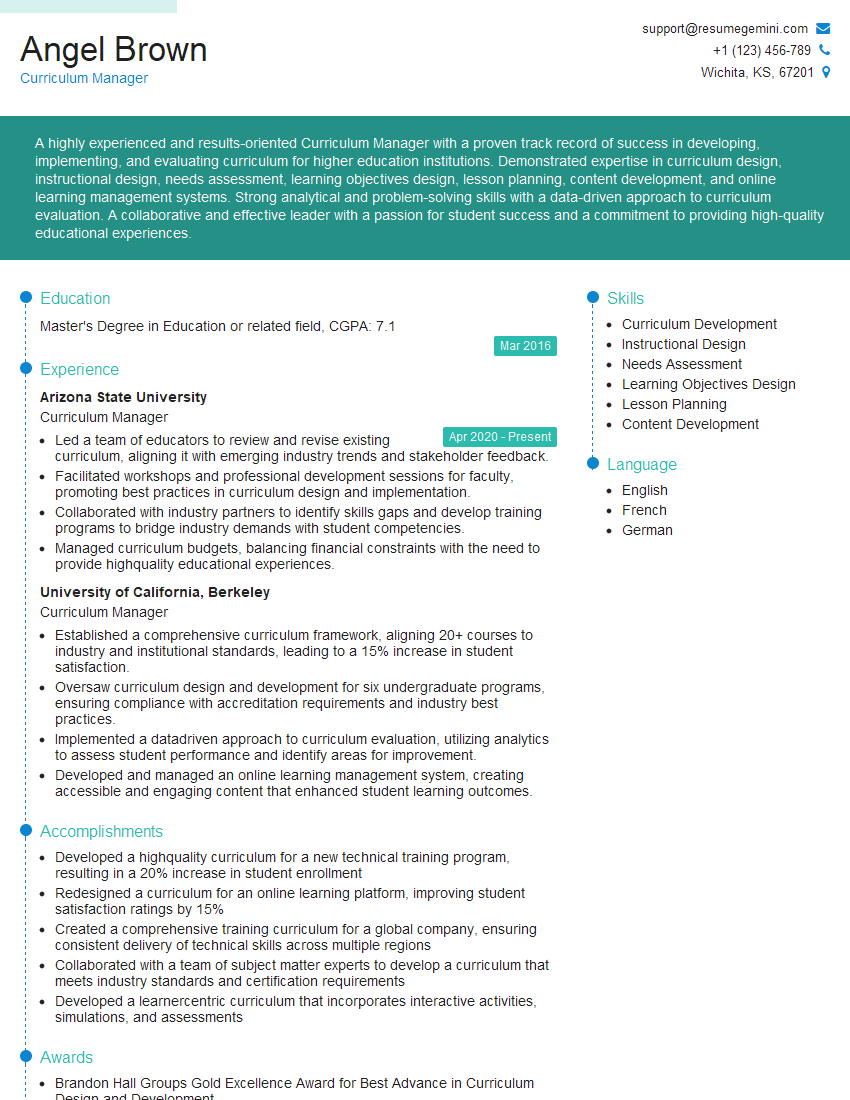
Curriculum Manager Resume Sample
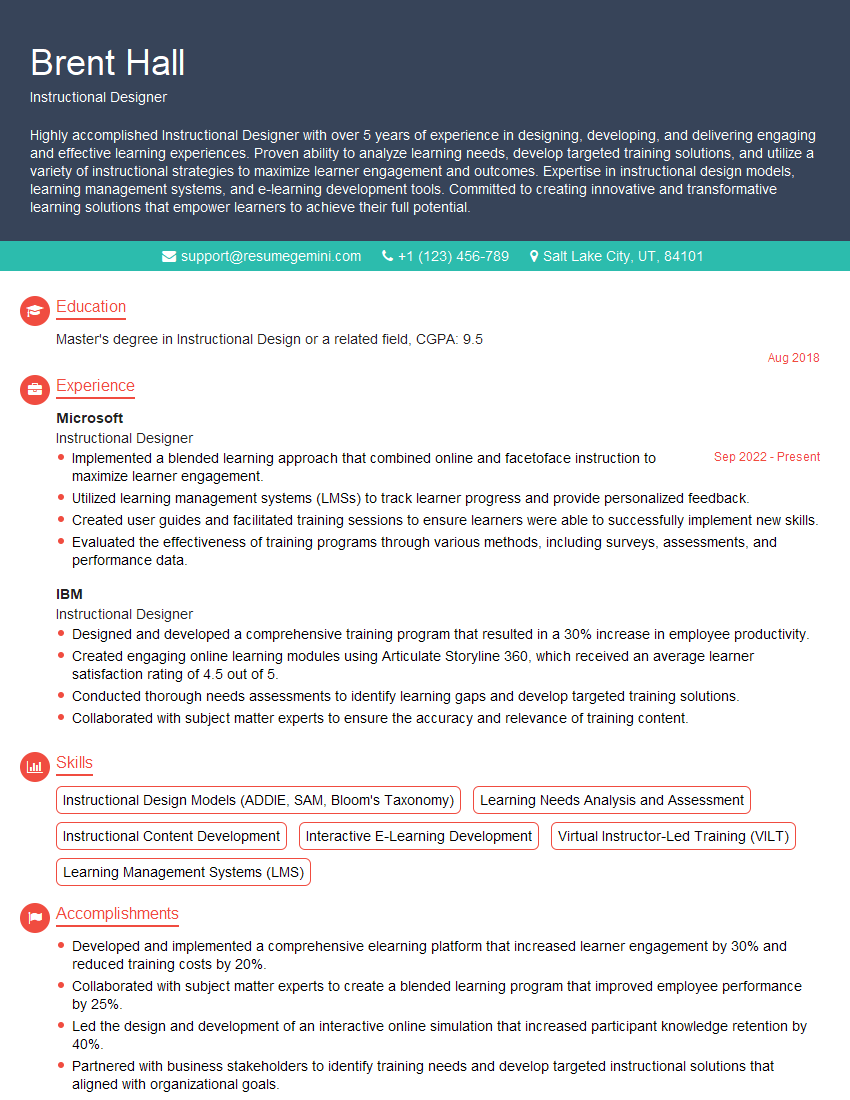
Instructional Designer Resume Sample

Educational Technologist Resume Sample
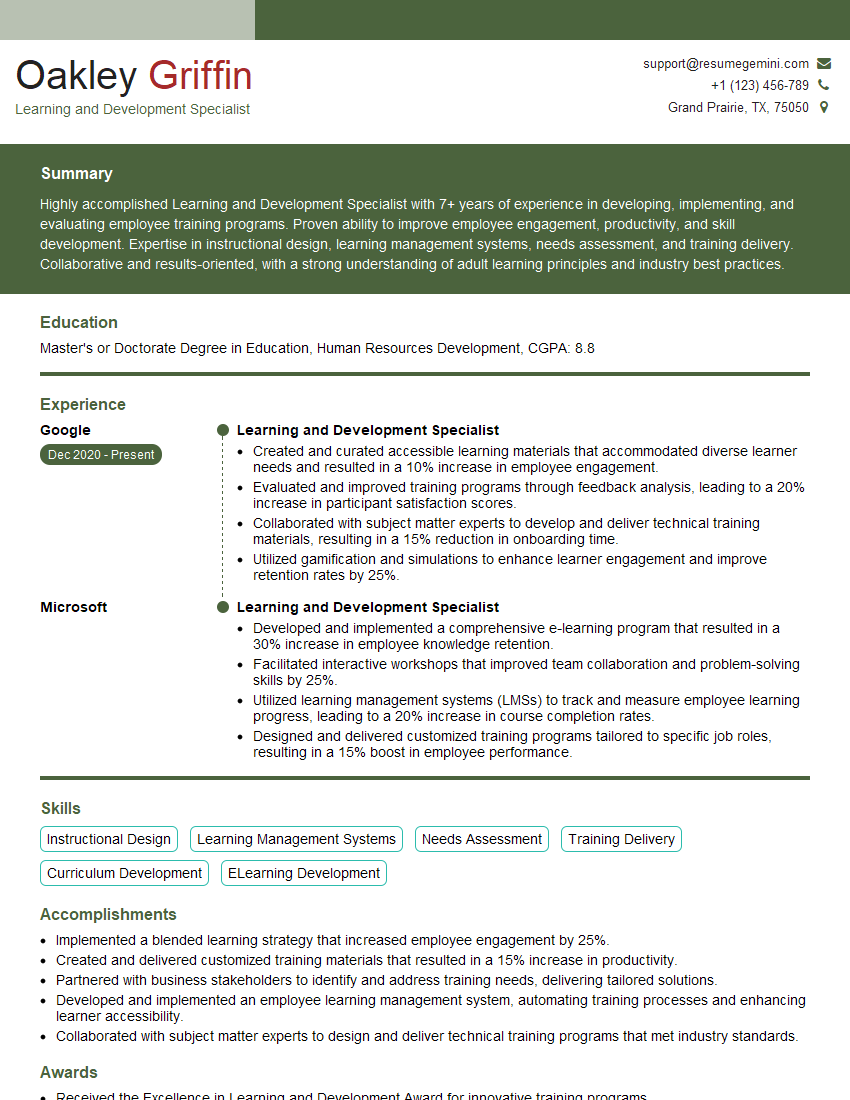
Learning and Development Specialist Resume Sample
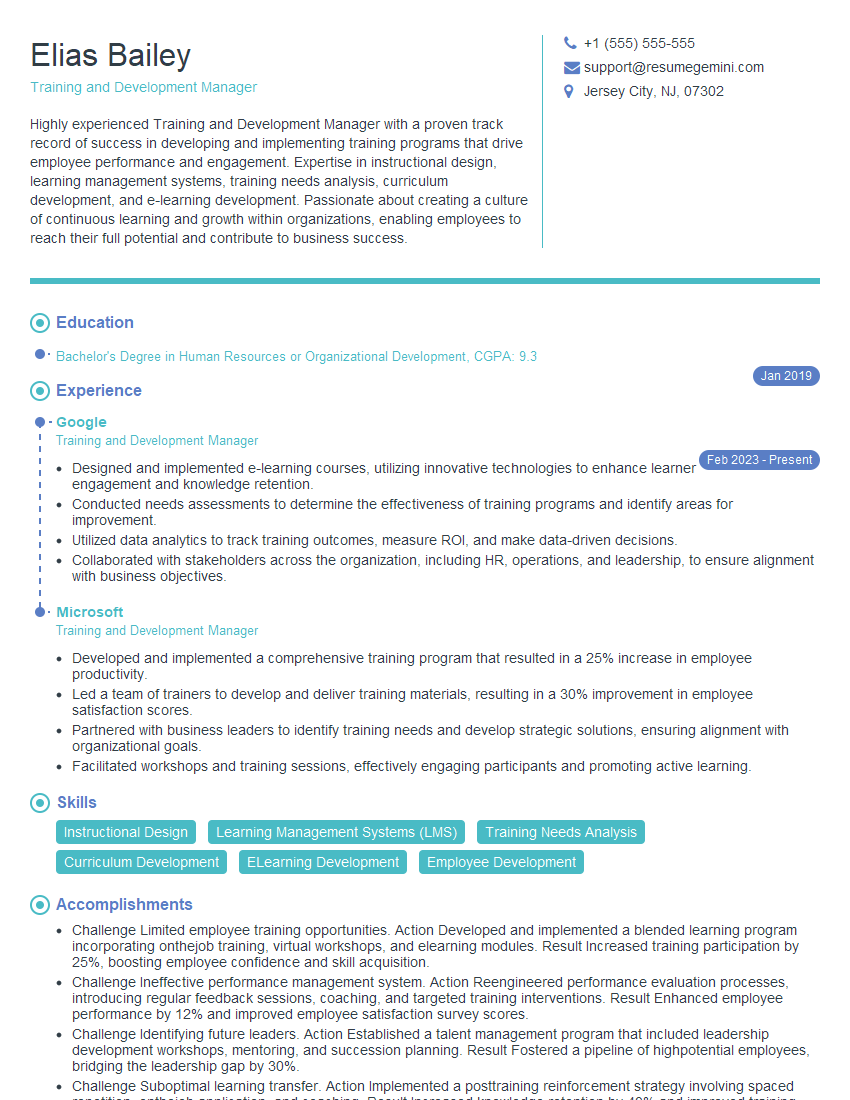
Training and Development Manager Resume Sample
Explore more articles
Users Rating of Our Blogs
Share Your Experience
We value your feedback! Please rate our content and share your thoughts (optional).
What Readers Say About Our Blog
Really detailed insights and content, thank you for writing this detailed article.
IT gave me an insight and words to use and be able to think of examples