Interviews are more than just a Q&A session—they’re a chance to prove your worth. This blog dives into essential Custom Quilting interview questions and expert tips to help you align your answers with what hiring managers are looking for. Start preparing to shine!
Questions Asked in Custom Quilting Interview
Q 1. Describe your experience with different quilting techniques (e.g., free-motion, walking foot, stippling).
My quilting journey has encompassed a wide range of techniques, each offering unique aesthetic and functional possibilities. Free-motion quilting, for instance, allows for incredibly expressive designs, limited only by the quilter’s imagination. I’ve mastered controlling the speed and pressure of my machine to create everything from delicate swirling patterns to bold, graphic shapes. This technique is perfect for adding personalized artistic flair.
Walking foot quilting, on the other hand, excels in creating even, consistent stitching, ideal for straight-line quilting or intricate geometric patterns. The even feed of the walking foot prevents fabric from shifting or bunching, ensuring a professional finish. I often use this for larger quilts or when working with thicker fabrics.
Stippling, a form of free-motion quilting using small, dense stitches, is a fantastic way to add texture and depth to a quilt. I often use stippling to fill in large areas of a quilt or to create a more subtle background texture for the main design. Mastering consistent stippling requires precise control of the machine and a good understanding of stitch density. It’s a favorite of mine for achieving visual interest and warmth.
Q 2. What types of quilting machines are you proficient with?
My expertise extends to a variety of quilting machines, both longarm and domestic. I’m highly proficient with longarm machines, specifically those with computerized features allowing for intricate designs and consistent stitching over large areas. This proficiency is crucial for handling large-scale custom projects efficiently. I’m equally comfortable using high-quality domestic sewing machines, adapted for quilting, to handle smaller or more detailed projects. I understand the nuances of each machine type, including the differences in needle selection, tension adjustment, and feed dog operation. For example, I know how to calibrate the stitch regulator on my longarm machine to create perfectly even stippling across different fabric weights.
Q 3. Explain your process for designing custom quilt patterns.
Designing custom quilt patterns is a collaborative process that starts with a deep understanding of the client’s vision. I begin each project with a thorough consultation to understand their preferences for color palettes, design styles, and the overall feel they wish to achieve. I then translate those ideas into sketches, using both hand-drawn illustrations and digital design software to visualize the pattern. For example, a client might bring in a collection of family photographs, and I’ll use those images to create a custom pattern that incorporates elements from each picture.
Once a preliminary sketch is approved, I carefully consider the fabric requirements, ensuring that the design complements the chosen textiles. This involves technical considerations such as seam allowances and pattern repetition. I often create small test blocks to evaluate the design in practice before finalizing the layout for the complete quilt. This ensures the final product is a perfect match to the client’s initial vision and my own standards of excellence.
Q 4. How do you select appropriate fabrics and batting for different quilt projects?
Selecting the right fabrics and batting is paramount to creating a successful quilt. The choice depends largely on the intended use of the quilt, its aesthetic, and the overall desired feel. For example, for a baby quilt, I might choose soft, high-quality cotton fabrics and a fluffy, hypoallergenic batting for maximum comfort.
For a more durable quilt, such as a bed quilt meant for frequent use, I would likely opt for stronger fabrics like linen or canvas blends, and a heavier batting for better longevity. Fabric weight and weave structure are also important. I always consider factors like shrinkage and colorfastness to ensure the quilt retains its shape, appearance, and quality over time. The batting’s loft (thickness) impacts the quilt’s overall warmth and drape. Thorough consideration of these factors ensures the project’s success and client satisfaction.
Q 5. Describe your experience with different quilt binding methods.
I’m proficient in several quilt binding methods, each offering unique aesthetic and functional qualities. The traditional method, using bias binding, creates a neat, professional finish. It’s versatile and works well with many quilt types. I’ve also mastered the ‘invisible’ binding technique, which produces a very clean and professional look, ideal for quilts with intricate details.
Another method I employ is machine binding, which is an efficient way to bind larger quilts, though it requires precision and a steady hand to achieve a consistent finish. My choice of method depends on the size, complexity, and the client’s preference. I always explain the pros and cons of each method to my clients before making a selection, ensuring they are fully informed and happy with the choice.
Q 6. How do you handle client consultations and feedback during the design process?
Client consultations are the foundation of my design process. I encourage open communication, actively listening to understand their vision and preferences. I use visual aids, such as fabric swatches and design sketches, to facilitate the discussion. Throughout the process, I offer my professional opinion and suggestions, while always maintaining the client’s vision as the guiding principle.
Regular updates and feedback sessions are essential. I present progress photographs and samples throughout the project, seeking input on color choices, pattern adjustments, or any other details. Open communication avoids misunderstandings and ensures the finished quilt precisely reflects the client’s expectations. For example, if a client expresses concern about the color intensity of a fabric, I’ll gladly source alternatives or modify the pattern to mitigate the issue.
Q 7. What is your experience with quilt finishing techniques?
Quilt finishing is the final, crucial stage of the process, where I meticulously ensure the quilt is both beautiful and durable. This involves squaring up the quilt layers, ensuring all seams are well-pressed and accurately aligned, and applying a consistent quilting pattern.
The binding is carefully attached, mitered corners are flawlessly executed, and the entire quilt is given a final pressing. I employ techniques such as edge stitching to prevent the layers from shifting and maintain the quilt’s structure for years to come. My goal isn’t simply to create a beautiful quilt; it’s to create a heirloom-quality piece that will be cherished for generations. Every detail, from the selection of thread to the final pressing, contributes to this enduring quality.
Q 8. How do you manage your time and prioritize tasks effectively when working on multiple quilt projects?
Managing multiple quilting projects effectively requires a structured approach. I utilize project management techniques like creating detailed lists with deadlines for each stage of each quilt. This includes fabric selection, cutting, piecing, quilting, and binding. I prioritize projects based on client deadlines and personal commitments, employing a Kanban-style board (physical or digital) to visualize workflow and identify bottlenecks. For example, I might dedicate Mondays and Wednesdays to piecing, Tuesdays and Thursdays to quilting, and Fridays to finishing details. This allows for focused work and minimizes context switching, which boosts efficiency and reduces errors.
I also break down large projects into smaller, manageable tasks. Instead of thinking ‘finish quilt X,’ I focus on ‘complete the quilting on block 3 of quilt X’ or ‘finish binding on quilt Y.’ This makes the overall process less daunting and provides a sense of accomplishment as each smaller task is completed. Regularly reviewing my project board and adjusting priorities as needed ensures I remain on track and meet deadlines consistently.
Q 9. Describe your experience with appliqué techniques.
Appliqué is a significant part of my quilting practice. I’m proficient in several techniques, including needle-turn appliqué, which creates precise, almost invisible stitches; machine appliqué, which is faster for larger projects; and raw-edge appliqué, ideal for a more rustic or folk-art aesthetic. My experience spans various appliqué shapes and fabric types. For instance, I’ve successfully appliquéd intricate floral designs onto fine silk and bold geometric patterns onto heavier cotton fabrics. I adapt my techniques depending on the project’s complexity and desired outcome. A recent project involved creating a detailed landscape using needle-turn appliqué—meticulous work, but the result was stunning, adding a unique depth to the final quilt.
I often experiment with different stitch densities and thread types for varied results, achieving a beautifully finished edge while maintaining the integrity of the design. I always pre-wash fabrics to avoid shrinkage after appliqué, ensuring lasting quality for the customer.
Q 10. How do you troubleshoot common quilting machine problems?
Troubleshooting quilting machine problems is a key skill. I start with the basics: checking the bobbin for correct winding and placement, ensuring the needle is correctly inserted and appropriate for the fabric type, and verifying the tension settings are correct for the thread I am using. Often, simple adjustments solve the issue. For example, if the stitches are uneven, I’ll first check the tension, then the needle, and lastly consider the feed dogs and their engagement with the fabric. If the machine jams, I meticulously inspect for any thread build-up or lint that might need to be removed.
For more complex issues, I systematically work through a checklist. Does the machine power on? Is there any noise indicating a mechanical problem? I utilize my knowledge of the machine’s mechanics and consult my manual if needed. If I can’t resolve the problem, I contact a qualified repair technician to ensure the machine’s longevity and my continued productivity.
Q 11. How do you ensure the accuracy and precision of your quilting work?
Ensuring accuracy and precision in quilting involves a multi-faceted approach. Accurate cutting is paramount, so I utilize rotary cutters and rulers for consistent and precise cuts. I also use templates or marking tools to guide my quilting designs, achieving even spacing and consistent patterns. Marking guidelines using a fabric pen or water-soluble marker helps ensure that my quilting lines remain precise. For instance, when creating parallel lines for a specific quilting pattern, I will use a ruler and carefully space my lines to maintain the same distance.
I use a walking foot for consistent feed and to prevent fabric layers from shifting during quilting, a common cause of inaccuracy. Regular maintenance of my machine, including cleaning and lubrication, contributes to its accuracy and reliability. Finally, paying close attention to detail throughout the process is essential to produce high-quality work.
Q 12. What are your preferred methods for creating consistent and even quilting stitches?
Creating consistent and even quilting stitches hinges on several factors. Proper machine maintenance, as discussed earlier, is crucial. I pay close attention to thread tension, which needs to be perfectly balanced between the needle and bobbin. Using a walking foot significantly reduces inconsistencies caused by fabric slippage. For free-motion quilting, maintaining a consistent speed and pressure on the foot pedal is key to even stitch lengths and density. Practicing free-motion quilting on a scrap fabric before starting a project is valuable for achieving mastery over stitch consistency.
For straight-line quilting, using a quilting guide or marking lines ensures that the stitches are evenly spaced. Even with my experience, regular testing and adjustment of the machine settings are essential to maintain consistency throughout a project. For example, a slight change in thread tension or foot pressure can dramatically impact stitch uniformity.
Q 13. Explain your approach to working with different fabric types and weights.
Working with different fabric types and weights requires adaptability and knowledge of fabric properties. Heavier fabrics, like denim, require a stronger needle and possibly a slower stitch speed to avoid stressing the machine. Lighter fabrics, such as silk, need a finer needle and potentially lower tension settings to prevent puckering or breakage. I always pre-wash all fabrics before starting a project to account for shrinkage and ensure the final quilt maintains its dimensions. Choosing appropriate thread weight and type is equally important – a heavier thread may be needed for thicker fabrics, and a finer thread suits delicate ones.
The quilting technique itself may also need adjustment. For example, I might use a walking foot for fabrics that tend to shift or a free-motion foot for more delicate fabrics. My approach is always to select the tools and techniques best suited to the fabric’s characteristics to achieve the most professional finish.
Q 14. Describe your experience working with various quilting patterns (e.g., meander, feathers, swirls).
My experience encompasses a wide range of quilting patterns. I’m comfortable with basic patterns like meander and straight-line quilting and have mastered more complex designs such as feathers, swirls, and various geometric patterns. I can adapt these patterns to fit different quilt sizes and designs, seamlessly integrating them into the overall aesthetic. For example, I might use a swirling pattern to enhance the curves of a floral quilt or incorporate straight lines to emphasize the sharp angles of a geometric quilt. I often combine several patterns within a single quilt to add visual interest and texture.
I constantly seek inspiration from various sources to expand my repertoire. Studying quilt books, attending workshops, and online resources help me refine my skills and discover new techniques. Recently, I incorporated a stippling pattern in a commission, achieving a beautifully textured and visually captivating effect that greatly pleased the client.
Q 15. How do you maintain the quality and durability of your quilting work?
Maintaining the quality and durability of my quilting work involves a multi-faceted approach, starting even before the needle hits the fabric. It begins with selecting high-quality materials – durable fabrics like cotton, linen, or even blends known for their strength and resistance to wear and tear. I meticulously pre-wash all fabrics to prevent shrinkage and ensure colors are colorfast.
During the quilting process itself, I utilize appropriate thread weight and tension to create strong, even stitches. I pay close attention to detail, ensuring accurate seam allowances and avoiding any stress points that might weaken the quilt. My quilting patterns are chosen to reinforce the fabric and distribute stress evenly across the surface, preventing unwanted puckering or tearing. Finally, proper finishing techniques, such as binding the quilt with a durable fabric and careful machine or hand stitching, add an extra layer of protection and enhance the quilt’s overall longevity. Think of it like building a strong house – a solid foundation of good materials and precise construction is key to a lasting result.
Career Expert Tips:
- Ace those interviews! Prepare effectively by reviewing the Top 50 Most Common Interview Questions on ResumeGemini.
- Navigate your job search with confidence! Explore a wide range of Career Tips on ResumeGemini. Learn about common challenges and recommendations to overcome them.
- Craft the perfect resume! Master the Art of Resume Writing with ResumeGemini’s guide. Showcase your unique qualifications and achievements effectively.
- Don’t miss out on holiday savings! Build your dream resume with ResumeGemini’s ATS optimized templates.
Q 16. How do you price your custom quilting services?
Pricing my custom quilting services depends on several factors. The most significant is the complexity and size of the quilt. A large, intricately designed quilt will naturally command a higher price than a smaller, simpler one. I consider the intricacy of the quilting pattern – denser, more elaborate designs require more time and skill. The type of fabric also plays a role; some fabrics are more challenging to work with than others. Finally, I factor in my time and skill level. I provide clear, upfront pricing based on a detailed quote that outlines all the aspects of the project. Transparency is essential to building trust with my clients, and ensures both parties understand the scope of work and associated costs. It’s not just about the money; it’s about delivering exceptional value for the client’s investment.
Q 17. What are your strengths and weaknesses as a custom quilter?
My strengths lie in my precision and attention to detail. I pride myself on creating quilts with clean, consistent stitching and flawless finishing. I also enjoy collaborating with clients to realize their vision, translating their ideas into beautiful, handcrafted works of art. I’m adept at working with a wide variety of fabrics and quilting styles. One of my recent projects involved incorporating a client’s cherished family heirlooms – vintage lace and embroidered pieces – into a modern quilt design, which resulted in a truly unique and sentimental piece.
However, like any artist, I have areas where I can continue to grow. Time management can be a challenge, especially when juggling multiple projects simultaneously. I’m actively working on refining my project planning and scheduling to ensure timely delivery. Another area I’m focusing on is expanding my knowledge of more advanced quilting techniques to offer even greater variety and customization to my clients.
Q 18. Describe your experience with digital quilting design software.
I’m proficient in using several digital quilting design softwares, including EQ8 and Electric Quilt. These programs allow me to create intricate, custom quilting designs that would be nearly impossible to accomplish by hand alone. I can plan the placement of quilting patterns, experiment with different color schemes, and even generate templates for intricate designs. For example, I recently used EQ8 to design a custom pantograph – a repeatable quilting pattern – that incorporated a client’s favorite flower motif, seamlessly integrating it into the overall quilt design. The software enables me to visualize the final product, refine details, and communicate effectively with the client throughout the design process. It’s a game-changer for efficiency and accuracy in complex projects.
Q 19. How do you handle difficult or demanding clients?
Handling demanding clients requires patience, clear communication, and a focus on problem-solving. I always start by actively listening to the client’s concerns and expectations. I then clearly outline the project’s scope and timeline, ensuring realistic expectations are set from the outset. If adjustments need to be made, I proactively communicate any potential impacts on the timeline or budget. When disagreements arise, I approach the situation with empathy and aim for a collaborative resolution. A recent example involved a client who had a change of heart regarding the fabric selection halfway through the project. Rather than getting upset, I calmly addressed their concerns, explored alternative options, and together we found a solution that still met their vision, albeit slightly adjusting the timeline.
Q 20. How do you stay up-to-date with current trends and techniques in custom quilting?
Staying current in the quilting world involves a blend of active learning and networking. I regularly attend quilting workshops and retreats, where I have the opportunity to learn new techniques from leading quilters and exchange ideas with fellow enthusiasts. I subscribe to quilting magazines and follow numerous online quilting communities and blogs. This allows me to stay informed about the latest trends in fabric design, quilting techniques (like free-motion quilting or innovative pattern design), and the newest quilting technology. I also actively participate in online forums and attend local guild meetings to share my knowledge and learn from others. This continuous learning ensures my work reflects the current trends while maintaining my own unique creative style.
Q 21. Explain your understanding of color theory and how it applies to quilt design.
Color theory is fundamental to effective quilt design. Understanding color relationships – such as complementary colors (colors opposite each other on the color wheel), analogous colors (colors next to each other), and triadic colors (three colors equally spaced on the color wheel) – is crucial for creating visually appealing and harmonious quilts. I consider the mood and feeling the client wants to evoke. For example, warm colors like reds and oranges might be used to create a cozy and inviting atmosphere, while cool colors like blues and greens can lend a calming or serene effect. I also factor in the value (lightness or darkness) and saturation (intensity) of colors, using a variety of shades and tints to add depth and visual interest to the quilt. Careful consideration of color theory ensures that the quilt is not only aesthetically pleasing but also conveys a specific emotional response, enhancing the overall impact of the finished piece.
Q 22. Describe your experience with different types of batting and their properties.
Choosing the right batting is crucial for a quilt’s drape, warmth, and overall quality. I have extensive experience working with various types, each with unique properties.
- Cotton batting: This is a classic choice, offering a soft hand, good loft, and relatively affordable price. It’s suitable for most quilting styles but can be prone to shrinking if not pre-washed. I often recommend it for beginners due to its ease of use.
- Polyester batting: Polyester provides excellent warmth-to-weight ratio, making it ideal for colder climates. It’s hypoallergenic, resists shrinking, and is relatively inexpensive. However, it can sometimes feel a bit stiff or less drapey than cotton.
- Wool batting: Wool batting is luxurious and naturally breathable, offering exceptional warmth without excessive weight. It’s naturally flame-resistant and has excellent drape. However, it’s more expensive and requires more careful handling during quilting, as it can be prone to needle breakage if not properly handled.
- Silk batting: The ultimate in luxury, silk batting offers incredible drape, softness, and breathability. It’s lightweight yet warm and ideal for heirloom quilts or delicate designs. Its high cost and delicate nature require experienced handling.
- Bamboo batting: A sustainable and eco-friendly option, bamboo batting is soft, breathable, and naturally hypoallergenic. It offers a good balance of warmth and drape and is becoming increasingly popular.
For example, I recently completed a quilt using silk batting for a client who wanted a lightweight, luxurious piece for their baby. The drape and softness were perfect for the intended use. For a family’s everyday quilt, I might choose a more affordable and durable cotton or polyester blend.
Q 23. How do you ensure the proper care and maintenance of your quilting equipment?
Maintaining my quilting equipment is paramount to ensuring the longevity of my work and my safety. I follow a strict maintenance schedule that includes:
- Regular cleaning: After each project, I thoroughly clean my sewing machine, including removing lint and dust from the bobbin case, feed dogs, and other areas. I also clean my rotary cutter blades and ironing board frequently.
- Lubrication: My sewing machine gets regular lubrication according to the manufacturer’s recommendations. This prevents wear and tear and ensures smooth operation.
- Needle replacement: I use new needles frequently, depending on the fabric and batting. Dull or bent needles can cause skipped stitches and damage the fabric.
- Storage: I store my equipment in a cool, dry place to prevent rust and damage. Rotary cutters are stored with blade covers to prevent accidental injury.
- Professional servicing: I schedule professional servicing for my sewing machine at least once a year, this allows a professional to identify and address any potential issues before they become major problems.
This preventative maintenance significantly extends the life of my equipment and helps ensure consistent, high-quality results.
Q 24. Explain your experience with quilt restoration or repair.
Quilt restoration and repair require a delicate touch and an understanding of both antique and modern quilting techniques. I’ve worked on several projects restoring antique quilts, addressing issues such as:
- Fabric repair: This involves carefully mending tears and holes using techniques like invisible mending or patching with matching fabrics. I often use hand-sewing for these repairs to maintain the integrity of the original work.
- Batting replacement: If the batting is severely damaged or deteriorated, I may need to remove it and replace it with a suitable alternative, preserving the original quilt top and backing.
- Cleaning: Antique quilts often require professional cleaning to remove stains and dirt without damaging the delicate fabrics. I usually partner with specialized textile cleaners for this.
- Color restoration: In some cases, I can work with a professional textile conservator to help restore faded colors using safe and appropriate techniques.
One memorable restoration project involved a family heirloom with significant water damage. By carefully cleaning the quilt, repairing damaged sections, and replacing a small portion of the batting, I was able to preserve this cherished family artifact.
Q 25. How do you incorporate client preferences and ideas into your custom quilt designs?
Collaborating with clients is central to my design process. I start by having a detailed conversation to understand their vision, including:
- Intended use of the quilt: Will it be for a baby, a bed, or wall art? This dictates the size, fabric choices, and quilting style.
- Style preferences: Do they prefer modern, traditional, or a specific aesthetic? We explore color palettes, fabric patterns, and overall design concepts together.
- Fabric choices: I guide clients through the selection of fabrics that complement their design and the quilt’s intended use. We consider factors such as durability, colorfastness, and texture.
- Quilting pattern preferences: I discuss different quilting patterns and their effect on the overall design, suggesting options based on their chosen style and the quilt’s function.
- Budget considerations: Transparency about costs is essential. I provide various options within their budget to accommodate their preferences and resources.
I always create sketches and fabric samples to allow clients to visualize the final product. This collaborative process ensures the final quilt perfectly reflects their personality and vision.
Q 26. Describe a challenging quilting project you completed and how you overcame obstacles.
One challenging project involved creating a custom quilt with an intricate, hand-appliquéd design incorporating hundreds of tiny, individually cut and sewn pieces. The challenge wasn’t just the complexity of the appliqué, but also the client’s request for specific, hard-to-find vintage fabrics.
I overcame the obstacles by:
- Thorough planning: I carefully sketched the design, created templates for the appliqué pieces, and organized the fabrics meticulously.
- Source material research: I spent considerable time searching online and visiting antique stores to locate the specific vintage fabrics the client desired.
- Time management: The project took significantly longer than anticipated, requiring careful time management and prioritization of tasks.
- Problem-solving: I encountered difficulties with some of the delicate vintage fabrics, which required careful handling and adaptation of my appliqué techniques.
The final result was a stunning, one-of-a-kind quilt that surpassed both my expectations and the client’s. The project taught me the value of thorough planning and creative problem-solving in the face of complex design challenges.
Q 27. What safety precautions do you take while operating quilting machinery?
Safety is my top priority when operating quilting machinery. I adhere to these safety practices:
- Proper machine maintenance: Regularly cleaning and lubricating my sewing machine ensures it operates smoothly, reducing the risk of malfunctions.
- Using appropriate needles and thread: Selecting the right needles for the fabric and thread prevents needle breakage and reduces the risk of injury.
- Keeping my work area clean and organized: A clutter-free workspace reduces the risk of tripping or entanglement in fabric or cords.
- Using safety guards: I always ensure the safety guards on my machine are in place and functioning properly, preventing accidental contact with moving parts.
- Never reaching under the needle while the machine is running: This simple but crucial rule prevents serious injury.
- Wearing appropriate attire: Loose clothing or jewelry can get caught in the machine, so I wear fitted clothing and remove any potential hazards.
- Following manufacturer’s instructions: This is paramount to understanding all safety protocols associated with the equipment being used.
By prioritizing these safety measures, I’ve managed to avoid accidents throughout my career as a quilter.
Q 28. How do you handle requests for custom quilting beyond your area of expertise?
Honesty and transparency are vital when dealing with requests beyond my expertise. If a client requests a technique or style I’m not proficient in, I’ll explain my limitations clearly and provide options:
- Referral: I might recommend another quilter who specializes in that specific area. My network of fellow quilters allows me to provide clients with appropriate referrals.
- Collaboration: For some projects, I might collaborate with a colleague who has the necessary skills, combining our expertise to meet the client’s needs.
- Honest assessment: I’ll always assess the feasibility of the project based on my capabilities. If it’s completely outside my skillset and no suitable alternative exists, I will recommend a course of action that best suits the client.
Maintaining professional integrity is more important than taking on a project I can’t execute successfully. Building trust with clients depends on honest communication.
Key Topics to Learn for Your Custom Quilting Interview
- Design & Pattern Creation: Understanding different quilting patterns, fabric selection for desired effects (drape, texture, etc.), and translating client visions into technical designs. Practical application includes sketching, software usage (e.g., design programs), and creating accurate cutting guides.
- Sewing Techniques & Machine Operation: Mastery of various sewing techniques relevant to quilting (e.g., piecing, appliqué, free-motion quilting). This includes understanding different sewing machine functionalities and troubleshooting common issues. Practical application includes demonstrating proficiency on various machines and understanding stitch selection for different fabric types and designs.
- Fabric Knowledge & Properties: Deep understanding of different fabric types (cottons, silks, etc.), their properties (weight, drape, shrinkage), and appropriate care instructions. Practical application includes selecting appropriate fabrics for specific projects and advising clients on fabric choices.
- Quilt Construction & Finishing: Knowledge of quilting techniques, including batting selection, layering, quilting methods (e.g., straight line, free motion, stippling), binding, and finishing techniques. Practical application includes explaining the process of creating a finished quilt, from initial design to final binding.
- Client Communication & Project Management: Effectively communicating with clients to understand their needs, managing expectations, and delivering projects on time and within budget. This involves active listening, clear communication of timelines, and problem-solving throughout the process.
- Business Acumen (if applicable): Understanding pricing strategies, material costing, and managing a client portfolio. This section is relevant depending on the specific role; for example, a shop owner role will require a stronger emphasis on business aspects.
Next Steps
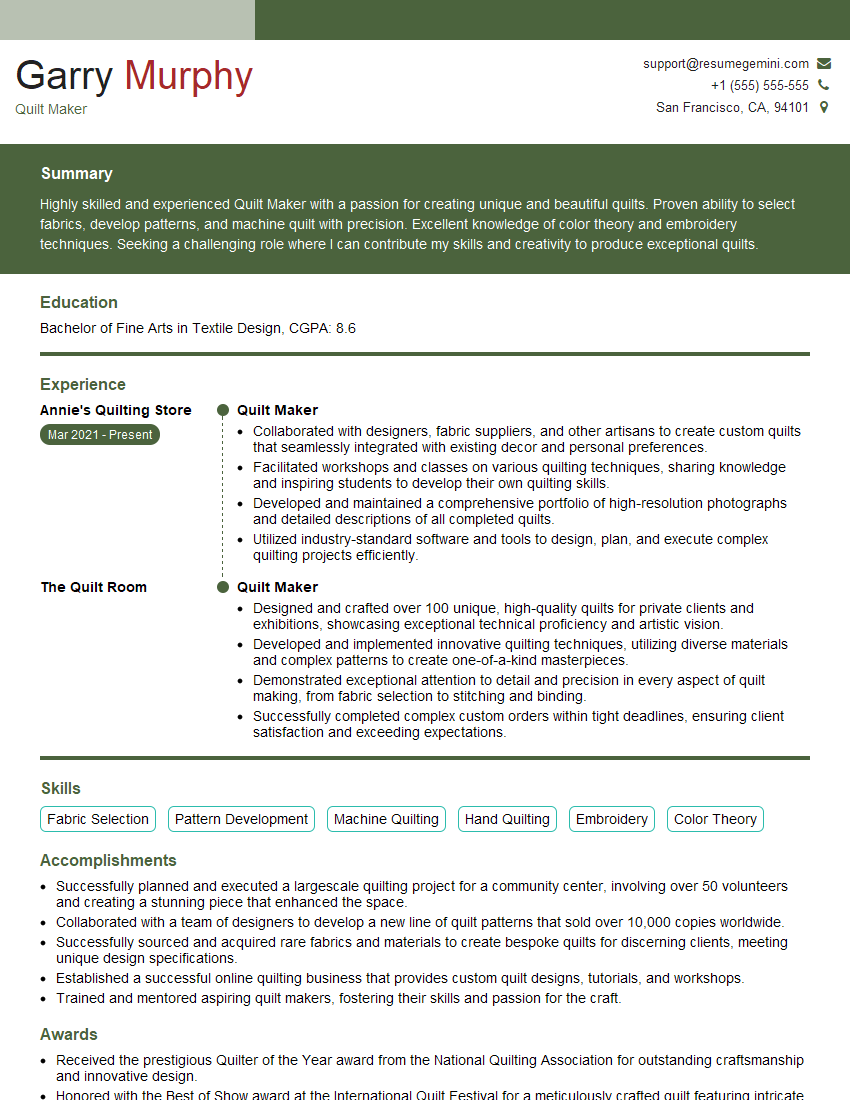
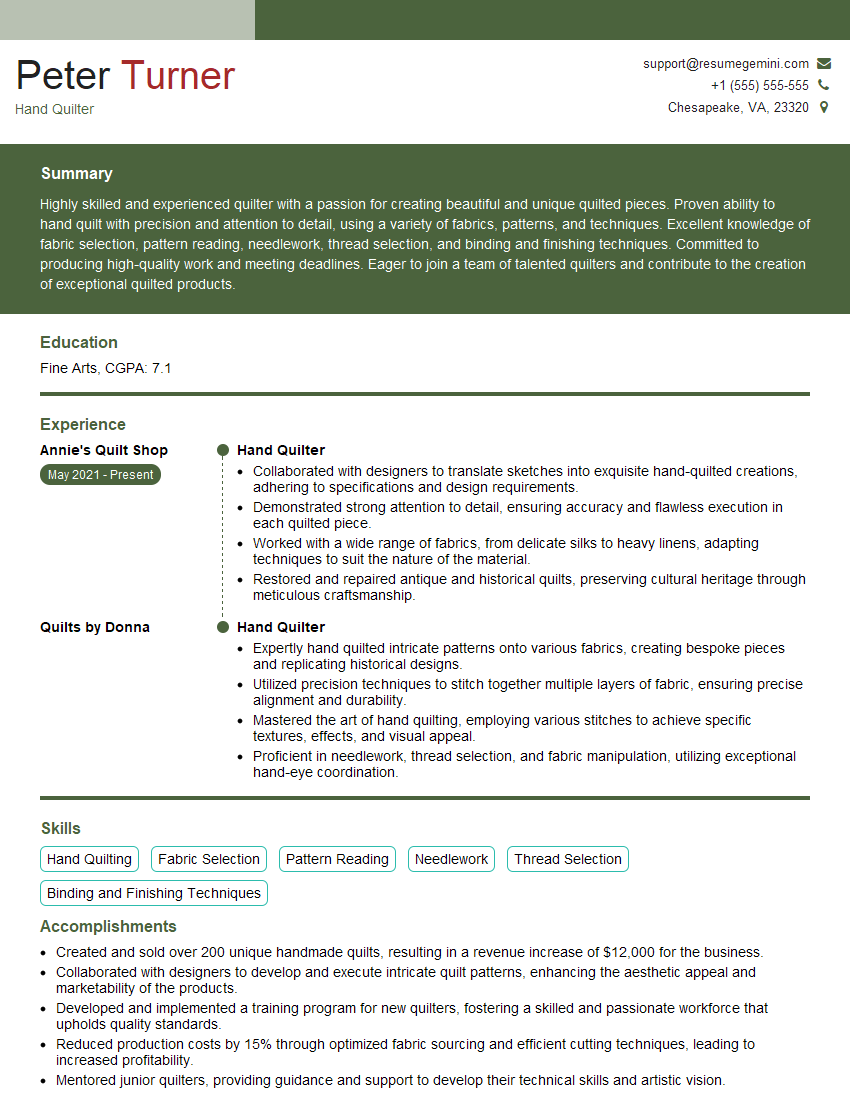
Mastering the art of custom quilting opens doors to exciting career opportunities, offering creative fulfillment and professional growth. To maximize your job prospects, creating an ATS-friendly resume is crucial. This ensures your application gets noticed by recruiters and hiring managers. We highly recommend using ResumeGemini to build a powerful and impactful resume. ResumeGemini provides a streamlined process and offers examples of resumes tailored specifically to the Custom Quilting industry, giving you a head start in showcasing your skills and experience effectively.
Explore more articles
Users Rating of Our Blogs
Share Your Experience
We value your feedback! Please rate our content and share your thoughts (optional).
What Readers Say About Our Blog
Really detailed insights and content, thank you for writing this detailed article.
IT gave me an insight and words to use and be able to think of examples