Preparation is the key to success in any interview. In this post, we’ll explore crucial Surveying Principles and Practices interview questions and equip you with strategies to craft impactful answers. Whether you’re a beginner or a pro, these tips will elevate your preparation.
Questions Asked in Surveying Principles and Practices Interview
Q 1. Explain the different types of surveying.
Surveying is broadly categorized into several types, each serving different purposes. Think of it like a toolbox with different specialized instruments – each perfect for a particular job.
- Plane Surveying: This is the most common type, where the Earth’s curvature is ignored. It’s suitable for smaller areas where the curvature’s effect is negligible, like mapping a city block or a construction site. Imagine surveying a football field; the Earth’s curvature is insignificant here.
- Geodetic Surveying: This takes into account the Earth’s curvature, crucial for large-scale projects spanning significant distances like mapping a state or country. It uses sophisticated techniques and models to account for the Earth’s ellipsoid shape. Think of mapping a whole continent – you definitely need to account for the Earth’s curve!
- Cadastral Surveying: This focuses on defining property boundaries, often involving legal implications. It’s all about accurately establishing land ownership and resolving disputes. Imagine resolving a property line disagreement between neighbors – cadastral surveying is key here.
- Topographic Surveying: This maps the Earth’s surface, including its natural and man-made features like elevation, rivers, buildings, etc., creating contour maps. It’s used for infrastructure planning, environmental studies, and more. Think of creating a detailed map for a new highway route.
- Hydrographic Surveying: This involves mapping water bodies, measuring depth, and charting the underwater terrain. It’s essential for navigation, dredging, and offshore construction. Think of creating charts for safe ship navigation.
- Route Surveying: This is focused on planning and designing transportation routes like roads, railways, and pipelines. It involves establishing alignments, gradients, and earthwork quantities. Imagine planning the route for a new high-speed rail line.
Q 2. Describe the process of conducting a boundary survey.
A boundary survey meticulously determines the exact location and limits of a property. It’s a precise process with legal ramifications, so accuracy is paramount. Think of it as establishing the precise ‘fence posts’ of a property’s legal boundaries.
- Review of Existing Records: This starts with examining deeds, plats, and other historical documents to understand the property’s history and existing boundary markers.
- Field Reconnaissance: A physical inspection of the site is crucial to identify existing markers, fences, and other features that might relate to the boundaries.
- Monumentation: Establishing or resetting boundary markers (monuments) is vital. These are permanent markers that precisely define the boundary corners.
- Measurements: Precise measurements are taken using high-accuracy equipment like total stations or GPS receivers. This includes distance, angles, and elevations.
- Data Processing and Analysis: The field data is processed using surveying software to create a precise boundary map.
- Preparation of the Boundary Survey Plat: A final plat (map) showing the property’s boundaries, monuments, and other relevant information is prepared, often including a legal description of the property.
- Legal Description: A formal, legal description of the property boundaries is prepared based on the survey results. This is crucial for legal purposes.
Q 3. What are the common sources of error in surveying?
Errors in surveying are inevitable, but understanding their sources allows for mitigation and improved accuracy. These errors can be broadly classified into:
- Instrumental Errors: These arise from imperfections or malfunctions in surveying equipment, such as miscalibration of a total station or a faulty level. Regular calibration and maintenance are essential.
- Natural Errors: These are caused by environmental factors, such as temperature variations affecting tape measurements, atmospheric refraction bending laser beams, or magnetic declination affecting compass readings.
- Personal Errors: These are mistakes made by the surveyor, like misreading a scale, incorrect recording of data, or poor instrument setup. Careful observation, double-checking, and standardized procedures are crucial.
- Systematic Errors: These follow a predictable pattern and can often be corrected for, such as tape sag or temperature effects on a steel tape. Understanding these errors and applying appropriate corrections is vital.
- Random Errors: These are unpredictable and are minimized through careful observation and multiple measurements. Statistical analysis is used to handle random errors.
Q 4. How do you ensure accuracy in your surveying measurements?
Accuracy in surveying measurements is paramount. It’s achieved through a combination of meticulous practices and technological advancements. Think of it like baking a cake – precise measurements are essential for a perfect result.
- Calibration of Instruments: Regular calibration of equipment is crucial to ensure its accuracy. This verifies the instrument is performing within its specified tolerances.
- Proper Instrument Setup: Correct instrument setup minimizes instrumental errors. Leveling, centering, and orientation are critical steps.
- Multiple Measurements: Taking multiple measurements of the same quantity helps to reduce random errors and identify outliers.
- Error Detection and Correction: Using appropriate techniques to identify and correct systematic and random errors is essential. This involves understanding the sources of error and applying corrections.
- Quality Control Procedures: Implementing quality control procedures throughout the surveying process helps ensure accuracy and consistency. This might include independent checks and reviews.
- Use of Redundant Measurements: Employing techniques like double centering and independent checks enhances accuracy and helps to detect blunders.
- Data Processing and Analysis: Using appropriate software and techniques to process and analyze data helps to identify and correct errors.
Q 5. Explain the concept of coordinate systems and datums.
Coordinate systems and datums are fundamental to surveying. They provide a framework for locating points on the Earth’s surface. Imagine a grid system overlaid on the Earth, enabling precise location determination.
Coordinate Systems: These define the way coordinates are represented. The most common is the Cartesian coordinate system (x, y, z), but others exist such as polar coordinates. These systems give you the ‘address’ of a point.
Datums: These are reference surfaces that define the origin and orientation of a coordinate system. They are mathematical models of the Earth’s shape. A datum provides the ‘location’ of the grid itself. Examples include NAD83 (North American Datum of 1983) and WGS84 (World Geodetic System 1984). Choosing the correct datum is essential for consistency and accuracy, especially in large-scale projects.
The relationship is that a coordinate system is a way to represent location, and a datum is a reference surface from which that coordinate system is defined.
Q 6. What are the different types of surveying equipment and their applications?
Surveying employs a variety of equipment, each tailored to specific tasks. Think of them as specialized tools in a surveyor’s toolbox.
- Total Stations: These electronic instruments measure distances, angles, and elevations simultaneously, significantly increasing efficiency and accuracy. They’re the workhorse of modern surveying.
- GPS (Global Positioning System) Receivers: These use signals from satellites to determine precise coordinates. They are widely used for large-scale mapping and positioning.
- Levels: These instruments are used to determine differences in elevation, essential for leveling and contouring.
- Theodolites: These are precision instruments used for measuring horizontal and vertical angles.
- Measuring Tapes: Used for measuring distances, various types exist (steel, fiberglass) depending on the required accuracy and environment.
- Prisms: Used with total stations to reflect the instrument’s signal, improving accuracy and range.
- Data Collectors: These handheld devices record and store data collected from surveying instruments, facilitating efficient data management.
- Survey Software: Software processes, analyzes, and visualizes survey data, creating maps and plans.
Q 7. How do you perform a level survey?
A level survey determines differences in elevation between points. The goal is to create a level surface or establish elevations relative to a benchmark. Imagine creating a perfectly level foundation for a building.
- Establish a Benchmark: A benchmark is a point of known elevation, serving as a reference point for all subsequent measurements. This could be an existing benchmark or one established using precise GPS or leveling techniques.
- Set Up the Level: The level is carefully set up, ensuring its line of sight is horizontal. Proper leveling is crucial to minimize errors.
- Establish the Height of Instrument (HI): The height of the instrument is determined by measuring the elevation of the benchmark and adding the reading from the level’s rod held on the benchmark.
- Take Readings: Readings are taken on a leveling rod held at different points, calculating the elevation of each point by subtracting the rod reading from the HI.
- Loop Closure: In larger surveys, a loop closure is often used to ensure accuracy by returning to the starting point and verifying elevation differences. Any discrepancies are analyzed and corrections applied.
- Data Processing and Analysis: The collected data is processed to generate elevation information, which can then be used to create contour maps or other representations.
Q 8. How do you calculate the area of a parcel of land using surveying data?
Calculating the area of a land parcel from surveying data often involves breaking down the parcel into simpler shapes. The most common method uses coordinates obtained through surveying techniques like traversing or GPS. We can then employ several methods depending on the shape of the parcel.
- Trapezoidal Rule: If the boundary is represented by a series of connected lines, the area can be approximated by dividing the parcel into a series of trapezoids. The area of each trapezoid is calculated as
0.5 * (b1 + b2) * h, whereb1andb2are the lengths of the parallel sides (surveyed distances between points), andhis the height (the perpendicular distance between the parallel sides – determined from the coordinates). - Coordinate Geometry: This is a more precise method, especially for irregularly shaped parcels. Using the coordinates of each boundary point, we can calculate the area using the surveyor’s area formula. For a polygon with n vertices (xi, yi):
Area = 0.5 * | (x1y2 + x2y3 + ... + xny1) - (y1x2 + y2x3 + ... + ynx1) | - Planimeter: A mechanical or digital planimeter can be used to directly measure the area from a scaled drawing of the parcel. This is a less precise method suitable for quick estimations.
For instance, imagine a triangular parcel with vertices at (0,0), (100,0), and (50,80) meters. Using the coordinate geometry method, the area would be 4000 square meters. Software packages like AutoCAD or GIS software automate these calculations significantly. The choice of method depends on the accuracy required and the complexity of the parcel’s shape.
Q 9. Explain the principles of GPS surveying.
GPS surveying relies on the principles of satellite triangulation. A network of satellites orbiting the Earth transmits signals containing precise timing and positional information. A GPS receiver on the ground receives these signals from at least four satellites to determine its three-dimensional position (latitude, longitude, and altitude). This works by measuring the time it takes for the signal to travel from the satellite to the receiver. By knowing the satellite’s position and the time the signal was emitted, the receiver can calculate its own position through trilateration – determining a location based on the distances from three known points.
Key principles include:
- Satellite Signals: GPS satellites broadcast signals that contain information about their precise location and time. The receiver uses this information to perform calculations.
- Signal Propagation: The speed of light is assumed constant, and any delays (atmospheric, ionospheric) in signal propagation are factored in to improve accuracy using atmospheric models and corrections.
- Trilateration: The receiver calculates its position by measuring the distance to multiple satellites. At least four are needed to account for clock errors in both the satellite and receiver.
- Error Sources: GPS signals can be affected by various factors, including atmospheric conditions, multipath (signals bouncing off objects before reaching the receiver), and satellite geometry (the relative positions of the satellites in the sky). These errors are mitigated using various techniques.
Q 10. What is the difference between RTK and PPK GPS?
Both RTK (Real-Time Kinematic) and PPK (Post-Processed Kinematic) are GPS surveying techniques that aim to achieve high accuracy, but they differ in how they process the data and achieve this accuracy.
- RTK GPS: This method provides real-time centimeter-level accuracy. It involves two GPS receivers: a base station at a known location and a rover receiver at the point being surveyed. The base station transmits corrections to the rover in real-time, compensating for atmospheric and other errors. This allows the surveyor to see the accurate position immediately. Think of it like a real-time collaboration between the base and rover receivers to cancel out errors.
- PPK GPS: PPK also achieves centimeter-level accuracy, but the processing happens after data collection. Both the base and rover receivers record data independently. This data is then processed together using specialized software, considering the precise timing information to correct for errors. This post-processing step allows for a more thorough error correction, and often results in higher accuracy than RTK, but the results are not immediately available.
The choice between RTK and PPK depends on factors like project requirements (how quickly the data needs to be available), budget considerations, and the level of accuracy required. RTK is preferred for immediate feedback and faster workflow, while PPK might be chosen when higher accuracy or the ability to revisit the data post-collection is essential.
Q 11. Describe the process of creating a topographic map.
Creating a topographic map involves several steps, starting with data acquisition and ending with map production. This process requires careful planning and execution.
- Data Acquisition: This is crucial and can involve various techniques such as traditional surveying (leveling, traversing, total stations), GPS (RTK or PPK), or even LiDAR (Light Detection and Ranging). The goal is to gather elevation data at numerous points across the area to be mapped.
- Data Processing: The collected data, whether coordinates or elevation points, is processed to correct for errors and ensure consistency. This might involve adjusting measurements, applying corrections for atmospheric conditions (if using GPS), and performing least-squares adjustments.
- Contouring: This is where the elevation data is used to generate contour lines. These lines connect points of equal elevation, visually representing the terrain’s shape. Software packages assist in automating this process using interpolation techniques.
- Map Compilation: The contour lines, along with other features like roads, buildings, and water bodies, are compiled onto a base map. This involves choosing a suitable map scale and projection.
- Map Drafting and Presentation: The final map is created using computer-aided design (CAD) software, ensuring it meets cartographic standards. Features like spot elevations, hill shading, and contour line labels are added to enhance the map’s clarity and understandability.
For example, to create a topographic map of a construction site, one would first use a total station or GPS to gather elevation data at various locations. Then using specialized software the points are interpolated to create contour lines which visualize the slopes and elevations of the site. This map would be essential for site planning and construction.
Q 12. How do you deal with obstructed lines of sight during surveying?
Obstructed lines of sight are a common challenge in surveying. Several techniques can be employed to overcome this:
- Traversing: This method involves establishing a network of interconnected survey lines. If a direct line of sight is obstructed, the surveyor can work around the obstacle by measuring angles and distances to reach the desired point indirectly.
- Trigonometric Levelling: When vertical measurements are obstructed, trigonometric leveling utilizes angles and distances to calculate the difference in elevation between two points, even if a direct level line is not possible. This often uses a theodolite.
- Reciprocal Leveling: This technique involves setting up a level at two different points and taking reciprocal readings between them to eliminate the effects of the curvature of the earth and atmospheric refraction.
- Using GPS: GPS techniques (RTK or PPK), provided adequate satellite visibility exists, can often overcome line-of-sight obstructions because the signal is received from satellites overhead, bypassing many obstacles on the ground.
- Establishing Intermediate Points: If an obstacle prevents a direct measurement, setting up intermediate points on either side of the obstacle helps in breaking down the measurement into smaller, unobstructed segments. These segments can then be measured and combined.
For example, if a building obstructs the line of sight between two points needing to be surveyed, the surveyor can establish an intermediate point on either side of the building and use angles and distances to connect to the points, effectively ‘circumventing’ the building.
Q 13. Explain the importance of surveying in construction projects.
Surveying plays a critical role in construction projects, from the initial planning stages to final completion. Accurate surveying ensures the project aligns with the design and is built in the correct location. Its importance is multifaceted:
- Site Analysis and Planning: Surveying provides crucial information about the site’s topography, existing features, and boundaries. This helps in determining the feasibility of the project, optimizing the design, and identifying potential challenges.
- Setting Out: Surveying is essential for accurately setting out the location of buildings, roads, and other structures. This ensures the construction aligns with the design drawings and prevents costly errors. Precise coordinates and elevations are crucial.
- Monitoring Progress: Throughout the construction process, surveying is used to monitor the progress of the work. This includes checking the position and alignment of structures, verifying the accuracy of excavation and fill, and ensuring that construction follows the planned design.
- Volume Calculations: Surveying is used to calculate the volumes of earthwork, concrete, and other materials. This is essential for accurate cost estimation, material procurement, and project management.
- As-Built Surveys: After completion, an as-built survey is conducted to document the final location and dimensions of all structures and utilities. This provides a permanent record for future maintenance and development.
Imagine a highway project: Surveying determines the optimal route considering terrain and existing infrastructure. It establishes accurate alignments for the road and structures. During construction, surveying monitors the quality of earthwork and ensures the road surface is constructed to the correct gradients and alignment. Finally, a post-construction survey documents the final as-built dimensions.
Q 14. What are the legal and ethical responsibilities of a surveyor?
Surveyors bear significant legal and ethical responsibilities, owing to the importance of their work in establishing property boundaries, infrastructure design, and more. Their responsibilities include:
- Accuracy and Precision: Surveyors must ensure the accuracy and precision of their measurements and data. Errors can have severe legal and financial consequences.
- Professional Competence: They are expected to maintain professional competence through continuous learning and adherence to industry standards. Using outdated equipment or neglecting professional development can compromise the quality of work.
- Legal Compliance: Surveyors must adhere to all relevant laws and regulations, including those related to land surveying, boundary disputes, and data protection.
- Ethical Conduct: They must act ethically and with integrity, avoiding conflicts of interest, maintaining client confidentiality, and providing unbiased professional advice.
- Due Diligence: Before undertaking any survey, surveyors need to carry out due diligence to understand the project’s requirements and potential risks. Thorough research and planning can prevent future issues.
- Proper Documentation: Maintaining accurate records, including field notes, calculations, and maps, is crucial for legal compliance and accountability. Records should clearly show every step of the surveying process.
A surveyor’s mistakes can lead to boundary disputes, construction errors, or even safety hazards. Adhering to legal and ethical responsibilities protects the surveyor, their clients, and the public interest.
Q 15. How do you manage survey data?
Managing survey data effectively is crucial for accuracy and efficiency. My approach involves a multi-step process. First, I ensure all data is collected using standardized procedures and appropriate equipment, minimizing errors from the outset. This includes meticulous field notes, clear instrument settings records, and regular instrument calibrations. Second, I utilize robust data management software to organize and process the raw data. This often includes cleaning the data to remove outliers or obvious errors, and transforming it into a usable format. Third, I perform quality control checks on the data, comparing results against known control points or using statistical methods to identify and address inconsistencies. Finally, the processed data is stored securely and backed up regularly, following strict data governance policies, to ensure long-term accessibility and integrity. This systematic approach ensures that the data is reliable, consistent, and readily available for analysis and report generation. For example, in a recent land survey project, I used a combination of total station data and GPS coordinates. The data was processed using a software package that enabled me to perform least squares adjustments, which helped identify and correct minor inconsistencies before creating the final survey plan.
Career Expert Tips:
- Ace those interviews! Prepare effectively by reviewing the Top 50 Most Common Interview Questions on ResumeGemini.
- Navigate your job search with confidence! Explore a wide range of Career Tips on ResumeGemini. Learn about common challenges and recommendations to overcome them.
- Craft the perfect resume! Master the Art of Resume Writing with ResumeGemini’s guide. Showcase your unique qualifications and achievements effectively.
- Don’t miss out on holiday savings! Build your dream resume with ResumeGemini’s ATS optimized templates.
Q 16. Describe your experience with different surveying software.
My experience spans several widely used surveying software packages. I’m proficient in Autodesk Civil 3D, a powerful software for designing and managing civil engineering projects, including surveying data processing. I also have extensive experience with Leica Geo Office, a software suite specifically designed for processing data from Leica surveying instruments, which often involves complex adjustments and data transformations. Additionally, I’m familiar with Bentley MicroStation, a CAD platform used for creating and managing various types of drawings and models, and it frequently incorporates survey data. My expertise includes utilizing the various functionalities of each software, from data import and processing to plan creation and reporting. I’m comfortable with various data formats, and I adapt my software selection based on the project’s specific needs and available resources.
Q 17. Explain the concept of error propagation in surveying.
Error propagation refers to how uncertainties in individual measurements accumulate and affect the overall accuracy of a calculated result in surveying. Think of it like building with slightly mis-sized bricks – a small error in one brick’s size might not be noticeable, but if that error repeats across the entire wall, the final structure will be off. In surveying, this happens with distance measurements, angles, and elevations. For instance, a small error in measuring the length of a baseline can lead to significant errors in the final coordinates of points further away. We use statistical methods to quantify and manage this propagation, including the analysis of variances and covariances. We consider the precision of the instruments used and the influence of environmental factors like temperature and atmospheric pressure. Techniques such as least squares adjustment minimize the effect of these propagated errors by distributing errors across the entire network of survey points. For example, if we know the standard deviation of our distance measurements is 2mm, we can use statistical methods to estimate the expected error in the calculated area of a polygon.
Q 18. How do you handle discrepancies in survey data?
Discrepancies in survey data are inevitable, and addressing them requires a careful and systematic approach. First, I investigate the source of the discrepancy. This involves reviewing field notes, instrument settings, and data processing steps to identify any possible procedural errors. If the discrepancy seems significant, I will re-measure the critical sections in the field to check for errors in measurement. Secondly, I analyze the data using statistical methods to determine if the discrepancy is within acceptable tolerances. If it’s within tolerance, I might just note it in the report. If the discrepancy falls outside acceptable tolerances, then I must investigate further. I might need to identify and correct errors using techniques like least squares adjustment, data filtering, or outlier removal. In some cases, it might necessitate re-surveying parts of the area to resolve the conflict, ensuring quality control throughout the process. For instance, in a boundary survey, discrepancies might arise due to conflicting deed descriptions or historical inconsistencies. In such a case, a thorough investigation is required, potentially involving legal research and further field work to reconcile the conflicting information.
Q 19. What are the different types of leveling instruments?
Leveling instruments are crucial for determining elevations. The most common types are:
- Automatic Levels: These use a compensator that automatically levels the line of sight, making them faster and easier to use than older methods. They are widely used for various leveling tasks.
- Digital Levels: These combine the automatic leveling of auto levels with electronic distance measurement (EDM) technology, allowing for faster and more efficient data acquisition, often integrated with data recording and processing capabilities.
- Precise Levels (or Tilting Levels): These offer higher accuracy than automatic levels due to the absence of a compensator, requiring careful leveling of the instrument before each reading. They are typically employed in high-precision leveling projects where accuracy is paramount.
- Hand Levels: Simpler instruments used for quick, approximate elevation checks or minor leveling tasks. They are much less precise than automatic or precise levels.
Q 20. Explain the concept of traverse surveying.
Traverse surveying involves establishing a network of connected lines to determine the relative positions of points. It’s like creating a chain of connected triangles or polygons to map out an area. We start with known points (control points) and measure the lengths and angles of lines connecting them. This data allows us to calculate the coordinates of all points within the network. There are two main types: open traverse, where the survey begins and ends at different points, and closed traverse, where it begins and ends at the same point. Closed traverses are preferred as they allow for checks on measurement accuracy – the misclosure (difference between the starting and ending coordinates) should be within acceptable tolerances. If the misclosure is too large, it indicates errors in measurements, requiring investigation and adjustments to the data. Traverse surveys are used extensively in mapping, land surveying, and route surveying for roads and pipelines. They form the basis for many larger-scale surveys.
Q 21. How do you perform a volume calculation using surveying data?
Volume calculations from survey data are essential in earthworks, reservoir capacity estimations, and stockpile quantification. The process typically involves creating a digital terrain model (DTM) from the survey data points. Then, we can use different methods to calculate the volume. Common methods include:
- The Cross-sectional Method: This involves dividing the area into a series of cross-sections, calculating the area of each section, and then using these areas to compute the volume using numerical integration techniques. This is useful for long and narrow areas such as roads or canals.
- The Grid Method: This creates a grid over the survey area and calculates the volume based on the elevations at each grid point. This is effective for irregular areas and allows for a more precise volume estimation.
- The Prismoidal Formula: A more accurate method that takes into account the shape of the area, providing a refined volume estimation compared to simpler methods. This requires the data to be arranged in a specific manner for efficient calculation.
Q 22. Describe your experience with different types of surveying projects.
My experience encompasses a wide range of surveying projects, from large-scale infrastructure developments to smaller-scale land surveys. I’ve worked on:
- Construction Surveying: Setting out building lines and levels, monitoring progress, and performing as-built surveys for projects such as highways, bridges, and high-rise buildings. For instance, I was involved in a project where we used precise GPS and total stations to ensure the accurate placement of foundations for a major bridge construction.
- Topographic Surveying: Creating detailed maps showing the Earth’s surface features, including elevation, contours, and man-made objects, using methods like traditional level surveys and drone-based photogrammetry. One memorable project involved mapping a challenging terrain with dense vegetation using a combination of LiDAR and conventional surveying techniques.
- Cadastral Surveying: Defining and mapping property boundaries, which involves meticulous research of title deeds and applying advanced surveying techniques to accurately establish legal boundaries. This work often requires careful consideration of legal implications and demands precise measurements.
- Hydrographic Surveying: Mapping underwater features and depths of water bodies, using sonar and GPS technology. I participated in a project surveying a riverbed to assess erosion and potential flood risks.
- Route Surveying: Planning and designing routes for roads, pipelines, and railways, this involves considering terrain, environmental factors and regulatory requirements. A recent project involved route optimization for a new highway minimizing environmental impact.
This diverse experience has provided me with a comprehensive understanding of various surveying methodologies and their applications.
Q 23. Explain your understanding of surveying regulations and standards.
My understanding of surveying regulations and standards is thorough and up-to-date. I am familiar with national and international standards like the American Society of Civil Engineers (ASCE) standards, the National Geodetic Survey (NGS) standards, and relevant local regulations. This knowledge is crucial for ensuring the accuracy, reliability, and legal compliance of all surveying projects.
For example, I understand the importance of using appropriately calibrated equipment, adhering to strict quality control procedures, and maintaining detailed records of all measurements and calculations. I’m proficient in applying error analysis and propagation techniques to assess the uncertainty associated with our measurements and reporting this transparently. Compliance with health and safety regulations, such as those related to working at heights or near traffic, is paramount, and I ensure all team members are properly trained and equipped.
Moreover, I am aware of the legal aspects of surveying, such as the implications of boundary disputes and the importance of providing accurate and defensible survey data for legal proceedings. Understanding these legal and ethical aspects are intrinsic to responsible surveying practice.
Q 24. How do you ensure the safety of yourself and your crew during surveying work?
Safety is my top priority. I establish a comprehensive safety plan for every project, tailored to the specific site conditions and tasks involved. This involves:
- Risk Assessment: Identifying potential hazards, such as uneven terrain, traffic, electrical lines, and weather conditions, and implementing appropriate control measures.
- Site Preparation: Ensuring the work area is adequately marked and cleared of obstacles. Using appropriate signage and barriers to prevent accidents.
- Personal Protective Equipment (PPE): Providing and enforcing the use of appropriate PPE, including hard hats, high-visibility clothing, safety glasses, and appropriate footwear.
- Training and Communication: Ensuring all crew members receive adequate training on safe work practices and have clear communication channels to report any hazards or concerns.
- Emergency Procedures: Establishing clear emergency procedures and ensuring that all team members are aware of them and know how to contact emergency services.
- Regular Inspections: Conducting regular inspections of equipment and the work area to identify and address any potential hazards.
By implementing these measures, I strive to create a safe and productive work environment for myself and my crew. I treat safety as a shared responsibility and actively encourage open communication about safety concerns.
Q 25. Describe your problem-solving skills in a surveying context.
Problem-solving is a core competency in surveying. I approach challenges systematically, drawing on my experience and knowledge of surveying principles. For example, in one project, we encountered unexpected underground utilities during excavation. Instead of halting the project, I collaborated with the utility companies, using ground-penetrating radar and careful hand excavation to accurately locate and mark the utilities, minimizing disruption to the project timeline and preventing potential damage.
Another example involved dealing with inaccurate control points on a large topographic survey. I systematically analyzed the data, identifying outliers and potential sources of error, such as atmospheric refraction or instrument malfunction. By implementing rigorous quality control checks and employing adjustment techniques, I corrected the inaccuracies and delivered reliable survey data.
My problem-solving approach involves:
- Identifying the problem clearly and defining its scope.
- Gathering relevant data and information.
- Analyzing the data and identifying potential causes.
- Developing and evaluating possible solutions.
- Implementing the chosen solution and monitoring its effectiveness.
- Documenting the process and lessons learned.
I believe in a proactive and collaborative approach to problem-solving, leveraging the expertise of the entire team to find efficient and effective solutions.
Q 26. What are the limitations of GPS surveying?
While GPS surveying is a powerful tool, it has limitations. The accuracy of GPS measurements can be affected by several factors:
- Atmospheric conditions: Ionospheric and tropospheric delays can introduce errors in the signal propagation, particularly during adverse weather conditions.
- Multipath errors: Reflections of the GPS signal from buildings or other structures can lead to inaccurate position measurements.
- Obstructions: Trees, buildings, or other physical obstacles can block the GPS signal, leading to signal loss or poor accuracy.
- Satellite geometry: The geometric configuration of the satellites in the sky affects the precision of position calculations; poor geometry can lead to less accurate results.
- Receiver limitations: The quality of the GPS receiver itself can impact accuracy. Lower-cost receivers may have lower precision than higher-end models.
These limitations can be mitigated through techniques like differential GPS (DGPS) or Real Time Kinematic (RTK) GPS, which employ additional reference stations to improve accuracy. However, even with these techniques, GPS surveying is not always suitable for all applications, particularly those requiring extremely high precision.
Q 27. Explain the concept of geodetic surveying.
Geodetic surveying deals with the determination of the Earth’s shape and size and the precise location of points on its surface. Unlike plane surveying, which assumes a flat Earth, geodetic surveying takes into account the Earth’s curvature. This is crucial for large-scale projects spanning significant distances, where ignoring the Earth’s curvature could lead to significant errors.
Geodetic surveying uses sophisticated techniques and datums (reference systems defining the Earth’s shape and orientation) to calculate accurate coordinates. It often involves the use of specialized equipment like precise GPS receivers and sophisticated mathematical models to account for the Earth’s ellipsoidal shape. Geodetic surveys provide the framework for national mapping and coordinate systems and are essential for infrastructure projects spanning large areas, satellite imagery referencing, and large-scale mapping projects.
Think of it like this: If you’re measuring a small field, assuming a flat surface is acceptable. But if you’re building a highway across a state, you absolutely must account for the Earth’s curvature to avoid significant errors in alignment and distance.
Q 28. How do you utilize GIS in your surveying work?
GIS (Geographic Information System) plays a vital role in modern surveying. I utilize GIS throughout the surveying workflow, from data acquisition to analysis and presentation. I use GIS software to:
- Data Management: Organize and manage large volumes of spatial data, including survey measurements, imagery, and attribute information. This is particularly useful for large, complex projects.
- Data Processing: Perform spatial analysis on survey data, such as calculating areas, volumes, and distances. This allows me to generate precise calculations based on the collected data.
- Data Visualization: Create maps and other visualizations to present survey data in a clear and understandable format for clients and stakeholders. This enables easy interpretation and comprehension of complex data.
- Integration with other data sources: Combine survey data with other GIS data layers, such as cadastral maps, aerial photos, or environmental data, to provide a comprehensive understanding of the project area.
- Project planning and design: Use GIS tools to aid in route planning, site selection, and other aspects of project design.
For example, in a recent project involving pipeline route design, I used GIS to integrate survey data with terrain data and environmental sensitivity maps to identify optimal routes minimizing environmental impact and cost. GIS is an indispensable tool for efficient and effective surveying practices in modern times.
Key Topics to Learn for Surveying Principles and Practices Interview
- Fundamental Surveying Concepts: Understanding coordinate systems (e.g., Cartesian, Geographic), datums, map projections, and their practical implications in different surveying projects.
- Leveling and Height Determination: Mastering techniques like differential leveling, trigonometric leveling, and their applications in establishing benchmarks and creating contour maps. Understand sources of error and mitigation strategies.
- Traversing and Angle Measurement: Familiarize yourself with different traversing methods (e.g., open, closed, and compass traversing), angle measurement techniques (e.g., theodolite use), and error analysis. Be prepared to discuss accuracy and precision.
- Distance Measurement: Explore various methods of distance measurement, including electronic distance measurement (EDM) techniques, and their applications in various surveying scenarios. Understand the impact of atmospheric conditions on measurements.
- Global Navigation Satellite Systems (GNSS): Gain a solid understanding of GNSS principles, including satellite constellations, signal reception, data processing, and error correction techniques. Be prepared to discuss RTK and precise point positioning (PPP).
- Topographic Surveying and Mapping: Understand the process of creating topographic maps, including data acquisition, data processing, and map production. Discuss different contouring methods and their applications.
- Construction Surveying: Be familiar with the role of surveying in construction projects, including setting out, monitoring progress, and volume calculations. Understand the use of total stations and other construction surveying equipment.
- Legal Aspects of Surveying: Gain a basic understanding of legal and ethical considerations related to land surveying, boundary determination, and property rights.
- Data Processing and Analysis: Familiarize yourself with common surveying software and techniques for data processing, error analysis, and quality control. Be prepared to discuss data management and presentation.
- Problem-Solving and Critical Thinking: Practice applying your knowledge to solve real-world surveying problems. Develop your ability to analyze data, identify errors, and propose solutions.
Next Steps
Mastering Surveying Principles and Practices is crucial for a successful and rewarding career. It opens doors to diverse roles and projects, leading to advancement and increased earning potential. To maximize your job prospects, create an ATS-friendly resume that highlights your skills and experience effectively. ResumeGemini is a trusted resource that can help you build a professional and impactful resume tailored to the surveying industry. Examples of resumes specifically designed for candidates with expertise in Surveying Principles and Practices are available to guide you. Take the next step towards your dream career today!

Cartographer Resume Sample

Photogrammetrist Resume Sample
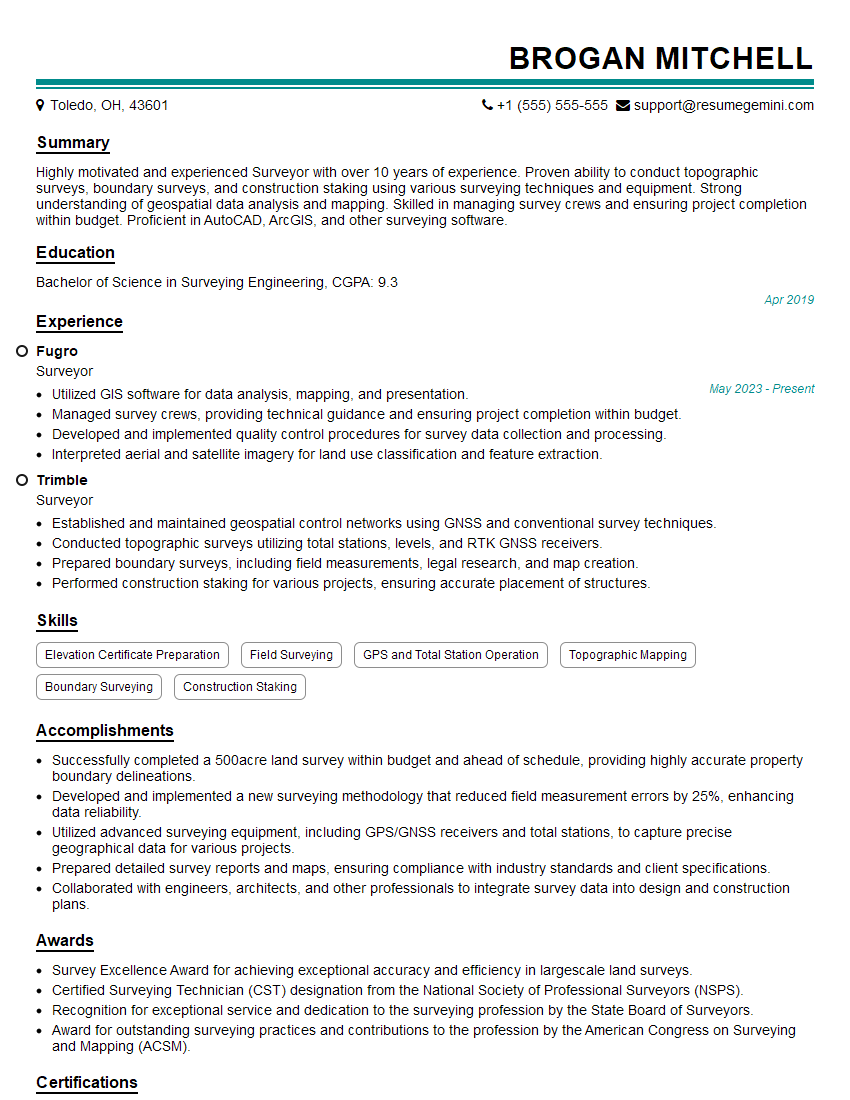
Surveyor Resume Sample
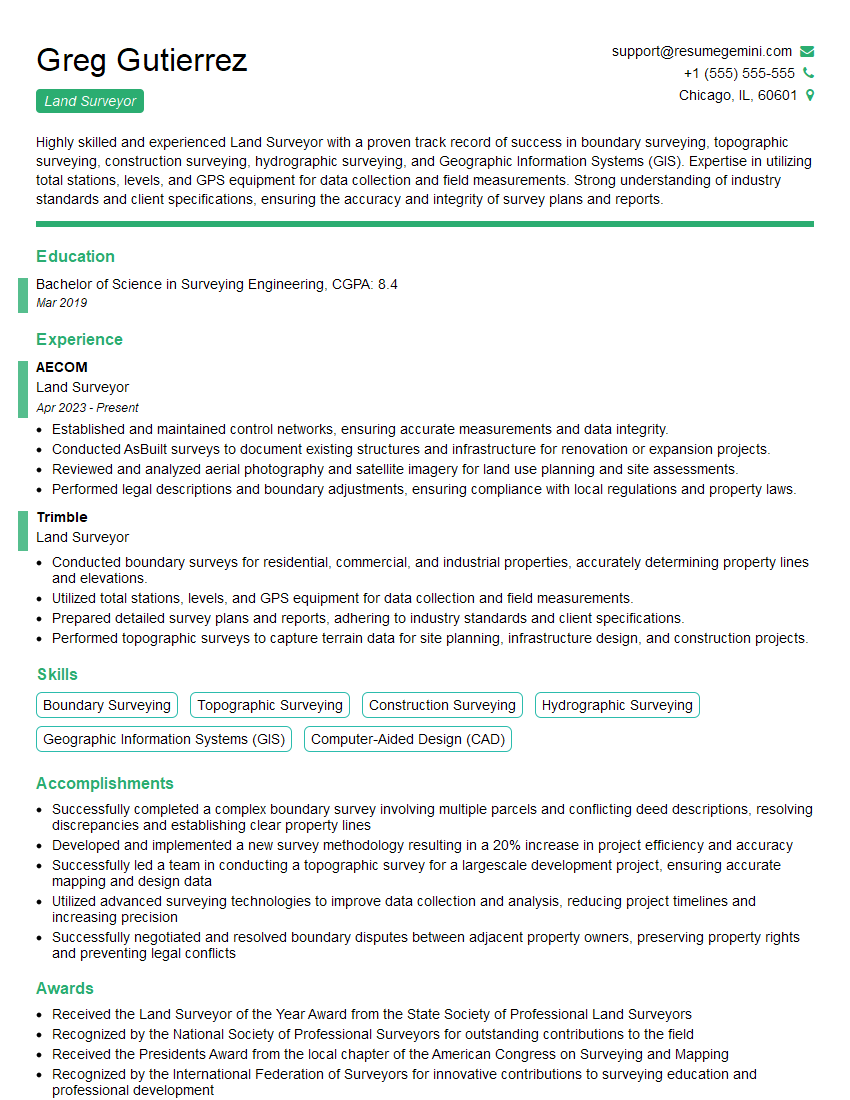
Land Surveyor Resume Sample

Mine Surveyor Resume Sample

Project Surveyor Resume Sample

Survey Manager Resume Sample

Survey Party Chief Resume Sample

Surveying Technician Resume Sample

Survey Crew Chief Resume Sample

Remote Sensing Specialist Resume Sample
Explore more articles
Users Rating of Our Blogs
Share Your Experience
We value your feedback! Please rate our content and share your thoughts (optional).
What Readers Say About Our Blog
Really detailed insights and content, thank you for writing this detailed article.
IT gave me an insight and words to use and be able to think of examples