Interviews are opportunities to demonstrate your expertise, and this guide is here to help you shine. Explore the essential Detailing and polishing techniques interview questions that employers frequently ask, paired with strategies for crafting responses that set you apart from the competition.
Questions Asked in Detailing and polishing techniques Interview
Q 1. Explain the difference between a single-stage and multi-stage polishing process.
The key difference between single-stage and multi-stage polishing lies in the number of steps and abrasiveness used to achieve the desired finish. Single-stage polishing uses a single compound and pad to correct imperfections and enhance shine. Think of it as a one-and-done approach, ideal for lightly scratched vehicles or as a maintenance polish. Multi-stage polishing, however, employs several compounds of varying abrasiveness – typically starting with a cutting compound to remove deeper scratches, then moving to a polishing compound for refinement, and finally a finishing compound to achieve a flawless, high-gloss finish. It’s like sanding wood; you’d start with a coarser grit before using progressively finer grits for a smooth surface.
Single-Stage: Faster, less time-consuming, suitable for minor imperfections. Multi-Stage: More thorough, capable of correcting severe defects, produces a superior finish, but requires more time and skill.
Q 2. Describe your experience with various polishing compounds (e.g., cutting, polishing, finishing).
My experience with polishing compounds is extensive, covering a wide spectrum of abrasiveness and applications. I’m proficient in using cutting compounds like Meguiar’s Ultimate Compound, which aggressively remove heavier scratches and swirls. These are usually more abrasive, resulting in a more aggressive cut. Polishing compounds, such as Menzerna FG400, are less aggressive and primarily focus on refining the surface, reducing the haze left by cutting compounds. They level out the surface after the heavy correction, making it smoother. Finally, finishing compounds such as Menzerna Final Finish SiO2 provide the ultimate gloss and clarity while leaving behind a very smooth surface, practically eliminating any remaining swirl marks. The choice of compound always depends on the condition of the paint. For example, a heavily swirled car would require a cutting compound, followed by a polishing and finishing compound. A lightly swirled vehicle may only need a polishing compound.
Q 3. What types of polishing pads are you familiar with and when would you use each?
I’m familiar with a wide variety of polishing pads, each designed for a specific purpose. Cutting pads, typically made from dense foam or wool, are used with cutting compounds to remove heavier defects. They are more aggressive, removing significant amounts of paint. Polishing pads, usually less aggressive and made from softer foam, are used with polishing compounds to refine the surface and reduce haze. Finishing pads, often made of very soft foam or microfiber, are used with finishing compounds to create the final gloss. The choice of pad depends on the compound used and the severity of the defects. For instance, a wool pad would be used with a cutting compound for maximum correction, while a microfiber pad would be used with a finishing compound for final refinement and gloss. Choosing the right pad is as crucial as choosing the right compound.
Q 4. How do you determine the appropriate level of correction needed for a paint defect?
Determining the appropriate level of correction involves a thorough assessment of the paint defects. I start with a visual inspection under different lighting conditions, looking for scratches, swirl marks, holograms, and other imperfections. A paint depth gauge can also help determine the paint thickness, which is critical to avoid cutting through the clear coat. The severity and depth of the defects directly influence the choice of compound and pad. Light swirl marks may only require a polishing compound and a soft pad, while deeper scratches may necessitate a cutting compound and a more aggressive pad. I always test my process in an inconspicuous area before applying it to the entire vehicle to ensure I’m achieving the desired results without causing further damage.
Q 5. Describe your process for preparing a vehicle for detailing (e.g., washing, drying).
Preparing a vehicle for detailing is crucial for optimal results. I begin with a thorough wash using two-bucket method, preventing cross-contamination of dirt particles which could cause scratches. The two buckets are filled with separate solutions. I use a grit-guard at the bottom of the wash bucket. Using a dedicated wash mitt, I wash the car in sections, rinsing frequently. After washing, I meticulously dry the car using a high-quality microfiber drying towel, ensuring no water spots are left behind. This prevents water spots that may need correction, and allows for a seamless process when polishing the vehicle. Using a detailer spray is a good idea to reduce friction and minimize the chance of scratches during the drying process.
Q 6. What are the common types of paint defects and how do you address them?
Common paint defects include scratches (ranging from light surface scratches to deeper clear coat scratches), swirl marks (fine circular scratches caused by improper washing techniques), holograms (interference patterns appearing as rainbow-like reflections), etching (chemical damage to the clear coat), and bird droppings (acidic stains). The approach to addressing each defect varies. Scratches are addressed using cutting or polishing compounds based on their depth. Swirl marks can usually be removed with a polishing compound and a soft pad. Etching, unfortunately, may be challenging to fully remove, often requiring significant correction or even repainting. Bird droppings require quick removal to prevent permanent etching, ideally using a dedicated bird dropping remover. Holograms are often caused by improper polishing techniques and require careful refinement with a fine finishing compound and a soft pad.
Q 7. Explain your experience with different types of paint sealant and wax.
My experience encompasses various paint sealants and waxes. Sealants, like Opti-Coat Pro, offer superior durability and protection, often lasting for years. They create a strong barrier against the elements. Wax, such as Collinite 845, provides excellent water beading and a deep shine, albeit with shorter longevity. The choice between sealant and wax depends on client preferences and budget. Sealants are typically more expensive but provide longer-lasting protection and are better against harsh elements. Wax is a great option for a less expensive, easy-to-apply alternative with a shorter lifespan. I often combine the two, applying a sealant for long-term protection followed by a wax for additional gloss and water repellency, offering the best of both worlds.
Q 8. How do you maintain the proper speed and pressure while polishing to avoid damage?
Maintaining the proper speed and pressure while polishing is crucial to avoid damage. Think of it like this: you’re not sanding, you’re gently coaxing out imperfections. Too much pressure and you risk burning the clear coat, leaving swirl marks or even etching the paint. Too little pressure and you won’t achieve the desired results.
The ideal speed depends on the pad, the polish, and the paint’s condition. Typically, a dual-action polisher (DA) will operate between 4-6 speed settings. I usually start at a lower speed (around 4) and gradually increase it depending on the level of correction needed. The pressure should be light – just enough for the polisher to move smoothly across the surface without feeling forced. I often use the weight of the machine itself, avoiding pressing down heavily. Think of it as guiding the machine, not pushing it.
Regularly assessing the paint’s surface during polishing – by using a bright light to check for defects – is a critical step. If the paint gets hot or if I notice significant defects, I immediately stop, readjust, or switch to a finer polish. Consistent monitoring allows me to make adjustments preventing mistakes.
Q 9. What are your strategies for dealing with swirl marks and holograms?
Swirl marks and holograms are common detailing challenges. Swirl marks are fine scratches that reflect light unevenly, while holograms are finer, more diffraction-like, and often have a rainbow effect. My approach is multi-faceted, starting with thorough assessment.
- Assessment: I carefully inspect the paint under various lighting conditions to determine the severity and type of defects. This helps me choose the appropriate products and techniques.
- Compounding (if necessary): For deep scratches or severe defects, a compounding step is needed. Compounding is more aggressive than polishing, and it removes a tiny amount of clear coat to level the surface. I use a medium-cut compound with a cutting pad on a DA polisher.
- Polishing: After compounding (if done), I move to a polishing step using a fine polish with a polishing pad. This refines the surface and minimizes any remaining scratches from compounding.
- Finishing Polish: I may finish with a very fine polish, often called a glaze, to leave a flawless, glossy finish. The technique is very similar but pressure is slightly less and speed is slower to ensure removal of fine polishing marks.
- Proper Technique: Maintaining consistent speed and overlapping passes are crucial during polishing and compounding. This ensures even correction across the panel and avoids introducing new defects. Working in small sections is helpful for better control.
The choice of pad (cutting, polishing, finishing) and polish (compound, polish, glaze) is crucial and depends entirely on the severity of the damage and the type of paint. It is an iterative process of checking, correcting and reassessing.
Q 10. Describe your experience with ceramic coatings and their application.
Ceramic coatings offer incredible protection and shine. My experience involves the entire application process, beginning with meticulous surface preparation. The vehicle needs to be absolutely spotless, free from contaminants, swirl marks, and holograms – this includes a thorough wash, clay bar treatment, and multiple polishing stages to create the perfect base.
The application process itself requires precision. I usually work in small sections, applying the coating evenly and thinly with a microfiber applicator. The manufacturer’s instructions are paramount, including dwell time, curing time, and necessary tools. Proper application technique is essential to prevent streaking or imperfections. After the curing time, a thorough wipe down removes excess coating and leaves a protective layer.
I’ve worked with a variety of ceramic coatings, each with its own characteristics and properties. Some are easier to apply than others, some offer longer protection. Keeping detailed records of the product used and its performance is essential for ongoing maintenance recommendations to the customer.
Q 11. How do you protect yourself and the vehicle from damage during the detailing process?
Protecting myself and the vehicle is paramount. I always start by preparing my workspace and ensuring good ventilation. This includes using respiratory protection when working with strong chemicals. Protective eyewear is also essential to prevent chemical splashes or dust getting into my eyes.
For the vehicle, I take several measures: I use detailing tape to protect trim, badges, and other sensitive areas. Wheel covers or towels also prevent damage to rims. I use microfiber towels specifically designed for automotive detailing, as they are lint-free and won’t scratch the paint. When necessary, I use padding or protection under the car when working from the underneath. Working on a clean, clear, and well-lit space reduces the risk of incidents and promotes safe work practice.
Proper disposal of chemical waste is also critical, following all relevant environmental regulations.
Q 12. What is your process for cleaning and maintaining interior surfaces (e.g., leather, fabric, vinyl)?
Interior detailing requires a tailored approach based on the material type. For leather, I use dedicated leather cleaners and conditioners. I always test the cleaner in an inconspicuous area first. I typically use a soft brush and a clean microfiber towel, working in sections and wiping off any residue carefully. Leather conditioners hydrate and protect the leather, preserving its suppleness.
For fabric, I use an upholstery cleaner appropriate for the fabric type. I generally use a detailing brush and a wet-dry vacuum to extract the cleaning solution and dirt. Pre-treating heavily soiled areas before the full clean is generally beneficial. For stubborn stains, specific stain removal techniques are employed.
Vinyl surfaces are cleaned with an all-purpose cleaner designed for automotive interiors. I carefully avoid harsh chemicals that could damage the vinyl and always follow the directions. Maintaining a consistent cleaning process is essential.
Regardless of material, vacuuming is the first step to remove loose debris.
Q 13. Explain your experience with steam cleaning or other specialized cleaning techniques.
Steam cleaning is a powerful tool for deep cleaning, especially in upholstery and carpets. The high-temperature steam helps loosen and lift dirt and grime. It’s particularly effective for removing stains and odors. However, it’s essential to use appropriate attachments to protect the materials from damage. Overuse or incorrect pressure can result in fabric discoloration or damage.
I use steam cleaning judiciously, considering the material’s sensitivity. I always test a small hidden area first to ensure compatibility and avoid discoloration. I often use this in combination with other cleaning methods, often following the steam clean with extraction using a wet-dry vacuum for best results. For delicate fabrics, I would always avoid steam cleaning.
Other specialized cleaning techniques I employ include extractions and ozone treatments to disinfect and remove stubborn odors. Ozone is safe but only used following proper ventilation practices. The choice of technique is always tailored to the specific material and condition.
Q 14. How do you handle customer concerns or complaints about detailing services?
Handling customer concerns is a critical part of the detailing process. My approach involves active listening and a commitment to finding a solution. I always start by carefully listening to the customer’s concerns, showing empathy and understanding. I try to reproduce the issues as described by the customer to better understand their perspective.
I then conduct a thorough inspection of the work to determine the cause of the concern. If there is a legitimate issue (e.g., a missed spot, an accidental scratch), I immediately offer a solution, whether it’s redoing the work or providing a partial refund. Documentation via pictures is useful in these situations to clarify the issue.
Open communication is vital throughout this process. I keep the customer informed of the steps being taken to address their concern. Even if the concern is not something I am directly responsible for, I will try to help the customer where I can. Ultimately, maintaining customer trust and satisfaction is my top priority.
Q 15. Describe your experience with different types of detailing tools and equipment.
My experience with detailing tools and equipment is extensive, encompassing a wide range of technologies for every stage of the process. I’m proficient with various washing systems, from pressure washers (both electric and gas-powered) with adjustable nozzles for different cleaning intensities, to foam cannons for pre-wash application of detergents. For drying, I utilize both high-quality microfiber drying towels and air compressors for efficient and streak-free results. My polishing expertise includes the use of rotary and dual-action polishers, each with various backing plates and pads tailored to specific paint correction needs. I’m skilled in selecting the appropriate pad hardness and polishing compound (e.g., cutting, polishing, finishing) depending on the condition of the paint. Additionally, I’m experienced with various vacuum systems, including wet/dry vacuums for interior cleaning and specialized detailing vacuums for powerful suction and detail work. I’m comfortable using all necessary detailing supplies, such as various brushes, applicators, and detailing spray bottles.
For example, when dealing with swirl marks on a dark colored car, I would utilize a dual-action polisher with a medium-cut polishing compound and a foam polishing pad to carefully remove the imperfections without causing further damage. Conversely, for a deep cleaning of engine bays, I use a specialized detail brush with a high-pressure washer to thoroughly clean all surfaces while minimizing water intrusion into sensitive electrical components.
Career Expert Tips:
- Ace those interviews! Prepare effectively by reviewing the Top 50 Most Common Interview Questions on ResumeGemini.
- Navigate your job search with confidence! Explore a wide range of Career Tips on ResumeGemini. Learn about common challenges and recommendations to overcome them.
- Craft the perfect resume! Master the Art of Resume Writing with ResumeGemini’s guide. Showcase your unique qualifications and achievements effectively.
- Don’t miss out on holiday savings! Build your dream resume with ResumeGemini’s ATS optimized templates.
Q 16. What is your process for maintaining and organizing detailing tools and supplies?
Maintaining and organizing my tools and supplies is crucial for efficiency and safety. I use a dedicated, lockable storage system with clearly labeled compartments for each type of item. This system keeps everything organized and readily accessible, preventing unnecessary searching during a detailing job. After each use, tools are cleaned thoroughly and stored in their designated spots. Microfiber towels are laundered separately in a delicate cycle to maintain their effectiveness and prevent cross-contamination. Chemicals are stored in a cool, dry place, away from heat sources and out of direct sunlight, ensuring their longevity and safe usage. Regular inventory checks help me identify and replace any worn or depleted supplies.
Think of it like a well-organized kitchen – if everything is in its place, you can work much more efficiently. This also prevents accidental damage to tools and ensures I have the correct supplies readily available for any detailing task.
Q 17. How do you ensure that the vehicle is completely dry after washing and detailing?
Ensuring complete dryness is paramount to prevent water spots and to allow for proper sealant or wax application. My process involves a multi-step approach. First, I use a high-quality microfiber drying towel to remove the majority of water. I work in small sections, overlapping my wipes to ensure thorough drying. For hard-to-reach areas, I use compressed air to blow away excess water. Finally, I use a dedicated air blower to ensure the vehicle is completely dry, focusing on crevices and tight spaces where water might collect. This meticulous drying process helps to prevent water spotting, which can be difficult to remove and may negatively impact the final appearance.
For example, I might pay special attention to door jambs, trunk seals, and window channels – areas often overlooked but prone to water retention.
Q 18. What safety precautions do you take when using detailing chemicals?
Safety is my top priority when using detailing chemicals. I always wear appropriate personal protective equipment (PPE), including gloves (nitrile gloves are best for many chemicals), eye protection, and a respirator when working with strong or volatile products. Before using any new chemical, I carefully read and follow the manufacturer’s instructions, paying close attention to safety warnings and dilution ratios. I work in a well-ventilated area, preferably outdoors or in a space with exhaust fans to mitigate the risk of inhaling fumes. I also ensure proper disposal of chemical waste in accordance with local regulations.
Mixing chemicals incorrectly can lead to hazardous reactions, so I’m always meticulous about measuring and mixing according to instructions.
Q 19. How do you manage your time effectively when detailing multiple vehicles?
Effective time management when detailing multiple vehicles involves careful planning and prioritization. I begin by assessing each vehicle’s condition and determining the required detailing services. I create a prioritized schedule based on the complexity of each job. I allocate specific time slots for each stage of the detailing process for each vehicle, optimizing workflow and minimizing downtime. This might involve batching similar tasks, such as washing multiple cars before moving onto polishing or interior cleaning. I also utilize checklists to ensure nothing is missed and to maintain a consistent workflow across multiple projects.
Think of it as an assembly line – each vehicle goes through the same steps, but the time spent on each step might vary depending on the vehicle’s needs.
Q 20. Describe your experience with working independently and as part of a team.
I’m equally comfortable working independently and as part of a team. When working independently, I’m self-motivated and capable of managing my time and resources efficiently to meet deadlines. I’m also adept at problem-solving and adapting to unexpected challenges that may arise. In team settings, I’m a collaborative team player, communicating effectively with colleagues and contributing my skills to achieve shared goals. I’m happy to mentor less experienced individuals and readily share my knowledge and experience.
For example, working independently allows for focused attention on intricate details, while teamwork allows for quicker completion of larger jobs, such as fleet detailing.
Q 21. Explain your experience with different types of vehicle detailing packages.
My experience encompasses a range of vehicle detailing packages, from basic washes and vacuums to comprehensive paint correction and ceramic coating services. I’m familiar with packages that include exterior detailing (wash, dry, polish, wax, sealant), interior detailing (vacuuming, upholstery cleaning, leather conditioning, window cleaning), engine bay cleaning, and paint protection film (PPF) installation. I’m skilled at customizing packages to meet client needs and budget constraints, suggesting additional services based on the vehicle’s condition and the client’s preferences.
A basic package might simply include a wash, wax, and vacuum, whereas a premium package may include paint correction, ceramic coating, and interior detailing.
Q 22. How do you price your detailing services and what factors influence your pricing?
Pricing my detailing services is a careful balancing act between the cost of materials, my time and expertise, and the market value for similar services in my area. I don’t use a one-size-fits-all approach. Instead, I provide detailed, customized quotes based on several factors.
- Vehicle Size and Condition: A large SUV requiring extensive correction will naturally cost more than a compact car needing only a basic wash and wax. The initial condition – heavily neglected, moderately dirty, or lightly soiled – significantly influences the time commitment.
- Requested Services: A simple exterior detail is priced differently from a full interior and exterior detail that includes engine bay cleaning, paint correction, and ceramic coating. The more comprehensive the service, the higher the cost.
- Type of Paint Correction: Paint correction can range from light polishing to intensive correction involving color sanding. This factor dramatically impacts labor time and material costs.
- Location and Accessibility: On-site detailing at a client’s location might incur additional charges for travel time and potential logistical challenges.
- Product Selection: Premium products, like high-end waxes or ceramic coatings, add to the overall cost due to their superior performance and longevity. I always discuss product options with clients and allow them to choose their preferred level of quality.
For example, a basic wash and wax for a sedan might cost around $100, while a full detail with paint correction could range from $500 to $1500 depending on the factors mentioned above. I always strive for transparency, providing clients with a detailed breakdown of the pricing before commencing any work.
Q 23. What is your experience with using a paint thickness gauge?
A paint thickness gauge is an indispensable tool in my detailing arsenal. It allows me to precisely measure the remaining clear coat thickness on a vehicle’s paint. This is crucial for several reasons:
- Safe Paint Correction: Knowing the clear coat thickness prevents me from sanding or polishing too aggressively, which could damage the underlying paint. I can adjust my polishing techniques to ensure I’m removing imperfections without compromising the paint’s integrity.
- Identifying Repaints: Variations in paint thickness can indicate areas that have been repainted, which may require different detailing techniques to avoid uneven results.
- Assessing Repair Quality: After a repair, the paint thickness gauge helps verify that the repair has been done to the correct specifications.
I use a digital paint thickness gauge for accuracy and consistency. Before starting any paint correction work, I systematically measure the clear coat thickness in multiple areas of the vehicle. This data guides my approach, ensuring I work safely and effectively. For instance, if I find an area with unusually thin clear coat, I’ll use less aggressive polishing techniques in that specific area to prevent damage. The tool is critical for preventing costly mistakes and maintaining the vehicle’s value.
Q 24. How do you choose the right polishing compound for a particular type of paint?
Choosing the right polishing compound depends entirely on the paint’s condition and the type of imperfections I need to remove. It’s not a one-size-fits-all approach. Each compound possesses a specific level of abrasiveness, tailored for different tasks.
- Coarse Compounds: These are used for removing heavy scratches, swirls, and other significant paint imperfections. They’re more aggressive but should be used cautiously to avoid removing too much clear coat.
- Medium Compounds: These compounds offer a balance between aggressiveness and safety. They effectively remove moderate imperfections while minimizing clear coat removal. They are frequently used after coarse compounds to refine the results.
- Fine Compounds: These are the least abrasive and are typically used to achieve a flawless, high-gloss finish. They refine the surface and eliminate minor imperfections.
For example, if a car has deep scratches and swirls, I would start with a coarse compound, then progress to a medium compound, and finish with a fine compound. Each step progressively refines the surface. The type of paint – single-stage, clear coat, etc. – also influences my compound choice. I always test the compound in an inconspicuous area first to evaluate its effect on the specific paint before proceeding to the rest of the surface.
Q 25. Describe your understanding of the color sanding process.
Color sanding is a highly specialized paint correction technique used to remove severe imperfections like deep scratches, orange peel, or other major paint defects. It involves using progressively finer grades of sandpaper with water as a lubricant to level the paint surface.
The process typically starts with coarser grit sandpaper (e.g., 2000-grit) to remove the most substantial imperfections. The grit is then gradually decreased (e.g., 3000-grit, then 5000-grit) to refine the surface and minimize sanding marks. Each step involves careful application and thorough rinsing to remove sanding residue. After color sanding, the surface is polished with progressively finer compounds to achieve a smooth, even finish. This entire process requires a high level of skill and precision to avoid damaging the paint.
It’s important to note that color sanding is an advanced technique that should only be performed by experienced detailers. Improper color sanding can easily damage the paint, requiring a professional repaint, which is significantly more costly than detailing.
Q 26. What methods do you use to remove water spots from paint?
Water spots are a common issue, especially in areas with hard water. They etch into the paint, leaving behind unsightly blemishes. There are a few ways to tackle them, depending on their severity.
- Washing and Detailing Spray: For minor water spots, a thorough washing using a high-quality car wash soap and a detailing spray can sometimes be enough. Careful rinsing is crucial to avoid re-depositing the minerals.
- Water Spot Remover: For more stubborn spots, specialized water spot removers are available. These products typically contain mild acids that dissolve the mineral deposits. It’s essential to follow the manufacturer’s instructions carefully and test the product in an inconspicuous area first.
- Polishing or Compounding: If water spots have etched deeply into the paint, polishing or even compounding may be necessary to remove them. This involves using a polishing compound with an appropriate cutting power to level the surface, carefully removing the affected areas.
The key is to always start with the least aggressive method first and proceed to more aggressive techniques only if needed. Prevention is key; always dry the vehicle thoroughly after washing, ideally with a quality microfiber drying towel or air dryer, to prevent water spots from forming in the first place.
Q 27. How do you address the issue of oxidation on a vehicle’s paint?
Oxidation is the dulling and fading of paint caused by prolonged exposure to the elements (UV rays, rain, etc.). It manifests as a chalky or hazy appearance and can make the paint look older than it is.
Addressing oxidation typically involves a multi-step process:
- Washing and Decontamination: The vehicle must be thoroughly washed and decontaminated to remove any loose dirt, grime, or contaminants that could interfere with the polishing process.
- Polishing or Compounding: This step uses polishing or compounding compounds (depending on the severity of the oxidation) to remove the oxidized layer and restore the paint’s shine. The choice of compound is crucial; aggressive compounds may be necessary for severe oxidation but must be used carefully to avoid removing excessive clear coat.
- Protection: After polishing, the paint needs to be protected from further oxidation. This is often achieved with a high-quality wax or a more durable ceramic coating.
The severity of the oxidation will determine the necessary steps. In less severe cases, polishing alone may suffice. However, for heavily oxidized paint, compounding might be necessary, followed by polishing to refine the surface.
Q 28. What is your experience with headlight restoration?
Headlight restoration is a common service I offer. Over time, headlights become cloudy and yellowed due to UV exposure and weathering, significantly reducing nighttime visibility.
My headlight restoration process typically includes:
- Cleaning: The headlights are thoroughly cleaned to remove any dirt or debris.
- Wet Sanding: Depending on the condition, wet sanding with progressively finer grit sandpaper is used to remove the cloudy layer. This is a delicate process requiring precision to avoid scratching the lens.
- Polishing: After sanding, the headlights are polished to remove any sanding marks and restore clarity.
- UV Protection: Finally, a UV-resistant coating is applied to protect the restored headlights from further deterioration and extend their lifespan. This step is crucial for long-term results.
I’ve worked on various headlight types and conditions, achieving significant improvements in clarity and visibility. It’s a rewarding service because it enhances safety and restores the vehicle’s overall appearance.
Key Topics to Learn for Detailing and Polishing Techniques Interview
- Surface Preparation: Understanding different surface types (paint, metal, glass, etc.) and their specific cleaning and preparation needs before polishing. This includes choosing the right cleaning agents and techniques to avoid damage.
- Compounding and Polishing Techniques: Mastering the use of various compounds and polishes, understanding their abrasiveness, and applying them correctly to achieve different levels of shine and defect removal. Practical application includes demonstrating proficiency with rotary and dual-action polishers.
- Paint Correction: Identifying and addressing common paint imperfections such as scratches, swirl marks, and holograms. This includes understanding different correction techniques and choosing the appropriate tools and products for each situation.
- Protection Techniques: Applying waxes, sealants, and ceramic coatings to protect the polished surface and enhance its longevity. This involves understanding the properties and application methods of each type of protective coating.
- Detailing Best Practices: Adhering to safe and efficient work practices, including proper ventilation, personal protective equipment (PPE) usage, and waste disposal. This also includes understanding the importance of organization and time management.
- Troubleshooting and Problem Solving: Identifying and resolving common issues encountered during the detailing process, such as buffer burn-in, uneven polishing, and product incompatibility. This includes demonstrating analytical thinking and a systematic approach to problem-solving.
- Product Knowledge: Familiarity with various detailing products, their compositions, and their intended uses. This includes understanding the differences between various brands and product lines.
Next Steps
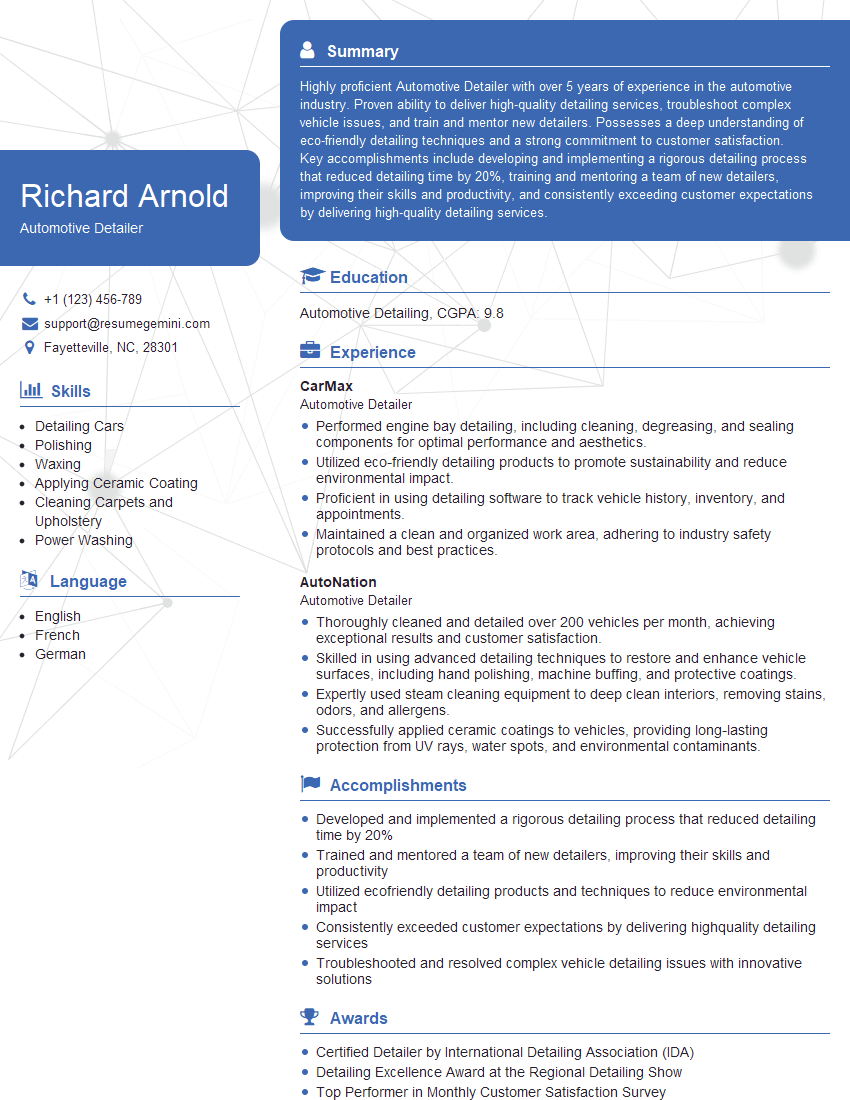
Mastering detailing and polishing techniques is crucial for career advancement in the automotive, marine, or other relevant industries. A strong understanding of these techniques demonstrates technical skill, attention to detail, and a commitment to quality, all highly valued by employers. To significantly boost your job prospects, create a professional, ATS-friendly resume that showcases your abilities effectively. ResumeGemini is a trusted resource to help you build a compelling resume that highlights your expertise. Examples of resumes tailored to detailing and polishing techniques are available to guide you.
Explore more articles
Users Rating of Our Blogs
Share Your Experience
We value your feedback! Please rate our content and share your thoughts (optional).
What Readers Say About Our Blog
Really detailed insights and content, thank you for writing this detailed article.
IT gave me an insight and words to use and be able to think of examples