Interviews are opportunities to demonstrate your expertise, and this guide is here to help you shine. Explore the essential Dimensional Control and Metrology interview questions that employers frequently ask, paired with strategies for crafting responses that set you apart from the competition.
Questions Asked in Dimensional Control and Metrology Interview
Q 1. Explain the principles of Geometric Dimensioning and Tolerancing (GD&T).
Geometric Dimensioning and Tolerancing (GD&T) is a symbolic language used on engineering drawings to define the size, shape, orientation, location, and runout of features on parts. It ensures that parts are manufactured to the required specifications and will function correctly when assembled. Instead of relying solely on traditional plus/minus tolerances, GD&T uses symbols and zones to precisely communicate acceptable variations. This leads to clearer communication and better understanding between designers, manufacturers, and inspectors.
- Size: Defines the basic dimensions of a feature, like the diameter of a hole.
- Form: Specifies the shape of a feature. For example, straightness, flatness, circularity, and cylindricity.
- Orientation: Describes the angular relationship between features. Examples include perpendicularity and angularity.
- Location: Defines the positional relationship between features. This includes position, concentricity, and symmetry.
- Runout: Controls the variation of a feature’s surface in relation to a datum axis or datum plane. This includes circular runout and total runout.
For instance, instead of simply stating a hole should be 10mm +/- 0.1mm, GD&T might specify the hole’s diameter, its position relative to other features, and the permissible deviation from perfect roundness, all in a clear, unambiguous manner. This prevents misinterpretations and ensures the part meets functionality requirements.
Q 2. Describe your experience with Coordinate Measuring Machines (CMM).
I have extensive experience operating and programming various types of Coordinate Measuring Machines (CMMs), including both bridge-type and articulated-arm CMMs. My experience spans various industries, from aerospace to automotive, where I’ve been involved in everything from routine inspection of parts to complex reverse engineering projects. I’m proficient in using various CMM software packages to create measurement programs, analyze data, and generate reports. A recent project involved verifying the dimensional accuracy of a complex turbine blade. Using a bridge-type CMM with a high-resolution probe, I developed a custom measurement program to capture critical dimensions and surface features, ensuring the blades met stringent aerospace tolerances. This involved utilizing advanced probing strategies to address the blade’s intricate geometry. The data analysis revealed minor deviations requiring adjustments in the manufacturing process.
Q 3. What are the different types of CMMs and their applications?
CMMs are broadly categorized into three main types: bridge, cantilever, and articulated arm. Each type has unique strengths and weaknesses making them suitable for different applications.
- Bridge CMMs: These are the most common type, featuring a bridge structure that moves along a horizontal X-axis and a probe that moves along the vertical Y and Z axes. They offer high accuracy and precision, making them ideal for large and complex parts.
- Cantilever CMMs: These have a single column structure and are often used for smaller parts. They offer a good balance of accuracy and flexibility.
- Articulated Arm CMMs: These are portable, flexible, and capable of measuring in hard-to-reach areas. However, their accuracy is generally lower than bridge or cantilever types and are more suited for quick checks or in-situ measurements.
The choice of CMM depends heavily on the part’s size, complexity, required accuracy, and the budget. For instance, a large automotive part might require a bridge CMM for its large measurement volume and high accuracy. Conversely, an articulated arm CMM might be preferred for inspecting components in a tight assembly.
Q 4. How do you ensure the accuracy and traceability of measurement equipment?
Ensuring the accuracy and traceability of measurement equipment is critical to maintain the integrity of dimensional control. This involves a multi-faceted approach:
- Regular Calibration: CMMs and other measuring instruments must undergo regular calibration against traceable standards. This involves using certified artifacts to verify the accuracy and repeatability of the equipment. Calibration certificates are crucial for demonstrating traceability to national or international standards, typically NIST (National Institute of Standards and Technology) in the US or equivalent standards in other countries.
- Environmental Control: Maintaining stable environmental conditions, such as temperature and humidity, is essential. Fluctuations can affect the accuracy of measurements. Our lab uses a climate-controlled environment to minimize these effects.
- Proper Maintenance: Regular maintenance, including cleaning and lubrication, is crucial to ensure the equipment functions optimally. Following the manufacturer’s recommendations is vital.
- Operator Training: Trained and skilled operators are essential for accurate and consistent measurements. This includes understanding measurement techniques, software operation, and the interpretation of results.
- Statistical Process Control (SPC): Implementing SPC helps monitor the performance of the equipment over time and to quickly identify any deviations from expected performance.
By meticulously following these procedures, we ensure measurement data is reliable, consistent, and fully traceable, which is essential for meeting quality standards and complying with regulations.
Q 5. Explain the concept of measurement uncertainty.
Measurement uncertainty quantifies the doubt associated with a measured value. It reflects the range of values within which the true value is likely to lie. It’s not about the accuracy of the instrument itself but the combination of many sources of error, such as the instrument’s inherent uncertainty, environmental conditions, operator skill, and the inherent variability of the part being measured. Think of it like aiming a dart at a target. Even with a perfect dart and a steady hand, there’s always a degree of uncertainty about where the dart will land.
Uncertainty is expressed with a numerical value and is often represented using a confidence level (e.g., 95%). For example, a measurement might be reported as ‘10.00mm +/- 0.02mm (95% confidence level)’, indicating that there is a 95% probability that the true value lies between 9.98mm and 10.02mm. Understanding measurement uncertainty is vital in interpreting results and making informed decisions. Overlooking uncertainty can lead to incorrect conclusions and potential quality issues.
Q 6. Describe your experience with statistical process control (SPC) in dimensional control.
Statistical Process Control (SPC) is indispensable in dimensional control. It allows us to monitor the manufacturing process, identify potential problems early, and prevent non-conforming parts. My experience involves using control charts (like X-bar and R charts, or other appropriate charts for specific applications) to monitor key dimensional characteristics over time. These charts visualize the variation within the process, making it easier to spot trends and identify assignable causes of variation – meaning causes that are not random variations inherent to the process but due to specific issues like tool wear, machine malfunction or material inconsistencies.
For example, in a recent project manufacturing precision shafts, we used X-bar and R charts to monitor the shaft diameter. The charts highlighted an increase in variation beyond the control limits, indicating a potential issue. Investigation revealed a worn tool, which was replaced. This prevented a batch of non-conforming shafts and ensured continuous process improvement.
Q 7. How do you interpret and analyze dimensional measurement data?
Interpreting and analyzing dimensional measurement data involves a methodical approach. It goes beyond simply looking at individual measurements; it requires understanding the distribution of data, identifying trends, and assessing whether the measured values meet the specified tolerances.
- Descriptive Statistics: Calculating mean, standard deviation, range, and other descriptive statistics provides an overview of the data’s central tendency and dispersion.
- Histograms and other visual aids: Creating histograms or other visual representations of the data helps in visualizing the distribution and identifying potential outliers or non-normal distributions.
- Statistical Tests: Depending on the requirements, appropriate statistical tests (e.g., t-tests, ANOVA) can be applied to compare measurements from different groups or assess the significance of observed differences.
- GD&T Compliance Verification: The data is analyzed to ensure compliance with the GD&T specifications defined on the engineering drawings. This may involve using specialized software to perform tolerance analysis and assess whether the measured values fall within the acceptable zones.
Software is extensively used for data analysis and reporting. This often involves generating reports which include statistical summaries, graphical representations of the data, and comparisons with specified tolerances. This allows for efficient analysis and easy identification of any deviation from expectations, allowing for necessary corrective actions.
Q 8. What are the common sources of measurement error?
Measurement errors are unavoidable in any dimensional control process. They stem from various sources, broadly categorized as systematic and random errors.
- Systematic Errors: These are consistent and repeatable errors caused by flaws in the measuring instrument, the measurement process, or the environment. Examples include instrument calibration drift (the instrument consistently reads high or low), incorrect setup of the measuring instrument (e.g., not zeroing a micrometer correctly), or environmental factors like temperature variations affecting the dimensions of the workpiece and the measuring instrument.
- Random Errors: These are unpredictable variations that occur due to uncontrollable factors. Examples include human error in reading the instrument, slight vibrations during measurement, or inconsistencies in the workpiece itself. They follow a statistical distribution, often a normal distribution.
- Environmental Errors: These are systematic errors caused by changes in the surroundings, such as temperature, humidity, and air pressure affecting the workpiece dimensions or the instruments’ performance. Proper environmental control is crucial for minimizing these.
Understanding these sources helps us implement appropriate strategies for error reduction, such as regular instrument calibration, standardized measurement procedures, and environmental control.
Q 9. How do you handle discrepancies between measured values and specifications?
Discrepancies between measured values and specifications are addressed through a structured investigation and corrective actions. The first step involves verifying the measurement’s accuracy by repeating the measurement multiple times using different instruments or techniques. If the discrepancy persists, we need to analyze the root cause.
- Process Analysis: Identify potential sources of error in the manufacturing process that could lead to deviations from the specification. This could involve reviewing process parameters, tooling conditions, and material properties.
- Instrument Verification: Ensure the measuring instruments are properly calibrated and functioning correctly. A recalibration or even instrument replacement might be necessary.
- Part Analysis: Determine if the discrepancy is due to an inherent defect in the part itself. This may require detailed inspection using advanced techniques like CMM (Coordinate Measuring Machine) or optical inspection.
- Specification Review: In some cases, the discrepancy might be due to an error or ambiguity in the design specifications. This requires careful review and possibly a revision of the specifications.
Depending on the severity of the discrepancy and the root cause, corrective actions can range from minor adjustments in the process to major design changes or even scrapping the affected parts. Proper documentation of the investigation, analysis, and corrective actions is crucial for continuous improvement.
Q 10. Explain your experience with calibration procedures and standards.
I have extensive experience with calibration procedures, following both ISO and NIST standards. Calibration ensures our measurement instruments provide accurate and reliable results. My experience includes:
- Calibration Techniques: I’m proficient in using various calibration methods, including trace-ability to national standards. This involves using calibrated reference standards and following documented procedures to verify the accuracy of measuring instruments.
- Calibration Frequency: I understand the importance of establishing appropriate calibration intervals based on instrument usage, environmental conditions, and the criticality of the measurement. Frequent calibration of critical instruments is essential to minimize measurement uncertainty.
- Calibration Records: I maintain meticulous calibration records, including instrument identification, calibration date, results, and any corrective actions taken. These records are crucial for maintaining traceability and ensuring compliance with industry standards.
- Calibration Software: I’m familiar with using calibration management software to schedule and track calibration activities, automate data collection and reporting, and maintain compliance.
For example, in a recent project involving the production of high-precision gears, we implemented a rigorous calibration schedule for our CMM to ensure the dimensional accuracy of the gears met the stringent customer requirements. We used certified standards and followed detailed procedures to ensure the traceability of our measurements.
Q 11. Describe your experience with various measurement instruments (e.g., calipers, micrometers, height gauges).
My experience encompasses a wide range of measurement instruments, including:
- Vernier Calipers: I’m adept at using vernier calipers for precise linear measurements, understanding their limitations and sources of error (parallax error being a significant one). I can measure internal and external dimensions, depths, and step heights with accuracy.
- Micrometers: I have extensive experience using micrometers for highly precise measurements of small dimensions, understanding how to avoid errors arising from improper force application or handling. I can work with various types of micrometers, including outside micrometers, inside micrometers, and depth micrometers.
- Height Gauges: I’m skilled in using height gauges for precise measurements of height and depth. I know how to set up and level a height gauge accurately and minimize measurement errors caused by misalignment or improper surface contact.
- Coordinate Measuring Machines (CMMs): I’m experienced with CMM operation, programming, and data analysis, allowing me to measure complex geometries with high precision and accuracy. I can also create and interpret CMM reports.
In one instance, I used a CMM to inspect the complex contours of an aircraft component, ensuring that the part met the stringent tolerances required for aerodynamic performance.
Q 12. How do you select the appropriate measurement instrument for a specific application?
Selecting the right measurement instrument is crucial for accurate and efficient dimensional control. The choice depends on several factors:
- Accuracy Required: The required accuracy determines the instrument’s resolution and precision. High-precision applications demand instruments like CMMs or high-resolution optical systems, while less critical applications may suffice with simpler instruments like vernier calipers.
- Dimension Range: The size of the part and the dimensions to be measured dictate the instrument’s measurement range. A micrometer is ideal for small parts, while a height gauge is better suited for larger components.
- Part Geometry: The shape and complexity of the part influence the instrument choice. Simple geometries can be measured with basic instruments, but complex shapes may require advanced instruments like CMMs or optical scanners.
- Material Properties: The material’s surface finish and hardness can affect the choice of instrument. Instruments need to be compatible with the material to prevent damage or inaccurate measurements.
- Cost and Availability: The cost and availability of instruments also play a role in the decision-making process.
For example, when measuring the thickness of a thin film, an optical profilometer would be a better choice than a micrometer due to its higher resolution and non-contact measurement capabilities.
Q 13. Explain your understanding of tolerance analysis.
Tolerance analysis is a crucial aspect of dimensional control that helps to determine the acceptable variation in dimensions and their impact on the final product’s functionality. It’s based on the principle of understanding how variations in individual dimensions accumulate to affect the overall assembly or function.
- Statistical Tolerance Analysis: This method uses statistical distributions to model the variation in individual dimensions. It allows us to estimate the probability of the final assembly falling within the specified tolerance limits.
- Worst-Case Tolerance Analysis: This approach considers the maximum possible variation in each dimension and adds them algebraically to determine the worst-case scenario. It provides a conservative estimate of the tolerance stack-up but can be overly pessimistic in some cases.
- Tolerance Stack-up Analysis: This involves analyzing how tolerances accumulate through a series of assembled parts. This helps in identifying critical dimensions that contribute the most to the overall tolerance variation. This method helps optimize manufacturing processes to reduce tolerance stack-up.
Understanding tolerance analysis is crucial for designing robust products that are less sensitive to manufacturing variations and for optimizing manufacturing processes to minimize costs while still achieving acceptable performance.
Q 14. Describe your experience with different types of dimensional inspection techniques.
My experience includes a range of dimensional inspection techniques, including:
- Contact Measurement: Using instruments like calipers, micrometers, height gauges, and CMMs for direct measurement of part dimensions.
- Non-Contact Measurement: Employing optical techniques like laser scanning, structured light scanning, and vision systems for non-contact measurement of complex geometries and surfaces. This avoids the risk of damaging sensitive parts and allows for faster inspection.
- Digital Image Correlation (DIC): Using DIC for precise deformation measurements and strain analysis. This technique is valuable in understanding the mechanical behavior of components under load.
- Automated Inspection Systems: Working with automated systems incorporating vision systems, robots, and measurement sensors for high-throughput inspection of large quantities of parts. This dramatically improves efficiency and consistency.
The choice of technique depends on factors like required accuracy, part complexity, throughput needs, and budget. For instance, in a high-volume manufacturing environment, automated optical inspection would be preferred for speed and consistency, while a CMM might be more suitable for inspection of highly complex or critical parts requiring high accuracy.
Q 15. How do you troubleshoot problems related to dimensional control?
Troubleshooting dimensional control problems involves a systematic approach. It starts with identifying the discrepancy – is a part consistently outside tolerance, or are there sporadic issues? Then, we delve into potential root causes. This often includes:
- Measurement System Analysis (MSA): Verifying the accuracy and precision of our measuring equipment – Are the instruments calibrated? Are we using the correct measurement methods for the part’s geometry?
- Process Capability Analysis: Assessing whether the manufacturing process is capable of consistently producing parts within the specified tolerances. This involves statistical analysis of process data to determine Cp and Cpk values.
- Part Design Review: Examining the part design itself. Are the tolerances achievable? Are there design features that make accurate manufacturing difficult?
- Material Analysis: Investigating whether material properties contribute to dimensional variations. For example, inconsistencies in material shrinkage during curing can cause dimensional drift.
- Machining Process Analysis: Examining the process parameters – speeds, feeds, tooling condition – to detect sources of variation. Tool wear, for instance, can lead to significant dimensional changes over time.
For example, I once investigated why a plastic injection molded part was consistently outside its thickness tolerance. Through MSA, we discovered that the measuring device wasn’t properly calibrated. After calibration, the issue was resolved, highlighting the crucial role of proper equipment maintenance.
Career Expert Tips:
- Ace those interviews! Prepare effectively by reviewing the Top 50 Most Common Interview Questions on ResumeGemini.
- Navigate your job search with confidence! Explore a wide range of Career Tips on ResumeGemini. Learn about common challenges and recommendations to overcome them.
- Craft the perfect resume! Master the Art of Resume Writing with ResumeGemini’s guide. Showcase your unique qualifications and achievements effectively.
- Don’t miss out on holiday savings! Build your dream resume with ResumeGemini’s ATS optimized templates.
Q 16. What software programs are you proficient in for dimensional measurement and analysis?
My proficiency extends to several industry-standard software packages for dimensional measurement and analysis. These include:
- PolyWorks: I’m highly proficient in PolyWorks for 3D scanning data processing, reverse engineering, and dimensional inspection. I regularly use its powerful inspection tools for creating reports and analyzing deviations from CAD models.
- PC-DMIS: I utilize PC-DMIS for CMM (Coordinate Measuring Machine) programming and data analysis. Its sophisticated algorithms allow for efficient measurement of complex geometries and robust statistical analysis.
- Metrolog X4: I have extensive experience with Metrolog X4, particularly its capabilities in creating robust measurement routines and its integration with CAD models for comparison.
- QDAS: I’m comfortable working with QDAS for statistical process control and data analysis. It’s especially useful for visualizing trends and identifying potential process instabilities.
Beyond these, I have experience with other specialized software packages depending on the specific requirements of a project, demonstrating my adaptability and breadth of knowledge.
Q 17. How do you ensure the repeatability and reproducibility of measurements?
Ensuring repeatability (consistency of measurements by the same operator using the same equipment) and reproducibility (consistency of measurements by different operators using different equipment) requires meticulous attention to detail. Key steps include:
- Calibration: Regular calibration of all measuring equipment to traceable standards is paramount. Calibration certificates must be maintained and reviewed.
- Standardized Procedures: Clearly defined measurement procedures, including fixturing techniques, part orientation, and data acquisition methods, must be followed consistently.
- Operator Training: Operators must be thoroughly trained on the use of measuring equipment and proper measurement techniques. Regular competency checks are vital.
- Environmental Control: Maintaining a stable environmental temperature and humidity minimizes measurement variations due to thermal expansion or contraction.
- MSA Studies: Performing regular Gage R&R (Repeatability and Reproducibility) studies to quantify the variability in the measurement system itself. This helps determine if the measurement system is suitable for its intended purpose.
For example, in a project involving precision machined parts, we conducted a Gage R&R study that revealed significant operator variation. Subsequently, we implemented additional training focusing on proper part handling and measurement techniques, significantly improving repeatability and reproducibility.
Q 18. Describe your experience with root cause analysis for dimensional issues.
My experience with root cause analysis for dimensional issues often involves employing structured problem-solving methodologies, such as the 5 Whys or Fishbone diagrams. This helps systematically uncover the underlying cause of a problem, rather than just treating the symptoms. The process generally includes:
- Data Collection: Gathering comprehensive data related to the dimensional issue, including measurement results, process parameters, material specifications, and operator inputs.
- Data Analysis: Utilizing statistical methods to identify patterns and trends in the data, and to determine the significance of observed variations.
- Hypothesis Generation: Formulating potential root causes based on the data analysis and prior experience.
- Hypothesis Testing: Systematically testing each hypothesis to determine its validity. This could involve conducting experiments or further data analysis.
- Root Cause Identification: Pinpointing the fundamental cause(s) of the dimensional issue.
- Corrective Actions: Implementing corrective actions to eliminate the root cause and prevent recurrence.
In one instance, we used a Fishbone diagram to identify the root cause of dimensional inconsistencies in a stamped part. The analysis revealed that inconsistent blank material thickness was the main culprit, leading to changes in our material sourcing and inspection protocols.
Q 19. How do you communicate dimensional control findings to other departments?
Communicating dimensional control findings effectively is crucial for collaborative problem-solving. My approach involves clear, concise, and visually appealing communication. This includes:
- Formal Reports: Preparing detailed reports that summarize the findings, including statistical data, charts, and graphs. These reports are tailored to the audience, focusing on the key takeaways and recommendations.
- Visualizations: Utilizing charts and graphs (e.g., histograms, control charts, scatter plots) to illustrate data trends and variations clearly.
- Presentations: Presenting the findings to relevant stakeholders, including engineering, manufacturing, and quality control departments. These presentations are interactive, encouraging questions and discussions.
- Data Sharing: Using collaborative platforms to share data and reports electronically, facilitating quick access and updates.
I strive to make the information easily understandable and actionable, avoiding unnecessary technical jargon. For instance, when communicating with manufacturing, I focus on practical solutions they can immediately implement.
Q 20. Explain your experience with developing and implementing dimensional control procedures.
I have extensive experience developing and implementing dimensional control procedures, which usually involve:
- Defining Measurement Requirements: Collaborating with engineering and design teams to determine the critical dimensions and tolerances that must be controlled.
- Selecting Measurement Methods: Choosing the appropriate measurement techniques and equipment based on part geometry, tolerances, and throughput requirements.
- Developing Measurement Plans: Creating detailed measurement plans that specify the steps involved in measuring each critical dimension, including fixturing, probing strategies, and data acquisition methods. These plans often involve creating control plans for continuous monitoring and process optimization.
- Implementing Measurement Systems: Setting up and implementing the measurement systems, including calibrating equipment, training operators, and establishing standard operating procedures (SOPs).
- Documentation: Thorough documentation of all procedures, including measurement plans, SOPs, and calibration records. This ensures consistency and traceability.
For example, in a recent project involving a complex automotive component, I developed a comprehensive measurement plan using CMMs and optical scanners, incorporating a detailed fixture design to ensure consistent part orientation and improve measurement accuracy.
Q 21. Describe your experience with improving dimensional control processes.
Improving dimensional control processes requires a continuous improvement mindset. My approach often involves:
- Data-Driven Decision Making: Analyzing historical data to identify areas for improvement, focusing on reducing variability and improving process capability.
- Process Optimization: Implementing process improvements to minimize dimensional variations. This can involve adjustments to machining parameters, tooling, fixturing, or material selection.
- Automation: Automating measurement processes wherever possible to increase speed, consistency, and accuracy. Automated optical inspection systems, for example, can significantly reduce manual measurement errors.
- Statistical Process Control (SPC): Implementing SPC charts to monitor process performance and identify potential problems before they escalate. This proactive approach helps prevent out-of-tolerance parts from being produced.
- Continuous Training: Providing ongoing training to operators and inspectors to improve their skills and knowledge in dimensional control techniques.
For instance, in a manufacturing line producing high-precision components, we implemented an automated vision inspection system, resulting in a significant reduction in scrap and rework, along with improved overall process efficiency.
Q 22. How do you manage dimensional control data and documentation?
Managing dimensional control data and documentation requires a robust, systematic approach. Think of it like meticulously keeping a patient’s medical history – every detail is crucial. We use a combination of methods, starting with a well-defined data management system. This typically involves a combination of a Computer-Aided Design (CAD) system for design specifications, a Manufacturing Execution System (MES) for tracking production parameters, and a dedicated Dimensional Measurement System (DMS) storing all inspection results. This DMS might be a specialized software or a combination of spreadsheets and databases, always ensuring traceability and version control.
Documentation includes detailed inspection plans, specifying the measurement methods, equipment used, acceptance criteria, and frequency of inspections. Calibration certificates for all measuring equipment are meticulously tracked, ensuring their accuracy and validity. Any deviations from specifications are documented with thorough root cause analysis (RCA) reports, detailing the problem, the implemented corrective action and preventative measures to avoid recurrence. This comprehensive approach ensures data integrity, facilitates process improvement, and offers clear audit trails for regulatory compliance.
- Example: In a recent project involving the manufacture of precision engine components, our system tracked every measurement taken on each part, linking it directly to the CAD model, the specific machine used, and the operator. This allowed us to pinpoint a recurring dimensional issue to a specific machine setting, leading to a swift correction.
Q 23. Explain your experience with different types of manufacturing processes and their impact on dimensional control.
My experience spans various manufacturing processes, each impacting dimensional control uniquely. Think of it like baking a cake: different recipes (processes) require different precision levels (dimensional control). For instance, machining processes like milling and turning require tight control of cutting parameters to maintain tolerances. Slight variations in speed, feed rate, or tool wear can significantly affect the final dimensions. We use statistical process control (SPC) charts to monitor these parameters and prevent deviations.
In additive manufacturing (3D printing), dimensional accuracy is influenced by factors like material properties, print speed, and layer thickness. Here, understanding the process’s inherent variability is key. Similarly, casting involves dealing with shrinkage and warping, requiring compensation during the design and post-processing stages. Sheet metal fabrication poses challenges due to bending, forming, and welding processes; precise tooling and careful process control are paramount. My experience encompasses developing and implementing control plans specific to each process, utilizing appropriate measurement techniques to ensure conformance to design specifications.
- Example: In a project involving injection molding of plastic parts, we employed Design of Experiments (DOE) techniques to optimize the molding parameters. This process resulted in reduced dimensional variation and improved part quality.
Q 24. Describe a situation where you had to resolve a critical dimensional control issue.
During a critical production run of aerospace components, we encountered an unacceptable level of dimensional variation in a key part. The initial reaction was understandably stressful – the impact on the project timeline and budget was significant. However, a methodical approach helped us resolve the situation. We started by rigorously reviewing all relevant data—process parameters, measurement results, and historical data—to pinpoint the root cause.
Our investigation revealed that a slight misalignment in the machining fixture was contributing to the inconsistencies. We didn’t simply adjust the setting; rather, we implemented several changes. First, we recalibrated the machine and confirmed its alignment. Second, we implemented a more robust quality control check at each step of the process. Finally, we retrained the operators on proper fixture usage and measurement procedures. The problem was solved, and it served as a valuable lesson. We improved our process monitoring system, incorporating additional real-time data analysis to detect anomalies early on. This prevented similar incidents in the future.
Q 25. How familiar are you with ISO standards related to dimensional metrology?
I am very familiar with ISO standards related to dimensional metrology, particularly ISO 10012-1 (Measurement Management Systems) and ISO 10012-2 (Requirements for measurement methods and systems). These standards provide a framework for establishing and maintaining a robust measurement system. They cover aspects such as traceability to national standards, equipment calibration, uncertainty analysis, and measurement procedures. Understanding and implementing these standards are crucial for ensuring the accuracy and reliability of measurement data.
I also have experience with ISO 9001, which although not strictly metrology-focused, profoundly influences dimensional control practices through its emphasis on quality management systems. My knowledge extends to specific standards related to measurement techniques, such as those concerning coordinate measuring machines (CMMs) and optical methods.
Q 26. Describe your experience with laser scanning or other non-contact measurement techniques.
I have extensive experience with laser scanning and other non-contact measurement techniques. These are invaluable tools for capturing detailed three-dimensional data efficiently and non-destructively. Laser scanners provide high-resolution point clouds that can be used for reverse engineering, dimensional inspection, and rapid prototyping. The data is processed using dedicated software to create 3D models and perform detailed analysis.
Other non-contact techniques I’ve used include structured light scanning, photogrammetry, and white light interferometry, each having its own strengths and applications. For instance, structured light scanning is well-suited for high-speed inspection of surfaces, while photogrammetry is ideal for capturing complex shapes. My expertise extends to analyzing the data obtained from these techniques, identifying potential sources of error, and ensuring the accuracy of the measurements.
- Example: In a project involving the inspection of complex automotive body panels, laser scanning was crucial for rapidly acquiring precise dimensional data, identifying deviations from the CAD model, and guiding corrective actions.
Q 27. How do you stay current with advancements in dimensional control and metrology technology?
Staying current in this rapidly evolving field is a continuous process. I actively participate in industry conferences and workshops, attending seminars and webinars presented by leading experts and technology providers. Reading professional journals and technical publications is also crucial. I actively follow industry news and publications, staying informed about new developments, techniques, and technologies. This includes publications like Dimensional Metrology, Quality Digest, and those provided by national metrology institutes.
Furthermore, I actively participate in professional organizations like the American Society for Quality (ASQ) and other relevant metrology societies, fostering connections and knowledge-sharing with fellow professionals. I also continuously seek opportunities to engage in training courses and workshops on advanced measurement technologies and data analysis techniques.
Q 28. What are your salary expectations?
My salary expectations are commensurate with my experience and expertise in the field of dimensional control and metrology. Considering my background, skills, and accomplishments, I am targeting a salary range of [Insert Salary Range Here]. However, I am open to discussing this further based on the specific responsibilities and benefits package offered.
Key Topics to Learn for Dimensional Control and Metrology Interview
- Geometric Dimensioning and Tolerancing (GD&T): Understand fundamental GD&T symbols, their application in engineering drawings, and how to interpret tolerances for various features.
- Measurement Techniques and Instruments: Become proficient in using various measurement tools like CMMs (Coordinate Measuring Machines), optical comparators, micrometers, calipers, and laser scanners. Understand the principles behind each and their respective applications.
- Statistical Process Control (SPC): Learn how to apply statistical methods to monitor and control manufacturing processes, focusing on analyzing data to identify trends and potential issues impacting dimensional accuracy.
- Calibration and Traceability: Grasp the importance of instrument calibration, traceable standards, and maintaining accurate measurement systems. Understand the impact of calibration uncertainties.
- Metrology Software and Data Analysis: Familiarize yourself with common metrology software packages for data acquisition, analysis, and reporting. Develop skills in interpreting measurement reports and identifying potential sources of error.
- Dimensional Inspection Planning: Learn to plan and execute effective dimensional inspections, considering factors like sampling plans, measurement strategies, and reporting requirements.
- Common Dimensional Control Challenges and Problem-solving: Prepare to discuss real-world challenges related to dimensional control, such as part variation, process capability, and effective corrective actions.
Next Steps
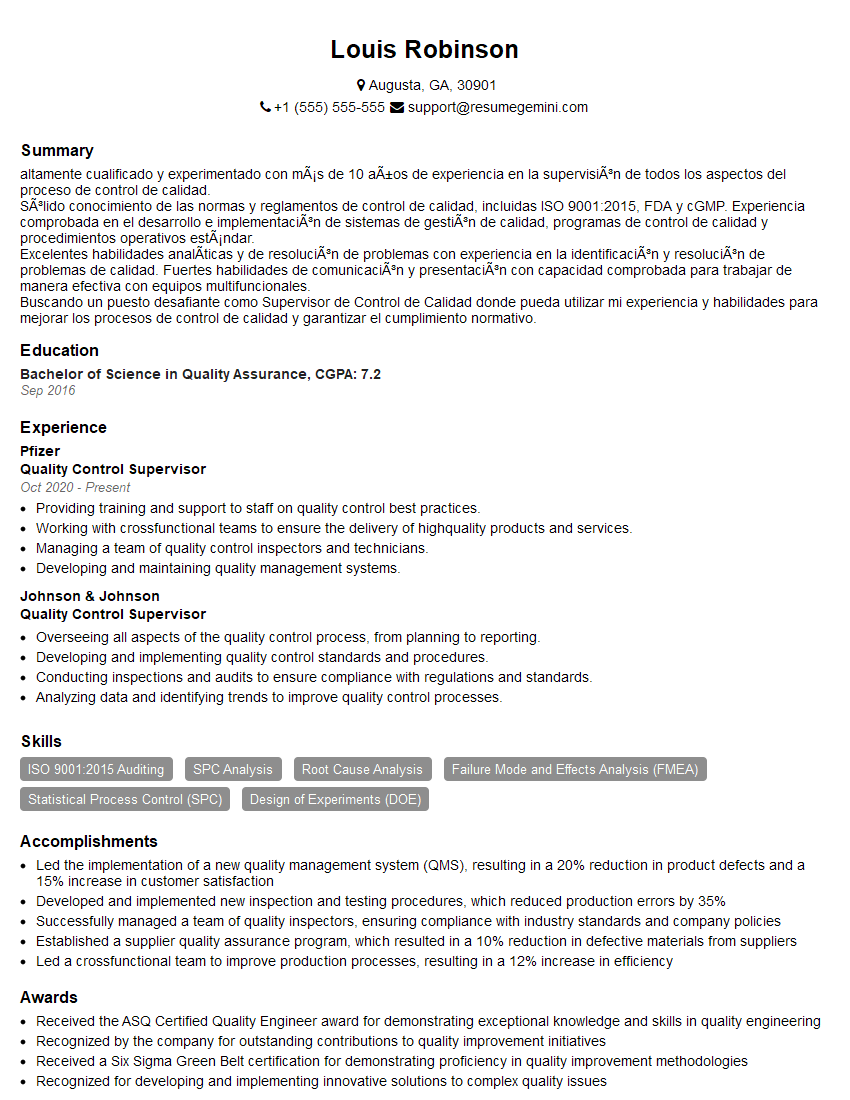
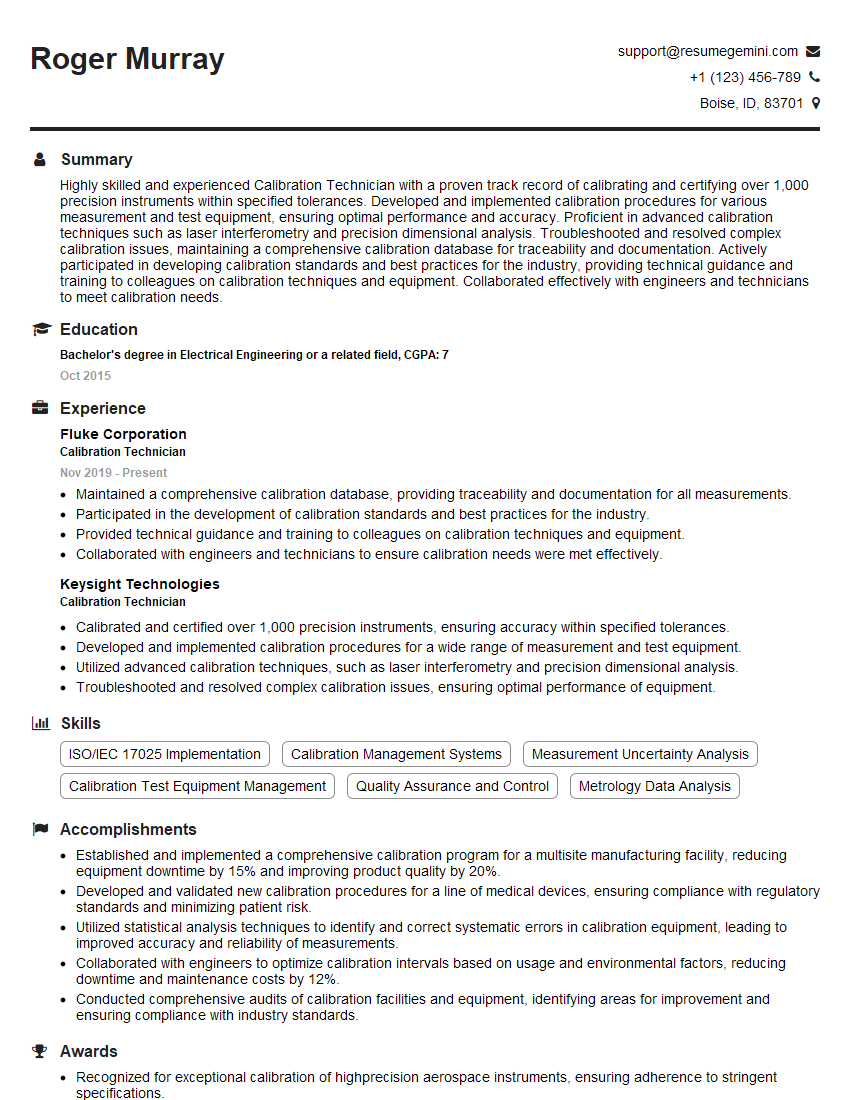
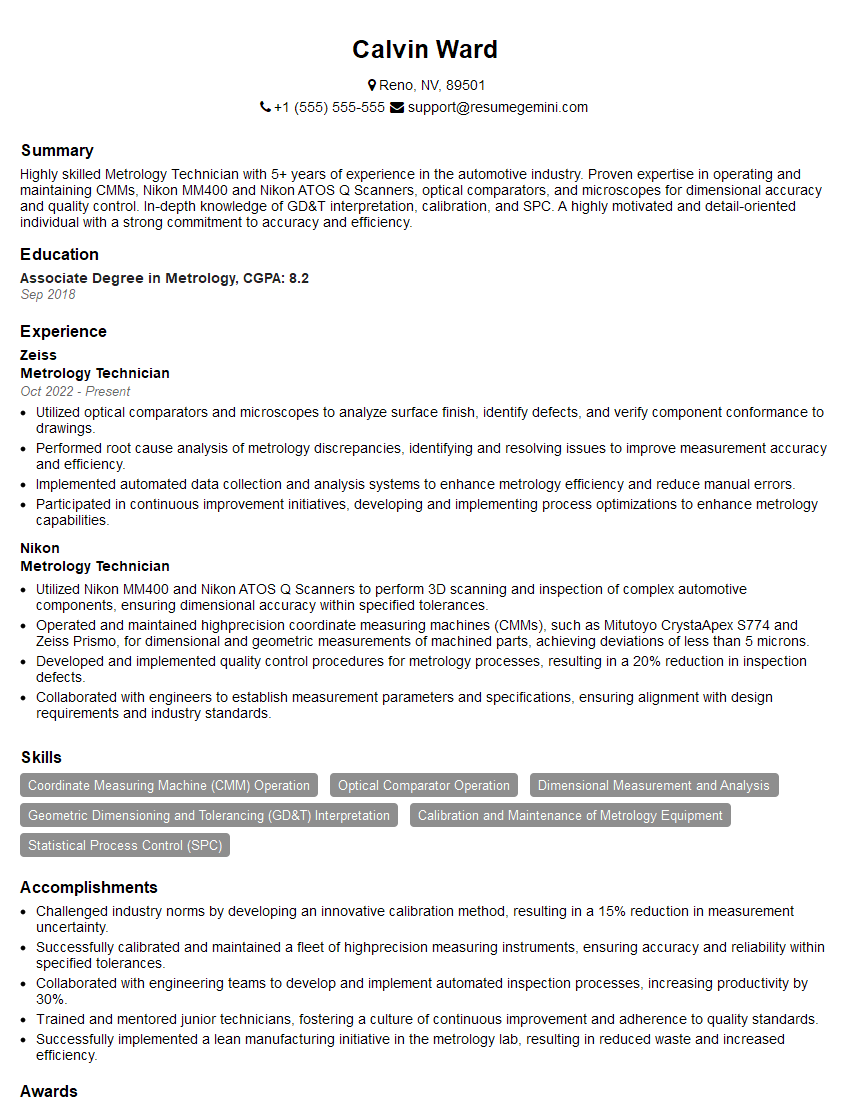
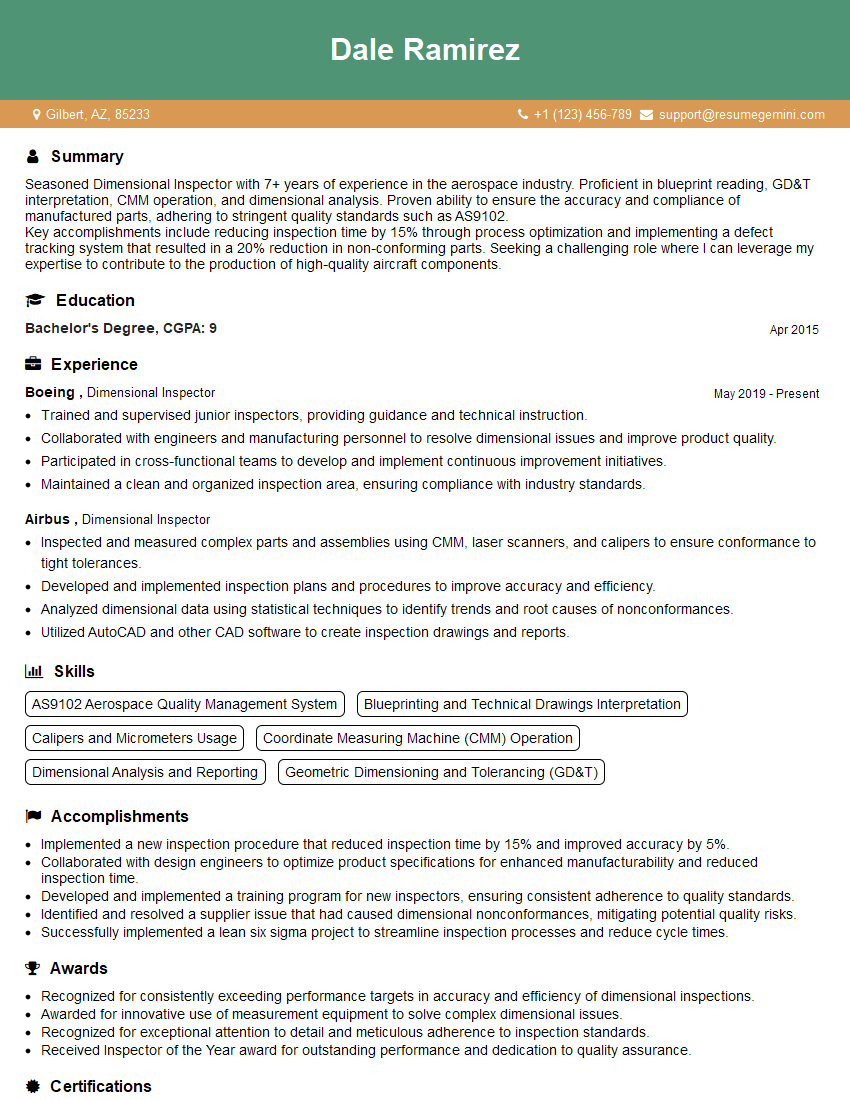
Mastering Dimensional Control and Metrology opens doors to exciting career opportunities in manufacturing, quality control, and engineering. A strong understanding of these principles is highly valued and sets you apart in a competitive job market. To maximize your chances of landing your dream role, it’s crucial to present your skills effectively. Building an ATS-friendly resume is key to getting your application noticed by recruiters and hiring managers. ResumeGemini is a trusted resource that can help you craft a professional and impactful resume that highlights your expertise in Dimensional Control and Metrology. We provide examples of resumes tailored to this field to guide you in creating a compelling application. Take the next step towards your career goals and leverage ResumeGemini’s resources today!
Explore more articles
Users Rating of Our Blogs
Share Your Experience
We value your feedback! Please rate our content and share your thoughts (optional).
What Readers Say About Our Blog
Really detailed insights and content, thank you for writing this detailed article.
IT gave me an insight and words to use and be able to think of examples