The thought of an interview can be nerve-wracking, but the right preparation can make all the difference. Explore this comprehensive guide to Drywall Repairs interview questions and gain the confidence you need to showcase your abilities and secure the role.
Questions Asked in Drywall Repairs Interview
Q 1. Describe your experience with different types of drywall.
My experience encompasses a wide range of drywall types, each with its own characteristics and applications. I’ve worked extensively with standard gypsum board, which is the most common type, used for its affordability and ease of installation. I’m also familiar with moisture-resistant drywall (often green-colored), crucial in bathrooms and kitchens to prevent mold and mildew growth. Furthermore, I’ve used fire-resistant drywall (often pink or purple) in locations requiring enhanced fire safety, like basements or near fireplaces. Finally, I’ve worked with specialized types, including sound-dampening drywall and textured drywall, demonstrating my adaptability to diverse project needs. Understanding the properties of each type is critical for choosing the right material and ensuring a successful project.
Q 2. Explain the process of patching a small hole in drywall.
Patching a small hole is a straightforward process, but proper technique is vital for a seamless finish. First, you need to clean the area thoroughly, removing any loose debris. Then, carefully cut away any damaged drywall around the hole, creating a clean, square edge. Next, apply a thin layer of drywall compound (also called mud) to the hole and surrounding area, using a putty knife. Let it dry completely, then lightly sand the area to smooth it out. Repeat this process until the hole is completely filled and flush with the wall surface. After the final coat dries, lightly sand again, prime the patched area, and then paint for a finished look. This step-by-step approach ensures a durable and invisible repair.
Q 3. How do you prepare drywall surfaces for painting?
Preparing drywall for painting is essential for a professional finish. The process starts with cleaning the surface to remove any dirt, dust, or cobwebs. Then, you need to repair any imperfections – cracks, holes, or dents – using drywall compound and sanding them smooth. Once all repairs are completed, the entire wall surface needs to be primed. Primer seals the drywall, provides a uniform surface for paint adhesion, and prevents the drywall from absorbing the paint unevenly. After the primer dries, lightly sanding might be necessary before applying the paint. This preparation ensures even paint coverage and a long-lasting, attractive finish. Think of it like preparing a canvas before painting a masterpiece!
Q 4. What are the common causes of drywall cracks, and how do you repair them?
Drywall cracks are a common problem, often caused by settling of the house, stress on the structure, or improper installation. Common causes include movement in the house’s foundation, expansion and contraction due to temperature changes, and inadequate support for the drywall. Repairing cracks involves first assessing the cause. Small hairline cracks can often be filled with a paintable caulk. Larger cracks require careful preparation. The cracked area might need to be cleaned, widened slightly (to create a “V” shape) and filled with drywall compound in layers, allowing each to dry completely before sanding. For significant cracks, reinforcement with mesh tape might be necessary to prevent re-cracking. Proper repair ensures structural integrity and a visually appealing result.
Q 5. Describe your experience with different drywall taping techniques.
My experience encompasses various drywall taping techniques, each suitable for different situations. I’m proficient in both hand-taping and using a taping knife, choosing the method based on the project’s scale and the desired finish. Hand taping offers more control for detailed work, while a taping knife is more efficient for larger areas. I’ve mastered the techniques of applying the tape smoothly and embedding it completely in the drywall compound to achieve a seamless, smooth surface. Over the years, I have developed an eye for detecting and correcting any inconsistencies, ensuring a professional finish. Proper taping is essential for preventing cracks and ensuring a long-lasting wall surface.
Q 6. How do you handle repairing water-damaged drywall?
Repairing water-damaged drywall is a specialized process requiring careful attention. The first step is to identify and address the source of the water damage. Then, any visibly damaged drywall must be removed. Water-damaged drywall often harbors mold and needs to be disposed of carefully. Before installing new drywall, the affected area needs to be thoroughly dried, often with dehumidifiers. After drying, an antimicrobial primer is applied before installing new moisture-resistant drywall to prevent future mold growth. This detailed process is crucial to preventing further damage and maintaining the health and safety of the building’s occupants.
Q 7. What tools and materials are essential for drywall repair?
Essential tools and materials for drywall repair include a variety of putty knives (different sizes for different tasks), a utility knife, measuring tape, sandpaper (various grits), a sanding block, drywall compound (also known as mud), joint tape, primer, paint, a bucket for mixing compound, a sponge, and safety glasses. The specific tools and materials may vary depending on the type and complexity of the repair, but these are the core items that I routinely utilize for most jobs. Having the right tools allows for efficiency and a quality finish.
Q 8. Explain the process of installing drywall.
Installing drywall involves several key steps, much like building with large, sturdy LEGOs. First, you need a solid framework – typically metal studs or wooden framing – that’s perfectly plumb (vertical) and level (horizontal). This is crucial for a smooth, even finished wall. Next, you lift and screw the drywall sheets into this framework, ensuring proper spacing between the sheets and careful screw placement to avoid cracking. This involves using specialized drywall screws and a screw gun for efficiency.
We use a technique called ‘cutting to fit’, precisely measuring and cutting the sheets to fill the space perfectly. Larger sheets are typically used for speed and efficiency, but we’ll cut and fit smaller pieces where necessary, especially around corners, doors, and windows. Taping and mudding the seams are crucial steps that follow. Think of it as meticulously filling the gaps between our ‘LEGOs’ with a special putty, ensuring a seamless finish.
- Framing: Ensuring the frame is square, plumb, and level is the foundation of a successful drywall installation.
- Sheet Placement: Overlapping vertical seams prevents weaknesses and maintains structural integrity.
- Fastening: Proper screw placement is vital. Too shallow and the sheet is loose; too deep and it can cause damage.
Q 9. How do you ensure proper alignment and finishing of drywall seams?
Achieving perfect alignment and finishing drywall seams is an art and a science! It all starts with precise cutting and placement of the drywall sheets. Even slight misalignments will be very noticeable after finishing. For seamless transitions, we use special drywall tape – paper or fiberglass – embedded into a layer of drywall compound (mud). We embed the tape to prevent it from cracking under stress during drying. Multiple coats of mud are applied, each carefully feathered out to a smooth transition.
We use a taping knife (varying sizes depending on the application) to smooth out the mud, removing any lumps or bumps. This creates a near-invisible seam, and often requires multiple coats and sanding between each to achieve a flawless result. I often use a wide knife for the initial application and a narrower knife for the final coats to really refine the edges and ensure perfect blending. A key tip is letting each coat dry completely before applying the next – rushing this step will lead to cracking.
- Tape Embedding: Pressing the tape firmly into the mud is essential for a durable seam.
- Multiple Coats: Building up thin layers prevents cracking and provides a durable base.
- Feathering: Carefully blending the mud into the wall surface provides a smooth transition.
Q 10. What are your methods for achieving a smooth and flawless finish?
A smooth, flawless drywall finish requires patience, attention to detail, and the right tools. As I mentioned before, multiple coats of mud are key. But beyond the taping process, achieving a smooth surface also involves careful sanding. We use various grits of sandpaper, starting with coarser grits to remove larger imperfections and gradually moving to finer grits for a silky smooth finish. A sanding pole is essential, extending the reach and minimizing hand fatigue. Regular vacuuming removes dust, ensuring the next coat adheres better.
We always check the work under various lighting conditions, especially with a bright light held close to the surface, to highlight any imperfections we might have missed. Sometimes, a skim coat – a thin, final layer of mud – is necessary to even out minor imperfections before a final sanding. The final step is priming and painting to mask any minor imperfections and provide a lasting finish. Think of it like polishing a fine piece of jewelry – the detail-oriented approach pays dividends in the final result.
- Sanding: Using different grits of sandpaper for progressive smoothing is vital.
- Lighting Checks: Inspecting the wall in various lighting conditions helps to identify imperfections.
- Priming: Applying primer seals the surface and prepares it for paint.
Q 11. Describe your experience working with various drywall textures.
Drywall textures add character and visual interest to a space. I’ve worked with a wide variety of textures, from the smooth, classic finish to more elaborate designs like knockdown, orange peel, and skip trowel. Each texture has its own unique application technique. For example, knockdown texture is achieved by applying a thick layer of mud and then dragging a special tool across it to create the characteristic dimpled effect. Orange peel texture is achieved with a specific spraying technique, while skip trowel involves a textured pattern created by the trowel itself.
The key is understanding the specific tools and techniques required for each texture. I’ve honed my skills by working on diverse projects, from modern minimalist designs that need a perfectly smooth finish, to more traditional homes that might require a more rustic, textured look. The client’s vision and the style of the house are always guiding factors.
- Knockdown: Achieved by applying thick mud and dragging a tool across the surface.
- Orange Peel: Created using a spray application method.
- Skip Trowel: A textured pattern created directly by the trowel.
Q 12. How do you estimate the materials and time required for a drywall repair job?
Estimating materials and time for a drywall repair job involves a methodical approach. First, I carefully assess the damage, measuring the affected area to determine the quantity of drywall needed. I factor in additional materials for waste and potential unforeseen issues. Next, I consider the type of repair. A small hole might only need a patch, while extensive damage might necessitate replacing a whole section of drywall.
The type of finish also plays a role. A simple repair might require less mud and time compared to a textured finish. My experience allows me to accurately estimate the number of coats of mud needed for a smooth finish, and the time required for drying and sanding between coats. Finally, I factor in time for preparation, cleanup, and unexpected delays. I’ve learned that underestimating the time needed often leads to delays and client dissatisfaction, so I always add a buffer in my estimates.
- Area Measurement: Precise measurement is crucial for accurate material estimation.
- Repair Complexity: The extent of damage impacts both material and time requirements.
- Finish Type: Different finishes have varying material and time needs.
Q 13. Explain your knowledge of different types of drywall mud.
Drywall mud comes in different types, each with specific properties suitable for various applications. All-purpose mud is a versatile option good for most repairs. However, lightweight mud is ideal for larger areas as it’s easier to handle and dries faster. Setting-type mud is useful for fast repairs because it sets quickly. Finally, there is taping mud, which is specifically designed for taping seams because it is thin and can be easily sanded. I often use different types of mud in a single project. For instance, a quick-setting compound for initial taping followed by all-purpose mud for subsequent coats.
The choice of mud depends on several factors, including the size of the repair, the desired texture, the drying time, and the overall project timeline. Understanding the characteristics of each type of mud ensures optimal performance and efficiency. I always check the manufacturer’s instructions for drying time and application advice. The wrong mud choice can easily lead to cracking or other issues.
- All-Purpose Mud: Versatile option for most repair needs.
- Lightweight Mud: Easier to handle, suitable for larger areas.
- Setting-Type Mud: Sets quickly, ideal for fast repairs.
- Taping Mud: Designed for taping seams, thin and easily sanded.
Q 14. How do you address problems with uneven drywall surfaces?
Uneven drywall surfaces are common problems, often stemming from improper installation or settling of the house. Addressing this requires a systematic approach. First, I identify the extent and nature of the unevenness. Simple imperfections can often be addressed with multiple coats of mud and careful sanding. However, more significant unevenness might require adding additional layers of drywall or using a special leveling compound.
Sometimes, patching or skim coating is necessary, creating a smooth surface over the existing unevenness. For deeper imperfections, I may need to use a specialized tool to scrape away the existing mud to build back the surface properly. I use a leveling tool and various sanding tools to check my work along the way and to remove high spots or create consistent surface transitions. It’s crucial to thoroughly check the surface after each sanding, often in different types of light, to evaluate the level of smoothness before continuing. Remember, a great deal of patience and many coats of mud are often required to achieve an even surface.
- Multiple Coats: Often needed to build up and smooth out uneven areas.
- Leveling Compound: Can help to quickly fill larger gaps or level areas.
- Skim Coating: Applying a thin layer of mud for smoothing purposes.
Q 15. What safety precautions do you follow when working with drywall?
Safety is paramount in drywall repair. Before I even begin, I always ensure I’m wearing appropriate personal protective equipment (PPE), including safety glasses to protect my eyes from flying debris, a dust mask to prevent inhaling drywall dust (which can be irritating and potentially harmful), and work gloves to protect my hands.
Furthermore, I meticulously assess the work area for potential hazards, such as loose wires or unstable structures. If working at heights, I use appropriate fall protection equipment, like a harness and safety line. Proper ventilation is crucial to mitigate dust accumulation, so I often use fans to circulate air. Finally, I always follow the manufacturer’s instructions for any tools or materials used, ensuring their safe operation and preventing accidents.
For instance, when using a power saw to cut drywall, I always secure the material firmly to prevent kickback. It’s not just about my safety; it’s also about maintaining a safe environment for others who may be working nearby. I communicate my actions and potential hazards to others in the work area.
Career Expert Tips:
- Ace those interviews! Prepare effectively by reviewing the Top 50 Most Common Interview Questions on ResumeGemini.
- Navigate your job search with confidence! Explore a wide range of Career Tips on ResumeGemini. Learn about common challenges and recommendations to overcome them.
- Craft the perfect resume! Master the Art of Resume Writing with ResumeGemini’s guide. Showcase your unique qualifications and achievements effectively.
- Don’t miss out on holiday savings! Build your dream resume with ResumeGemini’s ATS optimized templates.
Q 16. How do you manage your time and prioritize tasks on a drywall repair project?
Efficient time management is key to successful drywall repair. My approach involves a three-step process: planning, execution, and review.
- Planning: I begin by thoroughly assessing the scope of the project, creating a detailed list of materials needed, and determining the optimal sequence of tasks. This includes considering factors like accessibility, the complexity of the repairs, and potential complications. For example, if I’m dealing with a large hole, I’ll prioritize patching it before addressing smaller cracks.
- Execution: I follow the prioritized task list meticulously. I break down large tasks into smaller, manageable steps to maintain focus and efficiency. I also use time-saving techniques, such as pre-cutting drywall pieces to save time during installation. My experience helps me predict potential time-consuming issues, enabling preemptive measures to speed up the process.
- Review: Once the project is complete, I review my work and assess if any improvements can be made to my approach for future projects. This could involve exploring new techniques or better utilizing my tools.
This methodical approach allows me to stay on schedule and deliver high-quality results.
Q 17. What is your experience with repairing drywall in high-traffic areas?
Repairing drywall in high-traffic areas requires a strategic approach to minimize disruption. I prioritize speed and efficiency without compromising the quality of the repair. I start by carefully evaluating the traffic patterns and potential obstacles. I’ll often use quick-setting compounds to reduce drying time and minimize the time the area is inaccessible.
For example, if repairing a wall in a busy hallway, I’ll section off the repair area as much as possible while ensuring it’s still accessible. I also use protective coverings such as drop cloths and plastic sheeting to prevent dust and debris from spreading throughout the area. Communication with occupants is also vital to keep them informed of the work’s progress and potential inconveniences.
Moreover, I carefully select my materials, opting for lightweight compounds that dry quickly to limit the downtime. My experience allows me to anticipate and plan for potential problems, ensuring minimal disruption to those using the space.
Q 18. How do you handle challenging drywall repair projects?
Challenging drywall repairs require creative problem-solving and a thorough understanding of the underlying issues. This could involve dealing with water damage, significant structural problems, or intricate design elements.
For instance, repairing water-damaged drywall requires addressing the source of the leak before starting the repair, preventing future damage. This might involve collaborating with a plumber or other specialists. If dealing with significant structural damage, I’d consult with a structural engineer to ensure the stability of the repair before proceeding. In cases with intricate design elements, I’ll carefully match textures and patterns to maintain aesthetic consistency.
My approach involves meticulous assessment, careful planning, and a willingness to adapt my techniques as needed. I’m always open to researching new solutions or consulting with experts to find the most effective and durable repair method.
Q 19. Describe your troubleshooting skills when facing drywall issues.
Troubleshooting drywall issues starts with careful observation and a systematic approach. I begin by identifying the type of damage—is it a crack, a hole, water damage, or something else? Then I assess the extent of the damage and the potential causes. For instance, a large crack may indicate a structural problem, while recurring water stains suggest a leak needs addressing.
My troubleshooting steps generally involve:
- Visual Inspection: Carefully examining the damaged area to identify the cause and extent of the problem.
- Testing: Checking for moisture using a moisture meter in cases of suspected water damage. Inspecting the surrounding area for signs of structural issues.
- Research: If unsure about the cause, I might consult building codes, online resources, or other professionals for guidance.
- Experimentation: In some cases, I’ll need to experiment with different repair techniques to find the most effective solution.
Documenting the problem, the steps taken to resolve it, and the results helps me learn from each job and improve my troubleshooting abilities.
Q 20. How do you work effectively as part of a team?
Effective teamwork is essential in many drywall repair projects. I believe in clear communication, mutual respect, and a collaborative spirit. I start by listening to my team members’ ideas and input, valuing their expertise. I ensure that every team member understands their role and responsibilities. This includes clear task assignments and the necessary support they might require.
On larger projects, a well-defined plan is crucial, with clear timelines and delegated responsibilities to ensure tasks flow seamlessly. Regular check-ins and open communication are important to address any challenges or concerns that may arise during the process. I always strive to create a positive and supportive work environment to foster teamwork and productivity. I offer assistance to team members who might be struggling, and I’m always willing to learn from my colleagues’ experiences.
Q 21. What are your methods for cleaning up after a drywall repair job?
Thorough cleanup is crucial for leaving a professional impression and ensuring the client’s satisfaction. My cleanup process is systematic and meticulous.
- Dust Removal: I use a powerful vacuum cleaner with a HEPA filter to remove dust and debris from the work area. I pay close attention to detail, ensuring all surfaces are cleaned thoroughly. For very fine dust, I might even use a damp cloth to wipe surfaces.
- Waste Disposal: All drywall scraps, debris, and packaging materials are properly disposed of according to local regulations. I try to recycle as much material as possible.
- Tool Cleanup: All tools are cleaned and stored appropriately, ensuring they are ready for use on the next project.
- Final Inspection: A final inspection of the work area is conducted to ensure all debris is removed and the area is left clean and tidy.
Leaving the job site clean and organized shows respect for the client’s property and demonstrates professionalism.
Q 22. What is your experience with using specialized tools for drywall repair (e.g., skim coat knives)?
My experience with specialized drywall repair tools, like skim coat knives, is extensive. I’ve used a wide variety of them, from 4-inch to 12-inch blades, and understand the nuances of each. A smaller knife is great for detail work and tight spaces, while a larger knife allows for quicker coverage on larger areas. The flexibility of the blade is crucial; a more flexible blade is better for contouring curved surfaces, while a stiffer blade is better for achieving a perfectly smooth, flat finish. I’m also proficient with taping knives, used for applying drywall tape and compound, ensuring a seamless finish. The quality of the tool greatly impacts the final result; I always invest in high-quality tools for a professional finish. For example, I prefer knives with stainless steel blades for their durability and resistance to corrosion. Knowing how to properly handle and maintain these tools is just as important as choosing the right one for the job.
Q 23. How do you deal with customers or clients regarding drywall repairs?
Communication is key when dealing with clients. I start by listening carefully to their concerns and conducting a thorough assessment of the damage. I explain the repair process clearly, outlining the steps involved, materials used, and the estimated timeframe. Transparency is crucial; I provide upfront and honest cost estimates, addressing any potential challenges or unexpected issues proactively. I keep clients updated throughout the process, answering their questions and addressing their concerns promptly. For instance, if I encounter unforeseen complications, I immediately communicate this to the client, explaining the implications and proposing solutions. This open communication ensures client satisfaction and builds trust.
Q 24. How familiar are you with building codes and regulations related to drywall installation?
I’m very familiar with building codes and regulations concerning drywall installation, including fire codes, moisture resistance requirements, and accessibility standards. These regulations vary by location, so I always research the specific codes for the project’s location before starting the work. For example, fire-resistant drywall is mandated in certain areas, and I ensure that I use the appropriate type and install it correctly according to code. Understanding these regulations allows me to provide safe, compliant, and high-quality repairs that meet all necessary standards. This includes knowing the proper methods for installing drywall around electrical outlets and plumbing fixtures, ensuring everything is up to code and safe.
Q 25. Describe your experience with different types of drywall joints and their repair techniques.
I have extensive experience with various drywall joints, including butt joints, corner joints, and T-joints. Each requires a different approach. Butt joints, where two drywall sheets meet edge-to-edge, are usually taped and mudded using a multi-step process to create a seamless finish. Corner joints need special attention, often requiring corner beads for reinforcement and a smooth, finished corner. T-joints, where a sheet ends and another starts perpendicularly, also require careful taping and mudding to achieve a clean, professional look. The repair techniques differ depending on the type of joint and the severity of the damage. For example, a minor crack in a butt joint might only require a skim coat of compound, while a larger hole might require patching with a drywall piece.
Q 26. What is your experience with corner bead installation?
Corner bead installation is a crucial aspect of professional drywall finishing. I’m proficient in installing both inside and outside corner beads, using various methods depending on the specific project requirements. This includes properly aligning the bead, ensuring it’s flush with the drywall surface, and applying the compound smoothly to create a clean, durable corner. I understand the importance of using the correct type of bead for each application; using the wrong type can lead to cracking or a less than perfect finish. I also understand how to handle various materials, like metal, plastic, and vinyl corner beads, each having its pros and cons in terms of durability and cost.
Q 27. Explain your process for sanding and finishing drywall.
Sanding and finishing drywall is a meticulous process that significantly impacts the final aesthetic. After each coat of compound dries, I use various grades of sandpaper, starting with coarser grits to remove the majority of imperfections and gradually moving to finer grits to achieve a smooth, even surface. I use hand sanding blocks for smaller areas and orbital sanders for larger areas, always paying close attention to avoid sanding through the compound or creating uneven surfaces. Proper ventilation is crucial during this step to avoid breathing in dust. The key to a successful finish is patience and attention to detail – rushing this stage often results in imperfections that are hard to correct later.
Q 28. How do you ensure the longevity and durability of your drywall repairs?
Ensuring the longevity and durability of drywall repairs involves using high-quality materials and employing the correct techniques. I always choose quality drywall compound specifically designed for its application. I also take care to properly prepare the surface before applying the compound, ensuring that it is clean, dry, and free of any loose debris. Proper application of the compound, with multiple thin coats rather than one thick coat, helps prevent cracking. Careful sanding and proper sealing of the repaired areas also contributes to durability. Paying attention to these details ensures a long-lasting and attractive finish that can withstand the test of time.
Key Topics to Learn for Drywall Repairs Interview
- Understanding Drywall Types and Properties: Learn to identify different drywall types (e.g., standard, fire-resistant, moisture-resistant) and their respective strengths and weaknesses. This foundational knowledge is crucial for selecting appropriate repair methods.
- Assessing and Diagnosing Damage: Practice identifying various types of drywall damage (e.g., cracks, holes, water damage) and determining the root cause. This includes understanding the difference between minor cosmetic repairs and more extensive structural issues.
- Repair Techniques: Master various repair techniques, including patching small holes, repairing larger holes using drywall patches, and addressing cracks using different methods (e.g., taping and mudding). Understand the importance of proper surface preparation.
- Material Selection and Application: Learn about the different materials used in drywall repair (e.g., joint compound, tape, primer, paint) and their proper application techniques. This includes understanding the importance of using high-quality materials for long-lasting repairs.
- Tools and Equipment: Familiarize yourself with common tools and equipment used in drywall repair (e.g., putty knives, taping knives, sanding tools, safety gear). Understanding their proper use and maintenance is essential for efficiency and safety.
- Finishing Techniques: Master the art of achieving a smooth, seamless finish after repair. This includes understanding sanding techniques, primer application, and painting for a professional-looking result.
- Safety Procedures and Best Practices: Demonstrate an understanding of safety protocols, including proper handling of tools, use of personal protective equipment (PPE), and waste disposal. This showcases your commitment to a safe and responsible work environment.
- Troubleshooting Common Problems: Be prepared to discuss common problems encountered during drywall repair (e.g., cracking, uneven surfaces, improper adhesion) and how to troubleshoot and resolve them effectively.
Next Steps
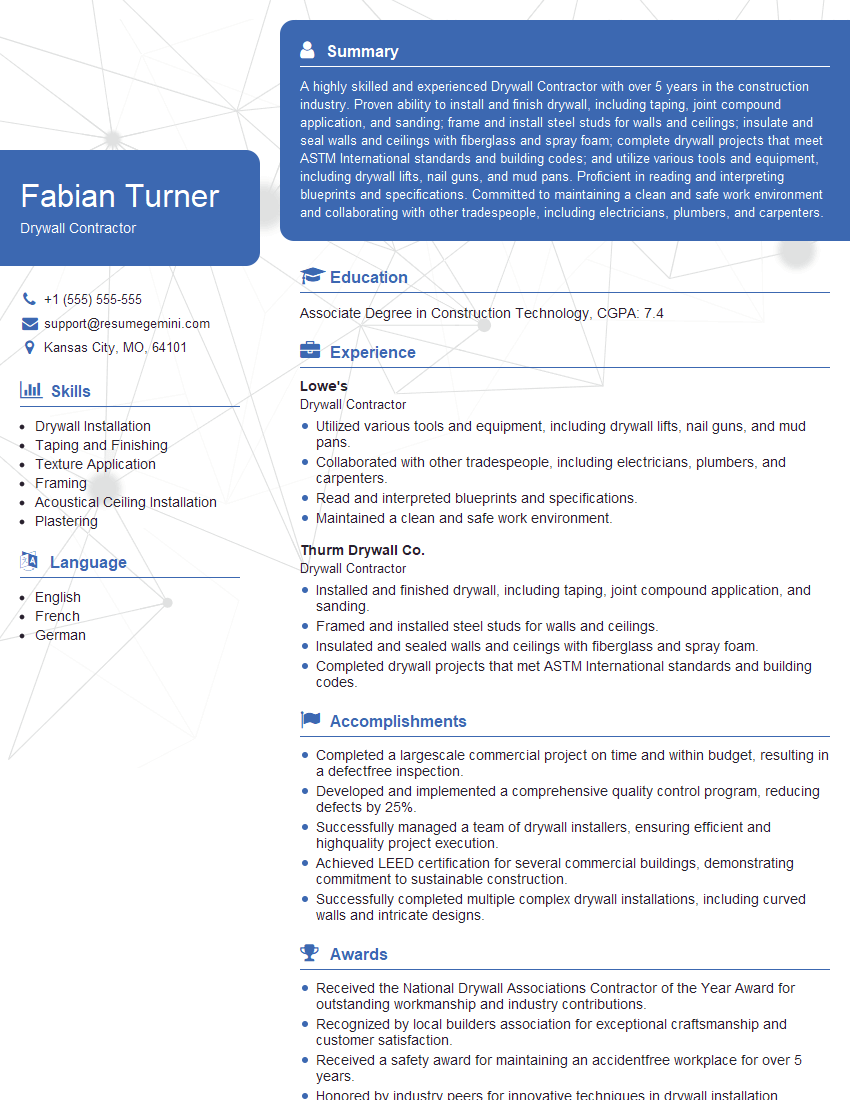
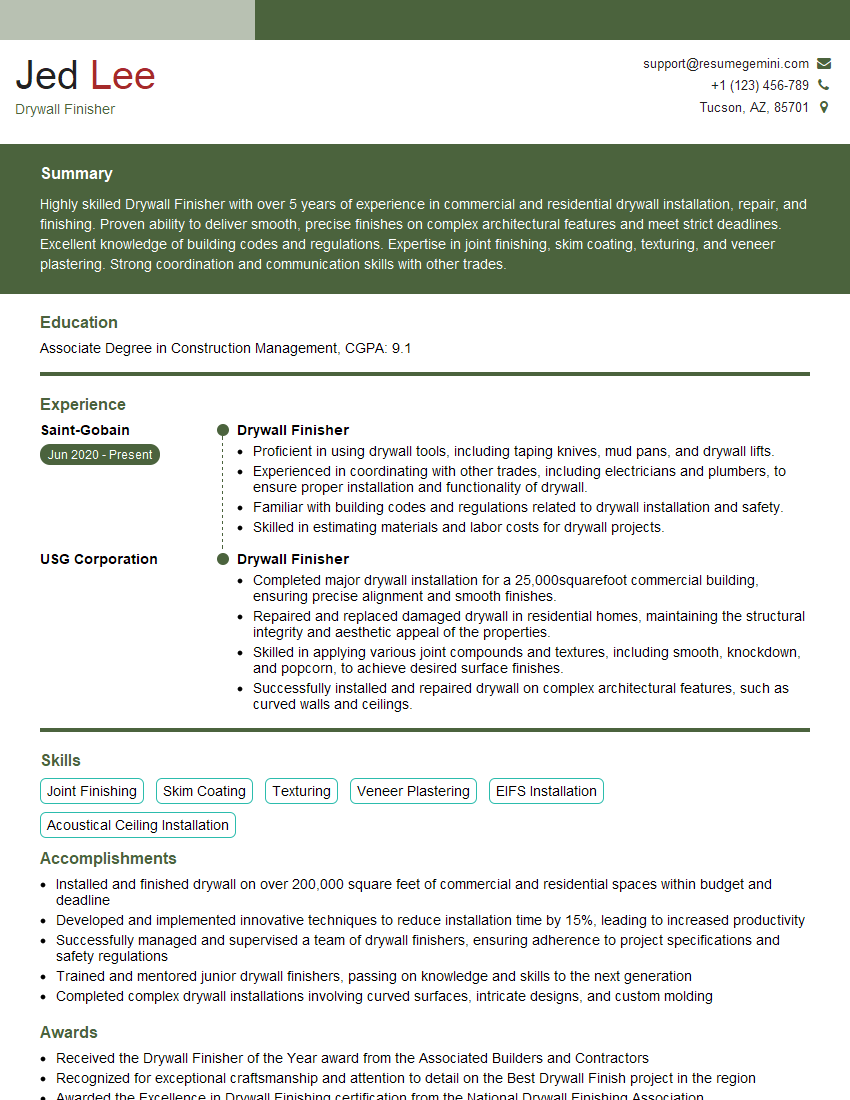
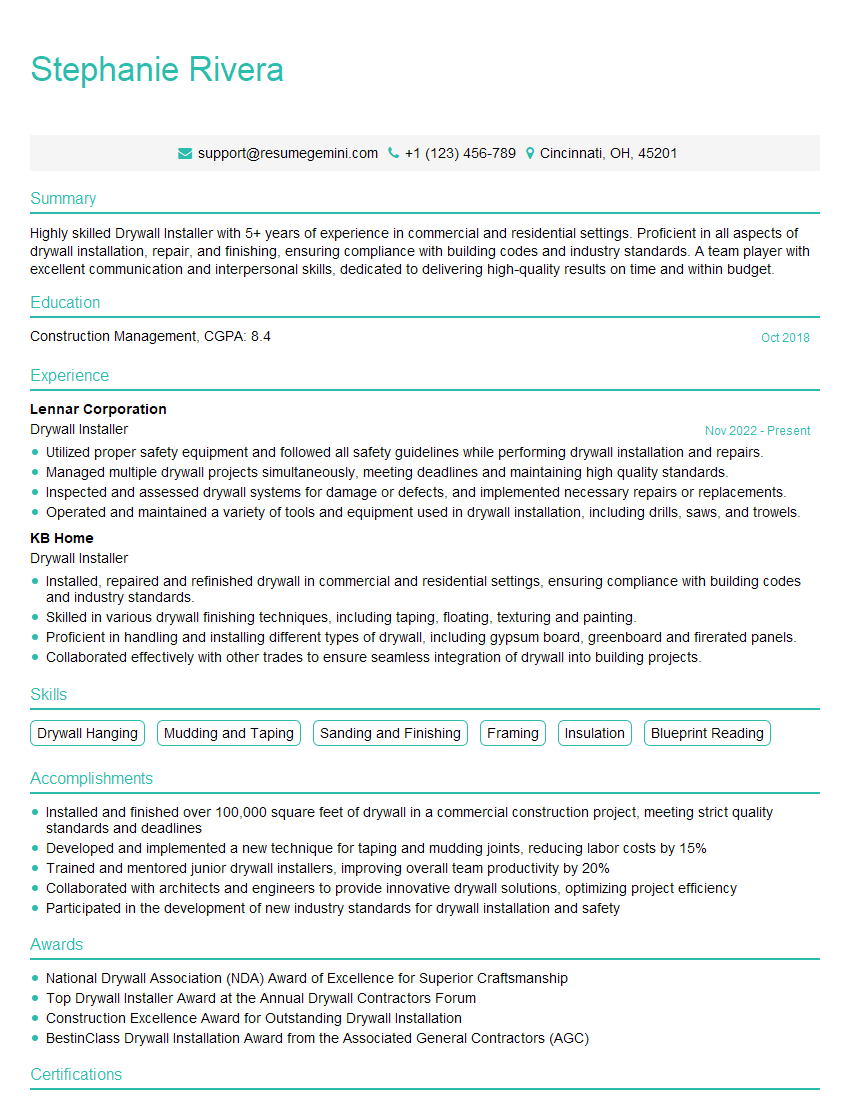
Mastering drywall repair skills opens doors to a rewarding career with excellent growth potential. A strong skill set combined with a well-crafted resume significantly increases your chances of landing your dream job. To make the most of your job search, focus on building an ATS-friendly resume that highlights your expertise. ResumeGemini is a trusted resource for creating professional, impactful resumes, and we offer examples tailored to the Drywall Repairs field to help you get started.


Explore more articles
Users Rating of Our Blogs
Share Your Experience
We value your feedback! Please rate our content and share your thoughts (optional).
What Readers Say About Our Blog
Really detailed insights and content, thank you for writing this detailed article.
IT gave me an insight and words to use and be able to think of examples