Cracking a skill-specific interview, like one for Refrigeration System Diagnostics, requires understanding the nuances of the role. In this blog, we present the questions you’re most likely to encounter, along with insights into how to answer them effectively. Let’s ensure you’re ready to make a strong impression.
Questions Asked in Refrigeration System Diagnostics Interview
Q 1. Explain the difference between high-side and low-side pressure in a refrigeration system.
The high-side and low-side pressures in a refrigeration system refer to the pressure levels in different parts of the cycle. Think of it like a water pump system; high pressure on one side, low pressure on the other, creating the flow.
The high-side pressure is the pressure in the part of the system where the refrigerant is a hot, high-pressure gas. This is primarily after the compressor and before the condenser. High-side pressure indicates the pressure the compressor is working against. A typical high-side pressure would be in the range of 200-300 PSI (pounds per square inch), depending on the refrigerant and system design. A significantly higher pressure than expected usually indicates a problem like a restriction in the system.
The low-side pressure is the pressure in the part of the system where the refrigerant is a cold, low-pressure gas or liquid. This is primarily after the evaporator and before the compressor. Low-side pressure reflects the refrigerant’s state before it enters the compressor. A typical low-side pressure would be in the range of 20-50 PSI, again depending on the refrigerant and system design. A significantly lower pressure than expected could suggest a refrigerant leak.
The difference between these pressures drives the refrigerant through the system, facilitating heat transfer and cooling.
Q 2. How do you troubleshoot a compressor that is not running?
Troubleshooting a non-running compressor requires a systematic approach. Imagine it like diagnosing a car that won’t start – you check various components systematically.
- Check the power supply: Ensure the compressor is receiving power. Use a multimeter to check for voltage at the compressor terminals. A simple blown fuse or tripped breaker could be the culprit.
- Inspect the start components: Depending on the compressor type, this could involve checking the start capacitor (for capacitor-start motors) or the overload protector (a safety device that cuts power if the motor overheats). A faulty capacitor will often show a bulge or leakage. An overload protector might need replacing if it has tripped.
- Verify the control circuit: The compressor’s operation is often controlled by a thermostat or other control devices. Check for continuity in the wiring and proper functioning of the control system using a multimeter. This could involve checking pressure switches that may be preventing the compressor from starting.
- Check for refrigerant level and pressure: A low refrigerant charge can prevent the compressor from starting, as can excessively high pressures. Use gauges to measure refrigerant pressures; low pressure may mean a leak, while high pressure might suggest a blockage.
- Listen for unusual noises: If the compressor is trying to start but failing, you might hear unusual noises like grinding or knocking. This often indicates a mechanical failure inside the compressor itself, requiring professional repair or replacement.
Always remember safety precautions when working with electrical components and refrigerants.
Q 3. Describe the function of a condenser in a refrigeration cycle.
The condenser’s job is to reject heat from the refrigerant. Imagine it as the radiator in a car engine; it dissipates the heat generated.
Hot, high-pressure refrigerant gas from the compressor enters the condenser. Within the condenser, this gas releases its heat to the surrounding environment (typically air or water). This heat rejection causes the refrigerant to change from a hot gas to a cool, high-pressure liquid, ready to proceed to the expansion valve.
Condenser types vary: air-cooled condensers use fans to blow air over finned coils; water-cooled condensers use water to absorb heat. The efficiency of a condenser directly impacts the refrigeration system’s overall performance; a dirty or malfunctioning condenser can significantly reduce cooling capacity.
Q 4. What are the common causes of refrigerant leaks?
Refrigerant leaks can occur due to a variety of reasons. Think of it as finding a leak in a water pipe; you look for possible points of failure.
- Component failure: Leaks can originate from small cracks or holes in components like the compressor, condenser, evaporator, or piping due to corrosion, vibration, or manufacturing defects.
- Loose connections: Poorly tightened fittings or connections can lead to leaks over time. Improper brazing or soldering techniques can also cause leaks.
- External damage: Physical damage to the system from impacts, rodents, or harsh environments can create openings for refrigerant to escape.
- Component wear and tear: Over time, seals and gaskets can wear down, resulting in leaks. This is particularly true in older systems.
- Improper installation: Faulty installation techniques can weaken connections and increase the risk of leaks.
Finding the exact location of a leak often requires specialized leak detection equipment such as electronic leak detectors or dye-tracing methods.
Q 5. How do you identify a faulty expansion valve?
Identifying a faulty expansion valve involves observing the system’s performance and using measurement tools. Imagine the expansion valve as a water faucet regulating water flow – if it malfunctions, the flow is disrupted.
Symptoms of a faulty expansion valve include:
- Insufficient cooling: The system might not cool effectively due to improper refrigerant flow.
- High superheat: This indicates that the refrigerant is not expanding sufficiently.
- Low subcooling: This indicates that the refrigerant is not condensing properly.
- Ice buildup on the suction line: This suggests that the expansion valve is delivering too much liquid refrigerant to the evaporator.
- Abnormal compressor discharge pressure or temperature: A malfunctioning valve will significantly impact the refrigerant’s thermodynamic properties.
To diagnose it, check the pressure and temperature readings across the expansion valve. Using gauges, measure the superheat and subcooling values and compare them to the manufacturer’s specifications. These will indicate whether the valve is delivering the appropriate refrigerant flow.
Q 6. Explain the purpose of a receiver tank.
A receiver tank acts as a storage vessel for liquid refrigerant in the high-side of a refrigeration system. Think of it as a reservoir for extra water in a plumbing system. It serves several important purposes:
- Liquid storage: It stores excess liquid refrigerant, ensuring a sufficient supply is available to the evaporator.
- Pressure equalization: It helps to equalize pressure fluctuations in the system, ensuring stable operation.
- Separation of liquid and vapor: It helps to separate liquid and vapor phases of the refrigerant, preventing vapor from entering the metering device.
- System charging: It facilitates efficient system charging and recovery of refrigerant.
The receiver tank is typically equipped with a sight glass to visually check the liquid level. It is usually installed near the condenser in larger refrigeration systems.
Q 7. What are the safety precautions when working with refrigerants?
Safety is paramount when handling refrigerants, which can be toxic, flammable, and harmful to the environment. Always follow these precautions:
- Proper ventilation: Work in well-ventilated areas to avoid exposure to refrigerant fumes. Refrigerant leaks can displace oxygen.
- Personal protective equipment (PPE): Use appropriate PPE, including safety glasses, gloves, and respiratory protection. Specific PPE depends on the type of refrigerant.
- Leak detection and repair: Use specialized leak detection equipment and proper techniques to identify and repair leaks immediately. Never attempt repairs without proper training.
- Refrigerant recovery and recycling: Always recover and recycle refrigerant properly instead of venting it to the atmosphere. Proper recovery equipment is required.
- Emergency procedures: Be aware of emergency procedures in case of leaks or accidents. Consult the Material Safety Data Sheet (MSDS) for the refrigerant used.
- Training and certification: Seek proper training and certification before working with refrigerants.
Following these safety measures is crucial for both your personal well-being and environmental protection.
Q 8. How do you interpret a pressure-temperature chart?
A pressure-temperature (P-T) chart is a crucial tool for refrigeration technicians. It graphically represents the relationship between the pressure and temperature of a refrigerant at various states (liquid, vapor, or a mixture). Think of it as a roadmap for your refrigerant. Each refrigerant has its own unique P-T chart because their thermodynamic properties vary.
Interpreting the Chart: You’ll typically find saturation curves (liquid and vapor lines) defining the phase change regions. The area below the liquid saturation curve represents the saturated liquid region; above the vapor saturation curve, it’s superheated vapor. The area between the two is a mixture of liquid and vapor. By measuring the pressure and temperature at a specific point in the refrigeration system (like at the evaporator outlet or condenser inlet), you can pinpoint the refrigerant’s state on the chart and diagnose potential problems.
Example: If you measure a low pressure and temperature reading, and that point falls far below the saturation curve, it might indicate insufficient refrigerant charge. Conversely, a point far above the curve might suggest a superheat issue needing attention.
Q 9. Describe the different types of refrigerants and their properties.
Refrigerants are classified based on their chemical composition and environmental impact. The selection of a refrigerant depends on factors like efficiency, safety, and environmental regulations.
- HFCs (Hydrofluorocarbons): These are widely used, relatively efficient, and non-ozone-depleting, but they are potent greenhouse gases. Examples include R-134a, R-410A, and R-407C. R-134a is commonly found in older automotive air conditioning systems, while R-410A is prevalent in newer residential and commercial systems.
- HFOs (Hydrofluoroolefins): These are designed to have low global warming potential (GWP) while maintaining good thermodynamic properties. R-1234yf and R-1234ze are examples, often found in newer automotive systems.
- Natural Refrigerants: These include ammonia (R-717), carbon dioxide (R-744), propane (R-290), and isobutane (R-600a). They are environmentally friendly but may have safety or flammability concerns, requiring specific handling and safety precautions. Ammonia, for example, is widely used in industrial refrigeration due to its excellent efficiency, but it’s toxic and requires specialized equipment.
Properties: Key properties considered include boiling point, critical temperature, operating pressure, toxicity, flammability, and GWP. The choice of refrigerant often depends on balancing these factors to meet the specific application’s needs and environmental considerations.
Q 10. How do you diagnose a system with excessive superheat or subcooling?
Excessive superheat or subcooling indicates inefficiencies in the refrigeration cycle. Let’s break down how to diagnose each:
Excessive Superheat: This means the refrigerant vapor leaving the evaporator is significantly hotter than the saturation temperature at the evaporator pressure. This often points to:
- Insufficient refrigerant charge: The lack of refrigerant means the evaporator isn’t fully flooded, leading to higher superheat.
- Restricted flow in the suction line: A clogged filter drier or a kinked line can restrict refrigerant flow, resulting in higher superheat.
- Faulty expansion device: A malfunctioning metering device (like a TXV or capillary tube) can overfeed the evaporator with refrigerant, also resulting in high superheat.
Excessive Subcooling: This occurs when the liquid refrigerant entering the metering device is significantly colder than its saturation temperature at the condenser pressure. This usually suggests:
- Overcharge of refrigerant: Too much refrigerant increases subcooling.
- Condenser problems: A dirty or restricted condenser reduces heat transfer, increasing subcooling.
- High ambient temperature: This can lead to increased condenser pressure and subcooling.
Diagnostic Steps: The diagnostic process involves observing the pressure and temperature readings at various points in the system, comparing them to the refrigerant’s P-T chart, and checking for any physical obstructions or malfunctions in components. A systematic approach, using manometers and temperature sensors, is crucial for accurate diagnosis.
Q 11. Explain the operation of a capillary tube.
A capillary tube is a simple, fixed restriction used as a metering device in smaller refrigeration systems. Think of it as a tiny, precisely sized tube that regulates refrigerant flow from the condenser to the evaporator.
Operation: High-pressure liquid refrigerant from the condenser enters the capillary tube. The tube’s narrow diameter creates significant pressure drop, causing the refrigerant to undergo a throttling process, which results in a mixture of liquid and vapor entering the evaporator. The pressure drop is the key; it forces the liquid refrigerant to absorb heat and vaporize in the evaporator.
Advantages: Capillary tubes are simple, inexpensive, and reliable, making them suitable for smaller refrigeration systems. However, they’re not suitable for systems requiring variable refrigerant flow as they are not adjustable.
Limitations: Their fixed restriction means they are only suitable for a specific operating range. Changes in ambient temperature or system load can significantly impact their performance. Furthermore, they are more prone to failure from blockage compared to more sophisticated metering devices like TXVs.
Q 12. What are the common causes of compressor overheating?
Compressor overheating is a serious issue that can lead to component damage or system failure. Several factors contribute to this problem:
- High Suction Pressure/Temperature: The compressor has to work harder if the refrigerant entering (suction) is too hot or the pressure is too high. This usually indicates an issue in the evaporator or suction line.
- High Discharge Pressure/Temperature: This might be due to a restricted condenser, insufficient airflow across the condenser, or an issue in the condenser itself.
- Low Refrigerant Charge: Insufficient refrigerant leads to increased compressor work, resulting in higher temperatures.
- Dirty or Plugged Filters: Obstructions in the refrigerant lines limit flow and increase the compressor’s load.
- Compressor Issues: Internal mechanical issues within the compressor (like worn bearings or valves) increase internal friction and lead to excessive heat generation.
- Lack of Lubrication: Sufficient oil is critical for compressor lubrication. Insufficient or degraded oil increases friction, leading to overheating.
Troubleshooting: To diagnose compressor overheating, you need to systematically check the pressures and temperatures at various points. Ensure that the condenser fan is functioning correctly and that there are no blockages in the system. Also, inspect the compressor’s external condition and carefully listen for abnormal noises.
Q 13. How do you troubleshoot a system with ice formation on the evaporator?
Ice formation on the evaporator indicates that the evaporator is colder than the surrounding air and the system likely has a problem. The primary cause is typically a reduced capacity to absorb heat, which could be due to:
- Insufficient Refrigerant Charge: Limited refrigerant reduces the evaporator’s ability to absorb heat, causing it to operate at a lower temperature and form ice.
- Air Circulation Issues: Restricted airflow across the evaporator prevents efficient heat transfer, resulting in frost build-up.
- Dirty Evaporator Coils: Dust or other debris accumulating on the coils reduces heat transfer efficiency.
- Malfunctioning Fan Motor: In air-cooled systems, a faulty fan motor limits airflow, causing ice build-up.
- Low Ambient Temperature: If the surrounding air temperature is exceptionally low, the evaporator temperature might still fall below freezing, even if the system is functioning correctly. This condition is more prevalent during the winter season.
Troubleshooting: The solution depends on the root cause. You would need to check refrigerant charge levels, inspect the evaporator coils and surrounding areas for blockages, and ensure the fan motor is running correctly. Often, defrost cycles are implemented in refrigeration systems to manage ice formation. In cases of severely restricted airflow or low refrigerant charge, professional intervention is necessary.
Q 14. Describe the function of a thermal expansion valve (TXV).
A thermal expansion valve (TXV) is a sophisticated metering device that precisely regulates the flow of refrigerant to the evaporator based on the evaporator’s superheat. It’s a crucial component in many refrigeration systems, ensuring optimal efficiency.
Function: The TXV uses a sensing bulb that monitors the superheat at the evaporator outlet. The sensing bulb is filled with the same refrigerant as the system. As the superheat increases (meaning the evaporator is not absorbing heat efficiently), the bulb’s pressure increases, causing the valve to open wider. Conversely, if the superheat decreases, the valve closes, regulating the flow and maintaining the desired superheat. This dynamic control ensures optimal evaporator performance.
Advantages: TXVs provide precise control of refrigerant flow, leading to improved efficiency and reduced energy consumption. They adapt well to varying loads and ambient temperatures, making them suitable for a wider range of applications compared to capillary tubes.
Maintenance: Regular maintenance, including checking for leaks and ensuring proper sensing bulb placement, is crucial for the TXV’s optimal performance.
Q 15. How do you charge a refrigeration system with refrigerant?
Charging a refrigeration system with refrigerant is a crucial process that requires precision and safety. It involves adding refrigerant to the system to restore its operational capacity after a leak or initial installation. The process differs slightly depending on the type of refrigerant and the system’s design, but generally involves these steps:
- Evacuation: Before adding any refrigerant, the system must be thoroughly evacuated to remove air, moisture, and other non-condensables that can contaminate the refrigerant and damage the compressor. This is done using a vacuum pump.
- Refrigerant Selection: The correct type and amount of refrigerant must be identified, matching the system’s specifications. Incorrect refrigerant can severely damage the system.
- Charging Method: Refrigerant can be charged using various methods, including:
- Weight Charging: This is the most accurate method, involving precisely weighing the refrigerant added to the system. This ensures the correct amount of refrigerant is added.
- Subcooling/Superheat Charging: This method involves measuring the subcooling of the liquid refrigerant or the superheat of the vapor refrigerant at specific points in the system. This approach requires specialized gauges and a good understanding of thermodynamic principles.
- Liquid Charging: Refrigerant is added in liquid form, usually through the liquid line. This method is simpler but requires careful monitoring to avoid overcharging.
- Leak Detection: After charging, a leak detection test is crucial to ensure there are no leaks, which would cause refrigerant loss and system inefficiency.
Example: Imagine you’re charging a small household refrigerator. You’d start by evacuating the system, then carefully weigh the correct amount of R-134a refrigerant, and finally, monitor the system’s pressure and temperature to confirm proper operation. Always remember to consult the manufacturer’s specifications and safety guidelines.
Career Expert Tips:
- Ace those interviews! Prepare effectively by reviewing the Top 50 Most Common Interview Questions on ResumeGemini.
- Navigate your job search with confidence! Explore a wide range of Career Tips on ResumeGemini. Learn about common challenges and recommendations to overcome them.
- Craft the perfect resume! Master the Art of Resume Writing with ResumeGemini’s guide. Showcase your unique qualifications and achievements effectively.
- Don’t miss out on holiday savings! Build your dream resume with ResumeGemini’s ATS optimized templates.
Q 16. Explain the principles of heat transfer in a refrigeration cycle.
The refrigeration cycle relies on the principles of heat transfer – specifically, absorption and rejection of heat. It works by utilizing a refrigerant’s properties to move heat from a low-temperature area (the space to be cooled) to a high-temperature area (the ambient environment). The cycle involves four main stages:
- Evaporation: The refrigerant absorbs heat from the refrigerated space as it evaporates in the evaporator, changing from a low-pressure liquid to a low-pressure gas. This is endothermic – the process absorbs heat.
- Compression: The low-pressure gaseous refrigerant is compressed by the compressor, increasing its pressure and temperature. This is adiabatic – little to no heat is exchanged with the surroundings.
- Condensation: The high-pressure, high-temperature refrigerant releases heat to the surroundings as it condenses in the condenser, changing from a high-pressure gas to a high-pressure liquid. This is exothermic – the process releases heat.
- Expansion: The high-pressure liquid refrigerant expands through an expansion valve (or capillary tube), decreasing its pressure and temperature, preparing it for the evaporation stage. This is also adiabatic.
In essence, the refrigerant acts as a heat carrier, absorbing heat from the space to be cooled and releasing it to the outside environment. Think of it like a sponge absorbing water (heat) in one location and squeezing it out (releasing heat) in another.
Q 17. What are the different types of refrigeration systems?
Refrigeration systems are categorized in various ways, primarily based on their working principles:
- Vapor-Compression Refrigeration: This is the most common type, using the four stages described earlier (evaporation, compression, condensation, expansion). It’s used in domestic refrigerators, air conditioners, and many industrial applications.
- Absorption Refrigeration: This system uses a refrigerant and an absorbent (like water and lithium bromide) to move heat. It doesn’t require a compressor, instead relying on heat input to drive the process. It’s often seen in smaller applications, like some water coolers.
- Air-Cycle Refrigeration: This system uses compressed air as the refrigerant, often employed in aircraft and other applications where conventional refrigerants might be unsuitable.
- Thermoelectric Refrigeration: This relies on the Peltier effect, where electric current passing through two dissimilar metals generates a temperature difference. It’s used in small-scale cooling applications like portable coolers.
Each type has its advantages and disadvantages in terms of efficiency, cost, and application suitability. For instance, vapor-compression systems are highly efficient but require compressors, while absorption systems are less efficient but require less energy input, albeit in the form of heat.
Q 18. How do you diagnose a system with low cooling capacity?
Diagnosing low cooling capacity requires a systematic approach. It’s like detective work; you need to systematically eliminate possibilities. Here’s a step-by-step process:
- Check Refrigerant Charge: Low refrigerant charge is a common culprit. Use pressure gauges and a sight glass to verify correct refrigerant level and pressures.
- Inspect Airflow: Ensure adequate airflow over the evaporator and condenser coils. Restricted airflow will reduce cooling capacity significantly. Clean any debris or dust buildup.
- Examine Condenser Operation: A dirty or restricted condenser will lead to high condensing pressures and reduced cooling. Clean the condenser fins or replace it if necessary.
- Check Compressor Operation: Measure compressor current and amps. High or low current compared to the nameplate values may indicate a problem. Listen for unusual noises – a noisy compressor could signify internal issues.
- Evaluate Evaporator Performance: Examine the evaporator coil for frost or ice buildup, which could indicate restricted airflow or low refrigerant charge.
- Inspect Expansion Valve/Capillary Tube: A restricted expansion valve will restrict refrigerant flow, leading to reduced cooling. Consider testing or replacing the component.
- Check for Leaks: Use a leak detection instrument to check for refrigerant leaks, which will significantly affect cooling capacity. Repair any leaks found.
By systematically checking these aspects, you’ll narrow down the cause of low cooling capacity and implement the necessary repairs.
Q 19. Describe the function of a sight glass.
A sight glass is a small, transparent component installed in the liquid line of a refrigeration system. It allows visual inspection of the refrigerant flow. It’s essentially a window into the system’s refrigerant condition. Key features observed include:
- Refrigerant Level: The sight glass shows the refrigerant level, ensuring there’s enough refrigerant in the system.
- Refrigerant Condition: The presence of bubbles or discoloration indicates potential problems, such as air or moisture in the refrigerant.
- Troubleshooting Aid: The sight glass provides vital information for troubleshooting, allowing technicians to quickly identify potential issues such as liquid slugging.
Example: If you see bubbles in the sight glass, it typically means the system is low on refrigerant or may contain non-condensables.
Q 20. How do you identify a faulty compressor motor?
Identifying a faulty compressor motor involves a multi-step diagnostic process:
- Measure the Compressor Current: Using a clamp meter, measure the compressor motor’s current draw. Compare this reading to the nameplate value; significant deviations indicate a potential problem. High current could signify a shorted winding, while low current might indicate an open winding or weak field.
- Listen for Unusual Noises: Listen carefully to the compressor while it’s running. Unusual noises such as knocking, squealing, or grinding sounds could point to bearing wear, internal damage, or mechanical issues.
- Check the Compressor’s Temperature: Excessive heat buildup on the compressor could indicate internal problems or a lack of sufficient cooling.
- Test the Starting Capacitor (if applicable): A faulty starting capacitor can prevent the compressor from starting or cause it to run erratically. A capacitance meter can test the capacitor’s health.
- Measure the Voltage: Ensure the voltage supplied to the compressor is within the specified range. Insufficient voltage can cause the motor to overheat and fail.
These tests will help pinpoint if the motor itself is at fault or if the problem stems from other components within the refrigeration system.
Q 21. What are the common causes of refrigerant contamination?
Refrigerant contamination, the presence of undesirable substances in the refrigerant, can significantly impact the system’s performance and lifespan. Common causes include:
- Air and Moisture: These enter during system repairs, improper charging, or leaks. Moisture reacts with the refrigerant and can form acids that corrode system components.
- Oil Contamination: Improper handling or a compressor failure can introduce mineral oil (from the compressor) into the refrigerant. This can lead to poor heat transfer and system damage.
- Non-condensables: These gases (air, nitrogen) don’t condense and lower the system’s efficiency. They also hinder heat transfer.
- Acids: Corrosion within the system can create acids, which damage components and further contaminate the refrigerant.
- Solvents and Cleaning Agents: Using inappropriate cleaning agents during system maintenance can introduce contaminants into the system.
Preventing contamination involves proper handling procedures, using clean equipment during charging, thorough evacuation before charging, and regular maintenance to identify and address leaks promptly.
Q 22. How do you troubleshoot a system with excessive noise?
Excessive noise in a refrigeration system is a clear indicator of a problem. It could stem from various sources, so a systematic approach is crucial. Think of it like listening to a car – a strange noise points to a specific issue. We’ll start by identifying the type of noise: is it a rattling, screeching, humming, or something else? This helps narrow down the possibilities.
- Compressor Noise: A loud rattling or knocking sound often points to a failing compressor bearing. This needs immediate attention to prevent catastrophic failure. We’d check the compressor’s vibration and oil level. A high-pitched screech could indicate insufficient lubrication or a worn-out piston ring.
- Fan Motor Noise: A humming or buzzing sound often originates from a worn-out fan motor bearing or a loose fan blade. We’d inspect the fan assembly for looseness, listen for unusual bearing sounds, and measure the current draw to detect excessive load.
- Condenser/Evaporator Noise: Unusual noises from these components, such as rattling, could be caused by loose tubes, debris buildup, or even ice accumulation. A visual inspection and a thorough cleaning are usually sufficient.
- Refrigerant Issues: In some cases, excessive noise can stem from refrigerant issues like refrigerant slugging (liquid refrigerant entering the compressor) or insufficient refrigerant charge. We’d check refrigerant levels and pressures and analyze their fluctuations.
Troubleshooting involves using diagnostic tools like vibration meters, acoustic sensors, and thermal cameras to pinpoint the exact source. Finally, fixing the root cause, whether it’s replacing a bearing, cleaning debris, or recharging the system, is key.
Q 23. Explain the operation of a scroll compressor.
A scroll compressor is a type of positive displacement compressor, meaning it uses mechanical action to compress refrigerant. Imagine two spirals, one fixed and the other orbiting, working together to trap and compress refrigerant. The orbiting scroll moves eccentrically within the fixed scroll, reducing the volume of the refrigerant pockets and increasing the pressure.
Here’s how it works:
- Suction Process: Refrigerant vapor enters the compressor through the suction port. The orbiting scroll sweeps the vapor into crescent-shaped pockets formed between the scrolls.
- Compression Process: As the orbiting scroll continues its rotation, the pockets progressively decrease in size, compressing the refrigerant vapor.
- Discharge Process: Once fully compressed, the refrigerant is discharged from the center of the scrolls through the discharge port.
Scroll compressors are known for their smooth operation, quietness, and high efficiency compared to reciprocating compressors. They’re widely used in residential and light commercial refrigeration systems.
Q 24. What are the different types of evaporators?
Evaporators are responsible for absorbing heat from the refrigerated space. There are several types, each designed for different applications:
- Flooded Evaporators: These are completely filled with liquid refrigerant, offering excellent heat transfer but needing sophisticated controls to prevent liquid refrigerant from entering the compressor.
- Dry Evaporators: These have less refrigerant, only partially filling the tubing. They are simpler to control but may not be as efficient as flooded evaporators.
- Plate Evaporators: These use thin plates to maximize heat transfer, often used in smaller systems due to space limitations.
- Air-Cooled Evaporators: These use forced air to draw heat from the refrigerant. They’re commonly seen in refrigerators and freezers.
- Direct Expansion (DX) Evaporators: This is a common type where the refrigerant directly evaporates within the evaporator coils, transferring heat to the air or other medium.
The choice of evaporator depends heavily on factors like the required cooling capacity, the type of refrigerant, and the physical space constraints of the system.
Q 25. How do you identify a faulty fan motor?
Identifying a faulty fan motor involves a multi-step process. Like a doctor diagnosing a patient, we need to gather evidence.
- Visual Inspection: Look for any obvious signs of damage such as burnt wires, loose connections, or physical damage to the motor housing.
- Listen for Unusual Sounds: A grinding, squealing, or humming sound often indicates bearing wear or electrical issues within the motor.
- Check the Current Draw: Use a clamp meter to measure the current draw of the fan motor. A current draw significantly higher than the motor’s rated value suggests a problem. A low current draw might indicate that the fan is not functioning correctly.
- Measure Voltage: Verify that the motor is receiving the correct voltage using a multimeter.
- Check the Capacitor (if applicable): If the fan motor has a capacitor, test it to ensure it’s not faulty. A bad capacitor can prevent the motor from starting or cause erratic operation.
- Check for obstructions: Sometimes the issue might simply be an obstruction blocking airflow.
If any of these tests reveal an issue, the faulty fan motor will need to be replaced or repaired.
Q 26. Describe the function of a filter drier.
A filter drier is a crucial component in a refrigeration system. It’s like a kidney for the system, removing moisture, acids, and other contaminants from the refrigerant. These contaminants can severely damage the compressor and other components, reducing efficiency and lifespan.
Its functions include:
- Moisture Removal: The desiccant material within the filter drier absorbs moisture, preventing corrosion and freezing in the system. Moisture can form ice, blocking flow and causing serious issues.
- Acid Removal: Acids can form within the refrigerant due to various factors, causing corrosion of the system’s metal parts. The drier neutralizes or filters them.
- Particle Filtration: The drier also filters out solid particles, protecting delicate components from damage. Think of it as a filter for the blood stream.
A clogged or saturated filter drier reduces the system’s efficiency and needs replacing. This is usually diagnosed through pressure measurements and refrigerant analysis.
Q 27. How do you troubleshoot a system with poor temperature control?
Poor temperature control in a refrigeration system can have various causes. A systematic approach is necessary, much like a detective investigating a crime scene. We start by checking the obvious, then move towards more complex aspects.
- Thermostat Malfunction: A faulty thermostat might not be accurately sensing or controlling the temperature. We test this through replacement or comparison against a known good unit.
- Insufficient Refrigerant: Low refrigerant charge results in poor cooling and temperature fluctuations. We measure the refrigerant pressure and amount using gauges.
- Dirty Evaporator Coil: A dirty evaporator coil restricts airflow and reduces heat transfer efficiency. Cleaning or replacing solves this.
- Faulty Compressor: A failing compressor may not be able to maintain the desired temperature, indicated by high discharge pressures and lack of cooling capacity.
- Blocked Airflow: Obstructions around the condenser or evaporator coils restrict airflow and affect cooling. A simple visual check is usually sufficient.
- Defrost Issues: Frequent or insufficient defrost cycles can cause temperature instability, particularly in freezers. Inspect defrost components and cycles.
Troubleshooting involves checking each of these aspects sequentially until the root cause is identified and addressed. Using diagnostic tools like pressure gauges, temperature sensors, and amp meters speeds up the process.
Q 28. Explain the importance of proper system evacuation.
Proper system evacuation is critical in refrigeration system maintenance and repair. It’s about removing all air and non-condensable gases (NCGs) from the system before charging it with refrigerant. Think of it as purifying the system’s ‘bloodstream’. Leaving air or NCGs in the system can severely impact efficiency and lifespan.
The importance lies in:
- Preventing Compressor Damage: Air and NCGs in the system increase the compressor’s operating pressure and temperature, leading to overheating and potential failure.
- Improving Efficiency: Air and NCGs reduce the system’s cooling capacity, requiring the compressor to work harder and consume more energy.
- Reducing Corrosion: Moisture in the system can react with refrigerant and system components to form corrosive acids. Evacuation removes moisture.
- Ensuring Accurate Refrigerant Charge: Proper evacuation guarantees an accurate refrigerant charge, crucial for optimal performance.
Evacuation is performed using a vacuum pump, achieving a deep vacuum to remove contaminants and ensuring a clean, dry system ready for refrigerant charging. The vacuum level and duration depend on the system size and type.
Key Topics to Learn for Refrigeration System Diagnostics Interview
- Refrigerant Properties and Cycles: Understanding the thermodynamic properties of refrigerants (e.g., pressure-temperature relationships, enthalpy, entropy) and the operation of various refrigeration cycles (e.g., vapor-compression, absorption). Practical application: Diagnosing refrigerant leaks and identifying the cause of low system pressure.
- Components and their Function: Deep knowledge of compressors, condensers, evaporators, expansion valves, and other key components. Practical application: Troubleshooting malfunctions in individual components based on observed symptoms (e.g., noisy compressor, restricted airflow in condenser).
- Electrical Systems and Controls: Understanding the electrical components (e.g., motors, starters, sensors, controllers) and their role in system operation. Practical application: Diagnosing electrical faults using multimeters and other diagnostic tools.
- Troubleshooting Techniques: Mastering systematic troubleshooting methodologies, including the use of pressure gauges, temperature sensors, and other diagnostic tools. Practical application: Identifying the root cause of system failures through logical deduction and data analysis.
- Safety Procedures and Regulations: Familiarity with safety regulations and procedures related to handling refrigerants and working with high-pressure systems. Practical application: Ensuring safe and compliant operation and maintenance of refrigeration systems.
- Environmental Considerations: Understanding the environmental impact of refrigerants and the importance of responsible refrigerant handling and disposal. Practical application: Identifying and mitigating potential environmental hazards associated with refrigeration systems.
- Data Acquisition and Analysis: Ability to interpret data from pressure gauges, temperature sensors, and other diagnostic tools to identify system issues. Practical application: Using collected data to support troubleshooting conclusions and recommendations.
Next Steps
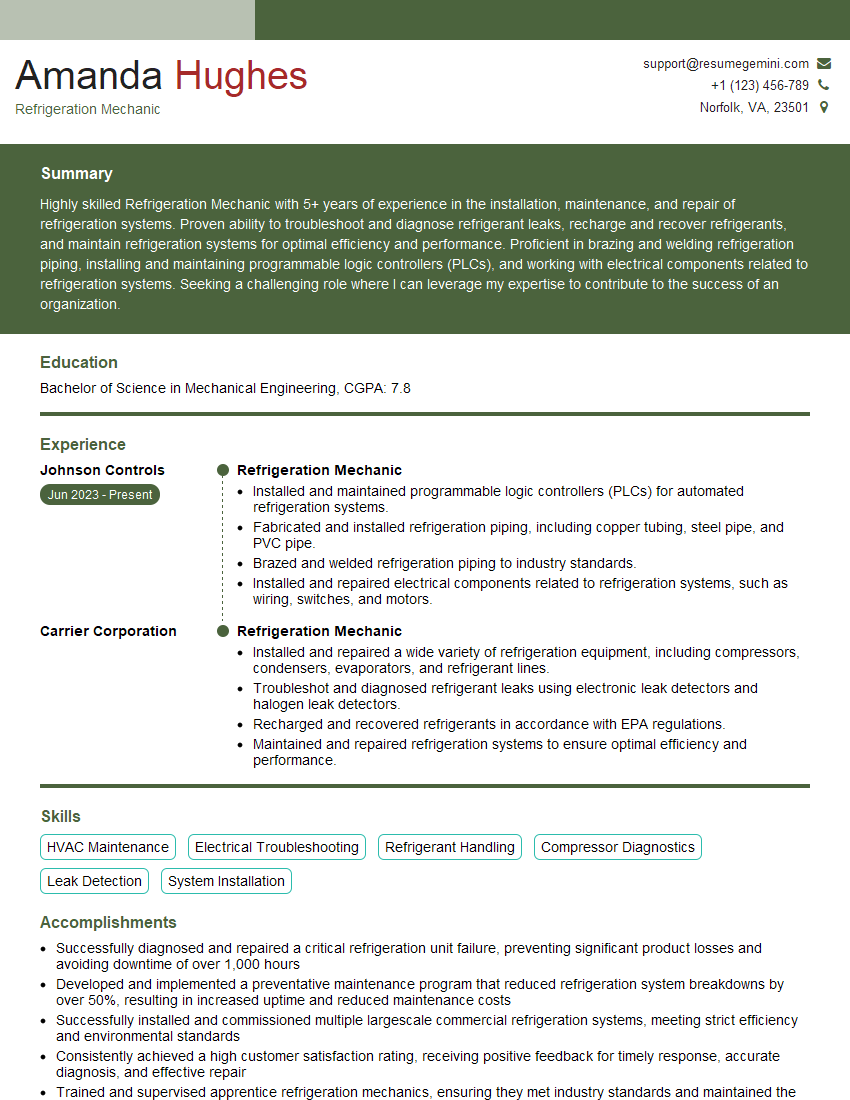
Mastering Refrigeration System Diagnostics is crucial for career advancement in this in-demand field. A strong understanding of these concepts will significantly enhance your interview performance and open doors to exciting opportunities. To increase your job prospects, create an ATS-friendly resume that highlights your skills and experience effectively. ResumeGemini is a trusted resource that can help you build a professional and impactful resume. Examples of resumes tailored to Refrigeration System Diagnostics are available to guide you, showcasing how to present your qualifications in the best light. Invest the time to craft a compelling resume – it’s your first impression with potential employers.
Explore more articles
Users Rating of Our Blogs
Share Your Experience
We value your feedback! Please rate our content and share your thoughts (optional).
What Readers Say About Our Blog
Really detailed insights and content, thank you for writing this detailed article.
IT gave me an insight and words to use and be able to think of examples