Preparation is the key to success in any interview. In this post, we’ll explore crucial Durability Analysis interview questions and equip you with strategies to craft impactful answers. Whether you’re a beginner or a pro, these tips will elevate your preparation.
Questions Asked in Durability Analysis Interview
Q 1. Explain the difference between fatigue and static strength.
Static strength refers to a material’s ability to withstand a constant load without failure. Think of it like holding a heavy weight – as long as the weight doesn’t exceed the material’s strength, it will remain intact. Fatigue strength, on the other hand, is a material’s ability to withstand repeated loading and unloading cycles. Imagine repeatedly bending a paperclip; eventually, it will break even if the force applied in each cycle is less than its static strength. The key difference lies in the loading type: static is constant, while fatigue involves cyclic loading.
For example, a bridge column needs to withstand a static load of its own weight plus the weight of vehicles. But it also experiences cyclic loading from traffic, wind, and thermal changes. Its design must account for both its static strength (to avoid sudden collapse) and its fatigue strength (to avoid failure over many cycles of loading).
Q 2. Describe the various types of fatigue failure mechanisms.
Fatigue failure mechanisms are complex but generally fall into these categories:
- Crack Initiation: This is the first stage, where microscopic flaws or stress concentrations in the material begin to grow into detectable cracks. This can be caused by various factors such as manufacturing imperfections or surface scratches.
- Crack Propagation: Once a crack initiates, it will propagate (grow) under repeated loading. This propagation happens through various mechanisms depending on the material, stress state, and environment.
- Final Fracture: The crack eventually reaches a critical size, leading to sudden and catastrophic failure. This final fracture is often a brittle event, occurring quickly with little or no warning.
Different types of fatigue failures can occur depending on the loading conditions and material properties. For instance, high-cycle fatigue occurs under many loading cycles with relatively low stress, while low-cycle fatigue involves fewer cycles with higher stress.
Q 3. What are the key factors influencing fatigue life?
Many factors influence fatigue life. These can be broadly categorized as material properties, loading conditions, and environmental factors. Let’s look at some key players:
- Material Properties: Tensile strength, yield strength, ductility, and the presence of inclusions or defects all directly affect a material’s fatigue resistance.
- Loading Conditions: The magnitude of the stress, the frequency of loading cycles, the mean stress (average stress level), and the stress ratio (minimum stress/maximum stress) all significantly impact fatigue life. A higher stress amplitude and a higher mean stress generally decrease fatigue life. Irregular loading patterns can also lead to premature failure.
- Environmental Factors: Temperature, humidity, corrosive environments, and surface treatments can significantly accelerate fatigue crack initiation and propagation. For instance, corrosion can create pits that act as stress concentrators, reducing fatigue life considerably.
- Geometric Factors: The presence of stress concentrations (e.g., sharp corners, holes) can drastically reduce fatigue life. A component with a smooth, uniform geometry will generally have a much longer fatigue life compared to one with sharp corners or other geometric discontinuities.
Understanding the interplay of these factors is crucial for accurate fatigue life prediction.
Q 4. Explain the concept of stress concentration and its effect on durability.
Stress concentration occurs when there is a localized increase in stress around geometric discontinuities such as holes, notches, fillets, or cracks. Imagine a piece of wood with a knot; the wood around the knot experiences higher stress than the surrounding areas when loaded. This localized increase in stress can significantly reduce the fatigue life of a component, as cracks are more likely to initiate at these points of high stress.
The effect of stress concentration is usually quantified by a stress concentration factor (Kt), which represents the ratio of the maximum stress to the nominal stress. A high Kt value indicates a significant stress concentration and a reduced fatigue life. In engineering design, mitigating stress concentration through design modifications (e.g., using fillets instead of sharp corners) is crucial for improving the durability of components. Careful design and analysis of these areas using FEA are essential.
Q 5. What are the different methods used for fatigue life prediction?
Several methods exist for fatigue life prediction, each with its own strengths and limitations:
- S-N Curves: These curves plot stress amplitude (S) versus the number of cycles to failure (N). Data for these curves is typically obtained from experimental fatigue testing. This is a relatively simple method, but it’s limited by its reliance on experimental data and may not accurately reflect complex loading scenarios.
- Strain-Life Methods: These methods consider the plastic strain accumulated during each cycle, providing more accurate predictions for low-cycle fatigue scenarios. These methods are more complex than S-N curves.
- Fracture Mechanics: This advanced approach predicts crack growth rate based on the stress intensity factor at the crack tip. This method is powerful for predicting the remaining life of a component containing existing cracks.
- Finite Element Analysis (FEA): FEA allows for the simulation of complex stress and strain distributions in components under cyclic loading. This is particularly useful for components with complex geometries or loading conditions where analytical methods are inadequate. FEA can be coupled with fatigue life prediction algorithms to obtain accurate fatigue life estimates.
The choice of method depends on the complexity of the component, loading conditions, and the required accuracy of the prediction.
Q 6. Describe your experience with finite element analysis (FEA) for durability.
I have extensive experience using FEA for durability analysis. In my previous role, we used FEA to model the fatigue life of critical components in automotive chassis. For instance, we modeled the stress and strain distributions in a vehicle suspension arm under various loading conditions, such as cornering, braking, and accelerating. This involved creating detailed FEA models, applying cyclic loading to these models, and using fatigue life prediction algorithms to estimate the fatigue life of the component. This allowed us to identify potential failure points and optimize the design for improved durability. One particular project involved investigating the fatigue life of a redesigned part that experienced premature failure in the field. By using FEA, we were able to identify areas of high stress concentration that were contributing to the failure, leading to successful redesign of the part and eliminating the field failures.
My expertise extends to meshing techniques, boundary condition definition, material model selection, and post-processing of FEA results for fatigue analysis. I am well-versed in using various fatigue life prediction methods within the FEA framework to provide accurate and actionable results.
Q 7. What software packages are you proficient in for durability analysis?
I am proficient in several software packages for durability analysis, including:
- Abaqus: A powerful and versatile FEA software package widely used in industry for complex simulations.
- Nastran: Another robust FEA software frequently employed for structural analysis and fatigue life prediction.
- Ansys: A comprehensive simulation suite with capabilities for FEA, fatigue analysis, and other engineering simulations.
- HyperWorks: A suite of engineering software tools providing a complete workflow for durability analysis, from pre-processing to post-processing.
My experience with these software packages encompasses a wide range of applications, including static and dynamic analysis, fatigue life prediction, and optimization studies.
Q 8. How do you validate FEA results?
Validating Finite Element Analysis (FEA) results in durability analysis is crucial to ensure the accuracy and reliability of the predictions. This involves a multi-pronged approach, combining various techniques to build confidence in the model. Think of it like baking a cake – you wouldn’t just trust the recipe; you’d check the ingredients, the oven temperature, and ultimately, taste the final product!
Comparison with Analytical Solutions: For simple geometries and loading conditions, analytical solutions (e.g., beam theory) can be used as a benchmark. The FEA results should align reasonably well with these simpler calculations.
Mesh Convergence Study: The accuracy of FEA is highly dependent on the mesh density. A convergence study involves running the analysis with progressively finer meshes to ensure that the results stabilize and don’t change significantly with further mesh refinement. This confirms that the mesh is sufficiently fine to capture the relevant details.
Experimental Validation: The most powerful validation comes from comparing FEA predictions to experimental data. This could involve strain gauge measurements, acoustic emission monitoring, or even full-scale component testing. The closer the FEA predictions are to the experimental measurements, the higher the confidence in the model.
Code Verification: Regular checks should be performed to ensure the FEA software is functioning correctly and the model is correctly set up. This may involve simple benchmark problems with known solutions.
Sensitivity Analysis: Evaluating the impact of input parameters (material properties, boundary conditions, loads) on the results helps identify potential sources of error and improve model accuracy.
In my experience, a combination of these validation methods provides the most robust assessment of FEA results. For example, on a recent project involving the durability of a car chassis, we used a combination of mesh convergence studies, comparison with simplified analytical models, and experimental strain gauge data to validate our FEA model, ultimately leading to a design that met the stringent durability requirements.
Q 9. Explain the concept of a fatigue S-N curve.
The fatigue S-N curve (Stress-Number of cycles) is a graphical representation of the relationship between the applied stress amplitude (S) and the number of cycles to failure (N) of a material under cyclic loading. It’s a cornerstone of fatigue analysis. Imagine it as a map that tells you how many times you can repeatedly bend a wire before it breaks, depending on how hard you bend it each time.
The curve is typically plotted on a log-log scale, showing that as the stress amplitude increases, the number of cycles to failure decreases significantly. It often features a distinct knee point, after which the curve tends to flatten indicating a fatigue limit (endurance limit) for some materials. This means that below a certain stress level, the material can theoretically withstand an infinite number of cycles without failure.
The S-N curve is crucial because it allows engineers to predict the lifespan of a component under cyclic loading, such as engine parts subjected to thousands of stress cycles during operation or bridges subject to repeated loading from traffic. By knowing the stress amplitude a component experiences, one can use the S-N curve to determine its expected fatigue life.
Example Data:  S (MPa) | N (cycles)
 500 | 10^4
 400 | 10^5
 300 | 10^6
The data above would be plotted on an S-N curve to derive the relationship.
Q 10. What is the role of material properties in durability analysis?
Material properties are absolutely fundamental to accurate durability analysis. They define how a material behaves under different loading conditions, and their influence on the overall performance of the component cannot be overstated. Think of it like choosing the right ingredients for your cake recipe – using the wrong ones will drastically affect the outcome.
Young’s Modulus (Elastic Modulus): This represents the material’s stiffness, determining how much it deforms under stress.
Poisson’s Ratio: This describes the relationship between lateral and axial strain, affecting stress distribution under load.
Yield Strength: This indicates the stress at which the material starts to deform permanently.
Ultimate Tensile Strength: This signifies the maximum stress the material can withstand before failure.
Fatigue Properties: These properties, as represented by the S-N curve, are vital in predicting fatigue life under cyclic loading.
Fracture Toughness: This property indicates the material’s resistance to crack propagation, crucial for analyzing crack initiation and growth.
The accuracy of the durability analysis is directly tied to the accuracy of these material properties. Obtaining reliable material properties often requires extensive testing. In my work, we use a combination of supplier-provided data, internal testing, and literature reviews to ensure the material properties used in our analyses are accurate and representative of the components being studied.
Q 11. How do you account for uncertainties in durability predictions?
Uncertainties in durability predictions are unavoidable. Material properties, loading conditions, manufacturing tolerances, and even the model itself contain inherent variability. Ignoring these uncertainties can lead to overly optimistic or pessimistic predictions, potentially resulting in costly failures or unnecessary over-engineering.
To account for these uncertainties, I often employ probabilistic methods such as:
Monte Carlo Simulation: This involves running the analysis many times with variations in input parameters based on their probability distributions. The results provide a statistical distribution of the predicted life, indicating the range of possible outcomes and the associated probabilities.
Design of Experiments (DoE): This helps to efficiently explore the impact of different variables and their interactions on the durability predictions. It is particularly useful in identifying the most influential parameters.
Reliability Analysis: This employs statistical methods to quantify the probability of failure and assess the robustness of the design against various sources of uncertainty.
For instance, in a recent project involving a wind turbine blade, we used Monte Carlo simulations to consider variability in material properties and wind loading. The results allowed us to determine a design life with a specified confidence level, leading to a more robust and reliable design.
Q 12. Describe your experience with experimental testing for durability.
My experience with experimental testing for durability is extensive. I’ve been involved in various testing programs, from small-scale component tests to full-scale system testing. These tests are essential for validating FEA predictions, investigating failure mechanisms, and verifying design robustness.
I have expertise in designing and conducting fatigue tests, using various methods such as:
Constant Amplitude Fatigue Testing: This involves subjecting a specimen to a constant stress or strain amplitude until failure. It provides data for constructing S-N curves.
Variable Amplitude Fatigue Testing: This simulates real-world loading conditions, typically using a spectrum of stress or strain amplitudes. It provides a more realistic assessment of fatigue life.
Creep Testing: This evaluates material behavior under sustained high-temperature loads.
Impact Testing: This assesses the material’s resistance to sudden, high-energy loads.
I’m also proficient in data acquisition and analysis, using advanced techniques to identify crack initiation and growth, quantify damage accumulation, and correlate test results with FEA predictions. I find that clear communication and collaboration between testing and analysis teams are key to successful durability studies.
Q 13. What are some common durability testing methods?
Common durability testing methods cater to different aspects of material and component behavior under various loading conditions. The selection of appropriate methods depends on the specific application and the type of failure mechanisms expected.
Fatigue Testing (as mentioned above): This is a primary method for assessing a component’s resistance to cyclic loading. Different types exist, such as constant amplitude, variable amplitude, and spectrum loading tests.
Creep Testing: Used to determine the material’s deformation and failure behavior under sustained high-temperature loads, relevant for applications in high-temperature environments such as gas turbines.
Stress Relaxation Testing: This evaluates the decay of stress over time in a material under constant strain. This is useful for components under constant deformation.
Impact Testing (e.g., Charpy, Izod): These tests measure a material’s resistance to sudden impact loads, important for components subjected to impact or drop events.
Corrosion Testing: This assesses a material’s resistance to environmental degradation, crucial for applications exposed to harsh environments.
Accelerated Life Testing: Techniques like thermal cycling or highly stressed tests are used to accelerate the degradation processes, enabling faster evaluation of durability.
Often a combination of these methods is employed to get a holistic understanding of a component’s durability characteristics.
Q 14. How do you interpret and analyze durability test data?
Interpreting and analyzing durability test data is a critical step in the durability analysis process. It involves careful examination of the raw data, identifying trends and anomalies, and correlating the results with FEA predictions and design requirements.
My approach involves:
Data Cleaning and Preprocessing: This involves identifying and handling outliers, missing data, and other inconsistencies.
Statistical Analysis: This includes calculating mean, standard deviation, and other relevant statistical measures to summarize the data and identify significant trends.
Failure Analysis: This involves examining failed specimens to understand the failure mechanisms (e.g., fatigue crack initiation, fracture, creep rupture). Microscopic examination (fracture surface analysis) is frequently used.
Life Data Analysis: This may involve fitting statistical distributions (Weibull, lognormal) to life data to predict reliability and estimate component lifespan.
Correlation with FEA: This is a crucial step where the experimental results are compared with the FEA predictions to validate the model and identify any discrepancies.
Effective data visualization is critical for identifying trends and patterns. Software such as MATLAB and specialized fatigue analysis software are commonly used. Careful consideration is given to uncertainties and limitations of the test data. The ultimate goal is to draw meaningful conclusions about the component’s durability performance and inform design improvements.
Q 15. How do you incorporate durability considerations into product design?
Incorporating durability considerations into product design is crucial for ensuring a product’s lifespan and reliability. It’s not a ‘bolt-on’ afterthought, but rather an integral part of the design process from conception to prototyping and testing. This involves a multi-faceted approach.
- Material Selection: Choosing materials with appropriate strength, fatigue resistance, and corrosion resistance is paramount. For instance, selecting a high-strength, low-alloy steel for a car chassis versus using a weaker material that might yield under stress.
- Design for Manufacturing (DFM): The design should account for manufacturing processes. Sharp corners or stress concentrations introduced during manufacturing can significantly reduce durability. Smooth transitions and robust designs help mitigate this.
- Finite Element Analysis (FEA): FEA is a powerful tool to simulate loading conditions and predict stress, strain, and fatigue life. This allows for early identification of potential failure points and iterative design improvements.
- Testing and Validation: Physical prototypes undergo rigorous testing, including fatigue tests, vibration tests, and environmental tests, to validate the design’s durability. These tests often exceed the expected operating conditions to ensure robust performance.
- Predictive Maintenance: Integrating sensors and data analysis into the product allows for predictive maintenance, preventing failures and extending lifespan. For example, monitoring vibration patterns in a turbine to predict bearing failure.
For example, in designing a bicycle frame, we’d consider the stresses on the frame during various riding conditions (jumping, cornering). FEA would be used to optimize the tube diameters and wall thicknesses to minimize weight while ensuring sufficient strength and fatigue resistance. The material choice might involve high-tensile aluminum or carbon fiber composites for lightness and strength.
Career Expert Tips:
- Ace those interviews! Prepare effectively by reviewing the Top 50 Most Common Interview Questions on ResumeGemini.
- Navigate your job search with confidence! Explore a wide range of Career Tips on ResumeGemini. Learn about common challenges and recommendations to overcome them.
- Craft the perfect resume! Master the Art of Resume Writing with ResumeGemini’s guide. Showcase your unique qualifications and achievements effectively.
- Don’t miss out on holiday savings! Build your dream resume with ResumeGemini’s ATS optimized templates.
Q 16. Describe your experience with durability-related standards and regulations.
My experience with durability-related standards and regulations is extensive. I’ve worked extensively with standards such as:
- ISO 9001: This standard outlines quality management systems, which are crucial for consistently producing durable products.
- ISO 14001: For environmentally conscious design and manufacturing, impacting material choices and waste reduction. This influences durability indirectly by encouraging the use of sustainable, long-lasting materials.
- Industry-specific standards: I am familiar with standards in the automotive (SAE, VDA), aerospace (ASME, ASTM), and medical device industries (FDA, ISO 13485) that dictate durability and reliability requirements. For example, automotive standards specify fatigue test procedures for components.
- Regulations: I’m aware of the relevant regulations concerning product safety and liability. These often influence design requirements, ensuring products meet minimum durability expectations.
Understanding these standards and regulations is crucial for ensuring compliance and developing robust products that meet both performance and safety criteria. In my previous role, I was instrumental in guiding a project through certification to an automotive industry standard related to fatigue testing and analysis.
Q 17. What is your experience with modal analysis and its application to durability?
Modal analysis is a vital technique for understanding the dynamic behavior of structures, directly impacting durability assessment. It identifies the natural frequencies and mode shapes of a component or assembly. These are critical because resonant frequencies excited by operational vibration can lead to fatigue failure or excessive wear.
In durability analysis, modal analysis helps us identify:
- Resonant frequencies: These frequencies should be far from expected operational frequencies to prevent excessive vibration.
- Mode shapes: The mode shapes show how the structure deforms at its natural frequencies, indicating areas of high stress and potential failure points.
For example, in analyzing an aircraft wing, modal analysis helps identify its natural frequencies. If an engine’s operating frequency is close to the wing’s resonant frequency, it could lead to significant fatigue damage and structural failure. Adjustments to the wing’s stiffness or mass distribution can be made to shift the resonant frequencies away from potentially harmful ranges.
I’ve used modal analysis extensively using software such as ANSYS and ABAQUS, validating the results with experimental modal testing when necessary. The combined approach leads to more robust and accurate models and allows us to confidently predict durability.
Q 18. Explain the concept of damage accumulation in fatigue.
Damage accumulation in fatigue refers to the progressive degradation of a material’s structure under cyclic loading. It’s not a sudden failure, but rather a gradual process where microscopic cracks initiate, grow, and eventually lead to catastrophic failure. The damage accumulates incrementally with each cycle.
Several factors influence damage accumulation:
- Stress amplitude: Higher stress amplitudes lead to faster damage accumulation.
- Number of cycles: More cycles mean more damage.
- Material properties: Material fatigue strength significantly impacts damage rate.
- Mean stress: A non-zero mean stress accelerates fatigue damage.
- Stress concentration: Geometric discontinuities (holes, notches) concentrate stresses, increasing damage.
Think of it like repeatedly bending a paperclip. Each bend creates microscopic damage until eventually the paperclip snaps. Fatigue life prediction models, such as Miner’s rule, are used to estimate the total fatigue damage based on the applied stress spectrum.
Q 19. How do you handle multiaxial stress states in fatigue analysis?
Handling multiaxial stress states in fatigue analysis is more complex than uniaxial loading because the stress state is defined by more than one stress component. We need to consider the interaction between these components to accurately predict fatigue life.
Common approaches include:
- Equivalent stress methods: These methods reduce the multiaxial stress state to an equivalent uniaxial stress using criteria like von Mises stress or Tresca stress. These equivalent stresses are then used in uniaxial fatigue life prediction models. However, this approach can be overly conservative or inaccurate.
- Critical plane approaches: These methods identify the critical plane within the component where fatigue damage initiates, often using shear stress, normal stress, or a combination. Fatigue life is predicted using stress components on this plane. This is a more accurate approach than equivalent stress methods but more computationally intensive.
- Energy-based approaches: These methods consider the energy dissipated during each cycle. They are particularly useful when dealing with complex loading scenarios and various material behaviors.
The choice of method depends on the complexity of the loading and material behavior. Software packages often offer capabilities to perform these analyses. For instance, in designing a connecting rod, the multiaxial stress states at the big end and small end need careful consideration due to bending and axial loading.
Q 20. What are the different types of boundary conditions used in FEA for durability?
In FEA for durability, the choice of boundary conditions is critical as they define how the component interacts with its surroundings. Incorrect boundary conditions can lead to inaccurate stress and fatigue life predictions.
Common boundary conditions include:
- Fixed support: A constraint that completely restricts all degrees of freedom at a point or surface.
- Simply supported: Allows rotation but restricts translation in specific directions.
- Hinge support: Allows rotation about a specific axis but restricts translation.
- Roller support: Allows translation along a specific direction but restricts rotation.
- Pressure loads: Simulate the effect of external pressures on surfaces.
- Force loads: Apply concentrated forces at specific points.
- Displacement loads: Prescribe displacements at specific points or surfaces.
The choice of boundary conditions depends on the specific application. For instance, in simulating a car chassis, we would use fixed supports at the mounting points to the body and apply loads to represent the weight and acceleration forces. Accurate representation of the boundary conditions is crucial to obtaining realistic results.
Q 21. Explain the concept of crack propagation and its modeling in FEA.
Crack propagation is the process where an existing crack grows under cyclic loading, eventually leading to component failure. Modeling crack propagation in FEA is a critical aspect of durability analysis, providing more accurate predictions than traditional fatigue life estimations.
Common methods for modeling crack propagation in FEA:
- Linear Elastic Fracture Mechanics (LEFM): This approach uses stress intensity factors (K) to predict crack growth rates. It’s applicable for cracks in relatively brittle materials where plastic deformation at the crack tip is small.
- Elastic-Plastic Fracture Mechanics (EPFM): Accounts for plastic deformation at the crack tip, making it more suitable for ductile materials. It uses parameters like J-integral or crack tip opening displacement (CTOD).
- Cohesive Zone Models (CZM): Simulate crack initiation and propagation by introducing a cohesive zone at the crack tip with a constitutive model that defines the relationship between traction and crack opening displacement. This allows for more accurate modeling of the crack growth process.
Software packages utilize these methods to predict crack growth paths and times to failure. The input includes initial crack geometry, material properties, and loading conditions. For instance, in analyzing a turbine blade, we’d use crack propagation analysis to predict the lifespan considering the presence of small manufacturing defects or surface flaws.
Q 22. How do you determine the appropriate mesh density for a durability analysis?
Determining the appropriate mesh density for a durability analysis is crucial for balancing accuracy and computational cost. Too coarse a mesh can lead to inaccurate stress predictions and ultimately unreliable fatigue life estimates. Too fine a mesh dramatically increases computation time without necessarily providing a proportional increase in accuracy. The optimal mesh density depends on several factors:
- Geometry Complexity: Highly complex geometries with sharp corners or small features require finer meshes in those areas to accurately capture stress concentrations.
- Material Properties: Materials with highly localized stress responses might need finer meshes than homogeneous materials.
- Loading Conditions: For dynamic or cyclic loading, finer meshes might be needed to accurately capture stress variations during the loading cycle.
- Analysis Type: Different analysis types, such as linear static, nonlinear static, or transient dynamic, have different mesh sensitivity requirements.
A common approach is to perform a mesh convergence study. This involves running the analysis with progressively finer meshes and comparing the results. When the difference in results between successive meshes becomes negligible, you’ve achieved sufficient mesh density. For example, in analyzing a weld joint, I’d start with a relatively fine mesh around the weld itself to capture the stress concentration and a coarser mesh further away where the stress gradients are less significant. Visualization tools within FEA software are invaluable in assessing the mesh quality and identifying areas requiring refinement.
Q 23. Describe your experience with different element types in FEA for durability.
My experience with element types in FEA for durability analysis spans various applications. The choice of element type heavily influences the accuracy and efficiency of the analysis. I frequently use:
- Solid Elements (Hexahedral and Tetrahedral): Hexahedral elements (bricks) generally provide greater accuracy and faster convergence than tetrahedral elements (pyramids), particularly for stress analysis. However, hexahedral meshing can be more challenging to generate for complex geometries. Tetrahedral elements are more versatile for complex shapes but may require a finer mesh for similar accuracy.
- Shell Elements: For thin-walled structures like sheet metal components, shell elements are computationally efficient and accurate. They model the structure as a surface with thickness, significantly reducing the number of elements compared to solid modeling. I’ve successfully used them in analyzing car body panels and other thin structures experiencing fatigue.
- Beam Elements: Suitable for long, slender components where bending is dominant. They greatly simplify the model and reduce computational time, particularly useful when dealing with large assemblies. I’ve used them extensively in analyzing chassis frames and similar structures.
The selection of element type always involves a trade-off between accuracy, computational cost, and meshing complexity. I carefully consider the geometry, loading, and material properties to select the most appropriate element type for each specific situation. For instance, I might use a combination of solid and shell elements in modeling a complex assembly, employing solids in critical stress regions and shells elsewhere to maintain accuracy and efficiency.
Q 24. How do you manage large FEA models for durability analysis?
Managing large FEA models for durability analysis requires a strategic approach. Simply throwing more computational power at the problem is often insufficient and uneconomical. Effective strategies include:
- Model Reduction Techniques: Employing techniques like component mode synthesis (CMS) or Guyan reduction can significantly decrease the model size without sacrificing crucial accuracy. These techniques essentially condense the model into a smaller set of representative degrees of freedom.
- Submodeling: Focusing on critical areas of the model by creating smaller, higher-resolution sub-models within the larger model. This allows for detailed analysis of high-stress regions without the computational burden of a fully detailed model.
- Parallel Processing: Leveraging parallel processing capabilities of modern FEA solvers can significantly reduce the solution time. This involves distributing the computational workload across multiple processors or cores.
- Data Management: Efficiently managing the large datasets generated during the analysis is critical. This requires the use of appropriate data storage solutions and pre- and post-processing tools capable of handling large files efficiently.
For instance, when analyzing a complete vehicle chassis, I’d likely use submodeling to focus on high-stress regions like suspension mounts or welds, employing model reduction techniques to manage the rest of the structure. Parallel processing would be essential for handling the significant computational demand of this task.
Q 25. What are some common challenges in durability analysis and how have you overcome them?
Common challenges in durability analysis often stem from uncertainties in material properties, loading conditions, and boundary conditions. Some examples include:
- Material Variability: Real-world materials exhibit inherent variability in their properties. This can lead to uncertainties in fatigue life predictions. I address this by using statistical methods, incorporating material property distributions into the analysis, and performing probabilistic fatigue assessments.
- Load Data Acquisition and Representation: Accurate load data is crucial for realistic fatigue simulations. However, acquiring and representing complex real-world loads can be challenging. I use techniques like rain flow counting to process raw load data into a format suitable for fatigue analysis.
- Boundary Conditions: Accurate representation of boundary conditions is vital. Overly simplified boundary conditions can lead to inaccurate stress predictions. Careful consideration of the actual physical constraints is crucial for reliable results. I frequently validate boundary conditions with experimental measurements or data from simpler models.
- Validation and Verification: Comparing simulation results to experimental data is essential to validate the analysis. Discrepancies may point to issues in the model, material properties, or load data.
In one project, we faced challenges in accurately capturing the complex loading experienced by a wind turbine blade. We overcame this by combining field measurements of wind loads with advanced modeling techniques to simulate the complex aerodynamic and structural interactions.
Q 26. How do you balance computational cost and accuracy in durability analysis?
Balancing computational cost and accuracy in durability analysis is an ongoing challenge. It requires careful consideration of several factors:
- Mesh Density: As mentioned earlier, a mesh convergence study is crucial to determine the optimal mesh density.
- Model Simplification: Simplifying the model while retaining critical features is essential. This might involve neglecting minor details that don’t significantly affect durability.
- Analysis Type: Choosing the appropriate analysis type (linear vs. nonlinear, static vs. dynamic) can significantly affect both accuracy and computational cost. A more complex analysis might not be justified if the increased accuracy doesn’t outweigh the extra computational expense.
- High-Performance Computing: Utilizing high-performance computing resources can reduce computation time, allowing for more detailed analyses without excessive delays.
- Approximate Methods: For preliminary assessments, approximate methods can provide reasonable estimations of durability with significantly lower computational cost. For example, simple fatigue formulas can offer a quick screening evaluation before launching a full FEA model.
In practice, I often start with a simplified model to quickly assess the general durability performance. Then, I progressively refine the model and analysis approach, based on the initial findings and available resources, until an acceptable balance between accuracy and cost is achieved.
Q 27. Describe your experience with design optimization for durability.
My experience with design optimization for durability involves utilizing various techniques to improve a product’s fatigue life while meeting other design constraints. Common approaches include:
- Topology Optimization: This method identifies the optimal material layout within a given design space to maximize stiffness or minimize stress under specific loading conditions. This can lead to designs with improved fatigue life while reducing material usage.
- Shape Optimization: This method optimizes the shape of existing components to reduce stress concentrations and improve durability. It’s often used to refine designs based on initial FEA results.
- Size Optimization: This method adjusts the dimensions of components to optimize their fatigue life while considering factors like weight and manufacturing constraints.
- Response Surface Methodology (RSM): RSM is a statistical method used to build approximate models of the relationship between design variables and fatigue life. This allows for efficient exploration of the design space and identification of optimal designs.
I frequently use optimization software integrated with FEA to automate the optimization process. For example, in optimizing a connecting rod design, I’ve used topology optimization to identify an improved material layout, followed by shape optimization to refine the component geometry, resulting in a design with significantly enhanced fatigue life while reducing weight.
Q 28. Explain your understanding of reliability and its relation to durability.
Durability and reliability are closely related but distinct concepts. Durability focuses on the lifespan of a product or component under specific loading conditions, while reliability focuses on the probability of failure-free operation within a specified time period.
Durability analysis quantifies the expected lifespan of a component based on factors like material properties, loading history, and design features. Reliability analysis goes a step further, considering the variability in material properties, manufacturing processes, and loading conditions to estimate the probability of failure within a given timeframe. This probability is often expressed as a reliability function.
For instance, a component might be designed to have a durability of 10 years based on FEA. However, considering manufacturing variations and uncertainties in loading conditions, a reliability analysis might indicate a 95% probability of the component lasting for 8 years. This demonstrates the interplay between durability and reliability. Often, reliability analysis uses the outputs from durability analysis (such as fatigue life estimations) as input to calculate the probability of failure.
Key Topics to Learn for Durability Analysis Interview
- Fatigue and Fracture Mechanics: Understanding fatigue life prediction methods (e.g., S-N curves, strain-life approaches), crack propagation analysis, and fracture toughness testing.
- Practical Application: Analyzing stress concentrations in components under cyclic loading, predicting component lifespan in various operating conditions (e.g., high temperature, corrosive environments), and designing for enhanced durability.
- Finite Element Analysis (FEA) for Durability: Mastering FEA techniques for stress and strain analysis, modal analysis, and fatigue life prediction using FEA software (e.g., ANSYS, Abaqus).
- Experimental Techniques: Familiarizing yourself with various experimental methods used for durability testing, such as strain gauge measurements, acoustic emission monitoring, and fatigue testing machines.
- Material Selection and Characterization: Understanding the influence of material properties (e.g., yield strength, fatigue strength, fracture toughness) on component durability and selecting appropriate materials for specific applications.
- Reliability and Probabilistic Methods: Applying probabilistic approaches to assess the reliability of components and systems, accounting for uncertainties in material properties and loading conditions.
- Durability Design and Optimization: Learning techniques for designing components and systems to meet specific durability requirements, including weight optimization and cost-effective solutions.
- Case Studies and Problem Solving: Practicing solving realistic durability analysis problems and reviewing case studies to gain practical experience.
Next Steps
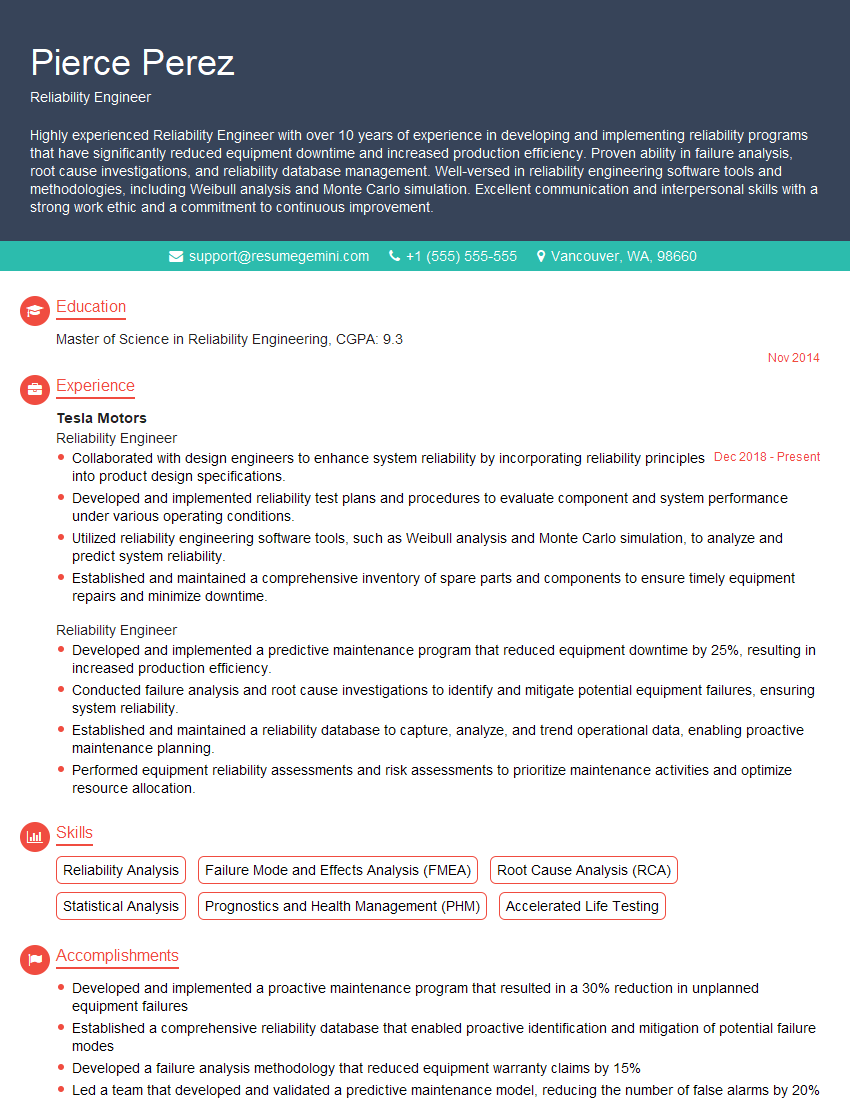
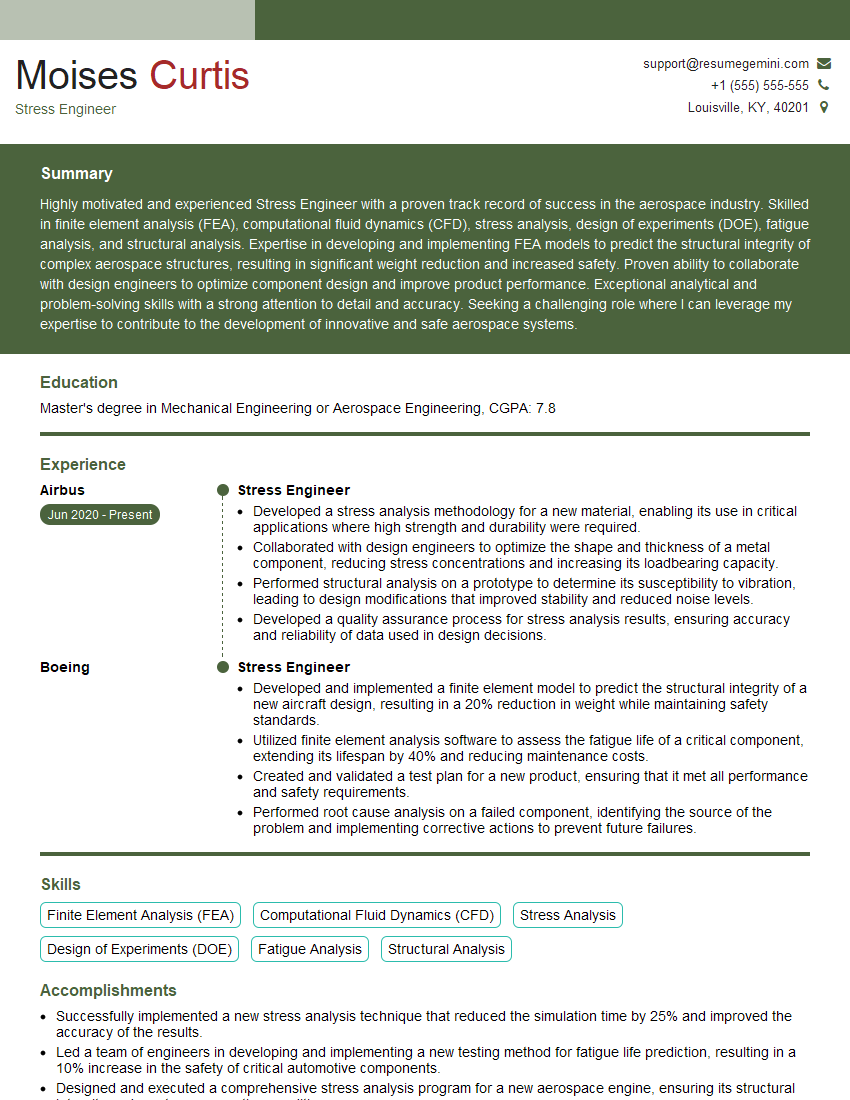
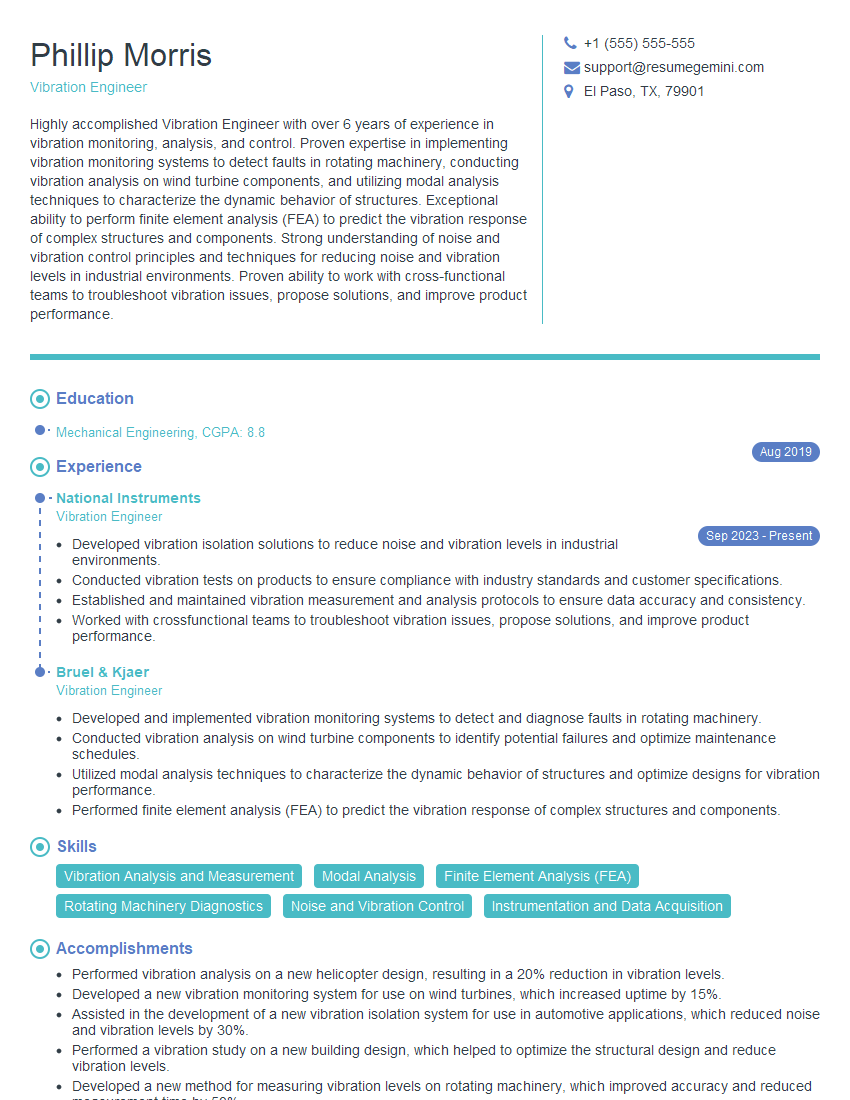
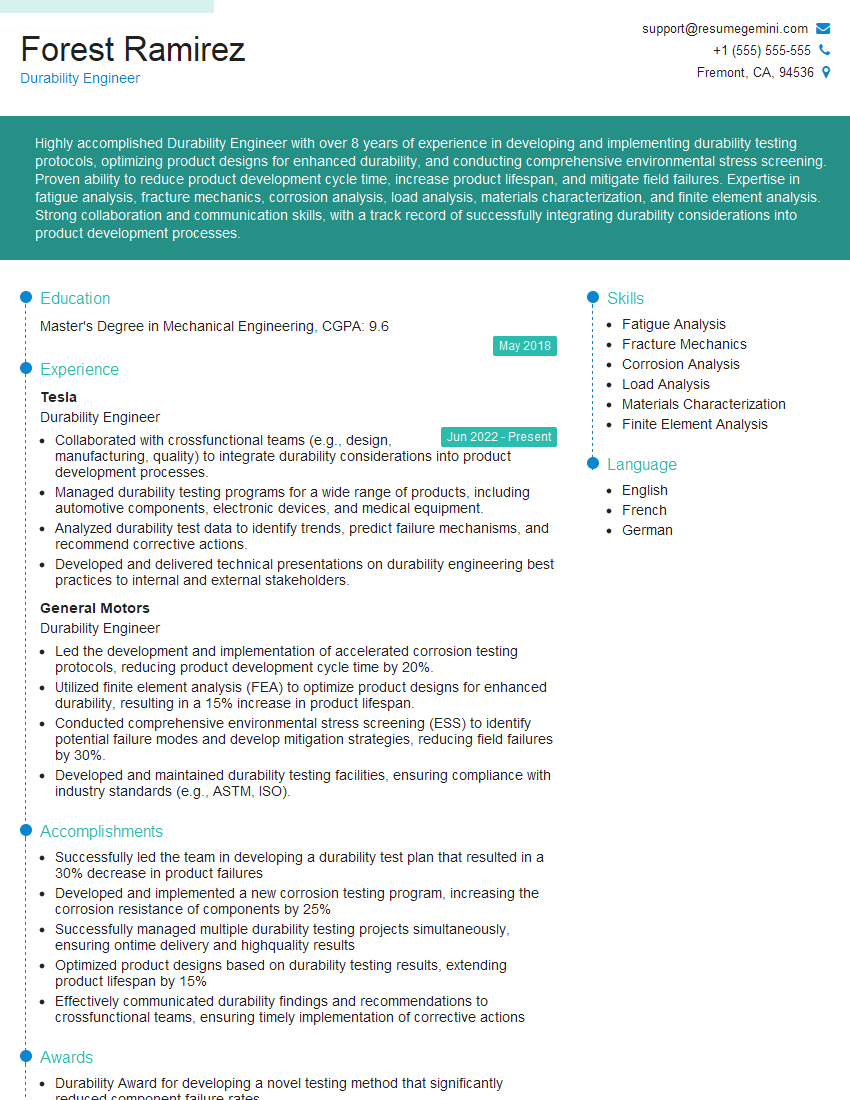
Mastering Durability Analysis is crucial for career advancement in engineering and related fields. A strong understanding of these principles opens doors to exciting opportunities and higher earning potential. To maximize your job prospects, it’s essential to present your skills effectively. Creating an ATS-friendly resume is key to getting your application noticed by recruiters. ResumeGemini is a trusted resource that can help you build a professional and impactful resume tailored to the Durability Analysis field. Examples of resumes tailored to this specialization are available, helping you showcase your expertise and land your dream job. Invest in your future – invest in your resume.
Explore more articles
Users Rating of Our Blogs
Share Your Experience
We value your feedback! Please rate our content and share your thoughts (optional).
What Readers Say About Our Blog
Really detailed insights and content, thank you for writing this detailed article.
IT gave me an insight and words to use and be able to think of examples