Cracking a skill-specific interview, like one for EdTech, requires understanding the nuances of the role. In this blog, we present the questions you’re most likely to encounter, along with insights into how to answer them effectively. Let’s ensure you’re ready to make a strong impression.
Questions Asked in EdTech Interview
Q 1. Explain your understanding of different Learning Management Systems (LMS) and their functionalities.
Learning Management Systems (LMS) are software applications designed to manage and deliver educational courses, training programs, or learning and development initiatives. They vary widely in features and capabilities, but generally encompass core functionalities like content delivery, communication tools, assessment management, and tracking student progress.
- Examples of LMS functionalities:
- Content Management: Uploading and organizing various learning resources like videos, documents, quizzes, and interactive exercises.
- Course Structure: Creating structured learning pathways with modules, lessons, and assignments.
- Communication: Facilitating communication between instructors and students through forums, announcements, and direct messaging.
- Assessment: Delivering quizzes, tests, and assignments, automatically grading where possible, and providing feedback.
- Progress Tracking: Monitoring student activity, completion rates, and overall performance through reports and dashboards.
- Examples of LMS platforms: Moodle, Canvas, Blackboard, Brightspace, and many more, each with its own strengths and weaknesses concerning user interface, features, pricing, and scalability.
Choosing the right LMS depends heavily on the specific needs of the institution or organization, including budget, technical expertise, the number of users, and the desired learning experience.
Q 2. Describe your experience with various educational technologies, including their strengths and limitations.
My experience spans various educational technologies, from traditional LMS platforms like Moodle and Blackboard to modern tools like video conferencing software (Zoom, Google Meet), interactive whiteboards (Miro), collaborative document editing platforms (Google Docs), and gamified learning apps.
- Strengths: Modern tools offer engaging and interactive learning experiences, fostering collaboration and communication among learners. LMS platforms provide structure and organization, making content easily accessible and trackable. Gamified apps can increase motivation and engagement, especially for younger learners.
- Limitations: LMS platforms can sometimes feel clunky or outdated, lacking the dynamism of newer tools. Over-reliance on technology can lead to digital fatigue and exclusion of learners with limited access. Effective integration of diverse tools requires careful planning and teacher training. Gamified elements, while engaging, may not always align with learning objectives.
For example, I’ve successfully integrated Zoom for synchronous sessions alongside a Moodle course for asynchronous learning materials. This blended approach leveraged the strengths of both technologies, addressing the limitations of each. However, careful consideration of accessibility and technical support for diverse learners was crucial for ensuring success.
Q 3. How would you design an effective online course using modern pedagogical approaches?
Designing an effective online course requires a deep understanding of modern pedagogical approaches, focusing on learner-centered design and active learning strategies. I would utilize the ADDIE model (Analysis, Design, Development, Implementation, Evaluation) as a framework.
- Analysis: Thoroughly defining learning objectives, identifying the target audience, and assessing their prior knowledge and needs.
- Design: Creating a clear course structure with logically sequenced modules and learning activities. Incorporating diverse media, including videos, interactive simulations, and real-world case studies to cater to different learning styles.
- Development: Creating and assembling the actual course content, ensuring it’s engaging, accessible, and aligned with learning objectives. This includes creating assessments that accurately measure learning outcomes.
- Implementation: Launching the course, providing ongoing support to learners, and actively monitoring their progress.
- Evaluation: Regularly assessing the course’s effectiveness through feedback, learning analytics, and assessment data. Using this data to iteratively improve the course.
For instance, I would incorporate elements of constructivism by designing activities that encourage learners to actively build their knowledge through collaboration and problem-solving. I would also use spaced repetition techniques to improve knowledge retention. Regular formative assessments would allow for timely feedback and adjustments to instruction.
Q 4. What are the key considerations for creating accessible learning materials for diverse learners?
Creating accessible learning materials is paramount for ensuring equitable access to education for all learners. Key considerations include:
- Alternative Text for Images: Providing detailed descriptions of images for screen reader users.
- Captions and Transcripts for Videos: Ensuring videos are accessible to deaf and hard-of-hearing learners.
- Readable Font Styles and Sizes: Using clear, easy-to-read fonts with sufficient contrast against the background.
- Keyboard Navigation: Designing interfaces that are fully navigable using only a keyboard.
- Color Contrast: Ensuring sufficient contrast between text and background colors to enhance readability for visually impaired learners.
- Structured Content: Using clear headings, subheadings, and bullet points to improve readability and organization.
- Simplified Language: Avoiding jargon and complex sentence structures.
- Multiple Formats: Providing materials in multiple formats (e.g., text, audio, video) to cater to different learning styles and preferences.
For example, providing transcripts for all video lectures allows learners who are deaf or hard of hearing to fully engage with the content. Similarly, using alternative text for images ensures that all learners can understand the visual information being presented.
Q 5. How familiar are you with learning analytics dashboards and interpreting data for instructional improvement?
I am very familiar with learning analytics dashboards and their use in instructional improvement. These dashboards provide valuable insights into student engagement, performance, and learning patterns.
Interpreting this data requires careful consideration of various metrics, including:
- Time on Task: Identifying areas where students spend a lot of time (potential difficulty) or very little time (potential lack of engagement).
- Completion Rates: Tracking the number of students completing assignments and modules.
- Assessment Scores: Analyzing student performance on assessments to identify areas needing improvement.
- Engagement Metrics: Monitoring student participation in discussions, quizzes, and other activities.
By analyzing these metrics, I can identify areas where the course needs improvement, such as clarifying confusing concepts, providing additional support, or adjusting the pacing of the course. For example, if a significant number of students are struggling with a particular module, I would analyze their performance on related assignments and quizzes to understand the specific challenges they are facing and adjust the teaching accordingly.
Q 6. Discuss your experience with developing and implementing blended learning models.
I have extensive experience developing and implementing blended learning models, which combine online and face-to-face instruction. The key to successful blended learning is a thoughtful integration of online and offline activities that leverage the strengths of each approach.
Examples of blended learning models I’ve used include:
- Flipped Classroom: Students learn content online before class, then engage in active learning activities during face-to-face sessions.
- Rotation Model: Students rotate between online and face-to-face learning activities throughout the course.
- Flex Model: Students choose the learning mode that best suits their needs and learning style.
In one project, we implemented a flipped classroom model for a large undergraduate course. Students watched online lectures and completed pre-class assignments before attending face-to-face sessions, which focused on collaborative problem-solving, discussions, and hands-on activities. This model increased student engagement and improved learning outcomes. Successful implementation required careful planning, clear communication, and ongoing support for both students and instructors.
Q 7. How do you ensure the quality and effectiveness of online learning materials?
Ensuring the quality and effectiveness of online learning materials is a continuous process requiring meticulous attention to detail and regular evaluation. My approach involves:
- Content Review and Editing: Having multiple reviewers check for accuracy, clarity, and engagement. This includes subject matter experts and instructional designers.
- Accessibility Checks: Ensuring materials meet accessibility guidelines (e.g., WCAG) to accommodate diverse learners.
- Usability Testing: Testing the materials with a representative sample of learners to identify areas for improvement in terms of navigation, clarity, and engagement.
- Regular Updates and Revisions: Keeping the content current and relevant by regularly reviewing and updating the materials based on learner feedback and new research.
- Alignment with Learning Objectives: Ensuring all learning materials directly support and contribute to achieving the defined learning objectives.
For instance, in developing an online module, I would always include a peer review step where subject matter experts would review the content before a usability test to ensure accuracy and clarity. This iterative approach allows me to refine the materials to meet the highest standards of quality and effectiveness.
Q 8. Describe your approach to addressing technical difficulties during online learning sessions.
My approach to addressing technical difficulties during online learning sessions is proactive, multi-faceted, and user-centric. It begins with robust pre-session checks ensuring all technology (hardware, software, internet connectivity) is functioning optimally. We utilize a tiered support system. First, readily available FAQs and troubleshooting guides are provided to empower learners to resolve common issues independently. Second, a live technical support channel—like a chat function or a dedicated helpline—is available during the session for immediate assistance. Finally, for complex problems, we have a dedicated team ready to remotely troubleshoot or provide alternative solutions, such as providing alternative access materials or rescheduling the session if necessary. For example, if a student experiences consistent microphone issues, we’d first check their device settings and internet connection. If the problem persists, we might offer to switch to a text-based communication method for the duration of the session. This structured approach minimizes disruption and ensures learners remain engaged in the learning process.
Q 9. How would you evaluate the effectiveness of an educational technology intervention?
Evaluating the effectiveness of an educational technology intervention requires a multi-pronged approach, combining quantitative and qualitative data. Quantitative methods include pre- and post-tests to measure knowledge gain, analyzing student engagement metrics (time spent on platform, completion rates, quiz scores), and surveying learners for their satisfaction levels. Qualitative data, however, provides crucial context. This might involve conducting focus groups or individual interviews with students and teachers to gain insights into their experiences, identifying any challenges or unexpected outcomes, and assessing the impact on learning beyond simply test scores. For instance, if we implemented a new gamified learning platform, we wouldn’t only look at the average score improvement but also interview students to understand if the gamification actually increased their motivation and enjoyment of the subject matter. A complete evaluation combines both types of data to give a holistic picture of the intervention’s success.
Q 10. What are some common challenges in implementing new EdTech solutions, and how do you overcome them?
Implementing new EdTech solutions often faces hurdles like teacher training and buy-in, technological infrastructure limitations, and integration challenges with existing systems. Overcoming these requires a phased approach. First, prioritize thorough teacher training, providing adequate time and resources for them to become comfortable with the new tools. This includes hands-on workshops, ongoing support, and opportunities for peer-to-peer learning. Second, address infrastructure needs proactively. This might involve upgrading internet connectivity, providing necessary devices, or ensuring compatibility with the existing learning management system (LMS). Third, dedicate resources to seamless integration. Effective integration often necessitates careful planning and coordination with IT departments, ensuring data migration is smooth and avoiding disruptions to existing workflows. For example, if implementing a new assessment platform, we would ensure that it integrates well with the existing LMS, allowing teachers to easily import student data and manage grades.
Q 11. Explain your experience with different assessment methods in online learning environments.
My experience encompasses a wide range of assessment methods in online learning, moving beyond traditional multiple-choice tests. I’ve utilized formative assessments like quizzes, polls, and discussion forums to gauge student understanding throughout the learning process and provide timely feedback. Summative assessments include more complex projects, essays, presentations (using video conferencing tools), and even simulations, depending on the subject matter and learning objectives. I also employ automated feedback mechanisms for objective questions, allowing for immediate grading and personalized hints. For subjective assessments like essays, I’ve implemented peer review systems and rubrics to ensure fair and consistent grading. Furthermore, I utilize learning analytics to track student progress and identify areas where individual students or the entire cohort might need additional support. The key is to select assessment methods that align with the learning objectives and provide rich insights into student learning. For example, if the goal is to assess critical thinking skills, a simple multiple-choice test wouldn’t suffice; instead, a more open-ended assignment requiring analysis and argumentation would be more appropriate.
Q 12. How familiar are you with different authoring tools for creating eLearning content?
I am proficient in several eLearning authoring tools, including Articulate Storyline, Adobe Captivate, and Lectora. My experience extends to using these tools to create various eLearning content formats, from interactive simulations and branched scenarios to microlearning modules and gamified lessons. I understand the importance of creating visually appealing and engaging content, and my skillset enables me to incorporate different media types, such as videos, audio, and interactive elements, to cater to diverse learning styles. For example, I’ve used Articulate Storyline to develop a branching scenario simulation for a medical training program, allowing learners to practice decision-making in a safe, virtual environment. The choice of authoring tool depends on the specific project requirements and the desired level of interactivity and complexity.
Q 13. How do you stay current with the latest trends and advancements in educational technology?
Staying current in the dynamic field of EdTech requires a multi-pronged strategy. I actively participate in online communities and professional development workshops focused on educational technology. I subscribe to relevant journals, newsletters, and podcasts, and regularly attend EdTech conferences and webinars. I also follow influential thought leaders in the field through social media and their publications. This keeps me informed about new technologies, pedagogical approaches, and research findings. Further, I continuously evaluate and explore new tools and platforms, experimenting with them in my work whenever appropriate. Staying informed is not just about knowing the latest tools, but also about understanding the evolving research on how people learn and how technology can best support that learning process.
Q 14. Describe your experience with project management methodologies in the context of EdTech projects.
My experience with project management methodologies in EdTech projects centers around Agile principles. The iterative and collaborative nature of Agile methodologies perfectly suits the evolving needs and feedback-driven nature of EdTech development. I’ve successfully employed Scrum, utilizing daily stand-up meetings, sprint planning sessions, and sprint retrospectives to manage timelines, allocate resources, and track progress. This methodology allows for flexibility and adaptation, particularly important when dealing with the often unpredictable challenges of integrating new technology into existing educational systems. For example, in a recent project involving the development of a new online learning platform, we used Scrum to break down the project into manageable sprints. Each sprint focused on delivering a specific feature, allowing for continuous testing and refinement based on user feedback. This ensured that the final product met the needs of both educators and learners effectively.
Q 15. How do you collaborate effectively with teachers and other stakeholders during the implementation of EdTech solutions?
Effective collaboration with teachers and stakeholders is crucial for successful EdTech implementation. It’s not just about dropping new technology into a classroom; it’s about integrating it seamlessly into existing teaching practices and addressing the needs of all users. My approach involves a multi-stage process:
- Needs Assessment: I begin by conducting thorough needs assessments, involving teachers, administrators, students, and even parents, to understand their specific challenges, learning styles, and technological proficiency. This helps tailor the technology to their unique context.
- Training and Professional Development: Comprehensive training is vital. I design and deliver customized professional development sessions for teachers, focusing on practical application and addressing their individual concerns. This goes beyond simple tutorials and incorporates strategies for integrating the EdTech tools into lesson plans and assessment methods.
- Ongoing Support and Feedback: Implementation isn’t a one-time event. I provide ongoing technical support and actively solicit feedback from teachers and students. Regular check-ins and feedback loops allow for adjustments and ensure that the technology is meeting its intended purpose. This feedback is crucial for iterative improvement.
- Collaboration Tools: Leveraging collaboration platforms like shared documents, online forums, or project management software facilitates seamless communication and knowledge sharing among stakeholders, allowing for efficient problem-solving and information dissemination.
For instance, in a recent project implementing a new learning management system (LMS), I conducted workshops tailored to different teacher experience levels, addressing their specific concerns regarding grading, communication, and resource management. This proactive approach resulted in high teacher adoption rates and positive student outcomes.
Career Expert Tips:
- Ace those interviews! Prepare effectively by reviewing the Top 50 Most Common Interview Questions on ResumeGemini.
- Navigate your job search with confidence! Explore a wide range of Career Tips on ResumeGemini. Learn about common challenges and recommendations to overcome them.
- Craft the perfect resume! Master the Art of Resume Writing with ResumeGemini’s guide. Showcase your unique qualifications and achievements effectively.
- Don’t miss out on holiday savings! Build your dream resume with ResumeGemini’s ATS optimized templates.
Q 16. Discuss your experience with gamification techniques in educational settings.
Gamification, the application of game-design elements in non-game contexts, can significantly enhance student engagement and motivation. I’ve successfully incorporated gamification techniques in various projects, focusing on elements like:
- Points and Badges: Awarding points for completing tasks and awarding badges for achieving milestones provides immediate positive reinforcement and a sense of accomplishment.
- Leaderboards and Competition: Healthy competition can motivate students, but it’s crucial to implement them carefully to avoid fostering negativity. Focus on friendly competition and celebrate individual progress alongside group achievements.
- Storytelling and Narrative: Integrating a compelling narrative can make learning more immersive and engaging. This helps students connect with the material on a deeper level.
- Challenges and Puzzles: Incorporating challenges and puzzles adds an element of fun and encourages problem-solving skills. These can be integrated into quizzes, assignments, or even simulations.
In one project, we gamified a history curriculum by creating a virtual quest where students ‘traveled’ through different historical periods, earning points and badges for completing research tasks and solving historical puzzles. This resulted in significantly improved student engagement and understanding of the subject matter.
Q 17. How would you design a personalized learning experience using technology?
Personalized learning experiences leverage technology to cater to individual student needs and learning styles. Effective design involves several key components:
- Adaptive Learning Platforms: These platforms adjust the difficulty and content based on student performance, providing customized learning paths. They often use AI algorithms to analyze student data and adapt the learning experience in real-time.
- Learning Analytics and Data-Driven Insights: Analyzing student data, such as quiz scores, time spent on tasks, and learning patterns, allows for identifying areas of strength and weakness. This informs the creation of tailored learning plans.
- Differentiated Instruction: Technology enables teachers to deliver differentiated instruction efficiently, offering varied learning materials and activities to accommodate different learning styles and paces.
- Student Choice and Agency: Providing students with choices in their learning materials, activities, and assessment methods increases their engagement and motivation. This allows them to tailor their learning journey to their individual preferences.
For example, a personalized learning platform might adjust the complexity of math problems based on a student’s performance, providing more challenging problems for proficient learners and simpler ones for those who need more support. This ensures that all students are appropriately challenged and can progress at their own pace.
Q 18. What are your thoughts on the ethical implications of using AI in education?
The ethical implications of using AI in education are significant and require careful consideration. Key concerns include:
- Bias and Fairness: AI algorithms are trained on data, and if that data reflects existing societal biases, the AI system may perpetuate those biases in its recommendations or assessments. This can lead to unfair or discriminatory outcomes for certain student populations.
- Privacy and Data Security: AI systems often collect and analyze vast amounts of student data, raising concerns about privacy and data security. Robust measures are necessary to protect student information and ensure compliance with data protection regulations.
- Transparency and Explainability: It’s crucial to understand how AI systems make decisions and to ensure that their recommendations are transparent and explainable to both teachers and students. This builds trust and allows for scrutiny of the AI’s processes.
- Teacher and Human Interaction: The over-reliance on AI could diminish the role of human teachers and the importance of human interaction in the learning process. AI should be a tool to enhance, not replace, the teacher’s role.
Addressing these concerns requires careful planning, responsible data handling practices, and ongoing evaluation of AI systems to ensure fairness, transparency, and ethical implementation.
Q 19. Explain your understanding of different learning theories and their application to EdTech.
My understanding of learning theories is foundational to my approach to EdTech. Several prominent theories inform my work:
- Constructivism: This theory emphasizes active learning and knowledge construction. EdTech tools like simulations, interactive exercises, and collaborative projects support constructivist learning by encouraging students to actively engage with the material and build their own understanding.
- Cognitivism: This focuses on mental processes involved in learning. EdTech tools can aid in information processing, memory consolidation, and problem-solving by providing structured learning paths, feedback mechanisms, and opportunities for practice and retrieval.
- Behaviorism: This theory highlights the role of reinforcement and rewards in learning. Gamification techniques, points systems, and immediate feedback mechanisms in EdTech align with behaviorist principles to motivate students.
- Connectivism: This emphasizes learning in networks and the importance of connections and collaboration. EdTech facilitates connectivist learning through online communities, collaborative platforms, and social learning tools.
By applying these theories, I strive to create engaging and effective EdTech solutions that cater to diverse learning styles and preferences.
Q 20. Describe your experience with using data to inform instructional decisions.
Data-driven decision-making is central to effective EdTech implementation. I regularly utilize learning analytics to inform instructional decisions. This process involves:
- Data Collection: Gathering data from various sources such as LMS platforms, assessment tools, and student engagement metrics.
- Data Analysis: Utilizing statistical methods and data visualization techniques to identify trends, patterns, and areas for improvement.
- Actionable Insights: Translating data insights into concrete actions, such as modifying lesson plans, adapting teaching strategies, or providing targeted interventions for struggling students.
- Iterative Improvement: Using the data to continuously evaluate the effectiveness of EdTech interventions and make adjustments as needed.
For instance, by analyzing student performance data on a particular module, I might identify areas where students are struggling. This might lead to the development of additional resources, tutorials, or alternative teaching approaches to improve student understanding.
Q 21. How do you ensure that EdTech solutions are aligned with learning objectives?
Aligning EdTech solutions with learning objectives is paramount. This requires a thoughtful and systematic approach:
- Clear Learning Objectives: Begin with clearly defined learning objectives that are measurable, achievable, relevant, and time-bound (SMART). These objectives should guide the selection and implementation of EdTech tools.
- Technology Selection: Choose EdTech tools that directly support the achievement of learning objectives. Consider the specific features and functionalities of different tools and select those that best address the needs of the students and the curriculum.
- Curriculum Integration: Seamlessly integrate the EdTech tools into the curriculum, ensuring that they complement existing teaching methods and enhance the learning experience, not disrupt it.
- Assessment and Evaluation: Use EdTech tools to assess student learning and evaluate the effectiveness of the technology in achieving learning objectives. This includes utilizing formative and summative assessments, providing feedback, and making data-driven adjustments.
For example, if the learning objective is for students to improve their problem-solving skills, I would select EdTech tools that provide interactive simulations, problem-solving exercises, or collaborative projects that directly engage students in critical thinking and problem-solving processes.
Q 22. What are some key considerations for selecting appropriate EdTech tools for a specific learning context?
Selecting the right EdTech tool hinges on understanding your specific learning context. This means considering the learners’ needs, the learning objectives, the available resources, and the overall pedagogical approach. It’s not a one-size-fits-all solution.
- Learner Needs: Are your students primarily visual, auditory, or kinesthetic learners? What are their technological skills and access to devices? For example, a highly interactive, gamified platform might be unsuitable for learners with limited internet access or technological proficiency.
- Learning Objectives: What specific skills or knowledge should students gain? Different tools cater to different learning outcomes. A vocabulary-building app is useless if your objective is to improve critical thinking skills.
- Resources: Consider budget, technical support capabilities, and teacher training requirements. A sophisticated LMS (Learning Management System) might be too expensive or complex for a small school.
- Pedagogical Approach: Does your teaching philosophy favor collaborative learning, project-based learning, or direct instruction? The EdTech tool should support your chosen approach. A tool emphasizing individual practice might clash with a project-based learning environment.
For instance, if I’m designing a course on coding for beginners, I might choose a platform with interactive coding exercises, built-in tutorials, and a collaborative coding space to facilitate peer learning, unlike a simple lecture-based tool.
Q 23. How do you handle resistance to change among educators when implementing new EdTech solutions?
Resistance to change is a common hurdle in EdTech implementation. It’s crucial to address this through proactive communication, collaboration, and professional development. The key is to frame the new technology not as a replacement for teachers, but as a powerful tool to enhance their teaching.
- Communication: Explain clearly the benefits of the new tool, addressing specific concerns educators might have about its usability or impact on their workload. Openly discuss potential challenges and how they will be addressed.
- Collaboration: Involve educators in the selection and implementation process. Gather their feedback, and consider their suggestions. Pilot programs and feedback loops are vital for addressing initial concerns.
- Professional Development: Provide ample training and ongoing support. This includes technical training on using the tool, as well as pedagogical training on how to integrate it effectively into the curriculum. Mentorship and peer support can also be helpful.
- Showcasing Success: Share success stories and highlight how the tool has improved student outcomes in other settings. This can build confidence and excitement.
In one project, I addressed teacher resistance by organizing workshops where educators could experiment with the new LMS, share their experiences, and receive personalized support. This collaborative approach fostered a sense of ownership and significantly reduced resistance.
Q 24. Describe your approach to creating engaging and motivating online learning experiences.
Creating engaging online learning experiences involves employing various strategies to capture and maintain learners’ attention. It’s about moving beyond passive consumption of content and fostering active participation.
- Interactive Content: Incorporate interactive elements like quizzes, polls, simulations, and games. Avoid long blocks of text; break information into smaller, digestible chunks.
- Collaboration and Communication: Facilitate peer-to-peer interaction through discussion forums, group projects, and collaborative tools. This promotes a sense of community and enhances learning through shared experiences.
- Personalized Learning: Adapt the learning experience to individual needs and preferences using adaptive learning platforms or personalized learning pathways. This caters to diverse learning styles and paces.
- Gamification: Integrate game mechanics like points, badges, leaderboards, and challenges to increase motivation and engagement. This taps into intrinsic motivation and creates a sense of accomplishment.
- Real-World Relevance: Connect learning to real-world applications through case studies, simulations, and projects that address relevant issues.
For example, I once designed an online history course that used interactive timelines, virtual museum tours, and collaborative research projects to engage students and make history come alive. The use of gamification elements, such as earning points for completing assignments, further boosted engagement.
Q 25. How do you assess the user experience (UX) of an educational technology tool?
Assessing the UX of an EdTech tool requires a multifaceted approach that combines quantitative and qualitative data. The goal is to understand how effectively the tool supports the learning process and whether it’s user-friendly and accessible.
- Usability Testing: Observe users interacting with the tool to identify areas of confusion or frustration. Conduct interviews to gather feedback on their experience.
- Data Analytics: Analyze usage data to understand how users interact with the tool, which features are used most frequently, and where users drop off. Tools like Google Analytics can be valuable here.
- Surveys and Feedback Forms: Collect user feedback through surveys and feedback forms to gauge their satisfaction with the tool’s design, functionality, and overall effectiveness.
- Accessibility Audits: Ensure the tool adheres to accessibility standards (WCAG) to ensure usability for learners with disabilities. This includes checking for features such as screen reader compatibility, keyboard navigation, and sufficient color contrast.
For example, in a recent project, we conducted usability testing with a group of students to evaluate the interface of a new learning platform. The feedback from the usability testing informed significant design improvements, making the platform more intuitive and user-friendly.
Q 26. Explain your understanding of the importance of accessibility in EdTech.
Accessibility in EdTech is paramount because it ensures that all learners, regardless of their abilities or disabilities, have equal access to educational resources and opportunities. It’s about ensuring inclusivity and equity in education.
- Universal Design for Learning (UDL): This framework emphasizes creating flexible learning materials and environments that cater to diverse learning needs. It’s about providing multiple means of representation, action, and engagement.
- WCAG Compliance: Adhering to Web Content Accessibility Guidelines (WCAG) is crucial for creating accessible online learning materials. This includes providing alternative text for images, using clear and concise language, and ensuring sufficient color contrast.
- Assistive Technology Compatibility: The EdTech tool should be compatible with assistive technologies such as screen readers, text-to-speech software, and alternative input devices.
- Captioning and Transcription: Provide captions for videos and transcriptions for audio content to support learners with hearing impairments.
Ignoring accessibility not only excludes learners with disabilities, but it also limits the potential reach and impact of the EdTech tool. An accessible tool benefits everyone, including learners with different learning styles and preferences.
Q 27. Describe your experience with different types of educational simulations and their application in learning.
Educational simulations offer powerful ways to engage learners in active learning experiences. They allow students to explore complex concepts in a safe, risk-free environment.
- Game-based Simulations: These immerse learners in interactive scenarios, encouraging problem-solving and critical thinking. Examples include simulations of running a business, managing a city, or navigating a historical event.
- Virtual Reality (VR) and Augmented Reality (AR) Simulations: These offer highly immersive experiences that can enhance engagement and understanding. VR can simulate real-world environments or historical events, while AR overlays digital information onto the real world.
- Lab Simulations: These allow students to conduct experiments and explore scientific concepts without the need for expensive equipment or potentially hazardous materials. This is particularly useful in science education.
I have experience using simulations in various contexts. In one project, we used a business simulation to teach students about financial management. The students worked in teams to run virtual businesses, making decisions about pricing, marketing, and production. This hands-on experience significantly enhanced their understanding of the concepts.
Q 28. How familiar are you with the implications of data privacy and security in EdTech?
Data privacy and security are crucial considerations in EdTech. The collection and use of student data raise significant ethical and legal concerns. Compliance with relevant regulations such as FERPA (in the US) and GDPR (in Europe) is essential.
- Data Minimization: Collect only the data that is necessary for the intended purpose. Avoid collecting sensitive personal information unless absolutely necessary.
- Data Security: Implement robust security measures to protect student data from unauthorized access, use, or disclosure. This includes encryption, access controls, and regular security audits.
- Transparency and Consent: Be transparent about how student data is collected, used, and protected. Obtain informed consent from parents or guardians before collecting any data from students.
- Data Anonymization and Pseudonymization: When possible, anonymize or pseudonymize student data to protect their identities.
- Compliance with Regulations: Stay up-to-date on relevant data privacy and security regulations and ensure that your EdTech practices comply with them.
Ignoring data privacy and security can have serious consequences, including legal penalties, reputational damage, and erosion of trust. A robust data privacy and security framework is essential for responsible and ethical use of EdTech.
Key Topics to Learn for Your EdTech Interview
- Learning Technologies & Platforms: Understand the landscape of Learning Management Systems (LMS), e-learning platforms, and various educational technologies. Consider practical applications like designing engaging online courses or troubleshooting technical issues within an LMS.
- Instructional Design & Pedagogy: Familiarize yourself with different instructional design models (ADDIE, SAM, etc.) and their application in the EdTech context. Be prepared to discuss how technology can enhance learning outcomes and address diverse learning styles.
- Educational Data & Analytics: Grasp the importance of data-driven decision making in EdTech. Explore topics like learning analytics, data visualization, and how data informs the development and improvement of educational technologies.
- Accessibility & Inclusivity: Understand the principles of Universal Design for Learning (UDL) and how to create inclusive educational experiences using technology. Be prepared to discuss accessibility features and considerations for diverse learners.
- Emerging Technologies in EdTech: Explore the potential of AI, VR/AR, and personalized learning technologies. Consider how these technologies are transforming education and their practical applications in various educational settings.
- Project Management & Agile Methodologies: EdTech projects often involve collaborative teamwork and iterative development. Understanding agile principles and project management best practices is crucial.
Next Steps
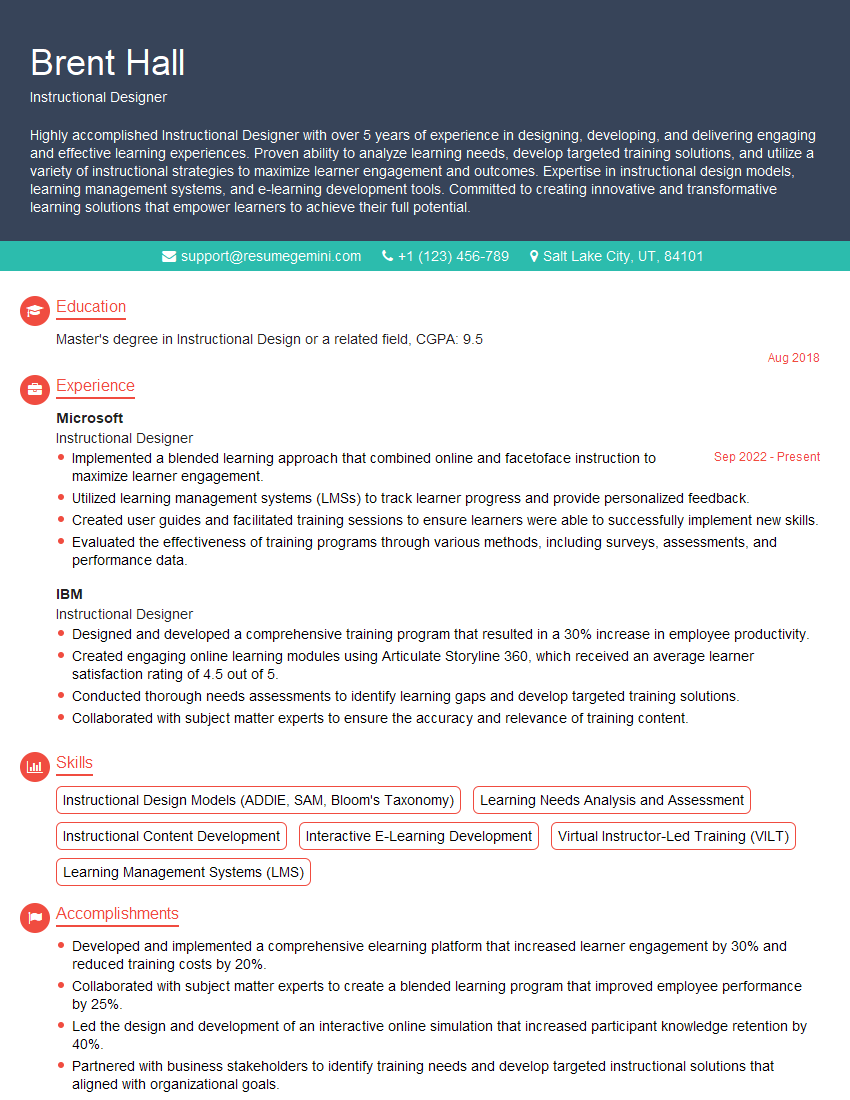
Mastering EdTech positions you at the forefront of a rapidly evolving and impactful field. The demand for skilled professionals in this sector is high, opening doors to exciting and rewarding career opportunities. To maximize your job prospects, crafting a compelling and ATS-friendly resume is essential. ResumeGemini is a trusted resource that can help you build a professional resume that truly showcases your skills and experience. We provide examples of resumes tailored to the EdTech industry to give you a head start. Invest in your future – build your best resume with ResumeGemini today!



Explore more articles
Users Rating of Our Blogs
Share Your Experience
We value your feedback! Please rate our content and share your thoughts (optional).
What Readers Say About Our Blog
Really detailed insights and content, thank you for writing this detailed article.
IT gave me an insight and words to use and be able to think of examples