Cracking a skill-specific interview, like one for Electrical Panel Assembly, requires understanding the nuances of the role. In this blog, we present the questions you’re most likely to encounter, along with insights into how to answer them effectively. Let’s ensure you’re ready to make a strong impression.
Questions Asked in Electrical Panel Assembly Interview
Q 1. Describe your experience with different types of electrical panels.
My experience encompasses a wide range of electrical panels, from small residential load centers to large industrial switchboards. I’ve worked extensively with various manufacturers’ products, including Square D, Eaton, Siemens, and GE. This includes experience with different panelboard types like:
- Molded-case circuit breakers (MCCBs): These are self-contained units commonly used in residential and smaller commercial applications. I’m proficient in installing and troubleshooting both single-pole and multi-pole MCCBs.
- Air circuit breakers (ACBs): I’ve worked with ACB panels in larger industrial settings, understanding their intricacies, including their higher amperage ratings and more complex configurations. These often require specialized knowledge of bussing and coordination schemes.
- Switchboards: My experience includes assembling and maintaining high-voltage switchboards used in industrial facilities and power distribution substations. This involves understanding complex protection and metering systems.
- Metering panels: I’m familiar with assembling and wiring panels that include energy metering equipment, ensuring accurate readings and compliance with local utility requirements.
This diverse experience allows me to adapt to various panel types and project requirements, ensuring the safe and efficient installation of electrical systems.
Q 2. Explain the process of assembling a typical electrical panel.
Assembling an electrical panel is a precise and regulated process. It begins with careful planning based on the electrical schematic and load calculations. Here’s a typical process:
- Preparation: This involves gathering all necessary materials (panels, breakers, wires, conduits, etc.) and ensuring the workspace is clean, organized, and well-lit. Thorough inspection of all components for damage is critical.
- Mounting and Grounding: The panel is securely mounted to its designated location, and the grounding system (ground rod and bonding wires) is installed. This forms the critical safety foundation of the entire system.
- Main Breaker Installation: The main breaker, which is the primary disconnect, is installed and secured within the panel. This is crucial, as it controls all power flowing to the system.
- Wiring: Following the electrical schematic, wires are run through the panel’s knockouts to the designated breaker locations. Each wire is carefully stripped and connected to the correct terminal, ensuring tight connections and avoiding loose wires. I always use the correct wire size for the intended amperage.
- Breaker Installation: Circuit breakers are installed in their designated positions within the panel. They must match the panel’s voltage and amperage requirements. This is often where experience with various breaker types becomes crucial.
- Testing and Inspection: Before closing the panel, the entire wiring is carefully inspected for any errors, loose connections, or damage. Testing using a multimeter to confirm proper voltage and continuity is essential. A visual inspection to ensure wiring is correctly routed and secured is also critical.
- Panel Enclosure: Finally, the panel enclosure is secured, and the service entrance cable is connected. Any required labeling is added.
Throughout the entire process, adherence to the National Electrical Code (NEC) and other relevant safety regulations is paramount.
Q 3. What safety precautions do you take when assembling electrical panels?
Safety is my top priority. When working with electrical panels, I always follow these safety precautions:
- Lockout/Tagout (LOTO): Before beginning any work, the power to the panel is completely de-energized, and LOTO procedures are strictly followed. This prevents accidental energization and ensures personal safety.
- Personal Protective Equipment (PPE): I always wear appropriate PPE, including safety glasses, insulated gloves, and safety shoes. The right PPE minimizes risks of electrical shock, burns, or injury.
- Double-Check De-energization: Even with LOTO procedures, I always use a non-contact voltage tester to double-check that the power is off before touching any wiring or components.
- Proper Tools: I use the correct insulated tools specifically designed for electrical work, helping prevent accidental shorts or shocks.
- Awareness of Surroundings: I maintain awareness of my surroundings to avoid potential hazards, such as falling objects or tripping.
- Working Alone Policy: I never work alone on potentially hazardous tasks like assembling electrical panels. A second person is always present for safety and assistance if needed.
My experience includes working on various panel types and projects where safety protocols are paramount. I firmly believe that safety is not just a protocol but an attitude that must be integrated throughout the entire process.
Q 4. How do you ensure proper grounding and bonding in an electrical panel?
Proper grounding and bonding are essential for safety and the efficient operation of an electrical panel. Grounding protects against electrical shock by providing a low-resistance path for fault currents to flow to the earth, while bonding equalizes electrical potentials to prevent voltage differences that could cause damage or hazards.
Here’s how I ensure proper grounding and bonding:
- Ground Rod Installation: A properly sized ground rod is driven into the earth and connected to the panel’s grounding bus bar using a sufficiently sized grounding conductor. This is the earth connection point.
- Grounding Conductor Connection: The grounding conductor from the service entrance cable is connected to the panel’s grounding bus bar. This provides continuity to the grounding system.
- Equipment Bonding: Metal enclosures of equipment connected to the panel are bonded together to ensure that they are at the same electrical potential. This minimizes the risk of voltage differences creating hazards.
- Continuity Verification: After installation, I use a continuity tester to verify that a continuous, low-resistance path exists from the grounding bus bar to the ground rod.
Using appropriate sized conductors and proper techniques for these connections is critical. Any compromise could result in unsafe conditions. I rigorously check ground continuity testing to ensure the safety of the electrical system.
Q 5. What are the common tools and equipment used in electrical panel assembly?
The tools and equipment required for electrical panel assembly vary depending on the project’s scale and complexity. However, some common tools include:
- Voltage Testers: Non-contact voltage testers and multimeters are crucial for ensuring that the power is off and for testing continuity and voltage after installation.
- Wire Strippers/Cutters: These are essential for preparing wire ends for connections. Proper stripping is vital to ensure good contact and prevent shorts.
- Crimping Tools: Used for securing wire connectors and lugs to terminals, ensuring strong and reliable connections.
- Screwdrivers: Various sizes of insulated screwdrivers are needed for working with different panel components and securing connections. Insulated handles are crucial for safety.
- Fish Tape/Cable Pullers: Used for pulling wires through conduits and into the panel.
- Drill/Driver: For installing panels in some cases and potentially other tasks dependent on the situation.
- Level: Ensures proper installation of the panel for aesthetic and functional reasons.
- Measuring Tape/Ruler: For accurate measurements in ensuring correct positioning of components within the panel.
- Punch Down Tool: For terminating wires to terminal blocks (commonly used in certain panels).
Beyond these handheld tools, we might also use specialized equipment such as cable pullers, and lifting devices for very large or heavy panels.
Q 6. How do you interpret electrical schematics and wiring diagrams?
Interpreting electrical schematics and wiring diagrams is fundamental to my work. These diagrams act as blueprints, guiding the assembly process and showing how different components and circuits interconnect.
My approach involves:
- Understanding Symbols: I have a thorough understanding of standard electrical symbols used in schematics and diagrams. This allows me to quickly identify components like breakers, switches, outlets, motors, and other devices.
- Tracing Circuits: I can systematically trace the flow of electricity through the circuit, following the wires from the power source to the loads (devices using electricity). This ensures that components are connected as specified.
- Identifying Load Requirements: I carefully assess the load requirements of each circuit, determining the appropriate size of wires and breakers needed for each circuit. This ensures safety and prevents overloads.
- Identifying Panel Components: I cross-reference the schematic with the physical components of the panel, ensuring that the correct breakers, bus bars, and other elements are used.
- Checking for Errors: After tracing the entire system, I carefully review for errors or inconsistencies in the wiring. This is a critical step to prevent issues.
My experience allows me to read and understand various levels of complexity in schematics, ensuring accuracy and safety in the assembly process. Often, I find myself interpreting very specific diagrams which vary between manufacturers and electrical installations.
Q 7. What is your experience with different types of wire and cable?
My experience with different types of wire and cable is extensive. I understand the importance of selecting the correct wire type for each application, considering factors such as voltage, amperage, temperature ratings, and environmental conditions.
Here are some wire types I’ve worked with:
- Copper Conductors: The most common type, offering excellent conductivity. I understand the different gauges (AWG) and their corresponding current carrying capacities.
- Aluminum Conductors: Used in some higher voltage applications due to cost-effectiveness. I’m aware of the special considerations needed for aluminum wiring, such as the use of appropriate connectors and termination methods to prevent corrosion and ensure safe connections.
- Insulated Wires: I’m familiar with different insulation types, such as thermoplastic (THHN), cross-linked polyethylene (XLPE), and others. Each insulation type is suitable for different temperature ratings and environmental conditions.
- Armored Cables: Used in locations requiring protection against physical damage, often found in commercial and industrial settings. I know how to work with metal and plastic conduit safely and correctly.
- Grounding Wires: I have extensive experience working with grounding conductors, both bare and insulated, for panel grounding systems. I ensure correct grounding for safety and operational efficiency.
Proper wire selection is critical to ensure the safety and longevity of the electrical system. Choosing the wrong wire can lead to overheating, fire hazards, or system failures.
Q 8. How do you identify and troubleshoot common wiring errors?
Identifying and troubleshooting wiring errors in electrical panel assembly requires a systematic approach. It starts with a thorough understanding of the panel’s schematic diagram. This diagram acts as a roadmap, detailing the intended path of each wire and its connection points. Discrepancies between the schematic and the actual wiring are the primary source of errors.
Common errors include:
- Incorrect wire routing: A wire may be connected to the wrong terminal or routed through the wrong path, leading to short circuits or incorrect operation of circuits.
- Loose connections: Poorly tightened wire nuts or terminal screws can result in overheating, intermittent operation, and potential fire hazards.
- Incorrect wire sizing: Using wires with inadequate ampacity (current-carrying capacity) for the intended load can lead to overheating and potentially dangerous situations. For example, using a 14 AWG wire for a 20-amp circuit is unsafe.
- Phase imbalances (in three-phase systems): Unequal load distribution across phases in a three-phase system can lead to inefficient operation and overheating of components.
Troubleshooting involves visually inspecting each wire and connection, using a multimeter to verify voltage and continuity, and comparing the actual wiring to the schematic. I use a methodical process, starting with the main power supply and tracing each branch circuit to ensure accurate connections. Thermal imaging can also be useful in detecting overheating, indicating loose connections or overloaded circuits.
For example, if a circuit breaker keeps tripping, I would first visually inspect the connected wires for signs of damage or overheating. Then, I’d use a multimeter to check for shorts or other faults within the circuit. Finally, I’d carefully compare the wiring to the schematic to identify any deviations from the design.
Q 9. What is your experience with various types of circuit breakers and fuses?
My experience encompasses a wide range of circuit breakers and fuses, including molded-case circuit breakers (MCCBs), miniature circuit breakers (MCBs), thermal magnetic circuit breakers, and various types of fuses such as cartridge fuses, plug fuses, and HRC (High Rupturing Capacity) fuses. I’m familiar with their respective applications and ratings.
MCCBs are commonly used in larger industrial applications for their high breaking capacity and ability to handle significant fault currents. MCBs are more prevalent in residential and smaller commercial settings due to their compact size and ease of replacement. Understanding the differences in trip characteristics – thermal, magnetic, or a combination – is crucial for choosing the appropriate protection device for a given circuit.
Fuses, while simpler in design, offer another layer of protection. Their selection involves carefully matching the fuse rating to the circuit’s current requirements. A crucial consideration is the fuse’s interrupting capacity, ensuring it can safely handle fault currents without causing damage. I always make sure to use fuses and circuit breakers with the correct ratings and interrupting capacity to ensure appropriate protection for the system.
For instance, in a situation where a circuit experiences frequent tripping, I would analyze the load characteristics and potentially upgrade to a circuit breaker with a higher amperage rating, provided it’s within the wire’s ampacity limits, or investigate the load for potential overcurrents.
Q 10. How do you ensure the proper termination of wires and connectors?
Proper termination of wires and connectors is critical for safety and reliability. It’s about ensuring a secure and consistent electrical connection that minimizes resistance and prevents overheating. I follow a strict protocol for every termination, depending on the type of connector and wire.
Key aspects include:
- Stripping wires to the correct length: Too much insulation can lead to poor contact, while too little can expose the conductor, increasing the risk of shorts. I always use the correct wire strippers for the wire gauge to ensure precise and clean stripping.
- Crimping connectors: When using crimped connectors, I ensure a proper crimp using the right crimping tool for the specific connector type. A poorly crimped connection is a major source of failure and can lead to overheating and fire hazards.
- Using the correct terminal screws: Terminal screws must be appropriately tightened to ensure a secure connection. Over-tightening can damage the wire or terminal, while under-tightening can lead to loose connections. I always use a torque wrench to ensure consistent and appropriate tightness.
- Checking for strand breakage: When working with stranded wire, I carefully inspect the strands to ensure none are broken or frayed, preventing poor contact.
For example, when terminating wires to a terminal block, I always visually inspect the connection for proper seating and tightness. I often use a small tool like a wire ferrule to ensure a better connection for stranded wire and prevent strand breakage.
Q 11. Explain your experience with testing and commissioning electrical panels.
Testing and commissioning electrical panels is a critical phase that ensures the panel functions correctly and meets safety standards. This involves a series of tests, from initial continuity checks to functional verification of the protection devices.
My testing process typically includes:
- Visual inspection: A thorough visual check of all wiring, connections, and components to identify any physical defects or inconsistencies before energizing the panel.
- Continuity testing: Using a multimeter, I check the continuity of all circuits to verify that there are no unintended breaks in the conductors.
- Insulation resistance testing: This involves measuring the insulation resistance between conductors and ground to ensure sufficient insulation integrity. This test helps identify potential insulation faults which might lead to short circuits.
- Grounding tests: Verifying that the panel’s grounding system is properly installed and provides effective fault current paths.
- Circuit breaker and fuse testing: Checking the operation of circuit breakers and fuses by simulating tripping conditions to ensure they operate within their specified ratings.
- Functional testing: Activating different circuits to verify that they perform as intended and that there are no issues with the panel’s operation.
For example, after the panel is assembled, I perform a continuity test on each circuit from the main breaker to the end devices. Then, I simulate a fault condition on one of the circuits to verify the corresponding circuit breaker trips correctly and safely interrupts the current flow.
Detailed documentation is essential, recording the results of all tests and any corrective actions taken.
Q 12. What are the relevant safety standards and codes you follow?
Safety is paramount in electrical panel assembly. I adhere strictly to relevant safety standards and codes, primarily the National Electrical Code (NEC) in the US or equivalent international standards. These codes provide comprehensive guidelines for the safe design, installation, and operation of electrical systems. Specific adherence to relevant articles of the NEC (or equivalent) is strictly followed throughout the assembly process. For instance, wiring methods, grounding requirements, and overcurrent protection devices are all guided by these standards.
These codes cover various aspects, including:
- Wiring methods: Proper techniques for routing, securing, and protecting wires to prevent damage and short circuits.
- Grounding requirements: Ensuring proper grounding of the panel and all components to provide a safe path for fault currents.
- Overcurrent protection: Selecting and installing appropriate circuit breakers and fuses to protect circuits from overloads and short circuits.
- Arc flash hazard mitigation: Implementing procedures to minimize the risk of arc flash injuries during installation and maintenance.
Regular updates of the NEC (or applicable code) are essential for me to maintain my competency and ensure that my work meets current safety standards. This ensures my work complies with the latest best practices in the field and promotes a safer working environment.
Q 13. How do you manage your time effectively when assembling panels?
Effective time management in panel assembly is crucial for meeting deadlines and ensuring quality. My approach involves a combination of planning, efficient workflow, and prioritization.
My strategies include:
- Careful planning: Before starting, I thoroughly review the schematic diagrams and specifications. This allows for accurate material estimation and a well-defined assembly sequence, reducing potential delays caused by missing parts or unexpected issues.
- Organized workspace: Maintaining a clean and organized workspace allows for efficient access to tools and materials, minimizing time wasted searching for items. I keep all materials neatly arranged and readily available.
- Efficient workflow: I follow a systematic approach, completing each step meticulously before proceeding to the next, avoiding unnecessary backtracking or rework. This involves a stepwise approach, from layout and wiring to testing and commissioning.
- Prioritization: I prioritize tasks based on their urgency and impact, ensuring that critical elements are completed first. This allows for effective allocation of time and resources.
- Break-down of complex tasks: Complex assembly tasks are broken down into smaller, manageable sub-tasks. This makes the entire process more manageable and facilitates tracking progress more effectively.
For instance, if I encounter an unexpected problem during the assembly, I prioritize resolving the issue immediately rather than proceeding with other tasks, preventing cascading errors and potential project delays.
Q 14. Describe your experience working with different types of enclosures.
My experience encompasses a variety of enclosures, each with its own characteristics and application. I’m familiar with various materials, sizes, and types, including metal enclosures (steel, stainless steel, aluminum), and NEMA-rated enclosures for specific environmental protection.
Different enclosure types have distinct advantages:
- Steel enclosures: Offer good strength and protection at a relatively low cost, commonly used in general industrial settings. They provide good protection against mechanical impact and environmental elements.
- Stainless steel enclosures: Provide superior corrosion resistance, making them ideal for wet or corrosive environments. They are also more expensive than steel enclosures.
- Aluminum enclosures: Offer a good balance of strength, weight, and corrosion resistance. They are often preferred in applications where weight is a concern.
- NEMA-rated enclosures: These enclosures provide a specific degree of protection against environmental factors such as dust, moisture, and impact, classified by the NEMA type (e.g., NEMA 1, NEMA 3R, NEMA 4X). Selecting the correct NEMA rating is critical to ensure the panel’s safety and longevity in its intended environment.
The choice of enclosure depends on factors such as the application’s environment, the required level of protection, and budget considerations. For example, in a chemical processing plant, I would specify a stainless steel enclosure with a high NEMA rating to withstand the corrosive environment and provide appropriate protection from splashes and other hazards.
Q 15. How do you handle complex wiring configurations in a panel?
Handling complex wiring configurations requires a systematic approach. It’s like building with LEGOs – you need a plan before you start. First, I thoroughly review the schematic diagrams and specifications. I identify all the components, their functions, and their interconnections. Then, I create a wiring list, which helps me track every wire and its destination. This list often includes wire color codes, gauge sizes, and termination points. For particularly complex panels, I might use a dedicated wiring design software to virtually map the entire wiring layout and prevent potential conflicts or errors. For instance, in a motor control center with numerous starters and interlocks, this software helps avoid accidental short circuits or incorrect sequencing.
Next, I prioritize the wiring based on the circuit criticality and component interactions. I begin with the power distribution and main circuits before moving to the less critical control circuits. This step-by-step approach reduces the chances of mistakes and keeps the wiring organized. I also meticulously label each wire, using heat shrink tubing with clear labels and color coding that adheres to industry best practices. This labeling is crucial for future maintenance and troubleshooting.
Finally, I always perform a thorough visual inspection of the wiring before the panel is closed and tested. This includes checking for any loose connections, damaged wires, or incorrect routing.
Career Expert Tips:
- Ace those interviews! Prepare effectively by reviewing the Top 50 Most Common Interview Questions on ResumeGemini.
- Navigate your job search with confidence! Explore a wide range of Career Tips on ResumeGemini. Learn about common challenges and recommendations to overcome them.
- Craft the perfect resume! Master the Art of Resume Writing with ResumeGemini’s guide. Showcase your unique qualifications and achievements effectively.
- Don’t miss out on holiday savings! Build your dream resume with ResumeGemini’s ATS optimized templates.
Q 16. What is your experience with PLC and HMI integration?
I have extensive experience integrating Programmable Logic Controllers (PLCs) and Human-Machine Interfaces (HMIs) into electrical panels. My work involves selecting appropriate PLC modules based on the application’s I/O requirements, such as analog and digital inputs and outputs. I’m proficient in various PLC programming languages like Ladder Logic and Structured Text, allowing me to create the necessary control programs for automation processes.
The HMI integration focuses on creating user-friendly interfaces that allow operators to monitor and control the process. This includes designing screens with intuitive controls, alarms, and data visualization. I’m familiar with various HMI software platforms and protocols like Ethernet/IP and Modbus TCP for seamless communication between the PLC and HMI. For example, on a recent project involving a packaging line, I programmed the PLC to manage the conveyor speed, sensor inputs, and automated packaging process, while the HMI provided real-time data, error reporting, and manual overrides for the operators.
Q 17. How do you ensure quality control throughout the assembly process?
Quality control is paramount in panel assembly. It’s not just about building a functional panel; it’s about building a safe and reliable one. My quality control measures begin from the moment components arrive. I inspect each component for damage or defects before using it. Throughout the assembly process, I use checklists and work instructions to ensure that each step is followed correctly.
Regular inspections occur at key stages of the assembly process – after wiring, after termination, and before final testing. These inspections include visual checks, continuity testing with a multimeter, and insulation resistance testing with a megger. Documentation is crucial. I meticulously record all test results and any deviations from the specifications. I follow strict adherence to relevant safety standards and electrical codes (e.g., NEC).
Before the panel is shipped, a final inspection and functional test are conducted. This may involve simulating real-world operating conditions and testing the interoperability of different components. This ensures that the panel performs reliably and safely in the intended application. Think of it like a rigorous medical checkup – we leave nothing to chance.
Q 18. How do you handle unexpected problems during assembly?
Unexpected problems are inevitable in any assembly process. My approach involves a combination of troubleshooting techniques and problem-solving strategies. First, I remain calm and systematically investigate the issue. I start by reviewing the schematics and checking my work to identify the source of the problem. Tools like multimeters and wire tracers help me pinpoint faulty connections or components.
If the problem is not easily identified, I consult the relevant documentation, such as the manufacturer’s datasheets and technical manuals. I might also discuss the problem with colleagues or seek assistance from experienced engineers. If the problem is due to a defective component, I replace it with a verified working component. After resolving the issue, I document the problem, its solution, and any preventive measures implemented to avoid similar issues in the future. The goal is continuous improvement and error prevention.
For instance, if I encountered a short circuit during testing, I would use a multimeter to trace the short and carefully examine the affected wires and components for signs of damage or improper installation. The problem might be as simple as a nicked wire, a loose connection, or a faulty component – identifying the root cause is key.
Q 19. What is your experience with different types of termination methods?
I’m experienced with a variety of termination methods, including screw terminals, crimp terminals, and solder terminals. The choice of termination method depends on factors such as wire gauge, current carrying capacity, and environmental conditions.
Screw terminals are commonly used for smaller wires and offer a straightforward connection method, while crimp terminals are better suited for higher-current applications and provide a more reliable and vibration-resistant connection. Soldering, while requiring more skill and careful execution, is often employed for sensitive electronics or where extremely low-resistance connections are vital. I’m also skilled in using different types of connectors for quick and reliable wiring, such as DIN rail connectors and industrial-grade push-in connectors. I choose the termination method appropriate to the specific application and always prioritize safety and reliability. Using the wrong termination method could result in overheating, fire hazards, or electrical failures.
Q 20. Describe your experience with various types of busbars and lugs.
My experience encompasses various types of busbars and lugs, each with its own advantages and applications. Busbars are used for distributing power within a panel, and the choice depends on the required current capacity and space constraints. I’ve worked with copper busbars, aluminum busbars, and even specialized busbars with cooling fins for high-current applications. The selection of busbar size is critical; using an undersized busbar can lead to overheating and fire hazards.
Lugs are used to connect wires to busbars or other components. There are various lug types available, including ring lugs, spade lugs, and fork lugs, and the selection depends on the wire size and the connection point. For instance, ring lugs are ideal for connecting to busbars with screw connections, while spade lugs are better suited for connectors or terminals that accept spade-shaped connectors. Properly crimping and tightening lugs are critical to ensure a good connection and prevent failures. Poorly crimped lugs can cause overheating and eventually a connection failure.
Q 21. How do you manage inventory and supplies for panel assembly?
Efficient inventory management is essential for smooth panel assembly. I utilize a combination of methods, including a computerized inventory management system and a physical inventory tracking system. The computerized system allows for precise tracking of components, their quantities, and their location. This system helps prevent stockouts and overstocking. This system also generates automatic reordering alerts when component levels reach a predefined threshold.
In addition to the computerized system, I maintain a physical inventory, periodically checking stock levels and reconciling with the computerized data. This helps identify any discrepancies and ensures accuracy. Components are stored in organized bins or racks, properly labelled and categorized, to facilitate easy retrieval. Regular inventory checks and reconciliation prevent stockouts and streamline the assembly process, ensuring we always have the necessary parts available for panel construction.
Q 22. What are your strengths and weaknesses in electrical panel assembly?
My greatest strength in electrical panel assembly lies in my meticulous attention to detail and my deep understanding of electrical codes and safety regulations. I’m adept at troubleshooting complex wiring issues, identifying potential hazards, and ensuring the panel’s functionality and safety. I’m also proficient in utilizing various software and tools to design and build efficient and reliable panels. For example, I can quickly and accurately calculate wire sizes, breaker ratings, and grounding requirements to meet specific project needs. My weakness, if I had to identify one, is my occasional tendency to get overly involved in the details, sometimes at the expense of project deadlines. I’m actively working on improving my time management skills to balance thoroughness with efficiency.
Q 23. Describe a time you had to troubleshoot a complex wiring problem.
During a recent project involving a large industrial control panel, we experienced an intermittent short circuit that was proving incredibly difficult to locate. The panel controlled a critical manufacturing process, so downtime was costly. Instead of immediately replacing components, I systematically approached the troubleshooting. First, I used a digital multimeter to meticulously check the continuity and resistance of each wire and component in the affected circuit sections. I then employed an infrared thermal camera to identify any areas of excessive heat generation that might indicate a faulty connection. It turned out to be a hairline crack in a poorly soldered connection deep within the panel, almost invisible to the naked eye. By carefully re-soldering the connection, we resolved the issue, avoiding unnecessary component replacement and minimizing downtime. This highlighted the value of a methodical, multi-pronged approach to troubleshooting complex electrical problems.
Q 24. How do you stay updated with the latest industry standards and technologies?
Staying current with industry standards and technologies is crucial in this field. I achieve this through several methods: actively participating in professional organizations like the IEEE (Institute of Electrical and Electronics Engineers), subscribing to industry-specific publications and online journals, attending webinars and workshops focusing on new panel designs and safety regulations, and networking with other professionals at industry conferences. I also regularly review the latest updates to the National Electrical Code (NEC) and other relevant safety standards. This continuous learning ensures I’m always up-to-date on best practices and evolving technologies, like the incorporation of smart sensors and digital control systems within electrical panels.
Q 25. What software or tools do you use to assist with panel design or assembly?
My experience encompasses a range of software and tools. I am proficient in AutoCAD Electrical for panel design, allowing for efficient creation of schematics, wiring diagrams, and panel layouts. I also utilize EPLAN Electric P8 for more complex projects, leveraging its advanced features for component management and BOM generation. In the assembly process, I use tools such as wire strippers, crimpers, torque wrenches, and multimeters to ensure precise and safe wiring. Furthermore, I’m experienced in using specialized software for simulating panel performance under various conditions, which is vital for pre-emptive problem solving.
Q 26. What is your experience with documentation and record-keeping?
Thorough documentation and record-keeping are paramount for safety and compliance. For every panel I assemble, I maintain detailed records, including schematics, wiring diagrams, bills of materials (BOMs), and test results. This documentation adheres to company standards and relevant industry codes. I utilize both digital and physical records, ensuring traceability for every component and connection within the panel. This meticulous approach allows for efficient troubleshooting, easy maintenance, and ensures compliance with regulatory requirements. For example, I always carefully label all wires and components according to a consistent and easily understood scheme.
Q 27. How do you work effectively within a team environment?
I thrive in team environments. I believe in clear communication, active listening, and collaborative problem-solving. I’m always willing to share my knowledge and expertise to assist team members, and I’m equally receptive to learning from others’ perspectives. In previous projects, I’ve been responsible for coordinating with electricians, engineers, and project managers to ensure seamless integration of the panels into larger systems. Open and honest communication is crucial for effective teamwork, and I always strive to contribute positively to the team dynamic.
Q 28. Describe your experience with different types of industrial control systems.
I have significant experience with various industrial control systems, including Programmable Logic Controllers (PLCs) from different manufacturers such as Allen-Bradley, Siemens, and Schneider Electric. I understand the principles of input/output (I/O) modules, communication protocols like Ethernet/IP and Profibus, and the integration of PLCs with Human Machine Interfaces (HMIs) for controlling and monitoring industrial processes. My experience extends to working with SCADA (Supervisory Control and Data Acquisition) systems, which allow for centralized monitoring and control of multiple industrial processes. Understanding these systems is vital for properly integrating and configuring electrical panels within larger industrial automation systems.
Key Topics to Learn for Electrical Panel Assembly Interview
- Electrical Codes and Standards: Understanding NEC (National Electrical Code) and other relevant safety regulations is crucial. This includes proper wire sizing, grounding techniques, and safety procedures.
- Component Identification and Function: Be prepared to identify and explain the function of various components within an electrical panel, including circuit breakers, fuses, busbars, and terminal blocks. Practical experience with different types of components is invaluable.
- Wiring Techniques and Diagrams: Mastering proper wiring techniques, including wire stripping, crimping, and connecting wires to terminals, is essential. The ability to interpret and follow wiring diagrams is equally important.
- Panel Layout and Design: Understanding the principles behind efficient panel layout and design, including considerations for heat dissipation and accessibility, demonstrates a deeper understanding of the process.
- Testing and Troubleshooting: Familiarize yourself with testing procedures to ensure proper panel functionality and be able to troubleshoot common issues, such as blown fuses or tripped breakers. Problem-solving skills are highly valued.
- Safety Procedures and Practices: Demonstrate a strong understanding of and commitment to safety protocols, including lockout/tagout procedures and the use of appropriate personal protective equipment (PPE).
- Quality Control and Documentation: Understanding the importance of maintaining accurate documentation and adhering to quality control standards throughout the assembly process.
Next Steps
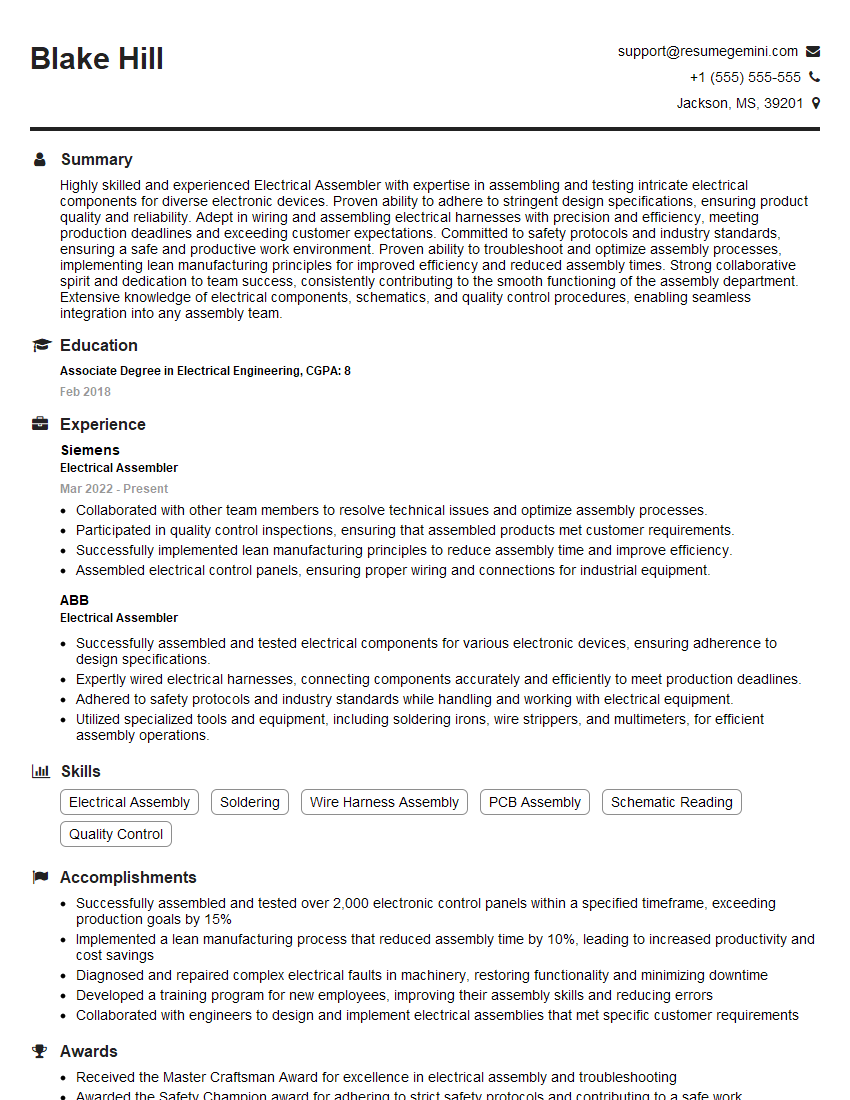
Mastering Electrical Panel Assembly opens doors to a rewarding career with excellent growth potential in a consistently in-demand field. To maximize your job prospects, create a strong, ATS-friendly resume that highlights your skills and experience effectively. ResumeGemini is a trusted resource that can help you build a professional and impactful resume tailored to your abilities. Examples of resumes specifically designed for Electrical Panel Assembly professionals are available to help you get started.
Explore more articles
Users Rating of Our Blogs
Share Your Experience
We value your feedback! Please rate our content and share your thoughts (optional).
What Readers Say About Our Blog
Really detailed insights and content, thank you for writing this detailed article.
IT gave me an insight and words to use and be able to think of examples