Feeling uncertain about what to expect in your upcoming interview? We’ve got you covered! This blog highlights the most important Electrical Schematic Reading and Interpretation interview questions and provides actionable advice to help you stand out as the ideal candidate. Let’s pave the way for your success.
Questions Asked in Electrical Schematic Reading and Interpretation Interview
Q 1. Explain the difference between a wiring diagram and a schematic diagram.
Wiring diagrams and schematic diagrams are both crucial for understanding electrical systems, but they serve different purposes and present information in distinct ways. Think of a wiring diagram as a detailed map showing exactly how wires are connected physically. It’s like a blueprint for a physical installation, meticulously documenting wire routing, color codes, and terminal connections. In contrast, a schematic diagram is a symbolic representation of the circuit’s functionality. It uses standardized symbols to show the components and their interconnection, focusing on the logical flow of signals rather than the physical layout. It’s more like a simplified roadmap showing the relationship between components rather than the specific pathways.
For example, a wiring diagram for a simple light switch would show the exact path of the wires from the power source, through the switch, and to the light bulb, including details like wire gauge and color coding. A schematic would simply show a power source, a switch symbol, and a light bulb symbol connected together in a series, abstracting the physical wiring details.
Q 2. Describe the purpose and function of a ladder diagram.
A ladder diagram is a type of schematic specifically used for representing the logic of programmable logic controllers (PLCs) and other industrial control systems. It’s called a ‘ladder’ because it resembles a ladder with two vertical rails representing power supply rails (typically positive and negative) and horizontal rungs connecting these rails which represent the electrical circuits. Each rung represents a circuit that controls an output device, such as a motor, solenoid, or light.
Ladder diagrams are incredibly useful for visualizing the logic of complex control systems. They make it easy to trace the flow of control signals and understand the conditions that must be met to activate or deactivate specific outputs. For instance, a rung might show a motor starting only when a pressure sensor is activated and a safety switch is closed. This clear visual representation makes troubleshooting and programming PLCs significantly simpler.
Q 3. Identify common electrical symbols used in schematics (e.g., resistor, capacitor, transistor).
Electrical schematics use a standardized set of symbols to represent components. Consistency is key; understanding these symbols is fundamental to reading and interpreting any schematic. Here are a few common examples:
- Resistor:
□or a zig-zag line, representing resistance to current flow. - Capacitor:
|---|or two parallel lines, storing electrical energy. - Transistor: Several variations exist (NPN, PNP), each with a unique symbol, representing a semiconductor device used for amplification or switching. Commonly shown as a triangle with leads.
- Inductor (Coil):
---representing a component that stores energy in a magnetic field. - Battery:
+---||---showing a DC voltage source. - Ground:
∙or a triangle, representing a common reference point for voltage.
Many other symbols exist, representing diodes, integrated circuits, operational amplifiers, and other components. Reference symbol libraries are readily available for detailed information.
Q 4. How do you interpret a schematic to troubleshoot a malfunctioning circuit?
Troubleshooting a malfunctioning circuit using a schematic is a systematic process. First, understand the expected function of the circuit. Then, trace the signal path from input to output, checking for discrepancies. If an output is incorrect, follow these steps:
- Identify the faulty output: Pinpoint the component or point in the circuit not functioning as expected.
- Trace the signal path backward: Follow the schematic back from the faulty output, checking each component along the way. Use a multimeter to measure voltages and currents at key points.
- Look for obvious issues: Check for burnt resistors, broken connections, or other physical damage.
- Consider component failure: If voltages or currents are outside expected ranges, a component might be faulty (e.g., a shorted capacitor, an open resistor).
- Verify power supply: Ensure the circuit receives the correct voltage and current.
- Check input signals: Ensure the input signal is correct and that there aren’t any issues with signal integrity.
Remember, safety is paramount. Always disconnect power before performing any physical checks on the circuit.
Q 5. Explain the process of tracing a signal path on a complex schematic.
Tracing a signal path in a complex schematic requires careful attention to detail and a methodical approach. Start at the input point of the signal and follow the connections through the circuit. Use the component symbols to identify the functional blocks and the direction of signal flow. Often, signal paths are color-coded or use different line thicknesses in large schematics to aid in tracing.
For instance, in a complex audio amplifier, tracing the audio signal path might involve following connections through several stages, including input coupling capacitors, amplifiers, filters, and output coupling capacitors. At each stage, you need to understand the function of the component and how it modifies the signal before moving on to the next component. It helps to highlight the signal path with a pen or pencil to keep track and avoid getting lost in complex circuitry.
Q 6. How do you identify the power supply requirements from a schematic?
Power supply requirements are usually explicitly stated on schematics, often near the power input terminals. Look for labels like ‘+V’, ‘-V’, ‘VCC’, ‘GND’, or other similar notations, along with the corresponding voltage and current values. These specifications are critical for proper operation and to avoid damaging the circuit. For example, a label of ‘+5V @ 1A’ indicates the circuit needs a 5-volt DC power supply capable of delivering at least 1 ampere of current.
If not explicitly labeled, you may need to trace back from active components to identify the power supply connections. Examine the circuitry around voltage regulators or integrated circuits, as these often have a clearly marked power input. Be mindful of voltage levels and current ratings to ensure compatibility with the chosen power supply. Using a multimeter to verify the voltages at specific points can also help confirm the power supply parameters.
Q 7. What are the different types of schematic diagrams (e.g., single-line, block, multi-line)?
Schematic diagrams come in various forms, each offering a different level of detail and serving different purposes:
- Single-line diagrams: These are highly simplified representations, often used in power systems, focusing on the main power flow paths without detailed component representation. Think of it like a highway map – you see the main routes but not the individual streets.
- Multi-line diagrams: These provide a more detailed representation of the circuit, showing multiple signal paths or phases in power systems. This is like a city map with detailed streets and landmarks.
- Block diagrams: These present the overall system architecture, breaking it down into functional blocks, without detailed internal circuitry. Each block represents a major functional unit. This is like an overview map – you see the overall structure but not the details.
The choice of schematic type depends on the specific application and the level of detail required. A single-line diagram suffices for a high-level overview of a power distribution system, while a multi-line diagram is necessary for the detailed design of a complex control circuit. Block diagrams are excellent for initial system design and communication.
Q 8. How do you interpret component values and tolerances from a schematic?
Component values and tolerances on a schematic are crucial for understanding the circuit’s behavior and ensuring proper functionality. Component values are typically represented using standard notation, for example, a resistor might be labeled as ‘1kΩ’ representing 1 kilohm. Capacitors might be shown as ’10µF’ for 10 microfarads, and inductors as ’10mH’ for 10 millihenries. The units are usually indicated, but sometimes omitted for brevity when consistent throughout the schematic. Tolerances describe the acceptable variation from the nominal value. This is often represented as a percentage or a range. For instance, a resistor labeled ‘1kΩ ±5%’ indicates that the actual resistance should fall between 950Ω and 1050Ω. A resistor labeled ‘1kΩ 1%’ signifies a tighter tolerance of ±1%. Understanding tolerances is vital as they directly impact the circuit’s performance and stability. For example, a high-precision application might necessitate components with tighter tolerances (e.g., 0.1% or even better), while a less critical circuit might use components with looser tolerances (e.g., 5% or 10%). Failure to account for tolerances could lead to unexpected behavior or even malfunctions.
Example: A schematic showing a capacitor labeled ‘470nF ±10%’ indicates a nominal capacitance of 470 nanofarads, with an acceptable variation of ±10%, meaning the actual capacitance could range from 423nF to 517nF.
Q 9. Describe your experience with different schematic capture software (e.g., AutoCAD Electrical, Eagle).
I have extensive experience using various schematic capture software packages, including AutoCAD Electrical and Eagle. AutoCAD Electrical is particularly well-suited for large-scale industrial projects, offering robust features for managing complex systems, including automated wire numbering, bill of materials generation, and integration with other design tools. I’ve used it extensively to design and document control systems for manufacturing plants, ensuring consistency and traceability throughout the design process. My experience includes creating and managing libraries of components, setting up design rules, and collaborating with other engineers on large-scale projects using its version control capabilities. Eagle, on the other hand, is a more versatile and agile tool, often preferred for smaller-scale projects and prototyping. It’s intuitive and easier to learn for rapid development, ideal for designing custom circuit boards. I’ve used Eagle extensively in designing embedded systems and test equipment. The difference in my approach is tailored to the project’s scale and complexity; large industrial projects require the organizational power of AutoCAD Electrical, while quicker prototyping favors Eagle’s flexibility.
Q 10. Explain your process for verifying the accuracy of a schematic.
Verifying the accuracy of a schematic is a critical step ensuring a successful project. My process involves a multi-step approach. First, I conduct a thorough visual inspection, checking for inconsistencies, such as missing components, incorrect component values, or un-routed connections. Then, I perform a connectivity check using the software’s built-in tools, verifying that all components are connected as intended. Following that, I conduct a component cross-reference check to ensure that every component listed in the bill of materials is present in the schematic and vice versa. Next, I simulate the circuit, using software like LTSpice or Multisim, to predict its behavior and validate the design against the intended specifications. Lastly, I compare the design against the initial requirements and specifications, ensuring that all aspects meet the client’s needs. Throughout this entire process, I meticulously document all findings and revisions. This multi-pronged approach minimizes the chances of errors and ensures a reliable design.
Q 11. How do you interpret grounding and shielding symbols on a schematic?
Grounding and shielding symbols on a schematic are critical for understanding signal integrity, noise reduction, and safety. A grounding symbol, often represented by a triangle or a three-line symbol connected to earth, indicates a connection to the circuit’s reference potential. This is crucial for returning current to the source, preventing voltage buildup, and eliminating noise. Shielding symbols, typically shown as a dotted line enclosing a component or group of components, indicate the use of a conductive enclosure to prevent electromagnetic interference (EMI). This protects sensitive circuits from external noise and vice versa. The understanding of these symbols is important for safety, preventing equipment damage, and meeting regulatory requirements. For example, in high-frequency applications, neglecting shielding could lead to significant noise interference. Incorrect grounding could lead to safety hazards, especially in high-voltage applications.
Example: A sensitive analog sensor might be shown enclosed within a shielding symbol and connected to ground through a dedicated low-impedance path to minimize interference.
Q 12. How do you understand and interpret relay logic diagrams?
Relay logic diagrams illustrate the control logic of a system using relays. These diagrams use symbols representing relays, contacts (normally open and normally closed), and other components like timers and switches to show the relationships between input signals and outputs. Interpreting these diagrams involves tracing the flow of signals through the relays, determining the state of contacts based on input conditions, and ultimately identifying the resultant output. Understanding relay logic is crucial for troubleshooting and designing control systems. For instance, a failure to correctly interpret a relay logic diagram can result in faulty system operation. Many industrial control systems, such as those used in automation and manufacturing, rely on relay logic diagrams. Learning how to read these is essential for anyone involved in the design or maintenance of such systems. Understanding ladder logic, a related form of relay logic, is equally important, given its widespread use in Programmable Logic Controllers (PLCs).
Q 13. Can you explain the use of different types of connectors shown on a schematic?
Different connector types shown on schematics indicate the physical interface between components or systems. These symbols provide crucial information for manufacturing and assembly. Common connectors include various types of terminals (screw terminals, quick-connect terminals), circular connectors (e.g., D-Sub, circular MIL-spec), rectangular connectors (e.g., DIN, ribbon connectors), and specialized connectors based on specific applications (e.g., optical fiber connectors). Each connector type has its specific pin arrangement and electrical characteristics. Incorrectly interpreting a connector symbol can lead to incorrect wiring and system malfunction. For example, a connector with a keyed design ensures it can only be plugged in one way, preventing potential short circuits. Recognizing these connector types ensures proper assembly and avoids potential errors during wiring and integration.
Example: A DB-9 connector symbol indicates the use of a standard 9-pin serial connector, each pin having its assigned signal function according to a defined standard.
Q 14. Explain the importance of proper annotation and labeling in a schematic.
Proper annotation and labeling are paramount for clarity and maintainability of a schematic. Clear labeling of components, wires, nodes, and signals enhances readability and reduces ambiguity. A well-annotated schematic is easier to understand, troubleshoot, and modify. It makes collaboration among engineers more effective and reduces the risk of errors. Consistent use of designators and designations (e.g., R1, C2, U3) helps keep track of components and their interconnection. Annotations such as notes clarifying specific design decisions, or reference designators for related documents, such as datasheets or PCB layouts, improve the overall quality of the documentation. Without these annotations, even a perfectly accurate schematic can be a puzzle to decipher. For large or complex circuits, this becomes even more important to ensure proper maintenance and future modifications.
Example: Instead of simply drawing a resistor, it’s labelled as ‘R1 1kΩ ±5%’ clearly showing the component value and tolerance.
Q 15. How do you handle inconsistencies or errors found within a schematic?
Inconsistencies and errors in schematics are a serious concern, potentially leading to faulty designs or dangerous equipment. My approach involves a systematic process:
- Verification: I first cross-reference the schematic against other design documents like the bill of materials (BOM) and PCB layout to identify discrepancies. For example, if a component is listed in the BOM but not on the schematic, or vice-versa, that’s a red flag.
- Traceability: I meticulously trace signals and power paths throughout the schematic, looking for broken connections, incorrect component values, or unintended loops. Think of it like detective work – following the flow of electricity to uncover anomalies.
- Component Analysis: I carefully examine each component’s designation, value, and tolerances. A simple typo in a resistor value (e.g., 1kΩ instead of 10kΩ) can significantly impact functionality.
- Rule Checking: I utilize schematic capture software with built-in design rule checking (DRC) features to automatically detect many common errors, such as incorrect net names or unconnected components.
- Consultation: If I can’t resolve an inconsistency, I consult with the design team or the original schematic’s creator to clarify the intended design.
- Documentation: I meticulously document all inconsistencies, errors identified and the corrective actions taken. This ensures future clarity and prevents similar errors from occurring again.
For instance, in a recent project, I discovered a mismatch between the schematic and the PCB layout for a critical power supply component. Through thorough tracing, I found the issue stemmed from an outdated schematic revision. By using the latest revision and communicating this discrepancy to the team, we avoided a potentially costly rework.
Career Expert Tips:
- Ace those interviews! Prepare effectively by reviewing the Top 50 Most Common Interview Questions on ResumeGemini.
- Navigate your job search with confidence! Explore a wide range of Career Tips on ResumeGemini. Learn about common challenges and recommendations to overcome them.
- Craft the perfect resume! Master the Art of Resume Writing with ResumeGemini’s guide. Showcase your unique qualifications and achievements effectively.
- Don’t miss out on holiday savings! Build your dream resume with ResumeGemini’s ATS optimized templates.
Q 16. Describe how to use a schematic to determine component placement on a PCB.
Schematics are the roadmap for PCB layout. They define the connections between components, but don’t directly dictate placement. However, they are crucial for determining placement in several ways:
- Connectivity: The schematic dictates which components need to be close together to minimize trace lengths and signal interference. For instance, high-speed signals should have short, direct traces to reduce signal degradation.
- Component Footprint: The schematic specifies component designations which can be cross-referenced with the library to determine the component’s physical dimensions and pinouts, influencing their placement on the PCB to avoid overlaps and routing issues.
- Signal Integrity: The schematic highlights sensitive analog circuits or high-frequency components that require careful placement to avoid noise and electromagnetic interference (EMI). These components should be spatially separated from noisy elements.
- Thermal Considerations: The schematic can help identify heat-generating components (e.g., power transistors). These should be strategically placed to facilitate heat dissipation, maybe near a heat sink or with sufficient spacing.
- Power Plane Design: The power distribution network depicted in the schematic dictates the placement of decoupling capacitors near ICs to stabilize voltage and minimize noise. These capacitors should be close to the IC pins they serve.
Essentially, using the schematic to guide component placement ensures a functional and reliable PCB, optimized for signal integrity and manufacturability. It’s like assembling a puzzle – the schematic provides the image, and the PCB layout is the finished product.
Q 17. Explain your approach to understanding complex control system schematics.
Understanding complex control systems requires a systematic approach. I begin by breaking down the schematic into smaller, manageable blocks. This involves:
- Block Diagram Representation: I often create a high-level block diagram of the system, simplifying the schematic’s complexity. This helps to identify the main control loops and their interactions.
- Signal Tracing: I meticulously trace the signals through each block, noting the input, processing, and output of every component. This is particularly important for understanding feedback loops and signal transformations.
- Component Function: I focus on understanding the role of each component within the larger system. For example, identifying operational amplifiers (op-amps) as amplifiers, comparators, integrators, or other functional blocks.
- Reference Design Documents: I always supplement the schematic with other documentation, such as datasheets, design specifications, and application notes, to understand the behavior and limitations of individual components.
- Simulation (If Applicable): If available, I use simulation software to model the system’s behavior under different conditions. This helps validate my understanding and can identify potential problems before physical construction.
Imagine a car’s engine control unit (ECU). The schematic will be incredibly complex. By breaking it into blocks like sensors, processors, and actuators, I can gradually understand how each part contributes to the overall control system. Simulating different scenarios allows me to predict the system’s response.
Q 18. What are the safety considerations when working with electrical schematics?
Safety is paramount when working with electrical schematics. Negligence can lead to serious injury or equipment damage. My safety considerations include:
- Proper Training and Knowledge: I always ensure I have sufficient knowledge and training before working on any electrical schematic, particularly those involving high voltages or hazardous equipment.
- Voltage Awareness: I am always mindful of potential voltage hazards present in the circuit. I would never work on a live circuit without proper lockout/tagout procedures.
- Schematic Accuracy: I verify the accuracy of the schematic before working with any associated hardware. An incorrect schematic can lead to serious safety hazards.
- Protective Equipment: When working with hardware related to the schematic, I use appropriate personal protective equipment (PPE), such as safety glasses, gloves, and insulated tools.
- Safe Work Practices: I adhere to all relevant safety regulations and procedures specified by my workplace or governing bodies.
A simple mistake, like misinterpreting a schematic and connecting a component incorrectly, could easily result in a short circuit, fire, or electric shock. Therefore, prioritizing safety is critical at every stage of the work.
Q 19. How do you interpret Boolean logic within a schematic?
Boolean logic in schematics is usually implemented using logic gates (AND, OR, NOT, NAND, NOR, XOR, XNOR) and often represents digital control signals. To interpret them:
- Identify Logic Gates: The first step is identifying the specific logic gates used in the schematic. Each gate has a unique symbol indicating its function.
- Understand Truth Tables: I use truth tables to understand the behavior of each gate. A truth table lists all possible input combinations and their corresponding output for a given logic gate.
- Trace Signals: I follow the signals through the logic gates, applying the truth table to determine the output of each gate. This process is done step by step.
- Boolean Algebra (Optional): For complex logic circuits, I may use Boolean algebra to simplify the expressions and predict the output of the circuit.
For example, an AND gate requires both inputs to be HIGH (1) to produce a HIGH output. An OR gate requires at least one input to be HIGH to produce a HIGH output. By understanding the function of each gate and tracing signals, I can determine the complete logic operation represented in the schematic. This process is crucial for digital circuit design and troubleshooting.
Q 20. Describe your experience in creating and modifying electrical schematics.
I have extensive experience in creating and modifying electrical schematics using industry-standard software packages like Altium Designer, Eagle, and KiCad. My experience encompasses a wide range of projects, including:
- New Designs: I regularly create schematics from scratch based on design specifications and functional requirements, selecting appropriate components and organizing the schematic for clarity and maintainability.
- Schematic Revisions: I frequently modify existing schematics to incorporate design changes, bug fixes, or component substitutions, ensuring consistency and traceability throughout the revision process.
- Component Libraries: I maintain and expand component libraries, creating new symbols and footprints as needed, and ensuring that the libraries are kept up-to-date with the latest component specifications.
- Documentation: I create and maintain comprehensive schematic documentation, including design notes, revisions history, and other relevant information, to maintain project transparency and facilitate collaboration.
For example, I recently led the revision of a complex power supply schematic for a medical device. This involved incorporating feedback from testing, replacing several components for improved reliability, and carefully documenting every change to ensure regulatory compliance.
Q 21. How do you stay up-to-date with changes and advancements in electrical schematic standards?
Staying current with changes in electrical schematic standards is vital. I utilize several methods:
- Industry Publications: I regularly read industry publications, such as EDN, Electronics Design, and IEEE Spectrum, to stay informed on emerging technologies and best practices.
- Professional Organizations: I am an active member of professional organizations like the IEEE, which provide access to technical papers, conferences, and workshops on the latest standards and advancements.
- Online Resources: I utilize online resources, such as manufacturer websites, application notes, and online forums, to access the latest datasheets and updates on components and design techniques.
- Training Courses: I participate in professional development training courses to enhance my skills and knowledge of the latest schematic capture software and design methodologies.
- Software Updates: I keep my schematic capture software updated to ensure compliance with the latest standards and to benefit from the newest features and improvements.
For example, I recently completed a course on the latest IPC standards for printed circuit board design, which directly impacted how I approach component placement and design rule checking in my schematic work. This continuous learning ensures that I am consistently applying best practices and adhering to the highest industry standards.
Q 22. How would you explain a complex schematic to someone with limited technical knowledge?
Explaining a complex schematic to someone without a technical background requires a simplified, step-by-step approach. I’d start by comparing the schematic to a map of an electrical system. Just like a road map shows how roads connect, the schematic shows how electrical components are interconnected.
Next, I’d introduce basic symbols – resistors (like water pipes restricting flow), capacitors (like water tanks storing energy), and transistors (like electrical valves controlling flow) – explaining their function using simple analogies. I would then trace the flow of electricity, highlighting the path and explaining what each component does along the way. For instance, I might say something like, “See this power supply? It’s like a water pump pushing the electricity. It flows through this resistor, which slows it down a bit, like a narrow pipe, before reaching this light bulb which uses the electricity to glow.” Visual aids, like annotated diagrams or even a physical model, are extremely helpful for comprehension.
Finally, I’d break down the schematic into smaller, manageable sections, explaining each section independently before connecting them to show the overall functionality. Instead of overwhelming them with the whole picture at once, I would build their understanding gradually.
Q 23. Explain your understanding of different types of circuit protection devices shown in schematics.
Circuit protection devices are crucial for safeguarding equipment and preventing damage or injury from overcurrent, overvoltage, or short circuits. Schematics commonly depict several types:
- Fuses: These are essentially sacrificial elements that melt and break the circuit if the current exceeds a specified limit. They are simple, inexpensive, and offer one-time protection.
- Circuit Breakers: These are electromechanical switches that automatically trip and open the circuit when an overcurrent is detected. Unlike fuses, they can be reset and reused.
- Overvoltage Protection Devices (OVPs): These devices, such as transient voltage suppressors (TVSs) or Metal-Oxide Varistors (MOVs), protect against voltage surges or spikes that exceed the rated voltage of components. They absorb excess energy to prevent damage.
- Thermal Fuses: These fuses are activated by excessive heat rather than current. They’re commonly used to protect motors and transformers.
- Current Limiting Resistors: While not strictly a protection device in the same way as the others, high-value resistors can limit current flow to protect delicate components. However, they dissipate excess power as heat, so proper derating is crucial.
The schematic indicates the type and rating of the protection device, allowing for proper selection and replacement.
Q 24. How do you determine the voltage and current ratings of components from a schematic?
Determining component voltage and current ratings from a schematic involves carefully examining the component’s symbol and any associated annotations. Component values are usually indicated directly on the symbol, or in a parts list accompanying the schematic.
For example, a resistor might be labeled “1kΩ” (1 kiloohm), indicating its resistance. A capacitor might be labeled “10µF 25V” indicating a 10 microfarad capacitance rated for 25 volts. This means it can withstand a maximum of 25 volts without breaking down. Current ratings are often less directly labeled, particularly for passive components. Instead, you often have to calculate the maximum current based on the power rating (e.g., a 1/4 W resistor) and voltage.
Active components, like transistors and integrated circuits (ICs), usually have datasheets referencing their part number. The datasheet provides all the necessary information on maximum voltage, current, and power ratings. You’d need to cross-reference the schematic’s component designation to find the part number and access the datasheet.
Q 25. How do you identify potential sources of interference or noise based on a schematic?
Identifying potential interference or noise sources from a schematic requires a systematic approach. I would look for potential coupling mechanisms and vulnerable components.
Coupling Mechanisms:
- Capacitive Coupling: Long traces act as antennas, picking up electromagnetic interference (EMI). I’d identify long, unshielded wires as potential sources.
- Inductive Coupling: Closely spaced traces or components can induce unwanted signals into each other, particularly at high frequencies. Poorly shielded transformers or inductors can also be sources.
- Grounding Issues: Multiple ground points or poorly designed ground planes can create ground loops, leading to noise. I’d examine the schematic for star or multiple-point grounding schemes.
Vulnerable Components:
High-gain amplifiers and analog-to-digital converters (ADCs) are particularly susceptible to noise. I’d pay close attention to their placement, shielding, and filtering in the circuit.
By combining an understanding of coupling mechanisms and knowledge of susceptible components, a thorough assessment of potential noise sources can be completed using just the schematic.
Q 26. How would you use a schematic to assist in the selection of appropriate test equipment?
A schematic is indispensable for choosing appropriate test equipment. It provides a roadmap of the circuit’s architecture and the components’ characteristics.
For instance, if the schematic shows a high-voltage power supply, it would indicate that I’d need a high-voltage probe for my oscilloscope or multimeter to avoid damaging the equipment. If the schematic reveals a low-current signal path, I would select sensitive instruments capable of resolving those smaller signals accurately. Similarly, if the schematic illustrates high-frequency components, I might choose an oscilloscope with a high bandwidth to accurately capture the signals. The types of connectors (e.g., BNC, banana plugs) are also indicated on the schematic, helping to select appropriate test leads.
In essence, the schematic guides the selection of appropriate test equipment that can safely and effectively measure the relevant signals within the system without causing damage or introducing interference.
Q 27. Describe a situation where you had to interpret a complex schematic to solve a problem. What was the outcome?
During a project involving a complex industrial control system, the main motor consistently failed after a short period. The schematic was incredibly detailed, with multiple control loops, sensors, and safety interlocks. Initial troubleshooting pointed towards potential motor issues, but replacement motors also failed.
Analyzing the schematic, I noticed a high-frequency switching noise generated by the Variable Frequency Drive (VFD) wasn’t properly filtered. The noise was capacitively coupled into the motor’s control circuitry, causing intermittent malfunctions that eventually led to failure. The schematic provided the details of the original filter circuit, which was insufficient.
By redesigning a robust filter circuit based on the schematic, implementing proper grounding techniques, and adding shielding, we successfully eliminated the noise and significantly extended the motor’s lifespan. The solution was effective and cost-efficient, avoiding expensive and time-consuming replacements of working parts.
Key Topics to Learn for Electrical Schematic Reading and Interpretation Interview
- Basic Schematic Symbols: Understanding standard symbols for components like resistors, capacitors, inductors, transistors, integrated circuits, and connectors. Practice recognizing and interpreting these symbols quickly and accurately.
- Circuit Analysis Techniques: Applying Ohm’s Law, Kirchhoff’s Laws, and other fundamental circuit analysis techniques to determine voltage, current, and power within a schematic. Be prepared to explain your approach to solving circuit problems.
- Reading and Interpreting Complex Schematics: Analyzing multi-page schematics, identifying hierarchical structures, and tracing signal paths through complex circuitry. Practice with increasingly challenging examples.
- Component Identification and Functionality: Understanding the function of various components and their roles within a larger system. This includes identifying passive and active components and their interactions.
- Troubleshooting from Schematics: Using a schematic to diagnose potential faults or malfunctions in a circuit. Explain your approach to systematic troubleshooting and fault isolation.
- Power Distribution and Grounding: Understanding the principles of power distribution and proper grounding techniques as depicted in a schematic. Be prepared to discuss safety considerations related to electrical systems.
- Signal Flow and Data Paths: Tracing signal flow and data paths within digital and analog circuits. Understanding timing diagrams and their relevance to schematic interpretation.
- Schematic Standards and Conventions: Familiarity with common schematic drawing standards (e.g., IEEE) and conventions. Understanding the importance of consistent and clear schematic documentation.
Next Steps
Mastering Electrical Schematic Reading and Interpretation is crucial for career advancement in numerous electrical engineering fields. Proficiency in this area demonstrates a strong foundation in electrical principles and enhances your problem-solving skills, making you a valuable asset to any team. To increase your job prospects, it’s essential to create a compelling and ATS-friendly resume that highlights your expertise. We strongly recommend using ResumeGemini to build a professional resume that showcases your skills effectively. ResumeGemini offers examples of resumes tailored to Electrical Schematic Reading and Interpretation to help guide you in creating a winning application.

Engineering Manager Resume Sample

Project Engineer Resume Sample

Automation Engineer Resume Sample

Test Engineer Resume Sample

Design Engineer Resume Sample

Maintenance Technician Resume Sample

Field Service Engineer Resume Sample

Electrical Engineer Resume Sample

Power Systems Engineer Resume Sample

Control Systems Engineer Resume Sample

Robotics Engineer Resume Sample

Electrical Drafter Resume Sample

Electronics Technician Resume Sample

Instrumentation Technician Resume Sample
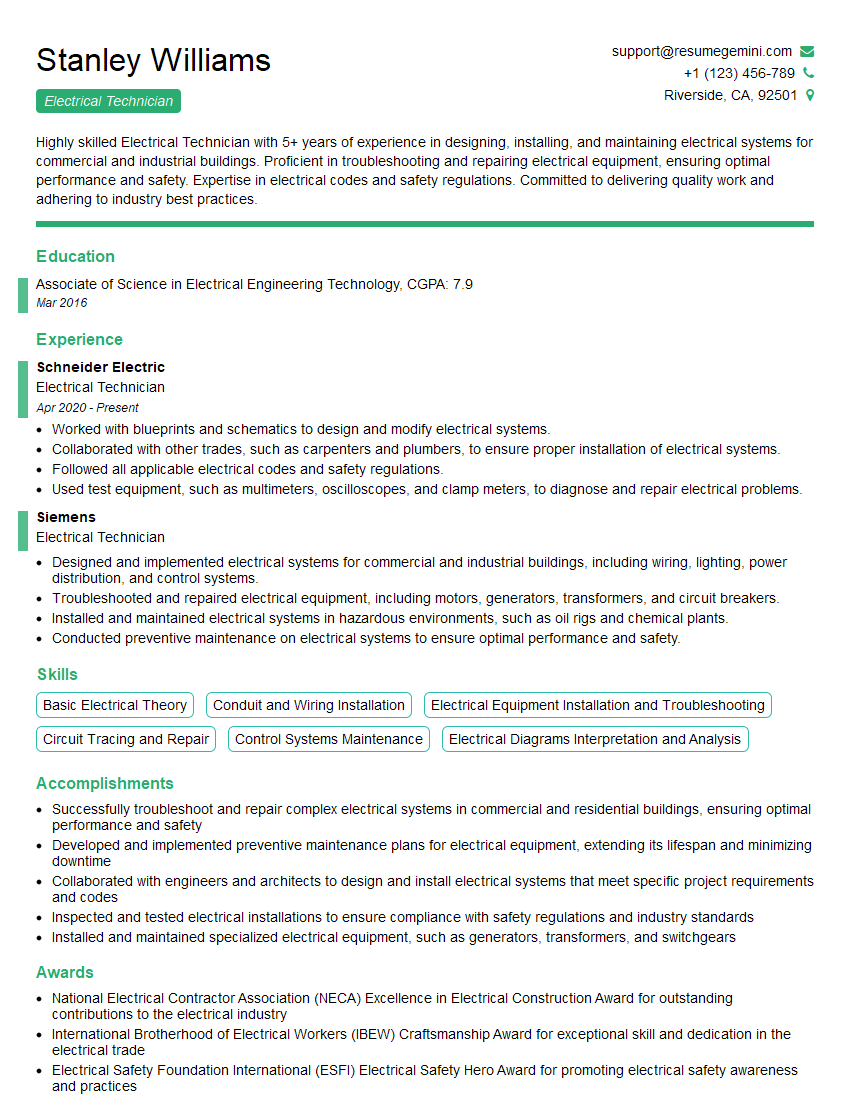
Electrical Technician Resume Sample
- Engineering Manager
- Project Engineer
- Automation Engineer
- Test Engineer
- Design Engineer
- Maintenance Technician
- Field Service Engineer
- Electrical Engineer
- Power Systems Engineer
- Control Systems Engineer
- Robotics Engineer
- Electrical Drafter
- Electronics Technician
- Instrumentation Technician
- Electrical Technician
Explore more articles
Users Rating of Our Blogs
Share Your Experience
We value your feedback! Please rate our content and share your thoughts (optional).
What Readers Say About Our Blog
Really detailed insights and content, thank you for writing this detailed article.
IT gave me an insight and words to use and be able to think of examples