Are you ready to stand out in your next interview? Understanding and preparing for Evacuation and Charging of Refrigerant Systems interview questions is a game-changer. In this blog, we’ve compiled key questions and expert advice to help you showcase your skills with confidence and precision. Let’s get started on your journey to acing the interview.
Questions Asked in Evacuation and Charging of Refrigerant Systems Interview
Q 1. What are the safety precautions associated with refrigerant evacuation and charging?
Refrigerant evacuation and charging involve handling potentially hazardous substances, so safety is paramount. Key precautions include:
- Proper Personal Protective Equipment (PPE): Always wear safety glasses, gloves, and appropriate clothing to prevent skin and eye contact with refrigerants. Some refrigerants are flammable or toxic, demanding extra caution.
- Ventilation: Work in a well-ventilated area to prevent the buildup of refrigerant vapors. Refrigerant leaks can displace oxygen, creating an asphyxiation hazard.
- Fire Prevention: Be mindful of ignition sources, especially when working with flammable refrigerants like propane or some blends. Ensure no sparks or open flames are present.
- Refrigerant Recovery and Recycling: Never vent refrigerant into the atmosphere. Use proper recovery equipment to capture the refrigerant for recycling or responsible disposal, in accordance with environmental regulations.
- Training and Certification: Always adhere to industry best practices and regulations. Proper training on refrigerant handling and safety procedures is essential.
- Leak Detection: Before starting any work, use a leak detector to identify and repair any existing leaks. This prevents unnecessary exposure to refrigerant and ensures efficient system operation.
For instance, imagine a scenario where a technician fails to wear safety glasses. A sudden refrigerant spray could cause serious eye damage. Similarly, neglecting proper ventilation could lead to asphyxiation from high refrigerant concentrations.
Q 2. Explain the process of evacuating a refrigeration system.
Evacuating a refrigeration system removes air, moisture, and non-condensables from the system before charging it with new refrigerant. This is crucial for optimal system performance and longevity. Here’s a step-by-step process:
- Isolate the System: Close the service valves on the compressor, condenser, and evaporator to isolate the system from the outside world.
- Connect the Vacuum Pump: Connect a properly sized vacuum pump to the system’s service ports, using appropriate adapters and hoses.
- Start the Vacuum Pump: Begin the evacuation process. A good vacuum pump will quickly pull the pressure down to a deep vacuum.
- Monitor the Vacuum Gauge: Continuously observe the vacuum gauge to monitor the pressure drop. The rate of pressure decrease will slow as the system is evacuated. This indicates that air and moisture are being removed.
- Hold the Vacuum: Once the desired vacuum level is reached, hold the vacuum for a minimum period specified by the manufacturer or industry standards (typically 30-60 minutes, depending on system size and complexity). This ensures that any remaining moisture is drawn out.
- Disconnect the Vacuum Pump: Carefully disconnect the vacuum pump, making sure the system remains sealed.
Think of it like cleaning a container before filling it with a precious liquid. You wouldn’t want to fill it with contaminated water; similarly, you want to remove contaminants from the refrigeration system before adding the refrigerant.
Q 3. What is the purpose of pulling a vacuum during evacuation?
Pulling a vacuum during evacuation serves several critical purposes:
- Removes Air and Non-Condensables: Air and other non-condensables reduce the refrigerant’s efficiency and can cause compressor damage. These gases decrease the system’s cooling capacity.
- Removes Moisture: Moisture in the system can react with the refrigerant, causing acid formation and corrosion of system components, especially the compressor. This leads to system failure and costly repairs.
- Improves Refrigerant Purity: A good vacuum ensures the refrigerant is as pure as possible, maximizing system performance.
Analogy: Imagine trying to fill a glass of water with ice. If air bubbles are present, the glass won’t be fully filled with water, reducing the amount of ice you can put into it. Similarly, air and moisture in the refrigeration system reduce the amount of refrigerant that can effectively cool.
Q 4. How do you determine the appropriate vacuum level for a system?
The appropriate vacuum level is usually specified by the equipment manufacturer or in industry standards. Generally, a deep vacuum, reaching 500 microns or less (absolute pressure), is the target. However, factors influencing the required level include:
- System Size: Larger systems may require longer evacuation times to achieve the same vacuum level.
- System Type: Different system designs might have slightly different requirements.
- Refrigerant Type: Some refrigerants may have slightly different sensitivity to moisture or air.
You’ll find the specific vacuum requirement in the system’s technical documentation. Failure to achieve the specified vacuum can lead to performance issues and potential damage.
Q 5. What are the potential consequences of inadequate evacuation?
Inadequate evacuation has several negative consequences:
- Reduced Cooling Capacity: The presence of air and moisture reduces the system’s ability to cool effectively, leading to higher energy consumption and poor performance.
- Compressor Damage: Non-condensables can cause high-pressure build-up in the system, leading to compressor damage or failure.
- Acid Formation and Corrosion: Moisture can react with the refrigerant, forming acids that corrode the system’s internal components, ultimately leading to leaks and system failure.
- Reduced System Lifespan: The cumulative effect of these issues significantly shortens the lifespan of the entire refrigeration system, resulting in premature failure and expensive replacements.
Think of it like leaving dirt and debris in an engine. Over time, it will wear down the parts and compromise its performance. Similarly, inadequate evacuation will impact the refrigeration system’s health and longevity.
Q 6. Describe the different types of refrigerant charging methods.
Refrigerant charging methods mainly fall into these categories:
- Weight Charging: This involves precisely measuring the amount of refrigerant added to the system using scales. The desired refrigerant charge is calculated based on the system’s specifications.
- Subcooling Charging: This method relies on measuring the refrigerant’s subcooling at the liquid line. The desired subcooling is achieved by adding refrigerant until the correct temperature difference is measured. This indicates the optimal charge based on temperature conditions.
- Superheat Charging: Similar to subcooling, this method involves monitoring the refrigerant’s superheat at the suction line. Refrigerant is added until the correct superheat is achieved.
The choice of method depends on the system’s design, the refrigerant used, and the technician’s preference. Each method requires a different set of tools and expertise.
Q 7. Explain the advantages and disadvantages of weight charging vs. subcooling charging.
Weight charging and subcooling charging each have advantages and disadvantages:
| Feature | Weight Charging | Subcooling Charging |
|---|---|---|
| Accuracy | Highly accurate, provided the scales are calibrated and the weight is accurately measured. | Accuracy depends on the accuracy of the temperature measurement and the stability of the system’s operating conditions. |
| Complexity | Relatively straightforward. | Requires more skill and understanding of thermodynamic principles. |
| Equipment | Requires accurate scales. | Requires accurate temperature measurement devices. |
| Cost | Relatively inexpensive. | Can be slightly more expensive due to specialized tools. |
| Speed | Can be faster for experienced technicians. | Can be slower, requiring adjustments and re-measurements. |
Example: A large commercial refrigeration system might benefit from weight charging for its precision and speed. Conversely, a smaller residential system might be adequately charged using subcooling methods, which can be more forgiving of minor variations.
The best method depends on the specific situation and technician expertise. However, all methods demand adherence to safety protocols and proper training.
Q 8. How do you identify the correct refrigerant for a specific system?
Identifying the correct refrigerant is crucial for the safe and efficient operation of a refrigeration system. Each refrigerant has unique properties, and using the wrong one can lead to system damage, reduced efficiency, and even safety hazards. The refrigerant type is usually specified on a label on the equipment itself, often located near the compressor or on the unit’s nameplate. This label will typically list the refrigerant using its ASHRAE designation (e.g., R-410A, R-134a, R-22). If the label is missing or illegible, you’ll need to consult the manufacturer’s documentation or use a refrigerant identifier tool. Never guess the refrigerant type; always confirm it definitively before proceeding.
For instance, you wouldn’t use R-22 in a system designed for R-410A. R-22, an older refrigerant being phased out due to its ozone depletion potential, has different pressure-temperature characteristics compared to R-410A. Using R-22 in an R-410A system could damage components or result in system failure.
Q 9. What tools and equipment are essential for safe and efficient evacuation and charging?
Safe and efficient evacuation and charging requires specialized tools and equipment. The essentials include:
- Vacuum pump: A robust vacuum pump is crucial for removing air and moisture from the system, ensuring optimal performance and preventing compressor damage. Two-stage pumps are generally preferred for achieving a deeper vacuum.
- Micron gauge: This gauge precisely measures the level of vacuum achieved during the evacuation process, indicating the amount of air and moisture remaining. It’s essential for verifying a proper evacuation.
- Refrigerant recovery/recycling machine: This machine safely recovers refrigerant from the system, allowing for reuse or responsible disposal. It is crucial for environmental compliance.
- Manifold gauge set: A manifold gauge set with pressure gauges for high-pressure and low-pressure sides allows for precise measurement and control of refrigerant charge. It helps to prevent overcharging and undercharging, which can damage the system.
- Refrigerant scales: Accurate scales are essential for precise refrigerant charging to ensure optimal system performance.
- Leak detector: A leak detector, either electronic or soap-and-water based, is crucial for identifying and repairing leaks before charging, as leaks can compromise the system’s efficiency and lead to environmental issues.
- Proper fittings and hoses: These must be compatible with the refrigerant used and must be leak-free to prevent refrigerant loss.
Remember to always use equipment that is properly rated for the refrigerant being handled, to ensure safe operation.
Q 10. How do you troubleshoot common problems encountered during evacuation and charging?
Troubleshooting during evacuation and charging involves systematically investigating potential issues. Common problems include:
- Slow evacuation: This could indicate a blockage in the system (e.g., a restricted filter drier), a leak, or a faulty vacuum pump. Check the system for blockages and ensure the vacuum pump is functioning correctly.
- Unable to reach deep vacuum: This usually points to a leak. Use a leak detector to pinpoint the leak’s location.
- High micron gauge reading after evacuation: This indicates insufficient evacuation, possibly due to a leak or insufficient vacuum pump capacity. Repeat the evacuation procedure.
- Inaccurate gauge readings: Ensure your manifold gauges are calibrated, and that there are no kinks in the hoses. Inaccurate readings can lead to incorrect charging and system malfunction.
- System overheating: During charging, overheating could be due to a refrigerant charge that is too high, resulting in high compressor pressure. Reduce the amount of refrigerant in the system.
A systematic approach, combining visual inspection with the use of diagnostic tools, is key to effective troubleshooting. It is always best to follow the manufacturer’s instructions, and consult specialized resources for complex issues.
Q 11. What is the role of a micron gauge during evacuation?
The micron gauge is an essential tool during the evacuation process. It precisely measures the level of vacuum within the refrigeration system, expressed in microns (µm) of mercury or Pascals (Pa). A deep vacuum is crucial to remove non-condensables like air and moisture, which reduce the system’s efficiency and can damage the compressor. Air and moisture act as insulators and prevent heat transfer, meaning that the refrigerant can’t effectively absorb and transfer heat from your refrigerator. The gauge indicates how well this evacuation process is working.
Q 12. How do you interpret micron gauge readings?
Micron gauge readings indicate the level of vacuum. Lower readings signify a higher vacuum, meaning there is less non-condensable remaining in the system. A typical target vacuum is 500 microns or less (or 67 Pa or less). Readings above this indicate insufficient evacuation. It’s crucial to achieve the specified vacuum level before charging the system to ensure optimal performance and longevity.
For example, a reading of 150 microns indicates a much better vacuum than a reading of 700 microns. If your gauge reads 700 microns after a reasonable evacuation period, you may have a leak.
Q 13. How do you handle leaks during the evacuation process?
Handling leaks during evacuation is critical for safety and environmental protection. If a leak is suspected (e.g., high micron gauge reading after evacuation), immediately stop the evacuation process. Use a leak detector to pinpoint the leak’s location. Leaks can be repaired only by appropriately trained technicians. Small leaks may sometimes be repaired with special leak-stop compounds, however, more significant leaks will require system repair or replacement of components.
Remember, refrigerant is under pressure and can cause injury or property damage if not handled safely. Always follow appropriate safety protocols. Once the leak is repaired, the system should be thoroughly evacuated again to ensure all air and moisture are removed.
Q 14. Explain the importance of proper refrigerant recovery and recycling.
Proper refrigerant recovery and recycling are essential for environmental responsibility and compliance with regulations. Refrigerants, especially older ones like R-22, can significantly contribute to environmental damage if released into the atmosphere. Recovering and recycling refrigerant reduces the demand for virgin refrigerant production and minimizes the release of harmful substances into the atmosphere. Recycling is done by purifying recovered refrigerant and returning it to the refrigerant supply chain for reuse.
Recovery involves safely removing refrigerant from a system without venting it to the atmosphere. Recycling involves cleaning and purifying the recovered refrigerant for reuse. These processes are required by law in many jurisdictions and are also a critical component of responsible environmental stewardship. Improper handling can lead to environmental damage and legal repercussions.
Q 15. What are the environmental regulations related to refrigerant handling?
Environmental regulations concerning refrigerant handling are stringent and vary by location, but generally aim to minimize the impact of refrigerants on the ozone layer and global warming. The most significant regulations revolve around the phase-out of ozone-depleting substances (ODS) like R-22 and the restriction of high global warming potential (GWP) refrigerants. These regulations often involve licensing requirements for technicians handling refrigerants, mandatory recovery and recycling practices, leak detection and repair protocols, and reporting requirements for significant releases. For instance, the Montreal Protocol is a landmark international treaty phasing out ODS, while many countries have their own regulations focused on GWP limits and the proper disposal of refrigerants. Failure to comply can result in hefty fines and legal repercussions.
Regulations often dictate the use of specific equipment for refrigerant recovery, such as certified recovery machines, and require technicians to be properly trained and certified. The specific requirements will depend heavily on the type and quantity of refrigerant being handled and the local environmental agency’s guidelines. Always check with your local or national environmental protection agency for the latest and most accurate regulations.
Career Expert Tips:
- Ace those interviews! Prepare effectively by reviewing the Top 50 Most Common Interview Questions on ResumeGemini.
- Navigate your job search with confidence! Explore a wide range of Career Tips on ResumeGemini. Learn about common challenges and recommendations to overcome them.
- Craft the perfect resume! Master the Art of Resume Writing with ResumeGemini’s guide. Showcase your unique qualifications and achievements effectively.
- Don’t miss out on holiday savings! Build your dream resume with ResumeGemini’s ATS optimized templates.
Q 16. How do you calculate the refrigerant charge required for a system?
Calculating the correct refrigerant charge is crucial for optimal system performance and efficiency. A system undercharged will not cool effectively, while an overcharged system can lead to high head pressure, compressor damage, and potentially dangerous operating conditions. The precise method depends on the system’s design and available data. The most common method involves using the system’s nameplate data which often includes a recommended charge weight. This is a starting point, however.
However, a more accurate method involves calculating the refrigerant charge based on the system’s volume. You need to determine the total volume of refrigerant that the system’s piping, condenser, evaporator, and receiver can hold. This typically involves using system blueprints and manufacturer’s specifications. Once the volume is known, you can convert it to a refrigerant weight based on the refrigerant density at a specific temperature, usually the ambient temperature. Remember that this is a theoretical calculation and doesn’t account for potential losses during installation.
Finally, you can use a refrigerant charge scale on the system itself, if available. These scales are often marked directly on the equipment and can provide a direct estimate of the needed charge. Always follow the manufacturer’s recommended procedures and consult the system’s documentation. Accurate charging requires careful measurement and a good understanding of the system’s operating parameters.
Q 17. What is the significance of superheat and subcooling in refrigerant charging?
Superheat and subcooling are critical parameters in refrigerant charging and indicate the efficiency and safety of a refrigeration system. Think of them as safety margins to ensure the compressor and condenser are not subjected to liquid refrigerant slugging, potentially causing damage.
- Superheat: This is the temperature difference between the refrigerant vapor leaving the evaporator and the saturation temperature of the refrigerant at that pressure. Adequate superheat ensures that only dry vapor enters the compressor, preventing liquid refrigerant from damaging the compressor. Insufficient superheat can lead to compressor slugging.
- Subcooling: This is the temperature difference between the refrigerant liquid leaving the condenser and the saturation temperature of the refrigerant at that pressure. Subcooling ensures that the refrigerant entering the expansion device is entirely liquid, enhancing the efficiency of the system and preventing the formation of flash gas. Insufficient subcooling can lead to reduced capacity and inefficiency.
The correct values of superheat and subcooling are crucial for optimal system performance. They are usually specified by the manufacturer of the refrigeration system or can be determined through experimentation and analysis of the system’s performance.
Q 18. How do you measure superheat and subcooling?
Measuring superheat and subcooling requires specialized tools, namely a refrigeration thermometer, pressure gauge set, and ideally, a manifold gauge set with temperature sensors. Here’s how:
- Superheat Measurement: Use the pressure gauge to determine the refrigerant pressure at the evaporator outlet. Then, use the refrigeration thermometer to measure the actual temperature of the refrigerant vapor at that point. Consult a pressure-temperature chart (P-T chart) for the specific refrigerant to find the corresponding saturation temperature at that measured pressure. The difference between the actual temperature and the saturation temperature is the superheat.
- Subcooling Measurement: Use the pressure gauge to determine the refrigerant pressure at the condenser outlet (liquid line). Measure the actual temperature of the liquid refrigerant at this point using the refrigeration thermometer. Again, consult the P-T chart for the refrigerant to determine the saturation temperature corresponding to the measured pressure. The difference between the saturation temperature and the actual temperature is the subcooling.
Accurate measurements require careful placement of the temperature sensor to avoid inaccuracies caused by ambient temperature or heat transfer. This process is best done by trained technicians for safe and effective measurement and to avoid system damage.
Q 19. Explain the relationship between refrigerant pressure and temperature.
Refrigerant pressure and temperature are directly related; they are intrinsically linked through the refrigerant’s thermodynamic properties. This relationship is often represented using a Pressure-Temperature (P-T) chart specific to each refrigerant. For a given refrigerant, a higher pressure corresponds to a higher temperature, and vice versa. This relationship is particularly important during charging because it allows technicians to determine the state of the refrigerant (liquid, vapor, or a mixture) within the system based on pressure and temperature readings.
For example, if the pressure in the liquid line of a refrigeration system is higher than expected, it might indicate an overcharge, whereas if the suction line pressure is too low, an undercharge is likely. This relationship is also crucial when using pressure-temperature charts to determine superheat and subcooling values, as we mentioned earlier. Different refrigerants have different P-T relationships; it’s critical to use the chart for the correct refrigerant.
Q 20. What is the effect of non-condensables on system performance?
Non-condensables, such as air or other gases, are undesirable in a refrigeration system because they significantly impact performance and efficiency. They don’t participate in the refrigeration cycle but occupy space in the condenser, reducing the volume available for refrigerant condensation. This leads to decreased cooling capacity and increased condensing pressure. Increased condensing pressure puts extra strain on the compressor, reducing its lifespan and potentially leading to overheating and failure. The higher condensing pressure also increases energy consumption.
In essence, non-condensables act like an insulating blanket on the condenser. They prevent the proper transfer of heat, making it harder for the refrigerant to release heat to the environment. This results in reduced efficiency, increased operating costs, and potential damage to the system.
Imagine trying to boil water in a pot partially filled with sand; the sand takes up space and impedes heat transfer, making the water take longer to boil. Non-condensables behave similarly in a refrigeration system, reducing its effectiveness.
Q 21. How do you identify and remove non-condensables?
Identifying and removing non-condensables requires a systematic approach. The first step is to suspect their presence. Symptoms such as high condensing pressures, reduced cooling capacity, and sluggish system operation can all point towards non-condensables.
The most effective way to remove non-condensables is through a process called evacuation. This involves using a vacuum pump to remove the refrigerant and any non-condensables from the system. Before evacuation, the system should be thoroughly leak-checked and repaired to prevent further air ingress. The evacuation process consists of several steps, such as pulling a deep vacuum to remove any residual air and moisture, and confirming that the deep vacuum holds for a period of time indicating a leak-free system.
Specialized equipment like vacuum pumps and manifold gauges are essential for proper evacuation. The procedure involves opening the service valves on the refrigeration system and connecting the vacuum pump. The depth and duration of the vacuum are crucial to ensure the effective removal of non-condensables. After evacuation, the system is recharged with the correct amount of refrigerant.
Q 22. Describe the process of leak detection in a refrigeration system.
Refrigerant leak detection is crucial for maintaining system efficiency and environmental safety. Several methods exist, each with its strengths and weaknesses. The choice depends on the system’s size, type, and the suspected location of the leak.
- Electronic Leak Detectors: These use sensors to detect refrigerant vapor. They’re handy for pinpointing leaks in hard-to-reach areas. Think of them like a super-sensitive nose for refrigerants! Different models have varying sensitivities, so choosing the right one is crucial.
- Ultrasonic Leak Detectors: These listen for the high-frequency sounds produced by escaping refrigerant. It’s like using a stethoscope to hear a faint whisper of a leak. This method is excellent for finding leaks in pressurized systems.
- Dye Tracing: A fluorescent dye is injected into the system. Under UV light, any leaks become clearly visible. Imagine a detective using a special lamp to uncover hidden clues!
- Pressure Testing: The system is pressurized with nitrogen (never refrigerant) and monitored for pressure drops. This is a good overall check, especially useful before adding refrigerant.
- Halide Torch: This older method involves burning a sample of refrigerant. A green flame indicates the presence of refrigerant. However, it is less sensitive and more environmentally unfriendly than other methods and is gradually phasing out.
Often, a combination of methods is used for comprehensive leak detection. For example, a pressure test might reveal a leak is present, while an electronic or ultrasonic detector could pinpoint its exact location.
Q 23. What are the common causes of refrigerant leaks?
Refrigerant leaks stem from various sources, often related to wear and tear, improper installation, or external damage. Here are some common culprits:
- Component Failure: Worn seals, cracked tubes, or faulty connections are frequent causes. Think of it like a leaky faucet – eventually, constant use or age leads to failure.
- Corrosion: Refrigerant lines, especially those made of copper, can corrode over time, creating weak points prone to leaks. This is accelerated by moisture or incompatible materials.
- Vibration: Constant vibrations from compressors or other system components can weaken connections and cause leaks. Imagine shaking a bottle constantly; eventually, the cap might loosen.
- Accidental Damage: Physical damage during installation, maintenance, or even accidental impacts can puncture lines.
- Improper Installation: Poorly fitted connections or insufficient brazing (soldering) are common sources of leaks during initial setup.
Understanding these causes allows for preventative maintenance – regular inspections, proper handling, and quality components can minimize the risk of leaks.
Q 24. How do you repair leaks in different types of refrigerant lines?
Repairing refrigerant leaks depends on the type of line and the severity of the damage. Minor leaks can sometimes be repaired with specialized epoxy or sealant, while larger leaks often require replacement of the damaged section.
- Brazed Joints: Leaks in brazed joints may require re-brazing after careful cleaning and preparation. This demands experience and proper safety precautions.
- Copper Tubing: Small holes in copper tubing can sometimes be repaired with specialized clamps or sleeves, but often it’s more practical to cut out the damaged section and braze in a replacement piece.
- Flexible Lines: Depending on the extent of damage, flexible lines might be repaired with specialized sealant, clamps or be replaced entirely.
Remember, any repair involving brazing requires a thorough understanding of the procedure and appropriate safety measures (discussed in the next answer). Improper repairs can lead to further leaks or even system failure.
In many instances, especially with significant damage, replacing the affected section or even the entire component is the best option, ensuring the system’s integrity and avoiding repeated problems.
Q 25. What safety precautions should be taken when working with refrigerants?
Working with refrigerants demands strict adherence to safety protocols, given their potential health and environmental risks. Here are some key precautions:
- Proper Ventilation: Always work in well-ventilated areas to minimize exposure to refrigerant vapors. This is crucial as many refrigerants can displace oxygen.
- Personal Protective Equipment (PPE): Use safety glasses, gloves, and respiratory protection to prevent contact with refrigerants and their potential by-products.
- Refrigerant Handling Training: Proper training on handling and recovery procedures is essential. This includes understanding the specific hazards associated with the refrigerant being used.
- Fire Safety: Some refrigerants are flammable, so appropriate fire safety measures must be in place. This means having appropriate fire extinguishers on hand and knowing how to use them.
- Emergency Procedures: Familiarize yourself with emergency procedures, including what to do in case of a leak or accidental exposure.
- Environmental Regulations: Adhere to all relevant environmental regulations for refrigerant handling and disposal. This often involves proper recovery and recycling practices.
Ignoring these precautions can have serious consequences, ranging from health issues to environmental damage. Always prioritize safety when working with refrigerants.
Q 26. Describe the different types of refrigerant recovery equipment.
Refrigerant recovery equipment is vital for environmentally responsible refrigerant handling. Several types are available, each suited for different applications:
- Self-Contained Recovery Units: These are portable units that recover refrigerant directly from a system and store it in an internal tank. They are common for smaller systems.
- Stationary Recovery Units: Larger and more powerful than self-contained units, these are used in workshops and service centers for handling larger systems.
- Refrigerant Recycling Units: These units not only recover refrigerant but also clean and process it for reuse. They reduce environmental impact significantly.
- Vacuum Pumps: While not strictly recovery units, these are essential for evacuating the system after refrigerant removal, ensuring proper system operation.
The choice of recovery equipment depends on the size and type of system, the amount of refrigerant, and the desired level of refrigerant processing (recovery only or full recycling).
Q 27. How do you maintain and care for refrigerant recovery equipment?
Proper maintenance of refrigerant recovery equipment ensures its longevity, accuracy, and environmental compliance. Here’s how:
- Regular Inspections: Regularly check for leaks, worn parts, and ensure all gauges and sensors are functioning correctly.
- Oil Changes: Change the oil in the compressor (if applicable) according to the manufacturer’s recommendations.
- Filter Changes: Replace filters regularly to prevent contamination of the recovered refrigerant.
- Calibration: Have the equipment calibrated periodically to ensure accurate measurements.
- Proper Storage: Store the equipment in a clean, dry environment to prevent damage and corrosion.
- Cleaning: Clean the equipment after each use to prevent cross-contamination.
Neglecting maintenance can lead to inaccurate readings, system damage, and ultimately, environmental contamination. A well-maintained recovery unit is an investment in both efficiency and environmental responsibility.
Q 28. What are the latest advancements in refrigerant handling technology?
Advancements in refrigerant handling focus on improving efficiency, safety, and environmental responsibility. Key trends include:
- Improved Recovery Equipment: More efficient and precise recovery and recycling units are constantly being developed, reducing refrigerant waste and improving recovery rates.
- Smart Sensors and Monitoring: The integration of smart sensors and data logging allows for real-time monitoring of refrigerant levels and leaks, improving preventative maintenance and reducing downtime.
- Automated Systems: Automated recovery and recycling systems are improving speed and efficiency, minimizing human intervention and error.
- Environmentally Friendly Refrigerants: The development and implementation of refrigerants with lower global warming potential (GWP) is a crucial focus, leading to less environmental damage.
- Leak Detection Technologies: More sensitive and accurate leak detection methods are constantly being developed, allowing for quicker identification and repair of leaks.
These advancements contribute to a future where refrigerant handling is safer, more efficient, and significantly less damaging to the environment.
Key Topics to Learn for Evacuation and Charging of Refrigerant Systems Interview
- Refrigerant Types and Properties: Understanding the different types of refrigerants (e.g., R-410A, R-134a), their properties, and their environmental impact is crucial. This includes knowing their pressure-temperature relationships and safety considerations.
- Evacuation Procedures: Mastering the proper procedures for evacuating a refrigeration system to achieve a deep vacuum. This includes understanding the purpose of evacuation, the equipment used (vacuum pumps, gauges), and troubleshooting common issues like leaks.
- Charging Methods: Familiarize yourself with different refrigerant charging methods (weight charging, subcooling, superheat), their advantages and disadvantages, and when to apply each method. Accurate charging is essential for optimal system performance.
- System Components and their Role: A thorough understanding of the components within a refrigeration system (compressor, condenser, evaporator, expansion valve) and how they interact during evacuation and charging is essential.
- Troubleshooting and Diagnostics: Be prepared to discuss common problems encountered during evacuation and charging, such as leaks, improper charging, and system malfunctions. Knowing how to diagnose and resolve these issues is highly valuable.
- Safety Precautions and Regulations: Understand the safety regulations and precautions associated with handling refrigerants, including personal protective equipment (PPE) and proper disposal procedures. This demonstrates responsibility and professionalism.
- Practical Application: Be ready to describe your experience with real-world scenarios involving evacuation and charging, highlighting your problem-solving skills and ability to apply theoretical knowledge in practice.
Next Steps
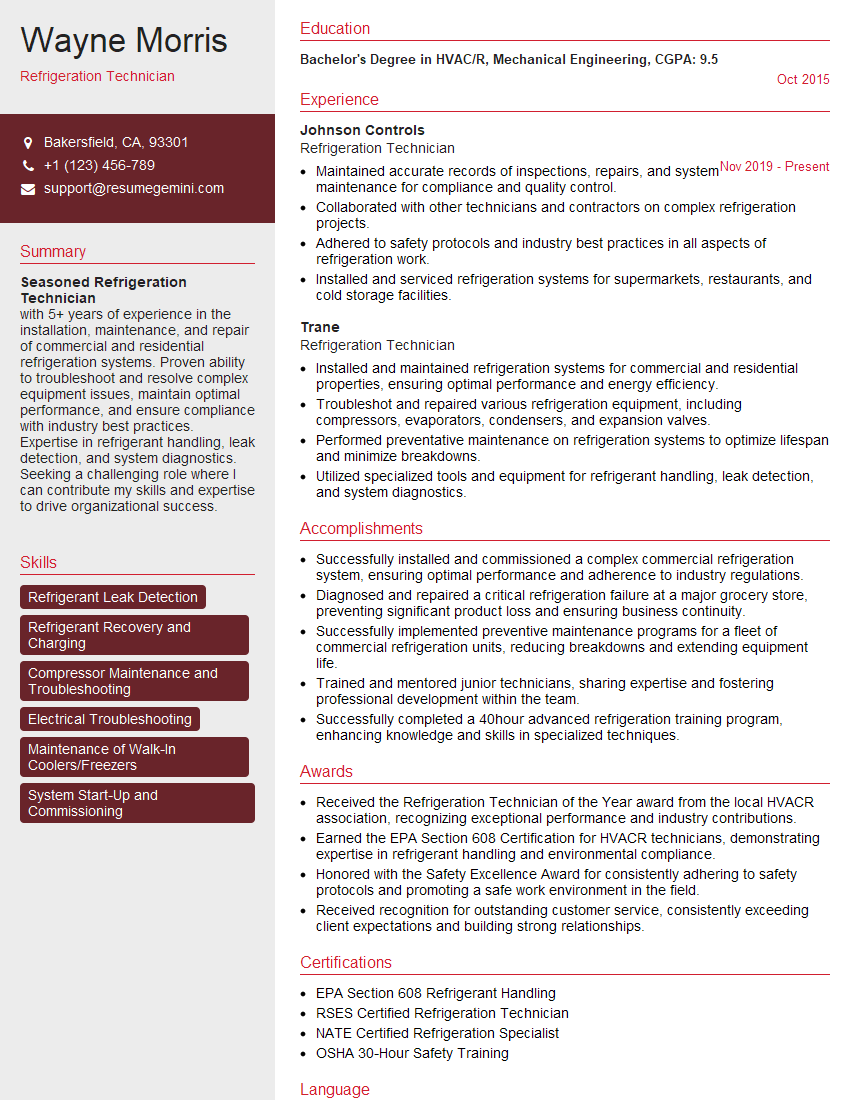
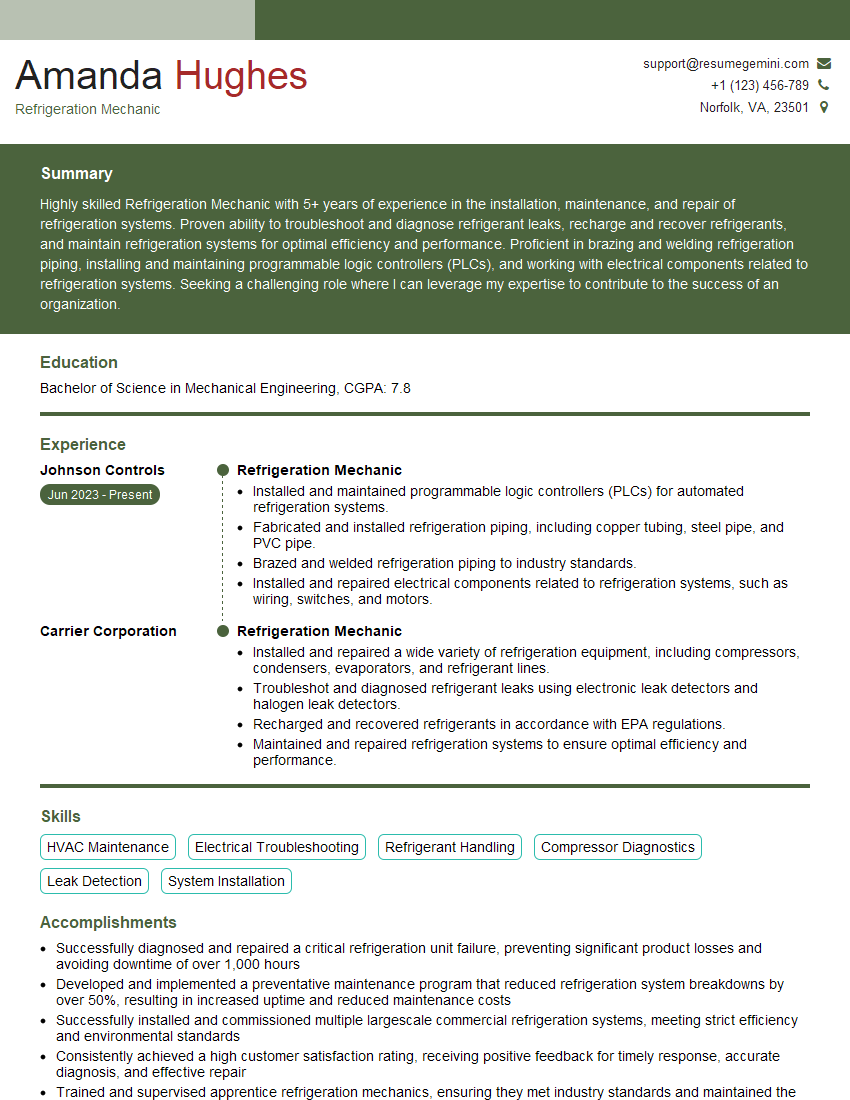
Mastering the evacuation and charging of refrigerant systems is vital for career advancement in HVAC/R. A strong understanding of these processes demonstrates technical proficiency and commitment to safety, making you a highly sought-after candidate. To maximize your job prospects, focus on creating an ATS-friendly resume that highlights your skills and experience effectively. ResumeGemini is a trusted resource that can help you build a professional and impactful resume tailored to the specific requirements of the HVAC/R industry. We provide examples of resumes tailored to Evacuation and Charging of Refrigerant Systems to guide you in creating a winning application.

Explore more articles
Users Rating of Our Blogs
Share Your Experience
We value your feedback! Please rate our content and share your thoughts (optional).
What Readers Say About Our Blog
Really detailed insights and content, thank you for writing this detailed article.
IT gave me an insight and words to use and be able to think of examples