Interviews are opportunities to demonstrate your expertise, and this guide is here to help you shine. Explore the essential Restoration of Furniture interview questions that employers frequently ask, paired with strategies for crafting responses that set you apart from the competition.
Questions Asked in Restoration of Furniture Interview
Q 1. Describe your experience with different wood types and their restoration requirements.
Working with different wood types is fundamental to furniture restoration. Each wood possesses unique characteristics influencing its restoration needs. For instance, hardwoods like mahogany and walnut are dense and durable, often requiring more aggressive techniques for repairs, while softer woods like pine are more easily damaged but also easier to work with.
- Mahogany: A beautiful, reddish-brown hardwood prized for its rich color and strength. Restoration often involves careful cleaning, filling small cracks with appropriate wood filler, and then refinishing to preserve its luster. It’s important to avoid over-sanding, as mahogany can be easily scratched.
- Walnut: Another strong hardwood with beautiful grain patterns. Similar to mahogany, walnut benefits from careful cleaning, crack repair with matching filler, and a thoughtful refinishing process, often using a penetrating oil finish to highlight the grain.
- Pine: A softer wood, more susceptible to dents and scratches. Restoration might involve filling dents with wood putty, repairing scratches with careful sanding and touch-up, and possibly applying a protective layer of varnish or shellac.
- Oak: A strong and durable wood, commonly used in antique furniture. Oak can be challenging to work with due to its hardness and tendency to show wear and tear. Restoration often requires careful cleaning, addressing woodworm damage (if present), and refinishing.
Understanding a wood’s inherent properties—its hardness, porosity, and grain structure—is critical to selecting the right tools and finishes for successful restoration. I always begin by carefully identifying the wood type before commencing any repair work.
Q 2. Explain the process of repairing a cracked chair leg.
Repairing a cracked chair leg requires precision and the right materials. The process involves several key steps:
- Assessment: Carefully examine the crack’s depth and extent. Determine if it’s a simple surface crack or a deeper, more complex break.
- Cleaning: Thoroughly clean the area around the crack with a soft brush and appropriate wood cleaner to remove any dirt or debris.
- Stabilization (if necessary): For deeper cracks, you may need to stabilize the leg using wood glue and clamps to prevent further damage during the repair. Allow the glue to dry completely.
- Filling: Use a high-quality wood filler that closely matches the chair leg’s color and grain. Apply the filler carefully, ensuring it fills the crack completely without overfilling. Let it dry completely and then carefully sand flush to the surface.
- Finishing: Once the repair is sanded smooth, apply a finish that matches the existing finish of the chair. This might involve applying a stain to match the wood’s color followed by several coats of varnish or shellac for protection.
Remember, working slowly and methodically is key. Rushing can lead to errors that are difficult to correct. For example, on a particularly valuable antique chair, I might use a very fine grain wood filler and multiple very thin coats of finish to achieve an almost invisible repair.
Q 3. How do you identify and address woodworm infestation in antique furniture?
Identifying and addressing woodworm infestation is crucial for preserving antique furniture. Woodworm, the larval stage of certain beetles, bores tunnels through the wood, weakening the structure and causing cosmetic damage.
- Identification: Look for small, round exit holes, often accompanied by fine wood dust. These holes typically indicate an active infestation. The presence of active larvae (small, white grubs) further confirms infestation.
- Treatment: There are several effective treatments, including chemical treatments (insecticides specifically designed for woodworm) and heat treatment. Chemical treatments are often applied directly to the affected areas, sometimes requiring multiple applications. Heat treatment involves raising the temperature of the wood to a level that kills the larvae without damaging the wood. The best approach depends on the severity of the infestation and the type of wood.
- Prevention: After treatment, maintaining low humidity is critical to prevent future infestations. Proper ventilation and climate control in the storage environment can greatly reduce the risk of recurrence.
For severely infested pieces, professional intervention might be necessary to ensure complete eradication. Remember, safety precautions should always be taken when using chemical treatments.
Q 4. What are the different types of wood finishes, and which is best suited for different projects?
Various wood finishes offer distinct aesthetics and levels of protection. The best choice depends on the project’s requirements and the desired look.
- Shellac: A natural resin finish known for its warm, amber tone and ease of application. It builds a durable yet relatively thin finish layer which is good for highlighting the wood grain.
- Varnish: Offers a durable, protective finish available in various gloss levels (from matte to high-gloss). It’s a popular choice for high-traffic furniture due to its protective qualities.
- Lacquer: A fast-drying finish known for its hardness and durability. It’s often used for pieces needing a high-gloss finish, but it can be more challenging to repair if damaged.
- Oil finishes (e.g., linseed oil, tung oil): Penetrate the wood, enhancing its natural beauty and providing some protection. They offer a more natural look than film-forming finishes like varnish or lacquer but may require more frequent reapplication.
- Polyurethane: A very durable, water-resistant finish, excellent for protecting furniture in high-moisture environments.
For example, a delicate antique might be best suited to shellac to preserve the character of the wood. A modern kitchen table might call for a durable polyurethane finish to withstand daily wear and tear. I always consider the piece’s age, style, and intended use when choosing the most appropriate finish.
Q 5. Explain your process for stripping and refinishing a piece of furniture.
Stripping and refinishing a piece of furniture is a multi-step process requiring patience and precision.
- Preparation: Protect the surrounding area and remove any hardware. Examine the piece for any loose or unstable parts.
- Stripping: Carefully remove the old finish using appropriate chemical strippers or mechanical methods like sanding. Always follow the manufacturer’s instructions for safety and proper application. Multiple applications might be necessary, and thorough cleaning after stripping is essential.
- Repair: Address any damage to the wood, such as cracks, dents, or scratches, using wood filler and appropriate repair techniques.
- Sanding: Sand the surface smooth using progressively finer grit sandpaper. This is crucial for a flawless finish. Be careful not to over-sand, which can damage the wood.
- Finishing: Apply the chosen finish according to the manufacturer’s instructions. This usually involves multiple coats of finish, each allowed to dry completely before the next application.
- Hardware Reinstallation: Once the finish is completely dry, reattach any hardware.
A thorough and patient approach is crucial for optimal results. I often find that working in small sections and focusing on quality over speed yields the best-looking and most durable results. For example, on a large dresser, I might strip and refinish one drawer at a time to maintain a manageable workflow.
Q 6. How do you match existing finishes to ensure a seamless repair?
Matching existing finishes is paramount for seamless repairs. It’s often more challenging than simply applying a new finish.
- Finish Identification: Determine the type of finish (shellac, varnish, lacquer, etc.) using various methods, including burn tests and solvent tests. This is often a matter of experience and carefully analyzing the finish’s characteristics.
- Color Matching: Carefully select a stain or paint that closely resembles the existing color. This often involves trial and error, testing different products on scrap wood until a suitable match is found.
- Finish Application: Apply the new finish in thin, even coats. Allow each coat to dry thoroughly before applying the next. Multiple thin coats are preferable to a single thick coat, resulting in a more even and consistent finish.
- Blending: Gently blend the repaired area with the surrounding finish to create an invisible repair. This often involves careful sanding and feathering of the edges of the repaired area.
Matching finishes is a skill honed over time. I’ve developed a keen eye for detail and an understanding of how different finishes react, allowing me to achieve nearly invisible repairs even on highly complex projects.
Q 7. Describe your experience with various upholstery techniques and materials.
Upholstery is a significant aspect of furniture restoration, requiring a combination of craftsmanship and knowledge of various materials.
- Techniques: I’m proficient in various techniques, including traditional hand-sewing, stapling, and the use of specialized upholstery tools. The choice of technique depends on the piece’s style, the type of fabric, and the desired finish.
- Materials: I work with a wide range of upholstery materials, including fabrics (cotton, linen, velvet, leather), foams, and webbing. Each material has its properties and requires specific handling techniques. For example, leather upholstery requires careful cleaning and conditioning to maintain its flexibility and prevent cracking. High-end upholstery fabrics might require specialized cleaning techniques to prevent damage.
- Restoration Process: A typical upholstery restoration involves removing the old fabric, cleaning the underlying structure (springs, webbing, etc.), repairing any damage, and then applying the new fabric. Precise measurements and pattern-making skills are essential for a professional finish.
Upholstery restoration adds significant value to restored pieces. Careful attention to detail and a keen understanding of historical techniques are essential for creating historically accurate and beautifully finished pieces.
Q 8. How do you choose appropriate adhesives for furniture repair?
Choosing the right adhesive is crucial for successful furniture restoration. The selection depends entirely on the materials being joined and the type of stress the joint will endure. Think of it like choosing the right glue for a specific project – you wouldn’t use superglue to mend a delicate china plate, right?
- Wood to Wood: For strong, durable bonds in most wood repairs, animal-hide glue is a traditional and excellent choice. It’s reversible with heat and water, which is invaluable if you need to make adjustments. For modern applications, polyurethane wood glue offers a strong, water-resistant bond.
- Veneer Repair: For delicate veneers, I often use a specialized hide glue or a very thin application of white glue (polyvinyl acetate). The key here is to avoid excess glue, which can seep out and cause blemishes.
- Broken Joints: For broken joints under significant stress, epoxy resins are excellent. They offer incredible strength and are ideal for repairing legs or heavily used areas.
- Fabric/Upholstery: Contact adhesives are often used for fabrics and upholstery, ensuring a strong bond between the fabric and the underlying structure.
Before applying any adhesive, always test it in an inconspicuous area to ensure compatibility and to check for any adverse reactions.
Q 9. What safety precautions do you take when working with chemicals and power tools?
Safety is paramount in furniture restoration. Working with chemicals and power tools demands meticulous attention to detail. My workshop is designed with safety in mind. I always wear appropriate personal protective equipment (PPE), which includes:
- Eye Protection: Safety glasses or a face shield are essential when using power tools or handling chemicals that could splash.
- Respiratory Protection: A dust mask is crucial when sanding, and a respirator is necessary when working with strong solvents or finishes. Certain finishes, such as shellac, even require a dedicated respirator.
- Hearing Protection: Ear muffs or earplugs are essential when using noisy power tools like routers or planers.
- Gloves: Appropriate gloves are essential when handling chemicals and sharp tools. Different types of gloves are required for different tasks to prevent irritation or damage to skin.
Additionally, I always ensure proper ventilation in my workshop, particularly when using solvents or finishes. I work in a clean and organized space to minimize the risk of accidents. And of course, I regularly inspect and maintain all my power tools to ensure they are functioning correctly.
Q 10. How do you handle intricate carvings or delicate veneers during restoration?
Intricate carvings and delicate veneers require a patient and precise approach. Think of it like performing microsurgery – every move must be carefully considered. I use specialized tools and techniques to minimize damage:
- Gentle Cleaning: I start with a very soft brush and mild cleaning solution to remove surface dirt and debris before any intervention.
- Careful Repair: For broken veneers, I might use a combination of hide glue and carefully applied pressure to reattach the pieces. In some cases, I’ll use very small clamps designed for this purpose.
- Specialized Tools: Small, sharp chisels, dental picks, and even specialized miniature clamps are invaluable for working on delicate carvings. I often use magnification to ensure precision.
- Stabilization: For severely damaged veneers, I may need to use a consolidant, which is a material that strengthens and stabilizes the veneer to prevent further degradation.
Patience is key; rushing could lead to irreparable damage. I often take photographs throughout the process to ensure I can track my progress and retrace my steps if necessary.
Q 11. Explain your approach to cleaning and preparing furniture for restoration.
Cleaning and preparation are fundamental steps, forming the groundwork for a successful restoration. Imagine preparing a canvas before painting; the surface must be clean and properly prepped for the paint to adhere properly. Similarly, a clean, prepared surface ensures the finish will properly adhere to the furniture.
- Assessment: First, I assess the piece to determine the extent of damage and the cleaning methods required. Different materials require different approaches.
- Dust Removal: A soft brush and a vacuum cleaner with a brush attachment are used to remove loose dirt and dust. Compressed air can be helpful for reaching crevices.
- Gentle Cleaning: I use a mild cleaning solution – often a mixture of mild dish soap and warm water – applied with a soft cloth or sponge. I always test the solution in an inconspicuous area first.
- Stain Removal: For stubborn stains, I might use specialized cleaning agents, but I always test these in an inconspicuous area to avoid damage or discoloration. It’s crucial to let the piece dry completely before moving to the next step.
- Repairing Damage: Any cracks, chips, or loose pieces are repaired before any finishing begins.
Thorough cleaning and preparation are critical for achieving a professional, long-lasting restoration.
Q 12. What are some common problems encountered during furniture restoration, and how do you solve them?
Many challenges can arise during furniture restoration. These often require creative problem-solving and a deep understanding of woodworking techniques. Here are some common problems and my solutions:
- Woodworm Damage: Infestation with woodworm requires treatment with specialized insecticide. I typically use a consolidant to stabilize the wood following treatment.
- Cracked Wood: Cracks can be repaired with wood glue, dowels, or splines, depending on the severity and location. For larger cracks, I might use wood filler to match the existing wood.
- Missing Veneer: Missing veneer can be tricky. Sometimes I can source a matching veneer piece. If not, careful reconstruction and matching the existing wood is needed.
- Water Damage: Water damage can cause significant warping and discoloration. The restoration might involve stabilizing the wood, replacing severely damaged sections, and then refinishing.
- Loose Joints: Loose joints can be tightened with glue and clamping, or in some cases, they might need reinforcing with additional wood pieces.
Problem-solving in furniture restoration is an art in itself. Often, the solution requires a combination of techniques and a great deal of patience.
Q 13. Describe your experience with restoring specific periods or styles of furniture.
My experience spans several periods and styles of furniture. I’ve had the pleasure of restoring:
- Victorian Era Furniture: This often involves intricate carvings and dark, rich finishes. The focus is usually on preserving the ornate details and restoring the original luster. I recently completed a restoration of a Victorian writing desk, which involved repairing several broken carvings and refinishing the mahogany.
- Art Deco Pieces: These pieces often feature geometric designs and bold colors. Restoration here often involves careful repair of the veneer and refinishing to restore the vibrant colors. I once restored an Art Deco sideboard that required replacing a damaged veneer panel with a near-perfect match.
- Mid-Century Modern Furniture: These often have simple, clean lines and are made from materials like teak or walnut. The focus is typically on preserving the original finish and repairing any structural damage. I have expertise in restoring iconic chairs by well-known designers, using original design techniques to ensure authenticity.
Each period brings unique challenges and techniques that must be adapted based on the construction and materials used.
Q 14. How do you determine the appropriate value of an antique piece before restoration?
Determining the value of an antique piece before restoration is a crucial step. It’s like assessing the value of a classic car before restoration: you need to know what you’re starting with to understand the project’s potential return. I approach this in a multi-faceted way:
- Research: I begin by researching the piece, identifying its maker, style, period, and any unique features. Online databases, auction records, and antique books are invaluable resources.
- Condition Assessment: A detailed assessment of the piece’s current condition is necessary. This includes noting any damage, wear, and tear, and how this affects the overall value. A heavily damaged piece will generally be worth less than one in good condition.
- Comparable Sales: I look at recent sales of similar pieces to gauge market value. Auction records are a great source for this information.
- Expert Consultation: In some cases, especially for exceptionally rare or valuable pieces, I may consult with an expert appraiser for a professional valuation.
The pre-restoration valuation helps determine the scope and cost-effectiveness of the restoration project, and allows the client to make informed decisions. It’s also crucial for insurance purposes.
Q 15. What is your experience with French polishing techniques?
French polishing is a traditional technique that produces a deep, lustrous finish. It involves applying multiple thin coats of shellac dissolved in alcohol, rubbing each coat with a pad of linen or cotton until a smooth, high-gloss surface is achieved. My experience spans over 15 years, working on a variety of antique and contemporary pieces. I’ve mastered the nuances of this technique, from selecting the appropriate shellac grade to understanding the impact of humidity and temperature on the process. For example, I recently restored a Louis XVI secrétaire, and the French polishing was crucial in recreating its original, rich patina. The process requires immense patience and precision. Each coat takes time to dry and blend seamlessly with the previous one. Improper technique can result in uneven finishes, so mastering the right pressure and rubbing motions is essential.
I’ve also explored variations of the technique, such as using different types of alcohol and experimenting with different polishing pads to achieve unique effects. For instance, a softer pad yields a warmer, more subtle sheen, while a firmer pad creates a higher gloss. The key is understanding how these factors interact to produce the desired finish.
Career Expert Tips:
- Ace those interviews! Prepare effectively by reviewing the Top 50 Most Common Interview Questions on ResumeGemini.
- Navigate your job search with confidence! Explore a wide range of Career Tips on ResumeGemini. Learn about common challenges and recommendations to overcome them.
- Craft the perfect resume! Master the Art of Resume Writing with ResumeGemini’s guide. Showcase your unique qualifications and achievements effectively.
- Don’t miss out on holiday savings! Build your dream resume with ResumeGemini’s ATS optimized templates.
Q 16. Describe your experience with repairing veneers and inlays.
Repairing veneers and inlays requires a delicate hand and a keen eye for detail. My approach begins with a thorough assessment of the damage, determining the extent of the loss and the best method for repair. For minor chips or scratches, I often use specialized wood fillers that closely match the original material. For larger losses, I may need to source replacement veneer from a similar piece, taking care to match the grain and color as precisely as possible. The process often involves steaming the veneer to make it pliable before carefully applying it to the damaged area. Inlays, whether they are wood, mother-of-pearl, or other materials, present their own unique challenges. I often utilize microscopic techniques and specialist tools for extremely fine repairs. Recently, I repaired a heavily damaged Victorian inlaid table. The inlay had significant water damage, requiring meticulous cleaning, stabilization, and the replacement of several tiny pieces of mother-of-pearl. It took considerable time and patience, but the final result was a seamless repair that preserved the integrity and beauty of the original piece. Accurate color matching is critical to ensure the repaired area blends seamlessly with the surrounding material.
Q 17. How do you handle furniture with water damage?
Water damage is one of the most challenging problems in furniture restoration. My approach is multifaceted and depends on the severity and location of the damage. The first step is always to thoroughly assess the extent of the damage, checking for swelling, warping, and mold. In the case of minor surface damage, careful cleaning and drying might suffice. For more significant damage, I might need to disassemble the piece to allow for better access to the affected areas. I frequently use specialized drying techniques, such as low-heat fans and dehumidifiers, to avoid further damage. In extreme cases, I may employ controlled heating to gently dry the wood and prevent cracking. Once the piece is dry, I carefully address any warping or damage to the wood structure before proceeding with repairs and refinishing. For instance, I recently restored an antique writing desk that had suffered significant water damage to its legs. The wood had swollen and warped, and several cracks had formed. I had to carefully disassemble the desk, dry the legs using a combination of fans and dehumidifiers, and then carefully glue and clamp the cracks. Once the repairs were complete, I refinished the desk to match the existing finish.
Q 18. What tools and equipment are essential for your work?
My workshop is equipped with a wide array of tools and equipment essential for various restoration tasks. Some of the most crucial tools include:
- Hand tools: Chisels, planes, scrapers, clamps, various types of saws, mallets, hammers
- Power tools: Drill press, router, sander (various grits), spindle sander
- Finishing tools: Spray gun, brushes, various types of sandpaper, polishing pads, rags
- Specialized tools: Steam iron for veneer work, specialized wood fillers, vacuum cleaner with HEPA filter for dust removal
- Measuring and marking tools: Calipers, rulers, squares, pencils
Beyond tools, maintaining a clean and organized workspace is vital for efficient and accurate work. I regularly inspect and maintain all my equipment to ensure their optimal performance. For example, maintaining sharp chisels is critical for clean cuts in delicate inlay work, whereas a well-calibrated sander ensures a smooth, even finish.
Q 19. Explain your process for documenting the restoration process.
Thorough documentation is essential for any restoration project. My process involves several stages:
- Initial assessment: Photographs, detailed notes of damage, and measurements of the piece.
- Treatment plan: A written outline detailing the proposed steps of restoration. This includes the materials, techniques and expected timelines.
- Progress photography: Documenting each stage of the restoration process with high-quality images.
- Detailed notes: Record-keeping of materials used, techniques applied and any encountered challenges or unexpected discoveries.
- Final report: A comprehensive summary of the entire process, including before-and-after images, and a description of the materials and methods used. I can include a short history or origin of the piece if available.
This documentation is vital for transparency, accountability, and to provide clients with a detailed record of the work performed. This also serves as a reference for future restorations on similar pieces. For example, detailed notes on the type of wood, its age and the finishes used allows for informed future work.
Q 20. How do you manage your time and resources effectively on a restoration project?
Effective time and resource management is crucial for success in furniture restoration. My approach involves:
- Detailed project planning: Breaking down the project into smaller, manageable tasks with realistic timelines. I factor in potential delays and unexpected issues.
- Prioritization: Focusing on the most critical aspects of the restoration first and working methodically through the process.
- Resource allocation: Efficient use of tools, materials, and my own time to avoid unnecessary waste. I prioritize acquiring high quality materials upfront to avoid rework and delays.
- Regular evaluation: Tracking my progress against the timeline and making necessary adjustments as needed.
- Communication: Maintaining open communication with clients to keep them informed and address any concerns. This is extremely important, especially in high-value restorations.
I use project management software to help track tasks, deadlines, and resources, ensuring that everything runs smoothly and within budget. This ensures both efficiency and client satisfaction.
Q 21. Describe your experience with working from design specifications or drawings.
I have extensive experience working from design specifications or drawings, particularly in historically accurate restorations. This often involves recreating missing parts or elements of furniture based on historical examples or surviving design documents. The process begins with a thorough analysis of the specifications or drawings, understanding the dimensions, materials, and construction techniques involved. I use the drawings as a guide while always remaining mindful of the materials available and the specific challenges presented by the project. Accuracy is paramount, particularly when working with antique pieces. For instance, I recently restored a set of antique chairs based on original construction drawings from the 18th century. The drawings indicated specific joinery techniques, wood types, and finishing styles which were meticulously followed to maintain the historical integrity and aesthetic appeal of the chairs. Understanding the context of the design, such as the style period or intended use of the piece, is crucial in making informed decisions throughout the restoration process.
Q 22. How do you maintain the structural integrity of a piece during restoration?
Maintaining a piece’s structural integrity throughout restoration is paramount. It’s like building a house – you wouldn’t put on the roof before the foundation is secure. We start with a thorough assessment, identifying any weaknesses, cracks, or loose joints. Then, we use appropriate methods to reinforce these areas. This might involve:
- Consolidating weakened wood: Using consolidants like Paraloid B-72 to strengthen decaying wood fibers.
- Replacing damaged sections: Carefully removing severely damaged sections and replacing them with compatible wood, often using traditional joinery techniques like mortise and tenon to ensure strength and stability.
- Reinforcing joints: Using wood glue and sometimes dowels or screws (concealed where possible) to strengthen loose joints. We always prioritize reversible techniques; we want the repair to be strong but easily removable if needed in the future by another restorer.
- Adding supports: In cases of significant structural compromise, we might add discreet internal supports to prevent sagging or warping. Think of this as adding extra beams to a house’s structure.
For example, on a Victorian chaise lounge with a broken stretcher, I’d carefully remove the broken pieces, clean the broken surfaces, apply a suitable adhesive like hide glue (a traditional, reversible glue), then reinforce the joint with strategically placed dowels before applying a final finish.
Q 23. What is your experience with the ethical considerations of antique furniture restoration?
Ethical considerations are at the heart of antique furniture restoration. My approach is guided by the principles of preservation and reversibility. I believe in minimal intervention – only restoring what’s necessary to stabilize and preserve the piece while retaining its historical integrity. This means:
- Documenting the process: Keeping detailed records of all repairs, including materials used and methods employed. This is crucial for future restoration or study.
- Using appropriate materials: Employing materials that are compatible with the original and are reversible. This allows future conservators to undo our work if needed. Avoid using materials that will irreversibly alter the piece, such as paints that are incompatible with the existing finish.
- Honesty and transparency: Openly disclosing any repairs or replacements to potential buyers. It’s about transparency and maintaining the integrity of the piece’s history.
- Avoiding stylistic changes: We don’t enhance a piece with modern interpretations or alter its original style unless explicitly requested and documented. The goal is preservation, not transformation.
For instance, I’d never replace a finely carved element with a mass-produced replica, even if it were difficult to repair. The original, even in its damaged state, offers far more historical value.
Q 24. How do you stay up to date with new techniques and technologies in furniture restoration?
The field of furniture restoration is constantly evolving, so continuous learning is essential. I stay up-to-date through several methods:
- Professional organizations: Membership in organizations like the American Institute for Conservation (AIC) provides access to publications, conferences, and workshops that feature the latest techniques and research.
- Workshops and courses: Participating in specialized workshops and courses offered by master restorers. This offers hands-on training and interaction with experts.
- Publications and journals: Staying current with relevant publications and journals focusing on conservation and restoration techniques.
- Online resources and communities: Engaging with online communities and forums for restorers. This allows for knowledge sharing and the discussion of challenging cases.
Recently, I attended a workshop focused on the use of advanced imaging techniques for the analysis of wood degradation, allowing for more targeted and effective treatments.
Q 25. Describe a challenging restoration project and how you overcame the difficulties.
One of the most challenging projects involved a heavily damaged Louis XVI secrétaire à abattant (a writing desk). The veneer was extensively detached, the structure weakened, and many pieces were missing. The difficulty lay in its complexity and the fragility of the surviving components.
My approach involved a phased strategy:
- Stabilization: Carefully consolidating the weakened wood and securing the loose veneer sections with appropriate adhesives.
- Reconstruction: Replicating missing components using historically accurate joinery and wood selection. This involved careful study of surviving elements and similar pieces to ensure authenticity.
- Veneer reconstruction: This was the most intricate part. The damaged veneer required meticulous repairs, including replacing missing sections with carefully matched veneers using traditional methods like bookmatching to create a seamless appearance. The process was painstaking and required significant time and precision.
- Finishing: Applying a finish that matched the existing patina, using traditional techniques like French polishing to achieve a smooth, lustrous surface.
The successful completion of this project required patience, meticulous attention to detail, and a deep understanding of both historical techniques and modern conservation methodologies. The client was ecstatic with the outcome, and the restored desk is now a cherished heirloom.
Q 26. How do you handle unexpected problems during a restoration project?
Unexpected problems are common in restoration. My approach is based on adaptability and problem-solving:
- Thorough assessment: Though sometimes hidden issues appear, a meticulous initial assessment reduces surprises. X-ray imaging can sometimes detect hidden problems.
- Research and consultation: Consulting with experts or researching relevant literature for solutions to unfamiliar problems.
- Testing: Before committing to a repair, I test various methods and materials on inconspicuous areas to see how they react and if they will be compatible.
- Adaptability: Being flexible and willing to modify my approach based on the challenges that arise. Sometimes, the initial plan might need to be adjusted during the restoration process.
For instance, discovering hidden woodworm infestation during a project requires immediate action: treating the infested areas with appropriate insecticides, carefully monitoring the condition, and possibly extending the project timeline accordingly. Open communication with the client is key.
Q 27. What is your preferred method for applying finishes?
My preferred method for applying finishes depends on the piece and its historical context. For antique furniture, I often use traditional methods that are reversible and compatible with original finishes:
- French polishing: A time-honored technique for achieving a high-gloss, deep luster on wood. It’s a delicate process involving the application of shellac in thin layers, rubbed to a high shine. It’s suitable for many antique pieces.
- Oil finishes: Natural oils like linseed or tung oil offer a durable and attractive finish, while still allowing the wood grain to show through. They are less glossy than shellac but ideal for certain types of wood.
- Wax finishes: Wax finishes add a protective layer and enhance the wood’s natural beauty. They are often used as a final step, after oiling or shellacing.
The choice of finish considers historical accuracy, the type of wood, and the desired level of sheen. Modern, fast-drying finishes are generally avoided unless absolutely necessary to ensure that the work remains historically faithful.
Q 28. Describe your experience with working independently and as part of a team.
I’ve worked both independently and as part of teams throughout my career. Independent work requires strong self-discipline, meticulous planning, and the ability to manage time and resources effectively. I thrive on the autonomy and creative control it offers. Teamwork, on the other hand, provides opportunities for collaboration, shared knowledge, and tackling large or complex projects that might be impossible for a single person.
My experience with collaborative projects has involved working with conservators, structural engineers, and art historians. The combined expertise ensured the successful restoration of several significant pieces. I value the complementary skills and the diverse perspectives that team projects bring.
Key Topics to Learn for Your Furniture Restoration Interview
- Wood Identification and Properties: Understanding different wood types (hardwoods, softwoods), their strengths, weaknesses, and appropriate restoration techniques.
- Repair Techniques: Practical application of techniques like wood filling, joint repair, veneer repair, and crack stabilization. Be prepared to discuss specific tools and methods.
- Finishing Techniques: Knowledge of various finishes (lacquer, varnish, shellac, wax), their application methods, and the importance of surface preparation.
- Color Matching and Stain Application: Understanding color theory and the practical skills needed to accurately match existing finishes and apply stains effectively.
- Furniture History and Styles: Familiarity with different furniture eras, styles (e.g., Victorian, Art Deco, Mid-Century Modern), and their construction methods. This demonstrates a deeper appreciation for the craft.
- Restoration Ethics and Preservation: Understanding the importance of ethical restoration practices, preserving original features, and documenting the process.
- Problem-Solving and Troubleshooting: Be ready to discuss how you approach challenges during the restoration process, such as unexpected damage or material incompatibility. Highlight your ability to adapt and find solutions.
- Health and Safety: Demonstrate awareness of safety precautions related to working with wood, chemicals (finishes, solvents), and power tools.
- Project Management and Time Estimation: Discuss your experience in planning restoration projects, estimating timelines, and managing budgets (if applicable).
Next Steps: Elevate Your Career in Furniture Restoration
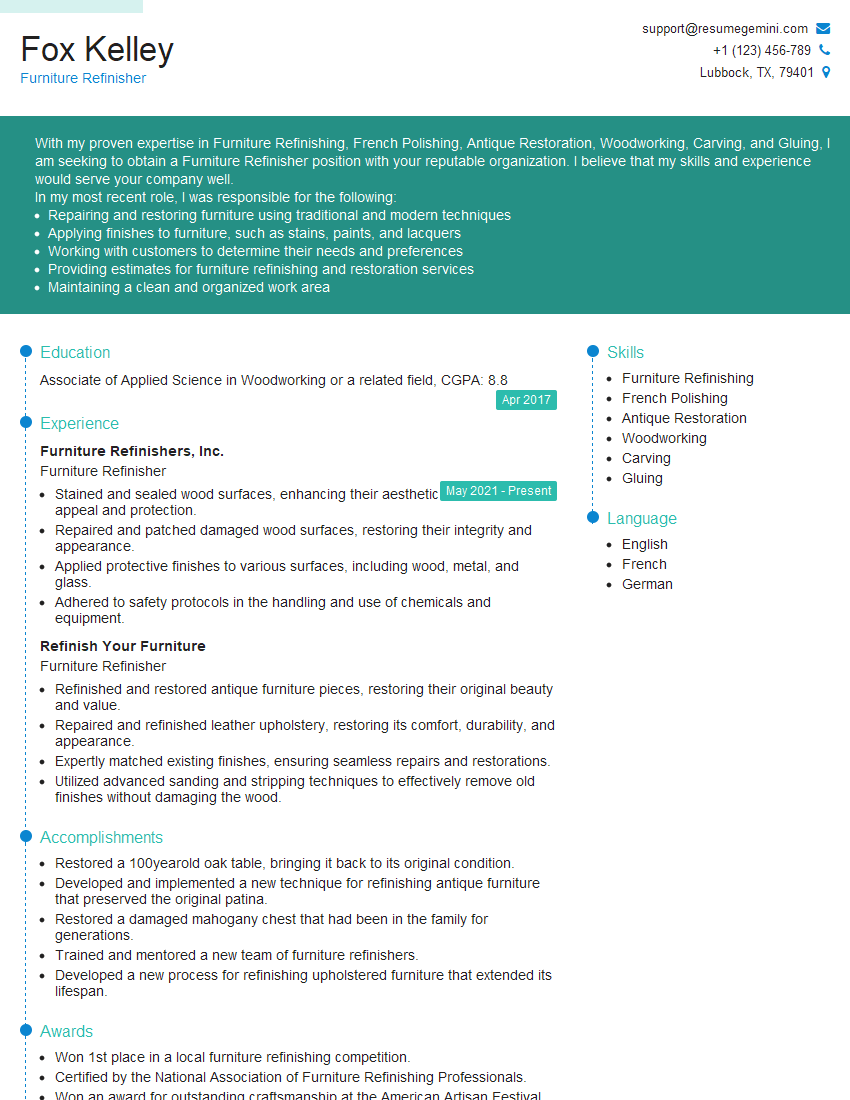
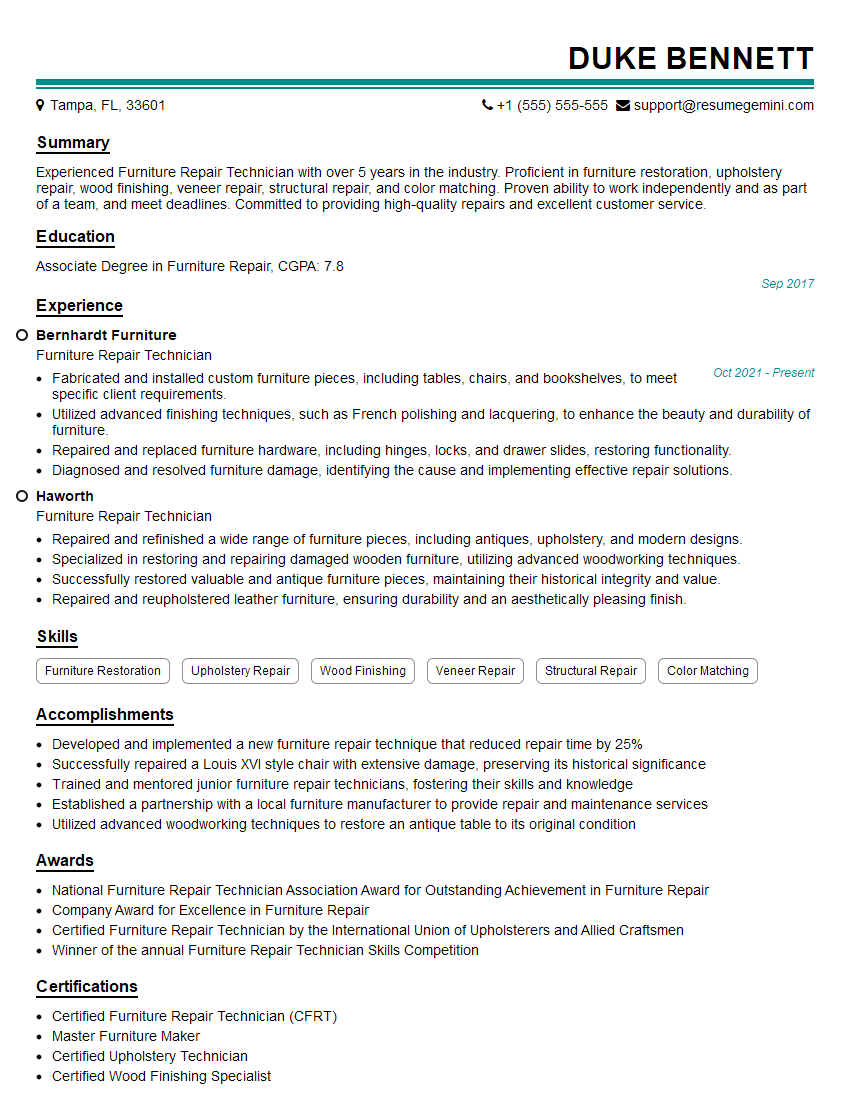
Mastering the art of furniture restoration opens doors to a rewarding and fulfilling career. A strong understanding of the principles and techniques discussed above is crucial for success in interviews and your future work. To maximize your job prospects, focus on crafting an ATS-friendly resume that highlights your skills and experience effectively. ResumeGemini is a trusted resource to help you build a professional and impactful resume. They provide examples of resumes tailored to the Furniture Restoration field, ensuring your application stands out from the competition.
Explore more articles
Users Rating of Our Blogs
Share Your Experience
We value your feedback! Please rate our content and share your thoughts (optional).
What Readers Say About Our Blog
Really detailed insights and content, thank you for writing this detailed article.
IT gave me an insight and words to use and be able to think of examples