Unlock your full potential by mastering the most common Experience in cotton trading and marketing interview questions. This blog offers a deep dive into the critical topics, ensuring you’re not only prepared to answer but to excel. With these insights, you’ll approach your interview with clarity and confidence.
Questions Asked in Experience in cotton trading and marketing Interview
Q 1. Explain the difference between spot and futures contracts in cotton trading.
Spot and futures contracts are two different ways to buy and sell cotton, differing primarily in the timing of delivery. A spot contract is an agreement to buy or sell cotton for immediate delivery – usually within a few days. Think of it like buying groceries at the supermarket; you pay and take the goods home right away. A futures contract, on the other hand, is an agreement to buy or sell cotton at a specific price on a future date. This is like pre-ordering a limited edition item; you agree on the price and delivery date in advance, mitigating the risk of price changes later.
For example, a textile mill might use a spot contract to purchase cotton immediately to keep their production line running. In contrast, a cotton farmer might use a futures contract to lock in a price for their harvest several months in advance, protecting against potential price drops before the cotton is ready for sale. The futures market offers price discovery and risk management tools unavailable in the spot market.
Q 2. Describe your experience with hedging cotton price risk.
Hedging is crucial in cotton trading to mitigate price risk. My experience involves using futures contracts extensively. For instance, a cotton farmer expecting a large harvest might sell futures contracts for an equivalent quantity of cotton. This locks in a minimum price, protecting them from a market downturn. Conversely, a textile mill anticipating high cotton demand in the future can buy futures contracts to secure supply at a predetermined price, safeguarding against price increases.
I’ve successfully employed various hedging strategies, including long and short hedging, depending on the client’s specific needs and market conditions. For example, a client worried about rising prices would benefit from a long hedge (buying futures contracts), while a client concerned about price declines would opt for a short hedge (selling futures contracts). The success of hedging relies on accurately forecasting market movements and selecting appropriate hedging ratios.
Q 3. How do you analyze cotton market trends and predict price fluctuations?
Analyzing cotton market trends involves a multi-faceted approach. I begin by examining macroeconomic factors like global economic growth, currency exchange rates, and inflation. These factors significantly influence demand for cotton textiles. Then, I dive into supply-side factors like weather patterns (affecting crop yields), government policies (subsidies, trade restrictions), and technological advancements in cotton farming. I use both fundamental analysis (examining supply and demand factors) and technical analysis (chart patterns, indicators) to predict price fluctuations.
Data from various sources, including government reports (USDA reports on cotton production and consumption), market intelligence services, and historical price data, are crucial. I use statistical models and forecasting techniques to interpret this data and make predictions, always acknowledging the inherent uncertainty in market forecasting. For example, unexpected weather events can drastically alter supply and price forecasts.
Q 4. What are the key factors influencing global cotton supply and demand?
Global cotton supply and demand are influenced by a complex interplay of factors. On the supply side, weather conditions in major cotton-producing regions are paramount. Droughts or excessive rainfall can significantly reduce yields. Technological advancements in farming practices, such as improved seed varieties and irrigation techniques, impact productivity. Government policies, such as subsidies or export restrictions, can also influence supply. Pest infestations and diseases are additional unpredictable variables affecting cotton production.
Demand for cotton is driven by the textile industry’s health, particularly clothing and apparel manufacturing. Global economic growth is a major influence, as strong economies translate into increased demand for textiles. Fashion trends and consumer preferences also play a part, with some fabrics more popular than others at different times. The emergence of substitute fibers, like synthetic materials, also impacts demand. Changes in trade policies and tariffs can significantly affect the flow of cotton in global markets.
Q 5. Explain your understanding of different cotton grades and qualities.
Cotton grades and qualities are determined by several factors, primarily fiber length, strength, uniformity, and micronaire (fiber fineness). Longer, stronger, and more uniform fibers generally command higher prices as they produce higher-quality textiles. Micronaire indicates fiber maturity and impacts the spinning performance. Different grades are classified using standardized systems, such as the USDA’s classification system, which uses various parameters like fiber length and strength to determine the grade.
For example, extra-long staple (ELS) cotton, known for its superior quality and high price, is used in high-end garments. Shorter staple cotton is used in lower-grade textiles. Understanding these grades is critical for pricing and matching cotton to specific manufacturing requirements. I’ve had extensive experience in assessing cotton quality through laboratory testing and visual inspection, ensuring clients receive cotton that meets their exact specifications.
Q 6. Describe your experience with international cotton trade regulations.
International cotton trade is governed by a complex web of regulations, including those set by the World Trade Organization (WTO), individual countries’ trade policies, and international agreements. These regulations affect tariffs, quotas, and sanitary and phytosanitary (SPS) measures. Understanding these regulations is essential for navigating the global cotton market. For example, tariffs imposed by importing countries can significantly impact the competitiveness of cotton exports from certain regions.
My experience includes ensuring compliance with all relevant regulations, including documentation requirements for international shipments. I understand the intricacies of trade agreements, such as those involving preferential trade arrangements, and have worked with different customs authorities to ensure smooth and efficient trading operations. Staying updated on changes in international trade policies is crucial to successful international cotton trading.
Q 7. How do you manage inventory risk in cotton trading?
Inventory risk in cotton trading involves the potential for losses due to price fluctuations, spoilage, or obsolescence. To manage this risk, I use several strategies. Accurate demand forecasting is paramount; overstocking leads to potential price drops and storage costs, while understocking can disrupt supply chains. Diversification across different cotton grades and qualities can reduce exposure to risks associated with specific types of cotton. I also employ efficient warehouse management systems to track inventory levels and minimize storage costs.
Furthermore, hedging strategies, as discussed earlier, play a vital role in managing inventory risk by protecting against price fluctuations. Insurance is another valuable tool to cover potential losses from unforeseen events, like fire or damage to stored cotton. Regular inventory audits and careful monitoring of market conditions help identify potential issues and allow for timely adjustments to mitigate risks. Effective inventory management is critical to ensure profitability in cotton trading.
Q 8. What are your strategies for negotiating favorable cotton purchase or sales agreements?
Negotiating favorable cotton purchase or sales agreements requires a multifaceted approach combining market knowledge, strong communication, and strategic planning. It’s akin to a chess game, anticipating your opponent’s moves and leveraging your strengths.
My strategy begins with thorough market research. I analyze current prices, supply and demand dynamics, and future projections using various market information platforms and analytical tools. This informs my initial offer price, ensuring it’s competitive yet profitable. For example, if I know a particular variety of cotton is experiencing a short supply due to weather conditions in a key growing region, I can leverage this information to negotiate a higher price for my sale.
Next, I focus on building strong relationships with buyers and sellers. Trust and rapport are essential. Open and transparent communication is crucial. I clearly lay out my terms and conditions, addressing any concerns proactively. I’m always prepared to compromise on certain aspects, but always protect my bottom line. For instance, I might negotiate flexible delivery schedules or payment terms in exchange for a slightly lower price.
Finally, I utilize a structured negotiation process. This includes identifying key priorities, defining walk-away points, and employing various negotiation tactics such as anchoring, bundling, and concession making. Always document everything – agreements, communications, and changes – to avoid future misunderstandings.
Q 9. How do you assess the creditworthiness of cotton buyers and suppliers?
Assessing the creditworthiness of cotton buyers and suppliers is critical to mitigating financial risk in this business. I use a multi-pronged approach that combines financial statement analysis, credit reports, and industry references.
Firstly, I request and thoroughly review the financial statements of potential partners. I look for indicators of financial health, such as profitability, liquidity, and solvency ratios. A low debt-to-equity ratio and strong cash flow are positive signs. I also carefully analyze their accounts receivable and payable to understand their payment history.
Secondly, I utilize credit rating agencies and commercial credit reports to obtain a comprehensive overview of the entity’s credit history and payment patterns. These reports provide a numerical score and detailed information on previous defaults or bankruptcies.
Thirdly, and perhaps most importantly, I conduct thorough industry background checks and seek references from other businesses that have worked with the buyer or supplier. Talking to others in the network provides invaluable insights into their reliability and reputation. It’s about building confidence in their ability to meet their financial obligations.
Combining these three methods gives a robust assessment, allowing me to make informed decisions and minimize the risk of non-payment.
Q 10. Explain your knowledge of various cotton delivery methods and logistics.
Cotton delivery methods and logistics are complex and vary depending on factors like volume, distance, and buyer requirements. I have extensive experience in managing all aspects of this process, ensuring timely and cost-effective delivery.
Common methods include rail transport, which is cost-effective for large volumes over long distances; trucking, suitable for smaller shipments and shorter distances; and ocean freight, crucial for international trade. The choice depends heavily on the specifics of each transaction. For example, I would choose rail transport for a large order to a nearby port, followed by ocean freight to an overseas buyer.
Logistics involve careful planning and coordination. This encompasses everything from selecting appropriate transport modes and arranging insurance to managing documentation and tracking shipments. I work closely with freight forwarders and logistics providers to optimize efficiency and minimize delays. Effective logistics management requires real-time tracking, ensuring transparency and responsiveness to potential issues. Using technology such as GPS tracking and online shipment management platforms is crucial in today’s market.
Furthermore, I’m intimately familiar with the importance of proper packaging and handling to prevent damage during transport. Appropriate packaging protects the cotton’s quality and reduces potential loss.
Q 11. How do you handle disputes or discrepancies in cotton transactions?
Disputes and discrepancies in cotton transactions are unfortunately common. My approach to resolving them emphasizes open communication, collaboration, and a fair and equitable solution. Prevention is key, and detailed contracts with clear terms are paramount.
My first step is always to review the contract carefully to understand the terms and conditions, identifying the specific area of disagreement. Then, I initiate open communication with the counterparty, seeking to understand their perspective and explore potential solutions. This often involves presenting supporting documentation such as quality test reports, shipping documents, and communication records.
If direct negotiation fails, I am prepared to involve independent third-party mediators or arbitrators to facilitate a resolution. The goal is always to reach a mutually agreeable solution that minimizes financial losses and preserves the business relationship where possible. However, I’m also prepared to pursue legal action if necessary to protect my interests.
To minimize disputes, I rigorously document every step of the transaction, from initial negotiation to final payment. This meticulous record-keeping provides a clear audit trail, making it easier to resolve any disagreements that might arise.
Q 12. Describe your experience with cotton quality control and testing procedures.
Cotton quality control and testing are crucial to ensuring the value and integrity of the product. My experience includes hands-on familiarity with various testing methods, from fiber length and strength measurements to color and micronaire assessments.
We typically begin with visual inspection to assess the cotton’s cleanliness and overall appearance. Then, we employ standardized testing procedures using high-precision equipment. This involves determining fiber length (using instruments like the High Volume Instrument or HVI), strength, and maturity (via micronaire readings). Color assessment is also vital, using standardized color scales. We might also test for impurities like leaf and trash content.
These tests are conducted either in-house using certified laboratory equipment or by independent third-party laboratories. Results are carefully documented and shared with buyers, helping to build trust and transparency. Adherence to industry standards, like those set by organizations such as the International Cotton Association (ICA), ensures consistency and reliability.
In addition to physical testing, I also take into account growing conditions and harvesting methods that could affect quality. This holistic approach provides a comprehensive view of the cotton’s quality, allowing for accurate pricing and expectations.
Q 13. How familiar are you with different cotton spinning technologies and their impact on market demand?
My understanding of cotton spinning technologies and their impact on market demand is extensive. Different spinning technologies produce yarns with varying characteristics, directly influencing the final product’s quality and cost, subsequently affecting market demand.
Ring spinning remains the dominant technology, producing robust and versatile yarns suitable for various applications. However, advancements in rotor spinning offer higher production speeds and lower costs, making it attractive for certain markets like inexpensive garments. Air-jet spinning generates finer and more uniform yarns, ideal for higher-quality fabrics.
Technological advancements constantly change the demand landscape. For example, the growing preference for sustainable and eco-friendly textiles is driving demand for yarns produced using more sustainable spinning technologies and cotton varieties.
I actively monitor advancements in spinning technologies and their market implications. This allows me to anticipate shifts in demand, adjust my trading strategies, and advise clients on the most appropriate cotton varieties for their specific needs. I also consider the environmental footprint of different production processes, aligning my activities with the emerging trends in sustainable sourcing.
Q 14. What is your experience with using cotton market information platforms and analytical tools?
I’m proficient in utilizing various cotton market information platforms and analytical tools to gain a competitive edge. These tools are indispensable for informed decision-making in this dynamic market.
I regularly consult reputable market reporting services that provide detailed information on prices, supply and demand trends, and market forecasts. I also use specialized software for data analysis, allowing me to identify patterns, predict price movements, and optimize trading strategies. This includes statistical modeling and forecasting techniques to better understand market volatility.
Furthermore, I use online trading platforms to access real-time market data, enabling me to react swiftly to price fluctuations and market opportunities. This constant monitoring allows for proactive adjustments to buying and selling strategies.
The integration of data analytics into my workflow is crucial. I leverage data visualization tools to effectively communicate market trends and insights to clients and stakeholders. This ensures informed decisions are made, reducing risk and improving profitability.
Q 15. Describe your understanding of sustainable cotton farming practices and their impact on the market.
Sustainable cotton farming, also known as sustainable cotton production, encompasses practices that minimize environmental impact and promote social responsibility throughout the cotton supply chain. This includes reducing water usage, minimizing pesticide and fertilizer application, protecting biodiversity, and ensuring fair labor practices.
The impact on the market is significant. Consumers are increasingly demanding sustainably produced goods, leading to a higher market value for certified sustainable cotton (like Better Cotton Initiative or Organic cotton). Brands are incorporating sustainability into their sourcing strategies to enhance their image and attract environmentally conscious consumers. This increased demand drives innovation in farming techniques and supply chain transparency.
For example, the adoption of water-efficient irrigation techniques not only benefits the environment but also can lead to lower production costs for farmers in water-stressed regions, making their cotton more competitive in the market. Similarly, reducing pesticide use improves worker health and safety, aligning with consumer expectations and potentially reducing the risk of pesticide residue-related recalls.
Career Expert Tips:
- Ace those interviews! Prepare effectively by reviewing the Top 50 Most Common Interview Questions on ResumeGemini.
- Navigate your job search with confidence! Explore a wide range of Career Tips on ResumeGemini. Learn about common challenges and recommendations to overcome them.
- Craft the perfect resume! Master the Art of Resume Writing with ResumeGemini’s guide. Showcase your unique qualifications and achievements effectively.
- Don’t miss out on holiday savings! Build your dream resume with ResumeGemini’s ATS optimized templates.
Q 16. How do you identify and mitigate risks associated with cotton price volatility?
Cotton price volatility is a major risk in the industry, driven by factors like weather patterns, global supply and demand, economic conditions, and government policies. Mitigating this risk requires a multi-pronged approach.
- Hedging: Utilizing financial instruments like futures contracts allows locking in prices for future cotton deliveries, protecting against price drops. For example, if I anticipate a price decline, I can sell futures contracts to offset potential losses.
- Diversification: Spreading risk across different cotton origins, grades, and trading partners minimizes the impact of localized events. A diversified portfolio is more resilient to unexpected price fluctuations in any one segment.
- Market analysis: Thorough monitoring of global cotton production forecasts, weather patterns, and economic indicators is crucial for predicting price trends and adapting trading strategies accordingly. This often involves using statistical models and considering geopolitical factors.
- Strong supplier relationships: Building long-term relationships with reliable suppliers allows for securing consistent supply at agreed-upon prices or price ranges, providing some protection against market volatility.
By combining these techniques, a robust risk management strategy can significantly reduce the impact of price fluctuations on profitability.
Q 17. What are the key challenges facing the cotton industry today?
The cotton industry faces several critical challenges:
- Climate Change: Erratic weather patterns, including droughts and floods, significantly impact cotton yields and quality.
- Pesticide Resistance: The overuse of pesticides leads to pest resistance, requiring more intensive and costly pest management strategies.
- Water Scarcity: Cotton cultivation is water-intensive, leading to concerns about water sustainability, especially in arid and semi-arid regions.
- Competition from Synthetic Fibers: The increasing use of synthetic fibers, like polyester, poses a challenge to cotton’s market share.
- Labor Concerns: Ensuring fair labor practices throughout the supply chain, including addressing issues like child labor and worker exploitation, is a critical ethical concern.
- Price Volatility: As previously discussed, unpredictable price fluctuations significantly impact profitability and investment decisions.
Addressing these challenges requires a collaborative effort involving farmers, industry stakeholders, researchers, and policymakers to promote sustainable and resilient cotton production systems.
Q 18. How do you forecast cotton prices for short-term and long-term strategies?
Cotton price forecasting involves analyzing various factors to predict future prices. Short-term forecasting (e.g., a few months) relies more heavily on immediate market dynamics like current supply and demand, recent weather events, and speculative trading activity.
Long-term forecasting (e.g., years) incorporates broader factors such as projected global consumption, technological advancements affecting production, and changes in consumer preferences. It often involves econometric modeling and considering long-term trends in global economies and agricultural production.
For example, a short-term forecast might use a moving average model based on recent price data, while a long-term forecast might utilize a more complex model that incorporates climate projections, demographic shifts influencing cotton demand, and estimates of the adoption of genetically modified cotton varieties.
While I can’t disclose proprietary forecasting methodologies, my approach always involves a combination of quantitative analysis and qualitative assessment of market trends and geopolitical factors. Accurate forecasting requires constant monitoring and refinement of predictive models.
Q 19. Explain your experience with building and maintaining relationships with cotton suppliers and buyers.
Building strong relationships with suppliers and buyers is crucial in cotton trading. It’s about trust, reliability, and mutual benefit.
With suppliers, I focus on establishing long-term partnerships based on fair pricing, consistent quality, and reliable delivery. This involves regular communication, site visits to farms when possible (to assess production methods and quality), and understanding their challenges and needs. A shared commitment to sustainability is becoming increasingly important in these relationships.
With buyers, building rapport is about understanding their specific needs and preferences regarding cotton quality, quantity, and delivery timelines. Providing excellent customer service, ensuring timely information updates, and proactively addressing any concerns builds trust and fosters long-term loyalty. Maintaining transparent communication and competitive pricing are key to maintaining strong buyer relationships.
One successful strategy I’ve used is organizing supplier visits to meet buyers, fostering direct interaction and building stronger bonds of trust and understanding.
Q 20. How do you manage a large cotton trading portfolio?
Managing a large cotton trading portfolio requires a systematic and organized approach. It involves:
- Portfolio diversification: Spreading investments across different cotton grades, origins, and contracts to mitigate risk.
- Risk management: Implementing hedging strategies, as discussed earlier, to protect against price fluctuations.
- Inventory management: Efficiently tracking and managing cotton inventory, including storage and logistics, to minimize costs and spoilage.
- Financial monitoring: Closely tracking financial performance, including profits, losses, and cash flows, to ensure profitability and identify areas for improvement.
- Data analysis: Utilizing data analysis tools to identify trends, evaluate risk, and make informed trading decisions.
- Compliance: Adhering to all relevant regulations and ethical standards in cotton trading.
Efficient use of technology, such as inventory management software and trading platforms, streamlines these processes and ensures accuracy.
Q 21. Describe your proficiency in using relevant software for cotton trading (e.g., trading platforms, ERP systems).
I’m proficient in several software applications crucial for cotton trading. This includes:
- Trading platforms: I have extensive experience using various trading platforms for executing futures and options contracts, accessing market data, and managing positions. These platforms often include real-time price information, charting tools, and order management functionalities. Specific examples include
Bloomberg Terminaland other proprietary trading systems. - ERP systems: Enterprise Resource Planning systems are essential for managing inventory, tracking transactions, and analyzing financial performance. I’m familiar with using these systems to manage the entire trading lifecycle, from purchase orders to invoicing.
- Data analysis tools: I utilize spreadsheet software like
Microsoft Exceland statistical packages likeRorPythonfor advanced data analysis, trend identification, and model building for price forecasting. - Supply chain management software: This is critical for managing logistics, tracking shipments, and ensuring timely delivery of cotton.
My proficiency in these software tools allows me to efficiently manage large-scale cotton trading operations and make data-driven decisions.
Q 22. How do you ensure compliance with relevant regulations in cotton trading?
Ensuring compliance in cotton trading hinges on meticulous adherence to a range of regulations, varying by location and trading entity. This involves understanding and following laws related to contract specifications, weight and quality standards, export/import regulations, and ethical sourcing practices. For example, the USDA’s regulations concerning cotton classification and quality grading are crucial in the US. Internationally, organizations like the International Cotton Advisory Committee (ICAC) provide guidelines and standards that many traders abide by. My approach includes:
- Regular updates on legal frameworks: Staying informed about changes in regulations through industry publications, legal counsel, and participation in relevant trade associations.
- Strict contract adherence: Ensuring every contract clearly outlines quality standards, delivery terms, payment conditions, and dispute resolution mechanisms, minimizing ambiguity and potential legal issues.
- Documentation and traceability: Maintaining meticulous records of every transaction, including origin, quality testing results, and transportation details, for complete transparency and compliance audits.
- Third-party verification: Utilizing independent inspectors and certification bodies to validate the quality and ethical sourcing of cotton batches, thereby ensuring compliance and building trust with buyers.
- Internal compliance programs: Implementing robust internal procedures and training programs to educate employees about compliance standards and best practices.
In one instance, a shipment was held up due to inconsistencies in documentation. By swiftly providing supporting evidence of compliance, we ensured timely release and avoided significant financial losses. This highlights the crucial role of proactive compliance.
Q 23. Describe your experience in market research for cotton.
Market research in cotton is multifaceted, requiring an understanding of both macro and micro factors impacting supply and demand. My experience involves a multi-pronged approach:
- Analyzing global supply and demand: Monitoring factors like weather patterns (affecting crop yields), global economic conditions, and textile industry trends to predict price fluctuations.
- Competitive analysis: Evaluating the strategies and market share of key competitors, identifying their strengths and weaknesses, and adapting our strategies accordingly. This includes examining pricing strategies, sourcing methods, and marketing approaches.
- Fiber property analysis: Assessing the quality characteristics of cotton from different growing regions to understand their suitability for various textile applications. For instance, extra-long staple cotton commands a premium due to its superior properties for high-end garments.
- Consumer trend analysis: Studying consumer preferences regarding clothing styles, fabric types, and sustainability concerns to anticipate future demands and align our product offerings accordingly.
- Data analytics and forecasting: Utilizing statistical modeling and predictive analytics to forecast cotton prices and demand trends, informing our trading and marketing decisions.
For instance, anticipating a lower-than-expected yield in a key cotton-producing region, due to drought, allowed us to proactively secure alternative supply sources and mitigate potential price increases, safeguarding our profitability.
Q 24. Explain your understanding of cotton bale packaging and handling.
Cotton bale packaging and handling are critical for preserving fiber quality and ensuring efficient transportation and storage. My experience covers:
- Bale preparation: Understanding the various methods of compressing and wrapping cotton bales to optimize density, minimize damage during transit, and protect against moisture and pest infestation. This includes knowledge of different bale sizes and wrapping materials.
- Transportation and logistics: Managing the efficient transportation of cotton bales, from the gin to warehouses and processing facilities, minimizing transit time and potential damage. This requires coordination with trucking companies, rail operators, and port authorities.
- Warehousing and storage: Implementing proper storage techniques to protect cotton bales from environmental factors like moisture and pests. This involves utilizing climate-controlled warehouses, proper stacking methods, and regular inspections.
- Quality control during handling: Implementing measures to monitor bale integrity throughout the handling process, identifying and addressing any damage or contamination issues. This includes regular inspections and sampling for quality assessment.
I’ve personally overseen projects improving warehouse efficiency through better stacking strategies and optimized transportation routes, reducing handling time and minimizing the risk of bale damage.
Q 25. How do you evaluate the financial performance of cotton trading activities?
Evaluating the financial performance of cotton trading requires a comprehensive analysis of various factors. My approach involves:
- Tracking key performance indicators (KPIs): Monitoring metrics like gross profit margin, net profit margin, return on investment (ROI), and inventory turnover to assess the profitability and efficiency of trading activities.
- Cost analysis: Analyzing the various costs associated with cotton trading, including purchasing, transportation, storage, insurance, and financing costs. Identifying areas for cost optimization is crucial for improving profitability.
- Risk management assessment: Evaluating the impact of price volatility, foreign exchange risk, and credit risk on trading performance. This includes employing risk mitigation strategies like hedging and diversification.
- Financial reporting and analysis: Preparing regular financial reports summarizing trading activities, analyzing performance trends, and identifying areas for improvement.
- Benchmarking and comparison: Comparing our trading performance against industry benchmarks and competitors to identify best practices and areas for enhancement.
For instance, through detailed cost analysis, we identified inefficiencies in transportation and implemented a new logistics system, resulting in a 15% reduction in transportation costs.
Q 26. What are your strategies for managing cotton supply chain disruptions?
Managing cotton supply chain disruptions requires a proactive and multi-layered approach. My strategies include:
- Diversification of sourcing: Procuring cotton from multiple origins and suppliers to reduce reliance on a single source and mitigate the impact of localized disruptions like adverse weather or political instability.
- Building strong supplier relationships: Cultivating strong relationships with key suppliers to ensure reliable supply even during challenging times. This often involves long-term contracts and collaborative partnerships.
- Inventory management: Maintaining strategic inventory levels to buffer against unexpected supply shortages or delays. This requires careful forecasting and demand planning.
- Contingency planning: Developing contingency plans to address various potential disruptions, such as natural disasters, geopolitical events, or transportation bottlenecks. This involves identifying alternative suppliers, transportation routes, and processing facilities.
- Real-time monitoring and communication: Employing real-time tracking systems to monitor the movement of cotton shipments and communicate effectively with suppliers, transporters, and customers to promptly address any issues.
During a recent port strike, our contingency plan, which involved rerouting shipments via alternative ports, allowed us to successfully meet our customer commitments without significant delays or cost increases.
Q 27. How familiar are you with different cotton fiber properties and their effects on textile manufacturing?
My understanding of cotton fiber properties and their impact on textile manufacturing is extensive. Fiber properties such as staple length, strength, fineness, maturity, and color significantly influence the final fabric’s quality, feel, and performance.
- Staple length: Longer staple lengths generally result in stronger, smoother, and more lustrous fabrics, suitable for high-quality garments.
- Strength: Stronger fibers lead to more durable fabrics with improved tear and abrasion resistance.
- Fineness: Finer fibers create softer, more comfortable fabrics with a luxurious feel.
- Maturity: Mature fibers are stronger and more resistant to damage, leading to better fabric quality.
- Color: Fiber color affects the dyeing process and the final fabric shade, influencing the cost and aesthetics of the final product.
For example, understanding that extra-long staple cotton is ideal for high-end shirting allows me to target the right buyers and command a premium price. Conversely, shorter staple cotton might be better suited for lower-cost blends, enabling effective price point management.
Q 28. Describe your experience in developing and implementing cotton marketing strategies.
Developing and implementing successful cotton marketing strategies necessitates a deep understanding of the market, competitive landscape, and customer needs. My approach involves:
- Market segmentation: Identifying specific target markets based on their needs, preferences, and purchasing behavior. This might include targeting specific textile manufacturers, retailers, or brands.
- Value proposition development: Articulating a clear and compelling value proposition that highlights the unique benefits of our cotton, such as superior quality, ethical sourcing, or sustainability certifications.
- Marketing channel selection: Choosing the most effective marketing channels to reach our target audience. This could include direct sales, online platforms, industry trade shows, and collaborations with key influencers.
- Branding and communication: Developing a strong brand identity that communicates the quality, reliability, and ethical values of our cotton. This includes crafting effective marketing materials and engaging in industry networking.
- Pricing strategy: Determining an optimal pricing strategy that balances profitability with competitiveness. This involves considering factors like supply and demand, cost structure, and competitor pricing.
In one instance, by leveraging a successful branding campaign highlighting our sustainable sourcing practices, we increased our market share within the niche of eco-conscious brands significantly, securing long-term contracts with major retailers.
Key Topics to Learn for Your Cotton Trading and Marketing Interview
- Understanding Global Cotton Markets: Analyze supply and demand dynamics, influencing factors (weather, geopolitical events, economic trends), and price forecasting methodologies.
- Cotton Trading Strategies: Explore hedging, speculation, arbitrage, and risk management techniques used in cotton trading. Understand the role of futures contracts and options.
- Marketing and Sales Techniques: Develop proficiency in identifying target markets, negotiating contracts, building client relationships, and managing sales pipelines within the cotton industry.
- Quality Control and Standards: Familiarize yourself with cotton grading systems, quality parameters, and international standards ensuring consistent product quality and meeting customer specifications.
- Logistics and Supply Chain Management: Understand the complexities of cotton transportation, warehousing, and inventory management. Analyze efficient supply chain strategies for minimizing costs and maximizing delivery efficiency.
- Regulatory Compliance: Gain awareness of relevant regulations and trade compliance procedures in the cotton industry, including import/export regulations and ethical sourcing practices.
- Data Analysis and Interpretation: Develop skills in interpreting market data, analyzing trends, and using this information to inform trading and marketing decisions. Proficiency in relevant software is advantageous.
- Problem-Solving and Decision-Making: Prepare examples demonstrating your ability to analyze complex situations, make informed decisions under pressure, and effectively manage risk in the fast-paced cotton market.
Next Steps
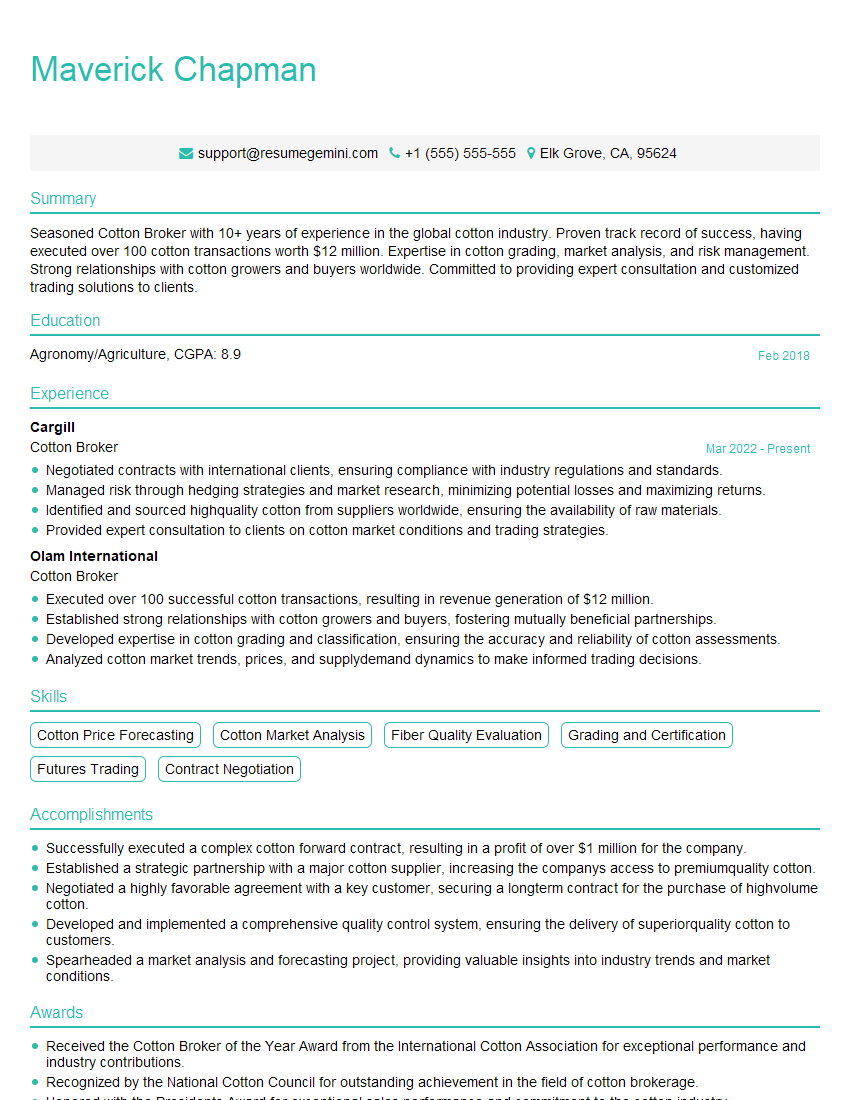
Mastering the intricacies of cotton trading and marketing is crucial for a successful and rewarding career in this dynamic industry. It opens doors to lucrative opportunities and positions you for professional advancement. To significantly increase your chances of landing your dream job, creating an ATS-friendly resume is paramount. This ensures your qualifications are effectively showcased to potential employers. We recommend leveraging ResumeGemini, a trusted resource for building professional resumes that stand out. ResumeGemini provides examples of resumes tailored specifically for individuals with experience in cotton trading and marketing, helping you craft a compelling document that highlights your skills and experience effectively.
Explore more articles
Users Rating of Our Blogs
Share Your Experience
We value your feedback! Please rate our content and share your thoughts (optional).
What Readers Say About Our Blog
Really detailed insights and content, thank you for writing this detailed article.
IT gave me an insight and words to use and be able to think of examples