The thought of an interview can be nerve-wracking, but the right preparation can make all the difference. Explore this comprehensive guide to Inking and Dampening Systems interview questions and gain the confidence you need to showcase your abilities and secure the role.
Questions Asked in Inking and Dampening Systems Interview
Q 1. Explain the function of an inking system in offset printing.
The inking system in offset printing is responsible for delivering the correct amount of ink to the printing plate, ensuring consistent color density and image quality across the entire print run. Think of it as the circulatory system of the printing press, constantly supplying the ‘blood’ (ink) to create the image.
It achieves this through a series of rollers that transfer ink from the ink fountain to the plate. These rollers work together in a precise sequence to meter, distribute, and transfer the ink effectively. The design of the inking system impacts the ink film thickness, which directly influences the final printed result.
A well-maintained inking system is crucial for preventing problems like streaks, mottling, and poor color reproduction. Regular cleaning and adjustments are vital for optimal performance.
Q 2. Describe the components of a typical dampening system.
A typical dampening system in offset lithography consists of several key components working in concert to maintain the proper balance of water on the printing plate. The goal is to prevent ink from adhering to the non-image areas. Imagine it as a carefully controlled water ‘shield’ protecting the non-image areas.
- Fountain Solution Reservoir: Stores the fountain solution (a mixture of water, isopropyl alcohol, and sometimes other additives).
- Ductor Roller: Transfers the fountain solution from the reservoir to the system.
- Dampening Rollers: A series of rollers that distribute the fountain solution evenly across the plate.
- Plate Cylinder: The cylinder which holds the printing plate and receives the dampening solution.
- Water Metering System: Controls the amount of fountain solution delivered to the plate (often with adjustable settings to control water flow).
The exact configuration and number of rollers can vary depending on the printing press model and specific requirements.
Q 3. What are the different types of ink used in offset printing?
Offset printing utilizes various types of inks, each designed for specific applications and substrates. The choice depends on factors such as the desired color gamut, drying properties, and the type of paper being printed on.
- Conventional (Solvent-Based) Inks: These inks use solvents to reduce viscosity and aid in drying. They provide vibrant colors and excellent gloss, but have environmental concerns due to VOC emissions.
- UV (Ultraviolet) Curable Inks: These inks cure instantly when exposed to UV light, eliminating drying time and allowing for immediate post-printing processes. They are environmentally friendly but require specialized equipment.
- Vegetable-Based Inks: These are environmentally friendly alternatives that use vegetable oils instead of petroleum-based solvents. They are gaining popularity due to their sustainability.
- Water-Based Inks: These inks use water as a solvent and are environmentally preferred, but their color vibrancy and drying properties might be less than those of solvent-based inks.
Selecting the right ink is paramount to achieving the desired printing quality and meeting environmental regulations.
Q 4. How does ink viscosity affect printing quality?
Ink viscosity—its thickness or resistance to flow—significantly affects printing quality. Imagine trying to paint with paint that is too thick or too thin; the results wouldn’t be ideal.
High Viscosity: Too thick ink leads to uneven ink transfer, resulting in blotchy prints, poor color reproduction, and slow drying times. It can also clog the ink system.
Low Viscosity: Too thin ink can lead to poor ink lay-down, blurry images, and excessive ink consumption. It can also cause the ink to spread beyond the intended image area.
Optimal viscosity is crucial for achieving consistent and high-quality prints. It’s usually controlled by adjusting the ink temperature and adding additives to modify its flow characteristics.
Q 5. Explain the role of fountain solution in offset printing.
Fountain solution, also known as dampening solution, plays a crucial role in offset lithography. It is a water-based solution that is applied to the printing plate to maintain a hydrophilic (water-loving) surface on the non-image areas. This ensures that only the image areas (hydrophobic, or water-repelling) accept the ink.
Without the fountain solution, the ink would adhere to the entire surface of the plate, resulting in a solid, unattractive print. The solution helps to control ink-water balance, a critical aspect for good print quality. The composition and pH of the fountain solution must be carefully monitored and adjusted to maintain optimal performance.
Q 6. What is the purpose of a ductor roller?
The ductor roller is a crucial component of the dampening system. Its primary function is to transfer the fountain solution from the reservoir to the dampening rollers. It acts as the ‘delivery system’ for the water.
It precisely meters the fountain solution, preventing excessive water from reaching the plate. A properly functioning ductor roller ensures a consistent and controlled supply of dampening solution, contributing to optimal ink-water balance and consistent print quality. Problems with the ductor roller can lead to poor print quality, such as streaks or mottle.
Q 7. Describe the process of ink transfer in offset lithography.
Ink transfer in offset lithography is a multi-step process involving a series of rollers and cylinders. The process leverages the principle of lithography, where ink adheres to the image areas of a plate while being repelled by non-image areas due to the careful balance of ink and water.
- Ink Transfer from Fountain to Rollers: Ink is transferred from the ink fountain to the ink rollers.
- Ink Distribution: The ink rollers distribute the ink evenly across the plate cylinder.
- Ink Transfer to Plate: The inked rollers transfer ink to the image areas of the printing plate.
- Intermediate Cylinder: The inked plate transfers the ink to an intermediate (blanket) cylinder.
- Paper Transfer: The intermediate cylinder transfers the ink to the paper, completing the printing process.
The precise and controlled movement of these rollers and cylinders is essential for accurate and consistent ink transfer, ensuring high-quality prints. Any issue in this sequence can lead to printing defects.
Q 8. How do you adjust ink density on a printing press?
Adjusting ink density on a printing press is crucial for achieving the desired print quality. It’s a delicate balance – too much ink leads to smearing and poor image definition, while too little results in faint, weak prints. The method depends on the type of press, but generally involves manipulating the ink supply to the rollers.
For example, on a sheet-fed offset press, you might adjust the ink keys (small screws or levers) on the ink fountain. Turning these keys alters the amount of ink flowing from the fountain to the rollers. You’ll also find adjustments on the individual ink rollers themselves, allowing fine-tuning of ink distribution across the form. Another crucial aspect is the durometer (hardness) of the rollers; softer rollers pick up more ink, while harder rollers transfer less. Monitoring and adjusting these factors is key to consistent density.
Another common method involves adjusting the roller settings on the inking system. This could involve changing the nip pressure between rollers or adjusting their position to optimize ink transfer. Remember to make small, incremental adjustments and visually check the results before making significant changes.
Q 9. What are the common problems associated with inking systems?
Inking system problems often manifest as inconsistent ink density, such as light or heavy areas on the printed sheet, or color variations across the run. Here are some common culprits:
- Roller wear or damage: Worn, scored, or incorrectly installed rollers lead to uneven ink transfer. Think of it like a worn tire – it doesn’t grip the road evenly.
- Ink viscosity issues: Ink that’s too thick or too thin will not transfer properly. Temperature fluctuations significantly affect ink viscosity, so temperature control is crucial.
- Fountain roller issues: Problems with the fountain roller, such as improper cleaning or incorrect adjustment, affect ink pickup from the fountain.
- Ink duct clogging: Accumulated ink or debris in the ink ducts restricts ink flow and can lead to streaks or missing ink.
- Incorrect ink-water balance: An imbalance drastically impacts ink transfer. We’ll discuss this in more detail later.
Addressing these requires a systematic approach, often involving visual inspection, cleaning, and replacement of worn parts.
Q 10. How do you troubleshoot a dampening system malfunction?
Dampening system malfunctions typically result in poor ink-water balance, leading to problems like mottle (uneven ink distribution), slur (ink smearing), or excessive water on the printed sheet. Troubleshooting involves a step-by-step approach:
- Visual Inspection: Carefully examine the dampening system rollers for wear, scoring, or contamination. Look for any leaks or blockages in the water delivery system.
- Water Level and Pressure Check: Ensure the fountain solution reservoir is filled to the correct level and that the water pressure is appropriate for the press. Incorrect water pressure can cause uneven distribution.
- Roller Adjustment: Check and adjust the dampening roller settings (pressure, position). The aim is for the rollers to distribute the fountain solution evenly across the plate.
- Fountain Solution Analysis: The pH and conductivity of the fountain solution should be within the recommended range for optimal performance. Testing the solution helps pinpoint issues related to its properties.
- Roller Cleaning: Thoroughly clean the dampening rollers to remove any ink or accumulated debris. Use the appropriate cleaning agents for your roller type.
Remember to make small adjustments and observe their impact before making significant changes. If the problem persists, consult your press manual or seek professional assistance.
Q 11. Explain the concept of ink-water balance.
Ink-water balance is the delicate equilibrium between the amount of ink and fountain solution (water-based solution) applied to the printing plate. It’s essential for high-quality offset printing. The fountain solution is used to keep the non-image areas of the plate from accepting ink, allowing for clean, sharp images. Too much water leads to poor ink transfer (resulting in light print or mottle), while too little causes the ink to smear (slur).
Imagine a sponge: The ink is like oil, and the water helps prevent the oil from spreading uncontrollably. The ideal balance ensures the ink only adheres to the image area of the plate.
Achieving the correct ink-water balance is a crucial aspect of print quality control. It’s monitored and adjusted constantly throughout a printing run to compensate for changes in temperature, humidity, and ink viscosity.
Q 12. How does temperature affect ink and fountain solution?
Temperature significantly affects both ink and fountain solution. Ink viscosity (thickness) increases in colder temperatures, making it harder to transfer, potentially resulting in light areas or stopping up the ink system. Conversely, warmer temperatures can thin the ink, leading to smearing or slur.
Fountain solution is also affected. Temperature changes alter its surface tension and pH, impacting its ability to repel ink from the non-image areas. Maintaining a consistent temperature within an ideal range is vital for consistent print quality. In many print shops, climate control in the pressroom becomes an essential aspect of maintaining print quality.
Q 13. What are the different types of dampening rollers?
Dampening systems employ various types of rollers, each with specific properties and functions. These are typically made of rubber, but their hardness (durometer) varies greatly:
- Ductor Roller: This roller picks up the fountain solution from the pan and transfers it to the other rollers.
- Form Roller(s): These distribute the fountain solution evenly across the printing plate. They typically have a slightly different durometer than the ductor roller.
- Dampening Rollers: These distribute the fountain solution across the plate before the ink rollers come into contact. Different designs and materials exist to optimize performance.
Choosing the right roller type and maintaining its condition is essential for proper dampening system function. The material and hardness of each roller are precisely chosen to effectively work with the others in the system.
Q 14. How do you maintain the proper ink-water balance?
Maintaining proper ink-water balance is an ongoing process, requiring constant monitoring and adjustments. Here’s a strategy:
- Regular Monitoring: Continuously observe the printed sheets for signs of imbalance (mottle, slur, light or heavy areas). Make small, incremental adjustments to the ink keys and dampening system controls based on these observations.
- Fountain Solution Control: Regularly check and maintain the correct pH and conductivity of the fountain solution. Using a fountain solution management system helps in automatic monitoring and adjustments of fountain solution.
- Temperature Control: Maintaining consistent temperature in the pressroom is crucial. Fluctuations affect both ink and fountain solution viscosity.
- Roller Maintenance: Regularly inspect and clean dampening rollers. Replace worn or damaged rollers promptly.
- Ink Viscosity Checks: Regularly check ink viscosity to ensure it’s within the manufacturer’s recommendations.
- Training and experience: A skilled press operator is crucial for effectively managing and adjusting the ink-water balance. Experience helps to quickly recognize subtle indications of changes in this delicate balance.
Think of it like baking – you constantly monitor and adjust the ingredients and temperature to achieve the perfect outcome. The same care and attention are needed to maintain the proper ink-water balance in printing.
Q 15. What is the impact of incorrect ink-water balance on print quality?
Incorrect ink-water balance significantly impacts print quality. Think of it like baking a cake – you need the right ratio of ingredients. Too much water (fountain solution) leads to mottling (uneven ink distribution), slurring (blurred text), and ink picking (ink lifting from the paper). Too little water results in dry trapping (ink not transferring smoothly), offsetting (ink smearing onto non-printed areas), and emulsion breaking (the ink and water separating, causing poor color reproduction). The ideal balance ensures smooth ink transfer, crisp images, and vibrant colors. Maintaining this balance requires regular monitoring of the dampening system and adjustments based on factors like paper type, ink viscosity, and environmental conditions.
Career Expert Tips:
- Ace those interviews! Prepare effectively by reviewing the Top 50 Most Common Interview Questions on ResumeGemini.
- Navigate your job search with confidence! Explore a wide range of Career Tips on ResumeGemini. Learn about common challenges and recommendations to overcome them.
- Craft the perfect resume! Master the Art of Resume Writing with ResumeGemini’s guide. Showcase your unique qualifications and achievements effectively.
- Don’t miss out on holiday savings! Build your dream resume with ResumeGemini’s ATS optimized templates.
Q 16. Describe the different methods for cleaning ink and fountain solution.
Cleaning ink and fountain solution is crucial for maintaining print quality and equipment longevity. Several methods exist:
- Wash-up solution: A specialized chemical solution designed to break down and emulsify ink and fountain solution, allowing for easy removal. This is often used in automated wash-up systems.
- Manual cleaning: This involves using rags or brushes to clean rollers, blankets, and other components. It’s labor-intensive but effective for smaller presses or localized cleaning. Different solvents may be needed depending on the type of ink used.
- Automated wash-up systems: Larger presses often utilize automated systems that circulate wash-up solution and mechanically clean the components. These are efficient but require regular maintenance and proper chemical handling.
Choosing the appropriate method depends on the size of the printing press, the type of inks and fountain solutions used, and the level of automation available. Regardless of the method, proper disposal of waste solutions is essential to comply with environmental regulations.
Q 17. How do you identify and solve problems related to ink drying?
Ink drying problems can manifest as slow drying, excessive drying, or uneven drying. Identifying the cause requires a systematic approach:
- Slow Drying: This could be due to high humidity, low ink viscosity, low temperature, or insufficient ink absorption by the paper. Solutions include adjusting the pressroom environment, using a higher viscosity ink, increasing the temperature, or selecting a more absorbent paper.
- Excessive Drying: This usually indicates a lack of moisture in the dampening system, leading to dry trapping. Check the fountain solution level, adjust the water balance, and ensure the dampening rollers are properly functioning. You might also consider a different type of fountain solution.
- Uneven Drying: This points to inconsistencies in ink application or paper absorption. Examine the inking system for irregularities, inspect the dampening rollers for wear, and check for variations in the paper itself.
Using a hygrometer to monitor humidity and a viscosity meter to check ink consistency can be helpful in diagnosing and addressing these problems. Accurate record-keeping is vital for tracking changes and solutions implemented.
Q 18. Explain the role of the metering roller.
The metering roller is a critical component of the inking system. Its primary role is to control the amount of ink transferred from the ink duct to the ink fountain. Imagine it as a valve controlling the ink flow. It’s responsible for maintaining a consistent ink film thickness, which directly impacts the print density and quality. A worn or improperly adjusted metering roller can lead to inconsistent ink distribution, resulting in light or heavy areas on the printed sheet. Regular maintenance, including cleaning and replacement when necessary, is crucial to its proper functioning. The design and material of the metering roller will also influence its performance; some are made of harder materials designed to resist wear better than others.
Q 19. What are the different types of inking units?
Different types of inking units exist, each suited to different printing processes and press designs:
- Conventional inking units: These use a series of rollers to transfer ink from the duct to the printing plate. They’re common in sheet-fed offset presses.
- Short inking units: These feature fewer rollers, resulting in a more compact design and quicker ink transfer. They’re frequently found in smaller presses.
- Long inking units: These incorporate multiple rollers for enhanced ink distribution and control, providing greater flexibility for various ink types and printing techniques.
- Anilox rollers: These are found in flexographic and gravure printing and contain an engraved cell structure that precisely meters the ink onto the printing surface. They require specialized cleaning and maintenance.
The choice of inking unit depends heavily on factors like the type of press, the printing process, the desired print quality, and the type of ink being utilized.
Q 20. How does the type of paper affect ink transfer?
Paper significantly influences ink transfer. Think of it like painting on different surfaces: some absorb the paint quickly, while others resist. The paper’s characteristics such as porosity (how easily the ink is absorbed), smoothness (how well the ink lies on the surface), surface sizing (the coating that can affect ink absorption), and coatings (additional layers that can alter ink absorption) all affect ink transfer. Highly porous papers absorb ink readily, potentially leading to increased drying time and potentially lower print quality due to ink bleeding. Smooth, coated papers offer better ink lay, resulting in cleaner and sharper prints, but may require more precise ink-water balance. Understanding these properties helps in selecting the right paper and ink combination for optimal print quality.
Q 21. What are the safety precautions when working with inks and fountain solutions?
Safety is paramount when handling inks and fountain solutions. Here’s what to consider:
- Personal Protective Equipment (PPE): Always wear appropriate PPE, including gloves, eye protection, and a respirator, to prevent skin and respiratory irritation. Always read the Material Safety Data Sheet (MSDS) for specific safety information.
- Ventilation: Ensure adequate ventilation in the pressroom to minimize exposure to ink and solvent vapors. Exhaust systems are essential.
- Proper Handling: Avoid spilling inks and solutions. Clean up spills immediately and dispose of waste according to regulations.
- First Aid: Be aware of emergency procedures and have access to appropriate first-aid supplies. Know the appropriate actions for skin or eye contact with inks and solutions.
- Waste Disposal: Follow all environmental regulations for the proper disposal of ink and solution waste.
Regular training on safe handling practices is crucial for all pressroom personnel.
Q 22. Explain the importance of regular maintenance of inking and dampening systems.
Regular maintenance of inking and dampening systems is crucial for consistent, high-quality print output and the longevity of your printing press. Neglecting this can lead to print defects, increased waste, and costly repairs.
- Ink System Maintenance: This involves regular cleaning of ink ducts, rollers, and fountain rollers to prevent ink buildup and ensure smooth ink transfer. Checking ink viscosity and adjusting accordingly is vital for consistent ink flow. Replacing worn rollers prevents streaks and other print imperfections.
- Dampening System Maintenance: Cleaning the dampening rollers and ensuring the correct balance of fountain solution (alcohol-water mixture) is key. This prevents issues like mottling (uneven ink distribution) and ensures proper ink-water balance. Regular checks for leaks and proper functioning of the dampening system components are equally important.
- Frequency: The frequency of maintenance depends on the press type, workload, and ink/fountain solution used but is typically daily, weekly, and monthly checks and more substantial cleaning and adjustments.
Think of it like this: a car needs regular oil changes and tune-ups to run smoothly; similarly, your printing press requires regular maintenance for optimal performance.
Q 23. How do you assess the quality of ink and fountain solution?
Assessing ink and fountain solution quality is a multi-step process involving both visual inspection and instrumental testing.
- Ink: Visual inspection includes checking for proper viscosity (thickness), color consistency, and absence of any contaminants like skinning or sedimentation. Instrumental tests can measure the precise viscosity using a viscometer and spectrophotometric analysis to verify the color density.
- Fountain Solution: The pH and alcohol content of the fountain solution are critical. A pH meter accurately measures the acidity or alkalinity, while a hydrometer or refractometer determines the alcohol concentration. Visual checks for any contamination are also essential. A good fountain solution ensures proper ink transfer and prevents problems like scumming (ink drying on the plate).
For example, if the ink is too viscous, it might not transfer properly to the paper, leading to light prints. Similarly, an improperly balanced fountain solution can cause problems with ink-water balance, producing mottled or blurry prints. Regular monitoring ensures print quality and minimizes waste.
Q 24. Describe the process of color calibration in offset printing.
Color calibration in offset printing ensures consistent and accurate color reproduction across different print runs. It involves several steps:
- Profile Creation: Using a spectrophotometer, a color profile is created for the specific printing press, paper, and inks being used. This profile acts as a reference for color matching.
- Color Management Software: Color management software (e.g., Adobe Acrobat, GMG ColorProof) uses the created profile to translate digital color data into the correct instructions for the press.
- Test Prints and Adjustments: Test prints are produced and compared to the target colors. Adjustments are made to the ink keys, fountain solution balance, or other press settings until the desired color accuracy is achieved. This process often involves iterative adjustments until a satisfactory match is reached.
- Standard Color Charts: Color charts like the Pantone Matching System (PMS) provide standardized color references for maintaining consistency throughout the printing process.
Accurate color calibration is crucial for brand consistency, especially in packaging and marketing materials where color accuracy is paramount. Without proper calibration, you may end up with inconsistent color reproduction, leading to wasted materials and unhappy clients.
Q 25. How do you handle different types of ink problems (e.g., piling, mottle)?
Ink problems like piling (ink building up on the plate) and mottle (uneven ink distribution) require targeted troubleshooting:
- Piling: This is often caused by high ink viscosity, incorrect ink-water balance, or a dirty plate. Solutions include reducing ink viscosity, adjusting the fountain solution, thoroughly cleaning the plate, and checking for roller wear.
- Mottle: Mottle results from inconsistent ink-water balance, dirty rollers, or issues with the dampening system. Addressing mottle involves cleaning the rollers, checking the fountain solution, adjusting the dampening system settings, and examining the plate for defects.
- Other Issues: Other common problems such as picking (paper fibers adhering to the ink), set-off (ink transferring to the back of the sheet), and scuffing (rubbing off of the ink) require specific diagnosis and solutions involving the type of ink, paper, and press adjustments.
Troubleshooting these issues requires systematic investigation. Start with the simplest solutions (cleaning rollers, adjusting ink/water balance) and progressively investigate more complex causes if the issue persists. Keeping detailed records of adjustments made aids in future problem solving.
Q 26. What are the environmental considerations related to ink and fountain solution disposal?
Environmental considerations for ink and fountain solution disposal are significant due to their chemical composition. Improper disposal can contaminate water sources and harm the environment.
- Wastewater Treatment: Fountain solution, containing alcohol and other chemicals, requires proper treatment before discharge into the sewage system. This often involves utilizing specialized wastewater treatment plants designed to handle these chemicals.
- Ink Disposal: Spent inks, containing pigments, resins, and solvents, should be managed according to local regulations. This might include collecting and recycling the ink, sending it to a hazardous waste facility, or using specialized ink disposal systems.
- Regulations and Compliance: Staying compliant with local and national environmental regulations is crucial. This necessitates proper documentation of disposal procedures and working with certified waste management companies.
Sustainable practices are increasingly important. This includes exploring environmentally friendly inks and fountain solutions and implementing waste reduction strategies like optimizing ink usage and employing closed-loop systems where feasible.
Q 27. Explain the impact of ink film thickness on print quality.
Ink film thickness significantly impacts print quality. Too thin, and the print will be faint and lacking in color density; too thick, and it may lead to piling, set-off, or slow drying times.
- Optimal Thickness: The optimal ink film thickness depends on the printing press, ink type, paper stock, and the desired print quality. Too thin an ink film might appear faded and lack vibrancy. Conversely, excessively thick ink film may cause piling on the printing plate, resulting in uneven color distribution and smearing.
- Factors Affecting Thickness: Several factors influence ink film thickness, including ink viscosity, fountain solution balance, roller pressure, and the speed of the printing press. These parameters must be carefully adjusted and maintained to achieve the desired ink film thickness.
- Impact on Print Quality: Consistent ink film thickness ensures sharp images, rich color saturation, and even ink distribution. It contributes to overall print quality, preventing defects like uneven coverage, mottling, and smudging.
Think of it like painting a wall: too little paint, and the color will be weak; too much, and the paint will run and be uneven. Maintaining the correct ink film thickness is essential for achieving a professional-looking final product.
Q 28. Describe your experience troubleshooting and resolving inking and dampening system issues.
Throughout my career, I’ve encountered various inking and dampening system issues. One memorable instance involved a press experiencing severe mottle. The initial approach involved cleaning the dampening rollers and adjusting the fountain solution balance, which yielded minimal improvement.
Further investigation revealed a partially clogged ducting system within the dampening unit. The clog was causing uneven fountain solution distribution to the rollers, resulting in the mottle. After systematically flushing and cleaning the ducting system, the problem was resolved, restoring consistent print quality. This experience highlighted the importance of a thorough and methodical approach to troubleshooting, starting with the simplest solutions and progressively examining more intricate components of the system.
Another occasion involved a recurring issue with ink piling on a specific color unit. After eliminating factors like ink viscosity and fountain solution, it was found that the plate itself was slightly damaged. A minor imperfection on the plate was causing ink to accumulate in that area, leading to piling. Replacing the damaged plate immediately resolved the issue. This underlined the necessity of regular plate inspection and maintenance as part of overall press maintenance. These experiences taught me the value of meticulous observation, systematic troubleshooting, and the importance of knowing how each component of the inking and dampening systems functions.
Key Topics to Learn for Inking and Dampening Systems Interview
- Ink Transfer Mechanisms: Understand the physics behind ink transfer from the fountain to the printing plate, including factors like ink viscosity, surface tension, and durometer.
- Dampening System Components and Functions: Detail the role of each component (fountain rollers, dampening rollers, form rollers) and their impact on print quality. Analyze the differences between various dampening systems (conventional, alcohol-free, etc.).
- Ink-Water Balance: Explain the critical relationship between ink and water in achieving proper ink transfer and print quality. Discuss how to identify and troubleshoot imbalances.
- Troubleshooting Common Issues: Be prepared to discuss common problems like mottle, slur, and hickeys, and explain the diagnostic steps and corrective actions to resolve them. This includes understanding the impact of paper type and environmental conditions.
- Different Ink Types and Their Properties: Discuss the characteristics of various ink types (e.g., UV, vegetable-based) and how their properties affect the inking and dampening processes.
- Automation and Control Systems: Familiarize yourself with the automated aspects of modern inking and dampening systems, including sensors, controls, and adjustments.
- Maintenance and Cleaning Procedures: Understand the importance of regular maintenance and cleaning to ensure optimal performance and longevity of the system. Be prepared to discuss preventative measures.
- Sustainability and Environmental Considerations: Discuss environmentally friendly practices related to ink and dampening solutions, waste reduction, and responsible disposal.
Next Steps
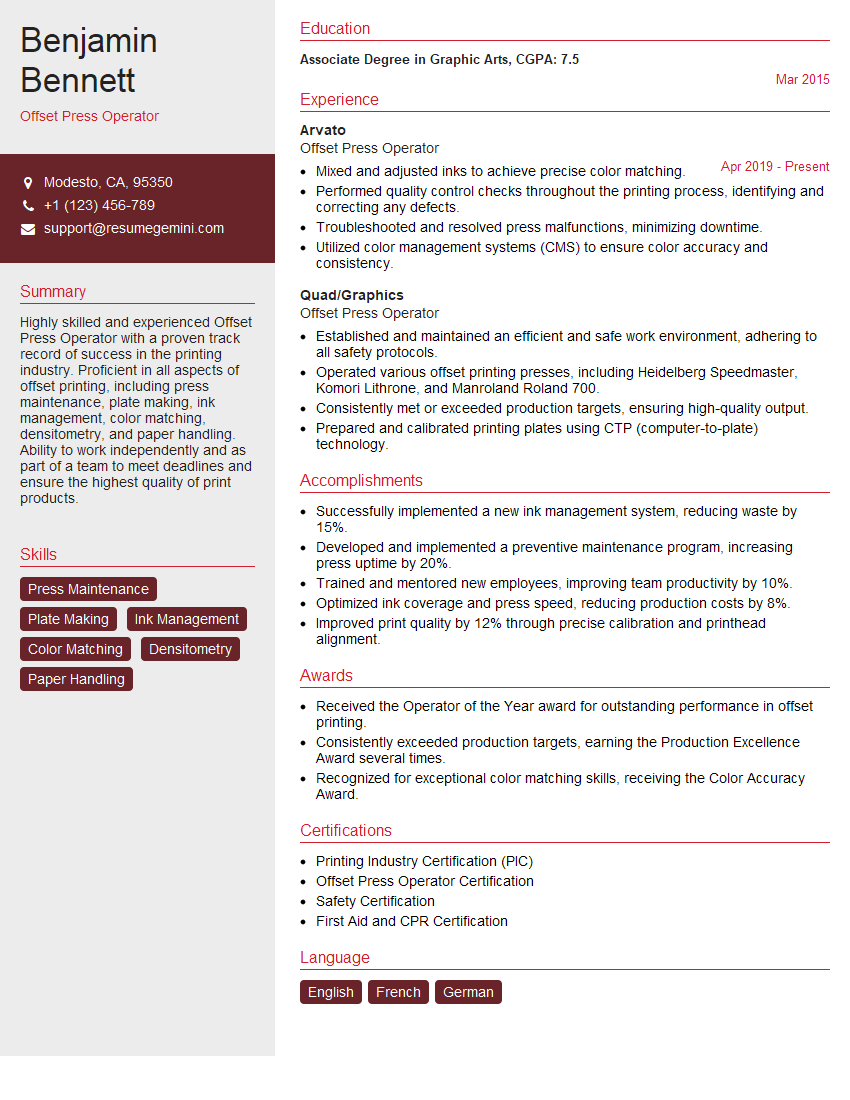
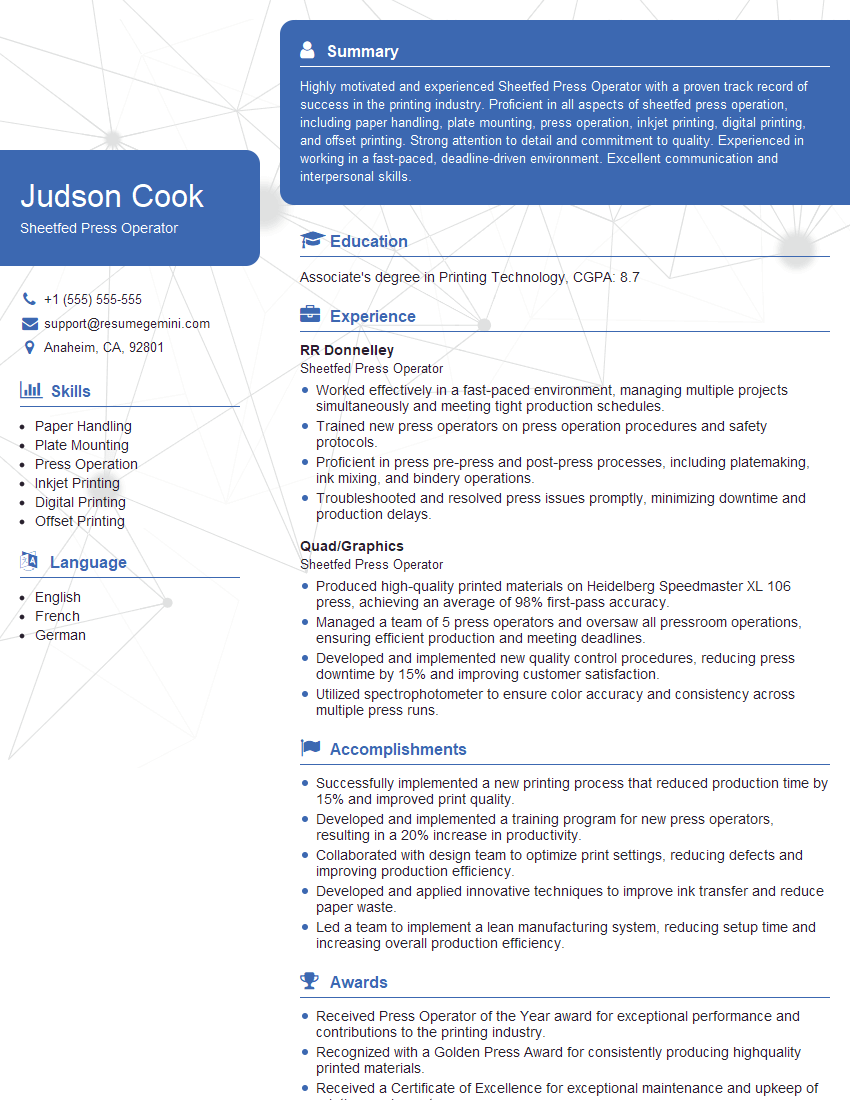
Mastering Inking and Dampening Systems is crucial for career advancement in the printing industry, opening doors to specialized roles and higher earning potential. A strong understanding of these systems demonstrates valuable technical skills and problem-solving abilities highly sought after by employers. To maximize your job prospects, create a compelling and ATS-friendly resume that highlights your expertise. ResumeGemini is a trusted resource to help you build a professional and impactful resume. Examples of resumes tailored to Inking and Dampening Systems are available to guide you in showcasing your skills effectively. Invest the time to craft a strong resume – it’s your first impression on a potential employer.


Explore more articles
Users Rating of Our Blogs
Share Your Experience
We value your feedback! Please rate our content and share your thoughts (optional).
What Readers Say About Our Blog
Really detailed insights and content, thank you for writing this detailed article.
IT gave me an insight and words to use and be able to think of examples