Preparation is the key to success in any interview. In this post, we’ll explore crucial Experience in Traffic Data Collection interview questions and equip you with strategies to craft impactful answers. Whether you’re a beginner or a pro, these tips will elevate your preparation.
Questions Asked in Experience in Traffic Data Collection Interview
Q 1. Explain different methods for collecting traffic data.
Traffic data collection employs various methods, each with its strengths and weaknesses. The choice depends on factors like budget, desired accuracy, and the specific information needed.
- Loop Detectors: Inductive loops embedded in the pavement detect vehicles by sensing changes in the electromagnetic field. They’re relatively inexpensive and provide reliable data on vehicle counts and speeds.
- Video Image Processing (VIP): Cameras capture video footage, and sophisticated software analyzes the images to extract traffic parameters like speed, density, and vehicle classification. This offers rich visual data but can be computationally intensive and susceptible to poor weather conditions.
- Radar Technology: Radar sensors emit microwave signals and measure the reflected signals to detect vehicles and their speeds. They’re unaffected by weather conditions, but they can be less accurate in dense traffic due to signal interference.
- GPS Data: GPS devices in vehicles transmit their location and speed data. Aggregated data from many vehicles provides a comprehensive picture of traffic flow across a larger area. However, this depends on the availability of GPS-equipped vehicles.
- Probe Vehicle Data: This uses data from commercial fleets or volunteer drivers with GPS devices to obtain real-time traffic information. It’s cost-effective for large-scale monitoring, but data may be sparse in certain areas.
- Point Counters/Manual Counts: Human observers manually count vehicles at a specific location. It’s the simplest method but is labor-intensive, time-consuming, and limited to a single point.
Think of it like choosing the right tool for a job: A simple hammer might be sufficient for some tasks, while a sophisticated power drill is necessary for others.
Q 2. Describe the advantages and disadvantages of loop detectors.
Loop detectors are a staple in traffic data collection, but like any technology, they have their pros and cons.
- Advantages: Relatively inexpensive, reliable for counting vehicles and measuring speed, durable, require minimal maintenance, well-established technology with readily available data analysis tools.
- Disadvantages: Can be affected by pavement conditions (e.g., cracks, repairs), prone to damage from heavy vehicles, provide limited data on vehicle type or other characteristics, require physical installation, inflexible in location changes.
For example, a city might use loop detectors on major arteries for continuous vehicle count and speed monitoring, benefiting from their reliability and cost-effectiveness. However, for more detailed analysis like vehicle classification, they might supplement this with video image processing.
Q 3. What are the strengths and weaknesses of video image processing for traffic data collection?
Video image processing (VIP) offers a powerful tool for detailed traffic analysis, but challenges remain.
- Strengths: Provides rich visual data, capable of identifying various vehicle types, can measure multiple parameters (speed, density, lane occupancy, etc.), allows for post-processing and analysis, useful for incident detection.
- Weaknesses: High initial investment in cameras and software, computationally intensive, susceptible to poor weather conditions (rain, snow, fog), requires significant processing power and expertise for analysis, privacy concerns regarding image storage.
Imagine using VIP to identify bottlenecks in a city center. The detailed information on vehicle type and speed allows for tailored solutions to optimize traffic flow, but the system’s vulnerability to inclement weather needs to be factored into the design.
Q 4. How does radar technology contribute to traffic data acquisition?
Radar technology plays a significant role in acquiring traffic data by employing microwave signals to detect and measure the speed of vehicles.
Radar sensors transmit electromagnetic waves; the time it takes for these waves to reflect back reveals the vehicle’s speed and distance. They are often used in speed detection systems, traffic monitoring systems, and adaptive traffic control systems.
- Advantages: Unaffected by weather conditions, can provide accurate speed measurements even at long distances, relatively easy to install and maintain, capable of detecting multiple vehicles simultaneously.
- Disadvantages: Can be affected by signal interference, may not provide detailed information on vehicle type or classification (some newer systems improve this), higher initial costs compared to loop detectors.
Radar excels in applications where reliable speed data is crucial, regardless of weather. For instance, a highway authority might use radar to monitor speed limits and enforce regulations, even during heavy rain or fog, a situation where VIP might fail.
Q 5. Explain the role of GPS data in traffic analysis.
GPS data is transforming traffic analysis by providing a macroscopic view of traffic flow across large geographical areas.
GPS receivers in smartphones, navigation devices, and fleet vehicles transmit location and speed data. This data, when aggregated, paints a dynamic picture of traffic patterns, speeds, and congestion.
- Applications: Real-time traffic updates, route optimization, incident detection, travel time prediction, traffic flow modeling.
- Data Considerations: Data privacy, sampling bias (not all vehicles have GPS), accuracy of GPS data in urban canyons.
Think of GPS data as a vast network of sensors distributed across the entire road network. This allows for broader insights than point-based measurements, but data quality and privacy must be carefully managed.
Q 6. Discuss the use of probe vehicle data in traffic studies.
Probe vehicle data leverages GPS-equipped vehicles to collect real-time traffic information cost-effectively.
This data comes from commercial fleets, taxis, or even volunteer drivers who share their GPS traces. Analysis of these trajectories reveals traffic conditions along the routes taken.
- Advantages: Cost-effective for large-scale monitoring, provides real-time information, can cover extensive areas, offers data on travel times and speeds.
- Disadvantages: Data sparsity in certain areas, potential for sampling bias, data quality depends on GPS signal strength, privacy concerns regarding individual vehicle tracking.
Imagine using probe vehicle data to understand the impact of a major sporting event on traffic patterns across an entire city. The broad coverage of probe data offers valuable insights that would be impossible to achieve with limited point sensors.
Q 7. What are some common challenges in traffic data collection?
Collecting reliable and accurate traffic data is fraught with numerous challenges.
- Data Quality: Inaccurate or missing data from sensors, inconsistent data formats, errors in data processing.
- Data Availability: Limited sensor coverage in certain areas, gaps in data due to sensor malfunctions or communication issues.
- Cost and Maintenance: High initial investment for sophisticated systems, ongoing maintenance costs for sensors and equipment.
- Data Security and Privacy: Protection of sensitive data, compliance with privacy regulations, anonymous data handling.
- Environmental Factors: Weather conditions (rain, snow, fog) can affect sensor performance, particularly for optical and acoustic sensors.
- Data Integration: Combining data from different sources (loops, cameras, GPS) requires careful consideration of data formats, time synchronization, and data consistency.
Addressing these challenges requires a multi-faceted approach, including rigorous sensor calibration, robust data validation techniques, effective data management systems, and careful consideration of privacy implications.
Q 8. How do you ensure data accuracy in traffic data collection?
Ensuring data accuracy in traffic data collection is paramount. It involves a multi-pronged approach focusing on the entire data lifecycle, from sensor selection and placement to data validation and quality control.
- Sensor Calibration and Maintenance: Regularly calibrating sensors (loop detectors, cameras, etc.) is crucial. A poorly calibrated loop detector, for instance, might consistently underreport or overreport vehicle counts, leading to skewed data. Regular maintenance minimizes sensor failure and ensures consistent data quality.
- Data Validation: We employ automated checks, like plausibility checks (e.g., ensuring vehicle speeds are within reasonable limits) and consistency checks (comparing data from multiple sources for discrepancies), to identify and flag potential errors immediately. For example, if a speed sensor reports an average speed of 200mph on a city street, it’s clearly erroneous and should be investigated.
- Redundancy and Cross-Validation: Utilizing multiple data sources—such as loop detectors, cameras, and GPS data—provides redundancy. By comparing data from these different sources, we can identify and correct inconsistencies. This cross-validation significantly enhances data reliability.
- Data Cleaning Protocols: Established protocols guide the handling of invalid or missing data points. These protocols include defining thresholds for acceptable error rates and outlining procedures for data imputation or removal. We maintain detailed documentation of all cleaning steps to ensure transparency and reproducibility.
Imagine a scenario where a sudden power outage affects a loop detector. By using data from nearby cameras and GPS data, we can still get a reasonably accurate picture of traffic flow during that period.
Q 9. Describe methods for handling missing data in traffic datasets.
Missing data is inevitable in traffic datasets due to sensor malfunctions, communication issues, or data transmission errors. Effective handling requires a combination of strategies:
- Deletion: If the amount of missing data is small and randomly distributed, complete case deletion might be acceptable. However, this method can lead to significant data loss if the missing data is substantial.
- Imputation: This involves replacing missing values with estimated values. Common methods include:
- Mean/Median Imputation: Replacing missing values with the mean or median of the available data. Simple but can distort the distribution if many values are missing.
- Regression Imputation: Using regression models to predict missing values based on other variables. More sophisticated but requires careful model selection.
- K-Nearest Neighbors (KNN) Imputation: Estimating missing values based on the values of similar data points (neighbors). Robust but computationally expensive.
- Model-Based Imputation: Advanced techniques like multiple imputation leverage statistical models to generate multiple plausible imputed datasets. This approach accounts for uncertainty associated with the imputation process.
Choosing the best method depends on the nature and extent of the missing data, the dataset size, and the analytical goals. For example, if missing data is concentrated in one area or time period, it’s more appropriate to focus on understanding the cause of the missingness rather than simply imputing values.
Q 10. How do you deal with outliers in traffic data?
Outliers in traffic data, such as exceptionally high speeds or unusually low traffic volumes, can significantly bias analyses and lead to inaccurate conclusions. Identifying and handling them requires careful consideration:
- Visualization: Box plots, scatter plots, and histograms can visually reveal outliers. These visual techniques enable us to identify data points that significantly deviate from the general pattern.
- Statistical Methods: Statistical methods such as the interquartile range (IQR) or Z-score can be used to identify data points that fall outside a defined range. Points exceeding a certain threshold (e.g., 1.5 times the IQR) are flagged as potential outliers.
- Domain Knowledge: Contextual understanding is critical. An unusually high speed might be genuine (e.g., an emergency vehicle) and should not be removed. Conversely, a sensor malfunction would show improbable values that should be investigated and possibly replaced with imputed values or removed.
- Winzorizing or Trimming: Instead of removing outliers, you can replace them with less extreme values (Winzorizing) or completely remove them (Trimming). This is often preferred over complete removal if the number of outliers is not too high.
For example, if we consistently observe unusually high speeds at a particular location during rush hour, it suggests that this location might have an issue that we need to address (such as poor traffic management or signal timing).
Q 11. Explain data cleaning and pre-processing techniques for traffic data.
Data cleaning and pre-processing are crucial steps for obtaining reliable results from traffic data. These steps typically include:
- Data Transformation: Converting data into a consistent format. For example, converting time data to a uniform format (e.g., Unix timestamps).
- Data Aggregation: Combining data from multiple sources or aggregating data over different time intervals (e.g., averaging speed over 5-minute intervals).
- Smoothing: Applying techniques like moving averages to reduce noise and highlight underlying trends in the data.
- Feature Engineering: Creating new variables from existing ones. For instance, we might derive average speed, density, or traffic flow from raw speed and occupancy data.
- Handling Missing Data (as discussed above): Implementing imputation or deletion techniques to manage missing values effectively.
- Outlier Detection and Treatment (as discussed above): Identifying and handling outliers appropriately, using visualization, statistical methods, or domain knowledge.
A real-world example: imagine our data has inconsistent timestamps. We’d standardize these using a consistent format, allowing for accurate temporal analysis of traffic patterns. Smoothing techniques might be used to filter out short-term fluctuations caused by individual vehicles and focus on the general traffic flow.
Q 12. What software or tools are you familiar with for traffic data analysis?
My experience encompasses a wide range of software and tools for traffic data analysis:
- Programming Languages: Python (with libraries like Pandas, NumPy, Scikit-learn), R (with packages like ggplot2, dplyr).
- Statistical Software: SPSS, SAS.
- GIS Software: ArcGIS, QGIS (for spatial analysis and visualization).
- Database Management Systems: PostgreSQL, MySQL (for handling and managing large traffic datasets).
- Specialized Traffic Software: Specific traffic simulation software (like VISSIM or SUMO) can be used in conjunction with data analysis to understand traffic dynamics and test scenarios.
The choice of tool depends on the specific task, dataset size, and the level of complexity required.
Q 13. Describe your experience with traffic data visualization.
Data visualization is essential for communicating insights derived from traffic data. I’m proficient in creating various visualizations including:
- Line charts: To illustrate traffic flow over time.
- Scatter plots: To show relationships between traffic variables (speed and density).
- Heatmaps: To visualize traffic congestion across a geographical area.
- Choropleth maps: To show variations in traffic metrics across different zones.
- Interactive dashboards: Using tools like Tableau or Power BI to enable users to explore and filter data interactively.
For instance, a heatmap showing congestion levels across a city during peak hours helps identify bottlenecks and areas needing improvement. Interactive dashboards allow stakeholders to dynamically view traffic patterns during different time periods, day of the week, or under varying weather conditions.
Q 14. How do you interpret traffic data to identify congestion patterns?
Identifying congestion patterns requires a combination of data analysis techniques and domain knowledge. The process typically involves:
- Data Aggregation and Filtering: Aggregating traffic data over appropriate time intervals (e.g., 15-minute or hourly averages) and filtering out irrelevant data points or outliers.
- Speed and Density Analysis: Analyzing speed and density data to identify areas with consistently low speeds and high densities, indicative of congestion. Time series analysis can highlight recurring congestion patterns (daily, weekly, or seasonal).
- Spatial Analysis: Using GIS techniques to identify specific locations or road segments experiencing frequent congestion. This often involves overlaying traffic data with road network data.
- Statistical Modeling: Using statistical models (e.g., regression analysis or time series forecasting) to predict congestion based on historical data and relevant factors (weather, events).
- Network Analysis: Examining the interconnectedness of the road network to identify how congestion in one area propagates through the system. This can be done using network flow models or graph theory.
For example, if a specific highway segment consistently shows low speeds and high density during morning peak hours, we know this is a recurrent congestion point. Combining this with network analysis could help determine if upstream bottlenecks are contributing to the congestion on that specific highway.
Q 15. How do you use traffic data to evaluate the effectiveness of traffic management strategies?
Evaluating the effectiveness of traffic management strategies relies heavily on comparing traffic conditions before and after implementing the strategy. We use traffic data collected from various sources – loop detectors, cameras, GPS traces, and crowdsourced data – to measure key performance indicators (KPIs) like speed, density, travel time, and queue lengths. For instance, if a new traffic signal timing plan was implemented, we would compare average travel times along the affected corridor before and after the change. A reduction in average travel time indicates improved effectiveness. We might also analyze the impact on congestion levels at specific intersections or bottlenecks. Furthermore, we use statistical methods to determine if the observed improvements are statistically significant, ruling out random fluctuations.
Imagine a scenario where a new roundabout was constructed to replace a signalized intersection. Pre-implementation data would show high congestion and long delays at peak hours. Post-implementation data would reveal changes in speed, density, and queue lengths. A reduction in average delay and improved traffic flow would signify the roundabout’s positive impact. However, we must consider other factors such as changes in traffic volume or time of day that could influence the results.
Career Expert Tips:
- Ace those interviews! Prepare effectively by reviewing the Top 50 Most Common Interview Questions on ResumeGemini.
- Navigate your job search with confidence! Explore a wide range of Career Tips on ResumeGemini. Learn about common challenges and recommendations to overcome them.
- Craft the perfect resume! Master the Art of Resume Writing with ResumeGemini’s guide. Showcase your unique qualifications and achievements effectively.
- Don’t miss out on holiday savings! Build your dream resume with ResumeGemini’s ATS optimized templates.
Q 16. Explain your experience with traffic modeling software.
My experience with traffic modeling software spans several years and encompasses various platforms, including VISUM, CORSIM, and SUMO. I’m proficient in data import, model calibration, scenario development, and result analysis. For example, in a recent project, we used VISUM to model the impact of a proposed light rail transit line on traffic flow in a dense urban area. We calibrated the model using real-world traffic data from loop detectors and then simulated various scenarios to predict the effects of the new transit line on congestion levels, travel times, and vehicle emissions. This enabled us to identify potential bottlenecks and refine the transit line design for optimal efficiency.
My expertise extends to handling large datasets, validating model outputs against observed data, and communicating complex modeling results effectively to non-technical stakeholders. I have experience dealing with the challenges of calibrating models in complex environments, including scenarios with significant pedestrian and bicycle traffic.
Q 17. Describe your experience with different types of traffic models (e.g., microscopic, macroscopic).
I have extensive experience with both microscopic and macroscopic traffic models. Microscopic models simulate the movement of individual vehicles, capturing details like driver behavior and vehicle interactions. Macroscopic models represent traffic flow as aggregate quantities like density and speed, offering a broader overview of traffic dynamics. The choice between them depends on the project’s goals and the available data. Microscopic models are valuable for detailed analyses of specific intersections or bottlenecks, while macroscopic models are more suitable for large-scale network simulations and strategic planning.
For example, I used a microscopic model (CORSIM) to analyze the impact of various signal timing plans at a complex intersection with multiple turning movements. The simulation allowed me to optimize signal timing to minimize delays and improve safety. In contrast, I used a macroscopic model (METANET) to assess the regional impact of a proposed highway expansion project on overall traffic flow and congestion levels. Macroscopic models are particularly useful when dealing with large-scale networks and assessing the impacts of major transportation infrastructure projects.
Q 18. How do you assess the quality of traffic data?
Assessing traffic data quality is critical for reliable analysis and modeling. I use a multi-step approach: First, I check for completeness and consistency of the data. Are there missing values or inconsistencies? Next, I identify and correct outliers or errors, using statistical methods and domain expertise to decide if the values should be replaced or excluded. Then, I assess the accuracy and precision of the data by comparing it to other data sources or ground truth measurements. Finally, I evaluate the data’s spatial and temporal resolution to determine its suitability for the intended analysis. The resolution may not be sufficient to capture highly localized congestion, which may impact our ability to draw conclusions.
For instance, if loop detector data shows unusually high speeds during a known traffic incident, this could indicate a sensor malfunction. Similarly, inconsistencies between GPS data and loop detector data may point to inaccuracies in either data source. Addressing these quality issues is essential for building reliable models and making informed decisions.
Q 19. What are the key performance indicators (KPIs) you use to evaluate traffic flow?
The key performance indicators (KPIs) I use to evaluate traffic flow vary depending on the project goals, but commonly include:
- Average speed: The average speed of vehicles along a given segment or network.
- Travel time: The time taken to travel between two points.
- Density: The number of vehicles per unit length of roadway.
- Flow rate: The number of vehicles passing a point per unit time.
- Queue length: The length of vehicles waiting at a signalized intersection or bottleneck.
- Level of service (LOS): A qualitative measure of traffic conditions, ranging from A (free flow) to F (extremely congested).
- Delay: The difference between the actual travel time and the free-flow travel time.
By tracking these KPIs over time, we can monitor traffic flow, identify trends, and evaluate the effectiveness of traffic management strategies. For example, a significant increase in average travel time or queue length might indicate a problem that requires attention.
Q 20. Explain your experience with traffic simulation software.
My experience with traffic simulation software is extensive. I’m proficient in using software such as Aimsun, VISSIM, and SUMO for simulating traffic flow under various scenarios. I can build complex network models, calibrate them using real-world data, and run simulations to assess the impact of different transportation interventions. For example, in a recent project, we used Aimsun to simulate the impact of a proposed bus rapid transit (BRT) system on traffic congestion. The simulation allowed us to optimize the BRT route and design to minimize disruption to traffic flow and maximize BRT efficiency. The simulations showed that careful planning of BRT lanes and integration with the broader traffic system were crucial to achieving the desired outcome. In another project, VISSIM was used to model pedestrian dynamics around a busy shopping area to assess the effectiveness of proposed pedestrian safety measures.
This involves not only running simulations but also interpreting the results and presenting them in a clear, understandable manner for both technical and non-technical audiences. Sensitivity analysis is also critical to understand the influence of input variables on simulation outcomes, ensuring robust conclusions.
Q 21. How do you use traffic data to support transportation planning decisions?
Traffic data is the foundation for sound transportation planning decisions. It helps us understand existing traffic patterns, identify problem areas, and evaluate the effectiveness of proposed solutions. For instance, we use traffic counts to determine the capacity requirements for new roads or highways, travel time data to assess the feasibility of bus routes, and accident data to pinpoint locations requiring safety improvements. The integration of traffic data with other sources like land use data, demographic data, and economic forecasts allows for a comprehensive approach to transportation planning.
In a recent project, we used traffic data to inform the design of a new highway interchange. By analyzing traffic volumes, speeds, and turning movements at the existing interchange, we were able to identify bottlenecks and design a new interchange that would improve traffic flow and reduce congestion. This involved using traffic modeling software to simulate various design options and select the most effective one. The process required iterative analysis, refining the design based on the results of simulations and stakeholder input.
Q 22. Describe your experience with spatial analysis techniques applied to traffic data.
Spatial analysis is crucial for understanding traffic patterns. It involves using geographic information system (GIS) techniques to analyze traffic data geographically. This allows us to visualize traffic flow, identify congestion hotspots, and analyze relationships between traffic conditions and geographical features.
For example, I’ve used techniques like kernel density estimation to visualize traffic density across a city, revealing areas of consistently high congestion. I’ve also utilized spatial autocorrelation analysis to identify clusters of accidents, suggesting potential infrastructure or safety issues requiring attention. Furthermore, I’ve employed network analysis to model traffic flow on road networks, optimizing routes and predicting travel times based on real-time and historical data. Think of it like mapping a city’s veins – showing where the traffic ‘blood’ flows smoothly and where there are blockages.
In one project, I used ArcGIS to overlay traffic accident data with road geometry and speed limit data. This spatial analysis revealed a strong correlation between high-accident areas and intersections with unusually low speed limits, leading to recommendations for improving signage and potentially raising speed limits in certain areas to improve traffic flow and reduce accidents.
Q 23. How do you integrate traffic data from multiple sources?
Integrating traffic data from disparate sources requires a systematic approach. Common sources include loop detectors embedded in roadways, GPS data from smartphones, CCTV cameras, and traffic management systems. The challenge lies in data standardization and format conversion.
- Data Standardization: Each source has its own format and units. A crucial first step is converting all data into a consistent format (e.g., using a common geographic coordinate system, consistent time stamps, and unified speed units).
- Data Cleaning: Raw data is often noisy, containing errors or missing values. Robust data cleaning techniques are essential, often involving outlier detection and imputation strategies.
- Data Integration Techniques: I’ve used both spatial joins and temporal joins to combine data sets. Spatial joins connect data based on geographic location (e.g., linking GPS data to road segments), while temporal joins connect data based on time (e.g., combining traffic count data from loop detectors with real-time weather data).
- Database Management: A relational database management system (RDBMS) or NoSQL database is vital to store and manage the integrated data efficiently.
For instance, I once integrated loop detector data with GPS data from ride-sharing apps to create a more comprehensive picture of traffic congestion, accounting for both individual vehicle movement and aggregate traffic flow.
Q 24. Explain your understanding of data security and privacy related to traffic data.
Data security and privacy are paramount when dealing with traffic data, which can potentially reveal sensitive information about individuals’ movements and activities.
- Anonymization and Aggregation: I regularly employ techniques like data aggregation (summarizing data to higher levels, like aggregated flow rates rather than individual vehicle trajectories) and anonymization (removing personally identifiable information, like license plates) to protect individual privacy.
- Access Control: Strict access control measures are necessary, restricting data access to authorized personnel only. This involves implementing role-based access control (RBAC) and secure authentication mechanisms.
- Data Encryption: Encryption, both in transit and at rest, is crucial to protect the data from unauthorized access.
- Compliance: Adhering to relevant data privacy regulations, like GDPR and CCPA, is critical. This involves implementing procedures for data retention, data subject access requests, and data breach response.
In practice, this means I meticulously manage data access, securely store data, and anonymize it before releasing any results for analysis or reporting to ensure compliance and protect privacy.
Q 25. Describe your experience with data warehousing or data lakes for traffic data.
Data warehousing and data lakes play crucial roles in managing the massive volume of traffic data. A data warehouse is a structured, centralized repository designed for analytical processing. A data lake is a more flexible, schema-on-read storage solution.
I’ve experience with both approaches. Data warehouses are ideal for structured, historical data requiring fast query performance for reporting and dashboards. I’ve used them to store aggregated traffic counts, average speeds, and incident reports for generating regular performance reports. Data lakes, on the other hand, are better suited for handling unstructured or semi-structured data like video feeds from CCTV cameras or GPS trajectories. This raw data can be later processed and analyzed as needed.
In a project involving real-time traffic management, we used a data lake to store the high-volume, continuously streaming data from various sensors, allowing us to perform flexible and ad-hoc queries for anomaly detection and predictive modeling. The structured data was then incrementally loaded into the data warehouse for more efficient reporting.
Q 26. How familiar are you with big data technologies in the context of traffic data analysis?
Big data technologies are essential for handling the massive volume, velocity, and variety of traffic data. I’m proficient with several technologies in this domain:
- Hadoop and Spark: These distributed computing frameworks are essential for processing large traffic datasets in parallel. I’ve used Spark for real-time analysis of streaming traffic data, providing insights for immediate operational decisions.
- NoSQL Databases: Databases like Cassandra and MongoDB are adept at handling the semi-structured and unstructured data generated by various traffic sources.
- Cloud Computing Platforms (AWS, Azure, GCP): These provide scalable infrastructure for storing and processing large traffic datasets.
- Data Streaming Technologies (Kafka, Flink): These tools are crucial for handling the real-time nature of traffic data. I’ve used them to build real-time traffic monitoring dashboards and predictive models.
For instance, I utilized Spark to perform machine learning algorithms on a massive GPS dataset to predict traffic congestion several hours in advance, providing valuable information for route planning and traffic management systems.
Q 27. How do you communicate your findings from traffic data analysis to non-technical audiences?
Communicating complex traffic data analysis findings to a non-technical audience requires clear and concise storytelling. I use a combination of techniques:
- Visualizations: Interactive dashboards, charts, and maps are essential for visualizing key findings. I focus on using clear and intuitive visuals that easily convey the information without overwhelming the audience.
- Analogies and Metaphors: I use relatable analogies to explain complex concepts. For example, I might compare traffic flow to the flow of water in a river, illustrating congestion as a bottleneck.
- Storytelling: Framing the analysis as a story with a clear beginning, middle, and end makes the information more engaging and memorable.
- Focus on Key Findings: I avoid technical jargon and concentrate on the key insights and implications for the audience. For example, instead of discussing algorithms, I focus on the practical improvements in traffic flow or safety.
For example, when presenting findings about traffic congestion to city council members, I used a map highlighting the most congested areas, combined with simple bar charts showing the impact on commute times, and explained the potential solutions with clear and relatable examples.
Q 28. Describe a time you had to solve a challenging problem related to traffic data analysis.
One of the most challenging problems I encountered involved a significant discrepancy between reported traffic incidents and the actual traffic flow observed in real-time data. We were relying on police reports for incident data, but these often had delays and inconsistencies.
To address this, I implemented a multi-pronged approach:
- Data Triangulation: We incorporated data from multiple sources, including GPS data from vehicles, traffic cameras, and social media posts mentioning traffic incidents, to cross-verify reported incidents.
- Anomaly Detection: We implemented machine learning algorithms to detect unusual patterns in real-time traffic data, indicating potential incidents that weren’t yet officially reported.
- Real-time Validation: We developed a system to validate reported incidents by cross-referencing them with real-time traffic data and visual inspection of traffic camera feeds.
- Improved Data Integration: We worked with the police department to improve their data reporting systems and ensure timely updates. This included developing a more structured incident reporting form and training officers on best practices.
This multifaceted strategy significantly improved the accuracy of our incident data, resulting in more effective traffic management and improved predictions.
Key Topics to Learn for Experience in Traffic Data Collection Interview
- Data Collection Methods: Understanding various techniques like loop detectors, video image processing, radar sensors, and GPS tracking; comparing their strengths and weaknesses in different contexts.
- Data Processing and Analysis: Familiarize yourself with techniques for cleaning, validating, and analyzing large traffic datasets. This includes understanding statistical methods and using software tools for data manipulation and visualization.
- Traffic Flow Models: Learn about common traffic flow models (e.g., microscopic, macroscopic) and their applications in analyzing traffic patterns and predicting congestion.
- Traffic Simulation Software: Gain experience with traffic simulation software (mentioning specific popular software is acceptable in a real-world application, but avoid it here for generality). Understand how these tools are used to model and analyze traffic scenarios.
- Data Interpretation and Reporting: Practice presenting your findings clearly and concisely through reports and visualizations. Develop skills in communicating complex technical information to both technical and non-technical audiences.
- Quality Assurance and Control: Understand the importance of data quality and the methods used to ensure accuracy and reliability of collected data. This includes error detection and correction techniques.
- Ethical Considerations: Be prepared to discuss ethical considerations related to data privacy and the responsible use of traffic data.
- Problem-Solving and Troubleshooting: Be ready to discuss examples where you had to identify and resolve issues related to data collection or analysis. Highlight your analytical and problem-solving skills.
Next Steps
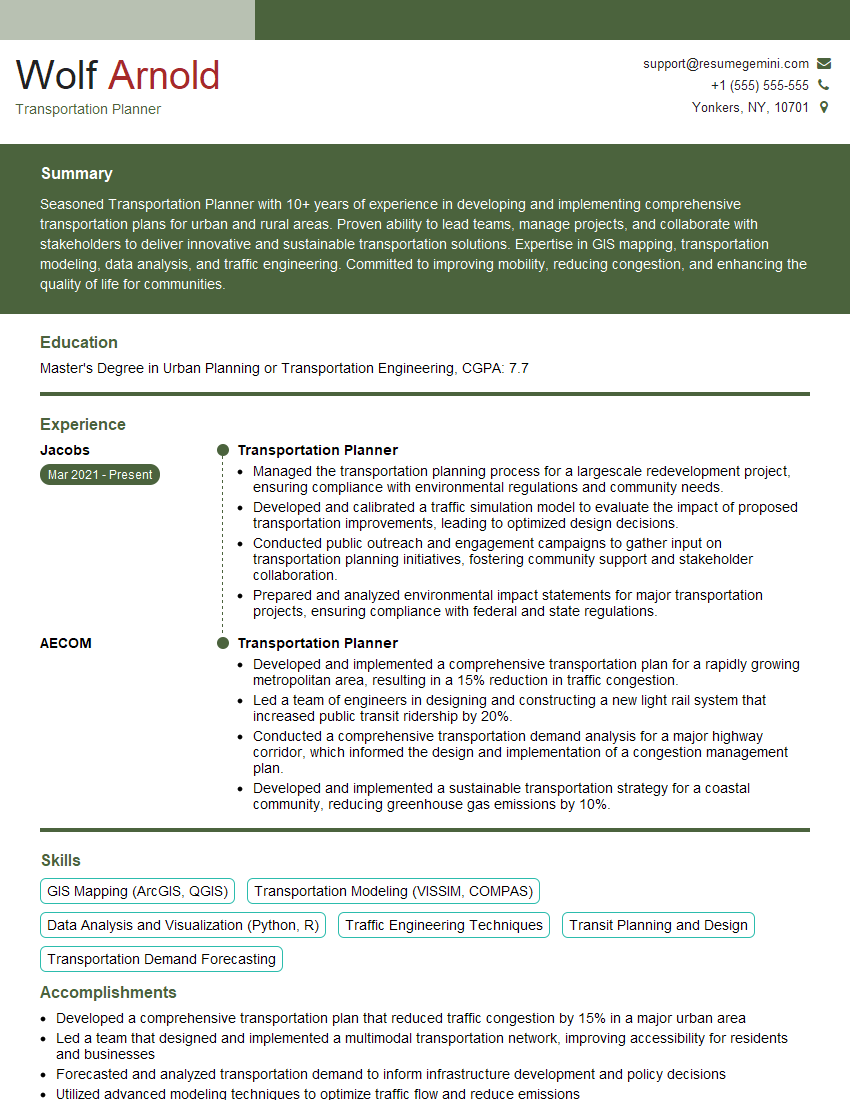
Mastering Experience in Traffic Data Collection opens doors to exciting career opportunities in transportation planning, engineering, and research. A strong understanding of these concepts is crucial for securing your dream role. To maximize your chances, focus on crafting an ATS-friendly resume that highlights your skills and experience effectively. ResumeGemini is a trusted resource that can help you build a professional and impactful resume. Take advantage of ResumeGemini’s tools and resources to create a resume that stands out. Examples of resumes tailored to Experience in Traffic Data Collection are available to guide you.

Explore more articles
Users Rating of Our Blogs
Share Your Experience
We value your feedback! Please rate our content and share your thoughts (optional).
What Readers Say About Our Blog
Really detailed insights and content, thank you for writing this detailed article.
IT gave me an insight and words to use and be able to think of examples