The thought of an interview can be nerve-wracking, but the right preparation can make all the difference. Explore this comprehensive guide to Experience with Agile Development Methodologies interview questions and gain the confidence you need to showcase your abilities and secure the role.
Questions Asked in Experience with Agile Development Methodologies Interview
Q 1. Explain the Agile Manifesto and its principles.
The Agile Manifesto is a declaration of values and principles for software development (and beyond) that prioritizes individuals and interactions over processes and tools, working software over comprehensive documentation, customer collaboration over contract negotiation, and responding to change over following a plan. It’s not about abandoning planning entirely, but recognizing the importance of adaptability.
- Individuals and interactions over processes and tools: Agile emphasizes teamwork, communication, and collaboration. Strong relationships build trust and improve problem-solving.
- Working software over comprehensive documentation: While documentation is valuable, delivering functional software that meets customer needs is paramount. Documentation should support the software, not vice versa.
- Customer collaboration over contract negotiation: Continuous feedback from the customer is key. Agile promotes frequent interaction and collaboration to ensure the product aligns with customer expectations.
- Responding to change over following a plan: Agile embraces change as inevitable. The process is designed to adapt to evolving requirements and priorities.
These values are supported by 12 principles focusing on delivering value quickly, adapting to change, and fostering collaboration. For example, one principle emphasizes delivering working software frequently (from a couple of weeks to a couple of months), with a preference to the shorter timescale.
Q 2. Describe the Scrum framework and its roles (Product Owner, Scrum Master, Development Team).
Scrum is a lightweight, iterative framework for managing complex projects. It uses short cycles called Sprints (typically 2-4 weeks) to incrementally develop and deliver working software. Think of it like a highly structured, time-boxed approach to tackling a large project one manageable piece at a time.
- Product Owner: The voice of the customer. They define the product backlog (a prioritized list of features and requirements), manage stakeholder expectations, and ensure the team builds the right product.
- Scrum Master: A servant leader who removes impediments for the development team, facilitates Scrum events, and ensures the team adheres to Scrum principles. They’re not a project manager in the traditional sense but rather a facilitator and coach.
- Development Team: A self-organizing, cross-functional team responsible for designing, developing, and testing the software. They estimate tasks, plan their work, and collaborate closely to deliver the Sprint goal.
In my experience, a successful Scrum team relies on strong communication, trust, and a shared understanding of the Sprint goal. For example, I once worked on a project where the Scrum Master proactively identified and resolved a dependency issue with another team, preventing a significant delay in the Sprint.
Q 3. What are the key differences between Scrum and Kanban?
Scrum and Kanban are both Agile methodologies, but they differ significantly in their approach to workflow management. Scrum is a framework with prescribed roles, events, and artifacts, while Kanban is a more flexible method that focuses on visualizing and limiting work in progress (WIP).
- Structure: Scrum is highly structured with defined events (Sprint Planning, Daily Scrum, Sprint Review, Sprint Retrospective), while Kanban is more flexible and adaptable.
- Iteration Length: Scrum uses fixed-length Sprints, typically 2-4 weeks. Kanban doesn’t have fixed iterations; work flows continuously.
- Work in Progress (WIP): Scrum focuses on completing a defined set of tasks within a Sprint. Kanban emphasizes limiting WIP to improve efficiency and reduce context switching.
- Ceremonies: Scrum has formal events and meetings. Kanban is less ceremonial, focusing on continuous flow and improvement.
Imagine a restaurant kitchen: Scrum would be like preparing a set menu for a fixed number of customers during a specific time (the Sprint). Kanban would be more like a buffet-style approach, constantly preparing dishes as they are ordered, adjusting production based on demand and available resources.
Q 4. How do you handle conflicting priorities in an Agile environment?
Conflicting priorities are common in Agile. The best approach involves transparency, prioritization, and collaboration. It’s crucial to involve the stakeholders (Product Owner, team members, and customers) in the decision-making process.
- Prioritization Techniques: Use techniques like MoSCoW (Must have, Should have, Could have, Won’t have) or value vs. effort matrices to rank requirements based on business value and effort required.
- Open Communication: Hold transparent discussions to understand the rationale behind different priorities and the potential impact of choosing one over another.
- Negotiation and Compromise: Sometimes, compromises are needed. Finding solutions that meet the majority of needs is often more effective than forcing a single priority.
- Documentation: Clearly document the agreed-upon priorities and trade-offs to avoid future misunderstandings.
For instance, I once faced a situation where two high-priority features conflicted in terms of development time within a single Sprint. Through collaborative discussion with the Product Owner and the development team, we decided to scope down one feature and deliver the other, prioritizing based on immediate business value and customer feedback. This decision was documented and communicated to the stakeholders.
Q 5. Explain the concept of Sprint Planning and its importance.
Sprint Planning is a crucial Scrum event that occurs at the beginning of each Sprint. It’s where the development team plans the work they will undertake during the upcoming Sprint. It involves two parts: Sprint Goal definition and Sprint Backlog creation.
- Sprint Goal Definition: The team collaboratively defines a concise, achievable goal for the Sprint. This provides a clear focus and direction for the entire Sprint.
- Sprint Backlog Creation: The team selects items from the Product Backlog (the prioritized list of features and requirements) and breaks them down into smaller, manageable tasks. They estimate the effort needed for each task and commit to completing them within the Sprint.
The importance lies in fostering shared understanding, commitment, and accountability. A well-defined Sprint Goal and a realistic Sprint Backlog significantly improve the likelihood of delivering value at the end of the Sprint. Without proper planning, the Sprint might become chaotic and fail to achieve its intended outcomes. Imagine building a house without a blueprint—it’s likely to be inefficient and unstable.
Q 6. What are some common Agile metrics you track?
Several Agile metrics help track progress and identify areas for improvement. The choice of metrics depends on the specific context and goals.
- Velocity: Measures the amount of work a team completes in a Sprint. It helps predict future Sprint capacity.
- Cycle Time: Tracks the time it takes to complete a task from start to finish. Identifying bottlenecks in the process.
- Lead Time: Measures the time from when a task is requested to when it’s delivered to the customer. Indicates the overall efficiency of the process.
- Burndown Chart: Visual representation of work remaining versus time. Helps monitor progress and identify potential issues.
- Defect Rate: Indicates the number of defects found in the software. Helps assess software quality.
For example, consistently low velocity might indicate a need for improved planning, better task estimation, or addressing team impediments. A high defect rate suggests a need for improved testing processes or code reviews. Tracking these metrics helps provide data-driven insights to improve team performance.
Q 7. Describe your experience with Sprint Retrospectives and their purpose.
Sprint Retrospectives are crucial Scrum events held at the end of each Sprint. They provide an opportunity for the development team and Scrum Master to reflect on the past Sprint and identify ways to improve the process for the next Sprint. It’s a time for continuous improvement and learning.
- Purpose: To identify what went well, what could be improved, and to create actionable items to implement in future Sprints.
- Process: Typically involves a structured discussion, often using frameworks like the ‘Start, Stop, Continue’ model. The team collaboratively identifies areas for improvement and creates specific actions to address them.
- Outcome: A list of actionable items to implement in the next Sprint, aimed at increasing efficiency, improving team collaboration, and enhancing the overall development process.
In one project, we used a retrospective to address a recurring issue with insufficient testing time. After discussion, we implemented a new process where testing tasks were prioritized earlier in the Sprint planning, ensuring dedicated time for thorough testing. This led to a significant reduction in the number of defects found after Sprint deployment.
Q 8. How do you facilitate effective daily stand-up meetings?
Effective daily stand-up meetings are the cornerstone of Agile’s iterative approach. They’re short, focused bursts of communication, not lengthy problem-solving sessions. My approach emphasizes brevity and accountability. I begin by setting a strict time limit (typically 15 minutes for a team of 5-7 people). Each team member answers three key questions: What did I do yesterday? What will I do today? What impediments am I facing?
To maintain focus, I actively manage time, politely steering conversations back on track when they veer off-topic. I encourage concise answers – bullet points are great! I also make sure everyone has a chance to speak and that we capture any impediments in a shared online tool (like Jira or Trello), ensuring follow-up and visibility. Finally, I often end with a quick review of progress against the sprint goal to reinforce shared objectives.
In one project, we were struggling with long, rambling stand-ups. By introducing a timer, a shared impediment tracking system, and a clear focus on the three key questions, we reduced the meeting time by half and increased team focus dramatically. The result was better productivity and a more positive team dynamic.
Q 9. Explain the concept of User Stories and their role in Agile development.
User stories are short, simple descriptions of a feature told from the perspective of the person who desires the new capability, usually a user or customer. They follow a simple format: As a [type of user], I want [some goal] so that [some reason]. This format helps ensure the story focuses on user needs and value.
Their role in Agile is crucial. They’re the building blocks of the product backlog, a prioritized list of features to be developed. They provide a common understanding between developers, testers, product owners, and stakeholders, fostering collaborative development. The ‘so that’ part highlights the benefit and helps prioritize features based on their value.
For example: ‘As a registered user, I want to be able to reset my password easily so that I can regain access to my account if I forget it.’ This simple story clearly defines who the user is, what they need, and why it’s important. During sprint planning, the team can break down these stories into smaller, more manageable tasks.
Q 10. How do you manage impediments in an Agile project?
Impediments are anything that blocks the team’s progress. My approach to managing them is proactive and transparent. First, I ensure a safe space for team members to openly voice their concerns. Once an impediment is identified during a stand-up or another meeting, I work with the team to determine the severity and urgency of the issue.
Next, I use a collaborative problem-solving approach. This could involve brainstorming solutions with the team, escalating the issue to relevant stakeholders (like management or other teams), or researching potential solutions myself. The key is to involve the right people and leverage the collective knowledge of the team. I also document the impediment, the proposed solution, and the assigned owner, ensuring that everyone is on the same page and that nothing falls through the cracks. We track impediments in our project management tool and review their status regularly in our sprint reviews.
In one instance, a team was blocked by a dependency on another team’s API. I facilitated a meeting between the two teams to discuss the issue, prioritize it, and agree on a resolution timeline. This proactive approach minimized the project delay and strengthened cross-team collaboration.
Q 11. What is your experience with Agile estimation techniques (e.g., Planning Poker)?
I have extensive experience with Agile estimation techniques, most notably Planning Poker. Planning Poker uses a deck of cards representing story points (e.g., Fibonacci sequence: 0, 1, 2, 3, 5, 8, 13, 20, etc.) to collaboratively estimate the relative size and complexity of user stories. It’s a highly effective technique for leveraging the collective wisdom of the team.
The process involves the team members individually reviewing a story, then simultaneously revealing their estimations. Any significant discrepancies spark a discussion to clarify misunderstandings or identify hidden complexities. This iterative process leads to a consensus estimate that reflects the team’s collective understanding.
Planning Poker minimizes bias and fosters healthy debate, ensuring more accurate estimations than individual estimations. It also improves team understanding of the task, fostering collaboration and shared ownership of the estimate. I’ve found it to be particularly effective in mitigating the risk of inaccurate estimations leading to missed deadlines or scope creep.
Q 12. Describe your experience with different Agile scaling frameworks (e.g., SAFe, LeSS).
My experience encompasses various Agile scaling frameworks, including Scrum of Scrums (SoS) and SAFe (Scaled Agile Framework). SoS is a simple and effective approach for coordinating multiple Scrum teams working on a larger project. It involves representatives from each team meeting regularly to discuss dependencies, impediments, and progress.
SAFe, on the other hand, is a more comprehensive framework that provides a structured approach to scaling Agile across large organizations. It defines roles, events, and artifacts specifically designed for large-scale development. While SAFe can be quite complex, its structured approach can be highly beneficial for large projects with many teams and stakeholders.
The choice of framework depends heavily on the project’s size, complexity, and organizational context. For smaller projects, SoS might suffice, whereas larger, more complex projects might benefit from the more structured approach of SAFe. The key is to select the framework that best supports the team’s needs and organizational structure, ensuring alignment and efficient communication across teams.
Q 13. How do you ensure quality in an Agile project?
Ensuring quality in an Agile project requires a holistic approach integrated throughout the development lifecycle, not just at the end. This includes several key practices:
- Test-Driven Development (TDD): Writing tests *before* writing code ensures that the code meets the requirements and reduces defects early on.
- Continuous Integration (CI): Regularly integrating code changes into a shared repository triggers automated builds and tests, quickly identifying integration issues.
- Code Reviews: Peer reviews of code catch defects and improve code quality, fostering knowledge sharing within the team.
- Automated Testing: Automating different levels of testing (unit, integration, system, acceptance) ensures thorough testing and reduces reliance on manual testing.
- Definition of Done (DoD): Establishing a clear DoD ensures that all criteria for a complete task are met before it’s considered finished.
By embedding quality practices throughout the process, we shift the focus from end-of-cycle testing to continuous quality improvement. This proactive approach reduces defects, improves code quality, and increases overall project efficiency.
Q 14. Explain the concept of continuous integration and continuous delivery (CI/CD).
Continuous Integration and Continuous Delivery (CI/CD) are two closely related DevOps practices that automate the software release process. CI focuses on integrating code changes frequently into a shared repository, triggering automated builds and tests to quickly identify integration issues. This reduces integration problems, which often become more complex and harder to fix the longer they go undetected.
CD extends CI by automating the deployment process, allowing for frequent and reliable releases of software to various environments (e.g., development, testing, production). This faster release cycle enables quicker feedback from users and faster iterations, aligning with Agile’s iterative approach.
A typical CI/CD pipeline might involve automated builds, unit tests, integration tests, deployment to a test environment, user acceptance testing, and finally, deployment to production. This automated process significantly reduces manual effort, increases efficiency, and improves the overall quality and reliability of software releases.
Consider a scenario where a team is manually deploying updates every two weeks. Using CI/CD, they can automate this process and potentially release multiple times per day, significantly shortening feedback cycles and enabling faster responses to user needs and market changes.
Q 15. How do you handle scope creep in an Agile project?
Scope creep, the uncontrolled expansion of project requirements, is a common threat to Agile projects. Think of it like building a house – you start with a blueprint, but if you keep adding features (a bigger pool, a sunroom, etc.) without adjusting the timeline or budget, the project will likely be delayed and over budget. In Agile, we proactively manage scope creep through several key strategies:
Prioritization with stakeholders: Regularly review the product backlog with stakeholders, ensuring everyone agrees on the highest-value items. Use techniques like MoSCoW (Must have, Should have, Could have, Won’t have) to prioritize features.
Timeboxing iterations: Each sprint focuses on a set amount of work. New features are added to the backlog and prioritized for future sprints, preventing uncontrolled expansion within a single iteration.
Clear acceptance criteria: Define precise acceptance criteria for each user story to avoid ambiguity and prevent feature creep. This ensures that a ‘done’ story is truly done and meets the defined requirements.
Change management process: Establish a formal process for managing changes. This might involve a Change Control Board or simply a documented procedure for evaluating the impact of new requirements on the schedule and budget.
Regular communication: Frequent communication with stakeholders keeps everyone informed about progress and allows for early identification of potential scope creep.
For example, in a recent project developing a mobile app, we initially focused on core features. During a sprint review, a stakeholder suggested adding a complex integration with another system. Using our change management process, we assessed the impact, added it to the backlog, and adjusted the project timeline accordingly, preventing the uncontrolled expansion of the sprint’s scope.
Career Expert Tips:
- Ace those interviews! Prepare effectively by reviewing the Top 50 Most Common Interview Questions on ResumeGemini.
- Navigate your job search with confidence! Explore a wide range of Career Tips on ResumeGemini. Learn about common challenges and recommendations to overcome them.
- Craft the perfect resume! Master the Art of Resume Writing with ResumeGemini’s guide. Showcase your unique qualifications and achievements effectively.
- Don’t miss out on holiday savings! Build your dream resume with ResumeGemini’s ATS optimized templates.
Q 16. How do you deal with team members who are not following Agile practices?
Dealing with team members who aren’t adhering to Agile practices requires a delicate balance of coaching, mentoring, and sometimes, more formal interventions. It’s crucial to understand the root cause of the non-compliance. Are they unfamiliar with the practices? Are there process issues? Or is there a lack of motivation?
Coaching and mentoring: Start with informal discussions. Pair programming can be a great way to demonstrate Agile practices and foster collaboration. Offer training and resources to bridge any knowledge gaps.
Open communication and feedback: Create a safe space for team members to discuss concerns and roadblocks. Regular retrospectives are crucial for identifying challenges and areas for improvement. Provide constructive feedback focusing on behaviors rather than personalities.
Adjusting the process: Sometimes, the Agile process itself might not be perfectly suited to the team or project. Look for areas for improvement and adapt the process accordingly. For instance, if daily stand-ups are too disruptive, consider adjusting their frequency or format.
Escalation: If informal approaches are unsuccessful, more formal interventions might be necessary. This could involve discussions with team leads or managers to address persistent issues.
In one project, a developer consistently missed sprint goals. Through individual coaching, we discovered that he was struggling with the complexity of a specific task. By pairing him with a more experienced developer and breaking down the task into smaller, manageable units, we were able to address the issue and improve his performance.
Q 17. What are your preferred Agile tools and why?
My preferred Agile tools depend on the specific project needs, but I find a combination of tools often works best. I’m a big advocate of using the right tool for the right job, rather than trying to force a single platform to serve every purpose.
Jira: For project management, issue tracking, and sprint management. Its flexibility and extensibility make it suitable for various Agile methodologies.
Confluence: For documentation, knowledge sharing, and collaboration. It allows teams to create and maintain a central repository of information.
Slack/Microsoft Teams: For quick communication and collaboration. It facilitates daily communication and helps to keep the team connected.
Git (with GitHub/GitLab/Bitbucket): For version control and code management. Essential for any software development project.
I’ve used other tools like Trello, Asana, and Azure DevOps in the past, but I find the combination of Jira and Confluence particularly effective for managing projects from planning to delivery.
Q 18. Describe your experience with Agile documentation.
Agile documentation is about creating just enough documentation, just in time. It’s a shift from heavy, upfront documentation to a more iterative approach, focusing on creating value for the users and the team. My experience emphasizes the following:
User stories: These concise descriptions from the user’s perspective guide development, replacing lengthy requirements documents.
Acceptance criteria: Clearly defined criteria ensure that the user stories meet the expectations.
Sprint backlogs: Detailed breakdowns of tasks within each sprint.
Meeting notes: Keeping track of decisions and action items from daily stand-ups, sprint reviews, and retrospectives.
Architecture diagrams (if needed): High-level architectural views that provide context.
In a previous project, we relied heavily on user stories and acceptance criteria, which proved much more effective than a large, upfront requirements document. The user stories drove development, and the acceptance criteria ensured that each feature functioned correctly and met the customer’s expectations. Any other documentation was minimal and created as needed to aid understanding of the system.
Q 19. How do you measure the success of an Agile project?
Measuring the success of an Agile project goes beyond simply delivering features on time and within budget. It’s about achieving value for the customer and the business. We measure success through various metrics, both quantitative and qualitative:
Velocity: Tracks the team’s productivity over time.
Cycle time: Measures the time it takes to complete a user story.
Throughput: The number of user stories completed in a given time frame.
Customer satisfaction: Regular feedback from the customer is crucial. Surveys, user interviews, and usability testing provide valuable insights.
Business value delivered: Did the project meet the business goals? This requires clear definition of the business objectives at the project’s outset.
For instance, in a recent project, we tracked not only velocity but also customer satisfaction through regular feedback sessions. While we delivered the features on time, the customer’s feedback highlighted some usability issues. This feedback allowed us to adapt and improve the product in subsequent sprints, ensuring overall project success.
Q 20. Explain the concept of DevOps and its relationship to Agile.
DevOps is a set of practices, tools, and a cultural philosophy that automates and integrates the processes between software development and IT operations teams. Agile, on the other hand, focuses on iterative development and collaborative efforts within the development team. The relationship between Agile and DevOps is symbiotic; they complement each other to accelerate the software delivery lifecycle.
Agile provides the framework for iterative development, while DevOps provides the infrastructure and processes for continuous integration and continuous delivery (CI/CD). The combination leads to faster feedback loops, more frequent releases, and increased efficiency. Think of Agile as the ‘how’ we build software, and DevOps as the ‘how’ we deploy and operate it.
For example, an Agile team might develop features in two-week sprints, whereas DevOps practices enable automated testing, deployment, and monitoring, allowing those features to be deployed to production frequently and reliably. This tight integration ensures that new features are quickly delivered to users, allowing for faster feedback and adjustments.
Q 21. Describe your experience with different Agile ceremonies.
My experience encompasses various Agile ceremonies, each serving a distinct purpose:
Sprint Planning: The team collaborates to define the sprint goals and select user stories from the product backlog. It’s about creating a shared understanding of what needs to be done.
Daily Stand-up: A short daily meeting (typically 15 minutes) where the team synchronizes, discusses progress, and identifies impediments. It’s a quick check-in to keep everyone on track.
Sprint Review: At the end of the sprint, the team demonstrates the completed work to stakeholders, gathers feedback, and assesses progress toward the product goals. It’s about showing the results and getting feedback.
Sprint Retrospective: The team reflects on the past sprint, identifying areas for improvement in processes and practices. It’s about learning and adapting for the future.
In one project, we experimented with different variations of these ceremonies to adapt them to our team’s needs. For instance, we shortened our daily stand-ups to 10 minutes and focused on specific questions to increase efficiency. We also found that incorporating visual aids into our sprint reviews greatly enhanced stakeholder understanding and engagement.
Q 22. How do you ensure stakeholder engagement in an Agile project?
Stakeholder engagement is crucial for Agile success. Think of it as building a strong foundation – without everyone on board, the project can crumble. My approach centers around consistent and transparent communication. This involves several key strategies:
- Regular communication channels: I establish clear communication channels, like daily stand-ups, weekly sprint reviews, and bi-weekly stakeholder meetings. This ensures everyone is informed about progress, roadblocks, and upcoming decisions.
- Visual progress tracking: Using tools like Kanban boards or burn-down charts, I provide visual representations of the project’s progress. This allows stakeholders to easily understand the status of various tasks and anticipate potential delays.
- Active listening and feedback loops: I actively solicit feedback from stakeholders through surveys, individual meetings, and collaborative workshops. This ensures their needs and concerns are addressed throughout the project lifecycle.
- Early and often demonstrations: Regular demonstrations of working software allow stakeholders to see tangible progress and provide feedback early on, preventing costly rework later in the development cycle.
- Collaboration tools: Leveraging platforms such as Jira, Confluence, or Microsoft Teams to centralize communication and documentation ensures everyone remains informed and connected.
For example, on a recent project involving a new mobile app, I implemented a weekly stakeholder meeting where we reviewed the sprint backlog, discussed challenges, and demonstrated the app’s functionality. This allowed for continuous feedback and ensured the final product met their expectations.
Q 23. What is your experience with different Agile artifacts (e.g., Product Backlog, Sprint Backlog)?
Agile artifacts are the lifeblood of any Agile project, providing structure and transparency. I have extensive experience with the following:
- Product Backlog: This is a prioritized list of features and functionalities required for the product. I’ve used it to manage requirements, track progress, and ensure alignment with the overall product vision. I often prioritize items using techniques like MoSCoW (Must have, Should have, Could have, Won’t have) to ensure focus on the most critical functionalities.
- Sprint Backlog: This is a subset of the product backlog that the team commits to completing within a single sprint (typically 2-4 weeks). I’ve used it to plan daily work, track progress within a sprint, and identify impediments. It typically includes user stories, tasks, and estimations.
- User Stories: These are short descriptions of features from the end-user perspective (e.g., “As a user, I want to be able to log in securely so I can access my account.”). I consistently use them to clearly define requirements and facilitate discussions within the team.
- Burndown Chart: This visual representation of work remaining against time helps to monitor sprint progress and identify potential risks early on. Regular review of this ensures timely adjustments are made.
For instance, in a recent project, we used a well-maintained product backlog to prioritize features based on business value and technical feasibility, ensuring that the most critical functionalities were delivered first. The sprint backlog then broke these down into manageable tasks for each sprint.
Q 24. How do you handle changes in requirements during an Agile project?
Change is inherent in software development; the ability to embrace and manage it effectively is crucial for Agile success. In Agile, we don’t fight change, we manage it. My approach involves:
- Embrace change as an opportunity: I encourage the team to view changing requirements not as problems but as opportunities to improve the product.
- Transparent communication: Any changes are immediately communicated to all stakeholders, ensuring everyone understands the implications.
- Prioritization and re-planning: The Product Owner collaborates with the team to evaluate the impact of the changes, re-prioritize the backlog, and adjust the sprint plan accordingly.
- Incrementally implementing changes: Large changes are broken down into smaller increments, minimizing disruption and allowing for continuous feedback.
- Using Agile methodologies effectively: Daily stand-ups, sprint reviews and retrospectives provide a mechanism to quickly incorporate changes and address any challenges that emerge.
In one project, a major regulatory change impacted our core functionality midway through the project. By immediately communicating the change, working with the Product Owner to re-prioritize, and implementing it incrementally over two sprints, we successfully adjusted our approach without jeopardizing the project’s timeline or quality.
Q 25. Describe a time when you had to adapt an Agile approach to a specific project challenge.
During a project for an e-commerce client, we encountered unexpected performance issues with the database. Our initial Agile approach, focused on short sprints and iterative development, was struggling to address the underlying issue. We adapted by:
- Dedicated spike: We dedicated a sprint to address the performance issue, essentially pausing feature development. This involved profiling the database, identifying bottlenecks, and implementing performance optimizations.
- Technical debt prioritization: We re-evaluated our technical debt backlog and prioritized addressing the database performance issues before continuing with feature development.
- Cross-functional collaboration: We increased collaboration between developers, database administrators, and performance engineers to efficiently address the issue.
This adaptation, while initially disrupting the planned feature delivery, ultimately prevented a major production issue and ensured the long-term stability and performance of the application. The retrospective helped the team understand the importance of proactive performance testing and improved our approach to managing technical debt in the future.
Q 26. What are some common challenges you have faced while working in an Agile environment?
Agile, while beneficial, isn’t without its challenges. Some common ones I’ve faced include:
- Scope creep: Uncontrolled addition of features without proper prioritization and consideration of their impact on the project timeline and budget.
- Insufficient stakeholder involvement: Lack of clear communication or engagement from stakeholders can lead to misunderstandings and rework.
- Difficult-to-estimate tasks: Accurately estimating task complexities, especially in the early stages of a project, can be challenging, leading to inaccurate sprint planning.
- Team dynamics: Managing team dynamics and ensuring effective collaboration can be challenging, especially with remote teams.
- Resistance to change: Some team members or stakeholders may be resistant to adopting Agile principles and practices, requiring careful communication and change management.
I address these by implementing robust processes for requirements gathering, actively engaging stakeholders, leveraging estimation techniques like story points, fostering a culture of open communication within the team, and actively seeking feedback through retrospectives.
Q 27. How do you contribute to a positive and collaborative team environment in an Agile context?
Creating a positive and collaborative team environment is paramount in Agile. It’s not just about writing code; it’s about building a team that thrives. My contribution involves:
- Open communication: Encouraging open dialogue and feedback within the team, ensuring everyone feels comfortable sharing their ideas and concerns.
- Respectful collaboration: Fostering a culture of mutual respect and trust among team members, where everyone feels valued and their contributions are acknowledged.
- Shared understanding: Ensuring everyone on the team has a clear understanding of the project goals, priorities, and working agreements.
- Team building activities: Participating in and organizing team-building activities to improve team cohesion and strengthen relationships.
- Continuous improvement: Facilitating regular retrospectives to identify areas for improvement in the team’s processes and working relationships.
For example, I’ve organized team lunches, initiated informal knowledge-sharing sessions, and actively participated in retrospectives to improve our collaboration and address team challenges. A supportive and collaborative environment fosters innovation and increases overall project success.
Key Topics to Learn for Agile Development Methodologies Interviews
- Agile Principles and Values: Understand the core tenets of the Agile Manifesto and how they guide development processes. Consider how these principles translate into practical decision-making.
- Scrum Framework: Familiarize yourself with Scrum roles (Product Owner, Scrum Master, Development Team), events (Sprint Planning, Daily Scrum, Sprint Review, Sprint Retrospective), and artifacts (Product Backlog, Sprint Backlog, Increment). Practice explaining your experience within this framework, focusing on contributions and problem-solving.
- Kanban Methodology: Learn the principles of Kanban, visualizing workflow, limiting work in progress (WIP), and continuous improvement. Be prepared to discuss how you’ve used Kanban to manage tasks and improve team efficiency.
- Sprint Planning and Estimation: Understand techniques like story points and relative estimation. Be ready to discuss your experience in planning sprints and managing estimations, highlighting successful outcomes and lessons learned.
- Daily Stand-ups and Retrospective Meetings: Explain how you contribute to effective daily stand-ups and retrospectives. Highlight your experience in identifying and resolving impediments and contributing to process improvements.
- Agile Metrics and Reporting: Understand common Agile metrics like velocity, cycle time, and lead time. Be prepared to discuss how these metrics are used to track progress and identify areas for improvement.
- Dealing with Conflicts and Challenges: Agile isn’t always smooth sailing. Prepare examples demonstrating how you’ve navigated conflicts, managed changing priorities, and solved problems within an Agile environment.
- Continuous Integration/Continuous Delivery (CI/CD): Understand the principles and benefits of CI/CD and how it integrates with Agile methodologies. Discuss your experience with CI/CD tools and pipelines.
Next Steps
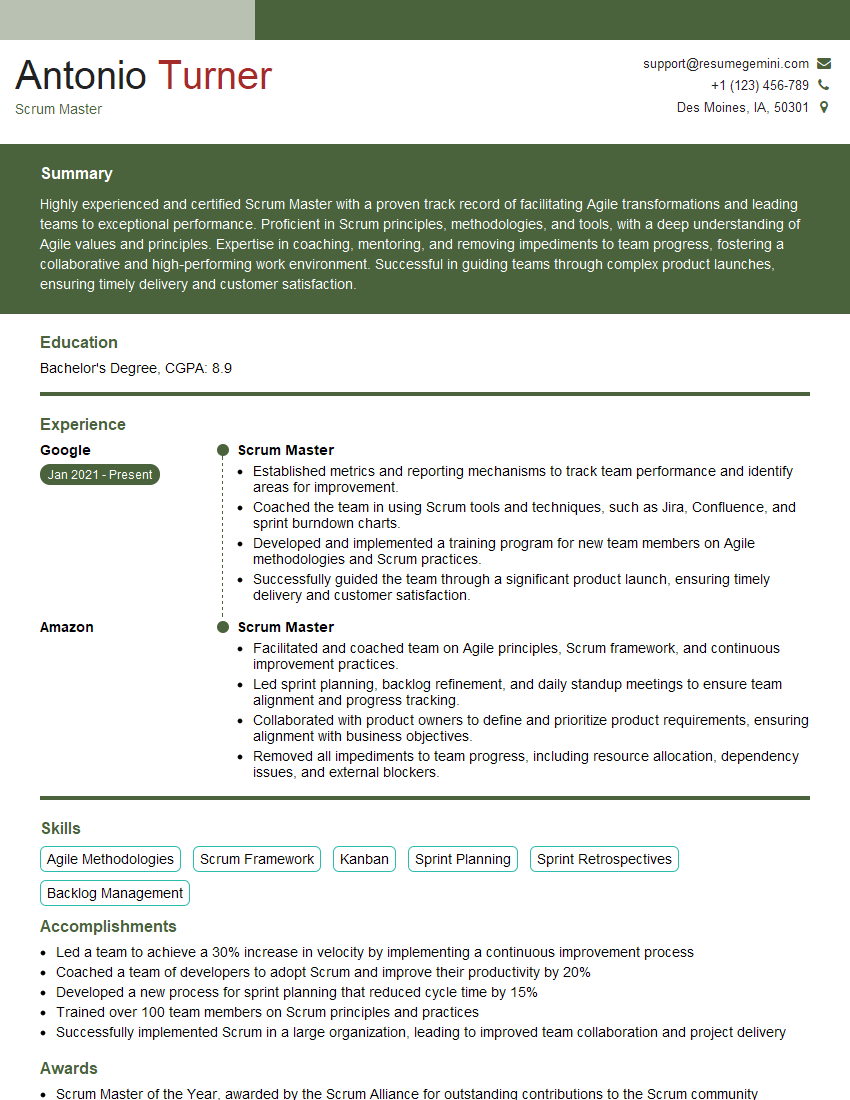
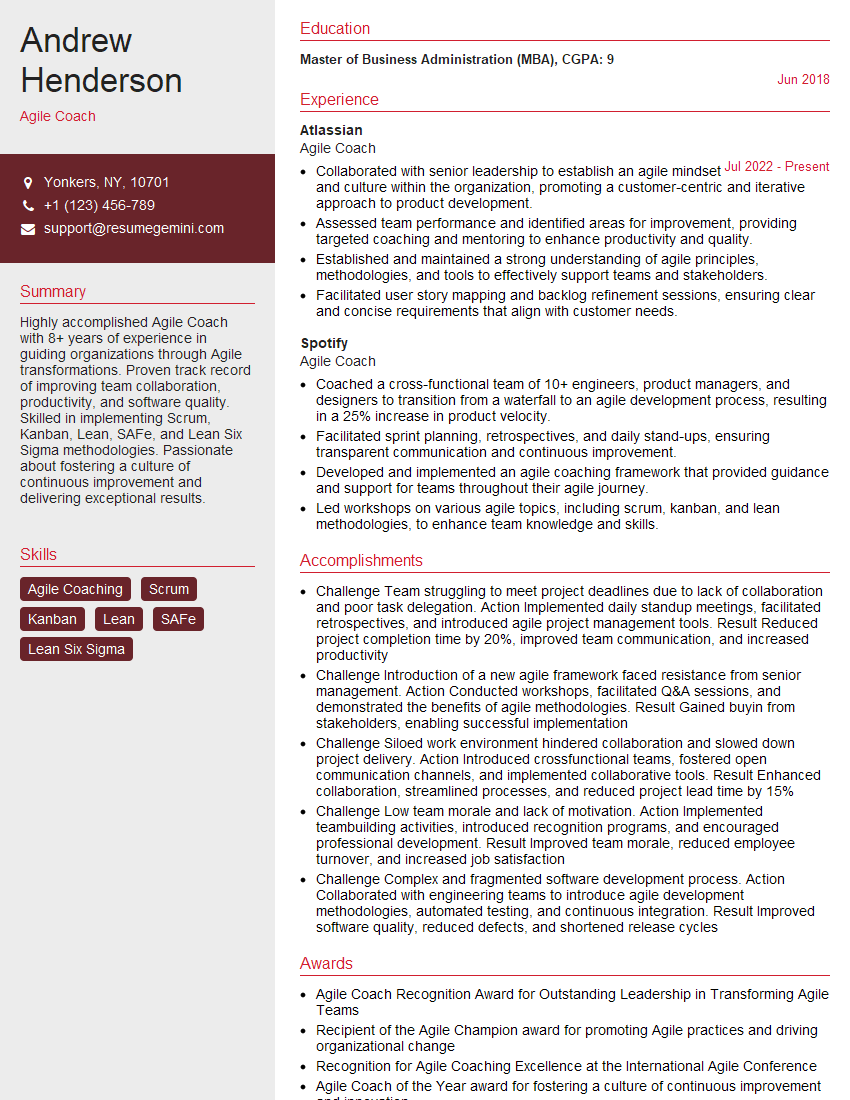
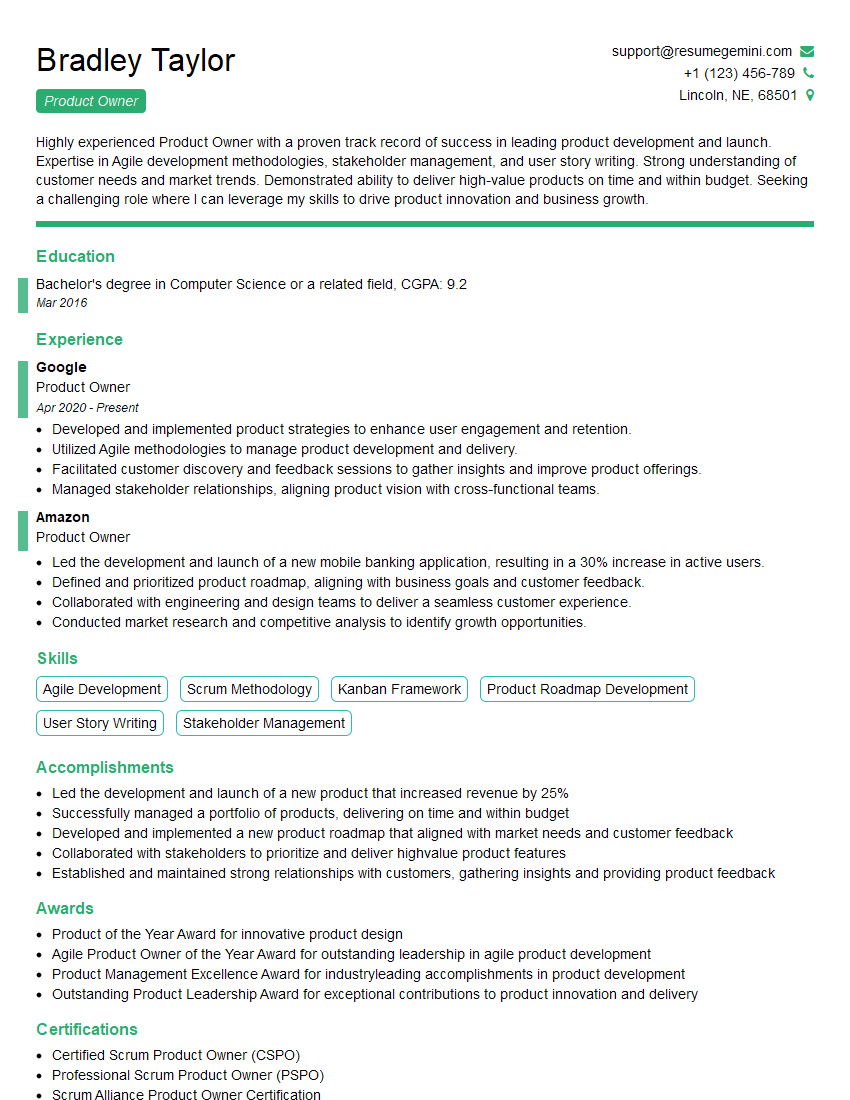
Mastering Agile Development Methodologies is crucial for career advancement in the tech industry. Demonstrating a strong understanding of Agile principles and practical experience is highly valued by employers. To increase your chances of landing your dream role, focus on creating an ATS-friendly resume that showcases your skills and accomplishments effectively. ResumeGemini is a trusted resource that can help you build a compelling resume tailored to your experience. We provide examples of resumes specifically designed for candidates highlighting Experience with Agile Development Methodologies, ensuring your qualifications shine through.
Explore more articles
Users Rating of Our Blogs
Share Your Experience
We value your feedback! Please rate our content and share your thoughts (optional).
What Readers Say About Our Blog
Really detailed insights and content, thank you for writing this detailed article.
IT gave me an insight and words to use and be able to think of examples