The thought of an interview can be nerve-wracking, but the right preparation can make all the difference. Explore this comprehensive guide to Export/Import Procedures interview questions and gain the confidence you need to showcase your abilities and secure the role.
Questions Asked in Export/Import Procedures Interview
Q 1. Explain the difference between Incoterms rules CIF and CFR.
Both CIF (Cost, Insurance, and Freight) and CFR (Cost and Freight) are Incoterms rules that define the responsibilities of the buyer and seller in an international transaction. The key difference lies in who is responsible for insuring the goods during transit.
CIF: Under CIF, the seller is responsible for arranging and paying for the cost of the goods, freight, and insurance to the named port of destination. The risk of loss or damage to the goods transfers from the seller to the buyer once the goods pass the ship’s rail at the port of shipment. Think of it as the seller covering all the bases until the goods arrive at the destination port.
CFR: With CFR, the seller is responsible for the cost of goods and freight to the named port of destination. However, the buyer is responsible for arranging and paying for the insurance. The risk of loss or damage also transfers at the ship’s rail at the port of shipment, just like CIF. The main difference is the buyer bears the insurance cost and risk.
Example: Imagine exporting furniture from China to the US. With CIF, the Chinese seller arranges and pays for shipping and insurance. With CFR, the US buyer handles the insurance.
Q 2. Describe the process of obtaining an export license.
Obtaining an export license is a crucial step for exporting certain goods. The process varies by country and the type of goods being exported. It generally involves several steps:
- Determine Licensing Requirements: First, you need to determine if an export license is required. This depends on the type of goods (e.g., military equipment, certain chemicals), the destination country, and your country’s regulations. Check your government’s export control list.
- Complete the Application: The application process usually involves completing detailed forms, providing accurate information about the goods, the buyer, and the intended use. Be thorough and accurate; mistakes can lead to delays or rejection.
- Provide Supporting Documentation: You’ll likely need to submit supporting documents such as commercial invoices, bills of lading, and end-user certificates (depending on the goods and destination). These documents verify the nature of the transaction and ensure compliance with regulations.
- Submit the Application: Submit your completed application and supporting documents to the relevant government agency. This could be done online or in person.
- Review and Approval: The agency reviews your application to ensure compliance with export control laws. This can take time, sometimes several weeks or even months, depending on the complexity of the application and the type of goods.
- License Issuance: If approved, you will receive your export license. This license permits you to export the goods under the specified conditions.
Failure to obtain the necessary export license can result in significant penalties, including fines and legal repercussions.
Q 3. What are the key documents required for exporting goods?
The specific documents required for exporting goods can vary depending on the products, destination country, and incoterms used. However, some key documents almost always included are:
- Commercial Invoice: This is a crucial document that details the transaction between the exporter and the importer. It includes information about the goods, their quantity, price, and other relevant details.
- Packing List: This document provides a detailed description of the contents of each package, including the quantity, weight, and dimensions. It’s essential for customs officials and freight forwarders.
- Bill of Lading (B/L): This is a document issued by the carrier acknowledging receipt of the goods and acting as a contract for carriage. It serves as proof of ownership and is crucial for claiming the goods at the destination.
- Certificate of Origin (COO): This document verifies the country of origin of the goods. It is often required to determine applicable tariffs and duties.
- Export License (if required): As mentioned earlier, this license is mandatory for exporting specific goods to certain countries.
- Insurance Policy (if applicable): Depending on the incoterms, the seller or buyer might be responsible for securing insurance. This document verifies the coverage.
- Other Documents: Depending on the goods, you may need additional certificates such as phytosanitary certificates (for plants and plant products), health certificates (for food products), or other specific documentation.
Having all the necessary documentation organized and ready is vital for a smooth export process. Missing or incomplete documents can lead to delays and increased costs.
Q 4. How do you handle customs inspections and potential delays?
Customs inspections are a normal part of the export/import process. However, unforeseen delays can arise. Here’s how to handle them:
- Accurate Documentation: The most effective way to avoid problems is to ensure all documentation is accurate, complete, and easily accessible. This minimizes the time customs officials spend reviewing your paperwork.
- Proper Packaging & Labeling: Ensure goods are properly packaged and labeled according to international standards. Clear, accurate labeling reduces the chance of inspections due to misidentification.
- Proactive Communication: Maintain open communication with customs officials and your freight forwarder. If there’s a delay, find out the cause and promptly provide any requested information.
- Relationship Building: Establishing good relationships with customs brokers can help expedite the process and facilitate communication during inspections or delays.
- Contingency Planning: Always have a contingency plan for potential delays. This might include having backup transportation options or alternative solutions to ensure your goods arrive on time, even if there are unforeseen delays.
- Understanding Regulations: Thoroughly understand the customs regulations of both the exporting and importing countries. This prevents potential issues caused by unknowingly violating regulations.
Delays can be frustrating but often unavoidable. Proactive preparation and effective communication are key to minimizing their impact.
Q 5. What are the common challenges faced in international shipping?
International shipping presents unique challenges:
- Documentation Complexity: Navigating the diverse regulations and required documentation for different countries can be complex and time-consuming.
- Transit Time & Delays: International shipments take longer than domestic ones, and unforeseen delays due to weather, customs, or logistical issues are common.
- Cost Fluctuations: Shipping costs are subject to fluctuations influenced by fuel prices, currency exchange rates, and global demand.
- Security & Risk Management: Protecting goods from theft, damage, or loss during transit requires careful planning and insurance.
- Language & Communication Barriers: Effective communication with international partners, freight forwarders, and customs officials is crucial and can be challenging if language barriers exist.
- Trade Regulations & Tariffs: Different countries have their own trade regulations and tariffs, which must be carefully considered to ensure compliance and avoid unexpected costs.
- Geopolitical Factors: Global events, political instability, or conflicts can severely impact international shipping routes and schedules.
Overcoming these challenges requires meticulous planning, attention to detail, and strong relationships with reliable international partners.
Q 6. Explain the process of classifying goods under the Harmonized System (HS) code.
The Harmonized System (HS) code is a standardized system used globally for classifying traded goods. Accurate classification is crucial for determining tariffs, duties, and import/export regulations.
The process of classifying goods involves several steps:
- Understand the HS Nomenclature: The HS system is a hierarchical structure of codes. You need to understand its structure and terminology to find the correct code for your goods.
- Identify the Product Characteristics: Carefully examine your product’s material composition, manufacturing process, intended use, and other relevant characteristics.
- Consult the HS Code Database: Use the official HS code database or specialized resources to search for the appropriate code based on your product’s characteristics. Consider using keywords related to the product’s material, function, and manufacturing process.
- Verify the Code: Once you’ve found a potential code, verify its accuracy against the detailed descriptions and rules provided within the HS system. Ensure that the code aligns with all aspects of your product.
- Seek Expert Advice (If Necessary): If you are unsure about the proper classification, consult with a customs broker or other trade expert who can assist in determining the correct HS code.
An incorrect HS code can lead to delays, fines, and disputes. Accurate classification is essential for smooth international trade.
Q 7. What is a Letter of Credit (LC) and how does it work in international trade?
A Letter of Credit (LC) is a financial instrument used in international trade to mitigate risk for both the buyer and seller. It’s essentially a guarantee from a buyer’s bank that payment will be made to the seller once specified conditions are met.
Here’s how it works:
- Buyer Applies for LC: The buyer (importer) applies to their bank (issuing bank) for a Letter of Credit, providing details of the transaction, including the amount, goods, and shipping terms.
- Issuing Bank Issues LC: If approved, the issuing bank issues the LC to the seller’s bank (advising bank).
- Advising Bank Notifies Seller: The advising bank notifies the seller (exporter) that the LC has been issued.
- Seller Ships Goods: Upon receiving the LC, the seller prepares the shipment and provides documents as specified in the LC (e.g., commercial invoice, bill of lading, packing list).
- Seller Submits Documents: The seller submits the required documents to their bank (negotiating bank).
- Negotiating Bank Verifies Documents: The negotiating bank verifies that all the documents conform to the conditions specified in the LC.
- Payment to Seller: Once the documents are verified, the negotiating bank releases payment to the seller.
- Issuing Bank Reimburses Negotiating Bank: The issuing bank reimburses the negotiating bank.
LCs provide security because the seller receives payment upon presentation of compliant documents, reducing the risk of non-payment. The buyer is assured that payment will only be released after receiving the goods as agreed. They are commonly used in high-value transactions to minimize risk in international trade.
Q 8. How do you manage export controls and sanctions compliance?
Managing export controls and sanctions compliance is paramount to avoiding legal issues and reputational damage. It involves a multi-faceted approach that begins with a thorough understanding of the applicable regulations. This includes knowing the specific export control classifications of goods (e.g., using the Harmonized System (HS) codes), understanding the destination country’s import regulations, and staying updated on any sanctions imposed by relevant bodies like the UN, EU, or the US government.
My process starts with a pre-shipment risk assessment. This involves identifying potential risks associated with the shipment, such as the goods themselves, their intended use, and the end-user. I would use tools like the BIS (Bureau of Industry and Security) website for US regulations and equivalent resources for other regions. I would then develop a compliance plan outlining procedures for screening customers, obtaining necessary licenses or authorizations (where needed), and meticulously documenting every step of the process. Regular training for staff on export control regulations is essential. For example, I’ve personally managed instances where a specific component, seemingly innocuous, fell under strict export controls due to its potential dual-use application. Careful review of the end-use statement and thorough due diligence on the end-user prevented a potential violation.
Finally, ongoing monitoring is crucial. This involves reviewing transactions for compliance, tracking shipment movements, and conducting periodic internal audits to ensure our processes remain effective. A proactive approach to compliance is always the best approach; being reactive is much more costly and potentially damaging.
Q 9. Describe your experience with different modes of transportation (sea, air, land).
My experience encompasses all major modes of transportation—sea, air, and land—each with its own unique considerations. Sea freight is ideal for large volumes of less time-sensitive goods, offering cost-effectiveness but potentially slower transit times. Air freight is faster and more suitable for smaller, high-value or perishable goods, though it carries higher costs. Land transportation, often involving trucking, is frequently used for shorter distances and regional shipments, providing flexibility but potentially posing challenges concerning border crossings and security.
In my career, I’ve coordinated countless shipments using all three modes. For instance, I once managed the export of heavy machinery via sea freight, employing specialized equipment to load and secure the cargo. In another project, we shipped temperature-sensitive pharmaceuticals via air freight, requiring precise temperature control throughout the transport process. And for local distribution within a region, land transport via truck was most efficient. The key is selecting the optimal mode based on a thorough analysis of factors like cost, speed, product characteristics, and destination.
Q 10. Explain the process of handling import duties and taxes.
Handling import duties and taxes is a critical aspect of international trade. It involves understanding the tariff classification of goods (again, using HS codes) to determine the applicable duty rates, as well as any value-added taxes (VAT) or other taxes imposed by the importing country. The process typically begins with the importer receiving a customs invoice along with the shipment documentation. This invoice details the goods, their value, and the country of origin.
Next, the importer needs to calculate the total import costs, including duties, taxes, and any applicable fees. This calculation uses the declared value of the goods and the relevant tariff rates. This is often done using specialized import calculation software, though it can also be done by hand if the tariffs are clearly understood. The importer then files a customs declaration with the relevant customs authority, providing all necessary documentation to facilitate customs clearance. Failure to accurately calculate and declare these duties can result in significant penalties.
For example, I once assisted a client who underestimated the import duties on a shipment of electronics. This oversight resulted in a significant delay and extra costs due to penalties. This reinforced the importance of accurate data and careful review of all applicable regulations and the necessity of using accurate valuation methods.
Q 11. How do you ensure accurate and timely customs declarations?
Ensuring accurate and timely customs declarations is vital for smooth import/export operations. Inaccuracy can lead to delays, penalties, and even the seizure of goods. My approach centers on meticulous data entry, using validated HS codes, and ensuring that the documentation complies fully with all requirements of the relevant customs authority. This includes utilizing a robust system for data verification and validation. It is also essential to provide all the supporting documentation necessary for customs clearance, including invoices, packing lists, certificates of origin, and any other required permits or licenses.
Software plays a crucial role here. I am proficient in various customs declaration software packages that automate many steps, reduce errors, and ensure compliance. Prior to submitting a declaration, we conduct a thorough review to identify and correct any discrepancies. Even small errors, such as a typo in the company name or incorrect quantity, can cause significant delays. I would also always advocate for utilizing electronic data interchange (EDI) with customs whenever possible for faster processing. For example, I’ve personally prevented costly delays by catching errors in customs declarations before submission, preventing significant disruptions to our clients’ operations. Proactive error detection is far better than reactive resolution.
Q 12. What are your strategies for minimizing import/export costs?
Minimizing import/export costs requires a strategic approach that considers all aspects of the supply chain. This begins with careful selection of suppliers, negotiating favorable pricing and payment terms. It also involves optimizing the shipping process. Efficient route planning and selecting the appropriate mode of transport can significantly reduce costs. Furthermore, understanding and utilizing various incoterms (International Commercial Terms) effectively helps manage responsibilities and associated costs between the buyer and seller.
Other cost-saving measures include exploring different packaging options that minimize weight and volume and strategically storing goods to minimize warehousing fees. Consolidating shipments, whenever possible, is also a smart practice. For example, in one instance, I negotiated a better freight rate with a shipping company by consolidating several smaller shipments into one larger container. This decreased costs and improved efficiency. Also, by working closely with logistics providers and customs brokers, I can negotiate beneficial deals and mitigate unexpected costs.
Q 13. How do you manage potential risks associated with international trade?
International trade carries inherent risks, including political instability, currency fluctuations, natural disasters, and logistical challenges. My risk management strategy involves proactive identification and mitigation of potential problems. This includes conducting thorough due diligence on business partners, researching market conditions and potential political risks in the destination country, and building robust contingency plans for various scenarios.
Insurance plays a key role in mitigating financial losses. I always recommend appropriate cargo insurance to cover potential damage, loss, or delay. Effective communication with all stakeholders is critical; maintaining clear lines of communication can help identify and resolve issues quickly. For example, I’ve used political risk insurance to protect against potential losses from political instability. A comprehensive understanding of the potential risks—and then implementing risk mitigation strategies, such as proper insurance and diversification of supply chains—is crucial for successfully managing trade operations.
Q 14. What software or tools are you familiar with for managing export/import operations?
I’m proficient in various software and tools used for managing export/import operations. These include:
- Enterprise Resource Planning (ERP) systems: Such as SAP, Oracle, or Infor, which integrate various business functions, including supply chain management and customs compliance.
- Customs declaration software: These provide automated customs declaration filing, simplifying the process and reducing errors.
- Transportation Management Systems (TMS): These aid in optimizing shipping routes, managing carrier relationships, and tracking shipments.
- Global Trade Management (GTM) software: Solutions such as those offered by various providers (e.g., Descartes, Amber Road) offering comprehensive functionalities for managing trade compliance, regulatory requirements, and various logistics aspects.
Additionally, I’m familiar with various specialized software for specific needs such as Incoterms management, shipment tracking, and document management. The specific tools and software utilized would always depend on the scale and complexity of the operation and the client’s specific requirements. Proficiency in these systems significantly improves efficiency and accuracy.
Q 15. Describe your experience with negotiating international contracts.
Negotiating international contracts requires a deep understanding of both the legal and commercial aspects of global trade. My experience involves crafting mutually beneficial agreements that address key areas like pricing, payment terms, delivery schedules, risk allocation, and dispute resolution. I approach negotiations strategically, starting with thorough due diligence on the counterparty and a clear understanding of market conditions. I believe in building strong relationships based on trust and transparency.
For example, in a recent negotiation with a European supplier, we successfully incorporated a force majeure clause that protected both parties from unforeseen circumstances like pandemics or natural disasters. We also carefully defined the specifications of the goods, incorporating quality control measures and acceptance criteria to minimize disputes. Another key element was establishing a clear payment schedule, utilizing a Letter of Credit to mitigate risks for both sides. The outcome was a contract that was fair, balanced, and protected the interests of all involved parties.
Career Expert Tips:
- Ace those interviews! Prepare effectively by reviewing the Top 50 Most Common Interview Questions on ResumeGemini.
- Navigate your job search with confidence! Explore a wide range of Career Tips on ResumeGemini. Learn about common challenges and recommendations to overcome them.
- Craft the perfect resume! Master the Art of Resume Writing with ResumeGemini’s guide. Showcase your unique qualifications and achievements effectively.
- Don’t miss out on holiday savings! Build your dream resume with ResumeGemini’s ATS optimized templates.
Q 16. How do you handle discrepancies between commercial invoice and packing list?
Discrepancies between commercial invoices and packing lists are a common challenge in international trade. They can lead to delays, disputes, and increased costs. My approach involves a systematic process to identify, analyze, and resolve these discrepancies quickly and efficiently. First, I meticulously compare both documents, noting any differences in quantity, description, or weight of the goods. I then investigate the root cause of the discrepancy – was there a data entry error, a packing error, or perhaps a misunderstanding in the order specifications?
For instance, if there’s a difference in quantity, I’ll cross-reference with the original order and shipping documents. If a description doesn’t match, I’ll clarify with the supplier or the shipping agent. Often, a simple communication resolves the issue. If the discrepancies are significant, I’ll prepare a detailed reconciliation report, providing evidence to support the correct quantities and descriptions. This clear documentation protects my client’s interests and facilitates smooth customs clearance.
Q 17. Explain the importance of insurance in international trade.
Insurance plays a crucial role in mitigating risks in international trade. It safeguards against potential losses or damages that can occur during transit, storage, or even due to unforeseen events. Different types of insurance policies, like marine cargo insurance, cover various risks like theft, fire, damage, and even political instability. The choice of coverage depends on the Incoterms used and the specific nature of the goods being shipped.
Think of it like this: insurance is a safety net for your shipment. Imagine shipping a valuable consignment across the ocean. Without insurance, any loss or damage during transit falls solely on the shipper or buyer, potentially leading to significant financial losses. Insurance protects against such risks, ensuring that the business can absorb potential setbacks without crippling financial consequences. The cost of insurance is a relatively small investment compared to the potential value of the goods and the financial repercussions of a loss.
Q 18. What are your strategies for managing supply chain disruptions?
Managing supply chain disruptions requires a proactive and adaptable approach. My strategies revolve around diversification, risk assessment, and strong communication. Diversifying suppliers mitigates reliance on a single source and helps avoid disruptions if one supplier experiences difficulties. Regular risk assessments identify potential vulnerabilities in the supply chain, allowing for contingency planning.
For example, during the recent global chip shortage, we proactively identified alternative suppliers and negotiated contracts in advance, securing our supply chain and ensuring continuous production. We also utilize robust supply chain management software to monitor inventory levels, track shipments, and predict potential disruptions. Open communication with suppliers and customers is key, ensuring that everyone is informed and works collaboratively to address any challenges.
Q 19. How do you stay updated on changes in international trade regulations?
Staying updated on international trade regulations is paramount. I utilize a multi-faceted approach to ensure compliance. This includes subscribing to reputable trade publications, attending industry conferences and webinars, and actively monitoring government websites for regulatory updates. I also engage with trade professionals and organizations that provide expert insights and training.
Specifically, I use online resources provided by organizations like the World Trade Organization (WTO) and government agencies to track changes in tariff schedules, customs procedures, and other relevant regulations. Regular review of these sources ensures I am well-informed about changes that may affect my clients’ operations. Additionally, maintaining contact with customs brokers and freight forwarders provides valuable on-the-ground insights into current practice and any emerging challenges.
Q 20. Describe your experience with various Incoterms (e.g., FOB, DDP, EXW).
Incoterms, or International Commercial Terms, define the responsibilities of buyers and sellers in international trade. My experience encompasses various Incoterms, including FOB (Free On Board), DDP (Delivered Duty Paid), and EXW (Ex Works). Understanding these terms is crucial for correctly allocating risks and responsibilities.
EXW (Ex Works):The seller’s responsibility ends when the goods are made available at the seller’s premises. The buyer bears all risks and costs from that point onward.FOB (Free On Board):The seller is responsible for delivering the goods to the named port of shipment and loading them onto the vessel. The buyer assumes responsibility for the goods once they are on board.DDP (Delivered Duty Paid):The seller is responsible for delivering the goods to the buyer’s designated location, including all import duties, taxes, and other costs. This is the most comprehensive Incoterm for the buyer.
Each Incoterm requires a different level of involvement and carries different implications for both parties. Choosing the right Incoterm is critical for a successful transaction and should be clearly defined in the contract.
Q 21. How do you ensure compliance with environmental regulations in international trade?
Ensuring compliance with environmental regulations in international trade is crucial for ethical and legal reasons. It’s not just about avoiding penalties; it’s about contributing to global sustainability. My approach involves understanding the specific regulations of both the exporting and importing countries. This includes researching and complying with restrictions on hazardous materials, waste disposal, and packaging requirements.
For example, the shipment of certain chemicals may require specific certifications and documentation to comply with international conventions like the Basel Convention. Similarly, packaging materials might need to meet specific biodegradable or recyclable standards. A proactive approach involves working with suppliers to ensure they meet these standards and obtaining all necessary certifications well in advance of shipping. Regularly reviewing and updating our processes ensures we stay ahead of any changes in environmental regulations and maintain a sustainable and responsible approach to international trade.
Q 22. Explain the process of handling returned goods from international customers.
Handling returned goods from international customers is a complex process requiring meticulous attention to detail and adherence to established protocols. It begins with clearly defined return policies communicated upfront in the sales agreement. This policy should outline who is responsible for return shipping costs (buyer or seller), the timeframe for returns, the condition the goods must be in upon return, and the method of refund or replacement.
Upon receiving a return request, we meticulously document all aspects – the customer’s reason for return, the condition of the returned goods, and the tracking information. We then initiate the return process, often utilizing the same logistics partner for consistency and tracking. If the return is due to a fault on our part (e.g., damaged goods, incorrect order), we cover all shipping costs and may offer expedited replacement. For returns due to customer reasons, we might negotiate a partial refund to cover some shipping costs or offer a store credit. Once the goods are received and inspected, we process the refund or replacement, meticulously documenting every step to ensure transparency and accountability.
For example, a customer received a damaged shipment of ceramics. After confirming the damage with photos and providing a prepaid shipping label, we processed a full refund upon inspection, and sent a replacement via expedited shipping.
Q 23. How do you manage communication and collaboration with international partners?
Managing communication and collaboration with international partners is crucial for successful export/import operations. Effective communication requires proactive engagement, multiple communication channels (email, phone, video conferencing), and a clear understanding of time zone differences. We establish a designated point of contact on both sides, ensuring efficient information flow. For complex projects, we leverage project management tools to track progress, deadlines, and tasks collaboratively. We prioritize clear, concise communication, using plain language to avoid misunderstandings across different linguistic and cultural backgrounds. Building trust through consistent communication and timely response is essential. We also ensure all communication, especially regarding critical details like shipping, customs documentation, and payment terms, is documented. This helps in resolving any discrepancies or disputes that may arise.
For instance, for a large-scale textile export, we established a weekly video conference call with our partners in India to discuss production updates, logistics and potential challenges. This collaborative approach ensured efficient execution of the order.
Q 24. Describe your experience with different payment methods in international trade.
My experience encompasses various payment methods in international trade, each with its own advantages and drawbacks. Letters of Credit (LCs) offer a high degree of security for both buyer and seller, with payment guaranteed once the goods are shipped and the documents are presented to the bank. Documentary Collections provide a balance of security and cost-effectiveness, but rely more heavily on trust. Telegraphic Transfers (TTs) offer faster payment but may lack the same level of security for the seller. Open Account transactions present the greatest risk for the seller but allow more flexibility for the buyer.
Recently, we’ve been increasingly incorporating secure digital payment platforms that offer enhanced tracking and security, especially for smaller transactions. The choice of payment method depends on the relationship with the partner, the transaction value, and the risk tolerance. We always meticulously review contracts to define the accepted payment methods, deadlines, and procedures. A well-defined payment structure ensures transparency and mitigates potential delays or payment disputes.
Q 25. How do you handle disputes related to international shipments?
Handling disputes related to international shipments requires a methodical and diplomatic approach. The first step involves thoroughly reviewing all documentation: contracts, invoices, packing slips, bills of lading, insurance certificates, and any relevant communication. We then determine the nature of the dispute: damaged goods, missing items, late delivery, or incorrect documentation. We attempt to resolve the issue through amicable negotiation with the involved parties – the customer, shipping carrier, and/or insurance company.
If negotiation fails, we may pursue alternative dispute resolution methods such as arbitration or litigation, depending on the severity of the dispute and the contract stipulations. Evidence from thorough documentation is essential in these cases. It’s crucial to understand the applicable laws and international trade regulations governing the transaction. Our goal is always to find a fair and mutually acceptable solution that preserves the long-term business relationship.
For instance, a delay in a container shipment due to port congestion led to a delay of goods. With clear communication with both the client and the shipping line, providing accurate documentation about the port situation and a proposed compensation plan, we successfully prevented a formal dispute.
Q 26. What is your experience with Free Trade Agreements (FTAs)?
My experience with Free Trade Agreements (FTAs) is extensive, and it is essential for optimizing import/export operations. FTAs reduce or eliminate tariffs and other trade barriers between participating countries, significantly impacting pricing and competitiveness. Understanding the specific rules of origin within an FTA is crucial to qualify for preferential tariffs. This requires precise documentation of the goods’ origin and manufacturing process. We regularly assess which FTAs apply to our products and destinations, thereby benefiting from reduced tariffs and streamlined customs procedures. The use of certificates of origin and other specific FTA documentation are key to leveraging these agreements effectively.
For example, utilizing the USMCA (United States-Mexico-Canada Agreement), we secured significant cost savings by reducing tariffs on goods shipped between the United States and Canada.
Q 27. How do you measure the success of your export/import operations?
Measuring the success of export/import operations involves a multi-faceted approach. Key Performance Indicators (KPIs) include profitability (net profit margin on each transaction), sales volume (total value of goods exported/imported), on-time delivery rate (percentage of shipments delivered within the agreed timeframe), customer satisfaction (measured through feedback surveys and repeat business), and efficiency (measured in terms of time and costs per transaction). We also monitor compliance metrics, ensuring adherence to all relevant regulations and avoiding penalties. We use this data to analyze performance, identify areas for improvement, and make strategic decisions to optimize our operations. Regular performance reviews and comparisons against benchmarks help to identify trends and highlight areas needing attention.
For example, we monitor our on-time delivery rate monthly. If this rate dips below our target, we initiate process improvements such as negotiating with logistics partners to optimize lead times or streamlining internal processes.
Key Topics to Learn for Your Export/Import Procedures Interview
- Incoterms: Understand the various Incoterms (e.g., FOB, CIF, DDP) and their implications for responsibility, cost, and risk allocation throughout the shipping process. Consider practical scenarios where choosing the wrong Incoterm could lead to disputes or financial losses.
- Documentation: Master the essential export and import documentation, including commercial invoices, packing lists, bills of lading, certificates of origin, and any other relevant permits or licenses. Practice identifying which documents are crucial for different shipment types and regulatory environments.
- Customs Regulations & Compliance: Develop a thorough understanding of customs procedures, import duties, tariffs, and trade regulations. Be prepared to discuss strategies for minimizing costs and ensuring compliance with international trade laws. Explore case studies of non-compliance and their consequences.
- Logistics & Supply Chain Management: Familiarize yourself with the various modes of transportation (sea, air, land), freight forwarding, customs brokerage, and inventory management within the context of international trade. Practice problem-solving scenarios involving logistics delays or disruptions.
- International Trade Finance: Understand different payment methods (e.g., letters of credit, documentary collections) and their associated risks and benefits. Be prepared to discuss how to mitigate risks in international transactions.
- Trade Regulations & Sanctions: Demonstrate awareness of current international trade policies, sanctions, and embargoes that might impact export/import operations. Be ready to discuss how these regulations affect business strategy.
- Risk Management: Discuss strategies for identifying and mitigating risks associated with international trade, such as political instability, currency fluctuations, and supply chain disruptions. Consider how insurance plays a role.
Next Steps
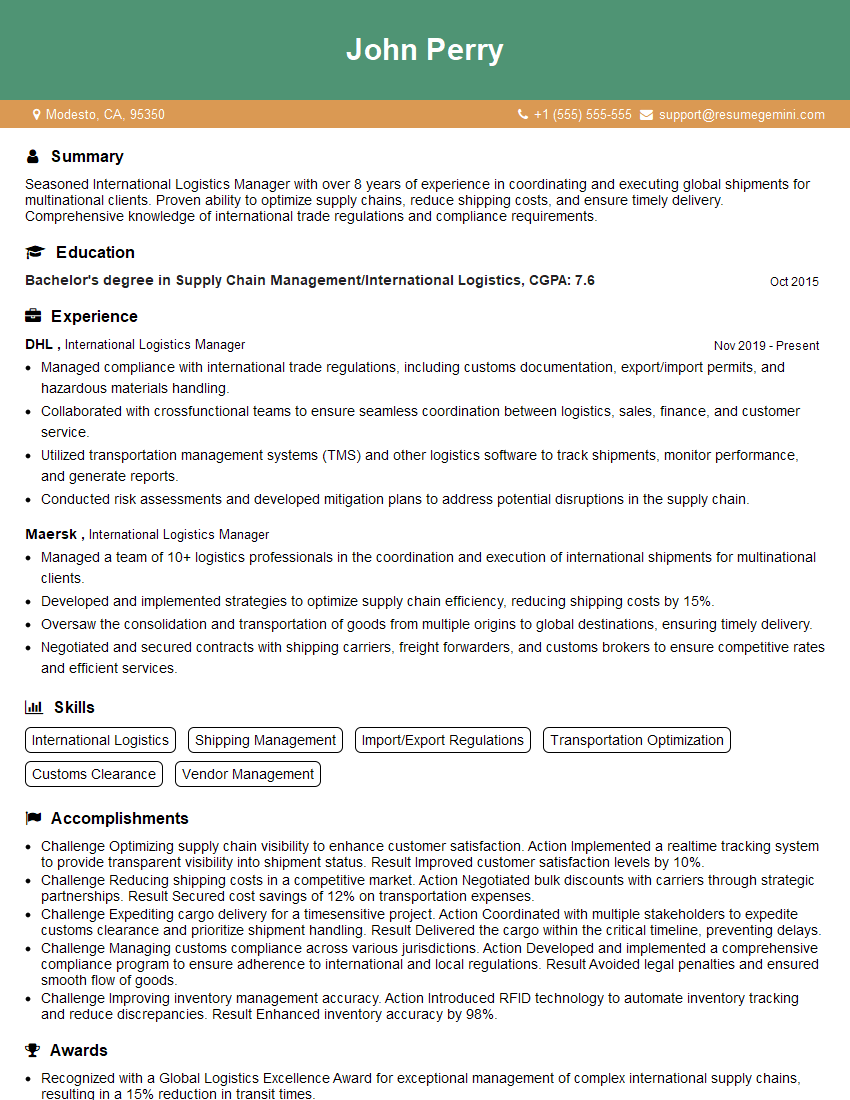
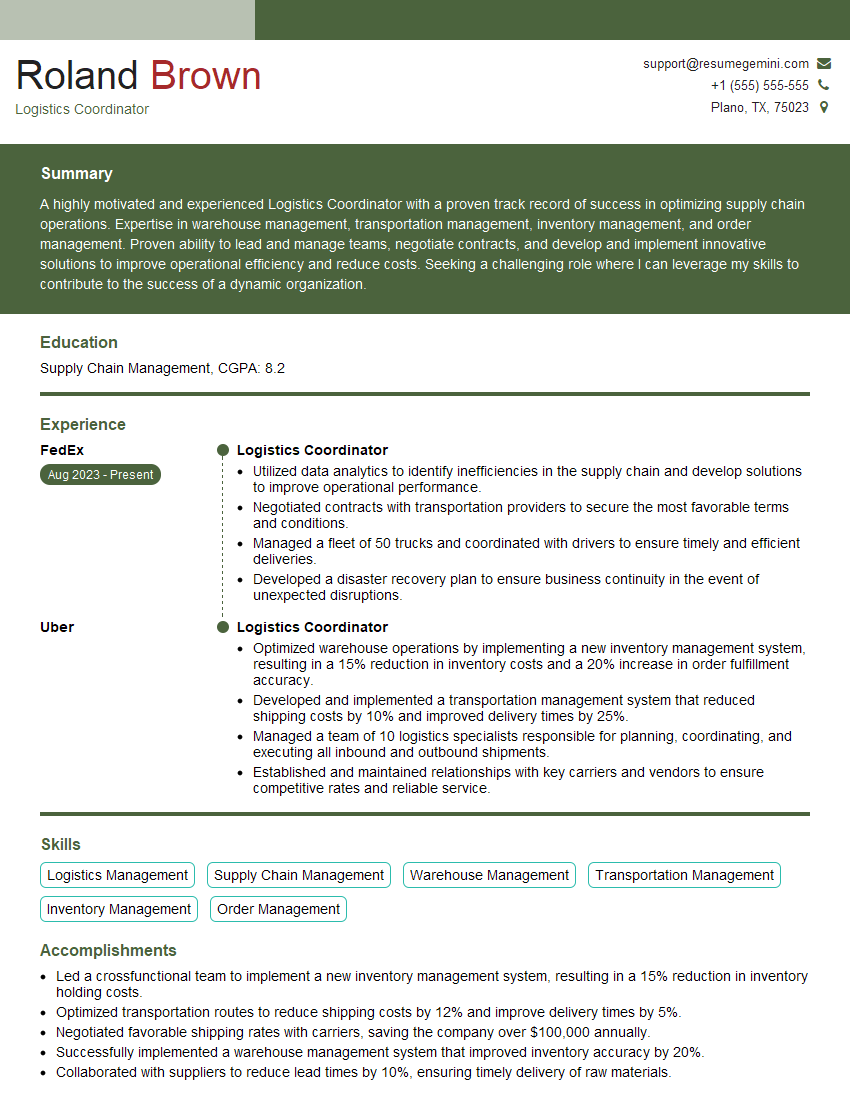
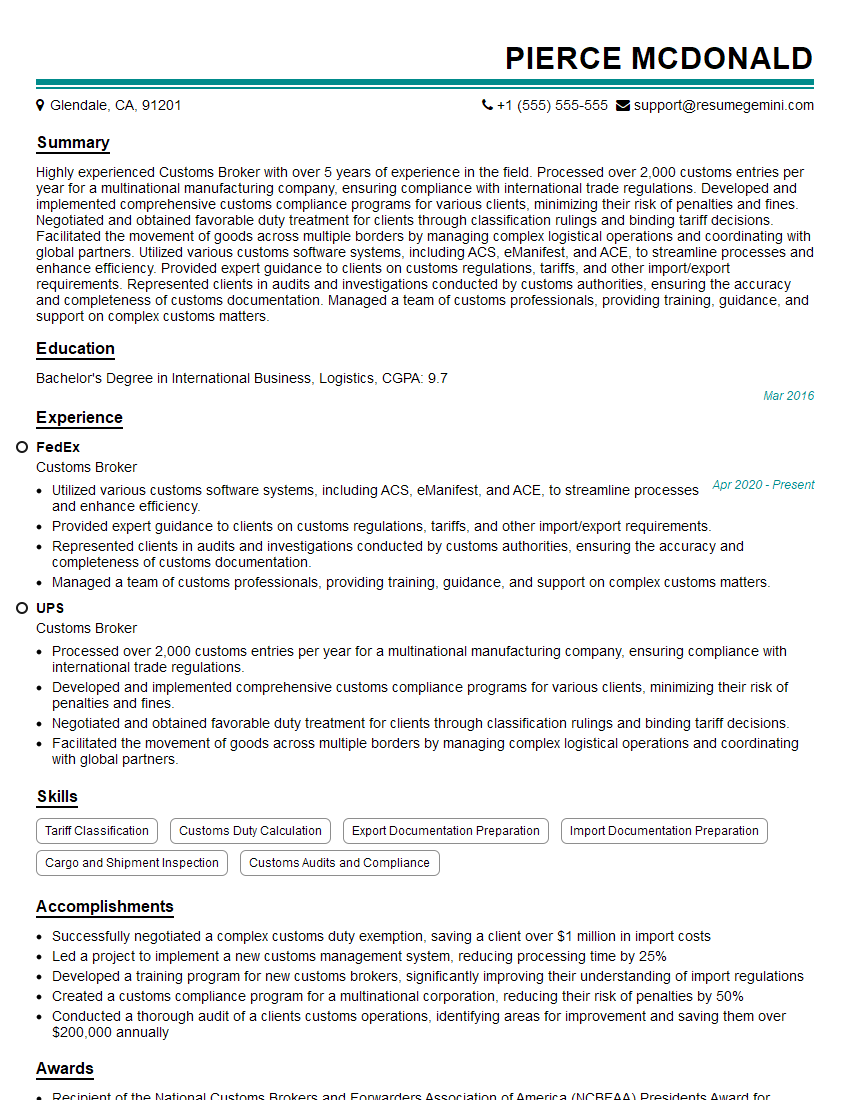
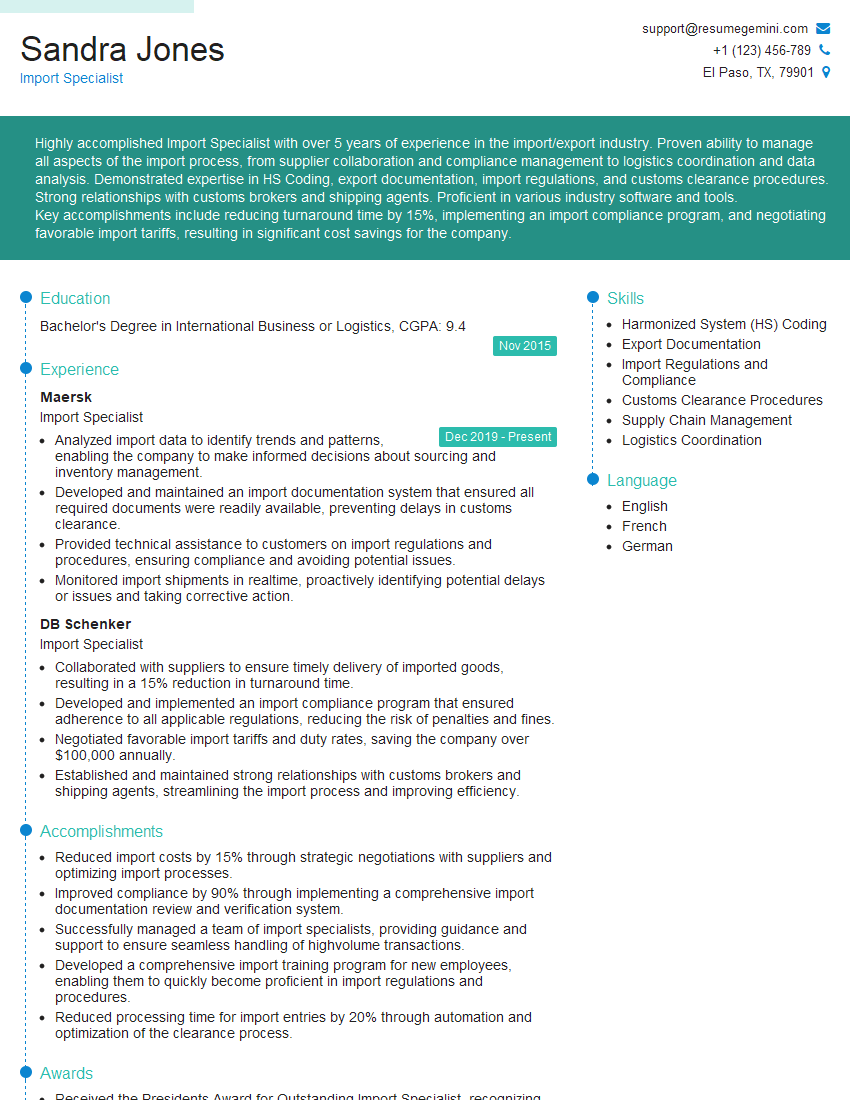
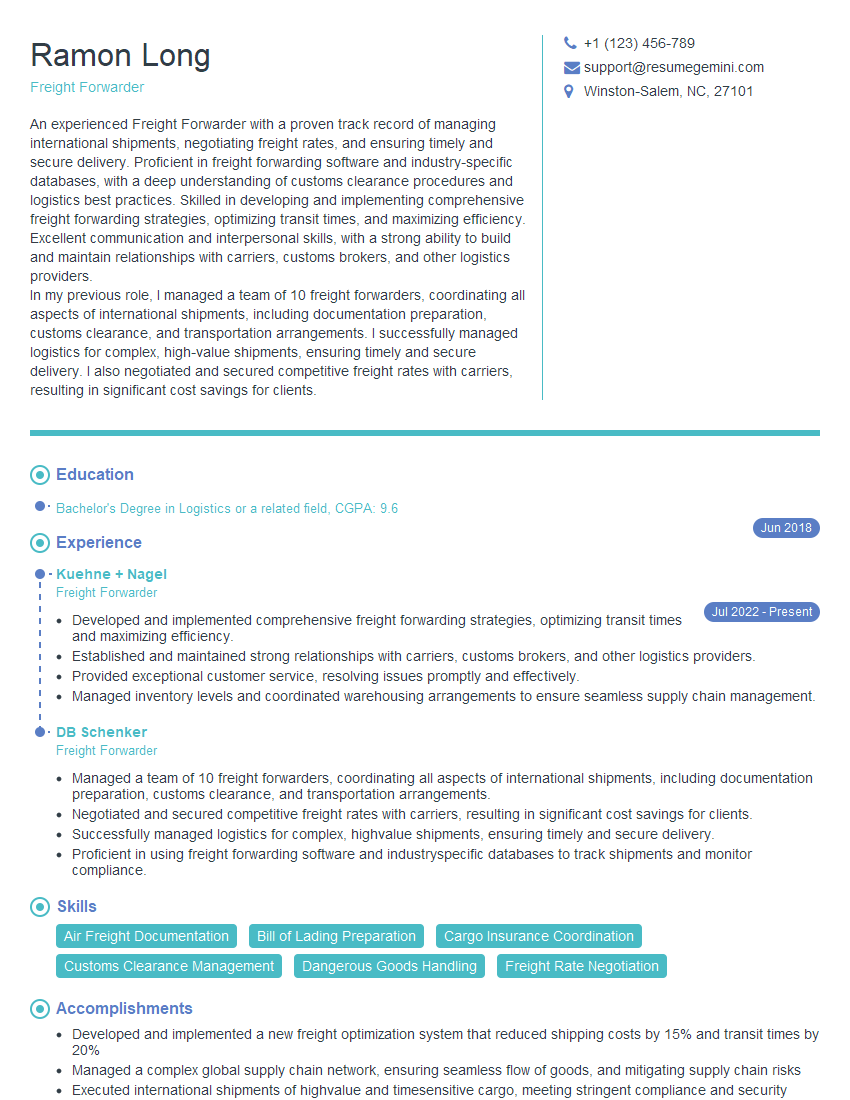
Mastering export/import procedures is crucial for a successful career in international trade, opening doors to diverse roles and higher earning potential. A strong understanding of these processes showcases your expertise and problem-solving capabilities to potential employers. To significantly boost your job prospects, create an ATS-friendly resume that highlights your skills and experience effectively. ResumeGemini is a trusted resource to help you build a professional and impactful resume, ensuring your application stands out. We provide examples of resumes tailored to Export/Import Procedures to help guide you.
Explore more articles
Users Rating of Our Blogs
Share Your Experience
We value your feedback! Please rate our content and share your thoughts (optional).
What Readers Say About Our Blog
Really detailed insights and content, thank you for writing this detailed article.
IT gave me an insight and words to use and be able to think of examples