Interviews are more than just a Q&A session—they’re a chance to prove your worth. This blog dives into essential Eye Setting interview questions and expert tips to help you align your answers with what hiring managers are looking for. Start preparing to shine!
Questions Asked in Eye Setting Interview
Q 1. Explain the different methods of eye setting.
Eye setting, in the context of optical component assembly, refers to the precise positioning of lenses or other optical elements within a housing or mount. Several methods exist, each with its own advantages and disadvantages. These methods are largely dictated by the precision required and the type of component being set.
Manual Eye Setting: This involves using tools like micrometer stages, adjustable holders, and optical alignment tools to manually position the element. It’s labor-intensive but allows for high precision in skilled hands. Think of it like a jeweler meticulously setting a gemstone—extreme care and patience are essential.
Semi-Automated Eye Setting: This combines manual adjustments with automated measurement and feedback systems. For example, a machine might automatically measure the position of the lens, guiding the operator towards the correct alignment. This reduces human error and increases efficiency.
Fully Automated Eye Setting: This employs robotic systems with advanced vision and control systems to handle the entire process. These systems are capable of setting lenses with extremely high precision and speed. Imagine a tiny, highly precise robotic arm performing the same task repeatedly and consistently.
Q 2. Describe your experience with various eye setting tools and equipment.
My experience encompasses a wide range of eye setting tools and equipment, from basic manual tools to fully automated systems. I’ve worked extensively with:
Micrometer stages: Essential for fine adjustments, providing precise control over the X, Y, and sometimes Z axes. I’ve used these extensively for delicate manual alignments.
Optical alignment telescopes and autocollimators: These allow for accurate measurement of angular positioning, crucial for ensuring the lens is properly oriented within the mount. I’ve relied on them for precision work involving prisms and other angular components.
Vision systems: These use cameras and software to provide real-time feedback on the lens’s position and orientation. I’ve used these in both semi-automated and fully automated systems, improving speed and consistency.
Robotic arms: I’ve worked with systems featuring six-axis robots equipped with specialized end effectors for handling lenses and performing automated setting operations, resulting in significant gains in throughput and consistency.
Q 3. What are the common challenges faced during eye setting, and how do you overcome them?
Common challenges include:
Maintaining precise alignment: Even minor deviations can significantly impact optical performance. This is especially challenging with larger or more complex components. Overcoming this involves using high-precision tools, meticulous techniques, and careful calibration.
Lens damage: Lenses are fragile, and improper handling can lead to scratches or other damage. I address this through proper handling procedures, use of specialized lens handling tools, and proper cleaning practices.
Environmental factors: Temperature and humidity fluctuations can affect alignment. This is mitigated through environmental control in the workspace and the use of temperature-compensated tooling.
Component tolerances: Variations in the dimensions of the lens or mount can make precise setting difficult. I address this by thoroughly checking component dimensions and using appropriate compensation techniques during the setting process.
To overcome these challenges, I utilize a combination of advanced tools, thorough planning, and meticulous attention to detail. A methodical approach, combined with the experience of identifying and anticipating potential issues, is key.
Q 4. How do you ensure the accuracy and precision of eye setting?
Accuracy and precision are paramount in eye setting. I ensure this through several key strategies:
Calibration: Regular calibration of all equipment using certified standards is crucial. This ensures that measurements are accurate and repeatable.
Measurement Techniques: Employing appropriate measurement techniques and tools, such as optical interferometry or laser-based systems, for highly accurate positioning and verification.
Multiple Measurements: I always take multiple measurements to confirm accuracy and identify any potential errors. This helps ensure that the lens is positioned correctly and consistently within the specified tolerance.
By meticulously following standardized procedures and using a multi-layered approach to verification, we can achieve the necessary levels of accuracy and precision.
Q 5. What quality control measures do you employ during eye setting?
Quality control is integrated throughout the eye setting process. I employ several measures:
Visual Inspection: A thorough visual inspection is conducted before, during, and after the setting process. This helps to detect any damage or misalignment early on.
Dimensional Verification: Accurate measurements are taken to verify that the lens is positioned within the specified tolerances. This often involves using precision measuring instruments.
Functional Testing: The assembled component is often subjected to functional tests to ensure that it meets the required performance specifications. This might include optical performance testing or environmental testing.
Statistical Process Control (SPC): I monitor key parameters using SPC charts to identify trends and prevent potential problems. This helps ensure consistent quality over time.
Documentation of each step, including measurements and inspections, forms a crucial part of the quality control process.
Q 6. Explain your understanding of tolerances and specifications in eye setting.
Tolerances and specifications define the acceptable range of variation in the lens’s position and orientation. These are crucial for ensuring the optical component functions correctly. For example, a tolerance of ±0.005mm might be specified for the X and Y position of a lens, while an angular tolerance of ±1 arcminute might be specified for its orientation. These specifications are usually dictated by the optical system’s design requirements and the intended application.
Understanding these tolerances is critical, as exceeding them can result in substandard performance or even malfunction. I work closely with engineering specifications to ensure adherence to all tolerances during the setting process.
Q 7. Describe your experience with different types of optical components.
My experience spans a variety of optical components, including:
Lenses: This includes various types such as spherical, aspherical, cylindrical, and achromatic lenses, with varying sizes and materials. The setting process often differs based on the lens type and material.
Prisms: I’ve worked with different prism types, requiring precise angular alignment. The tolerance and method used for setting prisms are significantly different than for lenses.
Mirrors: Setting mirrors often involves ensuring precise surface flatness and alignment. Specialized techniques and tools are often required to prevent damage or misalignment.
Diffractive Optical Elements (DOEs): DOEs require even more precise positioning due to their sensitivity to misalignment. I’ve worked on several projects involving their precise alignment.
Understanding the unique characteristics and potential challenges associated with each component type is essential for successful eye setting.
Q 8. How do you handle defective components during the eye setting process?
Handling defective components during eye setting is crucial for maintaining product quality and preventing costly rework. My process starts with a thorough visual inspection of each component before the setting process begins. I use magnification tools, as needed, to detect even minute flaws. Defects can range from surface scratches and discoloration to cracks or misalignments. Any component exhibiting a defect that could compromise the structural integrity or aesthetic appeal of the final product is immediately rejected and documented. This documentation includes the type of defect, the component’s identification number, and the reason for rejection. Rejected components are then segregated according to the defect type for analysis and potential root cause investigation. This meticulous approach helps ensure that only high-quality components are used, minimizing waste and enhancing the reliability of the final assembly. For instance, in a recent project involving miniature cameras, I identified several lenses with microscopic scratches that, while almost invisible to the naked eye, would have significantly impacted image quality. Their rejection prevented a large batch of defective products.
Q 9. What safety precautions do you take during eye setting?
Safety is paramount in eye setting. We always use appropriate personal protective equipment (PPE), including safety glasses to protect against flying debris, and anti-static wrist straps to prevent electrostatic discharge (ESD) damage to sensitive components. The work area is kept clean and clutter-free to prevent accidents and ensure efficient movement. Proper lifting techniques are employed when handling heavy components or materials, preventing strain and injury. We also follow strict procedures for handling adhesives, ensuring proper ventilation and avoiding skin contact. In addition, we regularly inspect and maintain our tools and equipment to ensure they are in safe working order. For example, we regularly check the integrity of our dispensing needles to prevent accidental spills or injuries. Furthermore, a well-defined emergency plan, including procedures for dealing with chemical spills and eye injuries, is in place and regularly reviewed. Safety training is mandatory for all personnel involved in eye setting.
Q 10. Describe your experience with automated eye setting systems.
I have extensive experience with automated eye setting systems, particularly those employing vision-guided robotics. These systems offer significant advantages in terms of speed, precision, and repeatability. I’m proficient in programming and operating various automated systems, including those utilizing collaborative robots (cobots) for enhanced safety. My experience includes working with systems from different manufacturers, allowing me to adapt to various software interfaces and hardware configurations. I’ve worked on projects integrating automated eye setting with other automated processes in the assembly line, leading to a significant improvement in overall productivity and product consistency. For instance, I implemented a vision-guided system that automatically inspected and aligned components before setting, reducing the rate of defects substantially. Furthermore, I am comfortable troubleshooting automated systems, including diagnosing and resolving mechanical and software issues. My expertise includes analyzing system data to identify potential areas for improvement in efficiency and accuracy.
Q 11. How do you troubleshoot common eye setting problems?
Troubleshooting eye setting problems often involves a systematic approach. It begins with a careful examination of the assembled unit, noting any misalignments, gaps, or other irregularities. I then analyze the process parameters, including adhesive viscosity, dispensing pressure, and curing time. The condition of the tooling and equipment is also thoroughly checked. Common issues include improper adhesive application, component misalignment, and insufficient curing. For example, if the components are consistently misaligned, I might check the jig or fixture for wear or damage. If the adhesive isn’t curing properly, I would investigate factors like temperature and humidity. I use various diagnostic tools, including microscopes and optical inspection systems, to identify root causes. A logical, step-by-step approach, combined with careful observation and analysis, is crucial to effectively solve eye setting problems. Data logging and statistical process control (SPC) charts are valuable tools to monitor the process and identify recurring issues.
Q 12. What is your experience with different types of adhesives used in eye setting?
My experience encompasses a wide range of adhesives used in eye setting, including UV-curable adhesives, epoxy resins, and cyanoacrylates (super glues). Each adhesive type has unique properties that make it suitable for specific applications. UV-curable adhesives, for instance, offer fast curing times and high precision, making them ideal for high-volume applications. Epoxy resins offer excellent strength and durability, while cyanoacrylates provide rapid bonding but may have limitations in terms of strength and flexibility. The selection of the appropriate adhesive depends on several factors, including the materials being bonded, the required bond strength, the curing time, and the environmental conditions. I’m familiar with the safety precautions associated with each adhesive type, including proper handling, ventilation, and disposal procedures. Moreover, I have experience optimizing adhesive application techniques to ensure consistent and reliable bonds, minimizing adhesive usage, and preventing issues like voids or excess adhesive squeeze-out. Each project requires a careful evaluation of the adhesive’s properties to ensure a successful outcome.
Q 13. How do you maintain clean room conditions during eye setting?
Maintaining clean room conditions during eye setting is vital to prevent contamination and ensure product quality. We adhere to strict cleanliness protocols, including the use of clean room garments (bunny suits, gloves, masks) and regular cleaning of the work area with appropriate solvents and cleaning materials. Particulate counts are monitored regularly to ensure they remain within acceptable limits. All tools and equipment are meticulously cleaned and maintained to prevent the introduction of contaminants. The air quality is controlled through the use of HEPA filters, and humidity and temperature are carefully monitored to maintain optimal conditions. We employ regular surface swabbing and environmental monitoring to detect any contamination. For example, we utilize sticky mats at entrances to trap particles from shoes, and compressed air is carefully used to remove loose particles from surfaces. A well-defined cleaning and maintenance schedule ensures that the cleanroom environment is consistently maintained at the required level of cleanliness.
Q 14. How do you ensure the proper alignment of components during eye setting?
Ensuring proper alignment of components during eye setting is critical to achieve the desired functionality and aesthetics of the final product. We use a variety of methods to achieve precise alignment, including jigs, fixtures, and vision systems. Jigs and fixtures provide mechanical guidance to ensure consistent placement of components. Vision systems provide real-time feedback, allowing for automated adjustments to achieve accurate alignment. In some cases, we may use a combination of these methods for optimal precision. For example, a jig might be used to hold the components in place, while a vision system verifies their alignment before adhesive application. Before setting, each component’s orientation and position are carefully checked to ensure they are correctly placed according to the design specifications. Precise alignment techniques are particularly critical when dealing with miniature components or those with tight tolerances. We regularly calibrate our alignment equipment and monitor the alignment process to ensure consistent accuracy.
Q 15. Describe your experience with different types of lenses.
My experience encompasses a wide range of lenses, from simple spherical lenses used in basic optical instruments to complex aspheric and diffractive lenses found in high-precision applications. I’m proficient in working with various materials, including glass, plastic, and crystalline materials, each exhibiting unique optical properties and requiring specific handling techniques. For example, I’ve extensively worked with high-index lenses, which require meticulous care due to their fragility and susceptibility to scratching. Similarly, my experience with cemented doublets and triplets requires a deep understanding of the alignment and centering processes to ensure optimal performance. I am also familiar with the challenges presented by specialized lenses such as cylindrical, toric, and freeform lenses, each needing a unique approach to precise placement.
- Spherical Lenses: These are the most basic type, easy to work with but often with limitations in aberration correction.
- Aspheric Lenses: These have non-spherical surfaces, minimizing aberrations for superior image quality; they require more precise alignment.
- Diffractive Lenses: These use diffraction gratings to focus light, offering advantages in compactness and potentially higher efficiency, but are highly sensitive to wavelength and require careful handling.
Career Expert Tips:
- Ace those interviews! Prepare effectively by reviewing the Top 50 Most Common Interview Questions on ResumeGemini.
- Navigate your job search with confidence! Explore a wide range of Career Tips on ResumeGemini. Learn about common challenges and recommendations to overcome them.
- Craft the perfect resume! Master the Art of Resume Writing with ResumeGemini’s guide. Showcase your unique qualifications and achievements effectively.
- Don’t miss out on holiday savings! Build your dream resume with ResumeGemini’s ATS optimized templates.
Q 16. Explain the importance of proper cleaning procedures in eye setting.
Proper cleaning procedures are paramount in eye setting, directly impacting the quality of the optical system and the longevity of its components. Contaminants like dust, fingerprints, and even microscopic particles can severely degrade image quality, introducing scattering and aberrations. My cleaning protocols adhere to strict industry standards. This involves using specialized lens cleaning solutions, microfiber cloths, and compressed air. We utilize a multi-step process, starting with a low-pressure burst of compressed air to remove loose particles, followed by gentle wiping with a lint-free cloth dampened with isopropyl alcohol. For delicate lenses, I use specialized cleaning brushes. Documentation of each cleaning step is crucial for traceability and quality control. I have experience in using ultrasonic cleaning for more intricate components, always carefully following manufacturer recommendations to avoid damage. Imagine trying to assemble a delicate watch with smudged lenses – the precision is lost! This is exactly why our cleaning procedures are so meticulous.
Q 17. How do you document the eye setting process?
I document the entire eye setting process meticulously using a combination of methods. Each project begins with a detailed work order that specifies lens type, tolerances, and any special instructions. Throughout the process, I maintain a detailed log that includes the date, time, and the specific steps undertaken, along with any measurements or observations. Digital imaging is integral to my documentation, capturing images of the lenses before, during, and after the setting process. This visual record allows for thorough quality checks and provides a valuable audit trail. In some cases, particularly for highly sensitive or critical applications, I generate detailed reports containing numerical data and graphs from measurement systems to confirm that the set lens meets the pre-defined specifications. These reports are essential for verifying the accuracy and repeatability of the process.
Q 18. What is your experience with using microscopes and other magnification tools?
My proficiency extends to a variety of magnification tools essential for precise eye setting. I regularly utilize stereo microscopes with various magnification levels, crucial for inspecting the smallest details of lens surfaces and ensuring proper alignment. I’m skilled in adjusting illumination and focusing to optimize visibility. I also have experience using measuring tools integrated within the microscope system for precise measurements of critical parameters, like the distance between the lens surfaces or the lens center height. Beyond microscopes, I employ specialized optical gauges and measuring tools to independently verify measurements, ensuring accuracy and minimizing potential errors. Familiarity with digital micrometers and video measuring systems further enhances my precision and reduces the chance of human error during the process.
Q 19. How do you ensure the longevity of the eye setting process?
Ensuring the longevity of the eye setting process hinges on several key factors. The most crucial element is the initial selection of high-quality materials and components. Employing robust mounting techniques that can withstand environmental factors and potential vibrations is critical. Proper handling during transportation and storage is also paramount, especially for delicate lenses. Regular maintenance checks and preventative cleaning help extend the lifespan. Furthermore, creating detailed process documentation, including assembly diagrams and torque specifications, facilitates repairs or future adjustments. Proper storage conditions, such as a controlled environment to minimize temperature and humidity fluctuations, can significantly impact the life of the system. By maintaining thorough records and using best practices throughout the process, we ensure the long-term stability and performance of the components involved.
Q 20. How do you manage your time effectively during a high-volume eye setting task?
High-volume eye setting requires an organized and efficient approach. I prioritize tasks using a combination of techniques. I begin by thoroughly reviewing the work order and preparing all necessary components and tools in advance. This reduces wasted time searching for materials. I use a ‘first in, first out’ system to organize my workflow, minimizing any delays. I’ve also developed a system of standardized procedures to ensure consistency and speed in routine tasks. Employing lean manufacturing principles, like identifying and eliminating bottlenecks, allows me to maximize my output. Taking short, planned breaks prevents fatigue and maintains accuracy and ultimately reduces errors, which is more efficient overall than trying to continue working while tired.
Q 21. How do you work effectively as part of a team during eye setting?
Effective teamwork in eye setting is vital. Clear communication is key: I actively participate in pre-project meetings to review specifications and discuss potential challenges. During the process, I maintain open communication with team members, especially when encountering unexpected issues or requiring assistance. I readily offer support to my colleagues, and I value their input and expertise. A collaborative environment fosters a sense of shared responsibility and quality control, leading to improved efficiency and accuracy. By working together and sharing knowledge, we achieve higher quality results and a more efficient process, fostering continuous improvement and a positive team dynamic. Think of it like a well-oiled machine: each part is essential for the overall functioning.
Q 22. Describe your experience with using statistical process control (SPC) in eye setting.
Statistical Process Control (SPC) is crucial for maintaining consistent quality in eye setting. It involves using statistical methods to monitor and control a process, identifying and addressing variations before they lead to defects. In my experience, I’ve implemented SPC charts, specifically X-bar and R charts, to track key parameters like eyelet placement accuracy and solder joint strength. For example, I monitored the distance between the eyelet and the designated location on a PCB over multiple samples. By plotting this data on an X-bar chart, I could quickly identify trends indicating potential issues such as machine misalignment or operator inconsistencies. If the data points fell outside the control limits, it triggered an investigation and corrective action, preventing the production of defective units.
Furthermore, I’ve utilized control charts to monitor the number of defects per sample. This allowed for the early detection of process drift and proactive adjustments to the eye-setting process. This proactive approach to quality control not only improved product quality but also minimized waste and rework. In essence, SPC has become an integral part of my quality assurance strategy in eye setting, enhancing process efficiency and reliability.
Q 23. What is your understanding of lean manufacturing principles as applied to eye setting?
Lean manufacturing principles focus on eliminating waste and maximizing efficiency. In eye setting, this translates to optimizing workflows, minimizing material handling, and reducing defects. My application of lean principles includes implementing 5S (Sort, Set in Order, Shine, Standardize, Sustain) to organize the workspace, reducing search time and improving overall efficiency. I’ve also worked on reducing setup times for different eyelet types by using standardized jigs and fixtures and implementing quick-changeover techniques. This ensures a smooth workflow and minimizes downtime. Another key aspect is implementing error-proofing methodologies, such as using visual aids and poka-yoke devices, to prevent common mistakes during the eye-setting process. This minimizes rework and improves the quality of the end product. For example, using a jig with clear visual indicators for correct eyelet placement helped prevent misalignments and significantly reduced defects.
Q 24. How do you prioritize tasks during a busy workday in eye setting?
Prioritization during a busy workday in eye setting requires a structured approach. I typically use a combination of methods: First, I assess the urgency and importance of tasks, often using a matrix that categorizes tasks based on their impact and deadline. Urgent and important tasks, such as addressing immediate production needs or fixing critical equipment malfunctions, get top priority. Next, I utilize a Kanban system (or a similar visual task management tool) to visualize my workflow and track progress. This allows me to easily identify bottlenecks and re-allocate resources as needed. Finally, I regularly communicate with my supervisor and team members to coordinate efforts and ensure that everyone is aligned on priorities. Effective communication is crucial to avoid conflicts and ensure timely completion of all tasks.
Q 25. What is your experience with different types of soldering techniques used in eye setting?
My experience encompasses various soldering techniques, primarily focused on those suitable for delicate eyelet applications. I’m proficient in both manual soldering using a fine-tipped iron, and automated soldering with reflow ovens for higher-volume production. For manual soldering, I’m adept at controlling temperature and applying the right amount of solder to create robust, reliable connections without causing damage to nearby components. In situations requiring high precision, I use microsoldering techniques with magnification tools. With reflow ovens, I’m experienced in setting appropriate temperature profiles for various solder pastes and eyelet materials. The selection of the soldering method depends heavily on the specific application and volume of the project.
Q 26. Describe your experience with using different types of fixtures for eye setting.
I’ve worked with a range of fixtures designed for different eyelet types and PCB designs. These include simple spring-loaded jigs that hold the eyelet in place during soldering, more complex fixtures that provide precise alignment and support, and automated placement systems for high-volume production. The choice of fixture depends on factors such as eyelet size, material, PCB design complexity, and production volume. For example, a specialized fixture may be required for placing very small eyelets on densely packed PCBs, ensuring precise alignment and preventing damage to surrounding components. The use of appropriate fixtures is critical to ensure consistent placement, accurate alignment, and efficient workflow.
Q 27. How do you maintain the calibration of your eye setting tools?
Maintaining the calibration of eye-setting tools is critical for consistent quality. I regularly check the accuracy of tools like microscopes and measuring equipment using calibrated standards. For example, I utilize gauge blocks to verify the accuracy of micrometers used for measuring eyelet placement. I maintain detailed logs of calibration checks, including the date, results, and any corrective actions taken. Beyond simple measurement tools, I also monitor the temperature consistency of soldering irons and reflow ovens with temperature sensors and ensure they operate within specified parameters. This meticulous approach ensures that the tools remain accurate and reliable, leading to consistent and high-quality results.
Q 28. What are your salary expectations for an eye setting position?
My salary expectations for an eye-setting position depend on several factors, including the specific job responsibilities, company size, location, and my experience. Considering my expertise and experience detailed above, I’m seeking a competitive salary commensurate with my skills and contributions. I’m open to discussing a specific salary range after a more detailed understanding of the position’s requirements and the company’s compensation structure.
Key Topics to Learn for Eye Setting Interview
- Lens Selection and Fitting: Understanding different lens types, their properties, and how to select the appropriate lens for various prescriptions and patient needs. Practical application includes explaining the process of determining lens power and fitting lenses accurately.
- Frame Selection and Adjustment: Knowledge of frame materials, styles, and measurements. Practical application includes demonstrating the ability to adjust frames for optimal fit and comfort, addressing common fitting challenges.
- Optical Instruments and Equipment: Familiarity with various instruments used in eye setting, such as lensometers, frame warmers, and other tools. Practical application involves explaining their functionality and proper usage techniques.
- Quality Control and Troubleshooting: Understanding procedures for quality assurance in eye setting, including detecting and resolving common issues such as lens decentering or frame damage. Problem-solving includes describing approaches to handling challenging fitting situations.
- Safety and Hygiene Practices: Knowledge of and adherence to safety regulations and hygienic procedures within the optical setting. Practical application includes detailing appropriate handling of lenses and equipment to prevent damage and contamination.
- Understanding Ophthalmic Prescriptions: Ability to correctly interpret and utilize prescription information to accurately set lenses into frames. Practical application involves explaining the different components of a prescription and their significance in lens selection and fitting.
Next Steps
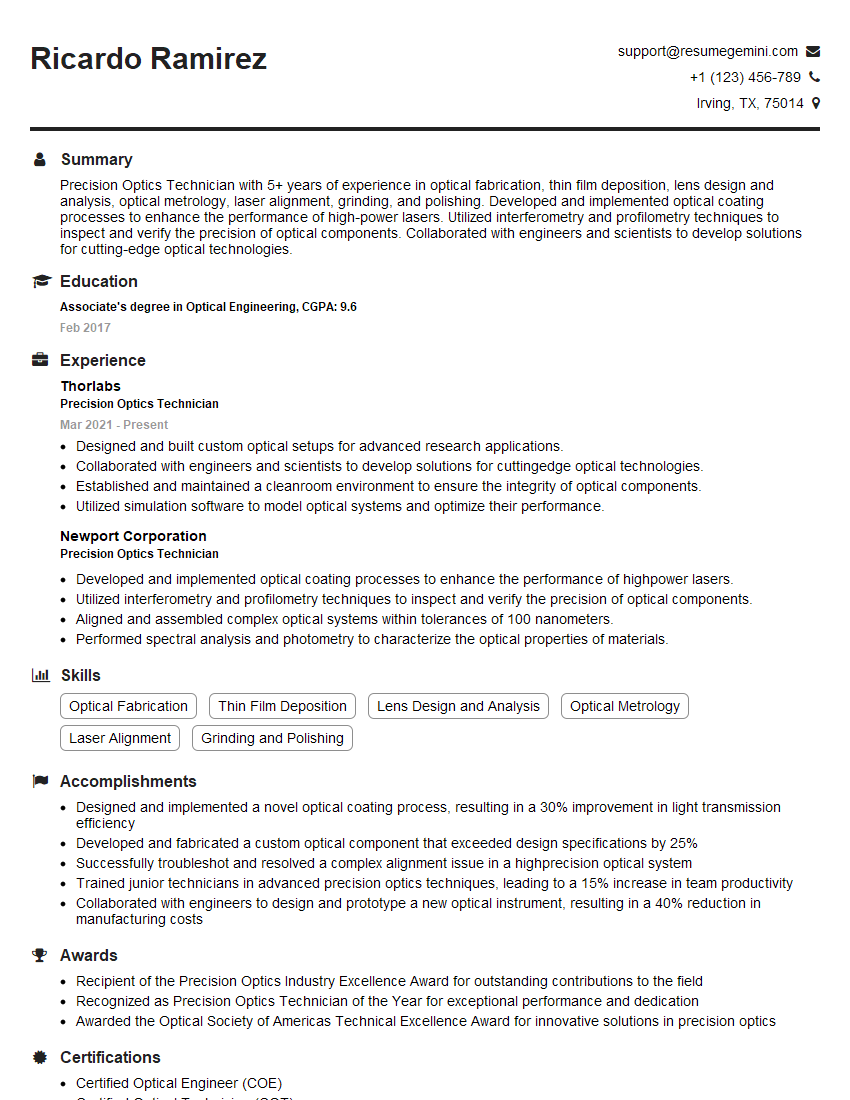
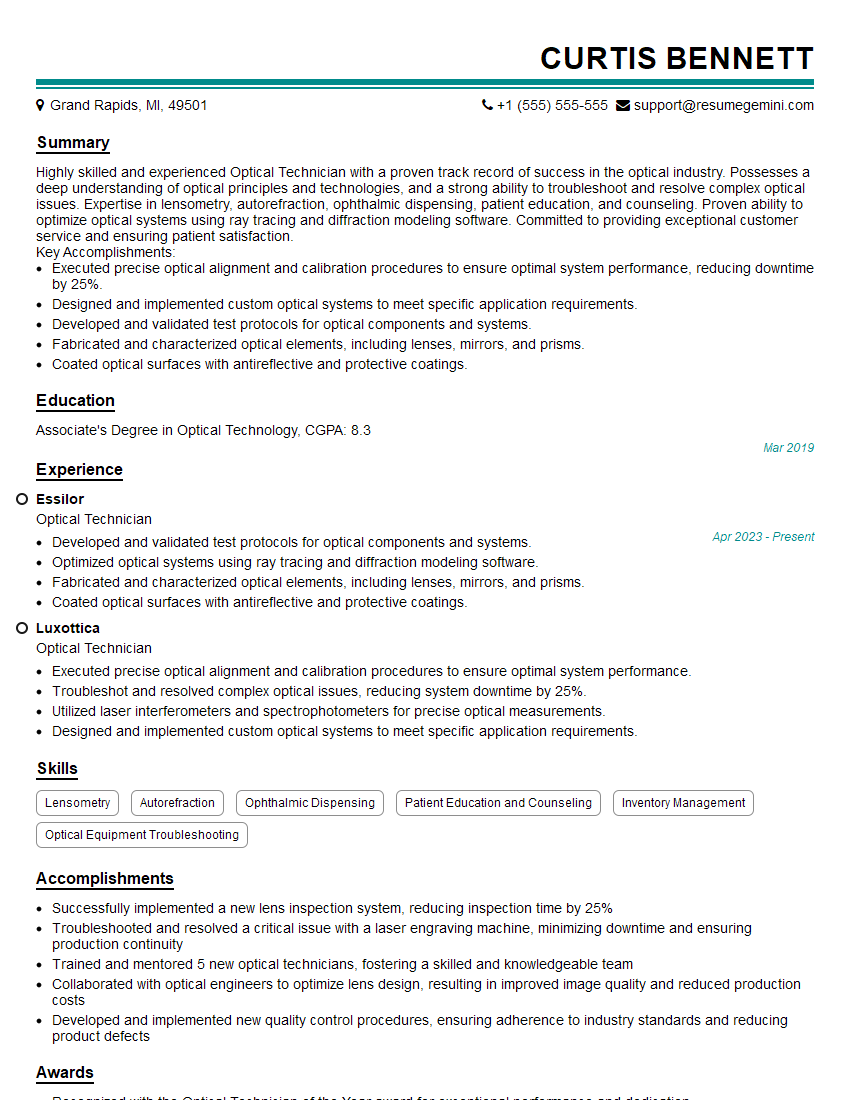
Mastering eye setting opens doors to rewarding careers in the optical industry, offering opportunities for specialization and advancement. To maximize your job prospects, creating a strong, ATS-friendly resume is crucial. ResumeGemini is a trusted resource that can help you build a professional resume that highlights your skills and experience effectively. Examples of resumes tailored to Eye Setting are available to provide you with further guidance and inspiration.

Explore more articles
Users Rating of Our Blogs
Share Your Experience
We value your feedback! Please rate our content and share your thoughts (optional).
What Readers Say About Our Blog
Really detailed insights and content, thank you for writing this detailed article.
IT gave me an insight and words to use and be able to think of examples