Unlock your full potential by mastering the most common Field Data Collection and Management interview questions. This blog offers a deep dive into the critical topics, ensuring you’re not only prepared to answer but to excel. With these insights, you’ll approach your interview with clarity and confidence.
Questions Asked in Field Data Collection and Management Interview
Q 1. Describe your experience with various data collection methods (e.g., GPS, mobile apps, sensors).
My experience spans a wide range of data collection methods, each chosen strategically depending on the project’s needs and the environment. For precise location data, I’ve extensively used GPS devices, both handheld and integrated into smartphones. This is invaluable for geographic information systems (GIS) work, mapping assets, or tracking movement. For example, in a recent ecological survey, we used GPS to record the precise locations of bird nests.
Mobile applications offer a flexible way to collect a wide variety of data, often directly from the field. I’m proficient in designing and utilizing customized apps for data entry, incorporating features like photo and video capture, barcode scanning, and data validation rules to minimize errors on-site. Imagine using an app to track construction progress, capturing images of completed phases and instantly logging materials used.
Finally, sensor technology provides continuous data streams. I have experience integrating and managing data from environmental sensors (temperature, humidity, soil moisture), accelerometers (for movement analysis), and even specialized sensors for specific research projects, like water quality monitoring sensors. Processing and analyzing sensor data requires specialized skills in data cleaning and handling large time-series datasets, which I’ve honed over many years.
Q 2. Explain your process for ensuring data accuracy and quality control.
Data accuracy and quality control are paramount. My process begins with meticulous planning. This includes defining clear data requirements, choosing appropriate collection methods, and developing standardized data entry protocols. Think of it like building a house – you need a solid blueprint before you start laying bricks.
During data collection, I emphasize training data collectors thoroughly on the protocols and implementing real-time checks. This can involve using mobile apps with built-in validation rules or conducting regular spot checks in the field.
After data collection, a rigorous quality assurance (QA) process is essential. This involves data validation, using statistical methods to identify outliers and inconsistencies. I also visually inspect data, often using GIS software to detect spatial anomalies. For example, a GPS reading that’s far outside the expected area might indicate a data entry error. Finally, comprehensive documentation ensures the entire process is transparent and auditable.
Q 3. How do you handle incomplete or inconsistent data?
Incomplete or inconsistent data is a common challenge. My approach is systematic and depends on the nature and extent of the problem. First, I try to identify the cause. Is it due to data entry errors, equipment malfunction, or perhaps a gap in the data collection protocol?
For missing data, I might use imputation techniques, depending on the context. Simple imputation involves replacing missing values with the mean or median of the available data. More sophisticated methods consider the correlation between variables. However, I always document my imputation choices and carefully consider potential biases.
Inconsistent data requires careful review. I look for patterns and inconsistencies, then try to reconcile them by going back to the source if possible. If the data is irredeemably corrupted or if the inconsistencies are too pervasive, I would flag the data as potentially unreliable for analysis.
Q 4. What software and tools are you proficient in for data collection and management?
My software proficiency is extensive, covering the entire data lifecycle. For data collection, I’m experienced in using various mobile data collection apps (e.g., Survey123, Fulcrum, Collector for ArcGIS), along with specialized software for sensor data acquisition.
For data management, I’m adept at using databases such as PostgreSQL and MySQL, and I’m comfortable working with cloud-based platforms like AWS and Azure. I am also highly proficient in various scripting languages such as Python, utilizing libraries like Pandas and NumPy for data analysis and manipulation.
For data visualization and analysis, I utilize ArcGIS, QGIS, R, and Tableau. This broad range of tools ensures that I can manage and analyze data effectively, regardless of the project’s complexity.
Q 5. Describe your experience with data validation and cleaning techniques.
Data validation and cleaning are crucial steps in ensuring data quality. Validation techniques often involve using automated checks to identify illogical or impossible values. For example, a negative value for height, or a date in the future, would be flagged automatically.
Cleaning involves correcting or removing invalid data. This could include handling missing values (as mentioned before), correcting typographical errors, or standardizing data formats. I use scripting languages (like Python) to automate much of this process, saving time and reducing the risk of manual errors. For example, I might use Python’s pandas library to identify and replace inconsistent date formats or to remove duplicate entries.
# Example Python code snippet for cleaning data using pandas import pandas as pd df = pd.read_csv('my_data.csv') df['Date'] = pd.to_datetime(df['Date'], format='%m/%d/%Y') # Standardize date format
Q 6. How do you manage large datasets efficiently?
Managing large datasets efficiently requires a combination of strategies. First, I leverage relational databases (like PostgreSQL or MySQL) or NoSQL databases, depending on the data structure. This allows for optimized storage and retrieval.
Next, I employ data compression techniques to reduce storage space and improve processing speeds. For analysis, I use parallel processing and distributed computing, breaking down large tasks into smaller chunks that can be processed simultaneously. This significantly reduces processing times, especially when dealing with terabytes or petabytes of data.
Finally, cloud computing platforms offer scalable solutions for storing and processing large datasets. I’m comfortable utilizing cloud-based data warehouses and using their built-in functionalities for data analysis and visualization. Using a combination of these techniques, I can ensure large datasets remain manageable and easily analyzed.
Q 7. What is your experience with data security and confidentiality?
Data security and confidentiality are of utmost importance. My approach involves multiple layers of protection. This includes secure data storage using encryption both in transit and at rest. I’m experienced in implementing access control mechanisms, ensuring only authorized personnel can access sensitive data.
For projects involving personally identifiable information (PII), I strictly adhere to relevant privacy regulations (e.g., GDPR, HIPAA). This means implementing anonymization or de-identification techniques when necessary, and ensuring that all data handling practices comply with the strictest legal and ethical standards.
Regular security audits and penetration testing are key components of my approach to maintaining a robust security posture. These help identify vulnerabilities and ensure that the security measures are effective in preventing unauthorized access or data breaches.
Q 8. How do you prioritize tasks in a fast-paced field data collection environment?
Prioritizing tasks in a fast-paced field data collection environment requires a structured approach. I typically use a combination of techniques, starting with a clear understanding of project objectives and deadlines. This involves identifying critical tasks that directly contribute to meeting those goals. I then employ prioritization frameworks like the Eisenhower Matrix (urgent/important), MoSCoW method (must have, should have, could have, won’t have), or simply ranking tasks based on their impact and dependency. For example, if we’re collecting data on endangered species, observations of those species would be prioritized over less critical data points. Real-time adjustments are key; unexpected events might necessitate re-prioritization. I use project management software to track progress, flag potential delays, and dynamically adjust the task order based on evolving circumstances. Regular communication with the team is also essential to maintain synchronization and resolve conflicts that might affect task prioritization.
Q 9. Explain your experience with different data formats (e.g., CSV, GeoJSON, shapefiles).
My experience spans various data formats commonly used in field data collection. CSV (Comma Separated Values) is a simple, widely compatible format ideal for tabular data, easily imported into spreadsheets and databases. I frequently use it for exporting data from field devices or importing data for analysis. GeoJSON is essential for geospatial data, representing geographic features like points, lines, and polygons with their associated attributes. I use GeoJSON extensively when dealing with location-based information, especially when integrating data with GIS software. Shapefiles, another geospatial format, are often used for storing vector data. I leverage shapefiles particularly when working with large datasets or when higher spatial accuracy is needed. Understanding the strengths and weaknesses of each format is crucial. For instance, CSV lacks spatial information, while GeoJSON and Shapefiles are less convenient for simple tabular data. The choice of format depends entirely on the nature of the data and the intended analysis.
Q 10. Describe a time you had to troubleshoot a technical issue during data collection.
During a biodiversity survey in a remote area, our GPS devices malfunctioned due to a software bug. This disrupted data collection significantly, as accurate location data was crucial for our research. My initial troubleshooting involved checking device settings, restarting the devices, and updating the firmware. However, the issue persisted. I systematically investigated potential causes, ruling out user error, battery issues, and network connectivity problems. I then researched the specific GPS model online, discovered a known bug, and found a workaround involving a specific configuration change in the device’s internal menu. After implementing this fix, the GPS devices resumed normal operation. This experience highlighted the importance of thorough investigation, accessing reliable resources, and remaining calm under pressure. Documenting the solution was crucial to prevent similar issues in the future.
Q 11. How do you ensure the integrity of collected data from multiple sources?
Ensuring data integrity from multiple sources involves a multi-faceted approach. It begins with establishing standardized data collection protocols, including clear guidelines for data entry, formatting, and unit measurements. Data validation checks are crucial, employing both automated and manual methods. Automated checks can involve range checks (ensuring data falls within expected values), consistency checks (checking for discrepancies between related data points), and plausibility checks (verifying the data’s reasonableness). Manual checks, performed by trained personnel, provide an additional layer of quality control. Data reconciliation techniques, like comparing data from different sources and identifying and resolving conflicts, are essential. Using version control systems to track changes and maintain data provenance also contributes to maintaining data integrity. Think of it as building a strong foundation with multiple checks and balances to ensure the reliability of your data.
Q 12. What is your experience with data warehousing and data lakes?
My experience with data warehousing and data lakes is extensive. Data warehousing involves organizing data from multiple sources into a centralized repository optimized for analytical processing. I’ve used data warehousing techniques to consolidate field data from various projects, enabling comprehensive analysis and reporting. The structured nature of a data warehouse is ideal for generating standardized reports and insights. Data lakes, on the other hand, provide a more flexible, schema-on-read approach. They store raw data in its native format, offering greater flexibility but requiring more sophisticated processing for analysis. I have worked with data lakes in projects involving diverse data types and sources, allowing for exploratory analysis and the ability to incorporate new data types easily. The choice between a data warehouse and a data lake depends heavily on the project’s specific requirements and scale. A large-scale project with diverse and evolving data might benefit more from a data lake, while a project requiring standardized reporting and simpler analysis might be better suited to a data warehouse.
Q 13. How do you communicate effectively with both technical and non-technical stakeholders?
Effective communication with both technical and non-technical stakeholders requires tailoring the message to the audience. With technical stakeholders, I can use precise terminology and detailed explanations, focusing on technical specifications and data quality metrics. For instance, discussing data validation techniques, database schemas, or API integrations is appropriate. With non-technical stakeholders, I use simpler language, visualizations, and less technical jargon. I would focus on the project’s overarching goals, key findings, and practical implications, possibly using charts and graphs to illustrate the data. Active listening is crucial in both scenarios. In all cases, clear, concise, and well-structured communication, supplemented by visual aids when necessary, is essential for ensuring everyone understands the data and its implications.
Q 14. Explain your process for documenting and reporting field data.
My process for documenting and reporting field data emphasizes completeness, accuracy, and accessibility. It begins with a detailed metadata scheme, defining all data elements, their units, and data quality standards. This metadata is crucial for understanding the data’s context and ensuring consistency. During data collection, I meticulously record all observations, using standardized formats and field-specific terminology. I use digital data collection tools whenever possible to ensure data quality and minimize manual transcription errors. After data collection, I perform data cleaning and validation, addressing errors and inconsistencies. Reporting involves creating clear, concise reports that present key findings and insights. These reports are tailored to the audience’s needs, using appropriate visualizations and avoiding technical jargon when necessary. I use version control to track changes and maintain the integrity of the documentation and reports. Finally, ensuring data accessibility involves archiving the data appropriately, providing clear instructions on how to access and interpret the data, and using a consistent file naming and storage structure.
Q 15. How do you handle conflicting data or discrepancies?
Handling conflicting data is crucial for data integrity. My approach involves a multi-step process. First, I carefully review the conflicting data points, noting the source, timestamp, and any metadata associated with each. This helps identify potential reasons for the discrepancy – perhaps a data entry error, a faulty sensor reading, or even a genuine change in the field condition.
Next, I investigate the root cause. This might involve revisiting the location, cross-referencing with other data sets, or consulting with field technicians involved in data collection. For example, if sensor readings for temperature differ significantly between two sensors, I’d examine sensor calibration records and environmental factors like shading or equipment malfunction.
Finally, I resolve the conflict using a documented and auditable process. This might involve flagging the conflicting data for manual review, applying data validation rules to identify and correct errors, or using statistical methods to estimate a more likely value if multiple data points are involved. The resolution process is meticulously documented, detailing the steps taken, justification, and final value used. Transparency and traceability are paramount.
Career Expert Tips:
- Ace those interviews! Prepare effectively by reviewing the Top 50 Most Common Interview Questions on ResumeGemini.
- Navigate your job search with confidence! Explore a wide range of Career Tips on ResumeGemini. Learn about common challenges and recommendations to overcome them.
- Craft the perfect resume! Master the Art of Resume Writing with ResumeGemini’s guide. Showcase your unique qualifications and achievements effectively.
- Don’t miss out on holiday savings! Build your dream resume with ResumeGemini’s ATS optimized templates.
Q 16. Describe your experience with data visualization and reporting.
Data visualization and reporting are key to effectively communicating findings. My experience spans a variety of tools and techniques. I’m proficient in creating charts, graphs, and maps using software such as ArcGIS, QGIS, and Tableau. For instance, I’ve used ArcGIS to create interactive maps showcasing spatial patterns in soil moisture data, allowing stakeholders to easily visualize areas needing irrigation.
I understand the importance of selecting the right visualization for the specific data and audience. For instance, a simple bar chart might suffice for presenting summary statistics, while a more complex network graph might be necessary to illustrate relationships between different data points. Beyond visuals, I develop comprehensive reports that include detailed methodology, data limitations, and clear interpretations of the results. I tailor these reports to different audiences, ensuring that the information is accessible and actionable. For example, I’ve presented data visualizations to both technical teams and non-technical stakeholders, adjusting my communication style and visual complexity accordingly.
Q 17. How do you maintain the chain of custody for collected data?
Maintaining the chain of custody for collected data is critical to ensuring its reliability and admissibility. This involves meticulously documenting every step of the data lifecycle, from collection to analysis. Think of it like a relay race – every handoff needs to be recorded.
My approach involves using unique identifiers for each data point, recording the date and time of collection, and specifying the collector’s identity and credentials. A detailed log is maintained, recording any transfers, modifications, or analysis performed on the data. Secure storage, both physical and digital, is implemented, and access is strictly controlled using appropriate permissions. For example, if data is collected using handheld devices, a secure system is used for transferring the data to a central repository, and all steps are logged. This rigorous approach ensures that the integrity and provenance of the data are always transparent and verifiable.
Q 18. What is your understanding of metadata and its importance?
Metadata is essentially data about data – it provides context and crucial information about a dataset’s creation, content, and quality. Imagine a photograph: the metadata might include the date and time it was taken, the camera used, GPS coordinates, and even keywords describing the content.
Its importance in field data collection is immense. It allows for efficient data discovery, improved data quality control, and enhanced data interoperability. For example, knowing the sensor’s calibration date and the environmental conditions during data collection helps assess the accuracy of the measurements. Metadata also helps in organizing and searching large datasets, ensuring that relevant data can be quickly found. Furthermore, properly documented metadata significantly improves data reproducibility and enables researchers or other users to easily understand the context of the data.
Q 19. What strategies do you use to optimize data collection efficiency?
Optimizing data collection efficiency involves a strategic approach combining technological and logistical considerations. First, it’s crucial to clearly define data requirements and objectives before initiating fieldwork. A well-defined data collection plan, including standardized protocols and data formats, minimizes errors and redundancy. For example, if you’re collecting soil samples, a precise protocol specifying sample depth, location coordinates, and storage methods will reduce ambiguity and ensure consistency across all samples.
Second, utilizing appropriate technologies significantly enhances efficiency. This includes employing automated data collection methods like sensors and drones where feasible, and using mobile apps and handheld devices for streamlined data entry. Efficient data transfer methods are also critical, such as using cloud-based platforms for data synchronization and real-time data validation.
Third, proper training and clear communication with field crews are essential. Well-trained personnel understand the protocols, utilize the technology effectively, and minimize errors in data entry and handling. Regular quality control checks and feedback mechanisms further enhance data accuracy and efficiency.
Q 20. How do you adapt to changing field conditions and unexpected challenges?
Adaptability is key in field data collection. Unexpected challenges – equipment malfunctions, weather changes, inaccessible locations – are common occurrences. My strategy involves proactive planning, flexible procedures, and a problem-solving mindset.
Before fieldwork begins, I develop contingency plans that address potential challenges. This includes having backup equipment, alternative data collection methods, and communication strategies for dealing with unexpected situations. For example, if we anticipate bad weather, we might schedule fieldwork for a specific time window when conditions are most favorable. During fieldwork, I encourage open communication among the team to rapidly identify and resolve problems. A willingness to adapt protocols, as needed, without sacrificing data quality, is essential. This might involve adjusting sampling methods, implementing alternative quality controls or choosing different data collection sites when necessary. Finally, a thorough post-fieldwork debriefing allows us to learn from the challenges encountered, further refine future plans, and continuously improve field procedures.
Q 21. Describe your experience with using cloud-based data storage and management solutions.
Cloud-based data storage and management solutions are integral to modern field data management. I have extensive experience using platforms like Amazon S3, Google Cloud Storage, and Azure Blob Storage for secure and scalable data storage. These platforms offer advantages including automated backups, increased accessibility for multiple users, and seamless data synchronization.
Furthermore, I’m proficient with cloud-based data management tools that integrate with field data collection apps, enabling real-time data transfer, validation, and analysis. For example, I’ve used platforms that provide features like data visualization dashboards, collaborative workspaces, and automated data quality checks. This cloud-based infrastructure streamlines workflows, enhances collaboration among team members, and enables rapid data analysis and reporting. Data security and compliance with relevant regulations are always prioritized, ensuring data confidentiality and integrity.
Q 22. How do you ensure compliance with relevant regulations (e.g., data privacy laws)?
Data privacy and regulatory compliance are paramount in field data collection. My approach begins with a thorough understanding of all applicable laws, such as GDPR, CCPA, and HIPAA, depending on the project’s location and the type of data collected. This involves careful review of the regulations before any data collection begins.
Next, I build data collection protocols that explicitly address compliance. This includes obtaining informed consent from individuals before collecting any personally identifiable information (PII). We utilize anonymization and pseudonymization techniques whenever feasible to minimize the risk of identifying individuals. For instance, instead of using full names, we might use unique identifiers. Data is encrypted both during transmission and storage, and access control measures are implemented to restrict access based on roles and responsibilities. Finally, robust data retention policies are established, ensuring data is kept only as long as necessary and securely deleted thereafter. Regular audits are also conducted to ensure ongoing compliance.
For example, in a recent environmental monitoring project, we collected data from sensors and GPS devices, but the GPS coordinates were aggregated and the project ID numbers replaced all potentially identifying information from our records before sending the data to third-party researchers.
Q 23. What is your experience with data integration and interoperability?
Data integration and interoperability are crucial for creating a cohesive view of collected field data. My experience includes working with diverse data sources, such as GPS devices, sensors, mobile applications, and databases, using various formats (CSV, shapefiles, GeoJSON).
I’m proficient in using ETL (Extract, Transform, Load) processes to integrate data from various sources into a central repository. This often involves cleaning, standardizing, and transforming data to ensure consistency and compatibility. I’ve worked extensively with APIs to exchange data between different systems and databases. For example, in a smart city project, we integrated data from traffic sensors, weather stations, and social media feeds to build a comprehensive traffic management system.
To achieve interoperability, I leverage standard data formats and ontologies, ensuring data can be seamlessly shared and exchanged among different applications and organizations. The use of open standards significantly enhances the capacity to share data across platforms.
Q 24. Describe your proficiency in using GIS software (e.g., ArcGIS, QGIS).
I have extensive experience with GIS software, particularly ArcGIS and QGIS. My skills encompass data input, spatial analysis, cartography, and data management. In ArcGIS, I’m adept at using tools like geoprocessing, spatial statistics, and 3D analysis for various applications, from creating thematic maps to analyzing spatial relationships between different datasets.
With QGIS, I’ve leveraged its open-source capabilities for tasks such as raster processing, vector data manipulation, and creating custom plugins tailored to specific needs of our projects. For example, in a recent project involving land use change analysis, I used QGIS’s raster calculator to compare satellite imagery over time.
My expertise extends beyond software specifics; I understand the underlying spatial data structures and algorithms which makes it easier to adapt to new software or tackle complex problems efficiently. I frequently train other team members on effective GIS techniques.
Q 25. How do you use technology to improve the accuracy and efficiency of data collection?
Technology plays a vital role in enhancing the accuracy and efficiency of field data collection. I employ several strategies to improve these aspects:
- Mobile data collection apps: These streamline data entry, ensuring consistent formatting and reducing transcription errors. We often use apps with GPS integration to automatically record locations.
- IoT sensors and automated data loggers: These significantly reduce manual input, improve frequency of data capture, and enhance accuracy. For example, using soil moisture sensors reduces the need for manual measurements and increases measurement frequency.
- Drones and remote sensing: Drones provide aerial imagery and data, improving accessibility to remote areas and capturing broader perspectives. Remote sensing techniques can enhance the volume and quality of data collected, reducing the need for extensive fieldwork in certain cases.
- Cloud-based data storage and management: This allows for real-time data sharing and collaboration among team members, improves data accessibility, and enhances data security.
The combination of these technologies reduces human error, improves timeliness of data acquisition, and facilitates more comprehensive analysis.
Q 26. What are some common challenges in field data collection, and how have you addressed them?
Field data collection presents various challenges. One common issue is inconsistent data quality due to human error, environmental factors, and equipment malfunctions. To combat this, we employ rigorous quality control checks at every stage, including data validation rules in mobile apps, regular equipment calibration, and data cross-checking.
Another challenge is data accessibility in remote or challenging environments. To address this, we select appropriate technologies, such as satellite communication for remote areas, and plan field logistics carefully. This includes safety measures to protect team members in challenging environments.
Data security and privacy are critical. We use secure data transfer methods, encryption, and access control measures to protect sensitive data. We carefully design systems to be compliant with applicable regulations.
Finally, managing large datasets can be challenging. We use efficient data management techniques, employing techniques like data compression, appropriate file formats, and cloud storage for effective management of data volume.
Q 27. Explain your understanding of spatial data and its applications.
Spatial data refers to any data that has a geographic component, meaning it’s associated with a specific location on the Earth’s surface. This can include points, lines, and polygons representing features like buildings, roads, or environmental attributes. Its applications are wide-ranging.
In environmental science, spatial data is fundamental for analyzing pollution patterns, monitoring deforestation, and managing natural resources. In urban planning, it’s crucial for designing infrastructure, managing land use, and assessing urban growth. In public health, it enables disease surveillance, identifying disease hotspots, and directing public health resources effectively.
Spatial data analysis allows for uncovering spatial relationships and patterns that would be invisible using non-spatial data. For example, by mapping the locations of reported illnesses and using spatial analysis, public health officials can identify a potential source of contamination. The capabilities of spatial data and its related analyses are only increasing with time and advancements in technology.
Q 28. Describe your experience working independently and as part of a team in a field setting.
I possess substantial experience in both independent and team-based field data collection. Working independently requires strong organizational skills, attention to detail, and the ability to problem-solve effectively. I’m comfortable planning my own fieldwork, managing my time, and completing tasks autonomously. For example, on one solo project involving biodiversity surveys, I effectively planned routes, managed equipment, and completed the data collection within the set timeframe.
Teamwork is just as crucial. I thrive in collaborative environments and actively participate in team discussions, sharing my expertise and insights. Effective communication is key when working in a field setting. In one project involving water quality monitoring, I worked with a team of hydrologists, technicians, and data analysts; effective communication was essential in successfully coordinating field work, data management and reporting. I understand the importance of clearly defined roles, regular communication, and a shared understanding of the project goals for the success of team-based projects.
Key Topics to Learn for Field Data Collection and Management Interview
- Data Collection Methods: Understanding various techniques like surveys, observations, interviews, and sensor data acquisition; choosing the most appropriate method for different projects and contexts.
- Data Validation and Quality Control: Implementing procedures to ensure data accuracy, consistency, and completeness; identifying and addressing outliers and errors.
- Data Management Software and Tools: Proficiency in using GIS software (e.g., ArcGIS, QGIS), database management systems (e.g., SQL), and data analysis tools (e.g., R, Python); demonstrating experience with relevant platforms.
- Data Security and Privacy: Understanding and adhering to data privacy regulations and best practices for secure data handling and storage; ensuring compliance with relevant legislation.
- Data Analysis and Interpretation: Extracting meaningful insights from collected data; using statistical methods for analysis and reporting; presenting findings clearly and effectively.
- Fieldwork Planning and Logistics: Developing efficient and safe fieldwork plans; managing resources, equipment, and personnel; adhering to timelines and budgets.
- Reporting and Communication: Preparing clear and concise reports summarizing data collection efforts and findings; effectively communicating complex information to both technical and non-technical audiences.
- Problem-Solving in the Field: Demonstrating the ability to adapt to unexpected challenges, troubleshoot technical issues, and make informed decisions in dynamic field environments.
Next Steps
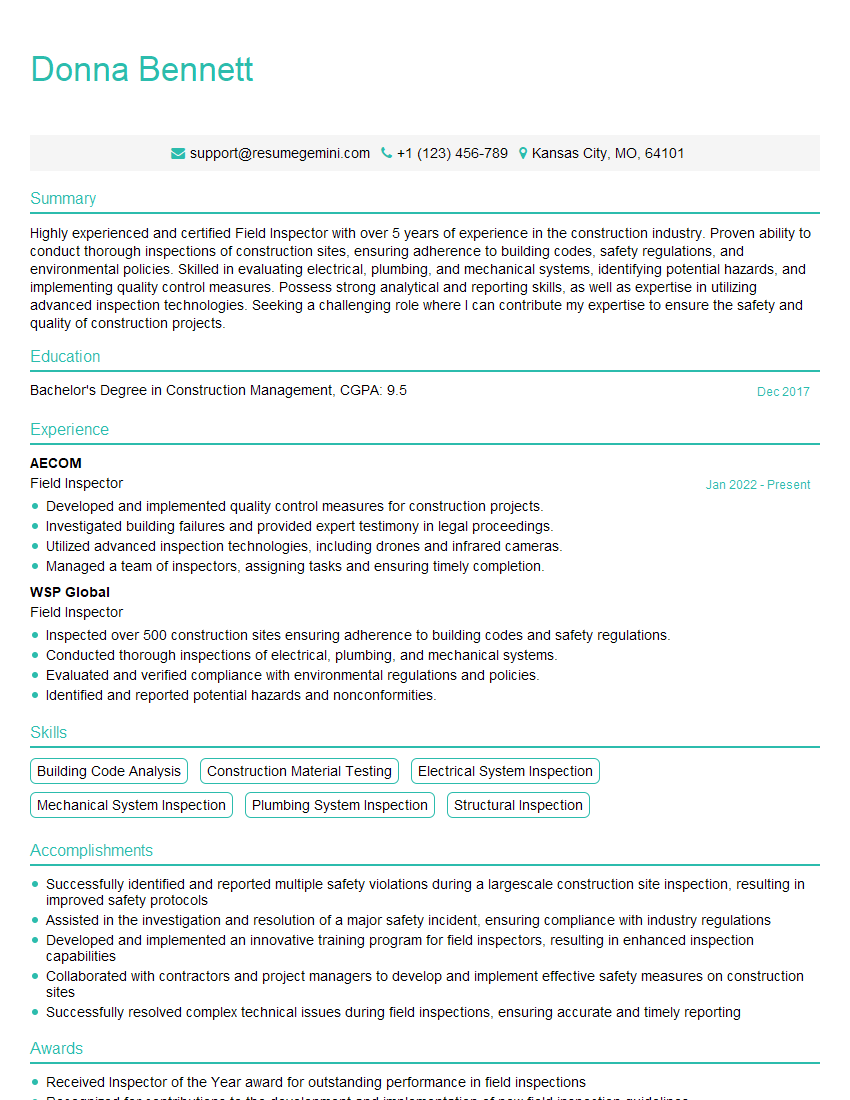
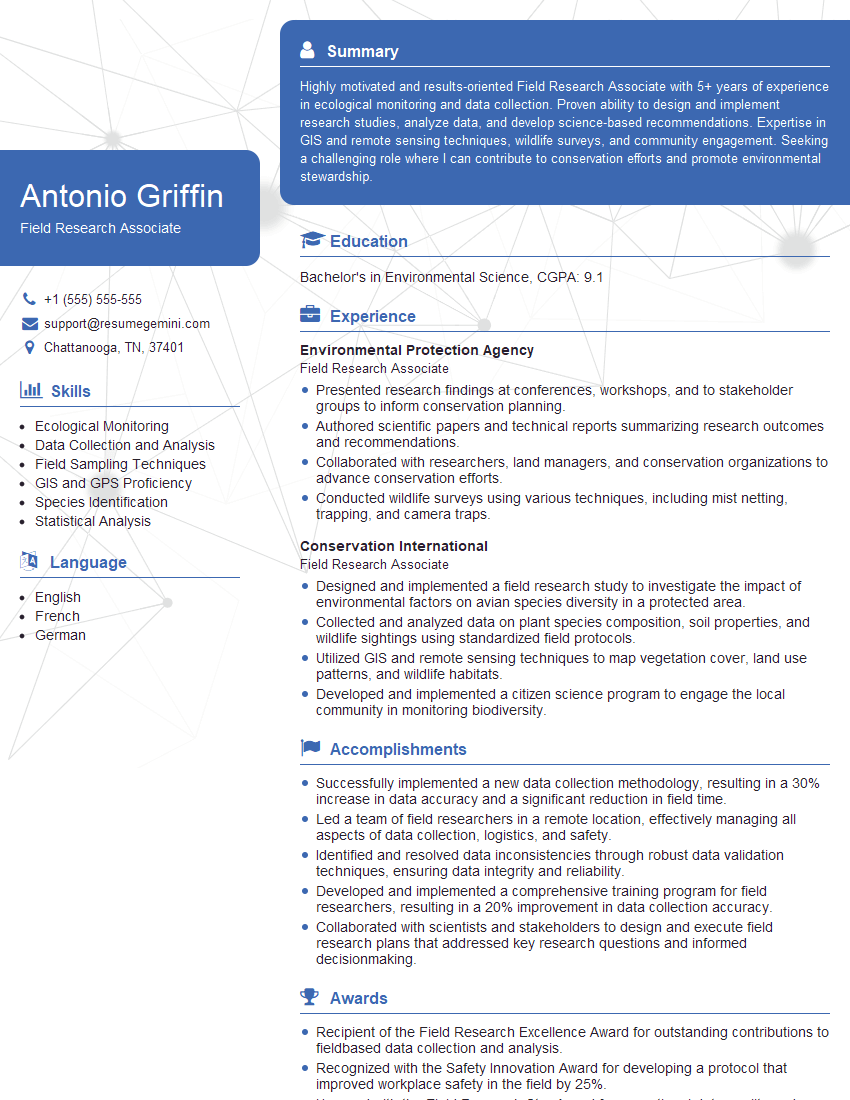
Mastering Field Data Collection and Management is crucial for career advancement in various sectors, opening doors to exciting opportunities and higher earning potential. A strong resume is your key to unlocking these possibilities. Building an ATS-friendly resume is essential for getting your application noticed by recruiters. We strongly recommend leveraging ResumeGemini to craft a compelling and effective resume that highlights your skills and experience. ResumeGemini provides valuable tools and resources, and we offer examples of resumes tailored to Field Data Collection and Management to help guide you.
Explore more articles
Users Rating of Our Blogs
Share Your Experience
We value your feedback! Please rate our content and share your thoughts (optional).
What Readers Say About Our Blog
Really detailed insights and content, thank you for writing this detailed article.
IT gave me an insight and words to use and be able to think of examples