Are you ready to stand out in your next interview? Understanding and preparing for Forestry and Agriculture Monitoring interview questions is a game-changer. In this blog, we’ve compiled key questions and expert advice to help you showcase your skills with confidence and precision. Let’s get started on your journey to acing the interview.
Questions Asked in Forestry and Agriculture Monitoring Interview
Q 1. Explain the principles of remote sensing in agriculture monitoring.
Remote sensing in agriculture leverages the principles of electromagnetic radiation to monitor crops without physical contact. Essentially, we use sensors to detect and measure the radiation reflected or emitted by plants. This radiation carries information about the crop’s health, growth stage, and stress levels. Different plant species and conditions reflect different wavelengths of light, allowing us to differentiate between healthy and stressed crops, or even identify specific crop types.
For example, healthy, actively growing vegetation reflects strongly in the near-infrared (NIR) portion of the electromagnetic spectrum. This is the basis of many vegetation indices, like NDVI (Normalized Difference Vegetation Index), which we’ll discuss later.
The process involves several steps: data acquisition (using satellites, drones, or aircraft), pre-processing (correction for atmospheric effects and geometric distortions), data analysis (calculating indices and creating maps), and interpretation (relating the data to on-the-ground conditions).
Q 2. Describe different types of sensors used in forestry monitoring.
Forestry monitoring employs a variety of sensors, each with its strengths and weaknesses. The choice depends on the specific application and scale of the project.
- LiDAR (Light Detection and Ranging): Uses lasers to measure distances and create highly accurate 3D models of forest canopies. This is excellent for estimating forest volume, biomass, and identifying individual trees.
- Multispectral and Hyperspectral Sensors: These sensors, often found on satellites and aircraft, capture images at multiple wavelengths. Multispectral sensors use a few broad bands, while hyperspectral sensors use hundreds of narrow bands, providing very detailed spectral information about the forest, allowing for the identification of tree species and detection of stress factors.
- Thermal Sensors: These sensors measure temperature differences, useful for detecting areas of stress in trees due to drought, disease, or pest infestations. For instance, warmer temperatures in a localized area might indicate disease.
- Ground-based Sensors: These include instruments like dendrometers (for measuring tree diameter growth) and soil moisture sensors. While not remote, they are vital for ground-truthing remote sensing data and providing more detailed information at specific points.
Q 3. How do you analyze NDVI data to assess crop health?
NDVI is a powerful tool for assessing crop health. It’s calculated using the formula: NDVI = (NIR - Red) / (NIR + Red), where NIR represents near-infrared reflectance and Red represents red reflectance. Both values are obtained from multispectral imagery.
Healthy vegetation has a high NIR reflectance and low red reflectance, resulting in a high NDVI value (close to 1). Stressed vegetation, on the other hand, has lower NIR reflectance and higher red reflectance, leading to a low NDVI value (close to 0).
To analyze NDVI data, we typically create NDVI maps, where each pixel represents the NDVI value for a specific area. Areas with high NDVI values are displayed as green (healthy), while low values are displayed in browns and yellows (stressed).
Further analysis might involve comparing NDVI values over time to track crop growth and identify periods of stress. We can also use statistical methods to identify areas needing specific attention, such as irrigation or fertilization. For instance, consistently low NDVI values in a particular field might indicate a nutrient deficiency.
Q 4. What are the key indicators of forest health decline?
Forest health decline is a complex issue with multiple indicators that can be detected through remote sensing and ground observations. Key indicators include:
- Crown Condition: Changes in crown density, size, and color are often early warning signs. Remote sensing can detect these changes through spectral analysis and image classification.
- Mortality: Increased tree mortality rates are a clear indicator of decline. Aerial imagery and LiDAR can quantify the extent of tree death.
- Growth Reduction: Slowed tree growth is another significant indicator. LiDAR data and dendrometer measurements can help assess growth trends.
- Stress Indicators: Spectral signatures indicating drought stress (altered reflectance in the red and near-infrared regions) or disease (specific spectral patterns) can be identified using multispectral and hyperspectral data.
- Outbreak of Pests and Diseases: Discoloration in tree canopies, changes in canopy texture, or unusual patterns visible on aerial imagery can indicate significant pest or disease infestations.
Combining remote sensing data with field measurements and expert knowledge is crucial for accurate assessment and effective management of forest health decline.
Q 5. Explain the use of GIS in agricultural planning and management.
Geographic Information Systems (GIS) are indispensable in agricultural planning and management. GIS allows us to spatially analyze and visualize various agricultural data layers, integrating information on soil type, topography, climate, crop yields, and more.
Examples of GIS applications in agriculture include:
- Precision Farming: GIS helps create variable-rate application maps for fertilizers, pesticides, and irrigation, optimizing resource use and maximizing yields based on spatially varying needs.
- Crop Yield Prediction: By integrating historical yield data, weather patterns, and soil information, GIS can help predict yields and aid in planning for harvest and storage.
- Farm Management Planning: GIS can support farm layout optimization, efficient field access planning, and the design of irrigation systems and drainage networks.
- Pest and Disease Management: GIS enables the mapping of pest and disease outbreaks, helping in targeted intervention and preventing wider spread.
In essence, GIS provides a powerful framework for integrating diverse data sets to make informed decisions throughout the agricultural production cycle.
Q 6. How do you interpret aerial imagery for forestry assessments?
Interpreting aerial imagery for forestry assessments involves a multi-step process. Firstly, it is crucial to understand the image’s spatial resolution and spectral bands. Higher resolution images offer greater detail, allowing for individual tree identification, whereas lower resolution images are suitable for landscape-level analyses. Spectral bands provide information about vegetation health and structure.
Visual interpretation relies on identifying visual cues such as crown density, crown closure, and tree species identification based on their spectral signatures and shape. For example, healthy, dense forests will appear dark green, whereas stressed forests may appear yellow or brown.
Digital image processing techniques are often employed to enhance the interpretation. These can include:
- Image Classification: Assigning pixels to specific classes (e.g., tree species, forest types, healthy vs. stressed).
- Object-Based Image Analysis (OBIA): Grouping pixels into meaningful objects (e.g., individual trees or forest stands) for improved analysis.
- Change Detection: Comparing images taken at different times to identify changes in forest cover, such as deforestation or forest regeneration.
Combining visual interpretation with digital image processing allows for quantitative and qualitative assessment of forest characteristics, enabling informed management decisions.
Q 7. Discuss the advantages and disadvantages of different data acquisition methods (e.g., satellite, drone, ground-based).
Data acquisition methods for forestry and agriculture monitoring each offer unique advantages and disadvantages:
- Satellite Imagery:
- Advantages: Wide area coverage, synoptic view, frequent revisits (depending on the satellite), historical data availability.
- Disadvantages: Lower spatial resolution compared to drone imagery, cloud cover can hinder data acquisition, cost can be relatively high depending on the satellite and data processing.
- Drone Imagery:
- Advantages: High spatial resolution, flexible flight planning for targeted data acquisition, relatively low cost, quick turnaround time.
- Disadvantages: Limited flight time, weather dependent, requires skilled operators, regulatory restrictions on flight operations.
- Ground-based Measurements:
- Advantages: High accuracy and detail for specific locations, direct measurement of key variables.
- Disadvantages: Time-consuming, labor-intensive, limited spatial coverage, data collection can be biased towards specific locations.
The optimal choice depends on the specific project requirements, budget, and available resources. Often a combination of methods (e.g., satellite imagery for broad-scale monitoring and drone imagery for detailed analysis of specific areas) provides the most comprehensive and cost-effective solution.
Q 8. How do you handle data quality issues in forestry and agriculture monitoring?
Data quality is paramount in forestry and agriculture monitoring. Poor data can lead to inaccurate assessments and flawed management decisions. We address this through a multi-faceted approach.
Data Validation and Cleaning: We employ rigorous checks at each stage. This involves automated checks for outliers and inconsistencies, visual inspection of imagery and sensor data, and comparison against existing datasets and ground truth measurements. For example, if a satellite image shows an unexpectedly high biomass value in a known barren area, we investigate potential errors like cloud cover or sensor malfunction.
Metadata Management: Meticulous record-keeping is essential. We meticulously document data sources, acquisition methods, processing steps, and any known limitations. This metadata is crucial for understanding data reliability and traceability. It’s like keeping a detailed recipe – crucial for reproducing results and ensuring consistency.
Ground Truthing: We regularly collect ground-based measurements (e.g., tree height, diameter, biomass samples) to validate remotely sensed data. This ‘ground truth’ provides a benchmark against which to assess the accuracy of our remote sensing data. It’s like testing a new scale against a known weight to verify its accuracy.
Data Fusion: Combining data from multiple sources (remote sensing, field measurements, weather data) can improve data quality and reduce uncertainties. The combined strength of various datasets overcomes the weaknesses of individual ones – like building a strong structure with various materials.
Q 9. What are some common challenges in using remote sensing for agricultural monitoring?
Remote sensing offers incredible potential for agricultural monitoring but faces several challenges:
Atmospheric Effects: Clouds, haze, and aerosols can obscure the view, reducing image clarity and making accurate analysis difficult. Imagine trying to see a field through a foggy window – it’s challenging to get a clear picture.
Spatial Resolution: The resolution of satellite imagery affects the detail visible. High-resolution imagery is expensive and may not be necessary for all applications, while low-resolution imagery might miss important details such as small crop variations within a field.
Temporal Resolution: The frequency of image acquisition matters. Rapid changes in crop growth need frequent monitoring. Infrequent imaging might miss critical growth stages or pest infestations.
Data Processing Complexity: Processing large volumes of satellite data requires significant computational resources and expertise in image processing techniques. This can be a bottleneck in timely data analysis.
Cost: Acquiring and processing high-quality satellite data can be expensive, especially for large-scale monitoring projects.
Q 10. Describe different methods for estimating forest biomass.
Estimating forest biomass involves several methods, each with its strengths and weaknesses:
Field Measurements: This involves directly measuring tree dimensions (diameter at breast height, height) and biomass from felled trees. This is highly accurate but time-consuming and destructive, limiting its scalability.
Allometric Equations: These statistical models relate easily measured tree attributes (diameter, height) to biomass. These equations are derived from field measurements and provide a non-destructive estimation method. However, their accuracy depends on the model’s applicability to the specific forest type.
Remote Sensing: LiDAR (Light Detection and Ranging) and radar provide 3D information about forest structure, which can be used to estimate biomass. Satellite imagery, combined with appropriate algorithms, can also estimate biomass based on spectral reflectance properties. This method is cost-effective for large areas, but its accuracy depends on data quality and the chosen algorithm.
Q 11. How do you use weather data in agricultural monitoring and forecasting?
Weather data is crucial for agricultural monitoring and forecasting. We integrate weather information (temperature, rainfall, humidity, solar radiation, wind speed) into our models in several ways:
Crop Growth Modeling: Weather parameters are critical inputs to crop growth models that predict yields and development stages. For example, we use historical and real-time weather data to predict the optimal planting time and estimate potential yield losses due to drought or excessive rainfall.
Irrigation Scheduling: Weather forecasts help determine irrigation needs, optimizing water usage and minimizing water stress on crops. We can trigger automated irrigation systems based on predicted evapotranspiration rates.
Pest and Disease Forecasting: Some pests and diseases are highly sensitive to weather conditions. Weather data can aid in predicting outbreaks, allowing for timely interventions.
Harvest Timing: Weather conditions influence the optimal harvest time, affecting crop quality and yield. Accurate weather forecasts help farmers plan harvesting operations effectively.
Q 12. Explain the concept of precision agriculture.
Precision agriculture involves using technology to manage agricultural inputs (fertilizers, water, pesticides, seeds) with site-specific precision. It’s about treating each part of a field as unique, optimizing resource use, and maximizing yield and efficiency.
Imagine a farmer using a GPS-guided tractor to apply fertilizer only where needed, based on soil test results and remote sensing data showing variations in crop health. This approach minimizes waste, reduces environmental impact, and improves profitability.
Key components include:
- GPS and GIS
- Remote sensing
- Variable rate technology
- Soil sensors
- Yield monitors
Q 13. What are the different types of soil sensors and their applications?
Various soil sensors measure different soil properties:
Soil Moisture Sensors: These measure the volumetric water content in the soil, crucial for irrigation management. Types include capacitance, time-domain reflectometry (TDR), and neutron probes.
Temperature Sensors: Measure soil temperature, influencing seed germination, root growth, and nutrient availability.
EC (Electrical Conductivity) Sensors: Measure the salinity of the soil, important for assessing the suitability of the land for different crops and managing irrigation water salinity.
pH Sensors: Measure the acidity or alkalinity of the soil, affecting nutrient availability and microbial activity.
Nutrient Sensors: Measure the concentrations of specific nutrients (e.g., nitrogen, phosphorus, potassium) in the soil, guiding fertilizer application.
These sensors provide real-time data, allowing for precise and timely adjustments in agricultural practices.
Q 14. How do you use yield monitors to improve agricultural practices?
Yield monitors, integrated into combine harvesters, measure crop yield in real-time as it is harvested. This data provides valuable insights for optimizing agricultural practices.
Yield Mapping: Creating yield maps showing variations in yield across the field allows for identification of high- and low-yielding areas. This can reveal problems with soil fertility, irrigation, or pest infestations.
Improving Input Management: Yield map data can be used to guide site-specific applications of fertilizers, pesticides, and irrigation water. This leads to more efficient resource use and reduced environmental impact.
Assessing the Effectiveness of Management Practices: Yield data can help evaluate the effectiveness of different agricultural practices, such as tillage methods or crop rotations.
Data Integration: Yield monitor data can be integrated with other data sources (e.g., soil sensors, weather data, remote sensing) to develop more comprehensive and precise farm management strategies.
Q 15. Describe the role of GPS in precision agriculture.
GPS (Global Positioning System) is revolutionizing precision agriculture by providing accurate location data for various field operations. Think of it as giving your farm a precise address for every square inch. This allows for site-specific management, optimizing resource use and maximizing yields.
For example, GPS enables variable rate technology (VRT), where fertilizer, pesticides, or seeds are applied only where needed, reducing waste and environmental impact. GPS-guided machinery ensures accurate planting, spraying, and harvesting, minimizing overlaps and maximizing efficiency. Imagine a farmer using GPS to precisely apply fertilizer based on soil nutrient levels detected by sensors, ensuring each plant receives the exact amount it needs – no more, no less. This significantly reduces costs and improves yields compared to traditional blanket application methods.
Furthermore, GPS data can be integrated with other sensors and software to create detailed maps of the field, showcasing variations in soil composition, moisture levels, and crop health. This allows farmers to make informed decisions about irrigation, fertilization, and pest control, leading to more sustainable and profitable farming practices.
Career Expert Tips:
- Ace those interviews! Prepare effectively by reviewing the Top 50 Most Common Interview Questions on ResumeGemini.
- Navigate your job search with confidence! Explore a wide range of Career Tips on ResumeGemini. Learn about common challenges and recommendations to overcome them.
- Craft the perfect resume! Master the Art of Resume Writing with ResumeGemini’s guide. Showcase your unique qualifications and achievements effectively.
- Don’t miss out on holiday savings! Build your dream resume with ResumeGemini’s ATS optimized templates.
Q 16. What are some sustainable forestry practices?
Sustainable forestry practices focus on balancing the economic benefits of timber harvesting with the long-term health and ecological integrity of the forest ecosystem. It’s about ensuring we have forests for generations to come.
- Selective logging: Instead of clear-cutting entire areas, selective logging removes only mature or diseased trees, leaving the forest structure relatively intact. This minimizes disruption to the ecosystem and allows for faster regeneration.
- Reforestation and afforestation: Planting trees in areas that have been deforested or have never had trees helps restore forest cover, sequestering carbon and supporting biodiversity.
- Reduced-impact logging (RIL): This technique minimizes damage to the forest during harvesting, reducing soil erosion and protecting water quality. It involves careful planning of logging roads and the use of specialized equipment.
- Forest certification: Organizations like the Forest Stewardship Council (FSC) set standards for sustainable forest management, ensuring that timber products come from responsibly managed forests. This allows consumers to make informed choices.
- Protecting biodiversity: Sustainable forestry aims to maintain biodiversity by preserving a variety of tree species, creating wildlife habitats, and protecting endangered species. This increases ecosystem resilience.
Imagine a logging operation that carefully plans its harvesting routes to avoid sensitive areas and re-plants trees after harvesting, ensuring the forest continues to thrive. This contrasts sharply with unsustainable practices that deplete forest resources without regard for future generations.
Q 17. Explain the importance of data visualization in agriculture monitoring.
Data visualization is crucial in agriculture monitoring because it transforms complex datasets into easily understandable and actionable insights. Instead of looking at rows and columns of numbers, we can see trends, patterns, and anomalies at a glance.
For example, visualizing yield data on a map can reveal areas with low productivity, allowing farmers to investigate the causes (e.g., poor soil quality, pest infestation) and implement targeted solutions. Similarly, visualizing sensor data from drones or satellites can show the spread of a disease or the impact of drought on crop health, enabling timely interventions. Using charts and graphs to track key indicators like soil moisture, nutrient levels, and crop growth allows farmers to monitor the effectiveness of their management practices and make adjustments as needed.
Effective data visualization empowers farmers to make informed decisions, improve resource allocation, and enhance overall farm productivity and sustainability. It’s about seeing the ‘big picture’ and understanding the story that the data is telling.
Q 18. How do you communicate complex data findings to non-technical audiences?
Communicating complex data findings to non-technical audiences requires translating technical jargon into plain language, using visual aids effectively, and focusing on the key takeaways. It’s about storytelling with data.
I typically start by identifying the core message and then present the findings in a clear, concise manner, avoiding technical terms whenever possible. I use visuals like maps, charts, and infographics to illustrate key trends and patterns. For example, instead of saying “the NDVI values in the north-western quadrant showed a significant decrease,” I might say “Satellite imagery shows that crops in the northwest corner of the field are significantly less healthy.” I also use analogies and real-world examples to make the information relatable and easy to grasp. For instance, I might compare the impact of drought on crop yield to the effect of a lack of water on a houseplant.
Finally, I actively engage the audience by encouraging questions and providing simple explanations to ensure understanding. The goal is to make the data relevant and meaningful to their lives, whether they are farmers, policymakers, or community members.
Q 19. What software and tools are you proficient in for data analysis (e.g., ArcGIS, QGIS, R)?
My proficiency in data analysis software is extensive. I’m highly skilled in using ArcGIS and QGIS for geospatial analysis, including creating maps, performing spatial statistics, and integrating various data sources. I’m also proficient in R for statistical modeling and data visualization. I use R for everything from simple data cleaning to complex statistical analysis.
For example, I’ve used ArcGIS to create detailed maps of forest cover change over time, using satellite imagery to track deforestation and monitor forest health. In R, I’ve developed statistical models to predict crop yields based on environmental variables like temperature, rainfall, and soil moisture. My expertise extends to using these tools to create compelling reports and presentations that convey findings effectively to various audiences.
Q 20. Describe your experience with different agricultural management systems.
My experience encompasses a range of agricultural management systems, including conventional, integrated pest management (IPM), and organic farming. I understand the principles and practices associated with each, including the benefits, limitations, and environmental considerations.
I’ve worked on projects involving precision agriculture technologies, where data-driven decision-making is paramount, as well as with traditional farming practices. I’ve helped farmers transition to more sustainable methods, incorporating technologies like GPS-guided machinery, remote sensing, and variable rate application techniques. I have experience analyzing data from diverse sources, including field observations, sensor networks, and satellite imagery, to assess the efficacy of different management strategies. This has allowed me to understand the strengths and weaknesses of each system and provide recommendations tailored to specific contexts and goals.
For example, I worked with a group of farmers transitioning from conventional to IPM practices. We used GIS to map pest distribution, allowing for targeted pesticide applications, minimizing environmental impact while controlling pest populations effectively. This involved monitoring pest populations using field surveys, integrating that data with GIS maps, and presenting results to farmers in a user-friendly format.
Q 21. Explain how you would monitor the impact of a forest fire on the surrounding ecosystem.
Monitoring the impact of a forest fire on the surrounding ecosystem requires a multi-faceted approach, combining field surveys, remote sensing data, and ecological modeling. The goal is to assess the immediate and long-term effects on vegetation, wildlife, soil, and water resources.
Immediately after the fire, I would use remote sensing techniques such as satellite imagery and aerial photography to map the burn severity and extent. This would inform the location of field surveys focusing on vegetation regeneration, soil erosion, and water quality. Field surveys would involve assessing the survival rate of different tree species, examining changes in soil properties (e.g., organic matter content, nutrient levels), and evaluating the impact on water quality by testing streams and rivers for sediment and nutrient loads. This ground truthing is vital to validate remote sensing data and fill gaps.
In the longer term, I would monitor the ecosystem’s recovery over time by repeated surveys and remote sensing observations. Ecological models could be used to predict the future trajectory of the ecosystem, such as the time required for vegetation to recover and the potential for invasive species to establish themselves. This information is then synthesized and disseminated to stakeholders to inform restoration efforts, land management decisions and fire prevention strategies.
Q 22. How would you assess the effectiveness of a reforestation project?
Assessing the effectiveness of a reforestation project requires a multi-faceted approach, going beyond simply counting trees. We need to evaluate success across ecological, economic, and social dimensions.
Ecological Success: This involves measuring the survival rate of planted trees, monitoring species diversity, assessing soil health improvements (e.g., carbon sequestration, reduced erosion), and evaluating the overall impact on the local ecosystem. For instance, we might compare pre- and post-reforestation data on biodiversity indices or soil organic matter content. We also need to consider the long-term health and resilience of the forest to stressors like disease or climate change.
Economic Success: This aspect focuses on the project’s financial sustainability and the benefits it provides to local communities. This could involve analyzing job creation, income generation from timber or non-timber forest products, and cost-benefit analysis of the entire project lifecycle. A successful project will demonstrate economic viability beyond initial investment.
Social Success: This crucial element assesses the project’s impact on local communities. Does it empower local people? Does it improve their livelihoods? We’d measure factors such as community participation, conflict resolution around land use, and improvements in local well-being. Successful projects foster community ownership and long-term commitment.
In practice, I would use a combination of field surveys, remote sensing data (satellite imagery and drones), and participatory approaches involving local communities to collect data and assess the success criteria. This integrated approach provides a comprehensive understanding of the project’s impact.
Q 23. What are the ethical considerations in forestry and agriculture monitoring?
Ethical considerations in forestry and agriculture monitoring are paramount. They involve safeguarding the rights and well-being of people and the environment.
Informed Consent and Data Privacy: When working with communities, obtaining free, prior, and informed consent is crucial before data collection. This means ensuring that people understand the purpose of data collection, how it will be used, and the implications for them. Protecting the privacy and confidentiality of this data is equally important.
Environmental Justice: Monitoring activities should not disproportionately burden marginalized communities or exacerbate existing environmental inequalities. For example, large-scale agricultural monitoring projects need to consider the impact on local livelihoods and access to resources. We must prioritize methods that minimize environmental disturbance.
Transparency and Accountability: The methods used, the data collected, and the conclusions drawn should be transparent and readily available to all stakeholders. This fosters trust and allows for scrutiny and accountability of the monitoring process itself.
Benefit Sharing: The benefits from monitoring initiatives, such as improved management practices or access to better markets, should be shared equitably among all stakeholders, including local communities. This could involve capacity building and technology transfer, amongst others.
Ignoring these ethical considerations can undermine the credibility and legitimacy of monitoring efforts, leading to mistrust and conflict.
Q 24. Explain your experience with data management and storage strategies.
My experience in data management involves a systematic approach from data acquisition to analysis and archiving. I am proficient in various techniques and technologies.
Data Acquisition: This includes using various sensors (e.g., GPS, hyperspectral cameras, LiDAR) and data sources (e.g., satellite imagery, field measurements, GIS data). I am skilled in designing effective data collection protocols and ensuring data quality control measures are in place.
Data Storage: I use cloud-based solutions (e.g., AWS, Google Cloud) that are secure, scalable, and allow for collaboration. Data is organized using structured file naming conventions and metadata schemas to facilitate easy retrieval and analysis. I also adhere to data backup and recovery procedures to ensure data integrity.
Data Management Software: I have extensive experience with GIS software (e.g., ArcGIS, QGIS), remote sensing software (e.g., ENVI, Erdas Imagine), and data management platforms (e.g., PostgreSQL/PostGIS). These tools allow for efficient data processing, analysis, and visualization.
Data Analysis: I leverage statistical software (e.g., R, Python) for data analysis. This involves creating customized scripts for data cleaning, transformation, analysis, and the generation of various reports.
For instance, in a recent project involving forest carbon monitoring, I implemented a system for managing several terabytes of satellite imagery and field measurements using cloud storage and a customized data pipeline built in Python. This allowed our team to analyze data efficiently and generate accurate carbon stock estimates.
Q 25. How do you stay up-to-date on advancements in technology and methodologies related to this field?
Staying current in this rapidly evolving field requires a multi-pronged approach.
Professional Development: I regularly attend conferences, workshops, and training courses related to forestry, agriculture, and remote sensing. This allows me to learn about the newest technologies and best practices directly from experts.
Literature Reviews: I dedicate time to reading scientific journals and publications in my field. This keeps me abreast of the latest research and advancements.
Online Resources: I leverage online platforms such as Coursera, edX, and professional organizations’ websites for access to webinars, tutorials, and online courses.
Networking: I actively participate in professional networks and online communities related to remote sensing, GIS, and agriculture to engage with peers and learn from their experiences.
Collaboration: Working on projects with experts in diverse areas, such as computer science, ecology, and social sciences, exposes me to new approaches and perspectives.
For example, I recently completed a course on the applications of artificial intelligence in precision agriculture, allowing me to integrate this advanced technology into my work.
Q 26. Describe your experience working with diverse teams and stakeholders.
Working effectively with diverse teams and stakeholders is crucial in this field. Successful projects rely on strong communication, collaboration, and mutual respect.
Communication: I prioritize clear and concise communication, adapting my style to different audiences (scientists, policymakers, local communities). I use various methods including meetings, reports, presentations, and workshops to ensure everyone is informed and engaged.
Collaboration: I believe in fostering a collaborative environment where everyone feels valued and can contribute their expertise. This involves active listening, respectful dialogue, and facilitating open communication between stakeholders.
Stakeholder Engagement: I involve stakeholders in all stages of a project, from planning to implementation and evaluation. This ensures their needs and concerns are addressed, and it builds trust and ownership.
Conflict Resolution: I employ conflict resolution strategies that are inclusive, fair, and focus on finding win-win solutions for all parties involved. This could include mediation or facilitated discussions.
In a recent project involving community-based forest management, I facilitated participatory mapping workshops with local communities to identify their priorities for forest conservation. This collaborative approach led to a project plan that was truly owned and implemented by the local communities.
Q 27. How would you handle conflicting priorities in a fast-paced agricultural monitoring project?
Handling conflicting priorities in a fast-paced project requires a structured and proactive approach.
Prioritization Framework: I start by clearly defining project goals and objectives. Then I use a prioritization framework (e.g., MoSCoW method – Must have, Should have, Could have, Won’t have) to rank tasks based on their importance and urgency. This provides a clear roadmap to guide decision-making.
Risk Assessment: I identify potential risks and conflicts early on and develop mitigation strategies. This could include setting realistic timelines, securing additional resources, or adjusting project scope.
Communication and Negotiation: Open communication with stakeholders is essential to highlight trade-offs and negotiate compromises. This involves explaining the reasons behind prioritization decisions and seeking buy-in from all parties involved.
Flexibility and Adaptability: In a fast-paced environment, things rarely go as planned. I maintain flexibility and adaptability to adjust plans as needed, based on new information or changing priorities. This involves continuous monitoring and evaluation of the project’s progress.
Documentation: All decisions and changes are carefully documented to maintain transparency and accountability throughout the project lifecycle.
For example, in a project where budget constraints clashed with the desired data acquisition scope, I used a cost-benefit analysis to prioritize the data most crucial for achieving project goals. This involved transparent communication with the stakeholders to justify the decisions and gain consensus.
Key Topics to Learn for Forestry and Agriculture Monitoring Interview
- Remote Sensing Techniques: Understanding the principles and applications of satellite imagery, aerial photography, and LiDAR for monitoring forest health, deforestation, and agricultural practices. Practical application includes analyzing imagery to identify areas of crop stress or illegal logging.
- Geographic Information Systems (GIS): Mastering GIS software for data visualization, spatial analysis, and creating maps to represent forestry and agricultural data. Practical application includes developing maps showing changes in land cover over time or predicting potential wildfire risks.
- Data Analysis and Interpretation: Developing skills in statistical analysis and data interpretation to extract meaningful insights from monitoring data. This includes understanding accuracy assessments and error propagation in remote sensing data. Practical application includes identifying trends in agricultural yields or assessing the effectiveness of conservation efforts.
- Forest Inventory and Management: Familiarize yourself with different forest inventory methods and sustainable forest management practices. Practical application includes understanding how to assess timber volume or carbon sequestration potential.
- Precision Agriculture Technologies: Understanding the use of GPS, sensors, and data analytics for optimizing agricultural practices, improving yields, and minimizing environmental impact. Practical application includes analyzing data from precision farming equipment to adjust irrigation or fertilizer application.
- Environmental Regulations and Policy: Knowledge of relevant environmental regulations and policies related to forestry and agriculture is crucial. This includes understanding sustainable development goals and their implications for monitoring practices.
- Problem-solving and Critical Thinking: Develop your ability to analyze complex data sets, identify anomalies, and propose solutions to challenges in forestry and agriculture monitoring. This includes the ability to adapt to new technologies and approaches.
Next Steps
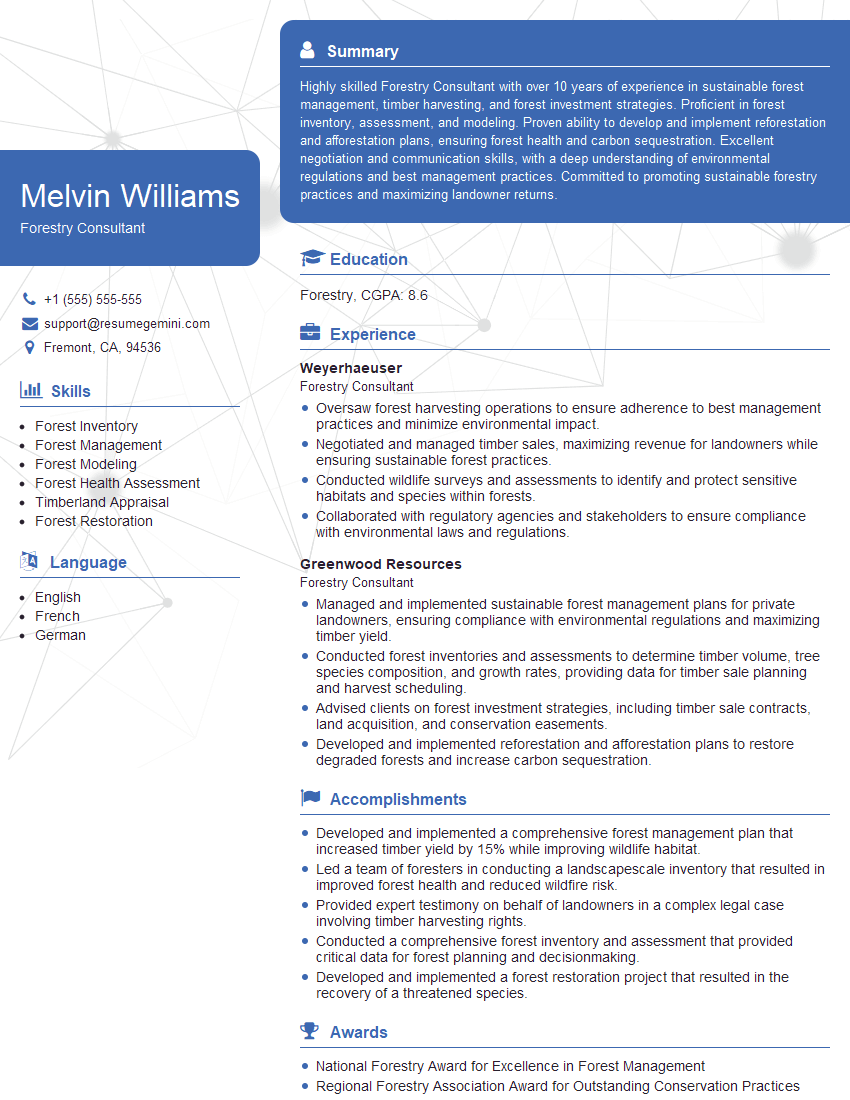
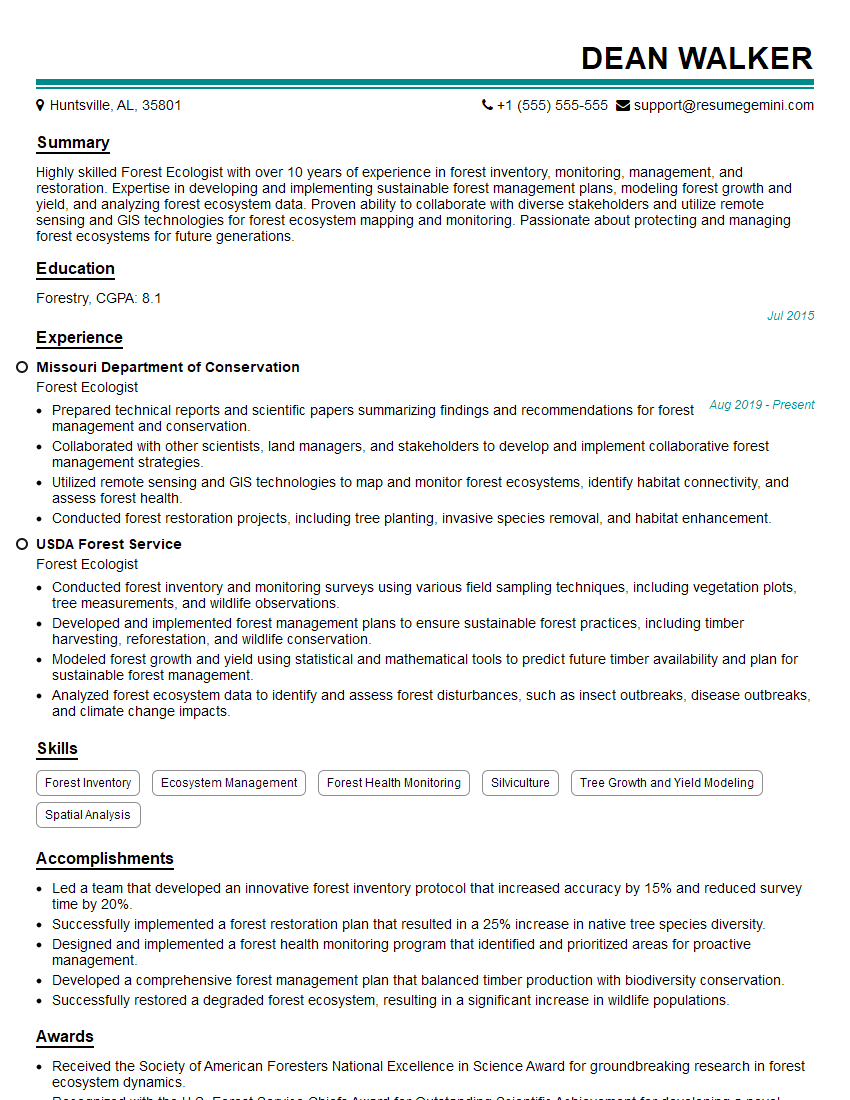
Mastering Forestry and Agriculture Monitoring opens doors to a rewarding career with significant impact on environmental sustainability and food security. To maximize your job prospects, it’s crucial to present your skills effectively. Creating an ATS-friendly resume is key to getting your application noticed. We highly recommend using ResumeGemini, a trusted resource for building professional resumes. ResumeGemini provides examples of resumes tailored to Forestry and Agriculture Monitoring, helping you showcase your qualifications in the best possible light. Invest time in crafting a compelling resume—it’s your first impression on potential employers.
Explore more articles
Users Rating of Our Blogs
Share Your Experience
We value your feedback! Please rate our content and share your thoughts (optional).
What Readers Say About Our Blog
Really detailed insights and content, thank you for writing this detailed article.
IT gave me an insight and words to use and be able to think of examples