Preparation is the key to success in any interview. In this post, we’ll explore crucial Geodetic Monitoring and Deformation Analysis interview questions and equip you with strategies to craft impactful answers. Whether you’re a beginner or a pro, these tips will elevate your preparation.
Questions Asked in Geodetic Monitoring and Deformation Analysis Interview
Q 1. Explain the difference between static and kinematic GPS surveying.
The key difference between static and kinematic GPS surveying lies in how the GPS receiver is used to collect data. Think of it like taking a photograph: static is like taking a long exposure, capturing a very precise position over a longer time, while kinematic is like taking a series of quick shots, capturing movement in real-time.
Static GPS surveying involves placing a GPS receiver at a fixed point for an extended period (typically several hours). During this time, the receiver collects data, allowing for highly accurate position determination through the accumulation of satellite signals. This method is excellent for establishing precise control points for mapping or deformation monitoring networks. The longer the observation period, the more precise the result – it’s about maximizing the signal-to-noise ratio.
Kinematic GPS surveying, on the other hand, involves continuously moving the GPS receiver while it’s collecting data. This allows for the determination of precise positions at multiple points along a trajectory over a shorter time. It’s ideal for tasks such as surveying roads, pipelines, or monitoring moving objects. The accuracy relies on a precise initial position and a continuous lock onto the satellite signals. Real-time kinematic (RTK) GPS is a common application of this, providing centimeter-level accuracy in real-time.
In short: Static GPS is for high-accuracy, fixed-point positioning; Kinematic GPS is for high-accuracy, mobile positioning.
Q 2. Describe the principles of InSAR (Interferometric Synthetic Aperture Radar) and its applications in deformation analysis.
InSAR (Interferometric Synthetic Aperture Radar) is a powerful remote sensing technique that uses radar data from satellites to measure ground deformation with incredible precision. Imagine having a pair of eyes that can see through clouds and vegetation, measuring even subtle changes in the Earth’s surface.
Principles: InSAR works by comparing two or more radar images of the same area acquired at different times. Subtle phase differences between the radar waves reflected from the ground are detected. These phase differences are directly related to the change in distance between the satellite and the ground, which can be caused by ground deformation. By analyzing these phase differences, we can create interferograms, which are maps showing the deformation pattern. The interference pattern, like ripples on a pond, reveals where the ground has moved.
Applications in deformation analysis: InSAR is exceptionally useful for monitoring large-scale ground deformation phenomena such as:
- Subsidence: Measuring ground sinking due to groundwater extraction or underground mining.
- Volcanic deformation: Monitoring inflation and deflation of volcanoes before eruptions.
- Earthquake deformation: Mapping coseismic and post-seismic deformation.
- Landslide monitoring: Detecting and quantifying slow-moving landslides.
- Glacier movement: Tracking the flow and melting of glaciers.
InSAR offers a cost-effective and large-area coverage method for deformation analysis, making it invaluable for various applications.
Q 3. What are the common error sources in GPS measurements, and how are they mitigated?
GPS measurements are susceptible to several error sources. Think of it like trying to pinpoint your location with a slightly faulty compass and map – the more factors you account for, the better your position.
Common error sources:
- Atmospheric effects: The ionosphere and troposphere can delay or refract GPS signals, leading to positional errors. These effects can be mitigated using models and differential GPS techniques.
- Satellite geometry: Poor geometry (e.g., satellites clustered in a small part of the sky) can weaken the solution and increase error. This can be improved by longer observation times and careful planning.
- Multipath effects: Signals reflecting off buildings or other surfaces can interfere with the direct signal, causing positional errors. This can be mitigated through careful antenna placement and signal processing techniques.
- Receiver noise: Electronic noise in the GPS receiver itself can introduce error. Higher quality receivers reduce this impact.
- Orbital errors: Inaccuracies in the satellite orbits can also impact the position solution. Precise ephemerides (satellite orbit data) are crucial.
Mitigation strategies: These errors are mitigated using various techniques, including:
- Differential GPS (DGPS): Comparing measurements from a receiver at a known location (base station) to correct for atmospheric and other systematic errors.
- Precise Point Positioning (PPP): Using precise satellite orbit and clock information to achieve high accuracy without a base station.
- Data processing techniques: Employing sophisticated algorithms to filter out noise and identify and correct errors.
Q 4. How do you process and analyze GNSS data for deformation monitoring?
Processing and analyzing GNSS data for deformation monitoring involves several key steps. It’s a bit like assembling a puzzle, where each piece represents a data point and the final picture reveals the deformation.
Data Processing:
- Data Acquisition: Collecting GNSS data from multiple receivers over a period of time.
- Data Pre-processing: Cleaning and preparing the data, removing outliers and correcting for known errors like cycle slips.
- Positioning: Determining the coordinates of each receiver at each epoch (time instant) using appropriate processing techniques (e.g., double-differencing, PPP).
- Baseline Processing: Calculating the relative positions between receivers.
Data Analysis:
- Time Series Analysis: Examining the changes in coordinates over time to identify patterns of deformation.
- Statistical Analysis: Evaluating the uncertainty associated with the measurements and assessing the significance of detected deformation.
- Geospatial Analysis: Visualizing the deformation using maps and other geospatial tools (e.g., GIS software).
- Deformation Modeling: Fitting mathematical models to the data to quantify the rate and pattern of deformation.
Software packages such as Bernese GNSS Software, GAMIT/GLOBK, and GipsyX are commonly used for these tasks. The choice depends on the complexity of the project and the level of accuracy required.
Q 5. Explain the concept of a geodetic datum and its importance in deformation analysis.
A geodetic datum is a reference system that defines the origin and orientation of a coordinate system used to locate points on the Earth’s surface. It’s like choosing a starting point and direction on a map – everything else is relative to that.
Concept: A datum is based on a specific ellipsoid (a mathematical approximation of the Earth’s shape) and a set of control points with known coordinates. Different datums exist because the Earth isn’t perfectly spherical; different areas will use datums best suited to the local shape and needs.
Importance in deformation analysis: The choice of datum is crucial in deformation analysis because the measured deformation is relative to that datum. Using inconsistent datums can lead to significant errors in interpreting deformation patterns. If the datum itself is unstable or shifting, it will mask or introduce spurious ground deformation. For example, if using different datums for before-and-after measurements of a landslide, you might conclude it’s much bigger or smaller than it is, leading to incorrect conclusions about its impact.
Consistency in datum is key to accurate and reliable deformation analysis. Researchers usually transform all data to a common global reference frame, such as ITRF (International Terrestrial Reference Frame), to prevent systematic errors.
Q 6. What are the advantages and disadvantages of using LiDAR for deformation monitoring?
LiDAR (Light Detection and Ranging) is a remote sensing technique that uses laser pulses to measure distances to the Earth’s surface. Think of it as a highly detailed 3D scanner for the Earth.
Advantages:
- High accuracy and resolution: LiDAR can provide very accurate and detailed elevation data, allowing for precise detection of even subtle deformation.
- Dense point cloud: LiDAR produces a dense point cloud representing the surface, allowing for detailed analysis of complex terrain.
- Penetration through vegetation: Although not as effective as radar, it can often penetrate through vegetation to some extent allowing measurement of underlying ground.
- Fast data acquisition: Modern LiDAR systems can cover large areas relatively quickly.
Disadvantages:
- Cost: LiDAR surveys can be expensive, especially for large areas.
- Weather dependency: LiDAR surveys can be affected by adverse weather conditions, such as clouds, rain, or fog.
- Limited penetration through dense vegetation: Dense vegetation can significantly affect data quality.
- Data processing complexity: Processing LiDAR data can be complex and computationally intensive.
LiDAR is a valuable tool for deformation monitoring, particularly in areas with complex terrain or dense vegetation where other techniques may be less effective. However, its cost and weather dependency should be considered.
Q 7. Describe different types of deformation (e.g., subsidence, uplift, lateral movement).
Deformation encompasses various types of ground movement. Think of it as the Earth’s skin shifting and changing shape.
Types of deformation:
- Subsidence: Vertical downward movement of the ground surface. Examples include land sinking due to groundwater extraction, mining activities, or compaction of sediments.
- Uplift: Vertical upward movement of the ground surface. Examples include tectonic uplift, isostatic rebound (the rebound of land after the removal of ice sheets), and volcanic inflation.
- Lateral movement: Horizontal ground movement. Examples include landslides, creep (slow, gradual movement of soil), and fault movement.
- Tilting: Rotational movement of a landmass resulting in uneven vertical displacements. This can be caused by various geological and anthropogenic processes.
- Faulting: Abrupt displacements along a fault plane, often associated with earthquakes.
Understanding the type of deformation is vital for interpreting the causes and potential hazards associated with the movement. For example, identifying subsidence could help predict future land instability and guide preventative measures.
Q 8. How do you assess the accuracy and precision of geodetic measurements?
Assessing the accuracy and precision of geodetic measurements is crucial for reliable deformation analysis. Accuracy refers to how close a measurement is to the true value, while precision refers to the repeatability of measurements. We assess these using several methods:
Internal consistency checks: Examining the standard deviation of repeated measurements at a single point. A smaller standard deviation indicates higher precision. For example, if we repeatedly measure the distance between two points using a total station and obtain readings within a few millimeters of each other, this demonstrates good precision.
External checks: Comparing our measurements against independent, high-accuracy data. This could involve comparing GNSS-derived coordinates to those from a highly precise leveling survey. Significant discrepancies might indicate accuracy issues.
Statistical analysis: Applying statistical tests like the chi-squared test to assess the goodness of fit of our data to a model. This helps identify potential outliers or systematic errors.
Error propagation: Calculating the overall uncertainty in derived quantities (like deformation rates) by considering the uncertainties in individual measurements. This provides a realistic estimate of the reliability of our results.
Calibration and maintenance of equipment: Regularly calibrating instruments like GNSS receivers and total stations is essential. Proper maintenance ensures that equipment operates within its specified tolerances, contributing to both accuracy and precision. For instance, a poorly calibrated total station might introduce systematic errors in distance measurements.
Q 9. Explain the concept of coordinate transformations and their relevance to deformation analysis.
Coordinate transformations are essential in deformation analysis because geodetic measurements are often made in different coordinate systems. These systems might be based on different datums (reference ellipsoids and origins), projections (mapping 3D Earth to 2D surfaces), or even different coordinate units. For example, one survey might use a local coordinate system tied to a benchmark, while another uses a global coordinate system like WGS84.
Deformation analysis requires all measurements to be in a consistent coordinate system to avoid misinterpreting apparent movement caused by coordinate system differences. Common transformations include:
Datum transformations: Converting coordinates from one datum to another (e.g., NAD83 to NADCON). We use specialized software and parameters (like Helmert transformations) for accurate conversions.
Projection transformations: Converting coordinates between different map projections (e.g., UTM to geographic coordinates). Software packages handle the complex mathematical equations needed for these transformations.
Coordinate system shifts: Adjusting coordinates to account for known shifts or offsets in the coordinate system. This could involve applying a constant offset to all coordinates to align them with a reference point.
Without accurate coordinate transformations, deformation analysis can lead to incorrect conclusions about the actual ground movement.
Q 10. What software packages are you familiar with for processing geodetic data (e.g., GiS, specific GNSS software)?
My experience includes extensive use of various software packages for processing geodetic data. These include:
GNSS processing software: I’m proficient in using
RTKLIB,Bernese GNSS Software, andOPUSfor precise point positioning (PPP) and network processing of GNSS data. These packages allow for accurate coordinate determination and the analysis of GNSS observations.Total station data processing software: I have experience with software such as
Leica GeoMosandTrimble Business Centerfor processing data from total station surveys, including calculations of distances, angles, and coordinates, as well as creating digital terrain models (DTMs).GIS software: I utilize
ArcGISandQGISfor data visualization, spatial analysis, and map creation. GIS is crucial for interpreting geodetic data in a spatial context, making it easier to identify patterns and anomalies in ground deformation.Specialized deformation analysis software: I am familiar with software designed specifically for deformation analysis, such as
GeoStudioandRockWare, which provide tools for advanced statistical analysis, modeling, and visualization of deformation patterns.
Q 11. How do you handle outliers in geodetic datasets?
Handling outliers in geodetic datasets is critical to avoid bias in deformation analysis. Outliers – measurements that significantly deviate from the overall pattern – can result from various causes, including measurement errors, equipment malfunction, or unforeseen events.
My approach involves a multi-step process:
Data visualization: I start by visually inspecting the data using scatter plots, histograms, and other graphical representations to identify potential outliers. This often reveals obvious errors or anomalous measurements.
Statistical outlier detection: I employ statistical methods like the Grubbs’ test or the Chauvenet criterion to determine whether a data point is statistically significant outlier. These tests provide objective criteria for outlier identification.
Investigating potential causes: If an outlier is identified, I investigate the possible reasons behind it. This may involve reviewing field notes, checking equipment logs, or even re-measuring the point to verify the outlier status. Perhaps a temporary obstruction affected a GNSS measurement, for instance.
Data treatment: Depending on the nature and cause of the outlier, I might choose to either remove it (if it’s clearly an error), down-weight it (reducing its influence in analysis), or retain it (if it represents a real phenomenon and deserves further scrutiny).
Robust estimation techniques: I utilize robust statistical methods, like Least Trimmed Squares (LTS) or RANSAC, which are less sensitive to outliers than traditional least-squares methods during the coordinate calculation and deformation analysis.
The decision to retain or remove outliers is always carefully considered, and the justification for the chosen approach is clearly documented.
Q 12. Describe your experience with different geodetic techniques (e.g., leveling, total station surveying).
My experience encompasses a wide range of geodetic techniques. I’ve worked extensively with:
GNSS (Global Navigation Satellite Systems): This forms the backbone of much of my work, using both static and kinematic surveying techniques for high-accuracy positioning. This includes both single point positioning and precise point positioning (PPP) methods for centimeter-level accuracy. I’ve managed projects involving large-scale GNSS networks for monitoring deformation over extensive areas.
Leveling: I am skilled in performing both precise and trigonometric leveling surveys, essential for establishing vertical control and monitoring vertical movements. I understand the importance of proper leveling procedures to minimize systematic and random errors. A recent project involved monitoring the subsidence of a levee system using high-precision leveling.
Total Station Surveying: I frequently use total stations for detailed topographic surveys, measuring distances, angles, and coordinates to create detailed 3D models. This is often integrated with GNSS for better control and efficiency. For example, I utilized total station surveying for a detailed survey of a landslide area.
InSAR (Interferometric Synthetic Aperture Radar): I have worked on projects involving InSAR data processing and analysis to monitor large-scale ground deformation. InSAR excels in remote sensing applications, providing coverage over vast areas.
The choice of technique depends on the project requirements, desired accuracy, spatial coverage, and cost considerations. I have the experience to select and apply the most appropriate method for a particular project.
Q 13. Explain the concept of temporal and spatial resolution in geodetic monitoring.
Temporal and spatial resolution are critical aspects of geodetic monitoring. Temporal resolution refers to the frequency of measurements over time, while spatial resolution refers to the density and precision of measurements in space.
Temporal resolution determines the sensitivity of the monitoring system to detect and capture deformation events. High temporal resolution (e.g., daily measurements) allows for the detection of rapid deformation processes, such as landslides or seismic events. Lower temporal resolution (e.g., annual measurements) might be sufficient for slow deformation phenomena, like glacial movement or tectonic creep.
Spatial resolution relates to the detail of the deformation field. High spatial resolution (e.g., densely spaced measurement points) provides a more refined picture of deformation patterns. Low spatial resolution (e.g., sparsely distributed points) can only detect broad-scale movements. For instance, a high-resolution survey might capture localized subsidence in a building foundation whereas low resolution would only show the overall subsidence of an entire area.
The optimal balance between temporal and spatial resolution depends on the project goals, the nature of the deformation process, and budgetary constraints. A high temporal and spatial resolution system is generally more expensive to implement and maintain.
Q 14. How do you determine the appropriate monitoring frequency for a specific project?
Determining the appropriate monitoring frequency for a specific project requires careful consideration of several factors:
Rate of deformation: If the expected deformation rate is high (e.g., rapid landslide movement), a high monitoring frequency is necessary (e.g., daily or even continuous measurements). For slow deformation (e.g., tectonic creep), less frequent measurements might suffice (e.g., monthly or annual).
Type of deformation: Different deformation mechanisms have characteristic time scales. For example, seismic events occur rapidly, whereas glacial movement is slow. The monitoring frequency should be chosen to capture the relevant time scales of the process.
Project objectives: The goals of the project dictate the needed level of detail. A project aimed at detecting early warning signs of failure would require a higher monitoring frequency than a project aimed at long-term trend analysis.
Budgetary constraints: More frequent measurements increase costs associated with data acquisition, processing, and analysis.
Environmental conditions: Weather conditions, accessibility, and other environmental factors may influence the feasibility and cost of frequent measurements.
Often, a phased approach is employed. Initially, higher frequency monitoring might be used to characterize the rate and nature of deformation. Once this is understood, the frequency can be adjusted to optimize cost-effectiveness while still meeting the project objectives. A pilot study with a higher frequency of measurements might be used to determine the actual deformation rate and justify the final monitoring frequency.
Q 15. Describe your experience with quality control and quality assurance procedures in geodetic surveys.
Quality control (QC) and quality assurance (QA) are paramount in geodetic surveys, ensuring the accuracy and reliability of our results. Think of it like baking a cake – you wouldn’t skip measuring ingredients! My experience encompasses all stages, from pre-survey planning to final report delivery.
Pre-survey Planning: This involves selecting appropriate equipment based on project requirements, defining survey specifications (accuracy, precision, tolerances), and strategizing optimal measurement strategies to minimize error sources. For example, for a large dam monitoring project, we’d use high-precision GNSS and possibly a total station to achieve centimeter-level accuracy.
Field Data Acquisition: Rigorous QC procedures during fieldwork are crucial. This includes regular instrument calibrations, redundant measurements (multiple observations of the same point from different setups), and meticulous data logging. I personally always double-check coordinates and instrument settings on-site. We also employ meteorological sensors to correct for atmospheric effects on GNSS measurements, further enhancing accuracy.
Data Processing: This stage utilizes sophisticated software to process raw data. QA checks involve examining residual plots for outliers and systematic errors. Any anomalies are investigated; sometimes, it means revisiting the field to re-measure problematic points. Software-based QC checks, such as statistical tests for outlier detection, are indispensable here.
Post-Processing and Reporting: Final results are rigorously reviewed to ensure consistency with project specifications. We generate comprehensive reports detailing the methodology, data processing steps, uncertainty estimations, and conclusions. Peer review is frequently implemented to ensure objectivity and catch any oversights.
Career Expert Tips:
- Ace those interviews! Prepare effectively by reviewing the Top 50 Most Common Interview Questions on ResumeGemini.
- Navigate your job search with confidence! Explore a wide range of Career Tips on ResumeGemini. Learn about common challenges and recommendations to overcome them.
- Craft the perfect resume! Master the Art of Resume Writing with ResumeGemini’s guide. Showcase your unique qualifications and achievements effectively.
- Don’t miss out on holiday savings! Build your dream resume with ResumeGemini’s ATS optimized templates.
Q 16. How do you interpret and present geodetic monitoring results?
Interpreting geodetic monitoring results involves more than just looking at numbers; it’s about understanding the underlying deformation processes. I utilize several approaches to present results effectively.
Time Series Analysis: Plotting displacement or deformation rates over time reveals trends and patterns. This helps identify periods of rapid change or stability. For example, a graph might reveal seasonal variations in movement due to temperature changes or groundwater fluctuations.
Spatial Analysis: Mapping deformation patterns allows visualization of the spatial extent and magnitude of movements. This might include creating contour maps to illustrate the surface deformation field around a landslide or subsidence event.
Statistical Analysis: This is vital for quantifying uncertainties and assessing the significance of observed deformations. We perform hypothesis tests to determine if the observed movement is statistically significant or simply noise.
Presentation: Results are presented in clear, concise reports or presentations using maps, graphs, and tables. I focus on explaining complex technical information in an easily understandable way, using analogies where helpful to ensure the client grasps the implications.
For instance, in a presentation to non-technical stakeholders, I might explain ground deformation using the analogy of a slowly sinking sponge, contrasting it with a sudden, catastrophic collapse.
Q 17. What are the limitations of using GNSS for deformation monitoring?
GNSS (Global Navigation Satellite System) is a powerful tool, but it has limitations in deformation monitoring.
Atmospheric Effects: The ionosphere and troposphere can delay GNSS signals, leading to errors in positioning. Precise point positioning techniques mitigate this, but it remains a source of uncertainty, particularly in challenging atmospheric conditions.
Multipath Effects: Reflections of signals from buildings or other structures can cause errors. Careful site selection and advanced processing techniques can reduce multipath effects, but they cannot be entirely eliminated.
Satellite Geometry: The geometric configuration of satellites affects the precision of GNSS solutions. Poor geometry can result in larger uncertainties in position estimations. This is especially problematic in areas with limited satellite visibility, such as urban canyons or heavily forested regions.
Orbital Errors: Inaccuracies in the satellite orbit models can propagate into positioning errors. Using precise ephemeris data minimizes this issue, but it still represents a source of uncertainty.
Cost and logistical challenges: Continuous GNSS monitoring requires infrastructure (power, internet access) and equipment maintenance that could be a concern depending on the project location.
Q 18. Explain the challenges in monitoring deformation in complex geological environments.
Monitoring deformation in complex geological environments presents significant challenges. These environments are often characterized by high levels of heterogeneity and anisotropy, which means that material properties vary significantly both spatially and directionally.
High variability of ground conditions: Fractures, faults, and varying soil types influence deformation behavior in unpredictable ways, making it difficult to build accurate models. For example, a landslide in a highly fractured rock mass may exhibit very localized movement patterns that are hard to capture with sparse measurement networks.
Accessibility limitations: Steep slopes, dense vegetation, or unstable terrain can hinder access to measurement points, limiting the spatial density and quality of observations.
Instrument limitations: Some techniques, like GNSS, may perform poorly under dense canopy cover or in locations subject to multipath. More robust techniques might be needed, such as terrestrial laser scanning or InSAR, but these are more data-intensive and complex to process.
Interpretation Complexity: The interplay of multiple geological factors influencing deformation can create complex signals that are difficult to interpret. Advanced techniques such as finite element modeling are often required to understand the underlying processes.
Often, a combination of techniques is necessary to overcome these challenges, utilizing the strengths of each to compensate for the weaknesses of others.
Q 19. How do you integrate data from multiple geodetic techniques?
Integrating data from multiple geodetic techniques is often essential for comprehensive deformation analysis. This is done using several approaches.
Geostatistics: Techniques such as Kriging can be used to interpolate data from sparse measurements from one technique and combine it with denser measurements from another technique. This allows us to build a holistic picture of deformation even if data isn’t uniformly collected across the entire area.
Data Fusion: Advanced algorithms combine data from different sources to improve accuracy and spatial resolution. For example, we might combine GNSS measurements with InSAR data to capture both high-precision point measurements and broader deformation patterns across a wider region.
Joint Inversions: For geophysical applications, we can combine geodetic data (like surface displacement) with geophysical measurements (like gravity or seismic data) to infer the underlying deformation sources and their properties. This is especially useful in cases such as volcano monitoring.
Software tools: Several software packages are available to process and analyze multi-source geodetic data, enabling coordinate transformations, error analysis, and integrated modeling.
The key is to ensure the data are appropriately pre-processed and registered before integration to avoid systematic biases and erroneous interpretations.
Q 20. Describe your experience with data visualization techniques for geodetic data.
Data visualization is crucial for effective communication and interpretation of geodetic data. My experience includes various techniques.
Cartographic Mapping: I create thematic maps illustrating displacement vectors, deformation rates, or other relevant parameters using GIS software. This allows quick and intuitive interpretation of spatial patterns.
3D Visualization: For projects involving large-scale deformation, 3D models and animations can effectively communicate complex patterns of movement. This technique is particularly useful in explaining deformation patterns to non-technical audiences.
Time-lapse Animations: Animating the deformation process over time helps illustrate the evolution of the deformation patterns. This provides a dynamic visualization of how the ground is moving and changing over time.
Interactive Web Applications: I’ve developed interactive web maps allowing stakeholders to explore the data themselves. This empowers the users to better understand the data’s implications.
Choosing the right visualization approach depends on the audience and the nature of the data. A simple line graph might suffice for illustrating displacement over time for a single point, while a complex 3D model might be necessary to visualize a large landslide.
Q 21. What are the ethical considerations in geodetic monitoring and reporting?
Ethical considerations in geodetic monitoring are paramount. The information we gather can have significant societal and economic impacts.
Data Integrity: Maintaining the highest standards of accuracy and precision in data acquisition and processing is essential. Misrepresenting data or concealing uncertainties is unethical and can have serious consequences.
Transparency and Openness: We must be transparent about our methodology, uncertainties, and limitations. This is crucial for ensuring trust and accountability.
Confidentiality: Protecting sensitive data, especially regarding infrastructure security or environmental risks, is vital. Adhering to data protection regulations is non-negotiable.
Social Responsibility: Our findings should be communicated responsibly, considering the potential social and economic implications of our work. For instance, when analyzing landslides, it is crucial to accurately assess risk levels and communicate them clearly and responsibly to avoid panic or underestimation of danger.
Conflict of Interest: Avoiding any conflicts of interest is vital, ensuring impartiality and objectivity in our analysis and reporting.
Ultimately, ethical geodetic monitoring demands a commitment to scientific rigor, transparency, and social responsibility.
Q 22. How do you ensure the long-term stability and reliability of a geodetic monitoring network?
Ensuring the long-term stability and reliability of a geodetic monitoring network is crucial for accurate deformation analysis. It’s like building a sturdy house – you need a solid foundation and regular maintenance. This involves a multi-faceted approach:
- Careful Site Selection: Points should be chosen on stable bedrock, away from construction activity or other sources of disturbance. We rigorously assess potential hazards, including erosion, vegetation growth, and human interference.
- Robust Monumentation: Markers need to be durable and precisely positioned. This could range from simple concrete pillars to sophisticated underground benchmarks designed to withstand environmental stress. The materials and installation methods are carefully selected based on the site conditions and expected lifespan of the network.
- Regular Maintenance and Inspection: Periodic inspections are essential to detect any damage, displacement, or environmental changes affecting the network. This helps in promptly addressing any issues before they compromise data quality.
- Data Quality Control: Implementing rigorous data processing and quality control procedures is critical. This includes outlier detection, error analysis, and validation using multiple data sources whenever possible. This ensures that the data is reliable and accurate.
- Redundancy and Network Design: A well-designed network incorporates redundancy, so that the loss of one or two points does not significantly compromise the overall accuracy of the deformation analysis. A well-distributed network also enhances the robustness of the results.
- Environmental Monitoring: Factors like temperature and atmospheric pressure can influence measurements. Monitoring these environmental parameters allows us to correct for such influences and improve the accuracy of deformation results.
For instance, in a landslide monitoring project, I once encountered a marker that had shifted slightly due to ground movement. By detecting this early through regular inspections, we were able to adjust our analysis and continue monitoring the landslide accurately, avoiding misinterpretations.
Q 23. Explain the role of geodetic monitoring in infrastructure management.
Geodetic monitoring plays a vital role in infrastructure management by providing precise and continuous measurements of ground deformation and structural movements. This information is essential for:
- Early Warning Systems: Detecting subtle movements in dams, bridges, tunnels, and other critical infrastructure can provide early warnings of potential failures, allowing for timely interventions and preventing catastrophic events.
- Structural Health Monitoring: Continuous monitoring allows for the assessment of the structural health of assets over time, helping to understand their response to loading, environmental factors, and aging. This informs maintenance schedules and extends the lifespan of infrastructure.
- Risk Assessment and Management: Geodetic data provides critical information for risk assessments associated with natural hazards such as landslides, earthquakes, and subsidence. This allows for the development of mitigation strategies and safer infrastructure design.
- Asset Management: Precise deformation information aids in optimizing maintenance strategies and planning future upgrades or repairs, leading to cost savings and improved operational efficiency.
For example, in a recent project involving a large bridge, we used GNSS and inclinometer data to monitor the bridge’s movement during heavy traffic periods and extreme weather conditions. This data was essential in ensuring the structural integrity of the bridge and in planning necessary maintenance work.
Q 24. How do you handle data gaps in geodetic time series?
Data gaps in geodetic time series are a common challenge, but they don’t always mean the end of the analysis. Think of it like a puzzle with a few missing pieces – we can still reconstruct the picture, although with a degree of uncertainty. Several techniques are available:
- Interpolation: This involves estimating the missing values based on the available data using various techniques, such as linear interpolation, spline interpolation, or kriging. The choice of interpolation method depends on the nature of the data and the expected pattern of deformation.
- Prediction Models: If sufficient data exists, we can build prediction models based on the observed patterns. These models can then be used to predict the values during the gaps, with the caveat that these are estimations rather than directly observed measurements. The reliability of prediction models depends on the robustness of the model and the presence of reliable predictors.
- Data Fusion: Sometimes, incorporating data from different sensors or sources can help in filling the gaps. For example, integrating GNSS data with inclinometer or leveling data can provide a more complete picture.
- Gap analysis: A critical assessment of the missing data needs to be done to understand the reasons behind the gaps. This could range from equipment malfunctions to environmental factors which may impact the interpolation methods.
The choice of method depends on several factors, including the length and nature of the gap, the characteristics of the time series, and the level of accuracy required. It’s crucial to carefully assess the uncertainty introduced by each imputation technique to ensure transparency and reliability in the analysis.
Q 25. Describe your experience with different types of geodetic sensors and their applications.
My experience encompasses a wide range of geodetic sensors, each with unique applications:
- GNSS (Global Navigation Satellite Systems): Widely used for high-accuracy positioning and deformation monitoring over large areas. I’ve extensively used GNSS in numerous projects, including landslide monitoring, infrastructure deformation analysis, and crustal deformation studies. GNSS offers continuous monitoring capability.
- Total Stations: These optical instruments are excellent for precise measurements over shorter distances, particularly in areas with limited GNSS accessibility, such as dense urban environments or underground works. They provide high accuracy and flexibility in measurement setups.
- Leveling: A traditional but reliable method for measuring height differences with high accuracy over shorter distances. It remains valuable for specific applications where high vertical accuracy is paramount, for example, in precise height monitoring of dams.
- Inclinometers: Used to measure the inclination or tilt of structures, slopes, or boreholes. They provide continuous measurements of tilt and are particularly useful for monitoring the stability of slopes and retaining walls.
- Strainmeters: Measure very small changes in the length or strain of the ground or structures. These are often deployed in sensitive areas to detect subtle changes related to tectonic activity or subsurface processes.
The selection of the optimal sensor depends on factors such as project requirements (accuracy, spatial scale, and temporal resolution), site accessibility, and budget. In one project, we combined GNSS and inclinometer data to monitor a large-scale landslide, leveraging the strengths of each sensor for a comprehensive analysis.
Q 26. Explain the concept of atmospheric effects on GNSS measurements and how they are corrected.
Atmospheric effects, primarily the ionosphere and troposphere, significantly impact GNSS measurements. Think of it like light bending as it passes through different mediums: the signal from the satellite travels through the atmosphere before reaching the receiver.
- Ionosphere: This layer of the atmosphere contains free electrons that delay and refract the GNSS signals. The ionospheric delay is frequency-dependent, meaning signals at different frequencies are affected differently. This allows us to use dual- or multi-frequency receivers to model and correct for the ionospheric delay.
- Troposphere: This layer of the atmosphere contains water vapor and other gases that affect the signal’s speed. The tropospheric delay is less frequency-dependent and is typically corrected using models that account for atmospheric pressure, temperature, and humidity. Radiosonde or meteorological data is often used for this purpose.
Correction methods include:
- Differential GNSS (DGPS): Using a reference station with known coordinates helps mitigate some atmospheric effects.
- Precise Point Positioning (PPP): Utilizes precise satellite orbit and clock information to correct for atmospheric effects and achieve high accuracy.
- Atmospheric Models: Various models (e.g., Saastamoinen model) can estimate tropospheric delays based on meteorological data.
Ignoring these effects can lead to significant errors in positioning and deformation analysis, potentially resulting in misinterpretations. Accurate atmospheric correction is vital for achieving centimeter-level accuracy in many geodetic applications.
Q 27. How do you select appropriate reference points for a deformation monitoring project?
Selecting appropriate reference points is fundamental to a successful deformation monitoring project. These points should be stable and independent of the deformation you’re trying to measure. It’s like choosing a fixed point to measure movement against – a stable reference point is essential.
- Stability Assessment: The most critical step is evaluating the stability of potential reference points. This often involves reviewing historical data, geological surveys, and site investigations to identify areas less susceptible to ground movement.
- Distance and Geometry: Reference points should be distributed around the area of interest to provide a good geometric strength for the network, minimizing the influence of any unexpected movement. A well-distributed network increases the robustness of the results.
- Accessibility: Points should be easily accessible for measurements, considering safety, cost, and logistical factors.
- Environmental Considerations: Factors like vegetation growth, erosion, and human activity can affect the stability of reference points. These need to be considered during site selection.
- Monumentation: Choosing appropriate and durable markers for the reference points is crucial, ensuring their stability for the duration of the project. This can include concrete pillars, bedrock anchors, or even specially designed underground benchmarks.
In a recent dam monitoring project, we carefully selected reference points on stable bedrock several kilometers away from the dam to minimize the influence of any potential dam-induced ground movement. This ensured that we could accurately measure the deformation of the dam itself.
Q 28. Describe your experience with project planning and management in geodetic monitoring.
Project planning and management in geodetic monitoring are critical for ensuring the success of a project. This involves:
- Defining Project Objectives: Clearly specifying the project goals, the type of deformation to be monitored, the required accuracy, and the duration of the project. It’s like creating a detailed blueprint before starting construction.
- Site Reconnaissance and Survey Design: Thorough site investigation to understand the geological conditions, accessibility, and potential hazards. The survey design should optimize the network geometry for accuracy and efficiency.
- Sensor Selection and Deployment: Choosing the appropriate sensors based on project requirements and site conditions. Proper installation and calibration of the sensors are essential for accurate measurements.
- Data Acquisition and Processing: Developing a data acquisition plan that considers the frequency and duration of measurements. The data processing workflow should include quality control procedures to identify and correct errors.
- Data Analysis and Interpretation: Employing appropriate analysis techniques to interpret the geodetic data and quantify deformation. This includes statistical analysis, time series analysis, and potentially geomechanical modeling.
- Reporting and Communication: Preparing clear and concise reports summarizing the findings and communicating the results to stakeholders. Regular progress reports keep stakeholders informed.
- Budget and Resource Management: Developing a realistic budget and ensuring the availability of necessary resources, personnel, and equipment.
In one large-scale infrastructure project, effective project management involved coordinating the work of multiple teams, managing data acquisition from various sensors, and ensuring timely delivery of results to the client. Clear communication and meticulous planning were crucial in the successful completion of the project.
Key Topics to Learn for Geodetic Monitoring and Deformation Analysis Interview
- Geodetic Reference Systems and Datums: Understanding different datums (e.g., WGS84, NAD83) and their impact on accuracy and precision in deformation analysis.
- GPS/GNSS Data Processing: Familiarize yourself with techniques like precise point positioning (PPP), network adjustment, and the handling of atmospheric effects on measurements. Practical application: Analyzing GPS data to monitor landslide movement.
- InSAR (Interferometric Synthetic Aperture Radar): Learn about InSAR principles, data acquisition, processing steps, and limitations. Practical application: Detecting ground deformation caused by subsidence or earthquakes.
- Leveling and Total Station Surveys: Understanding traditional surveying techniques and their role in geodetic monitoring, especially for high-precision measurements over shorter distances. Practical application: Monitoring dam deformation using precise leveling.
- Statistical Analysis and Error Propagation: Mastering the application of statistical methods to assess data quality, detect outliers, and quantify uncertainties in deformation estimates. Practical application: Analyzing the uncertainty associated with displacement measurements.
- Deformation Modeling Techniques: Explore different models (e.g., linear, polynomial, time series) to represent and interpret deformation patterns. Practical application: Developing a model to predict future subsidence.
- Software and Tools: Familiarize yourself with commonly used software packages for geodetic data processing and analysis (mentioning specific software names is discouraged to keep the content general and applicable to various backgrounds).
- Case Studies and Real-World Examples: Review successful projects and applications of geodetic monitoring and deformation analysis in various fields (e.g., infrastructure monitoring, hazard assessment).
Next Steps
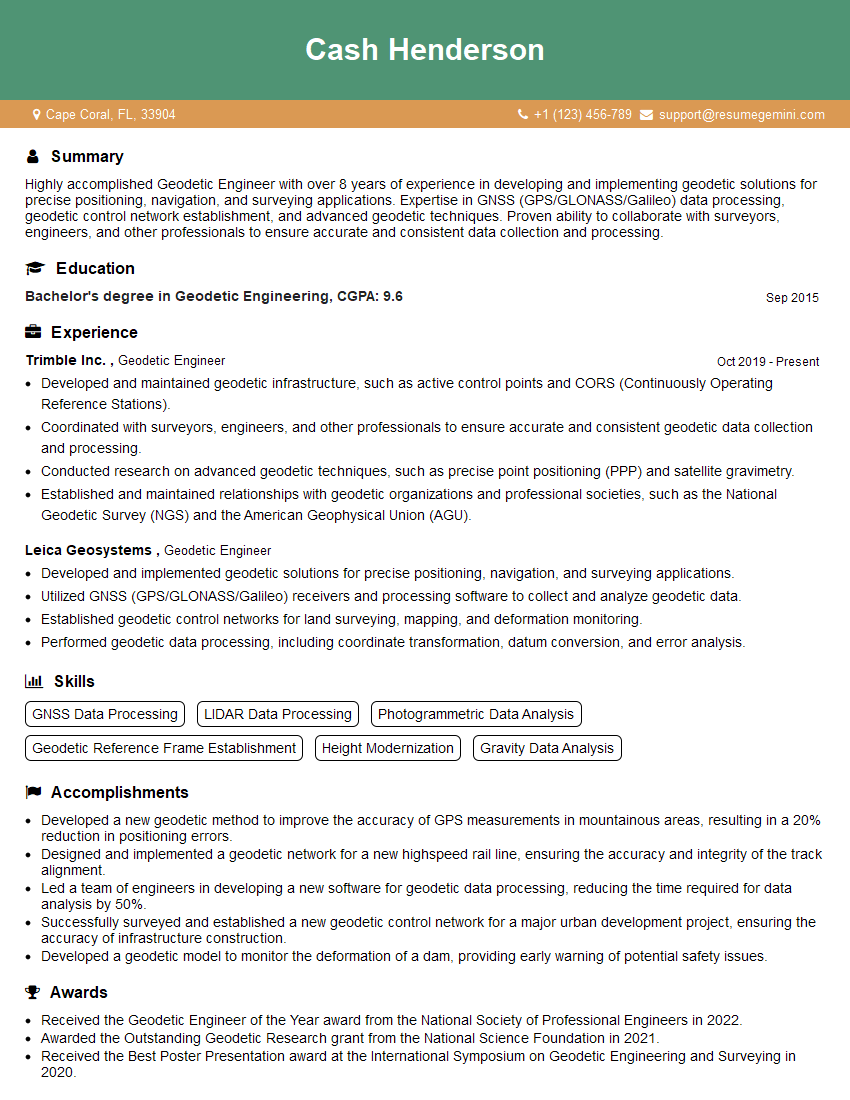
Mastering Geodetic Monitoring and Deformation Analysis opens doors to exciting career opportunities in diverse sectors, including infrastructure management, environmental monitoring, and hazard mitigation. A strong understanding of these techniques is highly valued by employers. To maximize your job prospects, create an ATS-friendly resume that clearly showcases your skills and experience. ResumeGemini is a trusted resource to help you build a professional and impactful resume. They provide examples of resumes tailored to Geodetic Monitoring and Deformation Analysis, ensuring your application stands out from the competition.

Explore more articles
Users Rating of Our Blogs
Share Your Experience
We value your feedback! Please rate our content and share your thoughts (optional).
What Readers Say About Our Blog
Really detailed insights and content, thank you for writing this detailed article.
IT gave me an insight and words to use and be able to think of examples