Feeling uncertain about what to expect in your upcoming interview? We’ve got you covered! This blog highlights the most important Geodetic Network Establishment interview questions and provides actionable advice to help you stand out as the ideal candidate. Let’s pave the way for your success.
Questions Asked in Geodetic Network Establishment Interview
Q 1. Explain the difference between a geodetic and a plane survey.
The core difference between geodetic and plane surveying lies in how they handle the Earth’s curvature. Plane surveying assumes the Earth is flat over the survey area, a reasonable approximation for small areas. Geodetic surveying, however, explicitly accounts for the Earth’s curvature, using an ellipsoidal model of the Earth’s surface. This is crucial for larger areas where the Earth’s curvature becomes significant, leading to noticeable errors if a flat-Earth assumption is made.
Think of it like this: If you’re surveying a small backyard, a plane survey is perfectly adequate. However, if you’re surveying a large area, such as a state or country, a geodetic survey is essential for accurate results. Ignoring the Earth’s curvature in large-scale surveys would accumulate significant errors in distance and direction calculations.
In essence, plane surveying uses Cartesian coordinates (X, Y) in a plane, while geodetic surveying utilizes geodetic coordinates (latitude, longitude, and height) on an ellipsoidal surface.
Q 2. Describe the various types of geodetic datums and their applications.
Geodetic datums are reference surfaces that define the size and shape of the Earth and the origin and orientation of a coordinate system. Different datums exist because the Earth isn’t a perfect sphere or even a perfect ellipsoid; its shape is complex and varies slightly regionally. Several types exist:
- Horizontal Datums: These define the Earth’s shape and orientation. Examples include NAD83 (North American Datum of 1983) and WGS84 (World Geodetic System 1984). NAD83 is a North American-centric datum, while WGS84 is a global datum widely used in GPS.
- Vertical Datums: These define the height or elevation above a reference surface, usually mean sea level. Examples include NAVD88 (North American Vertical Datum of 1988) and the various national vertical datums around the world. These datums often differ due to local variations in gravity and sea level.
- Geocentric Datums: These are 3D datums that define the Earth’s center of mass as their origin. WGS84 is a prime example and serves as the basis for many GPS applications. These are particularly important for satellite-based positioning systems.
The application of a datum depends on the scale and scope of the project. Local surveys might use a local datum for simplicity, while large-scale mapping and navigation projects invariably require a global datum like WGS84 for consistency and accuracy across diverse regions.
Q 3. What are the fundamental principles of least squares adjustment in geodetic networks?
Least squares adjustment is a fundamental technique used to reconcile discrepancies between observed and computed values in geodetic networks. It aims to find the ‘best-fit’ solution that minimizes the sum of the squared differences between observed and calculated values. The underlying principle is to find the most probable solution given the uncertainties in the observations.
Here’s a breakdown:
- Observation Equations: These mathematically relate the observed values (e.g., distances, angles, coordinates) to the unknown parameters (e.g., coordinates of points in the network).
- Weight Matrix: This matrix represents the relative precision of different observations. More precise measurements receive higher weights.
- Normal Equations: These are derived from the observation equations and the weight matrix. Solving these equations yields the best estimates of the unknown parameters.
- Minimization of Residuals: The least squares method finds the solution that minimizes the sum of the squared residuals (differences between observed and calculated values), leading to a statistically optimal solution.
Essentially, least squares adjustment accounts for the inevitable errors in measurements, providing a robust and statistically sound solution for the network’s geometry.
Q 4. How do you handle errors and outliers in geodetic observations?
Handling errors and outliers in geodetic observations is crucial for achieving reliable results. Errors are typically random fluctuations, while outliers are extreme values significantly deviating from the expected pattern. Several techniques are employed:
- Data Editing and Validation: A thorough check of the raw data for obvious blunders or inconsistencies. This involves examining individual measurements for plausibility and comparing them with known constraints.
- Statistical Tests: Applying statistical methods, such as the Chauvenet criterion or Grubbs’ test, to identify outliers that lie outside a certain confidence interval. These tests provide a quantitative way to decide whether to reject a suspected outlier.
- Robust Estimation Techniques: Methods like least absolute deviation (LAD) or M-estimators offer greater resistance to outliers compared to the traditional least squares method. They downweight the influence of outliers during the adjustment process.
- Iterative Adjustment: Repeatedly adjusting the network after identifying and removing outliers. This iterative approach refines the solution and ensures outliers don’t unduly influence the final results.
Careful consideration of both random errors and systematic biases is vital. Identifying the source of errors (instrumental, procedural, environmental) can lead to improvements in data acquisition and processing.
Q 5. Explain the concept of coordinate transformations and datum transformations.
Coordinate transformations and datum transformations are essential for working with geospatial data from different sources and coordinate systems. They involve mathematically converting coordinates from one system to another.
Coordinate Transformations involve changing the coordinate system while staying within the same datum. This might involve converting from a local coordinate system to a national grid or vice versa. Common transformations include translations, rotations, and scaling.
Datum Transformations are more complex, involving changes in both the coordinate system and the datum itself. This is necessary when working with data from different datums (e.g., converting coordinates from NAD27 to NAD83). Techniques like seven-parameter transformations (three translations, three rotations, and a scale factor) are commonly used for this purpose. More sophisticated models might include higher-order polynomial transformations for improved accuracy in regions with significant datum differences.
Imagine you have a map using a local datum and need to overlay it on a national map using a different datum. A datum transformation allows you to align these maps accurately.
Q 6. What are the different types of GNSS systems and their characteristics?
Several Global Navigation Satellite Systems (GNSS) are operational, each with its characteristics:
- GPS (USA): The most widely used, with a constellation of 24 satellites providing global coverage. Known for its accuracy and reliability.
- GLONASS (Russia): A similar system to GPS, offering global coverage. Often used in conjunction with GPS to improve position accuracy.
- Galileo (EU): A modern system emphasizing high accuracy, integrity, and availability. It complements and enhances the capabilities of other GNSS.
- BeiDou (China): A rapidly expanding system aiming for global coverage. It provides both open and restricted service levels.
These systems differ in their satellite configurations, signal structures, and accuracy levels. Combining data from multiple GNSS constellations (multi-GNSS) improves positioning performance, enhancing both accuracy and reliability. Multi-GNSS techniques mitigate signal blockage and improve the availability of positioning solutions.
Q 7. Describe the process of establishing a geodetic control network.
Establishing a geodetic control network involves a systematic process to create a framework of precisely surveyed points with known coordinates. This framework serves as the foundation for other surveying and mapping activities.
The process generally includes:
- Network Design: Planning the location and type of control points based on the area’s size and the required accuracy. A well-designed network should optimize the distribution of points and minimize error propagation.
- Field Observations: Measuring distances and angles between control points using precise surveying equipment such as total stations or GNSS receivers. Multiple measurements are taken to improve reliability.
- Data Processing: Applying least squares adjustment to reconcile discrepancies in the observations and obtain the most probable coordinates for all points. This step accounts for errors in the measurements.
- Quality Control: Rigorous checks are made to ensure the accuracy and reliability of the network. This includes analyzing residuals, assessing the network’s geometry, and comparing results to existing data.
- Documentation: Thoroughly documenting the network’s geometry, the observation data, the processing steps, and the final coordinates. This information is essential for future use and maintenance of the network.
The resulting network provides a high-precision coordinate system that serves as a reference for various applications, including mapping, cadastral surveying, engineering projects, and monitoring deformation.
Q 8. Explain the importance of geodetic control in GIS applications.
Geodetic control forms the foundational framework for any GIS application. Think of it as the skeleton upon which all spatial data is built. Without accurate geodetic control, GIS data becomes unreliable, leading to inaccuracies in maps, analyses, and decision-making processes. It provides the precise coordinates (latitude, longitude, and height) that are crucial for accurately positioning and relating spatial features. This allows for the proper registration and overlay of different datasets like satellite imagery, cadastral maps, and utility lines, ensuring they align correctly in a common spatial reference system.
For example, imagine trying to overlay a map of property boundaries onto a satellite image without a reliable geodetic framework. The boundaries might appear shifted or misaligned, leading to inaccurate land measurements and potential legal disputes. Geodetic control ensures that all spatial data is accurately located within a known coordinate system, promoting consistency and reliability.
Q 9. How do you assess the accuracy and reliability of geodetic measurements?
Assessing the accuracy and reliability of geodetic measurements involves a multi-faceted approach encompassing both fieldwork and post-processing analysis. In the field, meticulous attention to detail during data acquisition is paramount. This includes careful instrument calibration, proper observation techniques to minimize errors (e.g., centering the instrument over the benchmark), and environmental considerations like atmospheric refraction and temperature fluctuations. After data collection, rigorous statistical analysis is crucial.
This analysis might involve techniques such as least squares adjustment, which mathematically determines the ‘best fit’ for the observed data, considering the inherent uncertainties in each measurement. The results of this adjustment include measures like standard deviations and error ellipses, which quantify the uncertainties associated with the determined coordinates. Furthermore, redundancy in observations (taking multiple measurements) significantly improves reliability, allowing for the identification and mitigation of gross errors. A well-designed geodetic network also incorporates checks and balances to identify inconsistencies and blunders. In essence, assessing accuracy is not just about a single metric but a holistic evaluation of the entire process, from fieldwork to data processing.
Q 10. What are the different methods for determining the height of a point?
Determining the height of a point involves several methods, each with its own strengths and limitations. The most common methods include:
- Leveling: This traditional technique employs a level instrument and graduated rods to measure differences in elevation between points. It’s highly accurate over short distances but susceptible to cumulative errors over long lines.
- GPS (Global Positioning System): GPS receivers measure the distance to satellites, providing ellipsoidal heights (height above a reference ellipsoid). While convenient and efficient, the accuracy is affected by atmospheric conditions and satellite geometry.
- GNSS (Global Navigation Satellite Systems): This encompasses GPS and other satellite systems like GLONASS, Galileo, and BeiDou, offering improved accuracy and reliability through the combined use of multiple satellite constellations.
- Trigonometric leveling: This method utilizes angles and distances to calculate height differences. It’s useful in situations where direct leveling is impractical, such as across significant obstacles.
- Barometric leveling: This method utilizes air pressure to infer elevation. While convenient and inexpensive, it’s less accurate than other methods due to atmospheric variability.
The choice of method depends on the desired accuracy, project budget, terrain conditions, and accessibility.
Q 11. Explain the concept of ellipsoidal and orthometric heights.
Ellipsoidal and orthometric heights represent different ways of defining the height of a point. Imagine the Earth as an imperfect sphere, a bumpy ball. The ellipsoid is a mathematical approximation of this shape, a smooth, regular surface that closely fits the Earth’s geoid (the equipotential surface of the Earth’s gravity field).
Ellipsoidal height is the height of a point above this reference ellipsoid. It’s obtained directly from GPS or GNSS measurements. Think of it as measuring your height from a slightly misshapen, smooth ‘sea level’.
Orthometric height, on the other hand, is the height above the geoid – essentially the height above mean sea level. It’s often considered a more physically meaningful height, as it represents the distance along a plumb line to the geoid. Converting from ellipsoidal height to orthometric height requires the use of geoid models, which represent the separation between the ellipsoid and the geoid.
The difference between these two heights is called the geoid undulation and can vary significantly depending on location, even reaching several tens of meters.
Q 12. Describe the challenges in establishing geodetic networks in mountainous terrain.
Establishing geodetic networks in mountainous terrain presents unique challenges compared to flatter areas. The primary issues stem from:
- Line of sight obstructions: Mountains often block the direct line of sight between survey points, making it difficult to perform traditional measurements like leveling or triangulation. This necessitates the use of techniques like GPS, which can overcome line-of-sight limitations but might be affected by multipath errors (signals reflecting off mountains).
- Difficult accessibility: Reaching survey points in mountainous regions can be time-consuming, expensive, and potentially dangerous. This increases the cost and logistical complexities of the project.
- Atmospheric effects: Atmospheric conditions, such as temperature and pressure gradients, are more variable in mountainous areas. These variations can amplify the impact of atmospheric refraction on measurements, requiring more sophisticated corrections.
- Increased error propagation: The uneven terrain makes it challenging to precisely measure distances and angles, potentially leading to higher uncertainties in the final coordinate determinations. Careful planning and the use of robust surveying methods are crucial to minimize this error propagation.
Overcoming these challenges often requires a combination of innovative surveying techniques, careful planning, and specialized equipment. Drones and LiDAR are increasingly used to gather elevation data.
Q 13. What are the effects of atmospheric refraction on geodetic measurements?
Atmospheric refraction is the bending of light as it passes through the atmosphere, a phenomenon caused by variations in air density. This effect significantly impacts geodetic measurements, particularly those involving long distances or elevated observation points. Because the density of the atmosphere is not uniform (it’s denser closer to the Earth’s surface), the path of the light ray is not straight but curved. This leads to apparent changes in the measured angles and distances.
Imagine a straw in a glass of water – the straw appears bent because of the refraction of light as it passes from the water into the air. Similarly, atmospheric refraction causes a measured angle between two points to be slightly different from the true geometric angle. This effect needs to be corrected for using atmospheric models or real-time measurements of atmospheric conditions. Neglecting this correction can introduce significant errors into geodetic surveys, particularly in long-range observations. The severity of the effect is typically higher at longer distances and near the horizon.
Q 14. How do you account for the effects of Earth’s curvature in geodetic surveys?
Accounting for Earth’s curvature is crucial in geodetic surveys, especially over longer distances. A simple example: if you measure a distance of 100km along the Earth’s surface, assuming a flat Earth would lead to significant error. We use different methods depending on the level of accuracy needed.
For short distances, we can often use plane surveying, assuming the Earth is flat. However, for longer distances, this simplification is unacceptable, and we need to consider the curvature. This commonly involves using geodetic coordinates (latitude, longitude, and height) instead of planar coordinates. Geodetic calculations use ellipsoidal models of the Earth to accurately determine distances and positions, incorporating the Earth’s curvature in the mathematical formulations. Software packages and specialized algorithms are typically employed to perform these complex calculations. Techniques like traversing, where a series of connected lines are measured, require rigorous adjustments to account for the curvature.
Advanced techniques like employing ellipsoidal geometry and geodetic datums are employed to accurately represent the curved surface of the Earth during geodetic surveys, ensuring accuracy even at continental scales. Ignoring the Earth’s curvature would lead to large accumulated errors that become unacceptable in many geospatial applications.
Q 15. Explain the use of different types of surveying equipment (e.g., total stations, GPS receivers).
Different surveying equipment plays crucial roles in establishing geodetic networks. Total stations and GPS receivers are the workhorses, each with its strengths. Total stations, employing EDM (Electro-Optical Distance Measurement) technology, measure distances, angles (horizontal and vertical), and can even calculate coordinates directly. Think of them as highly precise theodolites combined with a sophisticated distance meter. They’re excellent for detailed, localized surveys, especially in areas with limited GPS reception like dense forests or urban canyons. I’ve personally used them extensively in cadastral surveys, mapping property boundaries with millimeter-level accuracy.
GPS receivers, on the other hand, leverage satellite signals to determine precise positions. They’re invaluable for large-scale projects spanning vast areas, providing a network’s overall geospatial framework. They are less precise than total stations for localized measurements but cover far greater distances. For instance, in a recent highway alignment project, we relied heavily on GPS to establish control points across several kilometers, optimizing the network’s design and minimizing fieldwork.
Other important equipment includes levels for precise elevation determination and robotic total stations which enhance efficiency by automatically tracking targets, increasing productivity. The choice of equipment always depends on project specifics, budget constraints, and required accuracy.
Career Expert Tips:
- Ace those interviews! Prepare effectively by reviewing the Top 50 Most Common Interview Questions on ResumeGemini.
- Navigate your job search with confidence! Explore a wide range of Career Tips on ResumeGemini. Learn about common challenges and recommendations to overcome them.
- Craft the perfect resume! Master the Art of Resume Writing with ResumeGemini’s guide. Showcase your unique qualifications and achievements effectively.
- Don’t miss out on holiday savings! Build your dream resume with ResumeGemini’s ATS optimized templates.
Q 16. Describe your experience with geodetic software and data processing techniques.
My experience with geodetic software and data processing is extensive. I’m proficient in several industry-standard packages, including GeoOffice, Leica GeoMos, and Bernese GNSS Software. My expertise extends beyond basic data input and manipulation to advanced techniques like least squares adjustment, outlier detection, and error propagation analysis. In one project involving a large-scale deformation monitoring network, I used GeoOffice to process thousands of GPS observations, identifying and mitigating systematic errors through rigorous data quality control procedures, ensuring the integrity and accuracy of the results. The application of least squares adjustment in Bernese is critical for integrating data from multiple sensors (e.g. GPS, total station, InSAR) to create a truly comprehensive and accurate geodetic model. This software excels at handling very large datasets with superior efficiency and accuracy compared to non-specialised software.
Q 17. How do you manage large datasets in geodetic network adjustment?
Managing large datasets in geodetic network adjustment requires a strategic approach. Simply put, it’s like assembling a giant jigsaw puzzle where each piece needs to fit perfectly. We use techniques like data partitioning, hierarchical processing, and parallel computing. Data partitioning involves breaking the dataset into smaller, manageable chunks for processing independently. Hierarchical processing uses a multi-level approach, starting with a coarse adjustment of the main network, and progressively refining the solution by incorporating more detailed measurements. Parallel computing utilizes multiple processors to simultaneously process different parts of the dataset, drastically reducing processing time. For instance, in a recent national-scale geodetic network adjustment, we employed parallel processing techniques on a high-performance computing cluster, which decreased processing time from several weeks to just a few days, allowing for quicker project delivery.
Furthermore, efficient data management practices including the use of appropriate database systems (e.g., PostgreSQL, Oracle Spatial) and the development of automated workflows are crucial for improving efficiency and reducing errors. Careful planning and selection of appropriate software are essential for effectively handling the volume and complexity of the data.
Q 18. Explain the concept of network design optimization in geodetic surveying.
Network design optimization is paramount in geodetic surveying. It’s about creating a network structure that maximizes accuracy and minimizes cost and fieldwork. Think of it as designing a strong, efficient bridge; you wouldn’t use a single, thin beam. Instead, you’d use multiple supports and strategically positioned elements to distribute weight effectively. Similarly, we optimize the network geometry, considering factors like station spacing, distribution of observation types, and the inclusion of control points. Poorly designed networks can lead to significant errors and ambiguities, rendering the results unreliable. Techniques like simulations and software packages specifically designed for network optimization help us evaluate different configurations and select the most efficient one. We aim for redundancy, ensuring that the network remains strong even if some measurements are lost or corrupted. In practice, we employ software to simulate different network geometries, assessing their accuracy and sensitivity to errors before commencing fieldwork, saving time and resources. For instance, in a recent urban survey, optimizing the network’s design allowed us to reduce the number of control points by 20%, saving both time and cost.
Q 19. How do you ensure the quality control and quality assurance of geodetic data?
Quality control (QC) and quality assurance (QA) are integral parts of geodetic data processing. QC involves the continuous monitoring of individual measurements and processes during data acquisition and processing to detect and correct errors. QA refers to a broader assessment of the entire workflow, ensuring all aspects meet the project’s requirements and standards. Specific QC steps include checking for blunders (gross errors) in observations, analyzing residuals (differences between observed and computed values) to identify outliers and potential systematic errors, and verifying the accuracy and precision of measurements through statistical analysis. QA involves developing and implementing comprehensive procedures, establishing clear specifications, regularly reviewing data processing methods, and utilizing independent checks on the overall network solution. We employ statistical tools and visualization techniques to thoroughly assess the quality of the results. Documentation of every step of the process is extremely important, allowing for traceability and accountability.
For instance, in a recent large-scale mapping project, our rigorous QA/QC procedures flagged a systematic error in the atmospheric refraction correction, which was promptly addressed, thus preventing propagation of a significant error throughout the entire network. Regular audits and external validation of our methods ensure adherence to high standards and provide evidence of our commitment to reliable data delivery.
Q 20. Describe your experience with different coordinate systems (e.g., UTM, geographic coordinates).
Experience with different coordinate systems is fundamental in geodetic surveying. Geographic coordinates (latitude and longitude) are based on the Earth’s ellipsoidal model and are ideal for representing locations globally. UTM (Universal Transverse Mercator) coordinates are a projected coordinate system, transforming the curved Earth’s surface onto a flat plane. UTM is commonly used for local mapping and engineering applications, as it simplifies distance calculations. Understanding transformations between these coordinate systems is vital. In practice, we often work with a mix of both systems, depending on the scale and application. For instance, a nationwide infrastructure project may use a geographic coordinate system for general positioning, while local construction activities will utilize a UTM projection for detailed measurements.
The choice of coordinate system is also heavily influenced by the selected geodetic datum (a reference surface for precise geospatial positioning). A datum’s selection needs to be carefully considered to ensure consistency and the avoidance of unnecessary coordinate transformations, which can introduce inaccuracies. This becomes particularly important when working with different datasets collected using different datums. I’ve had extensive experience transforming data between different datums, often using established transformation models and software tools to ensure seamless integration of geospatial data.
Q 21. What are the different types of errors that can occur in geodetic measurements?
Geodetic measurements are susceptible to various errors. These errors can be broadly categorized into systematic errors and random errors.
- Systematic errors are consistent and follow a predictable pattern. Examples include instrument calibration errors (e.g., an incorrectly calibrated total station), atmospheric refraction (bending of light rays due to atmospheric conditions), and earth curvature. These errors can be mitigated by careful calibration of equipment, application of appropriate corrections (e.g., atmospheric refraction correction), and proper survey design.
- Random errors are unpredictable and fluctuate randomly around a mean value. These are caused by factors like human error in reading instruments, thermal fluctuations impacting equipment performance, and unmodelled influences such as ground movement. They can be minimized by employing robust data acquisition techniques, rigorous observation procedures, and performing multiple measurements to average out random errors.
Other errors include gross errors (blunders), often human-related mistakes such as incorrect recording of measurements. A robust quality control process is needed to identify and eliminate such errors. Understanding the nature and source of these errors is key to effectively mitigate their impact on the accuracy and reliability of geodetic measurements. Statistical methods, such as outlier detection techniques and error propagation analysis, are vital for assessing the reliability of the results.
Q 22. How do you identify and correct systematic errors in geodetic data?
Systematic errors in geodetic data, unlike random errors, follow a pattern and are often caused by predictable factors. Identifying and correcting them is crucial for achieving high-accuracy results. We tackle this using a multi-pronged approach.
Careful Planning and Instrument Calibration: Before any fieldwork, we meticulously calibrate all instruments (total stations, GPS receivers) to minimize instrumental errors. Regular checks during the survey further reduce this risk. For example, ensuring proper collimation of a total station prevents systematic angular errors.
Environmental Corrections: We account for environmental factors like temperature, pressure, and humidity which affect instrument performance and signal propagation (especially in GPS measurements). Specialized software calculates these corrections based on on-site measurements or meteorological data.
Least Squares Adjustment: This powerful mathematical technique is the cornerstone of error correction. It uses observation equations and constraints (known coordinates, distances, or angles) to estimate the best-fitting solution for all unknown coordinates, minimizing the influence of systematic and random errors simultaneously. Software like Leica Geo Office handles this automatically.
Residual Analysis: After adjustment, we meticulously analyze the residuals (the differences between observed and computed values). Significant patterns in residuals often indicate the presence of undetected systematic errors. For example, consistently large residuals in one direction might suggest a systematic error in a specific instrument setting or a misidentified datum.
Data Validation and Quality Control Checks: We employ rigorous checks to ensure data integrity. This includes plausibility checks (e.g., verifying that measured distances are within reasonable ranges), outlier detection, and comparison with existing data (if available) to identify inconsistencies.
By combining these methods, we can effectively identify and mitigate systematic errors, leading to accurate and reliable geodetic networks.
Q 23. Explain your experience with data processing software like Leica Geo Office or similar.
I have extensive experience with Leica Geo Office, as well as other leading geodetic processing software like Trimble Business Center and TerraScan. Leica Geo Office, in particular, is a powerful tool for processing geodetic data from various sources, including total stations and GNSS receivers.
Data Import and Preprocessing: I’m proficient in importing raw data, applying corrections (atmospheric, instrument etc.), and identifying and managing outliers. This step is crucial for ensuring high data quality.
Network Adjustment: I leverage the software’s least squares adjustment capabilities to create optimal coordinate solutions. This involves defining network constraints, selecting appropriate adjustment models (e.g., free network, constrained network), and analyzing the resulting statistics (e.g., standard deviations, error ellipses).
Quality Control: I’m highly skilled in performing post-adjustment quality control analyses using the software’s built-in tools. This includes evaluating residual patterns to identify systematic errors, analyzing error propagation, and assessing the overall accuracy of the network.
Report Generation: I utilize the software’s reporting capabilities to generate clear, professional-quality reports including coordinate tables, error statistics, diagrams, and maps which accurately reflect the results of the survey.
My proficiency extends beyond basic data processing; I can handle complex scenarios, including network design optimization and the integration of different data sources. For example, I recently utilized Leica Geo Office to process data from a challenging urban survey, incorporating both total station and GNSS data to generate highly accurate 3D models of buildings and infrastructure.
Q 24. Describe your proficiency in using GIS software for visualizing geodetic data.
GIS software is indispensable for visualizing and analyzing geodetic data. My experience encompasses various GIS platforms, including ArcGIS and QGIS. I use them to:
Data Visualization: I can create visually informative maps that display survey points, control points, contours, and other geospatial features. This allows for efficient quality control checks and a deeper understanding of the survey area.
Spatial Analysis: I use GIS functionalities for spatial analysis, such as proximity analysis, overlay analysis, and terrain analysis to answer specific questions about the geodetic data and its relation to other data sets.
Data Integration: I seamlessly integrate geodetic data with other data layers (e.g., cadastral maps, aerial imagery) to enrich the analysis and derive meaningful insights. For instance, integrating geodetic data with elevation models allows for efficient volume calculations in earthwork projects.
Presentation and Reporting: GIS tools are valuable for producing high-quality maps and reports suitable for a wide range of stakeholders.
A recent project involved visualizing the results of a deformation monitoring network using ArcGIS. By overlaying the displacement vectors on a high-resolution aerial photograph, we were able to clearly show the extent of ground deformation and effectively communicate the findings to the client.
Q 25. What are your preferred methods for data visualization and presentation?
Effective data visualization is critical for communicating complex geodetic information clearly. My preferred methods include:
Interactive Maps: Web-based mapping platforms allow stakeholders to explore the data dynamically and gain a better understanding of the survey results. This interactive approach is particularly beneficial for large datasets or complex geodetic networks.
3D Models: For projects involving complex topography or infrastructure, 3D models provide a powerful way to visualize the data and communicate findings effectively to clients.
Charts and Graphs: Simple and effective ways to present statistical data, such as error distributions, accuracy assessments, and coordinate precisions. These help stakeholders to understand the quality and reliability of the survey.
High-Quality Reports: Combining maps, charts, and written descriptions in a well-structured report ensures that the geodetic information is presented comprehensively and is easy to understand.
I always tailor my visualization methods to the specific audience and project requirements. A client might benefit from an interactive web map, while a scientific paper may require more detailed charts and graphs.
Q 26. Explain your understanding of the legal and regulatory frameworks related to surveying.
A thorough understanding of the legal and regulatory frameworks governing surveying is essential. These frameworks vary by jurisdiction but generally cover aspects like:
Licensing and Professional Standards: I am a licensed surveyor and strictly adhere to the professional codes of conduct and ethical guidelines. This ensures that all my work meets the required standards of accuracy and professional responsibility.
Data Accuracy and Standards: I am familiar with national and international standards for geodetic surveying and ensure that all data collected and processed meets the required levels of accuracy. These standards are vital for the legal validity and reliability of survey results.
Legal Boundaries and Property Rights: I have a comprehensive understanding of how surveys inform property boundaries and legal descriptions. Any survey work I perform must accurately reflect and respect existing property rights and ensure compliance with relevant legislation.
Data Ownership and Confidentiality: I understand the legal implications regarding data ownership and confidentiality, ensuring that client data is handled and protected responsibly and in accordance with applicable regulations.
Ignorance of these frameworks can lead to legal issues and invalidate survey results. Therefore, I maintain a keen awareness of any changes or updates to the legal and regulatory landscape relevant to my profession.
Q 27. Describe a challenging geodetic project you have worked on and how you overcame the challenges.
One challenging project involved establishing a geodetic network in a dense urban area with significant building obstructions and limited access. The challenges included:
Limited Visibility: Tall buildings significantly reduced the visibility of control points, making traditional total station measurements challenging.
Multipath Effects: The dense urban environment caused significant multipath errors in GNSS measurements.
Obstructions and Safety Concerns: Navigating through busy streets and construction sites presented safety and logistical concerns.
To overcome these challenges, we employed a combination of strategies:
Careful Network Design: We designed a network that minimized the impact of obstructions, using multiple sightlines wherever possible and strategically placing control points to maximize visibility.
Combined Total Station and GNSS Measurements: We integrated both total station and GNSS measurements, leveraging the strengths of each technology. The total station data compensated for multipath and obstruction issues affecting the GNSS, and vice versa.
Advanced Data Processing Techniques: We used sophisticated data processing techniques, such as advanced multipath mitigation algorithms in GNSS processing and rigorous least squares adjustment techniques in the network adjustment software, to obtain reliable results.
Rigorous Safety Protocols: We implemented strict safety protocols to protect the survey team from potential hazards present in the urban environment.
This project highlights the importance of a flexible approach to geodetic surveying, adapting techniques and technologies based on site-specific challenges. The successful completion demonstrated my problem-solving skills and my ability to deliver accurate results even in difficult conditions.
Q 28. How do you stay current with advancements in geodetic technology and techniques?
Keeping up-to-date with the rapidly evolving field of geodetic technology is paramount. I employ several strategies to achieve this:
Professional Organizations: Active membership in professional organizations like the American Congress on Surveying and Mapping (ACSM) or similar organizations provides access to journals, conferences, and workshops which keep me informed about the latest advancements.
Conferences and Workshops: I regularly attend industry conferences and workshops to learn about new technologies, methodologies, and best practices. This allows me to network with other professionals and stay abreast of current trends.
Publications and Journals: I read relevant scientific publications and journals to deepen my understanding of theoretical and practical aspects of geodesy.
Online Resources and Training: I actively use online resources, webinars, and training courses to enhance my skills and knowledge in specific areas, such as GNSS technology, software applications, and data processing techniques.
Collaboration and Networking: I maintain a network of colleagues and collaborators, engaging in discussions and exchanging knowledge and experiences to remain informed about advancements in the field.
This continuous learning ensures I can leverage the most appropriate and efficient methods for each project, consistently delivering high-quality geodetic services.
Key Topics to Learn for Geodetic Network Establishment Interview
- Geodetic Datum and Coordinate Systems: Understanding different datums (e.g., WGS84, NAD83) and their implications for coordinate transformations. Practical application: Explaining the selection criteria for a suitable datum for a specific project.
- Network Design and Optimization: Principles of network design, including station placement, figure-of-merit analysis, and error propagation. Practical application: Discussing strategies to minimize errors and optimize the network’s accuracy and reliability.
- Measurement Techniques: Familiarity with various geodetic measurement techniques (GNSS, leveling, traversing). Practical application: Comparing the advantages and disadvantages of different techniques for specific surveying tasks.
- Data Processing and Adjustment: Understanding least squares adjustment methods and software packages used for geodetic network processing. Practical application: Describing the workflow for processing raw geodetic data and resolving discrepancies.
- Quality Control and Assurance: Implementing quality control procedures throughout the network establishment process. Practical application: Identifying potential sources of error and implementing mitigation strategies.
- Geodetic Reference Frames: Knowledge of ITRF and its relationship to local reference frames. Practical application: Explaining the importance of maintaining consistency and accuracy across different reference frames.
- Error Analysis and Uncertainty Propagation: Understanding and quantifying uncertainties associated with geodetic measurements and their impact on the overall network accuracy. Practical application: Interpreting error ellipses and assessing the reliability of computed coordinates.
Next Steps
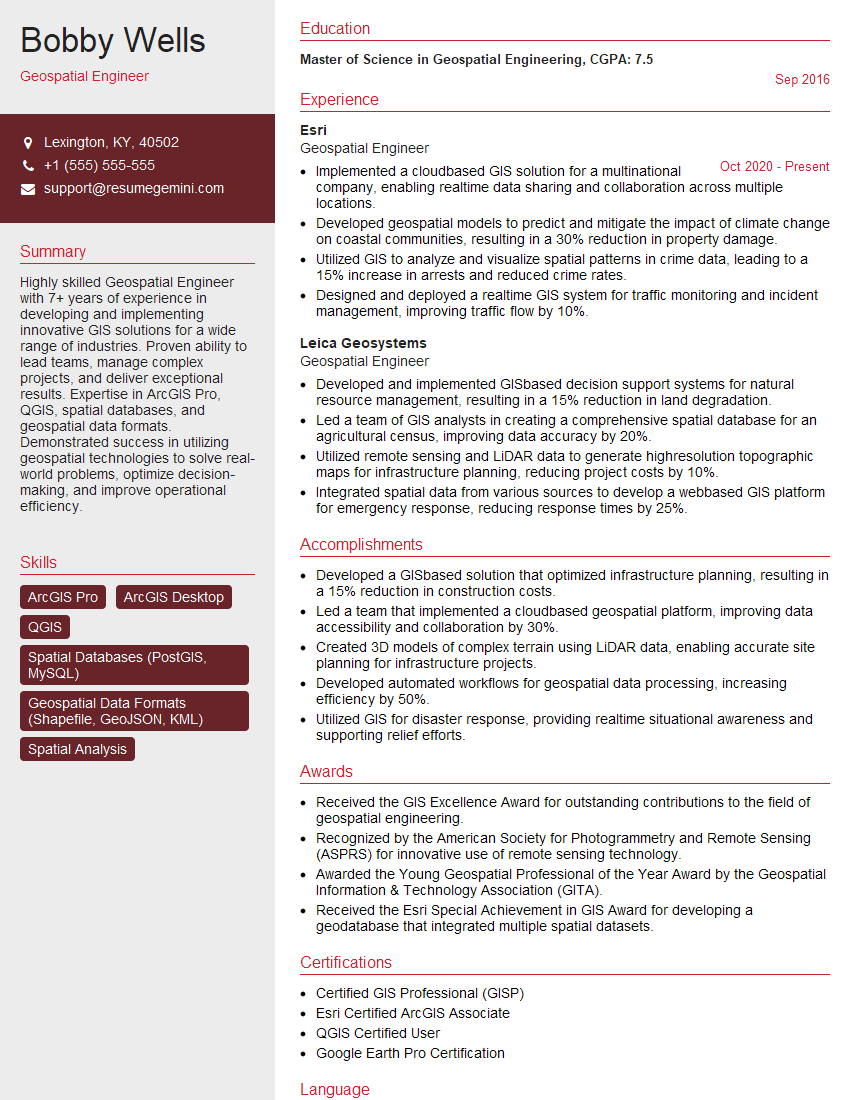
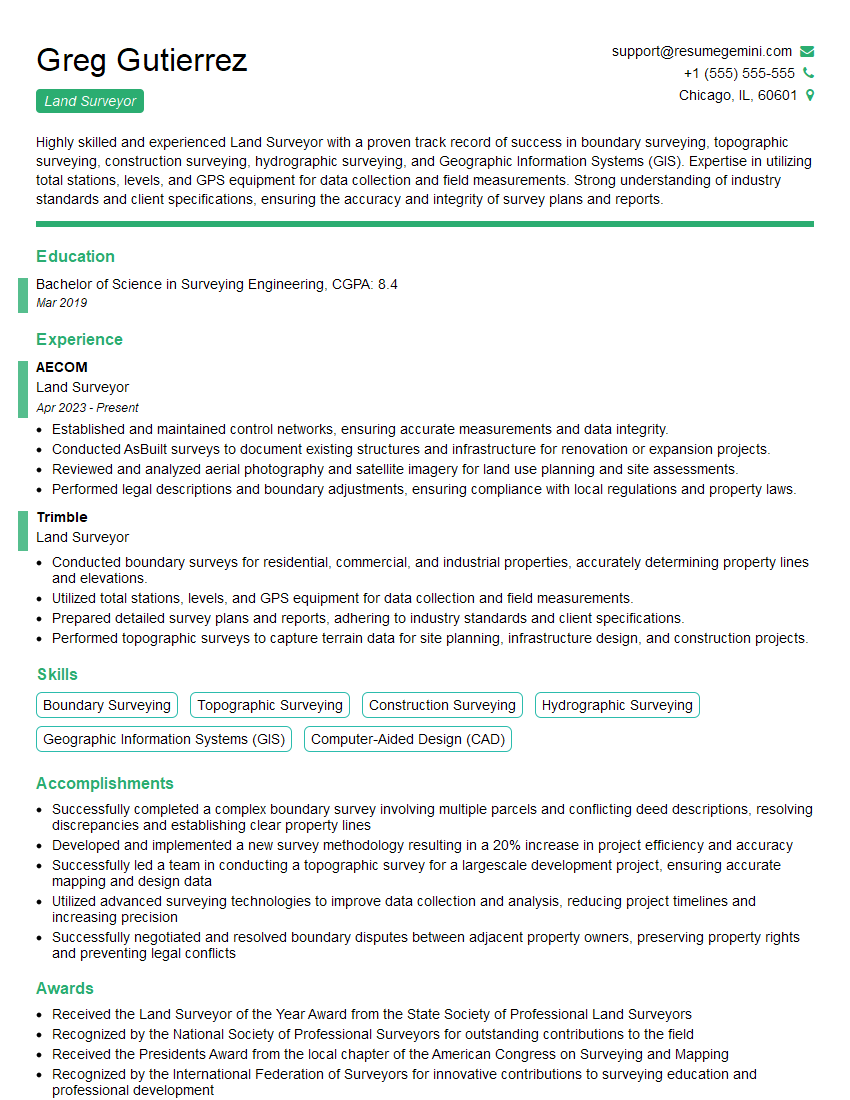
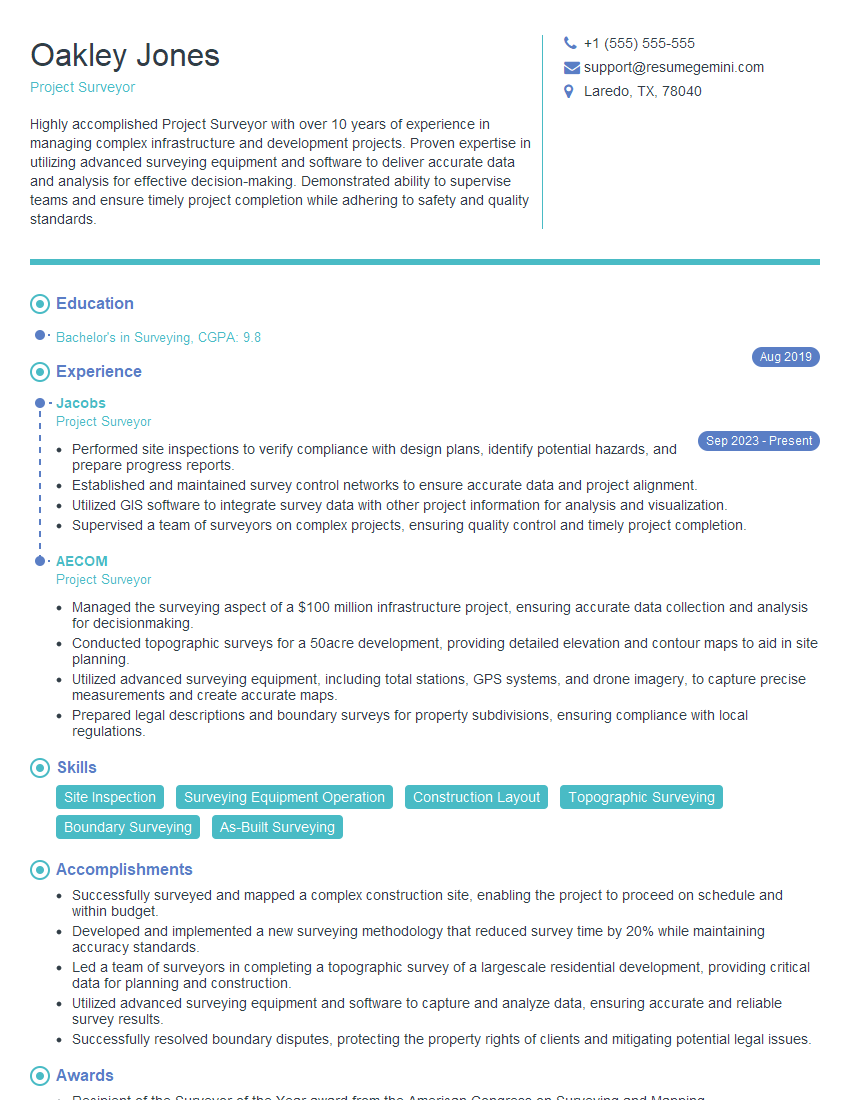
Mastering Geodetic Network Establishment opens doors to exciting career opportunities in surveying, mapping, and GIS. A strong understanding of these principles is highly valued by employers and demonstrates a commitment to precision and accuracy. To maximize your job prospects, crafting an ATS-friendly resume is crucial. ResumeGemini is a trusted resource that can help you build a professional and impactful resume that highlights your skills and experience effectively. Examples of resumes tailored specifically to Geodetic Network Establishment are available to guide you through the process.





Explore more articles
Users Rating of Our Blogs
Share Your Experience
We value your feedback! Please rate our content and share your thoughts (optional).
What Readers Say About Our Blog
Really detailed insights and content, thank you for writing this detailed article.
IT gave me an insight and words to use and be able to think of examples