Interviews are opportunities to demonstrate your expertise, and this guide is here to help you shine. Explore the essential Geospatial Data Acquisition interview questions that employers frequently ask, paired with strategies for crafting responses that set you apart from the competition.
Questions Asked in Geospatial Data Acquisition Interview
Q 1. Explain the difference between GPS, GLONASS, and Galileo.
GPS (Global Positioning System), GLONASS (Global Navigation Satellite System), and Galileo are all Global Navigation Satellite Systems (GNSS) that provide location and time information to users worldwide. However, they differ in their operational characteristics and ownership.
- GPS: Developed by the United States, it’s the most widely used GNSS, with a constellation of approximately 30 satellites. It offers high accuracy and global coverage.
- GLONASS: Developed by Russia, GLONASS offers similar functionality to GPS, providing global coverage with its constellation of satellites. It’s a strong alternative and often used in conjunction with GPS for improved reliability and accuracy.
- Galileo: Developed by the European Union, Galileo is a modern GNSS designed to provide highly accurate positioning, navigation, and timing services. It boasts enhanced features like improved accuracy and signal integrity.
Think of them like three different mobile phone networks – each offers similar core services (calls, texts, data), but might have different coverage areas, signal strengths, or pricing. Similarly, GNSSs provide location data, but differ in their accuracy, availability, and the underlying technology.
Q 2. Describe the process of georeferencing raster data.
Georeferencing raster data is the process of assigning geographic coordinates (latitude and longitude) to a raster image, effectively linking it to a real-world location. This allows the image to be integrated with other geospatial data in a GIS.
The process typically involves:
- Identifying Control Points: Selecting points on the raster image with known coordinates. These can be obtained from maps, ground surveys, or other georeferenced data. The more control points you use, the more accurate your georeferencing will be.
- Establishing a Transformation: Using the control points, a transformation function is calculated. This function mathematically links the pixel coordinates of the raster to the geographic coordinates. Common transformations include affine and polynomial transformations. The software you use automatically calculates these.
- Applying the Transformation: The transformation is applied to the entire raster, assigning geographic coordinates to each pixel.
- Evaluating Accuracy: Checking the accuracy of the georeferencing by comparing the coordinates of additional points (check points) to their known values. This helps assess the quality of the process.
For example, an aerial photograph of a city could be georeferenced using known street intersections as control points. This allows the photo to be accurately overlaid on a map, enabling analysis of land use, infrastructure, etc.
Q 3. What are the common sources of error in GPS data acquisition?
GPS data acquisition is prone to several errors, broadly categorized as atmospheric, geometric, and receiver errors.
- Atmospheric Errors: Ionospheric and tropospheric delays affect the signal’s travel time, leading to positional inaccuracies. The ionosphere (upper atmosphere) and troposphere (lower atmosphere) can bend and delay the GPS signals.
- Geometric Errors: Satellite geometry affects the accuracy of the position calculation. Poor satellite geometry (when satellites are clustered in a small area of the sky) leads to weaker and less reliable positioning solutions. Think of trying to pinpoint your location using only three points that are very close together – it’s much harder than using points widely spaced.
- Receiver Errors: These include multipath errors (signals reflecting off surfaces before reaching the receiver), receiver noise, and clock errors in the receiver itself. Multipath, for example, can cause the receiver to ‘think’ the signal came from a slightly different place than it actually did.
- Other Errors: Obstructions like buildings and trees can also block signals and lead to errors. This is called signal masking.
Techniques like differential GPS (DGPS) and Real Time Kinematic (RTK) GPS are employed to mitigate these errors, achieving centimeter-level accuracy in some cases.
Q 4. How do you handle data gaps in geospatial datasets?
Data gaps in geospatial datasets are common and can be addressed using various methods, depending on the nature of the data and the acceptable level of uncertainty:
- Interpolation: Estimating missing values based on surrounding known values. Methods like kriging, inverse distance weighting, and spline interpolation are commonly used. This is like filling in a missing piece of a jigsaw puzzle based on the surrounding pieces.
- Extrapolation: Estimating values outside the known range. This is less reliable than interpolation but might be necessary in some situations. It’s like guessing what the next piece in the jigsaw puzzle will look like based on the pattern.
- Data Acquisition: Collecting additional data to fill the gaps. This is the most accurate but can be costly and time-consuming. This is like finding the missing piece of the jigsaw puzzle.
- Using Proxy Data: If direct data is unavailable, using related data as a proxy might be feasible. This could involve utilizing data from a similar time period or location as a placeholder.
- Spatial Modeling: Applying models (e.g., land cover change models) to predict missing values based on known patterns and trends.
The choice of method depends on the specific application and the characteristics of the data. It’s crucial to document the methods used to handle data gaps to ensure transparency and maintain data quality.
Q 5. Explain the principles of photogrammetry and its applications in GIS.
Photogrammetry is the science of making measurements from photographs. It involves taking overlapping photographs from different viewpoints and using them to create 3D models and accurate maps.
Principles: Photogrammetry leverages the principles of geometry and optics. By analyzing the parallax (apparent shift in the position of an object viewed from different points) between overlapping images, the 3D coordinates of points in the scene can be determined. Specialized software automates the process.
Applications in GIS:
- Creating Digital Elevation Models (DEMs): Photogrammetry is extensively used to generate accurate DEMs, which depict the elevation of the terrain.
- Orthoimage Generation: Creating geometrically corrected images that are free from distortion, which is essential for accurate spatial analysis.
- 3D Model Building: Constructing 3D models of buildings, landscapes, and other features for various applications, such as urban planning and infrastructure management.
- Change Detection: Analyzing changes over time by comparing georeferenced images from different dates.
Imagine creating a 3D model of a building from multiple photos taken from different angles – photogrammetry does this automatically and at a large scale, producing accurate and highly detailed representations.
Q 6. What are the advantages and disadvantages of LiDAR data acquisition?
LiDAR (Light Detection and Ranging) uses laser pulses to measure distances to the Earth’s surface. The data is used to create highly accurate 3D representations of the environment.
Advantages:
- High Accuracy: LiDAR provides highly accurate measurements of elevation and surface features.
- Penetration Capabilities: LiDAR can penetrate vegetation cover, revealing the underlying terrain.
- Comprehensive Data: It captures data on both ground and above-ground features.
- Automation: Data acquisition is largely automated, making it efficient.
Disadvantages:
- Cost: LiDAR data acquisition is expensive, requiring specialized equipment and expertise.
- Weather Dependent: Adverse weather conditions can significantly impact data quality.
- Data Processing: Processing LiDAR data requires specialized software and skills.
- Safety: Operating LiDAR equipment can pose safety risks.
LiDAR is particularly useful for creating precise DEMs, mapping forests, and assessing infrastructure conditions. However, the high cost needs to be factored in when choosing a data acquisition method.
Q 7. Discuss different methods for data quality control in geospatial data acquisition.
Data quality control in geospatial data acquisition is crucial for ensuring the reliability and usefulness of the data. Several methods are used:
- Metadata Management: Thoroughly documenting the data acquisition process, including equipment used, methods applied, and potential sources of error. This allows others to understand how the data was collected and assess its quality.
- Visual Inspection: Reviewing the raw data for obvious errors or inconsistencies. This could involve checking for gaps, misalignments, or unrealistic values.
- Statistical Analysis: Using statistical methods to identify outliers and assess the overall accuracy and precision of the data. This often involves comparing the data to known reference values.
- Spatial Consistency Checks: Checking for topological errors, such as overlaps or gaps in polygon data.
- Accuracy Assessments: Comparing the data to known ground truth data or other high-accuracy data sources to assess the accuracy of the measurements.
- Data Validation: Using validation rules or consistency checks to identify and correct errors in the data. This often involves using a GIS to perform these checks.
Implementing robust quality control procedures throughout the geospatial data acquisition process is crucial for producing high-quality data that can be used with confidence in various applications.
Q 8. How do you ensure data accuracy and precision in geospatial projects?
Ensuring data accuracy and precision in geospatial projects is paramount. It involves a multi-faceted approach starting from data acquisition to processing and analysis. Think of it like baking a cake – if your initial ingredients (data) are flawed, the final product (analysis) will be too.
- Careful Data Acquisition: Utilizing high-accuracy sensors (e.g., GNSS receivers with precise positioning techniques like RTK or PPK) is crucial. We must also carefully consider environmental factors that could affect data collection, such as atmospheric conditions affecting GPS signals.
- Data Validation and Quality Control: This involves rigorous checks at each stage. For instance, we might compare elevation data from different sources, look for outliers using statistical methods, or visually inspect imagery for errors. Data editing techniques are essential here.
- Georeferencing and Projection: Accurately georeferencing data – aligning it with a known coordinate system – is critical. Choosing an appropriate map projection minimizes distortion for the specific analysis. This is like ensuring your cake pan is the right shape and size for the recipe.
- Metadata Management: Detailed metadata (information about the data) is crucial for traceability and understanding limitations. It’s like including the recipe with your cake – it tells you how it was made, what ingredients were used, and potential limitations.
- Accuracy Assessment: We always conduct accuracy assessments using independent data sources or ground truth data to quantify the uncertainties associated with our final geospatial products.
For example, in a project mapping floodplains, inaccurate elevation data could lead to an underestimation of the flood risk, resulting in inadequate mitigation strategies. By meticulously following these steps, we ensure our analyses are reliable and support informed decision-making.
Q 9. What are the different types of coordinate systems and their applications?
Coordinate systems define the location of points on the Earth’s surface. There are two main types: geographic and projected.
- Geographic Coordinate Systems (GCS): These use latitude and longitude, based on a spherical model of the Earth (e.g., WGS84). Think of it as drawing lines of latitude and longitude on a globe. Applications include global navigation and location-based services.
- Projected Coordinate Systems (PCS): These project the 3D surface of the Earth onto a 2D plane. This introduces distortion, but is necessary for mapping and analysis on flat surfaces. Different projections minimize different types of distortion, like area or shape. Common examples include UTM (Universal Transverse Mercator) for large-scale mapping and State Plane Coordinate Systems for smaller areas. UTM is ideal for large-scale mapping, while State Plane is better for smaller regions needing minimal distortion.
The choice of coordinate system is project-specific. For instance, a global analysis of climate change might use a GCS, while a local land-use planning project might utilize a PCS optimized for that region to minimize distortion and improve accuracy.
Q 10. Explain the concept of map projections and their impact on spatial analysis.
Map projections are mathematical transformations that translate the three-dimensional Earth onto a two-dimensional map. Because it’s impossible to perfectly represent a sphere on a flat surface without distortion, various projections have been developed to minimize different types of distortion – area, shape, distance, or direction.
- Types of Projections: Conic projections are good for mid-latitudes; cylindrical projections are suitable for equatorial regions; azimuthal projections are best for polar areas. Each projection has its strengths and weaknesses depending on the application.
- Impact on Spatial Analysis: The choice of projection significantly affects spatial analysis. Using an inappropriate projection can lead to inaccurate measurements of distances, areas, and angles. For example, calculating the area of a forest using a projection that severely distorts area in that region will lead to inaccurate results.
Imagine trying to flatten an orange peel – you’ll inevitably get wrinkles and distortions. Similarly, map projections all involve compromises. Choosing the right projection is crucial for obtaining accurate results in spatial analysis; the wrong choice can lead to flawed conclusions.
Q 11. Describe the process of creating a digital elevation model (DEM).
Creating a Digital Elevation Model (DEM) involves converting elevation data into a digital representation of the terrain surface. This can be done using various data sources.
- Data Acquisition: Sources include LiDAR (Light Detection and Ranging), photogrammetry (using overlapping aerial or drone imagery), and traditional survey data. LiDAR provides highly accurate point clouds, while photogrammetry is cost-effective for larger areas.
- Data Processing: Point clouds from LiDAR need to be processed to remove noise and artifacts. Photogrammetry involves generating a 3D model from overlapping images. This usually involves software packages that use Structure from Motion (SfM) and Multi-View Stereo (MVS) techniques.
- Interpolation: The raw elevation data points are then interpolated to create a continuous surface. Various interpolation methods exist (e.g., kriging, spline interpolation), each with its own strengths and weaknesses. The chosen method influences the smoothness and accuracy of the resulting DEM.
- DEM Generation: The interpolated surface is converted into a raster format (like GeoTIFF), representing the elevation at each grid cell.
For instance, creating a DEM for a landslide-prone area using LiDAR allows us to create accurate slope maps that can inform risk assessment and mitigation strategies. The choice of data acquisition and processing methods will significantly impact the accuracy and detail captured in the resulting DEM.
Q 12. What are the common file formats used for storing geospatial data?
Geospatial data is stored using a variety of formats, each with its strengths and weaknesses.
- Raster Formats: These represent data as a grid of cells, each with an associated value (e.g., elevation, temperature). Common formats include GeoTIFF, ERDAS IMAGINE, and MrSID.
- Vector Formats: These represent data as points, lines, and polygons. Shapefiles are a common format, but they consist of multiple files. GeoJSON and GeoPackage are increasingly popular due to their single-file structure and better support for different data types.
- Database formats: Geodatabases (in ArcGIS) and PostGIS (PostgreSQL extension) allow storing and managing large, complex geospatial datasets efficiently.
The choice of format depends on the type of data, the analysis to be performed, and the software used. For example, raster formats are suitable for satellite imagery, while vector formats are best for representing features like roads or buildings. Using appropriate formats ensures data integrity and facilitates efficient data processing and analysis.
Q 13. How do you manage large geospatial datasets?
Managing large geospatial datasets requires strategic planning and the use of appropriate tools and techniques.
- Data Compression: Techniques like lossless or lossy compression significantly reduce storage space without necessarily compromising data quality. The choice of compression depends on the acceptable tolerance for data loss (if any).
- Database Management Systems: Spatial databases like PostGIS or geodatabases provide efficient storage, retrieval, and analysis of large datasets. They support spatial indexing and querying, which significantly improves performance.
- Cloud Computing: Cloud platforms (e.g., AWS, Azure, Google Cloud) offer scalable storage and processing capabilities ideal for massive datasets. They allow for parallel processing and distributed computing, significantly speeding up analysis.
- Data Partitioning and Tiling: Breaking down large datasets into smaller, manageable chunks improves processing speed and reduces memory requirements. Tiles are especially useful for web mapping applications.
- Data Cubes: These are multi-dimensional arrays of geospatial data, suitable for analysis involving multiple variables over time.
For example, managing global satellite imagery data requires cloud-based solutions and data partitioning to handle the immense volume and complexity of data. Choosing the right approach ensures efficient processing, storage, and retrieval of the data.
Q 14. Explain your experience with different GIS software packages (e.g., ArcGIS, QGIS).
I have extensive experience with both ArcGIS and QGIS, two leading GIS software packages. ArcGIS is a powerful commercial software suite with a comprehensive set of tools, particularly strong in geoprocessing and advanced spatial analysis. QGIS, on the other hand, is a free and open-source alternative, which offers a surprisingly robust set of functionalities and a large active community.
- ArcGIS: I’ve used ArcGIS extensively for tasks such as creating custom map layouts, conducting spatial analysis using its spatial analyst and geostatistical extensions, managing geodatabases, and automating geoprocessing workflows using Python scripting.
- QGIS: QGIS is my go-to software for tasks requiring quick data visualization, exploration, and simpler spatial analysis. Its extensibility through plugins provides additional functionalities, and its open-source nature is especially beneficial when working with collaborative projects and publicly available data.
My choice of software depends on the project scope and requirements. For complex projects requiring advanced spatial statistics and large data management, ArcGIS might be preferable. For simpler tasks or projects where budget is a constraint, QGIS is often the ideal solution. In essence, I am proficient in both environments and can effectively leverage the strengths of each depending on the specific need.
Q 15. Describe your experience with spatial data analysis techniques.
Spatial data analysis involves examining geographic data to identify patterns, relationships, and trends. My experience encompasses a wide range of techniques, including:
- Geostatistics: I’ve used kriging and other interpolation methods to estimate values at unsampled locations, for example, predicting soil properties across a region based on point samples.
- Spatial Regression: I’m proficient in using techniques like geographically weighted regression (GWR) to model spatially varying relationships. For instance, I’ve used GWR to analyze the relationship between crime rates and socioeconomic factors, accounting for spatial autocorrelation.
- Spatial Clustering: I’ve employed algorithms like DBSCAN and hot spot analysis to identify clusters of similar features. This has been invaluable in applications such as identifying areas with high disease prevalence or identifying clusters of businesses within a city.
- Network Analysis: I have experience in analyzing spatial networks to understand connectivity and flow. For example, I have modeled transportation networks to optimize delivery routes or analyze pedestrian movement patterns in urban areas.
- GIS Software Proficiency: My expertise extends to various GIS software packages such as ArcGIS, QGIS, and R, utilizing their spatial analysis tools effectively.
These techniques are crucial for extracting meaningful insights from geospatial data, informing decision-making in various fields like urban planning, environmental management, and public health.
Career Expert Tips:
- Ace those interviews! Prepare effectively by reviewing the Top 50 Most Common Interview Questions on ResumeGemini.
- Navigate your job search with confidence! Explore a wide range of Career Tips on ResumeGemini. Learn about common challenges and recommendations to overcome them.
- Craft the perfect resume! Master the Art of Resume Writing with ResumeGemini’s guide. Showcase your unique qualifications and achievements effectively.
- Don’t miss out on holiday savings! Build your dream resume with ResumeGemini’s ATS optimized templates.
Q 16. How do you ensure data security and integrity in geospatial projects?
Data security and integrity are paramount in geospatial projects. My approach involves a multi-layered strategy:
- Access Control: Implementing strict access control measures, using role-based permissions to limit access to sensitive data based on user roles and responsibilities. This includes secure storage and version control of data.
- Data Encryption: Encrypting data both in transit and at rest using industry-standard encryption algorithms (e.g., AES-256) to protect against unauthorized access.
- Data Validation and Error Detection: Implementing rigorous data validation procedures to identify and correct errors during data acquisition and processing. This includes using checksums and metadata validation.
- Regular Backups: Maintaining regular backups of geospatial data to prevent data loss due to hardware failure or accidental deletion. Backups are stored securely, ideally offsite.
- Data Provenance Tracking: Maintaining a complete record of data origin, processing steps, and modifications to ensure data lineage and traceability. This helps maintain data integrity and allows for auditing.
- Compliance with Regulations: Adhering to relevant data privacy regulations (e.g., GDPR, CCPA) to ensure responsible handling of personal and sensitive geospatial information.
These measures, combined with regular security audits, help to maintain the confidentiality, integrity, and availability of geospatial data throughout its lifecycle.
Q 17. Discuss your experience with different types of remote sensing platforms (e.g., satellites, drones).
My experience with remote sensing platforms is extensive and spans various types:
- Satellite Imagery: I’ve worked with data from various satellite sensors, including Landsat, Sentinel, and MODIS. I’m experienced in processing and analyzing multispectral, hyperspectral, and radar imagery for applications like land cover classification, change detection, and precision agriculture.
- Unmanned Aerial Vehicles (UAVs or Drones): I’ve extensively used drones equipped with high-resolution cameras and sensors (RGB, multispectral, thermal) for acquiring detailed geospatial data. This includes planning flight missions, processing imagery using photogrammetry software (e.g., Pix4D, Agisoft Metashape) to create orthomosaics, DEMs, and 3D models for applications like infrastructure monitoring, environmental assessment, and precision agriculture. I’m familiar with relevant regulations and safety protocols for UAV operation.
- Aerial Photography: I have experience interpreting and analyzing aerial photographs from traditional airborne platforms for tasks such as mapping and land use analysis.
Each platform offers unique capabilities and trade-offs regarding spatial resolution, temporal resolution, cost, and data accessibility. The choice depends on the specific project requirements.
Q 18. What are the ethical considerations in geospatial data acquisition and management?
Ethical considerations in geospatial data acquisition and management are crucial. Key aspects include:
- Privacy: Protecting the privacy of individuals whose data is captured or inferred from geospatial data. This requires careful consideration of data anonymization and de-identification techniques.
- Informed Consent: Obtaining informed consent from individuals before collecting or using their personal data in geospatial projects.
- Data Bias: Recognizing and mitigating potential biases in geospatial data that may perpetuate social inequalities. For example, using biased data in urban planning could exacerbate existing disparities.
- Data Security: Protecting geospatial data from unauthorized access, use, or disclosure. This includes secure storage, access controls, and encryption.
- Transparency: Ensuring transparency in data acquisition, processing, and use. Clearly communicating the purpose, methodology, and limitations of geospatial data to stakeholders.
- Environmental Impact: Minimizing the environmental impact of geospatial data acquisition activities, particularly with respect to UAV operations or field surveys.
Ignoring these ethical aspects can lead to inaccurate conclusions, discrimination, and damage to public trust. A responsible approach necessitates careful consideration of ethical implications at every stage of a geospatial project.
Q 19. How do you select appropriate sensors and platforms for a specific geospatial data acquisition project?
Sensor and platform selection for a geospatial project is a critical decision based on several factors:
- Project Objectives: What needs to be measured or mapped? High-resolution imagery is needed for detailed mapping, while lower-resolution imagery might suffice for broad-scale land cover classification.
- Spatial Resolution: The level of detail required. High spatial resolution is crucial for detailed mapping, while lower resolution is acceptable for larger areas.
- Spectral Resolution: The number and width of spectral bands captured by the sensor. Hyperspectral sensors offer detailed spectral information for material identification, while multispectral sensors are more suitable for broader applications.
- Temporal Resolution: How frequently data needs to be acquired. Frequent updates are necessary for monitoring dynamic phenomena, while less frequent acquisitions are sufficient for static features.
- Budget and Time Constraints: Satellite imagery is generally more expensive than drone imagery, while drones require more time for data acquisition and processing.
- Accessibility and Logistics: Terrain limitations, weather conditions, and regulatory restrictions (e.g., flight permits for drones) influence platform choice.
For example, a project requiring detailed mapping of a small area might utilize drone imagery with a high-resolution RGB camera, while a large-scale land cover mapping project might leverage Landsat satellite data. Careful consideration of all these factors ensures optimal sensor and platform selection.
Q 20. Describe your experience with ground control points (GCPs) and their importance in georeferencing.
Ground Control Points (GCPs) are points with known coordinates on the ground that are identifiable in remotely sensed imagery. They are essential for georeferencing, which is the process of aligning imagery or other geospatial data to a known coordinate system.
My experience involves:
- GCP Measurement: Using high-precision GPS receivers to accurately measure the coordinates of GCPs in the field. Careful planning and execution are vital to minimize errors.
- GCP Identification: Identifying the GCPs in the remotely sensed imagery. This often requires visual interpretation, and high-contrast features are preferred.
- Georeferencing Software: Using georeferencing software (in GIS or photogrammetry software) to transform the imagery coordinates to real-world coordinates using the GCP measurements. This involves establishing a transformation model (e.g., polynomial transformation).
- Accuracy Assessment: Evaluating the accuracy of the georeferencing using Root Mean Square Error (RMSE) to ensure sufficient accuracy for the project requirements.
Without GCPs, remotely sensed imagery is unreferenced and cannot be integrated with other geospatial data. Accurate GCP measurements are crucial for producing accurate and reliable geospatial products.
Q 21. Explain your understanding of different geospatial data models (e.g., raster, vector).
Geospatial data models represent spatial data in different ways. The two most common are:
- Raster Data: This model represents spatial data as a grid of cells, each cell containing a value representing a particular attribute (e.g., elevation, temperature, land cover). Examples include satellite imagery and digital elevation models (DEMs). Raster data is well-suited for continuous data and easily processed using image processing techniques.
- Vector Data: This model represents spatial data as discrete objects, such as points, lines, and polygons. Each object has associated attributes. Examples include roads, buildings, and administrative boundaries. Vector data is more appropriate for representing discrete features and allows for precise geometric representation.
The choice of data model depends on the nature of the data and the intended analysis. For example, analyzing continuous surface data such as elevation requires a raster model, whereas mapping discrete features such as roads requires a vector model. Many GIS applications support both raster and vector data, allowing for their integration and analysis.
Q 22. How do you perform geometric corrections on remotely sensed imagery?
Geometric correction in remotely sensed imagery aligns the image to a known coordinate system. Think of it like straightening a slightly crooked photograph. It’s crucial because raw imagery is often distorted due to sensor imperfections, atmospheric effects, and the Earth’s curvature. The process involves identifying corresponding points (Ground Control Points or GCPs) in both the image and a reference dataset (like a map or higher-resolution imagery). These GCPs act as anchors to mathematically transform the image.
Several methods exist, including:
- Polynomial Transformation: Uses polynomial equations to model the geometric distortions. This is suitable for moderate distortions.
- Affine Transformation: A simpler transformation involving rotation, scaling, and translation. Best for images with minimal distortions.
- Projective Transformation: Accounts for perspective distortions, useful for images taken at oblique angles.
Software like ERDAS IMAGINE, ArcGIS, and ENVI utilize these methods. The process typically involves identifying GCPs, defining the transformation type, performing the transformation, and then assessing the accuracy of the correction using Root Mean Square Error (RMSE) analysis. A lower RMSE indicates better accuracy.
For example, imagine correcting a satellite image of a city. GCPs might be identifiable building corners or road intersections, whose coordinates are known from a high-accuracy map. The chosen transformation then mathematically adjusts the satellite image to match these coordinates, resulting in a geographically accurate representation.
Q 23. What is orthorectification and why is it important?
Orthorectification is a specialized type of geometric correction that removes both geometric distortions and relief displacement. Relief displacement refers to the apparent shift in the position of objects due to their elevation; taller objects appear shifted outwards from their true position. Think of taking a picture of a mountain range – the peaks appear further apart than they actually are. Orthorectification creates an image that is geometrically correct and visually ‘flat,’ as if viewed directly from above.
It’s important because it provides a true representation of the Earth’s surface, allowing for accurate measurements of distances, areas, and the spatial relationships between objects. This is critical for applications such as mapping, urban planning, environmental monitoring, and precision agriculture. For instance, accurate area calculations for land parcels or the precise measurement of a river’s width require an orthorectified image.
The process uses a Digital Elevation Model (DEM) that provides elevation information. Software packages then use this DEM along with the GCPs to remove both systematic and relief displacement distortions. The resulting orthorectified image is usually projected into a map projection system, ensuring compatibility with other geospatial datasets.
Q 24. Discuss the importance of metadata in geospatial data management.
Metadata is the descriptive information associated with geospatial data. It’s like a detailed label that provides context and background about the data’s origin, processing steps, and quality. It’s crucial for managing, understanding, and using geospatial data effectively.
Its importance lies in several aspects:
- Data Discovery and Search: Metadata allows users to easily find relevant data through keyword searches, date ranges, or other attributes.
- Data Quality Assessment: Metadata provides information about data accuracy, completeness, and limitations, allowing for informed decision-making.
- Data Interoperability: Standardized metadata helps ensure compatibility between different datasets and software.
- Data Provenance: It tracks the data’s history, from acquisition to processing, ensuring transparency and accountability.
- Data Archiving and Long-Term Preservation: Metadata makes it easier to organize and maintain data over time.
Examples of metadata elements include acquisition date, sensor type, projection information, processing history, and accuracy assessment results. In many projects, the data is only as good as the metadata describing it.
Q 25. Describe your experience with data visualization and cartography.
My experience with data visualization and cartography spans several years and numerous projects. I’m proficient in various software packages, including ArcGIS Pro, QGIS, and Carto, to create visually appealing and informative maps. I have experience designing thematic maps showing various spatial patterns, such as population density, land use changes, or environmental pollution.
Beyond simply plotting data, I focus on designing maps that are both aesthetically pleasing and effectively communicate the underlying information. I use color palettes, symbols, and labels judiciously, avoiding clutter and ensuring clarity. I’ve worked on projects where the effective communication of complex spatial relationships was key to stakeholder understanding and decision-making. For instance, creating interactive web maps that show real-time changes in air quality helped raise public awareness and encourage policy changes. Furthermore, my experience includes creating static maps for reports and presentations, incorporating legends, scale bars, and north arrows to ensure readability and adherence to cartographic best practices.
Q 26. How do you troubleshoot issues during geospatial data acquisition?
Troubleshooting during geospatial data acquisition involves a systematic approach. It often starts with identifying the source of the issue. This could range from sensor malfunctions to data processing errors or even incorrect metadata. A structured approach is key.
My troubleshooting steps usually involve:
- Checking Sensor Status and Calibration: Ensuring the equipment is functioning correctly and calibrated properly. This often involves examining sensor logs and performing pre-flight or pre-acquisition checks.
- Reviewing Data Acquisition Parameters: Ensuring settings such as altitude, flight path, and data format are optimal for the project’s goals. Incorrect parameters can lead to unusable data.
- Examining Raw Data for Anomalies: Visually inspecting the data for obvious issues like stripes, shadows, or missing data points. Identifying patterns can point to sensor problems or atmospheric effects.
- Investigating Data Processing Steps: Carefully reviewing each stage of data processing to identify errors or unexpected results. This includes checking for misalignments, incorrect transformations, or errors in data pre-processing.
- Utilizing Quality Control Metrics: Employing techniques such as RMSE calculations and visual comparison with reference data to assess the quality and identify potential issues. A high RMSE might suggest problems in GCP identification or transformation.
A recent example involved a drone-based survey where inconsistent imagery quality was detected. By reviewing the drone’s flight logs and image metadata, we discovered a problem with the sensor’s internal gyroscope, which was affecting the image stability. Replacing the gyroscope resolved the issue, ensuring high-quality data for the project. A thorough approach combines technical expertise with methodical problem-solving.
Q 27. Explain your experience with different spatial interpolation methods.
Spatial interpolation estimates values at unsampled locations based on known values at surrounding locations. It’s like filling in the gaps in a dataset. Several methods exist, each with its strengths and weaknesses.
My experience includes using:
- Nearest Neighbor: The simplest method, assigning the value of the nearest known point. It’s computationally efficient but can produce a blocky and inaccurate surface.
- Inverse Distance Weighting (IDW): Values are weighted inversely by their distance from the unknown point. Closer points have a greater influence. It’s relatively easy to understand and implement but can be sensitive to outliers.
- Kriging: A geostatistical method that considers spatial autocorrelation to create an optimal interpolation surface. It’s powerful and produces smooth surfaces but requires careful consideration of the variogram model.
- Spline Interpolation: Fits a smooth surface through the known points, minimizing the curvature. It’s often preferred for creating visually appealing surfaces.
The choice of method depends on the data characteristics, the desired level of accuracy, and the computational resources available. For example, in creating a surface of soil moisture content, Kriging might be preferred for its ability to capture spatial dependencies. However, for a quick estimation of elevation from sparse data points, IDW might suffice.
Q 28. How do you validate the accuracy of geospatial data?
Validating the accuracy of geospatial data is critical to ensure its reliability. This typically involves comparing the data against a reference dataset of known higher accuracy. This reference data could be ground surveys, highly accurate maps, or other reliable sources.
Methods include:
- Root Mean Square Error (RMSE): Calculates the average difference between the data and the reference, providing a quantitative measure of accuracy. Lower RMSE values indicate higher accuracy.
- Graphical Comparison: Visual inspection of overlays between the data and the reference to identify discrepancies and patterns of error. This can be especially useful in revealing systematic biases in the data.
- Statistical Analysis: Conducting statistical tests such as t-tests or ANOVA to assess significant differences between the data and the reference data.
- Qualitative Assessment: Evaluating the data’s suitability for its intended purpose, incorporating factors such as data completeness and consistency.
For example, if we create a digital elevation model (DEM) from satellite imagery, we can compare it to a DEM generated from LiDAR data (a higher-accuracy method). By calculating RMSE and visually comparing the two DEMs, we can assess the accuracy of the satellite-derived DEM and identify areas with greater uncertainty. The validation process is crucial as it ensures users are confident about the quality and reliability of the data they are using.
Key Topics to Learn for Geospatial Data Acquisition Interview
- Remote Sensing Principles: Understand the physics behind different sensor types (e.g., LiDAR, multispectral, hyperspectral), data collection methods, and image processing techniques. Consider practical applications like precision agriculture or environmental monitoring.
- GPS and GNSS Technology: Master the fundamentals of GPS and GNSS constellations, coordinate systems, error sources (atmospheric effects, multipath), and differential correction techniques. Explore applications in surveying, navigation, and location-based services.
- Spatial Data Models and Databases: Familiarize yourself with various data models (vector, raster, TIN), database management systems (PostGIS, SpatiaLite), and data formats (shapefiles, GeoTIFF, GeoJSON). Practice querying and manipulating geospatial data.
- Data Processing and Analysis: Gain proficiency in using GIS software (ArcGIS, QGIS) for data pre-processing (cleaning, georeferencing), analysis (spatial statistics, overlay analysis), and visualization. Prepare examples of your analytical skills.
- Data Accuracy and Quality Control: Understand the importance of data quality, error propagation, and methods for assessing and improving data accuracy. Be prepared to discuss strategies for handling uncertainties in geospatial data.
- Ethical Considerations and Data Privacy: Be aware of the ethical implications of geospatial data collection and usage, particularly concerning privacy and security. Consider examples of responsible data handling practices.
- Emerging Technologies: Stay updated on advancements in UAVs (drones), satellite imagery, and AI/ML applications in geospatial data acquisition and analysis. Be ready to discuss the potential impact of these technologies on the field.
Next Steps
Mastering Geospatial Data Acquisition opens doors to exciting careers in various sectors, offering strong growth potential and high demand. To maximize your job prospects, creating an ATS-friendly resume is crucial. This ensures your qualifications are effectively highlighted to recruiters and Applicant Tracking Systems. We strongly encourage you to leverage ResumeGemini, a trusted resource for building professional and impactful resumes. ResumeGemini provides examples of resumes tailored to Geospatial Data Acquisition to help you showcase your skills and experience effectively.
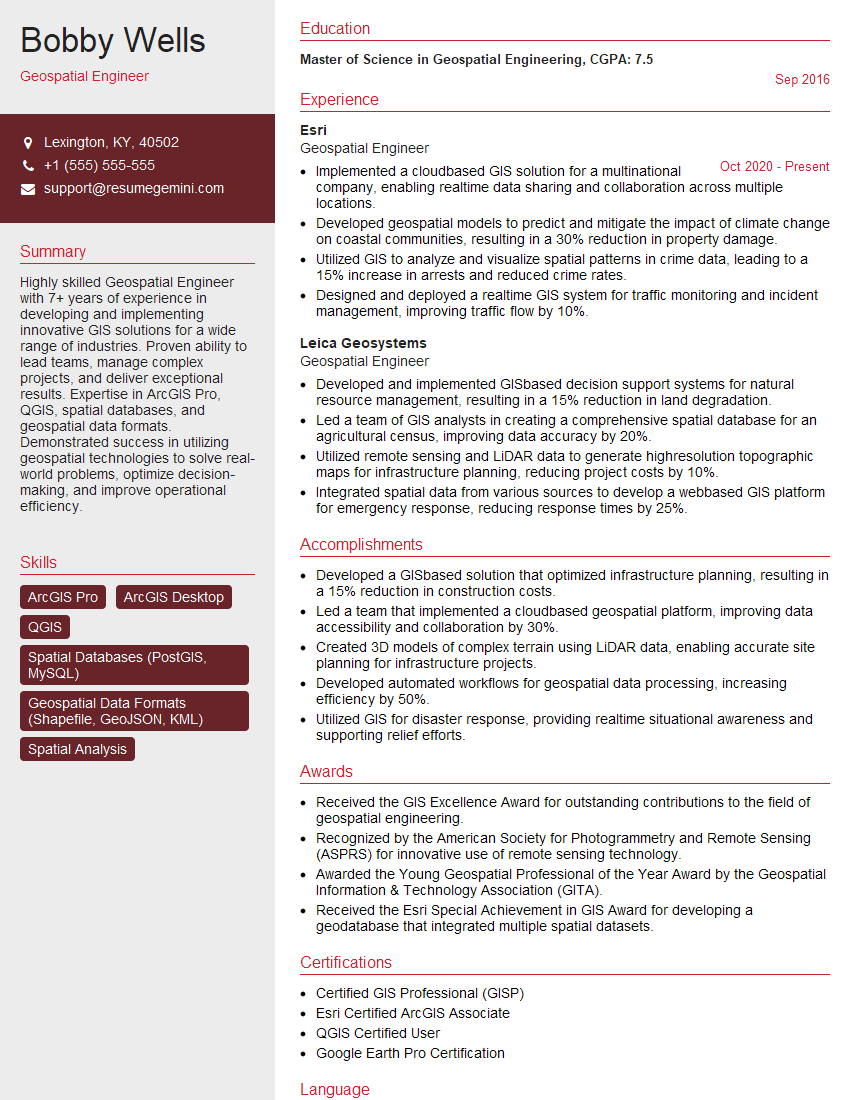
Geospatial Engineer Resume Sample

Cartographer Resume Sample

Surveyor Resume Sample

Land Surveyor Resume Sample
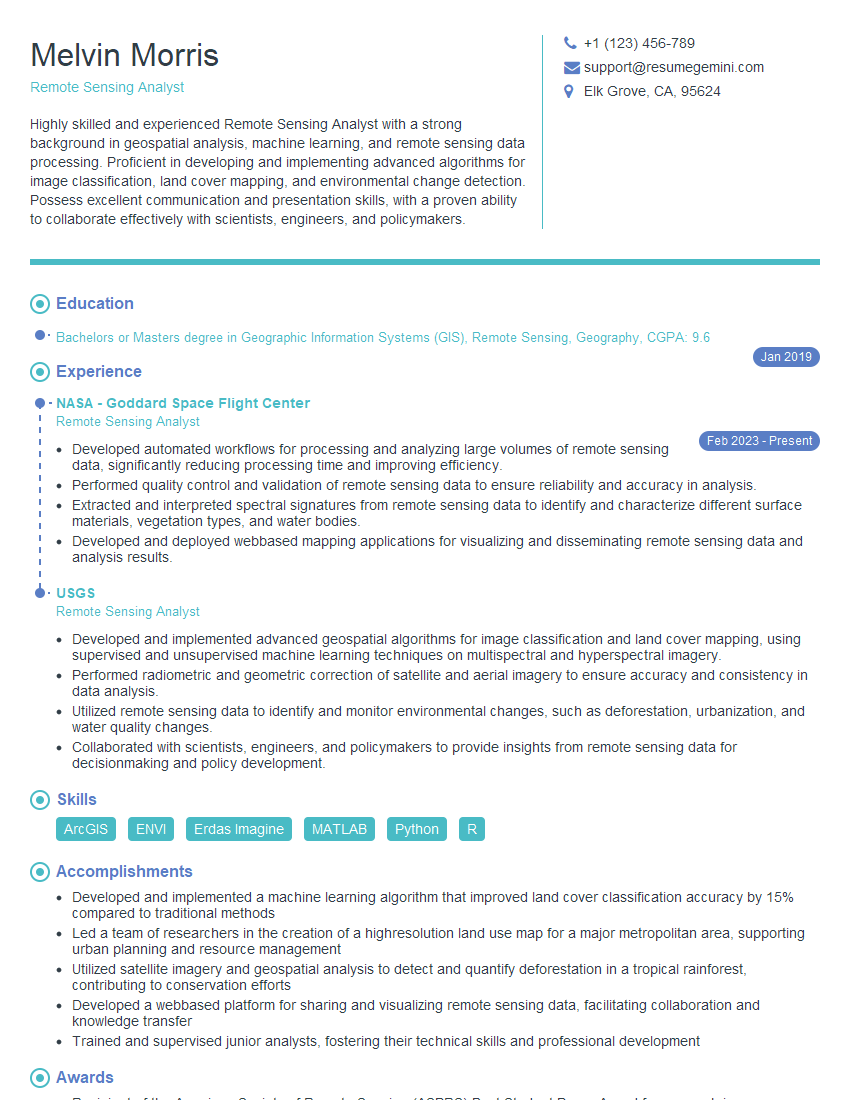
Remote Sensing Analyst Resume Sample

Remote Sensing Scientist Resume Sample
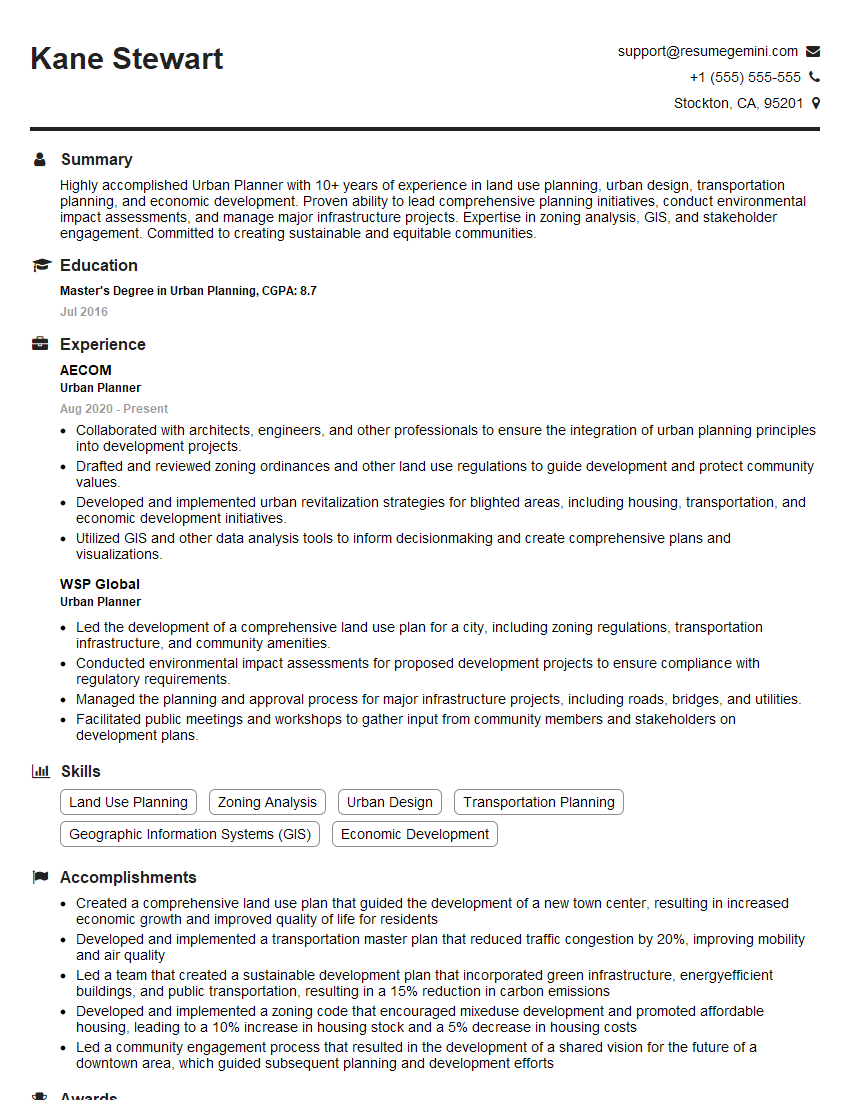
Urban Planner Resume Sample
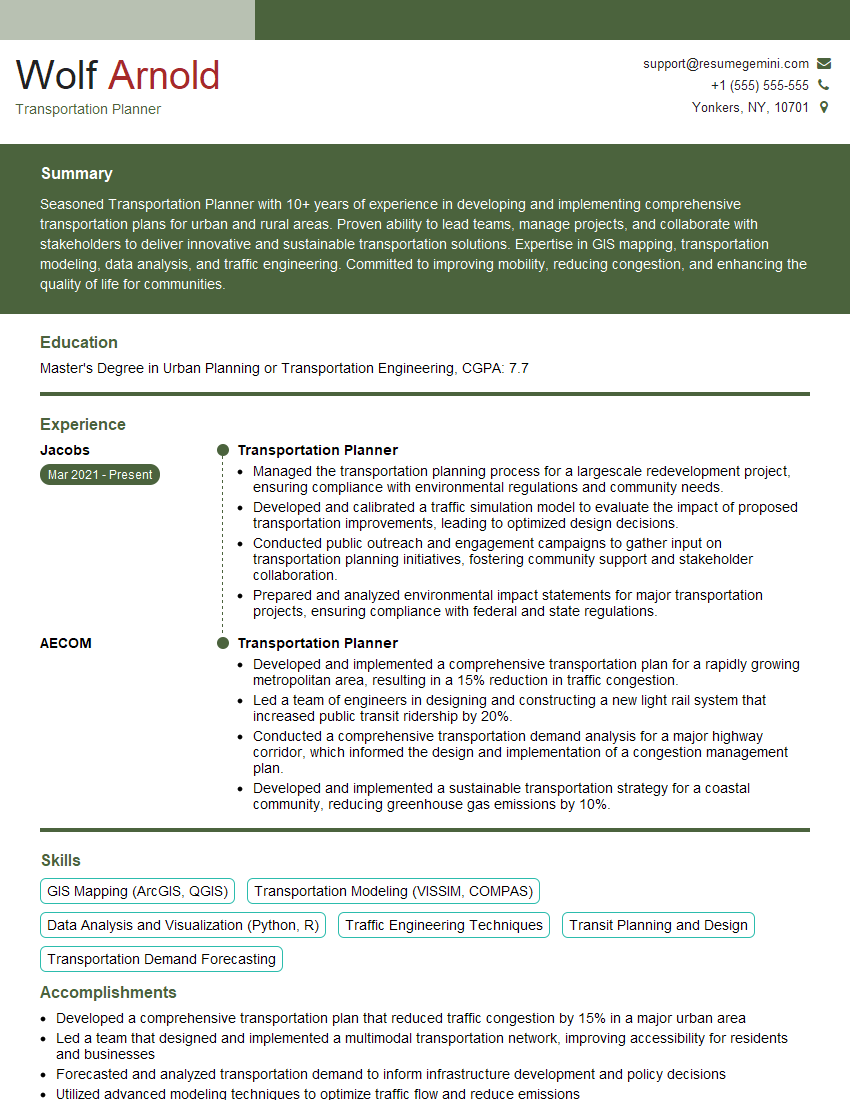
Transportation Planner Resume Sample

Precision Agriculture Specialist Resume Sample

3D Modeler Resume Sample
Explore more articles
Users Rating of Our Blogs
Share Your Experience
We value your feedback! Please rate our content and share your thoughts (optional).
What Readers Say About Our Blog
Really detailed insights and content, thank you for writing this detailed article.
IT gave me an insight and words to use and be able to think of examples