Are you ready to stand out in your next interview? Understanding and preparing for Geospatial Data Processing interview questions is a game-changer. In this blog, we’ve compiled key questions and expert advice to help you showcase your skills with confidence and precision. Let’s get started on your journey to acing the interview.
Questions Asked in Geospatial Data Processing Interview
Q 1. Explain the difference between vector and raster data.
Vector and raster data are two fundamental ways to represent geographic information in a computer. Think of it like this: vector data is like drawing a map with lines and points, while raster data is like taking a photograph of the map.
Vector Data: Represents geographic features as points, lines, and polygons. Each feature has precise coordinates and can store attributes (e.g., a point representing a city might have attributes like name, population, and elevation). Vector data is ideal for representing discrete features like roads, buildings, or boundaries. It’s generally smaller in file size and maintains high accuracy, especially when zooming in.
Raster Data: Represents geographic information as a grid of cells or pixels, each with a value representing a specific attribute (e.g., elevation, temperature, land cover). Raster data is better suited for continuous phenomena, like elevation or satellite imagery. While offering detailed views of surfaces, it can become very large and detailed, resulting in high file sizes and loss of precision when zooming in.
- Example Vector: A shapefile containing the outlines of countries.
- Example Raster: A GeoTIFF file of a satellite image showing land cover classification.
Q 2. Describe different coordinate reference systems (CRS) and their applications.
A Coordinate Reference System (CRS) defines how we locate points on the Earth’s surface. It’s essentially a set of rules that translates latitude and longitude coordinates into a usable system for maps and analysis. There are two main types:
- Geographic Coordinate Systems (GCS): Use latitude and longitude to define locations on a sphere or ellipsoid (a model of the Earth’s shape). WGS 84 is the most common GCS, used by GPS. It’s location-based, representing the earth’s curvature.
- Projected Coordinate Systems (PCS): Transform latitude and longitude from a 3D sphere to a 2D plane. This process inevitably introduces distortion. Various projections minimize distortion for specific purposes (e.g., preserving area, shape, or distance). Common examples include UTM (Universal Transverse Mercator), which divides the Earth into zones, minimizing distortion within each zone, and Albers Equal-Area Conic, useful for mapping large areas while preserving area accurately.
Applications:
- GCS: Global navigation, applications where spherical representation is essential (like earth models).
- PCS: Mapping and analysis requiring accurate distances, areas, or shapes in a particular region, like creating local city maps, cadastral mapping, or calculating areas of land parcels.
Q 3. What are the common file formats used in Geospatial Data Processing?
Many file formats are used in geospatial data processing, each with strengths and weaknesses:
- Shapefile (.shp): A widely used vector format. It’s actually a collection of files (.shp, .shx, .dbf, .prj) containing geometry, index, attributes, and projection information.
- GeoJSON (.geojson): A text-based vector format, popular for its simplicity and ease of use with web mapping applications and APIs.
- GeoTIFF (.tif, .tiff): A common raster format supporting georeferencing and various data types. It’s highly compatible with GIS software and handles large datasets well.
- KML (.kml): A keyhole markup language file type developed by Google Earth, used for creating and sharing 3D geospatial models, placemarks, and data.
- GRIB (.grib): Commonly used for meteorological data, it’s efficient for storing gridded data like weather forecasts.
Q 4. How do you handle spatial data projections and transformations?
Handling spatial data projections and transformations involves changing the CRS of a dataset. This is crucial for accurate analysis and visualization because computations (like distance calculations) are only accurate within a consistent CRS. GIS software and libraries provide tools to perform this using a variety of methods like datum transformations and reprojections.
Steps:
- Define the source and target CRS: Identify the current projection and the desired projection. This requires knowing the EPSG codes (e.g., EPSG:4326 for WGS 84).
- Select the appropriate transformation method: Consider the accuracy needed and the relationship between the source and target CRS. Some transformations are more accurate than others. This selection could be automatic or require manual selection based on data and knowledge of transformation methods.
- Perform the transformation: Most GIS software (like ArcGIS, QGIS) and programming libraries (like GDAL/OGR in Python) offer functions to directly reproject data. The process involves calculating the new coordinates based on mathematical equations defined by the transformation type.
- Verify the results: Check the transformed data to confirm it’s in the correct projection and that no significant distortion has been introduced.
Example (Conceptual Python with GDAL):
# Assuming 'input.shp' is in EPSG:4326 and 'output.shp' will be in EPSG:3857 import gdal # ... GDAL operations to open, reproject, and save the data ...Q 5. Explain the concept of georeferencing and its importance.
Georeferencing is the process of assigning geographic coordinates (latitude and longitude) to points on an image or map that doesn’t initially have them. Think of it like adding location information to a picture.
Importance: Georeferencing is essential for integrating datasets. Without it, you can’t overlay different data layers, perform spatial analysis, or accurately locate features. For instance, a scanned historical map might lack coordinates, but georeferencing using known control points (locations with known coordinates) allows its integration with modern GIS data.
Process:
- Identify control points: Find points common to both the image and a reference dataset (e.g., a map with known coordinates).
- Establish coordinate transformation: Use software to calculate a transformation that aligns the image to the reference data. This involves mathematical models (like affine transformations or polynomial transformations). The accuracy depends on the number and distribution of control points.
- Apply the transformation: Software transforms all pixels in the image to the new coordinate system.
- Evaluate accuracy: Assess the quality of the georeferencing using root mean square error (RMSE) values. Lower RMSE means better accuracy.
Q 6. What are the various spatial analysis techniques you are familiar with?
My experience encompasses a wide range of spatial analysis techniques including:
- Buffering: Creating zones around features (e.g., a buffer around a river to define a flood plain).
- Overlay analysis: Combining datasets to find spatial relationships (e.g., intersecting land use with soil types).
- Proximity analysis: Measuring distances and finding nearest neighbors (e.g., finding houses closest to a school).
- Network analysis: Analyzing movement along networks (e.g., finding the shortest route on a road network).
- Spatial interpolation: Estimating values at unsampled locations (e.g., estimating elevation between measured points).
- Density analysis: Calculating the density of points or features (e.g., population density).
- Spatial autocorrelation: Analyzing the spatial relationships between attributes (e.g., clustering of high-value properties).
Q 7. Describe your experience with spatial interpolation methods.
Spatial interpolation estimates values at unsampled locations based on known values at other locations. Think of it as filling in the gaps in a dataset.
I’m familiar with various methods, each with its own strengths and weaknesses:
- Inverse Distance Weighting (IDW): A simple method that weights values based on their distance from the estimation point. Closer points have a greater influence. It’s easy to understand but can be sensitive to outliers.
- Kriging: A more sophisticated geostatistical method that considers spatial autocorrelation. It models the spatial variability of the data to produce more accurate interpolations, but requires assumptions about data distributions.
- Spline interpolation: Creates a smooth surface that passes through or near the known points. It’s good for creating visually pleasing surfaces but may not accurately reflect the underlying spatial patterns.
The choice of method depends on the data characteristics, the desired accuracy, and the computational resources available. I’ve used these methods extensively for applications such as creating elevation models from point measurements, mapping pollution concentrations based on sampling locations, and predicting rainfall across a region.
Q 8. How do you handle spatial data errors and inaccuracies?
Handling spatial data errors and inaccuracies is crucial for reliable geospatial analysis. It’s like baking a cake – if your measurements are off, the final product won’t be right. We address these issues through a multi-pronged approach.
Data Source Evaluation: Before processing, I meticulously evaluate the source of the data. Knowing the acquisition method (GPS, surveying, remote sensing), accuracy specifications (e.g., RMSE), and potential biases is vital. For instance, data from a low-resolution satellite might be less accurate than data from high-precision LiDAR.
Data Cleaning: This involves identifying and correcting obvious errors. This can include removing duplicate points, fixing topological inconsistencies (e.g., overlapping polygons), and smoothing noisy data. For example, I might use spatial filters to smooth out noisy elevation data from LiDAR.
Spatial Error Propagation Analysis: I account for the accumulation of errors throughout the processing chain. This involves understanding how errors in the input data can affect the results of spatial analysis. For example, small errors in the locations of polygons can lead to significant inaccuracies when calculating areas or overlaps.
Uncertainty Modeling: To quantify the uncertainty in my results, I often incorporate techniques like buffer zones around point features or probability surfaces. This allows for a more realistic representation of the results and avoids overconfidence in precise numbers.
Quality Control Checks: Throughout the process, I employ various quality control checks. This can involve visual inspection of maps, statistical analysis of data, and comparisons against other known accurate datasets. For instance, I might compare my processed elevation data to existing elevation models from a reliable source to detect discrepancies.
Q 9. Explain your understanding of topology and its use in GIS.
Topology in GIS refers to the spatial relationships between geographic features. Think of it as the ‘rules’ that govern how features interact with each other. It’s fundamental for ensuring data integrity and enabling sophisticated spatial analysis.
Types of Topological Relationships: These include adjacency (which features are next to each other), connectivity (how features are connected), and containment (which features are inside other features). For example, knowing that a road is adjacent to a building helps with analysis of proximity.
Importance in GIS: Topology ensures data consistency. For instance, it prevents gaps or overlaps between polygons representing land parcels, guaranteeing that the area calculations are accurate. It also facilitates network analysis, allowing us to model the flow of traffic or utilities through a connected network.
Practical Applications: Topological relationships are used in many applications, including utility network management (modeling water pipes, electricity grids), transportation planning (route optimization), and environmental modeling (tracking the spread of pollutants).
Implementation: Topology is implemented through topological data models within GIS software. These models define rules and constraints that ensure data integrity and facilitate advanced spatial analysis functionalities.
Q 10. Describe your experience with different GIS software (e.g., ArcGIS, QGIS).
I have extensive experience with both ArcGIS and QGIS, two leading GIS software packages. My choice depends on the project’s scope and requirements.
ArcGIS: ArcGIS is a robust, commercially licensed software with advanced geoprocessing tools and a comprehensive suite of extensions. Its strong data management capabilities are well-suited for large-scale projects with complex datasets. I’ve utilized it extensively for tasks involving spatial analysis, data modeling, and map production in various professional settings.
QGIS: QGIS is an open-source, free alternative that offers many comparable functionalities to ArcGIS. Its affordability makes it ideal for educational purposes, personal projects, or situations with limited budget. I’ve found it particularly useful for quick data exploration, visualization, and prototyping before committing to a larger project in ArcGIS. Its plugin ecosystem provides a wealth of added functionality.
Example: Recently, I used ArcGIS Pro to perform a detailed land-use change analysis over a large region using high-resolution imagery. For a smaller, exploratory project involving a shapefile, QGIS was more efficient.
Q 11. How do you perform spatial joins and overlays?
Spatial joins and overlays are fundamental geoprocessing operations used to combine data from different spatial datasets. Think of them as merging information based on location.
Spatial Join: This operation adds attributes from one feature class to another based on spatial relationships. For example, I might join census data (attributes) to polygons representing neighborhoods (geometry). The join could be based on containment (census block within neighborhood) or proximity (nearest census block to a point).
Spatial Overlay: This integrates the geometries of multiple layers. There are various types:
- Intersect: Creates a new feature class containing only the overlapping areas from the input layers. This is useful for finding the areas where land-use categories overlap.
- Union: Combines all features from input layers. This is ideal for creating a complete coverage of all features.
- Erase: Removes features from one layer that overlap with another. Useful for excluding a portion of a dataset based on its interaction with another.
- Clip: Extracts the portion of a layer that falls within the extent of another. This is useful for focusing on a specific area of interest.
Example: In a project assessing flood risk, I would perform a spatial overlay (intersect) between a flood inundation map and a layer of building footprints to identify buildings at risk.
Software Implementation: Both spatial joins and overlays are easily implemented within ArcGIS, QGIS, and other GIS software packages using their respective geoprocessing tools.
Q 12. Explain your experience with spatial queries and database management.
Spatial queries and database management are essential for efficiently accessing and manipulating geospatial data. It’s like having a well-organized library where you can quickly find the book (data) you need.
Spatial Queries: These retrieve data based on location or spatial relationships. Examples include finding all points within a certain distance from a line (e.g., houses within 1km of a river) or selecting polygons that intersect a specific polygon (e.g., finding parcels within a designated conservation zone).
SQL and Spatial SQL: Spatial queries are often performed using Structured Query Language (SQL) and extensions for spatial data (Spatial SQL). This allows powerful and flexible data retrieval within a database management system (DBMS).
Database Management Systems (DBMS): PostGIS (for PostgreSQL), Oracle Spatial, and SQL Server are examples of DBMSs specifically designed to handle geospatial data. They ensure data integrity, efficient storage, and fast retrieval of large spatial datasets.
Example: In a project on wildlife tracking, I used spatial queries to find all animal sightings within a specific habitat type within a specified time period using PostGIS.
Q 13. Describe your understanding of remote sensing and its applications.
Remote sensing involves acquiring information about the Earth’s surface without physical contact. Imagine having a bird’s-eye view that provides detailed information. It’s a powerful tool for a wide range of applications.
Data Sources: Remote sensing data comes from various sources, including satellites (Landsat, Sentinel), airborne sensors (LiDAR, aerial photography), and drones.
Data Types: The data can be imagery (visible, infrared, multispectral), elevation data (LiDAR), or other sensor measurements.
Applications: Remote sensing is used in many fields, including:
- Environmental Monitoring: Tracking deforestation, monitoring pollution, assessing drought conditions.
- Urban Planning: Mapping urban sprawl, assessing infrastructure development.
- Agriculture: Monitoring crop health, estimating yields.
- Disaster Response: Assessing damage after natural disasters.
Data Processing: This involves geometric corrections (removing distortions), atmospheric corrections (accounting for atmospheric effects), and image classification (assigning categories to pixels based on spectral values).
Q 14. How do you process and analyze LiDAR data?
Processing and analyzing LiDAR data involves several steps, transforming raw point clouds into valuable spatial information. Think of it like assembling a 3D puzzle to reveal a detailed terrain model.
Data Acquisition: LiDAR data is acquired by airborne sensors that emit laser pulses and measure the time it takes for the pulses to return to the sensor. This gives precise 3D coordinates (X, Y, Z) for millions of points.
Data Pre-processing: This involves removing noise, outliers, and classifying the points into different classes (ground, vegetation, buildings). This stage is crucial for data quality.
Data Processing: This includes generating digital elevation models (DEMs), digital surface models (DSMs), and other derived products like slope, aspect, and hillshade. These products provide valuable insights into terrain characteristics.
Data Analysis: The processed data is used for various applications like:
- Terrain Modeling: Creating accurate 3D models of the terrain.
- Hydrological Modeling: Analyzing drainage patterns, identifying floodplains.
- Forestry: Estimating tree heights and biomass.
- Engineering: Planning infrastructure projects, designing roads.
Software: Software packages like ArcGIS, QGIS, and specialized LiDAR processing software are used for this purpose. The choice of software often depends on specific needs and experience.
Q 15. What is your experience with GPS data acquisition and processing?
My experience with GPS data acquisition and processing spans several years and diverse projects. I’m proficient in using various GPS receivers, from handheld units to high-precision geodetic receivers. Data acquisition involves understanding the nuances of different GPS constellations (GPS, GLONASS, Galileo, BeiDou), selecting appropriate sampling rates and settings based on the project’s accuracy requirements, and implementing quality control measures to minimize errors. Post-acquisition, I’m adept at processing raw GPS data using software such as RTKLib, Teledyne, or Trimble Business Center. This involves tasks like differential correction (using base station data or online services like CORS), coordinate transformations, and error analysis to ensure the positional accuracy meets the project’s specifications. For instance, in a recent project involving precision agriculture, I used RTK-GPS to create highly accurate field maps for variable-rate fertilization, achieving centimeter-level accuracy. This significantly improved the efficiency of fertilizer application and minimized waste.
Career Expert Tips:
- Ace those interviews! Prepare effectively by reviewing the Top 50 Most Common Interview Questions on ResumeGemini.
- Navigate your job search with confidence! Explore a wide range of Career Tips on ResumeGemini. Learn about common challenges and recommendations to overcome them.
- Craft the perfect resume! Master the Art of Resume Writing with ResumeGemini’s guide. Showcase your unique qualifications and achievements effectively.
- Don’t miss out on holiday savings! Build your dream resume with ResumeGemini’s ATS optimized templates.
Q 16. Explain your understanding of map projections and their limitations.
Map projections are methods of transforming the three-dimensional surface of the Earth onto a two-dimensional plane. This inherently involves distortion because it’s impossible to perfectly represent a sphere on a flat surface without some degree of compromise. Different projections minimize different types of distortion, making some better suited for certain applications than others. For example, the Mercator projection is well-known for preserving direction and shape locally but severely distorts areas at higher latitudes – Greenland appears much larger than it is in reality. Equidistant projections preserve distance from a central point, while equal-area projections accurately represent the relative sizes of areas. The choice of projection depends critically on the application. A navigation system might benefit from a projection that preserves direction, while a thematic map showing population density would require an equal-area projection. The limitations arise from the inherent impossibility of perfectly representing the Earth’s curved surface on a flat map; understanding these distortions is crucial for accurate interpretation of geospatial data.
Q 17. Describe your experience with geostatistics and spatial modeling.
My experience with geostatistics and spatial modeling involves applying statistical methods to analyze spatially referenced data. I’m familiar with techniques like kriging (ordinary, universal, and indicator) for interpolation and prediction of spatially continuous variables, such as soil properties or pollution levels. I also use geostatistical tools to assess spatial autocorrelation and model spatial dependencies. Furthermore, I have experience with spatial point pattern analysis, employing techniques like Ripley’s K-function to analyze the distribution of points and identify clustering or dispersion patterns. This expertise extends to spatial regression models, which account for spatial autocorrelation in the error terms, preventing biased estimates. For instance, in a project involving groundwater contamination, I used kriging to interpolate contaminant concentrations across the study area and subsequently used spatial regression to identify influential factors contributing to contamination, enabling more effective remediation strategies.
Q 18. How do you handle large geospatial datasets?
Handling large geospatial datasets necessitates efficient strategies. This often begins with data pre-processing to reduce file size, involving techniques like raster compression, feature simplification, and attribute data reduction. I utilize database management systems (DBMS) like PostGIS (extending PostgreSQL) or spatial databases like ArcGIS Enterprise for efficient storage and retrieval of massive datasets. These systems allow for spatial queries and analyses without needing to load the entire dataset into memory. Furthermore, I leverage parallel processing capabilities and cloud computing platforms (like AWS or Google Cloud) to distribute computationally intensive tasks, significantly reducing processing time. Geoprocessing tools, like GDAL/OGR, provide command-line interface capabilities for automating batch processing of large datasets. Using these techniques allows me to manage and analyze datasets that would otherwise be unmanageable.
Q 19. What are your experience with data visualization techniques in GIS?
Data visualization in GIS is crucial for communicating spatial information effectively. My experience encompasses a range of techniques, from creating simple thematic maps using color ramps and graduated symbols to sophisticated 3D visualizations and interactive web maps. I’m proficient in using GIS software like ArcGIS Pro and QGIS, and also have experience with web mapping libraries like Leaflet and OpenLayers to create dynamic and interactive web maps. For instance, I’ve used choropleth maps to show the distribution of a disease across a region, and 3D terrain models to visualize elevation changes over time, incorporating animations to clearly communicate trends. Choosing appropriate visualization methods depends on the type of data and the message to be conveyed. The goal is always clear, concise, and accessible communication of spatial information.
Q 20. Describe your approach to solving a geospatial problem.
My approach to solving a geospatial problem is systematic and iterative. It begins with a thorough understanding of the problem’s context, including the goals, available data, and limitations. I then proceed with the following steps:
- Data Acquisition and Assessment: Identifying and acquiring relevant data sources, evaluating their quality, accuracy, and completeness.
- Data Preprocessing and Cleaning: Transforming and cleaning the data to ensure consistency and accuracy. This might involve coordinate transformations, error correction, and data integration.
- Spatial Analysis: Applying appropriate spatial analytical techniques to address the specific problem. This could include interpolation, overlay analysis, network analysis, or spatial statistics.
- Modeling and Simulation (if necessary): Developing spatial models to simulate processes or predict future outcomes.
- Visualization and Interpretation: Creating informative visualizations to communicate results effectively and drawing meaningful conclusions.
- Validation and Verification: Assessing the accuracy and reliability of the results.
Q 21. Explain your knowledge of spatial indexing and optimization techniques.
Spatial indexing is crucial for efficient spatial query processing in large datasets. It involves creating data structures that allow for quick location of spatial objects based on their spatial properties. Common indexing methods include R-trees, quadtrees, and grid-based indexes. R-trees, for example, organize spatial objects into a hierarchical tree structure, allowing for efficient searches based on spatial relationships (e.g., finding all points within a certain radius). Optimization techniques further enhance performance. This can involve query optimization strategies (choosing the most efficient way to execute a query), data partitioning (dividing the data into smaller, manageable chunks), and utilizing parallel processing to distribute the computational load. For example, when working with a large point dataset, using an R-tree index significantly speeds up queries to find nearby points compared to a linear scan of the entire dataset. Similarly, partitioning a large raster dataset can greatly improve the speed of zonal statistics calculations.
Q 22. How do you ensure data quality and accuracy in Geospatial projects?
Ensuring data quality and accuracy in geospatial projects is paramount. It’s like building a house – a shaky foundation leads to a crumbling structure. We employ a multi-faceted approach, starting with data acquisition and continuing throughout the entire processing pipeline.
Source Evaluation: We meticulously assess the reliability and accuracy of source data. This includes examining metadata, understanding data collection methodologies (e.g., GPS accuracy, sensor resolution), and checking for known errors or biases. For instance, satellite imagery from different sources might have varying resolutions and spectral ranges, affecting the accuracy of land cover classification.
Data Cleaning and Preprocessing: This stage involves identifying and correcting errors, inconsistencies, and outliers. Techniques include spatial and attribute data cleaning, such as removing duplicate points, smoothing noisy lines, and handling missing values using interpolation or imputation methods. Imagine cleaning a messy dataset of street addresses – you need to correct misspellings, standardize formats, and resolve ambiguities.
Data Validation and Quality Control (QC): We implement rigorous QC checks at each stage. This might involve visual inspection using GIS software, statistical analysis to detect anomalies, and comparison against known ground truth data. A simple example is validating a digitized river network against a high-resolution aerial photograph.
Metadata Management: Comprehensive metadata documentation is crucial. This provides traceability and transparency, enabling future users to understand the data’s origin, processing steps, limitations, and potential errors. It’s like adding detailed instructions to a recipe, ensuring others can replicate your work.
Data Transformation and Projection: Ensuring consistent coordinate systems and projections is vital for accurate spatial analysis. Transforming data to a suitable projection (like UTM or Web Mercator) minimizes distortion and allows for accurate measurements and calculations. Failing to do this is akin to using different rulers to measure the same distance.
Q 23. Discuss your experience with version control for geospatial data.
Version control is essential for managing geospatial data, especially in collaborative projects. It’s like keeping a detailed history of architectural plans for a building – allowing us to revert to previous versions, track changes, and avoid conflicts. I’ve extensively used Git, often in conjunction with a cloud-based repository like GitHub or GitLab.
Repository Structure: I organize my repositories using a structured approach, separating raw data, processed data, scripts, and documentation into distinct folders. This ensures clarity and maintainability.
Branching and Merging: I utilize branching to isolate changes and prevent conflicts when multiple team members work on the same project. Merging allows us to integrate changes in a controlled manner.
Commit Messages: I write clear and concise commit messages detailing the changes made in each commit. This makes it easy to track progress and understand the evolution of the data. A good example would be ‘Updated road network with 2023 data from Open Street Map’.
Large File Storage: For managing large geospatial datasets, I often integrate Git with a large file storage system (like Git LFS) to efficiently store and manage versions of large files without bloating the repository.
This approach helps to prevent data loss, track changes, and facilitates collaboration in a highly efficient way. I’ve personally used this strategy on numerous projects involving extensive raster and vector data, avoiding significant headaches that would inevitably arise from poor version control.
Q 24. What are some common challenges faced in geospatial data processing?
Geospatial data processing presents unique challenges. They are not just technical, but also involve data quality, human factors, and computational constraints.
Data Heterogeneity: Integrating data from various sources with different formats, projections, and accuracy levels poses a significant challenge. Imagine trying to fit together puzzle pieces of different sizes and shapes.
Data Volume and Velocity: Processing massive datasets, such as satellite imagery or global elevation models, requires significant computational resources and efficient algorithms. This is like trying to process a massive database of all the street addresses in the world.
Spatial Errors and Uncertainties: Inherent uncertainties in data acquisition and processing (like GPS inaccuracies) need careful consideration and mitigation. These errors can propagate through analyses and affect results.
Data Sparsity and Missing Data: Dealing with missing or incomplete data requires careful imputation strategies to ensure the reliability of analyses. This is akin to having gaps in a map and needing to fill them logically.
Coordinate System Transformations: Converting data between different coordinate reference systems is crucial but can be complex, especially with non-linear transformations. This is similar to converting measurements between different units.
Q 25. How do you stay up-to-date with the latest advancements in GIS?
Staying current in GIS is essential. It’s a dynamic field with rapid advancements. My strategy involves a multi-pronged approach:
Conferences and Workshops: Attending conferences like Esri UC or GeoSpatial World provides exposure to the latest tools, techniques, and research.
Online Courses and Webinars: Platforms like Coursera, edX, and various vendor-specific training resources offer valuable learning opportunities.
Professional Networks: Engaging with online communities (like GIS Stack Exchange) and attending local user groups provides exposure to practical experiences and expert advice.
Academic Journals and Publications: Reading research papers from journals like the International Journal of Geographical Information Science keeps me abreast of cutting-edge advancements.
Industry Blogs and Newsletters: Regularly following industry blogs and newsletters from major GIS software vendors and research institutions helps to identify emerging trends.
Q 26. Describe your experience working with cloud-based GIS platforms.
I have extensive experience with cloud-based GIS platforms, primarily AWS and Google Cloud Platform (GCP). These platforms offer scalability and cost-effectiveness, particularly when handling large datasets or computationally intensive tasks. I’ve used them for:
Geoprocessing: Utilizing cloud-based processing services like AWS Lambda or Google Cloud Functions for automating geospatial analyses.
Data Storage and Management: Storing and managing large geospatial datasets using cloud storage services like Amazon S3 or Google Cloud Storage.
Web GIS Development: Deploying and managing web mapping applications on cloud platforms using services like AWS Elastic Beanstalk or Google App Engine.
Big Data Processing: Processing massive datasets using cloud-based big data platforms like Amazon EMR or Google Dataproc to perform advanced spatial analyses.
For example, in a recent project, we used Google Earth Engine to process terabytes of satellite imagery for land cover change detection. The scalability and computational power of the platform made the analysis feasible.
Q 27. Explain your experience with Python libraries for geospatial analysis (e.g., GDAL, GeoPandas).
Python is my primary scripting language for geospatial analysis. I’m proficient in GDAL and GeoPandas, two powerful libraries.
GDAL (Geospatial Data Abstraction Library): GDAL is a core component of my workflow for reading, writing, and manipulating various geospatial data formats (raster and vector). I use it for tasks such as:
import gdaldataset = gdal.Open('my_raster.tif')band = dataset.GetRasterBand(1)
This snippet shows opening a GeoTIFF file and accessing the first band. I’ve used GDAL for everything from reprojection and raster mosaicking to creating custom geospatial processing workflows.
GeoPandas: This library builds on Pandas and Shapely, providing powerful tools for working with vector data in Python. It simplifies tasks like spatial joins, geometric calculations, and data manipulation.
import geopandas as gpdgdf = gpd.read_file('my_shapefile.shp')gdf['area'] = gdf.geometry.area
This code reads a shapefile, calculates the area of each polygon, and adds it as a new column. I’ve used GeoPandas extensively for analyzing spatial relationships, creating maps, and conducting spatial statistical analyses.
Key Topics to Learn for Geospatial Data Processing Interview
- Data Acquisition and Formats: Understanding various data sources (e.g., LiDAR, satellite imagery, GPS), their characteristics, and common file formats (shapefiles, GeoTIFF, GeoJSON) is crucial. Be prepared to discuss the strengths and weaknesses of each.
- Data Preprocessing and Cleaning: This involves techniques like georeferencing, projection transformations, data cleaning (handling missing values, outliers), and error correction. Expect questions about your experience with specific tools and workflows.
- Spatial Analysis Techniques: Master core techniques such as buffer analysis, overlay analysis (union, intersection, difference), spatial interpolation, and proximity analysis. Be ready to discuss practical applications of these methods in different contexts.
- Geospatial Databases and Data Management: Familiarity with spatial databases (PostGIS, Oracle Spatial) and best practices for managing and querying geospatial data is essential. Understanding database design principles related to spatial data is highly beneficial.
- Data Visualization and Cartography: You should be comfortable discussing different map projections, symbolization techniques, and the creation of effective and informative maps using GIS software (ArcGIS, QGIS). Think about the principles of good map design.
- Remote Sensing Principles: A basic understanding of remote sensing concepts, including spectral signatures, image classification, and change detection, will be valuable, particularly if the role involves satellite imagery analysis.
- Programming and Scripting for Geospatial Data Processing: Proficiency in Python with relevant libraries (e.g., GDAL, GeoPandas) is highly sought after. Be ready to discuss your experience with automating geospatial tasks and processing large datasets.
- Spatial Statistics and Modeling: Depending on the role, you might be asked about spatial autocorrelation, spatial regression models, or other spatial statistical methods. Understanding the underlying concepts is key.
Next Steps
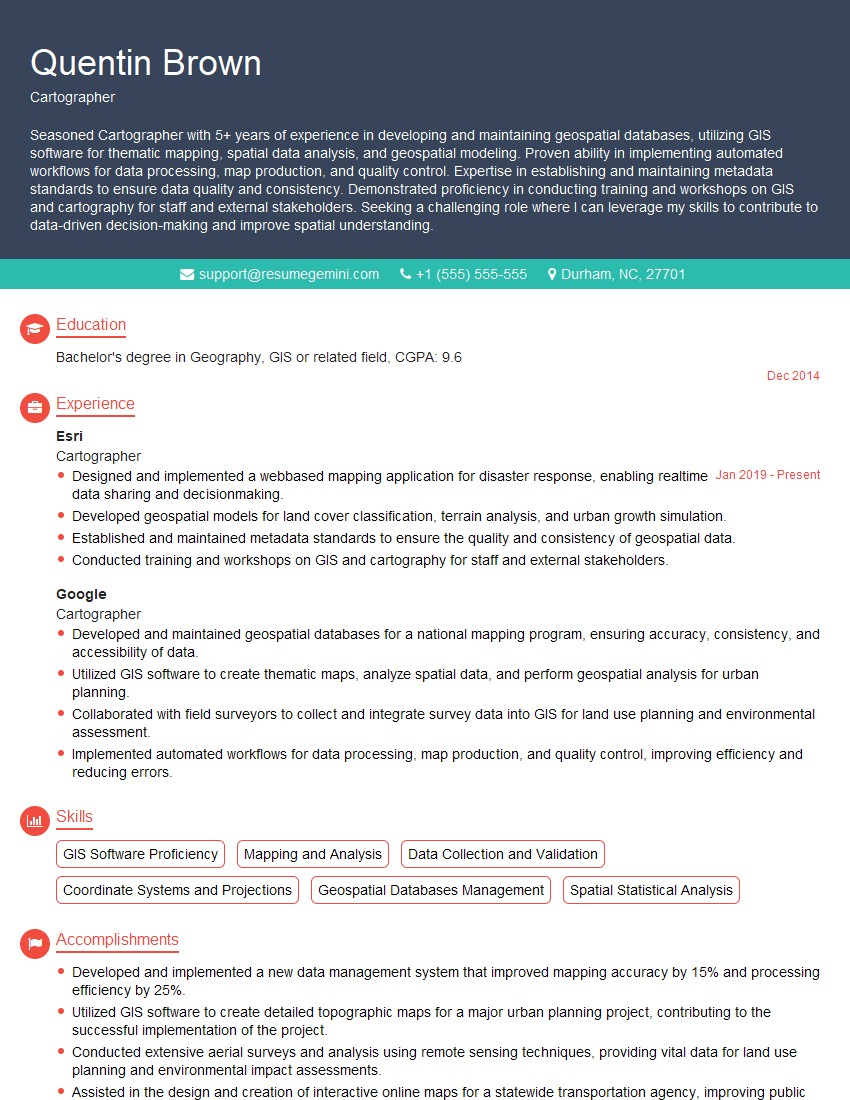
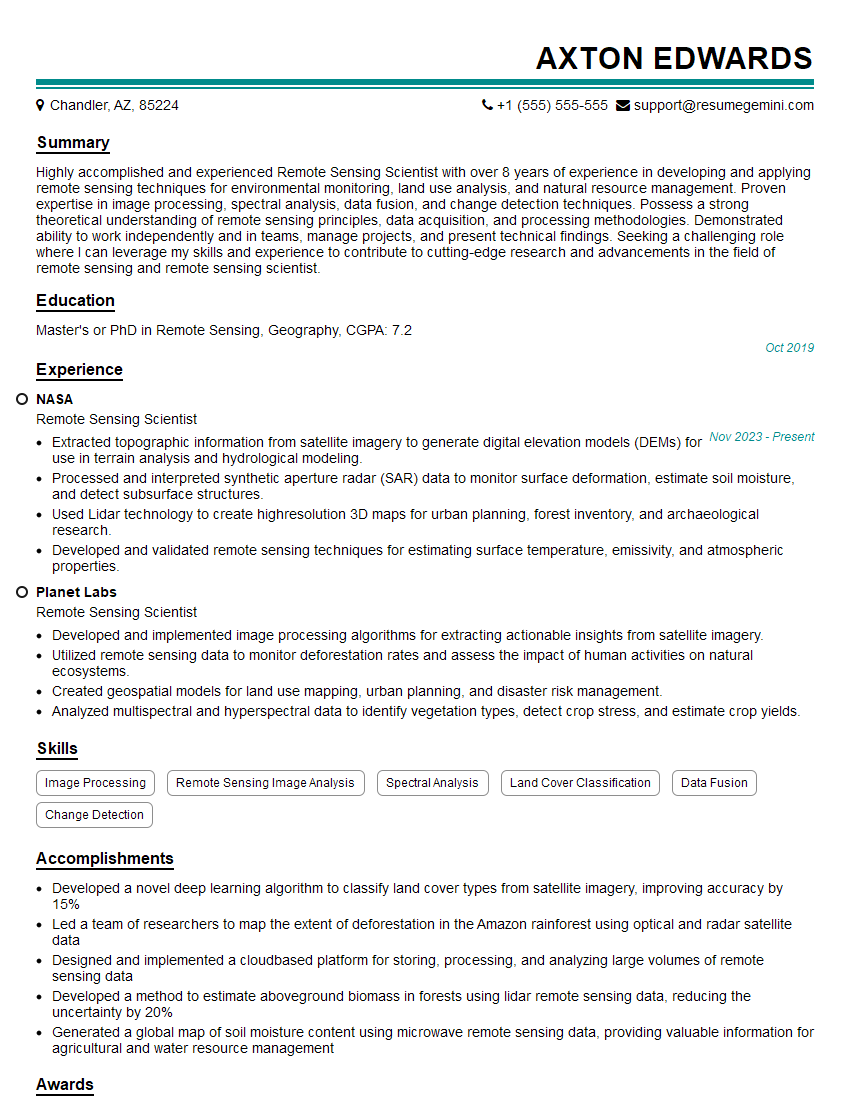
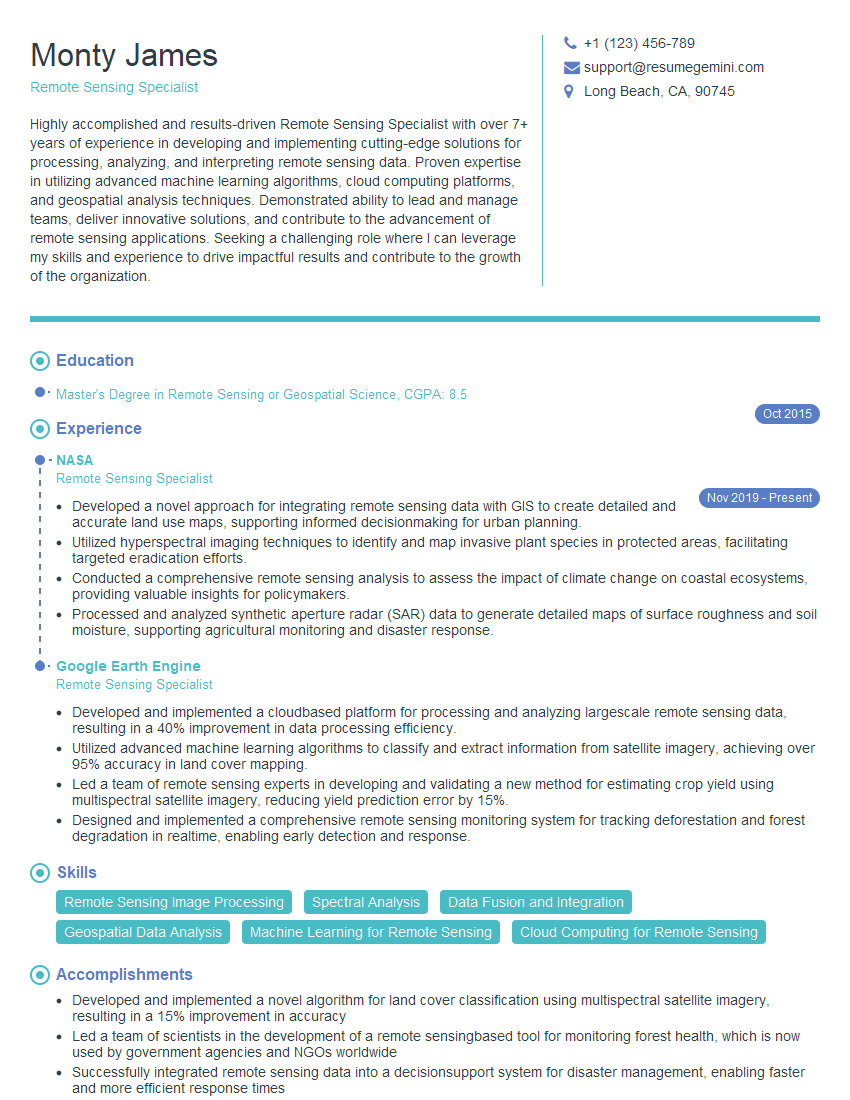
Mastering geospatial data processing opens doors to exciting and impactful careers in various sectors. To maximize your job prospects, invest time in creating a strong, ATS-friendly resume that highlights your skills and experience effectively. ResumeGemini is a trusted resource to help you build a professional and compelling resume. They provide examples of resumes tailored to Geospatial Data Processing to help you get started. Take the next step towards your dream career today!

Explore more articles
Users Rating of Our Blogs
Share Your Experience
We value your feedback! Please rate our content and share your thoughts (optional).
What Readers Say About Our Blog
Really detailed insights and content, thank you for writing this detailed article.
IT gave me an insight and words to use and be able to think of examples