Feeling uncertain about what to expect in your upcoming interview? We’ve got you covered! This blog highlights the most important Glass and Mirror Inspection interview questions and provides actionable advice to help you stand out as the ideal candidate. Let’s pave the way for your success.
Questions Asked in Glass and Mirror Inspection Interview
Q 1. Describe your experience with different types of glass (e.g., tempered, laminated, float).
My experience encompasses a wide range of glass types, each with unique properties and inspection requirements. Float glass, the most common type, is known for its flatness and is used extensively in windows and mirrors. Its inspection focuses on surface imperfections and thickness consistency. Tempered glass, strengthened through a heat-treating process, is crucial in automotive and safety applications. Inspecting tempered glass requires careful attention to potential stress fractures or spontaneous breakage points, often requiring specialized equipment. Lastly, laminated glass, consisting of multiple layers bonded together, offers enhanced safety features. Inspection of laminated glass is centered on detecting delamination (separation of layers), which could weaken the structure. I’ve worked with all three extensively, tailoring my inspection techniques to the specific properties and intended use of each type.
Q 2. Explain the process of visually inspecting glass for defects.
Visual inspection of glass is a meticulous process that requires keen observation and attention to detail. It typically begins with a thorough examination of the entire surface under various lighting conditions. I use both ambient light and direct, focused light sources to highlight even minor defects. The inspection angle is crucial; I often view the glass from different perspectives, including glancing angles, to catch surface imperfections that might be missed otherwise. This process helps identify any irregularities, such as scratches, chips, bubbles, or inclusions early on. I always document my findings with detailed notes and photographic evidence for clarity.
Q 3. What are the common defects found in glass and mirrors?
Common defects in glass and mirrors vary depending on the manufacturing process and type of glass. Scratches and chips are prevalent surface imperfections, often caused by handling or during production. Bubbles or inclusions (tiny air pockets or foreign particles trapped within the glass) can affect clarity and optical properties. Stone inclusions, often appearing as small opaque spots, are a common defect. Stress fractures, particularly common in tempered glass, can compromise its strength and safety. In mirrors, silvering defects like discoloration, peeling, or pitting, are significant concerns, indicating failure of the reflective coating. Wave distortion can create ripples and affect the mirror’s image quality. Each defect has implications for the glass or mirror’s functionality and safety.
Q 4. How do you measure the thickness and clarity of glass?
Measuring glass thickness and clarity involves using a combination of tools and techniques. Thickness is commonly measured using a micrometer or a digital caliper, ensuring accuracy and precision. For consistent results, multiple measurements are taken at different locations on the glass pane. Clarity, often related to light transmission, is assessed using different methods. Visual inspection can provide a preliminary assessment of clarity, but more precise measurements are achieved using specialized instruments, such as a spectrophotometer or a haze meter, which quantifies the amount of light scattered by the glass.
Q 5. What tools and equipment are used in glass and mirror inspection?
My toolkit for glass and mirror inspection includes a variety of instruments designed for different purposes. Micrometers and calipers are essential for precise thickness measurements. A magnifying glass or a microscope allows detailed observation of surface imperfections. Optical measuring instruments such as interferometers provide advanced analysis of surface flatness and defects. Light sources including both bright, directional lights and diffuse ambient light help to detect subtle variations in clarity and highlight scratches or other defects. Digital cameras and recording devices are also used for detailed documentation of findings. Finally, specialized tools may be used depending on the type of glass, such as stress testers for tempered glass.
Q 6. How do you identify scratches, chips, and other surface imperfections?
Identifying scratches, chips, and other surface imperfections requires a combination of visual inspection and appropriate tools. Scratches often appear as linear marks on the glass surface, varying in depth and width. Chips are more localized breaks or damage to the glass, potentially resulting from impact. Using a magnifying glass or microscope can help in assessing the severity and type of these defects. Lighting plays a key role – employing various angles and intensities can reveal even fine scratches that might be otherwise invisible. I also use my knowledge of defect formation to understand their origin and severity, which informs whether the defect is acceptable or warrants rejection.
Q 7. Describe your experience with using optical measuring instruments.
My experience with optical measuring instruments is extensive. I am proficient in using interferometers to measure the flatness and surface quality of glass with high precision. These instruments use interference patterns of light to detect even minute deviations from a perfectly flat surface. I also have experience using spectrophotometers to analyze the transmission and reflection properties of glass, which is important for evaluating optical quality and determining the presence of defects that affect light passage. This expertise allows for quantitative analysis that complements the visual assessment and ensures that inspections are not only thorough but also backed by precise data.
Q 8. How do you document inspection findings?
Documenting inspection findings is crucial for maintaining quality control and traceability. My approach involves a multi-step process. First, I use a standardized inspection checklist to ensure consistency and thoroughness. This checklist covers all aspects, from visual checks for scratches and chips to dimensional measurements and optical clarity assessments. Second, I record all findings directly onto a digital inspection report, using specific terminology and precise measurements. For example, if a mirror shows a 2mm scratch, I document it as such, including the location (e.g., ‘2mm scratch located 5cm from the top edge, 10cm from the left edge’). I include photos or videos for visual evidence of any defects. Finally, the report is reviewed by a supervisor for quality assurance, before being archived for future reference, ensuring full traceability. This systematic approach leaves no room for misinterpretation and facilitates efficient problem-solving and corrective action.
Q 9. What are the safety precautions you take during glass and mirror inspection?
Safety is paramount in glass and mirror inspection. We always wear safety glasses to protect our eyes from flying debris during handling or breakage. When inspecting large sheets of glass, I use appropriate lifting equipment to avoid strain and potential injury. Work areas are kept clean and free of obstructions to minimize tripping hazards. Proper handling techniques are crucial – we avoid sharp edges and always support the weight of the glass appropriately. Additionally, we never rush the process; a calm and methodical approach is essential to prevent accidents. In case of broken glass, the area is cordoned off immediately and cleanup procedures followed diligently, prioritizing safety. Furthermore, we undergo regular safety training to ensure everyone is updated on best practices and aware of potential hazards. For example, we have specific training on safe handling of different glass types and thickness.
Q 10. How do you handle non-conforming products?
Non-conforming products are handled according to a predefined procedure. First, the defect is clearly documented, including its type, severity, and location. Photographs are taken as evidence. Then, the product is segregated from conforming products to prevent accidental use or shipment. The next step involves determining the root cause of the defect. This could involve analyzing the production process or inspecting the raw materials. Based on the root cause analysis, the product is either repaired (if feasible and cost-effective), rejected, or downgraded to a lower grade. If rejected, a detailed report is generated documenting the reason for rejection and its disposal or return to the supplier. The focus is always on preventing similar defects in the future, and corrective actions are implemented to ensure quality improvement. For instance, if a recurring defect is found, we might review the machine settings or supplier quality. This process follows our standard operating procedure and adheres to company and industry quality standards.
Q 11. Explain your understanding of quality control standards relevant to glass and mirrors.
My understanding of quality control standards for glass and mirrors encompasses several key aspects. We adhere to international standards like ISO 9001 for quality management systems and relevant industry-specific standards. These standards cover various criteria, including dimensional accuracy (thickness, length, width), surface quality (scratches, pits, waviness), optical clarity (distortion, reflection), and chemical composition (for specific glass types). We utilize statistical process control (SPC) methods to monitor production parameters and identify trends that could lead to defects. This involves regularly collecting and analyzing data on critical quality characteristics to ensure they stay within acceptable limits. Beyond standards, we also have our company’s internal quality control procedures, ensuring every step from raw material inspection to final product verification is standardized and documented.
Q 12. Describe your experience with different inspection methods (e.g., visual, dimensional, optical).
My experience includes proficiency in various inspection methods. Visual inspection is the most common, where we visually assess the product for surface defects, scratches, chips, and other imperfections. Dimensional inspection involves measuring the dimensions of the glass or mirror using precise instruments such as calipers and measuring tapes to ensure adherence to specifications. Optical inspection is used to assess the quality of the reflection, distortion, and clarity. This can involve using specialized optical equipment to detect minute imperfections that may not be visible to the naked eye. Furthermore, I’m familiar with advanced techniques such as laser scanning for detailed surface analysis and automated inspection systems for high-volume production lines. Each method is chosen based on the specific requirements of the product and the level of accuracy needed.
Q 13. How do you ensure consistent inspection procedures?
Consistency in inspection procedures is achieved through meticulous documentation and training. We use standardized checklists, detailed work instructions, and regularly updated training materials to ensure that all inspectors follow the same procedures and criteria. This includes clear definitions of acceptable and unacceptable defects, along with examples and images. Regular audits of inspection records and procedures are conducted to verify compliance and identify areas for improvement. We also utilize calibration procedures for all measuring instruments to ensure accuracy and reliability. For instance, our measuring instruments are calibrated monthly to ensure they are functioning within acceptable tolerances. This systematic approach helps to maintain consistent quality standards across all inspections.
Q 14. How do you handle challenging or ambiguous inspection situations?
Challenging or ambiguous inspection situations require careful analysis and decision-making. If the defect is borderline, I document all observations thoroughly, including multiple photographs and measurements from various angles. I consult with senior inspectors or quality control engineers to discuss the findings and reach a consensus on classification. We may also use advanced inspection techniques, such as optical interferometry or microscopic analysis, to get a clearer understanding of the defect. The decision is then documented along with the rationale, ensuring full traceability and justification. For example, if a surface imperfection is subtle and its impact on functionality is unclear, we might consult with a design engineer to determine its acceptability. Open communication and collaboration are key to resolving such situations, prioritizing objectivity and data-driven decision-making.
Q 15. Describe your experience with different types of mirror defects (e.g., distortion, blemishes).
Mirror defects are a common concern in manufacturing and quality control. I’ve extensive experience identifying and classifying various defects, focusing on their impact on image reflection and overall product quality. Distortion, for instance, can manifest as a wave-like effect or localized bulging, significantly affecting image accuracy. This is often caused by inconsistencies in the silvering process or substrate irregularities. Blemishes, on the other hand, include surface scratches, pits, or inclusions that detract from the aesthetic appeal. I’ve worked with various detection methods, from simple visual inspection under controlled lighting conditions to advanced optical interferometry for precise distortion measurement. For example, I once identified a batch of mirrors with subtle distortion only detectable using a specialized interferometer, preventing a significant customer complaint.
- Distortion: Wave-like imperfections, causing image warping. Often detected using optical interferometry.
- Blemishes: Surface imperfections like scratches, pits, or embedded particles. Usually identified visually or with low-magnification microscopy.
- Silvering defects: Irregularities in the reflective coating, leading to uneven reflectivity or discoloration. Requires careful visual inspection under varying light angles.
Career Expert Tips:
- Ace those interviews! Prepare effectively by reviewing the Top 50 Most Common Interview Questions on ResumeGemini.
- Navigate your job search with confidence! Explore a wide range of Career Tips on ResumeGemini. Learn about common challenges and recommendations to overcome them.
- Craft the perfect resume! Master the Art of Resume Writing with ResumeGemini’s guide. Showcase your unique qualifications and achievements effectively.
- Don’t miss out on holiday savings! Build your dream resume with ResumeGemini’s ATS optimized templates.
Q 16. What is your experience with inspecting laminated glass for delamination?
Delamination in laminated glass is a critical safety concern. My experience involves employing various non-destructive testing methods to detect the separation of layers within the glass laminate. Visual inspection is often the first step, looking for bubbles, hazy areas, or discolouration between the plies. However, subtle delamination can be challenging to detect visually. I’ve extensively utilized ultrasonic testing, which uses high-frequency sound waves to detect internal flaws. The speed of sound changes across the interface of a delamination, providing a clear indication of the defect’s presence and extent. Additionally, I’m proficient in using polarized light to identify stress patterns indicative of delamination. During one project, ultrasonic testing revealed a hidden delamination in a batch of safety glass destined for a high-rise building, preventing a potentially catastrophic failure.
Q 17. How familiar are you with industry standards for glass and mirror safety?
I’m intimately familiar with a range of industry standards governing glass and mirror safety, including ANSI Z97.1 (Safety Glazing Materials Used in Buildings), and EN 12150 (Safety glass for buildings). These standards outline rigorous testing procedures to ensure products meet safety requirements. My knowledge extends to the specific requirements for different glass types, such as annealed, tempered, and laminated glass, and how these affect inspection methodologies. For example, I understand the critical importance of impact testing for tempered glass to verify its strength and fragmentation characteristics. Compliance with these standards is paramount, as it directly relates to public safety.
Q 18. What is your experience with statistical process control (SPC) in relation to glass inspection?
Statistical Process Control (SPC) is integral to maintaining consistent glass and mirror quality. My experience involves using SPC charts (e.g., control charts, X-bar and R charts) to monitor key quality parameters during manufacturing. For example, I’ve utilized SPC to track the thickness variations in glass sheets, the uniformity of the reflective coating in mirrors, and the number of defects per unit. This data-driven approach enables early detection of deviations from established standards, facilitating timely corrective actions and preventing large-scale quality issues. By analyzing trends and patterns, we can proactively address potential problems in the production process before they impact the end product. For instance, using SPC charts, we identified a slight drift in the thickness of the glass, leading to a minor adjustment in the manufacturing process that prevented further deviations and maintained consistent quality.
Q 19. Explain your experience with using a microscope for detailed inspection.
Microscopes are essential for detailed inspection, allowing me to examine glass and mirror surfaces at high magnification. I’m experienced with various types, including optical microscopes for visual inspection and measuring surface roughness, and specialized microscopes for analyzing the structure and composition of coatings. I can identify minute scratches, inclusions, and other imperfections that would be invisible to the naked eye. The microscope is particularly useful for examining coating uniformity and detecting delamination at an early stage. For example, using a high-powered microscope, I was able to pinpoint the source of recurring surface defects in a batch of mirrors to tiny particles embedded during the polishing process, leading to a refinement in the manufacturing procedure.
Q 20. How do you calibrate and maintain inspection equipment?
Calibration and maintenance of inspection equipment are crucial for ensuring accuracy and reliability. I follow strict protocols to ensure equipment is functioning optimally. This includes regular calibration checks against traceable standards, using certified reference materials or calibrated gauges. Detailed records are maintained for all calibration activities, and equipment is regularly serviced according to manufacturer recommendations. I’m familiar with the various types of equipment used in glass and mirror inspection, such as optical measuring instruments, microscopes, and ultrasonic testing devices. For example, I regularly calibrate our optical comparator against standard gauge blocks to ensure precise thickness measurements. Neglecting calibration can lead to inaccurate measurements and flawed quality assessments, potentially resulting in customer dissatisfaction or safety hazards.
Q 21. How familiar are you with different types of glass coatings and their inspection?
My experience includes working with various glass coatings, including low-E coatings for energy efficiency, anti-reflective coatings for improved visibility, and decorative coatings for aesthetic enhancement. Each type of coating requires specific inspection methods to ensure quality and functionality. Visual inspection assesses uniformity and absence of defects, while specialized instruments like spectrophotometers measure the optical properties of the coatings. I understand the importance of assessing coating adhesion, hardness, and resistance to environmental factors. A project involving low-E coated glass required a thorough evaluation of its thermal properties to ensure it met energy efficiency standards, involving specialized testing equipment and analysis techniques.
Q 22. How do you determine the acceptable defect levels for various glass applications?
Acceptable defect levels for glass applications are determined by a careful consideration of several factors: the intended use of the glass, the relevant industry standards, and the customer’s specifications. For example, glass destined for high-end architectural projects will have far stricter tolerances for imperfections than glass intended for use in a standard window.
- Intended Use: A minor imperfection might be acceptable in a low-visibility application like a backsplash, but would be completely unacceptable in a high-visibility storefront window.
- Industry Standards: Organizations like ASTM International publish standards that specify acceptable levels of defects for different types of glass. These standards often define the types of defects (e.g., bubbles, stones, scratches) and their allowable sizes or densities.
- Customer Specifications: The client’s requirements often dictate the acceptable quality levels. This might involve specific testing procedures or visual inspection criteria based on their particular needs and aesthetic preferences.
Determining acceptable defect levels often involves a collaborative process between quality control engineers, manufacturers, and clients to ensure that the final product meets the intended purpose and expectations. We use statistical process control (SPC) charts to track defect rates and identify trends. If defect rates exceed pre-defined limits, we investigate the root cause and implement corrective actions.
Q 23. Describe your experience with using software for data management and reporting of inspection results.
I have extensive experience using specialized software for managing and reporting glass inspection data. We utilize a system that allows for real-time data entry during inspection, automating data recording and reducing human error. This software allows us to:
- Track defects: Categorize and quantify various defects found during inspections (e.g., scratches, bubbles, inclusions).
- Generate reports: Create comprehensive reports that summarize inspection findings, including charts and graphs illustrating defect rates and trends.
- Analyze data: Identify patterns and correlations between manufacturing processes and defect occurrence, facilitating the implementation of corrective measures.
- Manage quality control: Maintain detailed records of inspections, enabling efficient tracking of product quality and compliance with standards.
For example, we use a system that integrates with our manufacturing equipment to automatically record production data alongside inspection results, giving us a complete picture of the production process and its influence on quality. The system also generates automated alerts if defect rates exceed pre-set thresholds, allowing for prompt corrective action.
Q 24. Explain your understanding of the relationship between glass manufacturing processes and defect occurrence.
Understanding the relationship between glass manufacturing processes and defect occurrence is crucial for effective quality control. Various stages of the manufacturing process can introduce defects. For instance:
- Raw Materials: Impurities in the raw materials (e.g., silica sand, soda ash) can lead to inclusions or stones in the finished glass.
- Melting Process: Insufficient melting or temperature fluctuations can result in bubbles or striae (lines of varying refractive index).
- Forming Process: Issues with the forming process, such as improper annealing or cooling, can cause stresses or imperfections in the glass’s structure.
- Finishing Process: Scratches or chips can occur during handling, cutting, and polishing.
By analyzing the types and locations of defects, we can often pinpoint the source of the problem in the manufacturing process. For example, a cluster of small bubbles in one area of a glass sheet might indicate a problem with the melting furnace in that specific zone. This allows for targeted improvements to the manufacturing process to reduce defect rates and improve overall quality.
Q 25. How do you communicate inspection findings to relevant personnel?
Communicating inspection findings clearly and effectively is paramount. My approach involves several steps:
- Detailed Reports: I prepare comprehensive reports that clearly document the type, location, and severity of any defects found, using standardized terminology and clear visuals (photos and diagrams).
- Visual Aids: I often include photographs and detailed sketches of the defects to aid in understanding and communication.
- Targeted Communication: I tailor my communication to the audience. Technical reports for engineers will be more detailed than a summary for management.
- Data Visualization: I use charts and graphs to effectively communicate trends and patterns in defect occurrence to highlight areas for process improvement.
- Face-to-face Discussions: When necessary, I have direct discussions with relevant personnel, clarifying any ambiguities and answering questions.
For instance, if a significant batch of glass is found to contain a high level of surface scratches, I’d not only report it but also suggest potential causes (e.g., improper handling during processing) and recommend corrective actions to avoid similar issues in the future. This proactive approach enhances collaboration and problem-solving.
Q 26. Describe your problem-solving skills in relation to resolving inspection discrepancies.
Resolving inspection discrepancies requires a systematic approach. My problem-solving strategy involves:
- Careful Re-inspection: First, I meticulously re-inspect the glass to confirm the initial findings.
- Root Cause Analysis: If the discrepancy is confirmed, I investigate the potential root causes. This could involve analyzing the manufacturing process, reviewing inspection procedures, or examining the calibration of inspection equipment.
- Data Analysis: I analyze relevant data, such as production records and inspection reports, to identify patterns or anomalies.
- Collaboration: I consult with other personnel, such as manufacturing engineers or quality control managers, to gather input and develop solutions.
- Corrective Actions: Once the root cause is identified, I recommend and implement appropriate corrective actions, ensuring these actions are documented and tracked.
For example, if a discrepancy arises concerning the size of a scratch, I’d verify the measuring tools used, check for inconsistencies in the inspection process, and perhaps even use a microscope for higher magnification to remove any doubt. Documentation of the resolution process is vital for continuous improvement.
Q 27. How do you stay up-to-date with the latest industry standards and best practices in glass inspection?
Staying current in this dynamic field is crucial. I employ several methods to keep abreast of the latest industry standards and best practices:
- Professional Organizations: I actively participate in relevant professional organizations like ASTM International and attend their conferences and workshops.
- Industry Publications: I regularly read industry journals, technical papers, and online resources to stay informed on new technologies and techniques.
- Training Courses: I pursue continuous professional development by participating in training courses on advanced inspection methods and new quality control technologies.
- Networking: I actively network with other professionals in the glass industry to share knowledge and best practices.
- Online Resources: I utilize online resources such as industry websites and databases to access technical information and standards.
This ongoing learning ensures I am equipped to apply the most up-to-date and effective methods in my work. For example, recent advancements in automated visual inspection systems utilizing AI are constantly evolving, so staying informed is essential for maximizing efficiency and accuracy.
Q 28. Describe your experience working in a fast-paced manufacturing environment.
I thrive in fast-paced manufacturing environments. My experience working in such settings has equipped me with the ability to prioritize tasks effectively, manage time efficiently, and adapt quickly to changing circumstances.
In a fast-paced environment, clear communication, organizational skills, and a proactive approach are essential. I’ve found success by employing tools such as Kanban boards and prioritizing tasks based on their urgency and impact. For example, I might need to quickly identify and resolve a critical quality issue on a production line impacting a large order before addressing other tasks. This requires prioritizing and multitasking effectively while ensuring attention to detail to maintain the high quality standards expected.
This experience has fostered my ability to work under pressure and maintain focus, delivering high-quality results even during periods of high demand and tight deadlines. Adaptability is paramount in these settings, and I have demonstrated this ability through successfully integrating new technologies and processes to enhance efficiency and quality control.
Key Topics to Learn for Glass and Mirror Inspection Interview
- Understanding Defects: Learn to identify common glass and mirror defects such as scratches, pits, bubbles, waves, and stains. Understand the severity and classification of these defects according to industry standards.
- Inspection Techniques: Master various inspection methods, including visual inspection, using magnification tools, and potentially automated systems. Practice describing your inspection process clearly and concisely.
- Quality Control Procedures: Familiarize yourself with quality control protocols and documentation requirements within the industry. Understand how to accurately record inspection findings and communicate them effectively.
- Material Properties: Gain a foundational understanding of the properties of different types of glass and mirror materials, including their strengths, weaknesses, and potential vulnerabilities.
- Safety Procedures: Demonstrate awareness of safety protocols related to handling glass and mirrors, including appropriate personal protective equipment (PPE) and safe handling techniques.
- Problem-Solving and Decision-Making: Practice analyzing inspection results, identifying root causes of defects, and proposing solutions. Be prepared to discuss situations where you had to make a critical decision related to quality control.
- Industry Standards and Regulations: Research and understand relevant industry standards and regulations pertaining to glass and mirror quality and safety.
- Technological Advancements: Stay updated on the latest technologies used in glass and mirror inspection, such as automated visual inspection systems and non-destructive testing methods.
Next Steps
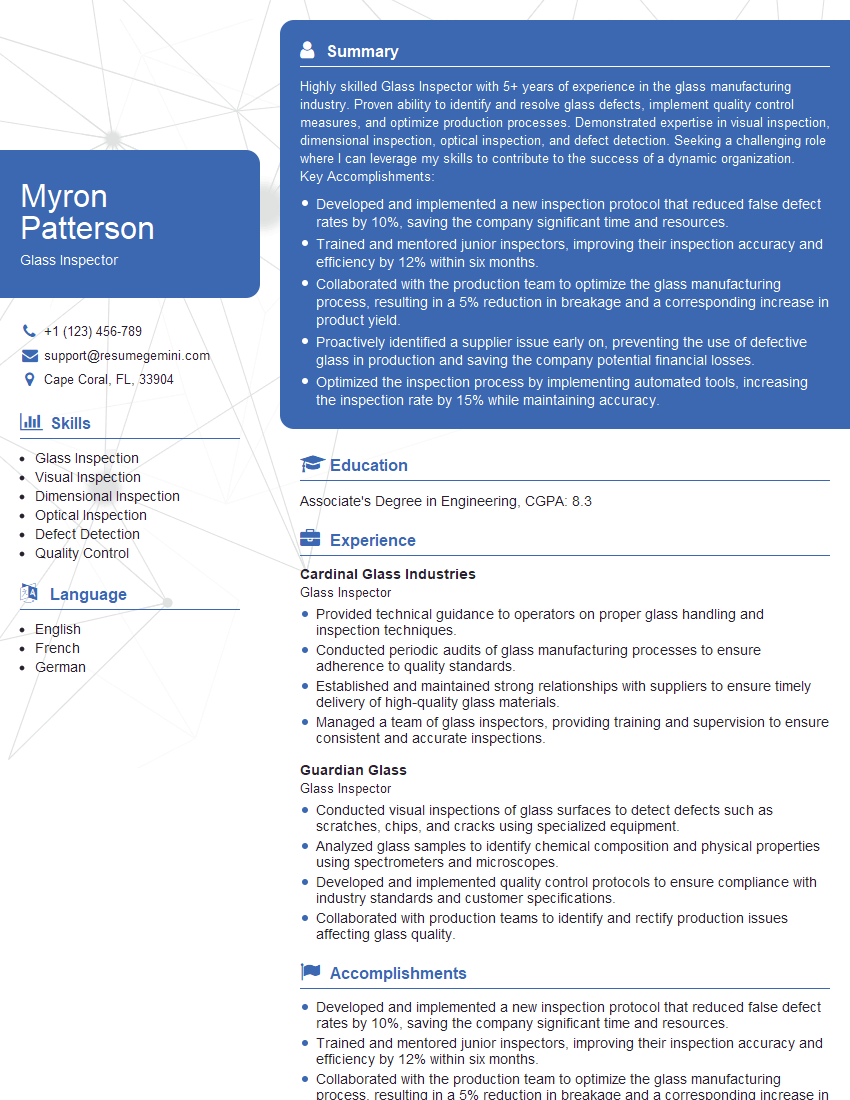
Mastering Glass and Mirror Inspection opens doors to a rewarding career with excellent growth potential in manufacturing, construction, and various other industries. A strong resume is crucial for showcasing your skills and experience to potential employers. Building an ATS-friendly resume significantly increases your chances of getting your application noticed. We highly recommend using ResumeGemini to craft a professional and impactful resume. ResumeGemini offers a user-friendly platform and provides examples of resumes tailored to Glass and Mirror Inspection, helping you present your qualifications effectively. Invest time in crafting a compelling resume – it’s your first impression!
Explore more articles
Users Rating of Our Blogs
Share Your Experience
We value your feedback! Please rate our content and share your thoughts (optional).
What Readers Say About Our Blog
Really detailed insights and content, thank you for writing this detailed article.
IT gave me an insight and words to use and be able to think of examples