Are you ready to stand out in your next interview? Understanding and preparing for Graphic Novel Art interview questions is a game-changer. In this blog, we’ve compiled key questions and expert advice to help you showcase your skills with confidence and precision. Let’s get started on your journey to acing the interview.
Questions Asked in Graphic Novel Art Interview
Q 1. Describe your process for creating a graphic novel page, from initial sketch to final art.
My process for creating a graphic novel page is iterative and involves several key stages. It begins with thumbnailing, where I quickly sketch out panel layouts and compositions on paper, focusing on pacing and storytelling. This helps me visualize the flow of the narrative before investing time in detailed drawings. Next, I move to pencils, refining the thumbnails into cleaner, more detailed sketches. This stage focuses on character poses, backgrounds, and detailed elements within each panel. I often experiment with different angles and perspectives during this stage. Following pencils, I ink my drawings, using either traditional methods with brushes and pens or digitally with a drawing tablet. Inking creates the final line art, defining shapes and outlines. After inking, I move to coloring and rendering, where I add color, shading, textures, and other visual effects to bring the page to life. I might use digital painting software to achieve a variety of looks – from flat, comic-book style coloring to more detailed, realistic rendering, depending on the desired aesthetic. Finally, I add lettering, which is crucial for conveying dialogue and narrative text. This often involves careful consideration of font choices and placement to enhance readability and visual appeal. I then check everything for any final revisions before it is considered finished.
Q 2. What software and tools do you use for creating graphic novels?
My workflow relies heavily on digital tools. For sketching and inking, I primarily use Clip Studio Paint, which offers a robust range of brushes and tools perfectly suited for comic book creation. Its powerful layer system is invaluable for managing complex compositions and keeping the art organized. For lettering, I use a combination of Clip Studio Paint and Adobe Photoshop depending on the specific font or effect required. Photoshop‘s capabilities in advanced color correction and manipulation are also helpful in the coloring and rendering phase. While I start with traditional methods (pencil and paper) for thumbnailing, the bulk of my work happens digitally, ensuring flexibility and precision. A high-resolution graphics tablet is essential for this process, allowing for a natural feel comparable to drawing on paper.
Q 3. Explain your understanding of visual storytelling in sequential art.
Visual storytelling in sequential art, or graphic novels, is all about communicating a narrative using a series of images. It’s a powerful combination of visual and textual elements. It’s not just about drawing pretty pictures; it’s about strategically composing panels to control the pace, emphasize key moments, and guide the reader’s eye. For instance, a large, full-page panel might convey a dramatic moment, whereas smaller panels can convey a faster-paced scene. The use of panel transitions (such as jump cuts or page turns) also heavily impacts storytelling, and understanding how to use different camera angles, such as close-ups or wide shots, can deeply influence the viewer’s emotional connection. Moreover, the strategic use of gutter space (the space between panels) is a crucial aspect – leaving large gaps can create a sense of distance or time passage, while smaller gaps create a sense of immediacy. Think of it as filmmaking, but using drawings and text instead of live-action footage. Every element is carefully considered to contribute to the overall narrative.
Q 4. How do you manage deadlines and workload in a graphic novel project?
Managing deadlines and workload in graphic novel creation requires meticulous planning and time management. I typically break down the project into smaller, manageable tasks, creating a detailed schedule with milestones and deadlines for each stage (script breakdown, page layouts, pencils, inks, colors, lettering). I use project management software like Trello or Asana to track progress and ensure I stay on schedule. It’s also crucial to prioritize tasks based on urgency and importance. Maintaining consistent work habits and avoiding procrastination are also key. Finally, open communication with editors and clients is crucial – any unexpected delays or problems must be addressed promptly and solutions must be found collaboratively.
Q 5. How do you incorporate character development through visual cues?
Character development through visual cues is central to creating believable and engaging characters. Changes in a character’s posture, facial expression, or attire can effectively convey shifts in mood, personality, or even their physical state. For instance, a character’s slumping shoulders might indicate sadness, while a clenched fist suggests anger. Similarly, a change in wardrobe can reflect a change in their social status or even their inner state. Even the use of color can be impactful; a character might initially be drawn in muted colors, reflecting their initial state of sadness, but shift to more vibrant tones as they evolve. Small, consistent details matter. For example, constantly showing a character with a specific nervous habit can add depth and layers to their personality that are not explicitly stated in the dialogue.
Q 6. Discuss your experience with different art styles relevant to graphic novels.
My experience encompasses a wide range of art styles relevant to graphic novels. I’m comfortable working in styles ranging from the clean, defined lines of classic comic books to the more expressive and painterly approaches often seen in independent graphic novels. I’ve experimented with manga-inspired styles, with their dynamic linework and expressive character designs, as well as more realistic styles for projects demanding a heightened sense of realism. The style I ultimately choose depends heavily on the narrative and the overall tone the graphic novel aims to create. Adaptability is key; each project requires a style appropriate to its story.
Q 7. How do you handle feedback and revisions on your work?
Handling feedback and revisions is a crucial part of the creative process. I approach feedback constructively, viewing it as an opportunity to improve the final product. I carefully consider all comments and suggestions, even if they initially seem challenging or different from my original vision. It’s vital to have open and respectful communication with editors or clients, asking clarifying questions if any feedback is unclear. I then revise my work based on the received feedback, focusing on making improvements while maintaining the overall integrity of the storytelling and my artistic vision. The revision process may include several iterations, and it’s important to be patient and willing to adjust my approach as needed to meet the expectations of the project while ensuring the narrative remains effective.
Q 8. Explain your understanding of panel composition and layout.
Panel composition and layout are fundamental to storytelling in graphic novels. Think of each panel as a single frame in a film, but with more control over the viewer’s eye. Effective composition guides the reader’s gaze, controls the pacing, and enhances the emotional impact of the narrative.
We use different panel shapes and sizes (e.g., large panels for dramatic moments, small panels for quick transitions), arrangements (e.g., grids, zigzags, asymmetrical layouts) and gutters (the space between panels) to achieve these effects. For instance, a series of small, vertically stacked panels could depict a fast-paced chase scene, while a single large panel could showcase a character’s emotional reaction. The gutters themselves are crucial; wide gutters slow the pace, while narrow ones create a sense of immediacy.
Consider the classic example of a fight scene. You might use a series of smaller panels showing rapid blows and movements, building tension and speed. Then, a larger panel might show the character’s reaction after receiving a significant hit, emphasizing the impact of the blow. The layout actively participates in the storytelling, conveying as much information as the artwork itself.
Q 9. Describe your approach to creating believable anatomy and expressions.
Creating believable anatomy and expressions relies heavily on understanding human form and emotion. I start with a solid understanding of anatomical structure – bone structure, muscle groups, and proportions – to build a foundation for dynamic poses and movement. References are invaluable; I use photographs, anatomical charts, and even videos to capture the subtleties of the human body in motion.
For expressions, it’s not just about drawing exaggerated features. I focus on the subtler nuances: a slight twitch of the mouth, the crinkle of the eyes, the tension in the jaw. These small details are what bring a character to life and make their emotions believable. I often study facial expressions in mirrors or through videos, paying close attention to how muscles work together to create different emotions. It’s a constant process of observation and refinement.
For example, drawing a character’s fear might involve widening their eyes, raising their eyebrows, and slightly opening their mouth, all while paying attention to subtle tremors in their hands or posture. It’s about going beyond simply drawing a ‘frightened face’ and capturing the physical manifestation of fear in the entire body.
Q 10. How do you ensure visual consistency throughout a graphic novel?
Maintaining visual consistency throughout a graphic novel is crucial for creating a cohesive and immersive reading experience. This involves establishing a consistent style guide early in the process which covers everything from character designs and environments to font choices and panel layouts.
I create a style guide that includes detailed character model sheets with different poses, expressions, and variations in clothing. For backgrounds, I establish a consistent color palette and architectural style. This guide serves as a reference throughout the project, ensuring that the art remains consistent even if multiple artists are involved.
Beyond the style guide, regular review and feedback are key. I frequently review my own work, comparing panels and pages to ensure consistency in line weight, shading techniques, and overall aesthetic. Digital tools like color palettes and layer styles help maintain consistency across pages. Regular checks help to catch inconsistencies early on, saving significant revision time later.
Q 11. How familiar are you with different printing processes for graphic novels?
I’m very familiar with different printing processes for graphic novels, including offset printing and digital printing. Offset printing is the traditional method, offering high-quality results and excellent color reproduction for large print runs. It’s still a popular choice due to its cost-effectiveness for large-scale projects. The process involves transferring the image from a plate to a rubber blanket and then to the paper.
Digital printing is increasingly popular, especially for smaller print runs and self-publishing. It’s faster and more flexible, allowing for on-demand printing and personalized customization. However, the quality might not always reach the same level as offset printing, especially for fine details or complex color gradients. Understanding the pros and cons of each method is essential when making decisions about printing and budgeting.
Choosing the right process depends on factors such as print run size, budget, desired quality, and turnaround time. For example, if I’m working on a large-scale project with a significant budget, offset printing is generally the better option. For a smaller, independent project, digital printing might be more suitable.
Q 12. What are some common challenges faced in creating graphic novels, and how do you overcome them?
Creating graphic novels presents numerous challenges. Time management is a significant hurdle; producing high-quality artwork consistently over a long period requires discipline and efficient workflow. Balancing the visual narrative with the written script is also crucial; the art needs to complement the story without overwhelming it or contradicting the text.
Another frequent challenge is maintaining artistic consistency and quality throughout the process, particularly in longer graphic novels. Burnout is a real danger, leading to a dip in quality or delays. To overcome these hurdles, I employ a rigorous project management system, breaking down the work into smaller, manageable tasks. Regular breaks and self-care are essential to avoid burnout. Open communication with the writer or editor is key to ensure a clear understanding of the story and a cohesive final product.
Finally, self-critique and seeking feedback from trusted colleagues are important. It can be easy to become too invested in one’s work, missing flaws that a fresh pair of eyes can easily spot.
Q 13. Discuss your knowledge of color theory and its application to graphic novel art.
Color theory is essential for creating mood, atmosphere, and visual impact in graphic novels. Understanding the color wheel – primary, secondary, and tertiary colors – is fundamental. I use color schemes strategically to convey emotions; warm colors like reds and oranges evoke feelings of energy and excitement, while cool colors like blues and greens can create a sense of calmness or melancholy.
Color temperature, saturation, and value (lightness and darkness) all contribute to the overall feel. A high-saturation palette can feel vibrant and intense, while a low-saturation palette can feel muted and subdued. Value contrast is critical for readability and visual hierarchy, drawing the reader’s eye to key elements. I will often use complementary colors (opposite each other on the color wheel) for dramatic effect or analogous colors (next to each other on the color wheel) for a harmonious feel.
For example, a scene set in a dark, mysterious forest might use a predominantly dark blue and green palette with hints of purple for dramatic shadows. In contrast, a joyful street scene might use bright, saturated yellows, oranges, and reds. Careful consideration of color theory ensures the visuals enhance the narrative and create an immersive reading experience.
Q 14. Explain your understanding of perspective and its importance in graphic novel art.
Perspective is crucial in graphic novel art to create believable three-dimensional spaces and to guide the reader’s eye. It helps to create depth, realism, and a sense of scale. Understanding one-point, two-point, and three-point perspective are essential tools for constructing environments and positioning characters within them.
One-point perspective is best for showing a straightforward view down a long road or corridor; all lines converge at a single vanishing point. Two-point perspective is excellent for showing corners and intersections of buildings; lines converge at two vanishing points. Three-point perspective adds height, often used for depicting towering buildings or expansive landscapes, featuring three vanishing points.
The application of perspective is crucial for establishing a sense of scale. For example, using forced perspective, where elements are positioned strategically to create an illusion of depth or size, can be used to enhance dramatic moments or create a visually stunning effect. Without proper perspective, a graphic novel might appear flat and two-dimensional, hindering the creation of a truly immersive world.
Q 15. How do you create dynamic action sequences in your work?
Creating dynamic action sequences in graphic novels hinges on understanding motion and visual storytelling. It’s not just about drawing fast-moving figures; it’s about conveying the feeling of speed and impact.
- Motion Lines and Blur: Employing motion lines (those classic speed lines) and blurring effects strategically guides the reader’s eye and emphasizes movement. Too many lines can be cluttered, so careful placement is key. For example, a speeding car might have a few bold lines radiating from its wheels, while the background is blurred to enhance the sense of velocity.
- Panel Composition and Sequencing: The arrangement of panels is crucial. Smaller, faster panels create a sense of urgency, while larger panels can be used to highlight a powerful impact or a dramatic pause. Think of it like film editing – cutting between shots to build suspense or emphasize action.
- Visual Staging: Positioning characters and objects within the panel is essential. Overlapping figures and dynamic angles can convey the intensity of the scene. Imagine a fight scene – overlapping limbs and a slightly tilted perspective adds a sense of chaos and immediacy.
- Body Language and Facial Expressions: Even in rapid motion, the characters’ expressions and body language must be clear and convey their emotions and intentions. A clenched jaw and determined eyes on a character mid-punch add believability.
I often experiment with different panel layouts and perspectives to find the optimal visual rhythm for the action. I might use a sequence of close-ups followed by a wider shot to show both the detail and the overall impact of a scene.
Career Expert Tips:
- Ace those interviews! Prepare effectively by reviewing the Top 50 Most Common Interview Questions on ResumeGemini.
- Navigate your job search with confidence! Explore a wide range of Career Tips on ResumeGemini. Learn about common challenges and recommendations to overcome them.
- Craft the perfect resume! Master the Art of Resume Writing with ResumeGemini’s guide. Showcase your unique qualifications and achievements effectively.
- Don’t miss out on holiday savings! Build your dream resume with ResumeGemini’s ATS optimized templates.
Q 16. Describe your approach to creating backgrounds and environments.
Backgrounds and environments are more than just pretty pictures; they’re integral to the story, establishing mood, setting, and even revealing character. My approach is to carefully consider the narrative function of the environment.
- Research and Reference: Thorough research is vital, whether I’m illustrating a futuristic cityscape or a historical village. Photographs, sketches, and even virtual tours provide invaluable reference material.
- Establishing Mood and Atmosphere: Lighting is a powerful tool for shaping the atmosphere. Dark, shadowy backgrounds can create a sense of mystery or danger, while bright, sunny scenes can evoke feelings of hope or optimism.
- Perspective and Depth: Mastering perspective is key to creating believable environments. Using linear perspective and atmospheric perspective (where objects fade in color and detail with distance) adds depth and realism.
- Details and Level of Detail: The level of detail depends on the scene’s importance. A crucial scene might have richly detailed backgrounds, while a less important scene might have a simpler, more stylized background to focus attention on the characters and their actions.
For example, in one project set in a bustling market, I included numerous small details – from the textures of the fabric stalls to the expressions on the faces of the vendors – to create a sense of immersion. In contrast, quieter, more reflective scenes had simpler, more minimalist backgrounds to emphasize the emotional weight of the moment.
Q 17. How do you balance visual detail with readability in your art?
Balancing visual detail with readability is a constant juggling act in graphic novel art. Too much detail can overwhelm the reader, making it hard to follow the narrative. Too little detail can make the art look bland and uninteresting.
- Value Contrast and Color Palette: Using strong value contrast (differences in light and dark) helps to guide the reader’s eye to the important elements. A limited, well-chosen color palette prevents visual clutter and creates visual cohesion. Think about using muted colors for backgrounds to let the characters pop.
- Simplification and Stylization: I often simplify complex details, focusing on the essential shapes and forms. Stylization can add character and impact while reducing the need for intricate detail.
- Line Weight and Emphasis: Varying the thickness of lines helps to emphasize important details and create a visual hierarchy. Thicker lines draw the eye, while thinner lines recede into the background.
- Whitespace: Don’t underestimate the power of whitespace. Leaving enough empty space around characters and objects makes the art easier to read and avoids visual congestion. It allows the reader’s eyes to rest, enhancing the pacing and rhythm of the story.
In practice, this often involves making artistic choices: deciding what to emphasize and what to simplify. I frequently make thumbnail sketches to plan out the composition and determine the appropriate level of detail for each panel.
Q 18. Discuss your experience with different inking techniques.
I’ve experimented extensively with various inking techniques, both traditional and digital. Each offers unique qualities and challenges.
- Traditional Inking: I’ve worked with brush pens, dip pens, and technical pens, each producing a different line quality. Brush pens offer a dynamic, expressive line, ideal for expressive characters and backgrounds, while technical pens are great for crisp, clean lines and precise details. Dip pens allow for a wide range of line variations, offering a lot of flexibility.
- Digital Inking: Digital inking using software like Clip Studio Paint or Photoshop provides incredible flexibility. I can easily adjust line weight, experiment with different brushes, and correct mistakes non-destructively. Digital inking allows for rapid prototyping and revisions.
- Combining Techniques: Sometimes I blend traditional and digital methods. I might ink traditionally and then scan my work to enhance and refine it digitally. This approach gives me the best of both worlds: the organic feel of traditional ink with the precision and flexibility of digital tools.
The choice of inking technique often depends on the style and aesthetic of the project. For a project aiming for a classic comic book look, I’d lean towards traditional methods, whereas a more modern, stylized approach might call for digital techniques.
Q 19. Explain your experience with various coloring techniques (digital and/or traditional).
Coloring is where the artwork truly comes alive. My experience spans both traditional and digital methods, each with its own strengths and drawbacks.
- Traditional Coloring: I’ve worked with various mediums, including watercolor, gouache, and colored pencils. Each offers unique texture and blending capabilities. Watercolor is excellent for atmospheric effects, gouache provides solid, opaque colors, and colored pencils allow for fine detail and precise line work. Traditional coloring adds a unique organic quality.
- Digital Coloring: Digital coloring software offers incredible control and flexibility. I use programs like Photoshop and Clip Studio Paint to experiment with various blending modes, textures, and color palettes. Digital allows for experimentation, easy correction, and high level of control and precision.
- Color Theory and Application: Regardless of the medium, a strong understanding of color theory is essential. I choose color palettes that support the mood and narrative, considering factors like color temperature, saturation, and value.
For example, a dark and moody scene might call for a muted color palette with deep blues and purples, while a vibrant, action-packed scene might use a brighter palette with contrasting colors. The approach is always carefully considered to support the story’s mood.
Q 20. How familiar are you with lettering conventions in graphic novels?
My familiarity with lettering conventions in graphic novels is extensive. It’s a critical element that often gets overlooked, but proper lettering contributes significantly to the overall readability and visual impact of the narrative.
- Font Selection and Style: The choice of font should reflect the tone and style of the story. A gritty crime story might use a bold, sans-serif font, while a whimsical children’s story might use a playful, hand-drawn font.
- Kerning and Tracking: Careful attention to kerning (the space between individual letters) and tracking (the space between words) ensures that the text is legible and aesthetically pleasing. Incorrect spacing can make text difficult to read.
- Placement and Hierarchy: The placement of lettering within the panels should be well-considered, guiding the reader’s eye and enhancing the visual flow. Different font sizes and weights can be used to create a visual hierarchy, emphasizing important information.
- Bubbles and Captions: Understanding the conventions for speech bubbles and caption boxes is essential. The shape and style of the bubbles should match the style of the artwork and reflect the speaker’s emotions.
While I often collaborate with dedicated letterers, I possess the knowledge to ensure seamless integration between the lettering and the artwork, providing feedback and guidance to ensure a consistent visual style.
Q 21. Describe your workflow for collaborating with writers or other artists.
Collaboration is key in graphic novel creation. My workflow for working with writers and other artists is built on clear communication and mutual respect.
- Initial Script Review: I begin by carefully reviewing the script with the writer, identifying key scenes and visualizing the visual narrative. This early collaboration is crucial for aligning our visions.
- Thumbnails and Storyboards: I create thumbnails and storyboards, outlining the visual layout of each page and scene. This allows for feedback and adjustments before detailed artwork begins.
- Regular Communication and Feedback: I maintain constant communication with the writer, sharing my progress and incorporating their feedback. Open dialogue is essential for resolving any creative differences.
- File Sharing and Version Control: I use cloud-based services to share files efficiently and track revisions. Version control helps to avoid confusion and ensures that everyone is working with the most up-to-date versions of the art.
- Color Collaboration: If working with a colorist, we often share color palettes and test pages early on to ensure consistency and visual harmony.
Effective collaboration requires clear expectations, mutual respect, and a willingness to compromise. It’s a process of shared creativity, building towards a cohesive and impactful final product.
Q 22. How do you approach creating different moods and atmospheres through visual means?
Creating mood and atmosphere in graphic novels is a crucial aspect of storytelling, going beyond simply illustrating the script. It’s about using visual language to evoke specific feelings in the reader. I achieve this through a multifaceted approach, considering several key elements.
Color Palette: A warm palette (reds, oranges, yellows) can create a feeling of warmth, excitement, or danger, while cool palettes (blues, greens, purples) can evoke calmness, sadness, or mystery. For example, a scene depicting a quiet forest at night would benefit from dark blues and greens, while a fiery battle scene would use vibrant reds and oranges.
Lighting: The use of light and shadow is paramount. High-contrast lighting can create drama and tension, while soft lighting can convey peace or intimacy. Think of film noir; the stark shadows contribute heavily to the suspenseful atmosphere.
Line Weight and Style: Thicker lines can suggest weight and strength, while thinner lines can convey fragility or delicacy. A sketchy style might create a rougher, more spontaneous feeling, whereas clean lines suggest order and control. The style itself can immediately set a tone – a heavily inked, almost scratchy style might convey unease, while a smoother, more polished style might create a sense of elegance.
Composition and Paneling: The arrangement of elements within a panel and the sequence of panels themselves impact the pacing and mood. Close-ups create intimacy, wide shots establish context, and a rapid succession of small panels can convey action and chaos. Conversely, large, sparsely populated panels can create a sense of isolation or vastness.
Symbolism: Using symbolic imagery, like recurring motifs or specific objects, can enhance thematic resonance and contribute significantly to the overall mood. For instance, recurring imagery of wilting flowers could subtly underscore a sense of loss or decay.
Q 23. What are some of your favorite graphic novels and why?
My favorite graphic novels are diverse, reflecting the breadth of the medium’s potential.
Maus by Art Spiegelman: A masterpiece of historical narrative and innovative storytelling, its use of animal representation is both poignant and effective in conveying the horrors of the Holocaust. The black and white palette perfectly complements the somber subject matter.
Persepolis by Marjane Satrapi: This graphic memoir is a striking example of how simple, almost childlike art can convey powerful and complex themes. Satrapi’s style perfectly matches the emotional journey of the narrative.
Watchmen by Alan Moore and Dave Gibbons: A landmark work in the superhero genre, it’s a masterclass in world-building, character development, and visual storytelling. Gibbons’s art is incredibly detailed and atmospheric, effectively capturing the cold war era setting.
These works stand out because they demonstrate the power of graphic novels to tackle complex themes with nuance and emotional depth, utilizing visual storytelling in unique and impactful ways.
Q 24. How do you research and gather inspiration for your work?
My research process is iterative and often begins with a deep dive into the subject matter of a project. This might involve historical research, interviews, travel, or simply immersing myself in the relevant culture or environment.
Primary Sources: I often seek out primary sources – photographs, diaries, letters, or artifacts – to gain a genuine feel for the period or setting. This allows me to capture the authenticity that resonates deeply with readers.
Visual Inspiration: I gather a vast range of visual inspiration, from paintings and photography to film stills and even everyday objects. I create mood boards to organize these images and to help visualize the overall aesthetic of the project.
Concept Sketching: I constantly sketch and experiment with different approaches, testing out character designs, compositions, and color palettes. This iterative process allows for exploration and refinement of my ideas.
Collaboration: For projects where applicable, collaborating with writers and other artists can be incredibly enriching. Their insights and perspectives frequently add new layers to my creative process.
The key is to approach research with a curious and open mind, constantly searching for visual elements and stories that will enhance the emotional impact of the narrative.
Q 25. Describe your experience with self-promotion and portfolio building.
Self-promotion and portfolio building are integral aspects of being a successful graphic novel artist. It’s not just about creating great art; it’s about getting that art seen.
Online Portfolio: I maintain a professional website and online portfolio showcasing my best work. This allows potential clients or publishers to easily view my range of styles and skills.
Social Media: I actively use social media platforms, such as Instagram and ArtStation, to share my work, engage with other artists, and connect with potential collaborators or clients. Consistent posting and interaction are crucial.
Networking: Attending industry events, conventions, and workshops allows me to meet other professionals, build relationships, and learn about new opportunities. Building a strong network is invaluable.
Submissions: I actively submit my work to publishers, contests, and anthologies. This is a crucial step in gaining exposure and establishing a reputation within the industry.
Personal Projects: Working on personal projects keeps my skills sharp and provides fresh material for my portfolio. These projects demonstrate initiative and creative vision, qualities highly valued by potential clients.
Building a strong online presence, actively networking, and continually refining my portfolio are all key strategies in my self-promotion efforts.
Q 26. What are your salary expectations?
My salary expectations are commensurate with my experience and the scope of the project. I’m open to discussing a range based on the specifics of the contract, including project length, deliverables, and royalties, if applicable. A detailed breakdown of these factors would allow me to provide a precise and fair estimate.
Q 27. How would you adapt your style to fit a specific graphic novel project?
Adaptability is crucial in the graphic novel industry. My approach involves carefully studying the script, identifying the core aesthetic and thematic elements, and then tailoring my style accordingly. This is not about abandoning my unique voice, but rather about enhancing it to best serve the story.
Style Analysis: I begin by analyzing the style of other works that share a similar tone and genre with the project. This helps me understand what visual approach might resonate best.
Character Design Adaptation: Character designs must align with the story’s tone and feel. A whimsical story might call for softer lines and brighter colors, while a gritty thriller might require darker tones and more angular features.
Paneling and Composition: The way I arrange panels and use composition can drastically affect the pacing and mood of the narrative. I would adjust the paneling to reflect the desired rhythm and flow of the story.
Collaboration with the Writer: Close collaboration with the writer is vital. We would discuss the visual direction, ensuring our approaches are mutually supportive and coherent.
Ultimately, the goal is to create a unified and cohesive visual narrative that complements and enhances the written story, maintaining a consistent stylistic approach throughout the project.
Q 28. What are your long-term career goals within the graphic novel industry?
My long-term career goals are multifaceted. I aim to build a strong reputation as a versatile and highly skilled graphic novel artist, capable of working on diverse projects and collaborating effectively with different teams.
Expanding My Portfolio: I want to continue expanding my portfolio by working on a variety of projects across different genres and styles, honing my skills and pushing creative boundaries.
Developing My Own Works: I aspire to create and publish my own original graphic novels, telling unique stories that resonate with readers.
Mentorship and Teaching: I hope to mentor aspiring graphic novel artists, sharing my knowledge and experience to help the next generation of creators.
Industry Collaboration: I want to continue collaborating with writers, publishers, and other artists to create innovative and impactful graphic novels.
My overarching goal is to make a significant and lasting contribution to the graphic novel industry, leaving a body of work that is both artistically compelling and deeply meaningful.
Key Topics to Learn for Graphic Novel Art Interview
- Narrative Structure & Pacing: Understanding how to effectively build suspense, create compelling characters, and manage the flow of information across panels and pages.
- Character Design & Development: Creating visually distinct and memorable characters that convey personality and backstory through design choices. Practical application: Demonstrating your ability to design characters consistent with a specific genre or style.
- Panel Composition & Layout: Mastering techniques for guiding the reader’s eye, creating visual rhythm, and using panel size and arrangement to emphasize key moments. Practical application: Analyzing existing graphic novels to understand effective panel layouts and apply similar techniques to your own work.
- Visual Storytelling Techniques: Employing visual metaphors, symbolism, and other techniques to enhance the narrative and communicate complex ideas without relying solely on dialogue.
- Style & Genre Understanding: Demonstrating familiarity with various graphic novel styles (e.g., manga, European comics, superhero comics) and genres, and adapting your style accordingly.
- Color Theory & Application: Understanding how color impacts mood, atmosphere, and character development. Practical application: Showcasing a range of color palettes and techniques used to achieve specific visual effects.
- Software Proficiency: Demonstrating competency in industry-standard software such as Adobe Photoshop, Illustrator, and Clip Studio Paint. Highlighting your skills in digital inking, coloring, and lettering.
- Process & Workflow: Articulating your creative process, from initial concept to final product, including outlining, sketching, inking, coloring, and lettering stages. Problem-solving approach: Describe how you handle creative blocks, feedback, and revisions efficiently.
- Collaboration & Communication: Explaining your ability to work effectively with writers, editors, and other collaborators in a team environment.
Next Steps
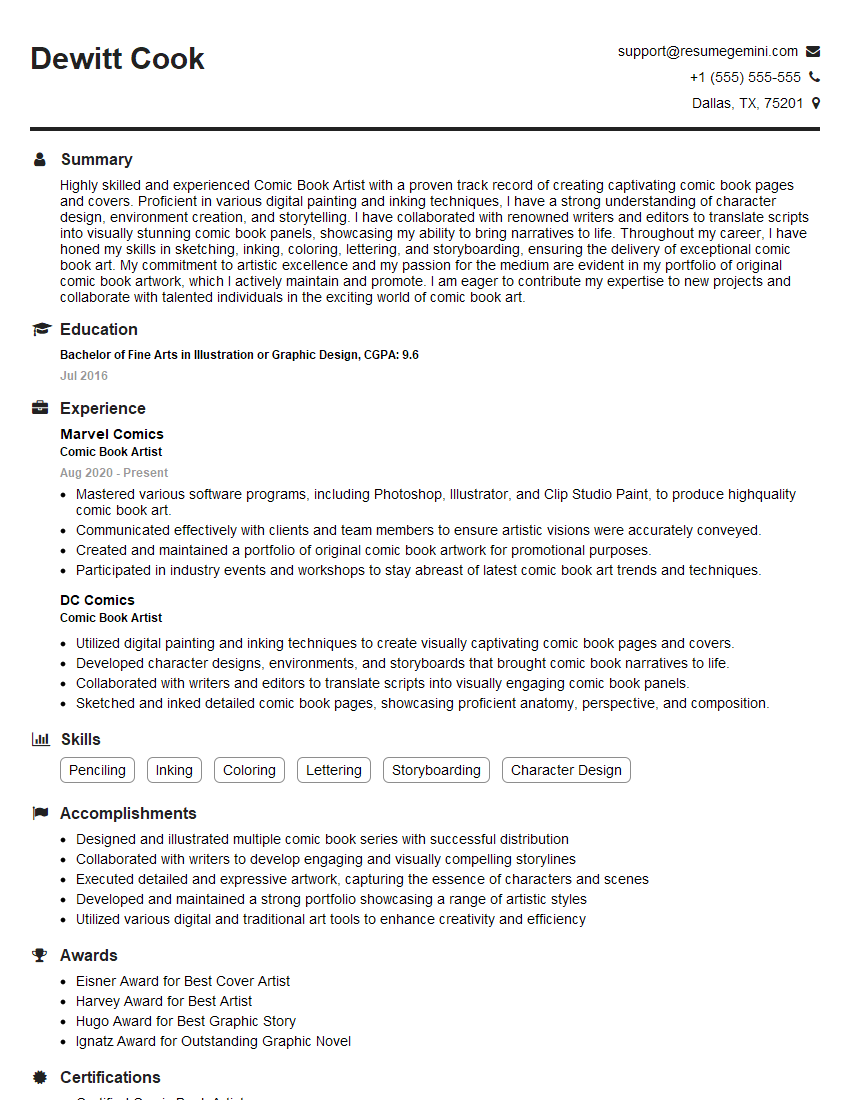
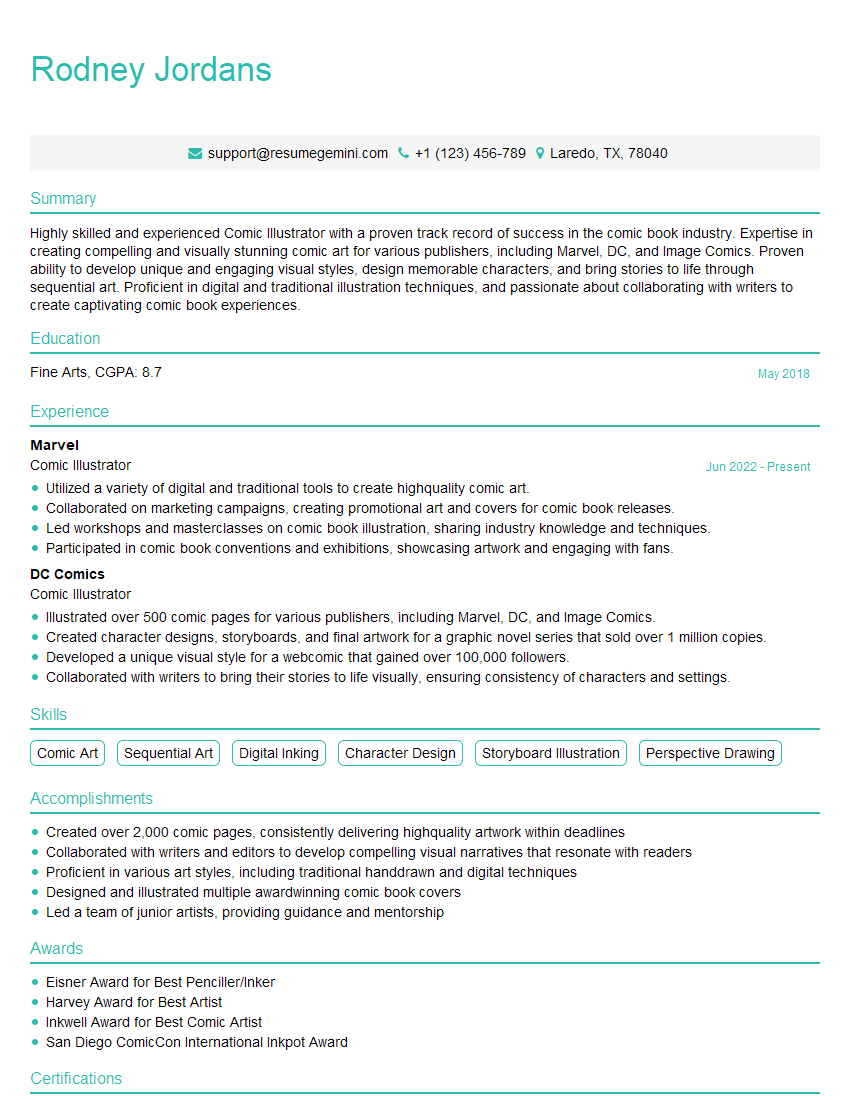
Mastering Graphic Novel Art opens doors to exciting and diverse career paths, from freelance work to studio positions. A strong portfolio is crucial, but so is a well-crafted resume that highlights your skills and experience effectively. An ATS-friendly resume is key to getting your application noticed by potential employers. ResumeGemini is a trusted resource that can help you build a professional and impactful resume. Examples of resumes tailored to the Graphic Novel Art field are available to help you get started.
Explore more articles
Users Rating of Our Blogs
Share Your Experience
We value your feedback! Please rate our content and share your thoughts (optional).
What Readers Say About Our Blog
Really detailed insights and content, thank you for writing this detailed article.
IT gave me an insight and words to use and be able to think of examples