Feeling uncertain about what to expect in your upcoming interview? We’ve got you covered! This blog highlights the most important Gravity and Geoid Determination interview questions and provides actionable advice to help you stand out as the ideal candidate. Let’s pave the way for your success.
Questions Asked in Gravity and Geoid Determination Interview
Q 1. Explain the difference between the geoid and the ellipsoid.
The ellipsoid and the geoid are both mathematical representations of the Earth’s surface, but they differ significantly. The ellipsoid is a simplified, smooth, mathematical surface that approximates the Earth’s shape. It’s a regular, slightly flattened sphere defined by its semi-major and semi-minor axes. Think of it as a best-fit surface for the Earth, ignoring all the bumps and dips. In contrast, the geoid is an equipotential surface that best represents mean sea level extended globally onto the continents. It’s a more complex, irregular surface that reflects the variations in the Earth’s gravity field due to mass distribution. Imagine it as the shape the oceans would take if only gravity and the Earth’s rotation influenced them, ignoring tides and currents. The key difference lies in their defining characteristics: the ellipsoid is defined geometrically, while the geoid is defined physically based on gravity.
Imagine a perfectly smooth, slightly squashed ball (ellipsoid) and then imagine that you pour water onto it, and it settles to find its level, following gravity’s pull. The water’s surface would form the geoid. The geoid undulates – sometimes above, sometimes below – the ellipsoid due to variations in the Earth’s gravity.
Q 2. Describe the methods used to determine the Earth’s gravity field.
Determining the Earth’s gravity field involves various methods, both terrestrial and space-based. Terrestrial gravimetry involves measuring gravity using highly sensitive instruments called gravimeters at various points on the Earth’s surface. These measurements provide point estimates of gravity acceleration. Airborne gravimetry uses gravimeters mounted on aircraft to collect gravity data over large areas, efficient for covering remote or inaccessible terrains. Satellite gravimetry utilizes satellites equipped with precise GPS receivers and accelerometers. As the satellite orbits, subtle changes in its trajectory caused by variations in Earth’s gravitational pull are measured. This data allows for the computation of a global gravity field model. Each method offers advantages and disadvantages concerning accuracy, spatial coverage, and cost. For example, terrestrial measurements are highly accurate but limited in spatial coverage. Satellite missions like GRACE and GRACE-FO provide global coverage but at a lower resolution compared to terrestrial measurements. All these methods are often combined to create a comprehensive gravity field model.
Q 3. What are the main sources of error in gravity measurements?
Gravity measurements are susceptible to several error sources. Instrumental errors arise from imperfections and limitations within the gravimeter itself. These can include drift, scale factor inaccuracies, and noise. Environmental effects include temperature changes, nearby moving masses (like vehicles or people), and even atmospheric pressure variations, all affecting the measurements. Terrain effects refer to the gravitational attraction of surrounding terrain features, which distort local gravity measurements. A mountain, for instance, will cause an increase in gravity at its base. Tidal effects relate to the gravitational pull of the Sun and Moon, causing variations in the Earth’s gravitational field. Finally, geological variations are inherent variations in rock density and subsurface mass distributions, leading to irregularities in the Earth’s gravity field which are often the subject of gravity surveys.
Q 4. How do you correct for latitude, elevation, and terrain effects in gravity data?
Correcting for latitude, elevation, and terrain effects in gravity data is crucial for accurate geoid modeling. Latitude correction accounts for the Earth’s flattening and the centrifugal force, causing gravity to vary with latitude. A standard formula based on the International Gravity Formula (IGF) is used. Elevation correction compensates for the decrease in gravity with height above the reference ellipsoid. The free-air correction is a simple linear approximation of this decrease. Terrain corrections are more complex and account for the gravitational attraction of surrounding terrain. This often involves numerical integration methods using a Digital Elevation Model (DEM) to compute the gravitational effect of nearby mountains, valleys, and other features. Sophisticated software packages and algorithms are commonly used to perform these corrections efficiently and accurately. The order of corrections might vary depending on the specific application and data quality.
Q 5. Explain the concept of geoid undulation.
Geoid undulation is the separation between the geoid and the reference ellipsoid at a specific point. It represents the height difference between the equipotential surface (geoid) and the mathematical surface (ellipsoid). Positive undulation indicates that the geoid is above the ellipsoid, while negative undulation signifies the geoid is below the ellipsoid. These undulations are caused by variations in the Earth’s density and mass distribution. For example, a large mountain range will cause a positive geoid undulation because the increased mass beneath pulls the geoid upwards. Conversely, a deep ocean trench will result in a negative undulation. Geoid undulations are typically measured in meters and are crucial for converting ellipsoidal heights (GPS heights) to orthometric heights (heights above the geoid).
Q 6. What are the applications of geoid models in surveying and mapping?
Geoid models play a vital role in surveying and mapping, primarily in connecting GPS/GNSS heights (ellipsoidal heights) to orthometric heights (heights above the geoid). This is crucial for determining precise elevations in surveying projects, engineering applications, and flood risk assessment. Geoid models are used to transform GPS measurements, which provide ellipsoidal heights, to orthometric heights, which are relative to mean sea level and are the standard for topographic mapping. In other words, geoid models provide the ‘bridge’ between satellite-based positioning and traditional elevation measurements. Accurate geoid models are essential for various applications, from constructing dams and bridges to creating precise elevation maps for navigation and environmental management.
Q 7. Discuss the use of GPS/GNSS in gravity field determination.
GPS/GNSS plays a critical role in gravity field determination, particularly in satellite gravimetry. The precise positioning data from GPS/GNSS receivers on board satellites allows scientists to track the satellite’s trajectory with remarkable accuracy. Deviations from the expected orbit are caused by variations in Earth’s gravity. By carefully analyzing these deviations, along with data from onboard accelerometers, scientists can model the Earth’s gravity field. Furthermore, GPS/GNSS is used in terrestrial and airborne gravimetry to determine the precise location of gravity measurements. This accurate positioning is crucial for creating detailed gravity maps. The combination of GPS/GNSS data with other gravity data from terrestrial and airborne gravimeters leads to improved resolution and accuracy in gravity field models.
Q 8. Describe different gravity data processing techniques.
Gravity data processing involves a series of steps to transform raw gravity measurements into meaningful information about the Earth’s subsurface. This process aims to remove systematic errors and highlight the subtle variations caused by density contrasts within the Earth. Key techniques include:
- Drift Correction: Gravity meters are not perfectly stable; their readings drift over time. Drift correction involves measuring the instrument’s drift at known base stations and subtracting this drift from the field measurements. Think of it like calibrating a scale before weighing items – you want to account for any inherent bias.
- Tidal Correction: The gravitational pull of the sun and moon affects gravity measurements. Tidal corrections remove these periodic variations. This is crucial for achieving high-precision gravity measurements.
- Latitude Correction: Gravity varies with latitude due to the Earth’s shape (oblateness) and rotation. This correction accounts for these variations using the International Gravity Formula (IGF).
- Instrumental Correction: Each gravity meter has its own calibration factor and scale, often measured during regular instrument calibration tests. This correction factors in the meter’s specific characteristics.
- Filtering and Smoothing: Often, raw gravity data contains high-frequency noise. Filtering techniques like median filters and moving averages smooth the data, reducing the impact of these random fluctuations. This step makes the underlying trends more obvious.
The order and specific techniques used depend on the application and data quality. For instance, in high-precision surveys, meticulous attention to drift and tidal corrections is crucial, while in regional-scale studies, the emphasis might be on efficient processing and robust filtering techniques.
Q 9. Explain the concept of gravity anomalies.
Gravity anomalies represent the difference between observed gravity and a reference gravity value. Imagine you’re expecting a certain weight (reference gravity) based on a theoretical model, but you find the actual weight is different (observed gravity). The discrepancy is the gravity anomaly. It reflects variations in subsurface density – denser rocks cause higher gravity, while less dense materials cause lower gravity. These anomalies provide valuable insights into the Earth’s subsurface structure, helping geophysicists locate mineral deposits, investigate tectonic features, and understand the Earth’s internal dynamics.
Q 10. What are the different types of gravity anomalies (e.g., Bouguer, free-air)?
Several types of gravity anomalies are used, each correcting for different aspects of the Earth’s gravity field. Key examples include:
- Free-air anomaly: This is the simplest type, representing the difference between observed gravity and the theoretical gravity at the same latitude but at a reference elevation (usually sea level). It corrects only for the change in gravity due to elevation, neglecting the mass between the observation point and the reference level. It’s sensitive to variations in elevation and subsurface density.
- Bouguer anomaly: This improves on the free-air anomaly by considering the gravitational attraction of the rock mass between the observation point and the reference level. It accounts for both the elevation difference and the mass of the rock column above the observation point. This correction significantly reduces the influence of topography.
- Isostatic anomaly: This accounts for the principle of isostasy, where large-scale topographic features are compensated for by deeper density variations. This anomaly removes the long-wavelength anomalies related to isostatic equilibrium.
Choosing the right type of anomaly depends on the specific application. For example, Bouguer anomalies are commonly used in regional geological studies, while free-air anomalies can be useful when studying smaller-scale features where the Bouguer correction might be less effective.
Q 11. How do you perform a Bouguer correction?
The Bouguer correction compensates for the gravitational attraction of the rock mass between the observation point and the reference datum (often mean sea level). It consists of two parts:
- Bouguer plate correction: This accounts for the gravitational attraction of an infinite horizontal slab of rock extending from the observation point down to the reference datum. The calculation involves the density of the rock (ρ), the acceleration due to gravity (g), and the elevation difference (h). The formula is approximately
2πGρh, where G is the gravitational constant. - Terrain correction: The Bouguer plate correction assumes a flat, infinite surface. In reality, topography is complex. The terrain correction accounts for the deviation from this assumption, calculating the effect of nearby hills and valleys on the gravity measurement. This is often computationally intensive and frequently utilizes digital elevation models (DEMs) and numerical integration techniques.
In practice, software packages perform these calculations automatically. The inputs typically include the observed gravity, elevation, rock density (which can be estimated from geological information or regional averages), and a DEM. The Bouguer anomaly is then calculated by subtracting the Bouguer plate and terrain corrections from the observed gravity.
Q 12. How do you model the terrain effect on gravity?
Modeling the terrain effect on gravity is crucial for accurate Bouguer anomaly calculations and gravity interpretation. The simplest approach is the terrain correction described above. However, several methods exist for more precise terrain modeling:
- Direct integration methods: These methods numerically integrate the gravitational attraction of all terrain elements within a certain radius of the observation point. They require detailed elevation data and are computationally intensive.
- Fast Fourier Transform (FFT) methods: These leverage the FFT to efficiently compute the gravitational attraction of the terrain. They’re faster than direct integration but might require assumptions about the terrain beyond the measured data.
- Analytical methods: These use simplified terrain representations (e.g., prisms, polygons) to approximate the gravitational attraction. They are less computationally demanding but might be less accurate than numerical methods.
The choice of method depends on the desired accuracy, the available computational resources, and the density and quality of the topographic data. High-resolution DEMs are essential for precise terrain corrections, especially in mountainous regions where topographic variations are significant.
Q 13. Explain the principle of least squares adjustment in geodetic applications.
The principle of least squares adjustment is fundamental in geodesy and geophysics. It provides a systematic approach to reconcile inconsistencies between measured data and a model. Imagine trying to fit a line through a scatter of data points: least squares finds the line that minimizes the sum of the squared distances between the points and the line. In geodetic applications, this principle is used to estimate optimal parameter values (e.g., coordinates, gravity values) by minimizing the differences between observations and a mathematical model that describes the physical system. This is achieved through solving a system of equations using matrix algebra.
Consider a simple example: determining the coordinates of a point using distance measurements from known points. The least squares adjustment would find the coordinates that best fit all the distance measurements simultaneously, even if the measurements contain small errors. The solution minimizes the overall error, resulting in a more reliable estimate of the point’s position.
The method is robust, particularly valuable when dealing with numerous observations that are subject to errors. It enables the efficient estimation of parameters and assessment of the uncertainty associated with the estimates, making it crucial for any situation where multiple observations are used to define a system, like creating a geodetic network or estimating gravity field models.
Q 14. What are the different types of geoid models (e.g., global, regional)?
Geoid models represent the equipotential surface that best approximates mean sea level. Different types exist, categorized mainly by their spatial extent and resolution:
- Global geoid models: These cover the entire Earth’s surface. Examples include EGM2008 and GRACE-derived models. They have relatively lower resolution than regional models but provide a global context for geodetic applications.
- Regional geoid models: These focus on a specific geographic area and offer higher resolution than global models. They are often built using denser gravity and GPS data within the region of interest. This is useful for national mapping or local engineering applications where high accuracy is crucial.
- Local geoid models: These are high-resolution models covering even smaller areas, often based on very detailed gravity surveys. These might be suitable for precise height determination in localized studies, for example, monitoring dam deformation or subsidence.
The choice depends on the application’s requirements. Global models are suitable for broad studies, while regional or local models are used when high accuracy is necessary within a limited area. The accuracy of any geoid model depends significantly on the density and quality of the underlying gravity and GPS data, as well as the modelling techniques used in its creation.
Q 15. Discuss the limitations of various geoid models.
Geoid models, while powerful tools for representing the Earth’s equipotential surface, are inherently limited by several factors. Their accuracy depends heavily on the quality and distribution of the gravity data used in their creation. Sparse data coverage, particularly over oceans and remote land areas, leads to uncertainties and inaccuracies in the resulting geoid.
Another limitation stems from the models’ inherent smoothing techniques. These techniques are necessary to handle noise and inconsistencies in the gravity data, but they can also filter out real, high-frequency variations in the Earth’s gravity field, potentially missing important details about local topography or subsurface structures.
- Resolution Limitations: Global geoid models typically have coarser resolutions compared to regional or local models. This means they cannot accurately capture small-scale variations in the Earth’s gravity field.
- Data Errors and Uncertainties: Errors in the input gravity data (e.g., satellite altimetry, terrestrial gravity measurements) directly propagate into the geoid model. These errors can stem from instrument calibration, atmospheric effects, or errors in positioning.
- Model Approximations: Geoid models rely on various mathematical and physical approximations. These approximations, while necessary for computational tractability, introduce uncertainties into the final product. For example, assumptions made about the Earth’s density structure can impact the accuracy.
- Temporal Variations: The Earth’s gravity field is not static; it changes over time due to various factors such as glacial isostatic adjustment, tectonic movements, and changes in groundwater storage. Geoid models are snapshots in time and may not reflect these dynamic changes.
For instance, a global geoid model might be accurate to within a few centimeters globally, but local variations could be much larger due to insufficient data in specific regions. This highlights the importance of considering the specific application and the limitations of the chosen model when interpreting results.
Career Expert Tips:
- Ace those interviews! Prepare effectively by reviewing the Top 50 Most Common Interview Questions on ResumeGemini.
- Navigate your job search with confidence! Explore a wide range of Career Tips on ResumeGemini. Learn about common challenges and recommendations to overcome them.
- Craft the perfect resume! Master the Art of Resume Writing with ResumeGemini’s guide. Showcase your unique qualifications and achievements effectively.
- Don’t miss out on holiday savings! Build your dream resume with ResumeGemini’s ATS optimized templates.
Q 16. Explain the role of gravity data in studying Earth’s internal structure.
Gravity data plays a crucial role in understanding Earth’s internal structure. Variations in gravity at the Earth’s surface reflect density variations within the planet. By meticulously measuring gravity anomalies – the differences between observed gravity and a theoretical reference gravity – geophysicists can infer the distribution of mass within the Earth.
High-density materials like rocks and metallic cores generate stronger gravity pulls than less-dense materials like water or sedimentary rocks. Analyzing gravity anomalies allows scientists to identify regions with differing densities, such as deep subsurface ore bodies, volcanic structures, or density variations within the Earth’s mantle. This process is often coupled with seismic data for a more comprehensive understanding.
For example, a significant negative gravity anomaly might indicate the presence of a large, low-density geological feature like a sedimentary basin. Conversely, a positive anomaly could point to a high-density intrusion of igneous rock or a buried ore deposit. Sophisticated inversion techniques are used to translate gravity anomalies into 3D density models, providing valuable insights into the planet’s composition, structure, and tectonic history.
Q 17. How do you evaluate the accuracy and precision of a geoid model?
Evaluating the accuracy and precision of a geoid model involves a multifaceted approach that combines statistical analysis, comparison with independent data sets, and assessment of the model’s performance in various applications. Accuracy refers to how close the model is to the ‘true’ geoid, while precision reflects the repeatability and consistency of the model’s values.
- Comparison with independent data: The geoid model’s accuracy can be assessed by comparing it against highly accurate GPS/levelling data at numerous points. Discrepancies between the model and these data reveal the model’s errors.
- Statistical analysis: Statistical measures, such as the root mean square error (RMSE), are used to quantify the overall discrepancies between the model and reference data. Smaller RMSE values indicate higher accuracy.
- Spatial analysis: Analyzing the spatial distribution of errors can reveal systematic biases in the model, potentially pointing to flaws in the data processing or modelling assumptions.
- Application-specific assessment: The suitability of a geoid model depends on the intended application. A model sufficient for broad-scale applications might be inadequate for highly precise engineering applications. Therefore, the accuracy requirements should be defined upfront based on the application.
For example, one might compare a new geoid model’s predictions of orthometric heights with those obtained from precise levelling surveys. Statistical analyses would then determine the level of agreement and identify areas of potential concern. The choice of validation data is crucial. High-quality GPS measurements with well-defined error characteristics are preferable for validating high-precision geoid models.
Q 18. What software packages are you familiar with for gravity and geoid processing?
My experience encompasses several software packages crucial for gravity and geoid processing. These tools provide functionalities for data pre-processing, modelling, analysis, and visualization.
- GRAVSOFT: A comprehensive suite of programs for gravity data processing, including reduction, gridding, and anomaly analysis. I’m proficient in using its tools for various tasks like upward/downward continuation and terrain correction.
- GMT (Generic Mapping Tools): An invaluable resource for data visualization and mapping. I use GMT to create maps of gravity anomalies, geoid heights, and other related geophysical quantities.
- MATLAB: A powerful programming environment used extensively for numerical computations and data analysis. I leverage MATLAB to develop custom algorithms for geoid modelling, error analysis, and data interpolation.
- GOCAD: For 3D geological modelling and visualization. This is particularly helpful when combining gravity data with other geophysical data to create subsurface models.
- Open-source libraries (e.g., Python libraries like NumPy, SciPy): I have used these for data manipulation, statistical analysis, and the development of custom gravity and geoid processing workflows.
Proficiency in these packages allows for efficient and accurate processing of large gravity datasets, ensuring reliable results for various geodetic and geophysical applications.
Q 19. Describe your experience with gravity data acquisition and instrumentation.
My experience with gravity data acquisition spans various techniques and instruments. I have participated in field surveys using both absolute and relative gravimeters.
Absolute gravimeters measure the absolute acceleration due to gravity at a specific location using highly accurate and sophisticated physical principles. These measurements are crucial for establishing a primary gravity network. I’ve used instruments such as FG5-X absolute gravimeters in various field campaigns, carefully following procedures to minimize environmental noise and instrument drift.
Relative gravimeters measure differences in gravity between different points. These are more portable and faster than absolute gravimeters, and are well suited for detailed gravity surveys over large areas. I have experience with various relative gravimeters, including Scintrex CG-5 and Micro-g LaCoste instruments. Accurate leveling and precise timing are essential to minimize errors when using relative gravimeters.
Beyond ground-based measurements, I’m also familiar with processing gravity data derived from satellite missions like GRACE (Gravity Recovery and Climate Experiment) and GOCE (Gravity field and steady-state Ocean Circulation Explorer). These satellite missions provide global gravity field models with unprecedented resolution.
Data acquisition involves meticulous attention to detail, including environmental corrections (e.g., tidal effects, instrument drift), instrument calibration, and accurate positioning of measurement points. Data quality control is crucial for obtaining reliable results. This often involves visual inspection of the data, error analysis, and comparison with existing data sets. A thorough understanding of instrumental limitations and environmental corrections is essential.
Q 20. Explain the concept of vertical datum and its relationship to the geoid.
A vertical datum defines a reference surface from which heights are measured. It’s a fundamental concept in surveying and mapping, crucial for applications ranging from infrastructure development to flood risk assessment. The most commonly used vertical datums are based on the geoid.
The geoid, an equipotential surface approximating mean sea level, serves as a natural and physically meaningful reference surface. However, it’s not a simple surface to define precisely. Orthometric heights, which are heights measured perpendicular to the geoid, are considered to be physically meaningful because they represent the height above mean sea level. This is different from ellipsoidal heights, which are measured perpendicular to the reference ellipsoid (a mathematical model of the Earth’s shape).
The relationship between the vertical datum and the geoid is direct. A geoid model is used to define the vertical datum, which is then used as the reference surface for determining orthometric heights. Variations in the geoid cause variations in orthometric heights at different locations, even if the ellipsoidal height is the same. The conversion between ellipsoidal and orthometric heights is accomplished using geoid height (N) values, which represent the separation between the ellipsoid and the geoid at each point: Orthometric Height = Ellipsoidal Height – Geoid Height (H = h – N).
Historically, various vertical datums have been established locally, often based on limited sets of leveling data. The development and use of high-precision global geoid models are leading to the modernization and unification of vertical datums worldwide, offering a consistent and globally consistent reference framework.
Q 21. How does the geoid affect height determination?
The geoid significantly impacts height determination because it’s the reference surface for orthometric heights, representing the true height above mean sea level. The shape of the geoid isn’t uniform; it undulates due to variations in the Earth’s gravity field, reflecting density differences within the Earth.
GPS measurements directly provide ellipsoidal heights (h) relative to a reference ellipsoid, not orthometric heights (H) relative to the geoid. To obtain orthometric heights, we need the geoid height (N) at each location. The geoid height is the separation between the geoid and the ellipsoid, so we use the equation: H = h – N.
Imagine trying to measure the elevation of a mountain peak. GPS will give you the elevation relative to the ellipsoid. But to know the true height above sea level, you must account for the geoid’s undulations. If the geoid is significantly higher or lower than the ellipsoid in that area, the orthometric height (height above sea level) will differ significantly from the ellipsoidal height (height above the ellipsoid).
The effect of the geoid on height determination is particularly crucial in applications requiring high accuracy, such as precision surveying, engineering, and flood modelling. Neglecting geoid undulations can lead to significant errors in height measurements, with potential consequences for infrastructure design, navigation, and environmental management.
Therefore, precise geoid models are essential for accurate height determination and are critical for integrating GPS measurements with traditional levelling techniques to obtain accurate orthometric heights.
Q 22. Discuss the impact of ocean tides on gravity measurements.
Ocean tides significantly impact gravity measurements because the mass of water in the oceans is constantly shifting due to the gravitational pull of the moon and the sun. This movement creates variations in the local gravitational field. Imagine a seesaw: when more water is on one side (due to high tide), the effective gravitational pull in that location increases slightly. Conversely, during low tide, the gravitational pull is slightly weaker. These variations are relatively small, but they can be significant enough to affect precise gravity measurements, especially when dealing with high-resolution studies or long-term monitoring. To minimize this impact, gravity measurements are often corrected using tidal models that predict the changes in the earth’s gravitational field caused by tidal effects. These models account for the position of the sun and moon, and their influence on the Earth’s oceans, providing a more accurate representation of the underlying Earth’s gravity field.
Q 23. What is the significance of the geopotential number in geodesy?
In geodesy, the geopotential number (W) represents the potential energy per unit mass at a given point in the Earth’s gravity field. It’s a fundamental concept because it combines the effects of both the Earth’s gravitational attraction and the centrifugal force resulting from the Earth’s rotation. Think of it as the total gravitational ‘influence’ at a specific location. A higher geopotential number indicates a higher potential energy, meaning an object at that point has a greater potential to fall. The geopotential number is crucial for defining the geoid – an equipotential surface that approximates mean sea level – and for various geodetic calculations, including determining heights and positioning.
For instance, when determining orthometric height (height above the geoid), the geopotential number is essential for accurate calculations. Differences in geopotential numbers between points directly relate to height differences, irrespective of the terrain.
Q 24. Describe different interpolation techniques used in gravity field modeling.
Several interpolation techniques are employed in gravity field modeling to estimate gravity values at unsampled locations. The choice depends on the data distribution, the desired accuracy, and the computational resources available. Common methods include:
Kriging: A geostatistical method that accounts for spatial autocorrelation in the data. It’s powerful for irregular data distributions but can be computationally intensive.
Inverse Distance Weighting (IDW): A simple and widely used technique where the gravity value at a point is estimated as a weighted average of surrounding measurements, with weights inversely proportional to the distance. It’s easy to implement but may not perform well with complex gravity variations.
Spline interpolation: This technique fits a smooth curve or surface through the data points, minimizing curvature. Different spline types (e.g., cubic splines) offer various trade-offs between smoothness and accuracy. It’s generally suitable for smoothly varying gravity fields.
Radial Basis Functions (RBFs): These methods use radial basis functions to interpolate the gravity field. The choice of basis function influences the smoothness and accuracy of the interpolation. They are effective for scattered data but can be computationally expensive for large datasets.
Each technique has its strengths and weaknesses. The selection of the most appropriate method often involves experimentation and comparison of results using different techniques.
Q 25. Explain the concept of spherical harmonics in representing the gravity field.
Spherical harmonics are mathematical functions used to represent the Earth’s gravity field as a series of terms. Imagine trying to describe the shape of a potato: you wouldn’t use a single simple shape; you’d need many smaller shapes to capture all the bumps and curves. Similarly, spherical harmonics allow us to approximate the complex, irregular Earth’s gravity field using a series of increasingly detailed terms. Each term represents a specific spatial pattern of gravity variation. Lower-order terms represent the overall shape and large-scale features, while higher-order terms capture increasingly finer details. The coefficients of these terms, called geopotential coefficients, are determined from gravity data collected globally. The higher the degree and order of the spherical harmonic expansion, the more detailed the representation becomes, but also the more data is required and the higher the computational cost. Global geopotential models like EGM2008 are commonly represented using spherical harmonics.
Q 26. How do you handle outliers in gravity data?
Handling outliers in gravity data is crucial for accurate modeling. Outliers can significantly distort the results. Several strategies can be used:
Visual inspection: The simplest method involves plotting the data to identify visually obvious outliers.
Statistical methods: Techniques like the box plot method or z-score can identify points that fall outside a certain statistical range. Points exceeding a defined threshold (e.g., three times the standard deviation) are flagged as potential outliers.
Robust estimation techniques: Methods like least absolute deviation or M-estimation are less sensitive to outliers compared to ordinary least squares. They are designed to minimize the influence of extreme values.
Spatial filtering: Techniques like median filtering can smooth the data and reduce the impact of isolated outliers. However, they can also smooth out genuine gravity variations.
The appropriate strategy often depends on the characteristics of the data and the specific goals of the analysis. Often, a combination of these methods is used. It’s important to carefully document how outliers are handled and to consider their potential impact on the final results.
Q 27. Discuss the challenges in maintaining a high-accuracy geoid model.
Maintaining a high-accuracy geoid model is a challenging endeavor, affected by several factors:
Data limitations: The accuracy of the geoid model is fundamentally limited by the quality and distribution of gravity data. Sparse data coverage in certain regions (e.g., oceans, remote areas) can lead to uncertainties.
Model limitations: The mathematical representation of the geoid using spherical harmonics has inherent limitations. Approximations are made, and higher-order terms may not always accurately capture fine-scale variations in the gravity field.
Dynamic Earth: The Earth’s gravity field is not static; it changes over time due to processes like glacial isostatic adjustment, tectonic plate movements, and changes in groundwater storage. These dynamic effects need to be considered to maintain a high-accuracy model.
Technological limitations: Although gravity measurements are constantly improving, there are inherent limitations to the precision achievable with current technology.
Overcoming these challenges requires continuous improvement in data acquisition techniques (e.g., using satellite gravity missions, denser terrestrial gravity surveys), development of advanced geodetic models, and incorporation of dynamic Earth processes in model updates.
Q 28. Explain the future trends in gravity and geoid determination.
Future trends in gravity and geoid determination are driven by advancements in technology and the growing demand for high-precision geodetic products:
Increased use of satellite gravity missions: Next-generation satellite missions will provide higher resolution gravity data with improved global coverage, enabling the creation of even more accurate geoid models.
Integration of multiple data sources: Future geoid models will likely integrate gravity data from various sources, including terrestrial surveys, airborne measurements, and satellite data, to leverage the strengths of each data type.
Improved modeling techniques: Development of advanced modeling techniques, including machine learning algorithms, will improve the accuracy and efficiency of geoid determination. These methods will help to better incorporate complex geological features and time-variable effects.
Focus on dynamic geoid modeling: More sophisticated models that explicitly account for the temporal variations of the gravity field will be developed to provide accurate geoid models over time.
These advances will lead to improved understanding of the Earth’s gravity field, providing valuable insights for various applications in geosciences, environmental monitoring, navigation, and resource management.
Key Topics to Learn for Gravity and Geoid Determination Interview
- Fundamental Concepts: Newton’s Law of Universal Gravitation, Gravity anomalies, Geopotential, Equipotential surfaces, the relationship between gravity and the Earth’s shape.
- Geoid Models: Understanding different geoid models (e.g., EGM2008), their applications, limitations, and accuracy. Methods for geoid height determination and their underlying principles.
- Gravity Data Acquisition and Processing: Techniques for gravity data acquisition (ground, airborne, satellite), data reduction, corrections (e.g., latitude, elevation, terrain), and error analysis.
- Practical Applications: Geoid applications in geodesy, surveying, mapping, and navigation. Understanding the role of gravity and geoid determination in precise positioning and height systems.
- Inertial Navigation Systems and GPS Integration: How gravity and geoid models contribute to the accuracy of inertial navigation systems and GPS positioning.
- Geophysical Interpretation: Using gravity anomalies to infer subsurface density variations and geological structures. Understanding the principles of potential field methods.
- Software and Tools: Familiarity with common software packages and tools used in gravity and geoid determination (mentioning specific software is optional, focus on the general skill).
- Problem-Solving Approaches: Develop your ability to analyze datasets, identify potential sources of error, and interpret results effectively. Practice tackling hypothetical scenarios related to data processing and interpretation.
Next Steps
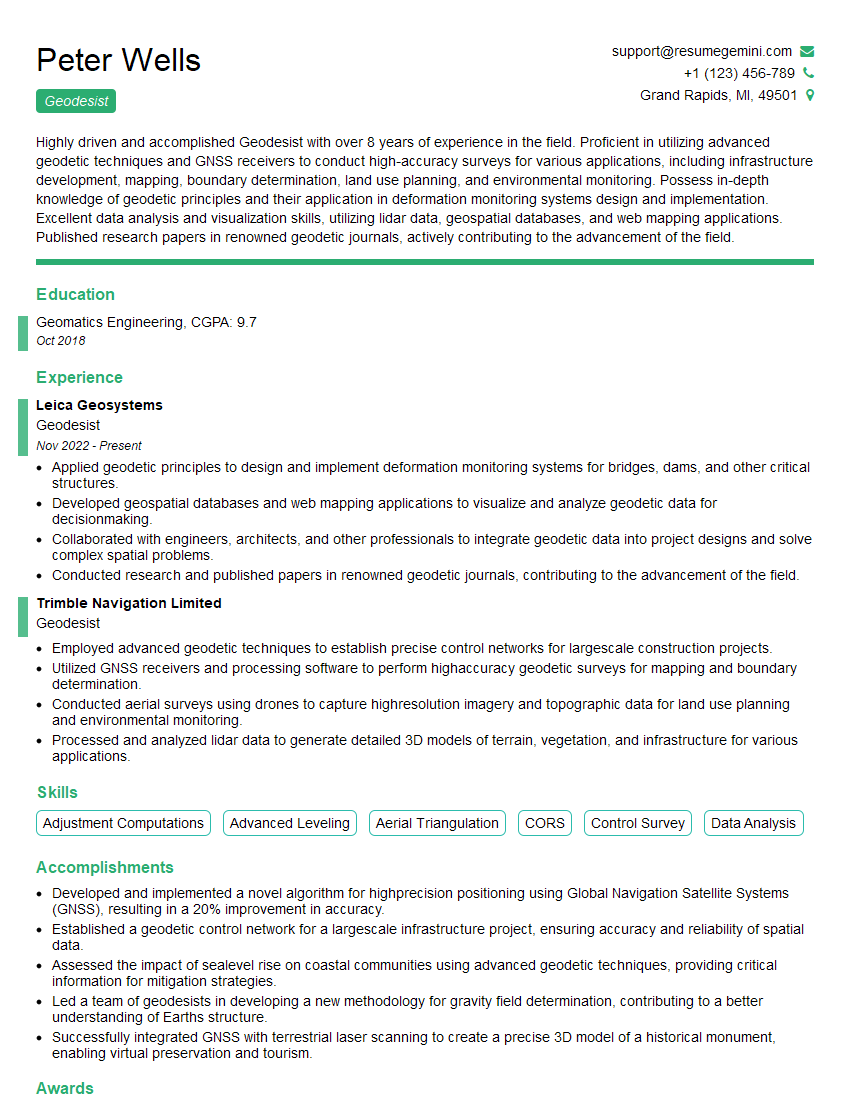
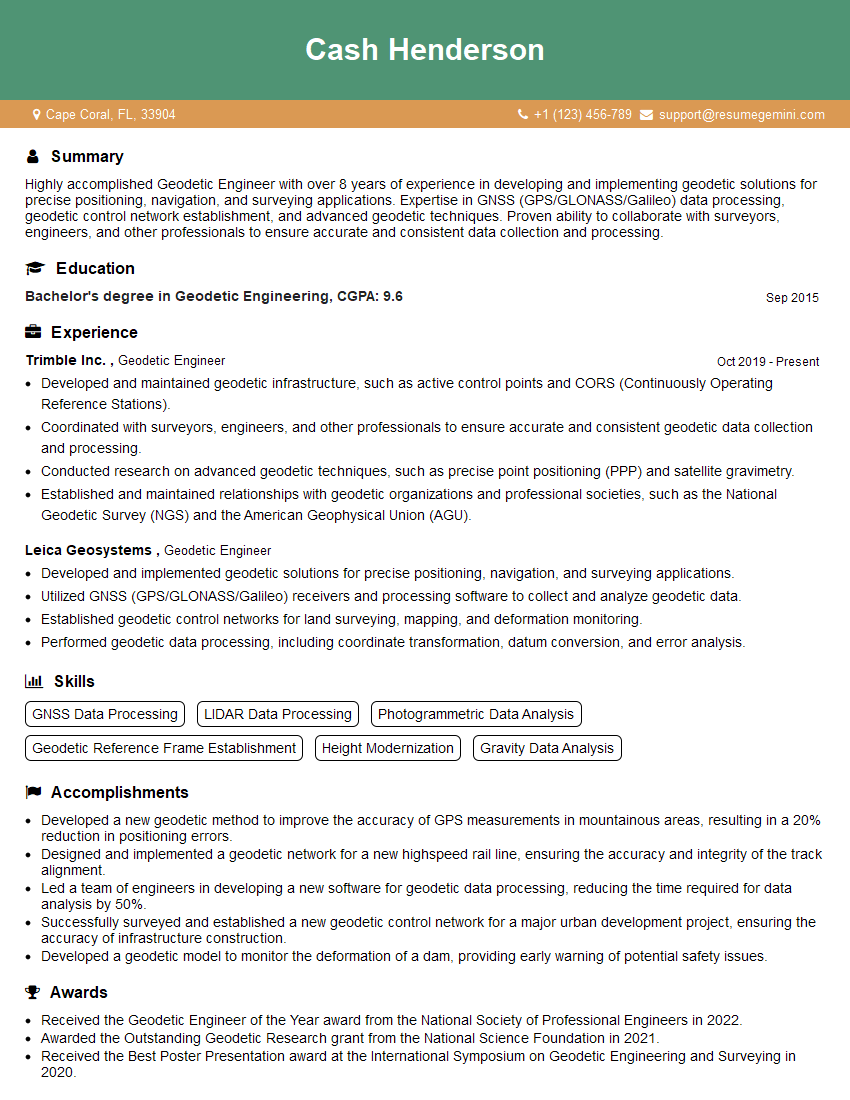
Mastering Gravity and Geoid Determination opens doors to exciting career opportunities in geodesy, geophysics, and related fields. A strong understanding of these concepts is highly valued by employers seeking skilled professionals. To significantly improve your job prospects, focus on building an ATS-friendly resume that highlights your skills and experience effectively. ResumeGemini is a trusted resource that can help you craft a professional and impactful resume, tailored to showcase your expertise in Gravity and Geoid Determination. Examples of resumes tailored to this specific field are available through ResumeGemini to guide your resume creation process.

Explore more articles
Users Rating of Our Blogs
Share Your Experience
We value your feedback! Please rate our content and share your thoughts (optional).
What Readers Say About Our Blog
Really detailed insights and content, thank you for writing this detailed article.
IT gave me an insight and words to use and be able to think of examples