Unlock your full potential by mastering the most common International Cooperation in Geodesy interview questions. This blog offers a deep dive into the critical topics, ensuring you’re not only prepared to answer but to excel. With these insights, you’ll approach your interview with clarity and confidence.
Questions Asked in International Cooperation in Geodesy Interview
Q 1. Explain the importance of ITRF (International Terrestrial Reference Frame) in global geodetic measurements.
The International Terrestrial Reference Frame (ITRF) is the cornerstone of global geodetic measurements. Think of it as a stable, globally consistent coordinate system that allows us to accurately pinpoint locations anywhere on Earth. It’s not fixed in space; it accounts for the Earth’s rotation and movement due to plate tectonics. Without a consistent frame like the ITRF, measurements taken in different locations using different reference systems would be incomparable. Imagine trying to build a skyscraper without a unified blueprint – the different sections wouldn’t fit together! The ITRF provides that essential blueprint, enabling precise positioning for applications like GPS navigation, monitoring crustal deformation, and studying sea-level rise.
The ITRF is regularly updated to improve its accuracy and consistency using data from various geodetic techniques like GNSS (Global Navigation Satellite Systems), VLBI (Very Long Baseline Interferometry), and SLR (Satellite Laser Ranging). These techniques provide independent measurements that are then combined to create the most accurate and reliable ITRF possible. Its importance is paramount for all global-scale geodetic activities.
Q 2. Describe different types of geodetic datums and their applications.
Geodetic datums are reference systems that define the origin and orientation of a coordinate system on the Earth. Different datums exist because the Earth isn’t a perfect sphere; it’s an oblate spheroid (slightly flattened at the poles). There are two main categories: horizontal datums and vertical datums.
- Horizontal Datums: These define the position on the Earth’s surface (latitude and longitude). Examples include NAD83 (North American Datum of 1983) and WGS84 (World Geodetic System 1984), which are widely used. The choice of horizontal datum depends on regional accuracy requirements. For example, NAD83 is optimized for North America, while WGS84 is a global datum widely used in GNSS.
- Vertical Datums: These define the height above or below a reference surface, typically mean sea level. Different regions might use different vertical datums based on local tidal gauges and other factors. These can be problematic as inconsistent height measurements can lead to inconsistencies in various applications such as mapping, flood forecasting, and infrastructure design.
Applications vary depending on the datum’s specific properties and area of coverage. Local datums offer higher accuracy within their designated regions while global datums like WGS84 are crucial for global positioning systems like GPS.
Q 3. What are the challenges in establishing a consistent global geodetic reference system?
Establishing a consistent global geodetic reference system presents several challenges:
- Earth’s Dynamic Nature: Plate tectonics constantly reshape the Earth’s surface, meaning the reference frame needs to continuously adapt. This requires sophisticated modelling and regular updates.
- Data Heterogeneity: Different geodetic techniques (GNSS, VLBI, SLR) provide measurements with varying accuracies and resolutions. Combining this data requires careful processing and error analysis.
- Regional Differences: Local geodetic networks might have different accuracies and reference frames, creating inconsistencies when integrating them into a global system. This necessitates robust transformation techniques.
- Technological Limitations: Obtaining precise measurements in remote areas or under challenging environmental conditions can be difficult, hindering global coverage and consistency.
These challenges necessitate ongoing international collaboration, sophisticated data processing techniques, and continuous refinement of the reference frame through regular updates, as is done with the ITRF.
Q 4. How do GNSS techniques contribute to international geodetic cooperation?
GNSS techniques, primarily GPS, GLONASS, Galileo, and BeiDou, are indispensable to international geodetic cooperation. Their global coverage and high precision allow for the collection of vast amounts of data from numerous locations worldwide. This data is crucial for:
- ITRF Realization: GNSS measurements contribute significantly to the determination of the ITRF, providing precise coordinates for numerous stations across the globe.
- Monitoring Earth’s Dynamics: GNSS allows us to monitor crustal movements, plate tectonics, and other geodynamic processes with unprecedented detail, which provides crucial input into global geophysical models.
- Datum Transformations: GNSS enables the accurate transformation of coordinates between different geodetic datums, facilitating interoperability and data exchange.
- Collaborative Research: Global networks of GNSS stations enable collaborative research projects involving scientists from various countries, promoting international cooperation and data sharing.
The free and open availability of GNSS data through organizations such as IGS (International GNSS Service) has significantly increased the availability of globally consistent positioning data. This accessibility plays a large role in international geodetic cooperation.
Q 5. Explain the role of IUGG (International Union of Geodesy and Geophysics) in advancing geodesy.
The International Union of Geodesy and Geophysics (IUGG) plays a vital role in advancing geodesy through coordination, standardization, and fostering international collaboration. It acts as an umbrella organization, bringing together scientists from different countries to work on common goals.
- Setting Standards: IUGG helps establish international standards and best practices for geodetic measurements and data processing, ensuring consistency and comparability of results worldwide.
- Facilitating Collaboration: It promotes international collaborations and data sharing among geodetic scientists, facilitating joint research projects and knowledge exchange.
- Supporting Research: IUGG supports research activities in various areas of geodesy, including the development of new techniques and technologies.
- Organizing Conferences and Workshops: It organizes numerous conferences and workshops, providing platforms for scientists to present their research and network with their peers.
In essence, the IUGG acts as a central hub for the global geodetic community, ensuring the progress of geodesy and its application in diverse fields.
Q 6. Discuss the impact of plate tectonics on geodetic measurements and modelling.
Plate tectonics significantly impacts geodetic measurements and modeling. The continuous movement of tectonic plates causes changes in the Earth’s shape and orientation, affecting the position of geodetic markers and the accuracy of measurements. These effects are subtle but significant over time.
- Crustal Deformation: Plate movement causes deformation of the Earth’s crust, which must be accounted for when making precise measurements. GNSS observations and other geodetic techniques provide valuable data to model these deformations. Ignoring these movements would lead to inaccuracies in mapping and other applications.
- Polar Wander: The movement of continents also influences the Earth’s rotation, leading to changes in the Earth’s orientation in space (polar wander). These effects are carefully monitored and incorporated in the ITRF.
- Sea Level Rise: Plate tectonics influence patterns of sea level change, both globally and regionally. Understanding this interaction is crucial for climate change research and coastal zone management.
Geodetic models must therefore incorporate plate tectonic motions to provide accurate and consistent results. These models use data from GNSS, VLBI, and other techniques to estimate plate velocities and deformation patterns.
Q 7. Describe the process of geodetic datum transformation.
Geodetic datum transformation involves converting coordinates from one datum to another. This is essential when working with data from different sources or regions, as different projects often use different reference systems. The process generally involves applying a set of mathematical equations that account for the differences in the origins, orientations, and shapes of the datums.
The transformation methods can be quite complex, and the accuracy depends on several factors, including the accuracy of the input data and the suitability of the transformation model. Common methods include:
- Seven-parameter transformation (Helmert transformation): This involves three translations (shifts in x, y, z), three rotations, and a scale factor. It’s a relatively simple but effective method for smaller areas.
- Molodensky-Badekas transformation: A more complex method used for larger areas or when significant differences exist between datums. It accounts for variations in the geoid (the equipotential surface that approximates mean sea level).
- Polynomial transformations: These involve higher-order polynomials to account for complex distortions between datums. They are typically used when the differences between datums are significant and non-linear.
Software packages like geographic information systems (GIS) frequently include tools to perform geodetic datum transformations. The choice of method depends on the specific datums involved and the required accuracy of the transformation. The importance of accurate transformations cannot be overstated for integrating data from different sources.
Q 8. Explain the concept of geodetic accuracy and precision.
In geodesy, accuracy and precision are crucial but distinct concepts. Accuracy refers to how close a measurement is to the true value. Think of it like hitting the bullseye on a dartboard – a high-accuracy measurement is very close to the center. Precision, on the other hand, refers to how close repeated measurements are to each other. This is like consistently hitting the same spot on the dartboard, even if that spot isn’t the bullseye. A highly precise measurement shows little variation between repeated observations. A geodetic measurement can be highly precise (repeatable) but inaccurate (far from the true value) if systematic errors are present. Ideally, we strive for both high accuracy and high precision in geodetic work.
For instance, if we’re measuring the height of a mountain, high accuracy means the measured height is very close to the mountain’s true height. High precision would mean that multiple measurements of the mountain’s height yield very similar results. A systematic error like a consistently miscalibrated instrument might lead to high precision but low accuracy.
Q 9. What are the different error sources affecting GNSS measurements and how are they mitigated?
GNSS (Global Navigation Satellite Systems) measurements are susceptible to various error sources. These can be broadly categorized as:
- Atmospheric Errors: Ionospheric and tropospheric delays cause signals to travel slower than expected, leading to positional errors. These are mitigated using sophisticated ionospheric and tropospheric models, often combined with dual-frequency measurements.
- Multipath Errors: Signals reflecting off buildings or other surfaces can arrive at the receiver later, causing inaccurate position estimations. Mitigation strategies include careful antenna placement, advanced signal processing techniques, and using multipath-mitigating antennas.
- Orbital Errors: Inaccuracies in the satellite orbits can introduce errors. Precise satellite orbit information, continuously updated by agencies like the International GNSS Service (IGS), significantly reduces these errors.
- Receiver Noise and Errors: Electronic noise within the receiver itself can affect measurements. High-quality receivers and careful data processing techniques help minimize this.
- Satellite Clock Errors: Imperfect timing on the satellites can introduce errors. These are corrected using precise clock information provided by the IGS and other organizations.
Mitigation often involves combining multiple measurements, using different satellite constellations, applying sophisticated mathematical models (like those accounting for atmospheric delays), and employing advanced data processing techniques like precise point positioning (PPP).
Q 10. How does international collaboration improve the accuracy of global geodetic networks?
International collaboration is fundamental to improving the accuracy of global geodetic networks. This collaboration manifests in several ways:
- Data Sharing: Organizations like the IGS collect and disseminate precise satellite orbit and clock information globally. This ensures that everyone uses the same high-quality data, leading to improved consistency in results.
- Standardized Techniques and Procedures: International agreements and collaborative efforts define standard processing techniques and data formats. This enhances comparability and reduces inconsistencies between different geodetic networks.
- Joint Projects and Campaigns: Large-scale geodetic projects often involve multiple countries, pooling resources and expertise to achieve higher accuracy than any single nation could manage independently. Examples include international efforts to establish a global geodetic reference frame.
- Calibration and Validation: Through joint campaigns, different national geodetic systems can be calibrated and validated against each other, ensuring mutual consistency and accuracy.
Without international cooperation, inconsistencies in data processing, reference frames, and data quality would significantly hamper the creation of a truly accurate and globally consistent geodetic reference system.
Q 11. Explain the concept of vertical datum and its relation to mean sea level.
A vertical datum defines the height of points on the Earth’s surface. It’s a reference surface from which elevations are measured. Historically, many vertical datums were based on mean sea level (MSL). Mean sea level is the average height of the sea surface over a long period, typically 19 years. However, MSL is not a perfect ellipsoid – it varies geographically due to ocean currents, tides, and atmospheric pressure. Therefore, while MSL provided a convenient starting point, modern vertical datums use sophisticated geodetic techniques to create more accurate and consistent reference surfaces, even though these might still be closely tied to MSL in some regions.
The relationship is that many historical datums used MSL as a fundamental reference, but modern geodetic datums are defined by more accurate geopotential models and avoid the inconsistencies inherent in the direct use of sea-level observations. The transition from MSL-based to geopotential-based vertical datums is a significant step forward in geodetic accuracy.
Q 12. Describe the principles behind gravimetric geoid determination.
Gravimetric geoid determination uses measurements of the Earth’s gravity field to model the geoid, which is an equipotential surface that approximates mean sea level. The principle is based on the relationship between gravity and the geoid’s shape. The geoid is a surface of constant gravitational potential, meaning that the force of gravity is the same at every point on the geoid. By measuring gravity at many locations across the globe and using sophisticated mathematical models (e.g., solving the Stokes’ problem), we can determine the shape of the geoid.
Gravity data is collected using gravimeters. The data is then processed to remove various influences and transformed into a representation of the geoid, which is usually represented by a grid of heights above a reference ellipsoid. The accuracy of the gravimetric geoid depends on the density and quality of the gravity measurements.
Q 13. What are the applications of InSAR (Interferometric Synthetic Aperture Radar) in geodesy?
InSAR (Interferometric Synthetic Aperture Radar) is a powerful remote sensing technique with wide-ranging applications in geodesy. It uses radar signals to create highly detailed 3D maps of the Earth’s surface. By comparing radar images acquired at different times, InSAR can measure ground deformation with millimeter-level accuracy.
- Measuring ground deformation: This includes monitoring land subsidence, volcanic activity, earthquake displacement, and glacier movement.
- Creating digital elevation models (DEMs): InSAR provides high-resolution DEMs with improved accuracy in challenging terrain compared to traditional methods.
- Monitoring infrastructure: Detecting deformations in bridges, dams, and buildings.
- Mapping glacier changes: InSAR is extremely effective at mapping changes in ice sheets and glaciers, providing crucial data for understanding climate change impacts.
InSAR is particularly useful in areas where ground access is difficult or dangerous, such as active volcanoes or unstable slopes.
Q 14. Discuss the role of geodetic data in disaster monitoring and response.
Geodetic data plays a vital role in disaster monitoring and response. Accurate geospatial information is critical for effective disaster management in several ways:
- Pre-disaster risk assessment: Geodetic data, including elevation models, maps, and ground deformation information, helps assess vulnerability to various hazards such as earthquakes, floods, and landslides.
- Real-time monitoring: During an event, geodetic techniques like InSAR and GNSS can monitor the extent and evolution of the disaster, providing crucial information for emergency response.
- Damage assessment: Post-disaster, geodetic data helps assess the extent of damage to infrastructure and the environment, facilitating aid distribution and recovery efforts.
- Reconstruction planning: Precise geospatial data is crucial for planning reconstruction efforts, ensuring that new infrastructure is built in safe and appropriate locations.
For example, after an earthquake, InSAR data can be used to map ground deformation, helping identify areas most affected by ground rupture and to guide rescue efforts. Similarly, during a flood, high-resolution elevation models can identify areas at risk of inundation.
Q 15. Explain how geodetic techniques are used in precision agriculture.
Geodetic techniques, which involve precise measurements of the Earth’s shape and gravity field, are revolutionizing precision agriculture. By providing highly accurate spatial information, these techniques allow farmers to optimize resource allocation and improve crop yields.
GPS-guided machinery: GPS and RTK (Real-Time Kinematic) GPS systems, based on geodetic principles, enable automated steering of tractors and other farm equipment. This ensures precise application of fertilizers, pesticides, and seeds, minimizing waste and maximizing efficiency. Imagine a tractor planting seeds only where needed, avoiding overlaps and gaps – that’s the power of geodetic precision.
Variable-rate technology: Geospatial data, derived from geodetic surveys and remote sensing, allows for variable-rate application of inputs. For instance, soil analysis combined with precise location data allows farmers to apply fertilizer only where it’s needed most, reducing costs and environmental impact. This is like giving each plant exactly the nutrients it requires, optimizing its growth.
Yield mapping: Geodetic surveying helps create precise maps of crop yields, identifying areas of high and low productivity. This helps farmers make informed decisions about future planting and resource management. It’s like having a detailed report card for each section of your field.
Career Expert Tips:
- Ace those interviews! Prepare effectively by reviewing the Top 50 Most Common Interview Questions on ResumeGemini.
- Navigate your job search with confidence! Explore a wide range of Career Tips on ResumeGemini. Learn about common challenges and recommendations to overcome them.
- Craft the perfect resume! Master the Art of Resume Writing with ResumeGemini’s guide. Showcase your unique qualifications and achievements effectively.
- Don’t miss out on holiday savings! Build your dream resume with ResumeGemini’s ATS optimized templates.
Q 16. Describe the importance of geodetic data standards in international cooperation.
Geodetic data standards are crucial for international cooperation because they ensure interoperability and comparability of measurements made across national borders. Without common standards, data from different countries would be incompatible, hindering collaborative projects and preventing the creation of a globally consistent geodetic reference frame.
Common datums and coordinate systems: Standards define common datums (reference surfaces for geographic coordinates) and coordinate systems, enabling seamless integration of geodetic data from various sources. This is like everyone agreeing to use the same measuring tape and units when building a global map.
Data formats and metadata: Standardized formats for storing and exchanging geodetic data, along with comprehensive metadata (information about the data), ensure data quality and facilitate efficient data sharing. Without standards, data sharing would be like trying to assemble a puzzle with pieces from different sets – almost impossible.
Accuracy and precision standards: Standards define acceptable levels of accuracy and precision for geodetic measurements, guaranteeing the reliability of results in international collaborative projects. This ensures that everyone is working with data of sufficient quality to make informed decisions.
Q 17. How is remote sensing data used in conjunction with geodetic measurements?
Remote sensing data, obtained from satellites and airborne sensors, provides broad-scale information about the Earth’s surface, while geodetic measurements provide highly accurate, ground-based information. Combining these data sources enhances the accuracy and completeness of our understanding of Earth’s features and processes.
Elevation models: Remote sensing data (e.g., LiDAR) can provide detailed elevation models, which can be improved and validated using ground-based geodetic measurements (e.g., GPS leveling). This creates a more complete and accurate picture of the terrain.
Deformation monitoring: Geodetic measurements (e.g., GNSS) can track ground deformation with high precision, while remote sensing (e.g., InSAR) can monitor larger areas. Combining these allows for a comprehensive understanding of phenomena like landslides or glacial movement.
Land cover mapping: Remote sensing provides information about land cover and land use. Geodetic data can then be used to improve the accuracy of these maps and integrate them with other spatial information, such as elevation data.
Q 18. Explain the differences between ellipsoidal height and orthometric height.
Both ellipsoidal height and orthometric height represent the vertical position of a point, but they refer to different reference surfaces.
Ellipsoidal height (h): This is the height above the ellipsoid, a mathematical model of the Earth’s shape. It’s easily obtained from GNSS measurements, but doesn’t directly represent the height above sea level.
Orthometric height (H): This is the height above the geoid, an equipotential surface that approximates mean sea level. It represents the true height above sea level, useful for hydrological and engineering applications. Calculating orthometric height requires more complex geodetic processing.
The difference between the two heights is the geoid undulation (N), where h = H + N. Think of the ellipsoid as a smooth, mathematical approximation of the Earth, while the geoid is a more complex surface that conforms to the Earth’s gravity field. The orthometric height is the height you would typically see on a map as elevation.
Q 19. Discuss the challenges of data sharing and interoperability in international geodetic projects.
Data sharing and interoperability in international geodetic projects face several challenges:
Different data formats and standards: Countries may use different data formats and standards, making it difficult to integrate data from various sources.
Data security and confidentiality concerns: Sharing sensitive geodetic data requires robust security measures to protect national interests and intellectual property.
Lack of metadata and documentation: Insufficient metadata makes it difficult to understand the quality and accuracy of the data, limiting its usefulness in international collaborations.
Cost and logistical barriers: Establishing robust data exchange mechanisms and training personnel can be expensive and logistically challenging, especially in developing countries.
Addressing these challenges requires international collaboration, establishing common standards, developing secure data exchange platforms, and investing in training and capacity building.
Q 20. How does the use of geodetic techniques support infrastructure development globally?
Geodetic techniques are essential for accurate and efficient infrastructure development worldwide. They provide the foundational spatial information needed for planning, design, construction, and maintenance.
Mapping and surveying: Geodetic surveys provide the accurate positional information needed for creating maps and plans for infrastructure projects, such as roads, railways, and pipelines. This ensures that constructions are correctly positioned and integrated with existing infrastructure.
Monitoring infrastructure deformation: Geodetic techniques, like GNSS monitoring, can track movements and deformations in structures like bridges and dams, enabling timely maintenance and preventing potential failures. Imagine detecting a subtle shift in a bridge before a collapse – this is the power of geodetic monitoring.
3D modeling: Accurate geodetic data are crucial for creating 3D models of infrastructure, which are essential for design, visualization, and simulation, improving efficiency and minimizing risks.
Q 21. Describe the impact of climate change on global geodetic networks.
Climate change significantly impacts global geodetic networks through several mechanisms:
Glacial isostatic adjustment (GIA): The melting of glaciers and ice sheets causes changes in the Earth’s gravity field and crustal deformation, affecting the accuracy of geodetic reference frames. This is a slow but significant process that needs to be accounted for in long-term geodetic monitoring.
Sea-level rise: Rising sea levels affect the vertical datum, the reference point for height measurements. This requires continuous monitoring and adjustments to maintain the accuracy of vertical datums.
Extreme weather events: Events like floods and earthquakes can damage geodetic infrastructure, such as GNSS stations, affecting data quality and continuity. This highlights the need for resilient infrastructure and data backup strategies.
Changes in Earth’s gravity field: Changes in the distribution of water mass due to melting ice and changing precipitation patterns alter the Earth’s gravity field, requiring adjustments to geodetic models.
To mitigate these effects, ongoing monitoring, improved geodetic models, and enhanced data processing techniques are essential to maintain the accuracy and reliability of global geodetic networks.
Q 22. What are the ethical considerations in international geodetic data management?
Ethical considerations in international geodetic data management are paramount, ensuring fairness, transparency, and equitable access. This involves several key aspects:
- Data Sovereignty and Ownership: Clearly defining who owns and controls geodetic data is crucial. Respecting national laws and regulations regarding data access and sharing is essential. This often involves negotiating data sharing agreements that respect the interests of all parties involved.
- Data Privacy and Security: Geodetic data can indirectly reveal sensitive information about populations or infrastructure. Robust security measures are needed to prevent unauthorized access and misuse, complying with relevant international data protection standards.
- Transparency and Openness: Promoting transparency in data collection, processing, and dissemination builds trust and facilitates collaboration. Open data policies, where appropriate, enhance accessibility and encourage wider use of geodetic information for societal benefit.
- Equitable Access: Ensuring all nations, particularly developing countries, have equitable access to geodetic data and technologies is crucial for global development and sustainability. This necessitates capacity-building initiatives and technological assistance.
- Attribution and Acknowledgement: Proper attribution and acknowledgement of data sources and contributors are vital for maintaining data integrity and recognizing intellectual property rights.
For example, a project involving the mapping of a shared river border requires careful consideration of data ownership by the riparian countries. Transparency in methods and clear agreements on data sharing prevent conflicts and build trust.
Q 23. Describe the use of geodetic techniques in defining maritime boundaries.
Geodetic techniques are fundamental in defining maritime boundaries, particularly for establishing baselines from which Exclusive Economic Zones (EEZs) and continental shelves are measured. This relies on accurate positioning and surveying techniques:
- Precise Positioning: Global Navigation Satellite Systems (GNSS) like GPS, GLONASS, Galileo, and BeiDou provide the backbone for determining the precise coordinates of coastal points. High-accuracy techniques like Real-Time Kinematic (RTK) GPS are used for onshore surveys.
- Hydrographic Surveying: Detailed surveys of the seabed topography are crucial for delimiting the continental shelf, using techniques like multibeam echo sounding to create bathymetric maps.
- Geodetic Datum Transformations: Harmonizing data from different sources and coordinate systems is critical. Datum transformations ensure consistent measurements across borders and different geodetic reference systems.
- Gravity Measurements: Gravity data helps in understanding the Earth’s geoid, which is essential for converting ellipsoidal heights (GNSS-derived) to orthometric heights (heights above mean sea level), crucial for defining maritime boundaries.
For example, in resolving a maritime boundary dispute, precise GPS measurements of coastal features and bathymetric data are used to determine the base points for calculating the EEZ limits. Discrepancies in data are resolved through collaborative efforts and the use of internationally accepted standards.
Q 24. Explain the role of capacity building in international geodetic cooperation.
Capacity building is essential for effective international geodetic cooperation. It empowers nations to participate fully and benefit from global geodetic initiatives. Key components include:
- Education and Training: Providing educational opportunities and training programs in geodetic surveying, data processing, and related technologies strengthens local expertise.
- Technology Transfer: Facilitating access to advanced geodetic instruments, software, and data processing techniques enables nations to enhance their capabilities.
- Knowledge Sharing: Promoting exchange of knowledge and best practices through workshops, conferences, and collaborative projects fosters innovation and improves efficiency.
- Standardisation and Interoperability: Training on international standards and promoting the use of interoperable systems ensures that data from different sources can be integrated effectively.
- Mentorship and Collaboration: Establishing partnerships between experienced geodesists and professionals in developing countries builds long-term capacity and sustainable solutions.
For instance, training programs on using modern GNSS technology and data processing software directly contribute to improving the quality of national geodetic infrastructure and participation in international projects.
Q 25. How do you ensure data quality and consistency in a global geodetic network?
Ensuring data quality and consistency in a global geodetic network requires a multi-faceted approach:
- Strict Quality Control Procedures: Implementing rigorous quality control protocols at every stage of data acquisition, processing, and analysis is crucial. This includes regular instrument calibrations and rigorous error analyses.
- International Standards and Best Practices: Adhering to international standards and best practices ensures uniformity and compatibility of data across different countries and organizations.
- Data Validation and Verification: Independent validation and verification of data using multiple methods and sources help to identify and correct errors or inconsistencies.
- Reference Frames and Datums: Adopting a common geodetic reference frame and datum enables consistent measurements and integration of data from various sources.
- Regular Network Monitoring and Adjustments: Continuous monitoring and periodic adjustments of the global geodetic network are necessary to account for tectonic plate movements and other dynamic processes.
- Data Fusion Techniques: Utilizing advanced data fusion techniques enables the integration of heterogeneous data sources and improves the overall quality and accuracy of the network.
For example, the International GNSS Service (IGS) plays a crucial role in ensuring the quality and consistency of global GNSS data by providing precise orbit and clock information, which is essential for accurate positioning.
Q 26. Discuss the latest advancements in geodetic instrumentation and technology.
Recent advancements in geodetic instrumentation and technology have revolutionized the field:
- Advanced GNSS Receivers: Multi-constellation GNSS receivers capable of tracking signals from multiple satellite systems (GPS, GLONASS, Galileo, BeiDou) provide improved accuracy and reliability.
- High-Resolution Sensors: Development of high-resolution LiDAR (Light Detection and Ranging) and InSAR (Interferometric Synthetic Aperture Radar) systems provide detailed 3D surface models and deformation monitoring capabilities.
- Improved Data Processing Techniques: Advanced data processing techniques, such as machine learning and artificial intelligence, are enhancing the accuracy and efficiency of geodetic data processing.
- Space-Based Geodetic Techniques: Advances in satellite gravimetry (GRACE-FO) and satellite altimetry provide improved measurements of the Earth’s gravity field and sea level changes.
- Unmanned Aerial Systems (UAS): The use of drones equipped with high-resolution cameras and LiDAR sensors provides cost-effective and efficient means for acquiring geospatial data.
For example, the use of InSAR technology has significantly improved our ability to monitor land subsidence, volcanic activity, and other geophysical phenomena.
Q 27. What are the key challenges in integrating different geodetic data sources?
Integrating different geodetic data sources presents several challenges:
- Different Coordinate Systems and Datums: Data from different sources may use different coordinate systems and datums, requiring careful transformations to ensure consistency.
- Data Formats and Structures: Inconsistent data formats and structures hinder seamless integration. Standardization and data interoperability are crucial.
- Data Accuracy and Resolution: Data from various sources may have different accuracies and resolutions, making it challenging to combine them effectively. Data fusion techniques help in resolving these differences.
- Temporal Variability: Data acquired at different times may reflect different states of the Earth’s surface, requiring careful consideration of temporal variations.
- Data Quality and Completeness: Data quality and completeness can vary significantly across sources, making it important to assess data quality before integration.
For instance, combining data from GNSS, LiDAR, and InSAR requires careful consideration of coordinate transformations, data accuracy, and temporal consistency. Sophisticated data fusion techniques are necessary to overcome these challenges.
Q 28. Describe your experience with international geodetic projects and your contributions.
My experience in international geodetic projects spans over fifteen years, encompassing various roles from project management to technical implementation. I’ve been involved in several key initiatives, including:
- Establishment of a national geodetic reference frame in a developing country: This project involved training local personnel, establishing a network of GNSS stations, and implementing a comprehensive quality control system. My contribution focused on developing standardized procedures and training materials, which led to the successful establishment of a robust national geodetic framework.
- Contribution to an international project on sea-level rise monitoring: I participated in the analysis of satellite altimetry data, combining it with in-situ measurements to improve the accuracy of sea-level rise predictions. My contribution involved developing improved data processing algorithms and contributing to peer-reviewed publications.
- Participation in a collaborative project on the definition of a maritime boundary: This involved the use of high-precision GNSS measurements, hydrographic surveys, and geodetic datum transformations to resolve discrepancies and establish a clear maritime boundary. My contribution focused on resolving technical challenges in data processing and ensuring consistency between data sources.
These experiences have equipped me with a deep understanding of the technical challenges and collaborative aspects of international geodetic projects. I am adept at handling diverse data sources, ensuring data quality, and facilitating successful collaboration between international teams.
Key Topics to Learn for International Cooperation in Geodesy Interview
- Global Geodetic Reference Frames: Understanding ITRF, its realization, and its importance in international collaborations. Consider the challenges of unifying different national geodetic systems.
- Satellite Geodesy Techniques: Deepen your knowledge of GNSS (GPS, Galileo, GLONASS, BeiDou) data processing, precise point positioning, and their application in global scale projects. Discuss the role of these techniques in monitoring crustal deformation and sea-level rise.
- Geodetic Data Exchange and Standardization: Explore the importance of international data sharing protocols and formats (e.g., various geospatial data models). Discuss the challenges and solutions involved in ensuring data interoperability across different countries and organizations.
- International Organizations and Initiatives: Familiarize yourself with key players like the International Association of Geodesy (IAG), International Hydrographic Organization (IHO), and their roles in promoting international cooperation in geodesy. Consider the impact of their standards and guidelines.
- Geospatial Data Analysis and Visualization: Practice analyzing and interpreting geodetic data using appropriate software and techniques. Be prepared to discuss visualizing geospatial data effectively for various audiences.
- Ethical Considerations in Geodesy: Discuss the ethical implications of data ownership, access, and usage, particularly within the context of international collaborations. Consider the responsible use of geospatial data for societal benefit.
- Problem-solving in International Projects: Be ready to discuss your approach to overcoming challenges related to language barriers, cultural differences, and differing technical standards when working in international teams.
Next Steps
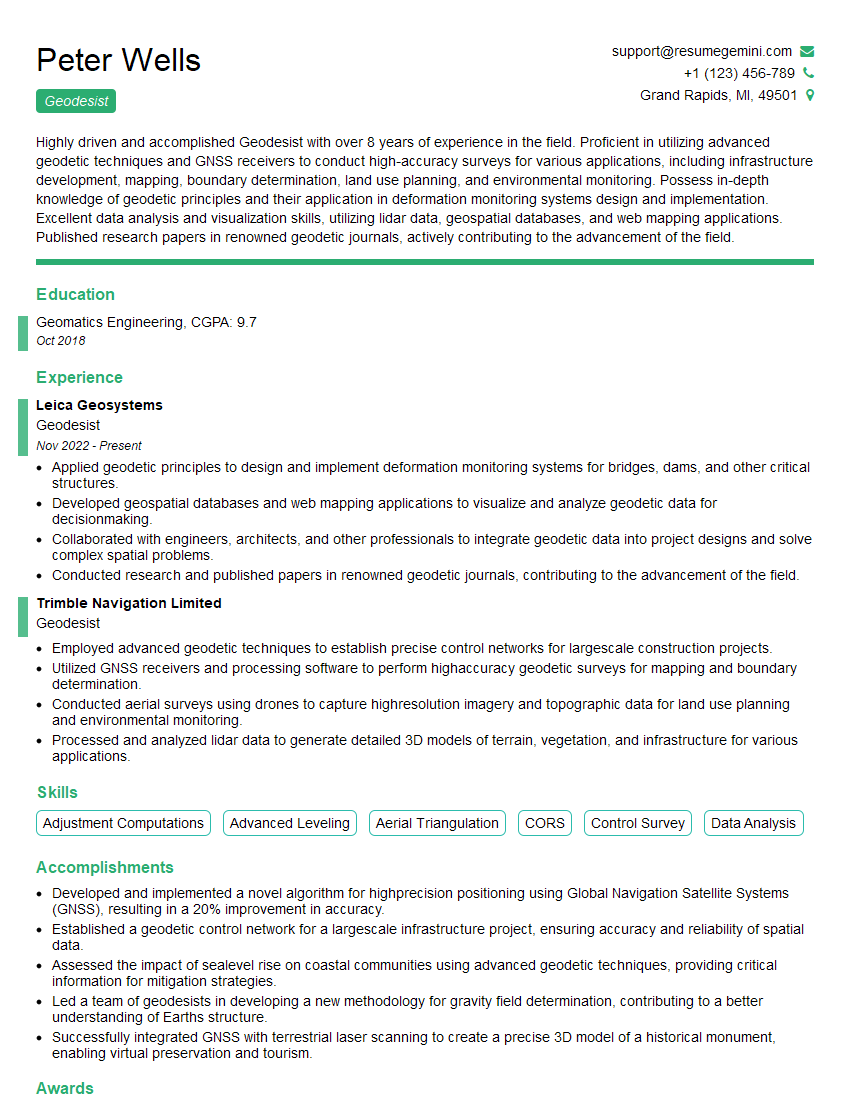
Mastering International Cooperation in Geodesy opens doors to exciting global careers, offering opportunities to contribute to significant projects with international impact. A strong resume is crucial to showcasing your skills and experience effectively to potential employers. To enhance your job prospects, create an ATS-friendly resume that highlights your relevant expertise and accomplishments. ResumeGemini is a trusted resource that can help you build a professional and compelling resume, tailored to the specific demands of the geospatial industry. Examples of resumes tailored to International Cooperation in Geodesy are available to guide you in creating your own.
Explore more articles
Users Rating of Our Blogs
Share Your Experience
We value your feedback! Please rate our content and share your thoughts (optional).
What Readers Say About Our Blog
Really detailed insights and content, thank you for writing this detailed article.
IT gave me an insight and words to use and be able to think of examples