The thought of an interview can be nerve-wracking, but the right preparation can make all the difference. Explore this comprehensive guide to Knowledge of Electrical Circuits interview questions and gain the confidence you need to showcase your abilities and secure the role.
Questions Asked in Knowledge of Electrical Circuits Interview
Q 1. Explain Kirchhoff’s Voltage Law (KVL) and Kirchhoff’s Current Law (KCL).
Kirchhoff’s laws are fundamental principles governing the behavior of electrical circuits. They provide a framework for analyzing complex networks.
Kirchhoff’s Current Law (KCL): This law states that the algebraic sum of currents entering a node (or junction) in a circuit is zero. Think of it like a water pipe junction – the total amount of water flowing into the junction must equal the total amount flowing out. In electrical terms, this means that the current entering a node is equal to the current leaving that node. Mathematically, ΣIin = ΣIout = 0.
Example: Imagine a node with three currents: I1 = 2A flowing into the node, I2 = 1A flowing out, and I3 flowing out. KCL dictates that 2A – 1A – I3 = 0, therefore I3 = 1A.
Kirchhoff’s Voltage Law (KVL): This law states that the algebraic sum of voltages around any closed loop in a circuit is zero. Imagine walking around a closed loop in a circuit. The total voltage you ‘gain’ (from sources like batteries) must equal the total voltage you ‘lose’ (across components like resistors). Mathematically, ΣV = 0.
Example: Consider a simple circuit with a 12V battery and two resistors, R1 and R2. If the voltage drop across R1 is 6V and the voltage drop across R2 is VR2, then KVL tells us 12V – 6V – VR2 = 0, meaning VR2 = 6V.
Q 2. What is the difference between AC and DC circuits?
The main difference between AC and DC circuits lies in the direction and nature of the current flow.
Direct Current (DC): DC circuits have a unidirectional current flow; the electrons flow consistently in one direction. Batteries and solar cells are common sources of DC power. DC voltage remains constant over time.
Alternating Current (AC): AC circuits have a current that periodically reverses direction. This reversal happens at a specific frequency, typically 50 or 60 Hz (cycles per second). Household power outlets provide AC power. The voltage and current in an AC circuit vary sinusoidally with time.
Implications: This difference greatly impacts circuit design and component selection. Capacitors and inductors behave differently in AC and DC circuits, as we’ll see later. DC circuits are simpler to analyze, while AC circuits often require more complex calculations involving phasors and impedance.
Q 3. Describe different types of resistors and their applications.
Resistors are passive components that oppose the flow of current in a circuit. They are characterized by their resistance, measured in ohms (Ω).
- Carbon Film Resistors: Inexpensive, widely used for general-purpose applications. They are compact and have a moderate power rating.
- Metal Film Resistors: More precise and stable than carbon film resistors, offering better temperature stability and tolerance. They are used in applications where accuracy is critical.
- Wirewound Resistors: Constructed by winding a wire around a core. They are suitable for high-power applications but can exhibit inductance, making them less ideal for high-frequency circuits.
- Surface Mount Resistors (SMD): Small, designed for surface mounting on printed circuit boards (PCBs). They are widely used in modern electronic devices due to their compact size.
Applications: Resistors are ubiquitous in electronics. They’re used to limit current, divide voltage, create voltage dividers, form bias networks for transistors, and serve as part of timing circuits.
Q 4. Explain the concept of impedance in AC circuits.
In AC circuits, impedance (Z) is the measure of opposition to the flow of current. It’s a complex quantity that includes both resistance (R) and reactance (X).
Resistance (R) accounts for energy dissipation as heat, while reactance (X) accounts for energy storage in electric and magnetic fields. Reactance is further divided into:
- Capacitive reactance (XC): Opposition due to a capacitor, decreasing with increasing frequency.
- Inductive reactance (XL): Opposition due to an inductor, increasing with increasing frequency.
Impedance is calculated using the formula: Z = R + jX, where ‘j’ is the imaginary unit (√-1). The magnitude of impedance is given by |Z| = √(R² + X²). Impedance is crucial for analyzing AC circuit behavior, including power calculations and filter design.
Q 5. How do capacitors and inductors behave in AC and DC circuits?
Capacitors and inductors exhibit vastly different behavior in AC and DC circuits.
Capacitors:
- DC: A capacitor acts as an open circuit in steady-state DC. It initially allows a transient current to charge, but once charged, no further current flows.
- AC: A capacitor acts as a frequency-dependent impedance. The capacitive reactance (XC = 1/(2πfC), where f is frequency and C is capacitance) decreases as frequency increases. At high frequencies, the capacitor acts almost like a short circuit.
Inductors:
- DC: An inductor acts as a short circuit in steady-state DC after the initial transient period. During the transient period, an inductor opposes changes in current.
- AC: An inductor acts as a frequency-dependent impedance. The inductive reactance (XL = 2πfL, where L is inductance) increases with increasing frequency. At high frequencies, the inductor acts almost like an open circuit.
In essence, capacitors block DC and pass AC, while inductors block AC and pass DC (at least, in a simplified sense. The transient response complicates things).
Q 6. What are the different types of filters (e.g., high-pass, low-pass, band-pass)?
Filters are circuits designed to selectively pass or attenuate certain frequencies. They are widely used in audio processing, signal processing, and power supplies.
- Low-pass filter: Passes low frequencies and attenuates high frequencies. A simple RC low-pass filter consists of a resistor in series with a capacitor to ground.
- High-pass filter: Passes high frequencies and attenuates low frequencies. A simple RC high-pass filter consists of a capacitor in series with a resistor to ground.
- Band-pass filter: Passes frequencies within a specific range and attenuates frequencies outside that range. These can be implemented using combinations of R, L, and C components.
- Band-stop filter (or notch filter): Attenuates frequencies within a specific range and passes frequencies outside that range. These are often used to remove unwanted noise or interference.
The design and characteristics of these filters depend on the component values (R, L, C) and the desired cutoff frequencies.
Q 7. Explain the operation of a simple transistor amplifier.
A simple transistor amplifier uses a bipolar junction transistor (BJT) or a field-effect transistor (FET) to amplify a weak input signal. Let’s consider a common-emitter amplifier using a BJT.
The circuit includes a BJT, a bias network (resistors to set the operating point), an input signal source, an output load resistor, and possibly a coupling capacitor. The input signal is applied to the base of the transistor. This small change in base current results in a much larger change in collector current. The resulting voltage change across the collector resistor is amplified version of input signal. The coupling capacitor isolates the DC bias from the input signal and load.
The gain of the amplifier is determined by the transistor’s characteristics and the resistor values. Negative feedback can be incorporated for better stability and linearity. This basic principle is used in countless electronic devices, from audio amplifiers to RF amplifiers in communication systems.
Q 8. Describe different types of semiconductor diodes and their applications.
Semiconductor diodes are two-terminal devices that allow current to flow easily in one direction (forward bias) and block current flow in the opposite direction (reverse bias). This unidirectional current flow property is fundamental to many electronic circuits. Several types exist, each with specific characteristics and applications:
PN Junction Diode: The most basic type, formed by the junction of P-type and N-type semiconductor materials. Used in rectification (converting AC to DC), clipping, clamping, and simple switching applications. Think of it as a one-way valve for electricity.
Zener Diode: Designed to operate in reverse breakdown, providing a stable voltage across its terminals regardless of current fluctuations. Commonly used as voltage regulators in power supplies to maintain a constant output voltage.
Schottky Diode: A metal-semiconductor junction diode with a lower forward voltage drop than a PN junction diode, making it faster and more efficient. Used in high-frequency applications and switching power supplies.
Light Emitting Diode (LED): Emits light when forward biased. Used extensively in displays, indicators, and lighting applications. The color of the light depends on the semiconductor material used.
Photodiode: Generates current when exposed to light. Used in light sensors, optical receivers, and light detection circuits. Imagine a solar cell, which is a large-area photodiode.
For example, in a simple power adapter, a PN junction diode is used to rectify the AC input voltage into a pulsating DC voltage, which is then further smoothed by a capacitor to produce a stable DC output. Zener diodes, on the other hand, ensure that this output voltage remains stable even if the input voltage fluctuates.
Q 9. What is a Thevenin equivalent circuit?
The Thevenin equivalent circuit simplifies a complex linear circuit into a simpler equivalent circuit consisting of a single voltage source (Vth) in series with a single resistor (Rth). This simplification allows easier analysis of the circuit’s behavior from the perspective of a specific load connected to the circuit.
To find the Thevenin equivalent:
- Find Vth: This is the open-circuit voltage across the two terminals where the load will be connected. Simply remove the load and calculate the voltage between those terminals.
- Find Rth: This is the equivalent resistance seen from the two terminals with all independent sources (voltage and current sources) deactivated (voltage sources shorted and current sources opened).
Think of it as representing the entire complex circuit as a simple battery with some internal resistance. This makes analyzing how different loads will draw current from the circuit much easier. For example, a complicated circuit supplying power to a motor can be reduced to a Thevenin equivalent to easily determine the motor’s current draw under different operating conditions.
Q 10. What is a Norton equivalent circuit?
The Norton equivalent circuit is another way to simplify a complex linear circuit, representing it with a single current source (In) in parallel with a single resistor (Rn). This is the dual of the Thevenin equivalent circuit.
Finding the Norton equivalent:
- Find In: This is the short-circuit current between the two terminals where the load will be connected. Simply short the terminals and calculate the current flowing through the short circuit.
- Find Rn: This is the same as Rth in the Thevenin equivalent – the equivalent resistance seen from the two terminals with all independent sources deactivated.
The Norton equivalent is particularly useful when dealing with current sources within the original circuit. Similar to the Thevenin equivalent, it simplifies analysis by representing a complex network with a simpler model. Imagine a complex network of solar panels feeding power to a home; the Norton equivalent helps simplify the analysis of the load current distribution.
Q 11. Explain superposition theorem.
The superposition theorem states that in a linear circuit with multiple independent sources, the response (voltage or current) at any element can be determined by finding the response due to each independent source acting alone and summing these individual responses. All other independent sources are deactivated (voltage sources replaced with short circuits and current sources with open circuits) when considering the effect of a single source.
Steps:
- Deactivate all independent sources except one.
- Calculate the voltage or current at the desired element due to the active source.
- Repeat steps 1 and 2 for each independent source.
- Sum the individual responses (algebraically) to find the total response.
This is a powerful tool for simplifying analysis, particularly in circuits with multiple voltage and current sources. Consider a circuit with multiple batteries supplying power to a load; superposition helps determine the total current flowing through the load by separately analyzing the contribution from each battery.
Q 12. Explain the concept of resonance in RLC circuits.
Resonance in an RLC (Resistor-Inductor-Capacitor) circuit occurs when the inductive reactance (XL = ωL) and capacitive reactance (XC = 1/ωC) are equal in magnitude, resulting in a minimum impedance and maximum current flow at a specific frequency (resonant frequency, f0). At resonance, the circuit’s impedance is purely resistive (equal to R), and the energy oscillates between the inductor and capacitor.
The resonant frequency is given by:
f0 = 1 / (2π√(LC))
where L is the inductance and C is the capacitance. At frequencies below resonance, the capacitive reactance dominates, and above resonance, the inductive reactance dominates. This concept is crucial in designing resonant circuits for applications such as filters and oscillators.
A radio receiver uses a resonant circuit to select a specific radio station’s frequency from a multitude of signals. By tuning the capacitor, the resonant frequency changes, allowing selection of the desired station.
Q 13. What are different types of oscillators and their applications?
Oscillators are circuits that generate periodic waveforms without any input signal. Several types exist, each with its own characteristics and applications:
Relaxation Oscillators: Generate waveforms by charging and discharging a capacitor or inductor. Simpler in design but often less stable in frequency. Examples include astable multivibrators used in timing circuits.
LC Oscillators: Use an inductor (L) and capacitor (C) to determine the oscillation frequency. They provide better frequency stability than relaxation oscillators. Examples include Hartley and Colpitts oscillators used in radio transmitters and receivers.
Crystal Oscillators: Use a piezoelectric crystal as the frequency-determining element. Offer high frequency stability and are commonly used in clocks, watches, and microcomputers.
RC Oscillators: Use resistors (R) and capacitors (C) to determine the frequency. Less stable than LC oscillators but simpler to design and implement. Examples include Wien bridge oscillators used in audio signal generation.
The choice of oscillator type depends on factors like required frequency stability, output waveform, and complexity of the design. For instance, a precise clock circuit would benefit from the high stability of a crystal oscillator, while a simple timing circuit might use a relaxation oscillator for its simplicity.
Q 14. How do you analyze a complex circuit using nodal or mesh analysis?
Nodal and mesh analysis are two fundamental techniques for analyzing complex circuits. Both rely on applying Kirchhoff’s laws (Kirchhoff’s Current Law (KCL) and Kirchhoff’s Voltage Law (KVL)).
Nodal Analysis:
This method focuses on the node voltages (voltages at the junctions of branches) in the circuit. KCL is applied at each node (except a reference node) to establish equations relating the currents flowing into and out of each node. These equations are then solved to determine the node voltages, which subsequently allow you to calculate branch currents and voltages.
Mesh Analysis:
This method focuses on the mesh currents (currents flowing around closed loops) in the circuit. KVL is applied to each mesh (a closed loop in the circuit) to establish equations relating the voltage drops across the elements within each mesh. These equations are then solved to determine the mesh currents, which subsequently allow you to calculate branch currents and voltages.
The choice between nodal and mesh analysis often depends on the specific circuit topology. Generally, nodal analysis is preferred for circuits with more nodes than meshes, while mesh analysis is better for circuits with more meshes than nodes. Both methods provide systematic procedures to solve complex circuit problems. A software tool like SPICE could be used to validate the results.
Q 15. Explain the concept of power factor and its significance.
The power factor is the ratio of the real power (kW) used by a load to the apparent power (kVA) drawn from the supply. It essentially represents how efficiently the electrical power is being utilized. A power factor of 1 indicates perfect efficiency, meaning all the apparent power is being converted into useful work. A lower power factor, say 0.8, signifies that a significant portion of the apparent power is wasted as reactive power, contributing to higher electricity bills and increased stress on the power system.
Significance: A low power factor can lead to several problems, including:
- Increased electricity costs: You’re paying for power you’re not actually using.
- Larger capacity equipment: The power system needs to handle a larger apparent power, requiring larger transformers, cables, and generators.
- Higher energy losses: Reactive power causes increased heating in equipment, leading to energy losses.
- Voltage drops: A low power factor can lead to excessive voltage drops in the system, impacting the performance of sensitive equipment.
Improving Power Factor: Techniques to improve the power factor include using power factor correction capacitors, which supply the reactive power needed by the inductive loads, minimizing the overall reactive power demand.
Example: Imagine two factories consuming the same apparent power (100 kVA). One has a power factor of 1 (real power = 100 kW), while the other has a power factor of 0.8 (real power = 80 kW). The factory with the lower power factor is wasting 20 kW of power, leading to higher electricity bills and potential system instability.
Career Expert Tips:
- Ace those interviews! Prepare effectively by reviewing the Top 50 Most Common Interview Questions on ResumeGemini.
- Navigate your job search with confidence! Explore a wide range of Career Tips on ResumeGemini. Learn about common challenges and recommendations to overcome them.
- Craft the perfect resume! Master the Art of Resume Writing with ResumeGemini’s guide. Showcase your unique qualifications and achievements effectively.
- Don’t miss out on holiday savings! Build your dream resume with ResumeGemini’s ATS optimized templates.
Q 16. What are different types of transformers and their applications?
Transformers are static devices that transfer electrical energy from one circuit to another through electromagnetic induction, without changing the frequency. They are crucial in power systems for voltage transformation and impedance matching.
Types of Transformers:
- Power Transformers: Used in power transmission and distribution systems for stepping up or stepping down voltage levels. They are large, high-power devices designed for high efficiency and reliability. Example: Transformers used at substations to step down high voltage from transmission lines to lower voltage for distribution.
- Distribution Transformers: Smaller transformers used to further reduce voltage levels for residential and commercial consumers. These are typically mounted on poles or underground.
- Instrument Transformers: Used for measuring current and voltage in high-voltage circuits. These include current transformers (CTs) and potential transformers (PTs). They provide safe and accurate measurements for monitoring and protection systems.
- Isolation Transformers: Provide electrical isolation between the input and output circuits. They are used to prevent ground faults and provide safety in certain applications.
- Autotransformers: Have only one winding, with a portion of the winding common to both the primary and secondary circuits. They are simpler and lighter than two-winding transformers but don’t provide isolation.
Applications: Transformers find widespread applications in power generation, transmission, distribution, industrial applications, electronics, and even in everyday devices like mobile phone chargers.
Q 17. Explain the working principle of a three-phase induction motor.
A three-phase induction motor operates on the principle of electromagnetic induction. It consists of a stator (stationary part) and a rotor (rotating part).
Working Principle: The stator windings are fed with three-phase AC power, creating a rotating magnetic field. This rotating field induces currents in the rotor windings (either squirrel-cage or wound rotor type). These induced currents produce a magnetic field in the rotor, which interacts with the stator’s rotating field, creating a torque that causes the rotor to rotate. The rotor speed is always slightly less than the synchronous speed of the rotating magnetic field (slip). The slip is necessary to induce currents in the rotor.
Types of Three-Phase Induction Motors:
- Squirrel-Cage Induction Motors: Simple, robust, and cost-effective, widely used in various applications.
- Wound Rotor Induction Motors: Have wound rotor with slip rings, allowing external resistance to be added, providing better starting torque and speed control.
Applications: Three-phase induction motors are used in a vast array of applications, including industrial machinery, pumps, fans, compressors, and many more.
Q 18. What are different types of protection relays used in power systems?
Protection relays are vital components of power systems, providing rapid detection and isolation of faults to ensure system stability and safety.
Types of Protection Relays:
- Overcurrent Relays: Detect excessive current flow due to short circuits or overloads. They are the most basic and common type of relay.
- Differential Relays: Compare currents entering and leaving a protected zone (e.g., transformer, generator). Any discrepancy indicates an internal fault.
- Distance Relays: Measure the impedance to the fault location. They are used to protect long transmission lines.
- Buchholz Relays: Used to protect oil-filled transformers from faults caused by gas accumulation or low oil levels.
- Overvoltage and Undervoltage Relays: Detect abnormal voltage levels, which can indicate system problems or faults.
- Ground Fault Relays: Detect faults involving the ground, crucial for safety and system protection.
Example: A differential relay protecting a transformer would compare the currents entering and leaving the transformer. If a fault occurs inside the transformer, the currents will be unequal, and the relay will trip, isolating the faulty transformer.
Q 19. Explain the concept of fault analysis in power systems.
Fault analysis in power systems involves identifying, analyzing, and mitigating potential faults (unexpected events) that can disrupt the power supply. This is crucial for maintaining system reliability and safety.
Techniques Used in Fault Analysis:
- Symmetrical Component Analysis: Transforms unbalanced fault conditions (e.g., a single line-to-ground fault) into symmetrical components (positive, negative, and zero sequence components) for easier analysis.
- Fault Calculations: Using circuit analysis techniques, such as Thevenin’s theorem, to calculate fault currents and voltages at various points in the system.
- Simulation Software: Software packages like ETAP or PSCAD are used for complex system modeling and fault analysis.
Importance of Fault Analysis: Accurate fault analysis helps determine the appropriate protective devices and settings for the power system, ensuring that faults are cleared quickly and effectively, minimizing disruption and damage.
Example: A short circuit fault on a transmission line will cause a large current surge. Fault analysis will help determine the magnitude of this current, the impact on other parts of the system, and the coordination of protection devices to isolate the fault quickly.
Q 20. How do you analyze transient response in circuits?
Analyzing the transient response of circuits involves studying how the circuit responds to sudden changes, such as switching actions or the application of step or impulse signals. This analysis is critical for understanding the behavior of circuits in dynamic situations.
Techniques for Transient Response Analysis:
- Differential Equations: Using Kirchhoff’s laws and element equations to formulate differential equations that describe the circuit’s behavior over time. These equations are then solved to find the time-domain response.
- Laplace Transform: Transforming the differential equations into the s-domain, making the analysis simpler. The inverse Laplace transform gives the time-domain response.
- Numerical Methods: Computer-aided simulation software (like SPICE) uses numerical techniques to solve the circuit equations and provide the transient response.
Example: Consider an RC circuit. When a step voltage is applied, the capacitor voltage doesn’t instantly reach the source voltage but exhibits an exponential rise. Analyzing this transient response using differential equations or Laplace transform reveals the time constant and the rate at which the capacitor charges.
Q 21. What is a Bode plot and how is it used?
A Bode plot is a graphical representation of the frequency response of a system. It consists of two plots: a magnitude plot (in decibels) and a phase plot (in degrees), both as functions of frequency (usually logarithmic scale).
Uses of Bode Plots:
- System Stability Analysis: Bode plots help determine the stability of feedback control systems by examining the gain and phase margins.
- Frequency Response Characterization: They provide a visual representation of how the system responds to different frequencies, identifying resonant frequencies, bandwidth, and cutoff frequencies.
- Filter Design: Used in designing and analyzing filters to achieve desired frequency response characteristics.
- System Identification: Bode plots can help in identifying the parameters of a system from experimental data.
Example: In designing a filter, a Bode plot would show the magnitude response (attenuation or amplification) at different frequencies and the phase shift at those frequencies. This allows engineers to ensure the filter effectively passes the desired frequencies while attenuating others.
Q 22. What are different types of feedback amplifiers and their applications?
Feedback amplifiers use a portion of their output signal to modify their input. This creates a loop, influencing the overall gain and characteristics of the amplifier. There are two main types: positive and negative feedback.
- Negative Feedback: This is the most common type. A portion of the output signal is subtracted from the input signal. This reduces the overall gain but significantly improves stability, reduces distortion, and increases bandwidth. Think of it like a self-correcting mechanism. If the output is too high, the negative feedback reduces it, and vice-versa. Applications include audio amplifiers (for cleaner sound), operational amplifiers (op-amps) in various configurations, and control systems (for precise regulation).
- Positive Feedback: A portion of the output signal is added to the input signal. This increases the gain, often dramatically. However, it makes the system unstable and prone to oscillations. It’s primarily used in oscillators, which generate specific frequencies (like the ones in your radio), and in some specialized switching circuits.
Choosing between positive and negative feedback depends entirely on the desired application. Need stable amplification? Negative feedback. Need to generate a signal? Positive feedback.
Q 23. Explain the concept of operational amplifiers (op-amps) and their applications.
Operational amplifiers (op-amps) are high-gain, direct-coupled voltage amplifiers. They are the workhorses of analog circuit design, incredibly versatile and used in countless applications. They’re characterized by their high input impedance (meaning they draw very little current from the source), low output impedance (meaning they can drive loads effectively), and extremely high gain (typically 100,000 or more). They are rarely used on their own but form the core of countless circuits. They’re like the LEGO bricks of analog electronics.
- Applications: Op-amps are ubiquitous. They’re used in:
- Amplifiers: Inverting, non-inverting, summing, difference (subtracting) amplifiers.
- Filters: High-pass, low-pass, band-pass, and band-stop filters, shaping signals to remove unwanted frequencies.
- Comparators: Comparing two voltages and providing a digital output depending on which is larger.
- Integrators and Differentiators: Performing mathematical operations on input signals.
- Signal generators and oscillators: Creating sine waves, square waves, and other waveforms.
For example, a simple inverting amplifier using an op-amp can easily amplify a weak signal while providing a stable and predictable output. The versatility and ease of use make op-amps essential for almost any analog circuit design.
Q 24. Describe different types of integrated circuits (ICs).
Integrated circuits (ICs) are miniaturized electronic circuits etched onto a single silicon chip. They contain transistors, resistors, capacitors, and other components interconnected to perform specific functions. There are several ways to classify them:
- By Function: This is the most common classification. Examples include:
- Digital ICs: Perform digital operations (logic gates, memory chips, microprocessors). Think of the brain of your computer.
- Analog ICs: Handle analog signals (op-amps, voltage regulators, timers). These process continuous signals, such as audio.
- Mixed-Signal ICs: Combine both digital and analog functionality on the same chip.
- By Complexity: ICs range from simple chips with a few components to highly complex microprocessors with billions.
- Small-Scale Integration (SSI): Few components (under 10).
- Medium-Scale Integration (MSI): Tens to hundreds of components.
- Large-Scale Integration (LSI): Thousands to hundreds of thousands of components.
- Very-Large-Scale Integration (VLSI): Hundreds of thousands to millions of components.
- Ultra-Large-Scale Integration (ULSI): Millions to billions of components.
- By Packaging: ICs come in various packages to suit different applications, from simple DIPs (Dual In-line Packages) to more complex surface mount packages.
Each type has its advantages and disadvantages in terms of cost, performance, power consumption, and size. The choice depends on the specific application requirements.
Q 25. Explain the concept of signal grounding and noise reduction techniques.
Signal grounding is crucial for ensuring a reference point for voltages and preventing unwanted currents. Proper grounding minimizes noise and ensures stable circuit operation. Noise is any unwanted electrical signal that interferes with the desired signal. It can originate from many sources, like electromagnetic interference (EMI), power supply fluctuations, and thermal noise.
- Noise Reduction Techniques:
- Proper Grounding: Establishing a single-point ground connection to minimize ground loops (multiple paths to ground that create circulating currents).
- Shielding: Enclosing sensitive circuits within a metal enclosure to block electromagnetic interference.
- Filtering: Using capacitors and inductors to remove unwanted frequencies from the signal.
- Differential Signaling: Using two wires to transmit the signal, with the difference in voltage representing the information. This is less susceptible to noise.
- Optical Isolation: Using light to transfer signals between circuits, eliminating direct electrical connection and noise coupling.
Imagine a radio trying to receive a weak signal. Without proper grounding and noise reduction, static and interference would drown out the desired audio. Grounding is like anchoring a ship; it provides stability and prevents unwanted movement.
Q 26. What are the safety precautions to be taken while working with high voltage circuits?
Working with high-voltage circuits presents significant risks, including electric shock, burns, and even death. Safety is paramount and requires strict adherence to procedures.
- Safety Precautions:
- Proper Training: Only work on high-voltage circuits if you have received adequate training and understand the risks.
- Lockout/Tagout Procedures: Always de-energize the circuit before working on it, using lockout/tagout procedures to prevent accidental energization.
- Personal Protective Equipment (PPE): Use appropriate PPE such as insulated gloves, safety glasses, and arc flash protection.
- Insulated Tools: Use only insulated tools designed for high-voltage work.
- Grounding: Properly ground the circuit to dissipate static electricity and prevent voltage surges.
- Awareness of Surroundings: Be aware of potential hazards and maintain a safe working distance from energized equipment.
- Emergency Procedures: Have a clear emergency plan and know the location of emergency equipment.
High-voltage work is not something to take lightly. Even a seemingly minor mistake can have devastating consequences.
Q 27. Describe your experience with circuit simulation software (e.g., LTSpice, Multisim).
I have extensive experience with LTSpice, a free and powerful circuit simulation software from Analog Devices. I’ve used it extensively throughout my career to design, simulate, and analyze various analog and digital circuits. My proficiency includes:
- Circuit design and schematic capture: Creating and modifying circuit schematics, including complex multi-stage amplifiers and digital logic circuits.
- Simulation and analysis: Running transient, AC, DC, and noise simulations to verify circuit performance and identify potential problems before physical prototyping.
- Component modeling: Utilizing built-in models and creating custom models for unique components or situations.
- Result interpretation and troubleshooting: Analyzing simulation results to identify design flaws and optimize circuit performance. For example, I used LTSpice to identify and resolve a high-frequency instability in a feedback amplifier design by adjusting component values and adding compensation networks.
Beyond LTSpice, I’m familiar with the basic principles of other simulators like Multisim and have used them in specific projects.
Q 28. Explain a challenging circuit design problem you have solved.
One challenging circuit design problem involved designing a high-precision, low-noise instrumentation amplifier for a biomedical sensor application. The requirement was to amplify a very small bio-potential signal (microvolts) with minimal noise amplification and high common-mode rejection ratio (CMRR). The challenge lay in balancing noise reduction with amplification and stability.
My solution involved a three-stage design. The first stage used an instrumentation amplifier configuration to provide high CMRR and amplify the weak signal. The second stage incorporated a low-noise amplifier to further boost the signal. The final stage included a precision active filter to remove any residual noise. The filter design was particularly challenging, requiring careful selection of component values to obtain the desired cutoff frequencies while minimizing signal distortion.
Extensive simulations using LTSpice were crucial for fine-tuning the design, ensuring optimal performance, and validating the CMRR, noise characteristics, and gain stability. The final design successfully met the demanding requirements of the application, demonstrating the signal amplification needed with very minimal added noise.
Key Topics to Learn for Your Knowledge of Electrical Circuits Interview
Acing your electrical circuits interview requires a strong grasp of both theory and practical application. Focus your preparation on these key areas:
- Circuit Fundamentals: Ohm’s Law, Kirchhoff’s Laws, voltage, current, resistance, power calculations. Understand how these fundamental principles govern circuit behavior.
- AC/DC Circuits: Differentiate between AC and DC circuits, analyze sinusoidal waveforms, and understand concepts like impedance, reactance, and resonance. Be prepared to discuss practical applications in power systems and electronics.
- Network Theorems: Superposition, Thevenin’s theorem, Norton’s theorem. Know how to apply these theorems to simplify complex circuits and solve for unknown voltages and currents.
- Passive and Active Components: Thoroughly understand resistors, capacitors, inductors, transistors, and operational amplifiers. Be prepared to discuss their characteristics, applications, and how they interact within circuits.
- Circuit Analysis Techniques: Node voltage analysis, mesh current analysis. Master these techniques to efficiently solve for circuit variables in complex networks.
- Transient Response: Understand how circuits respond to changes in input signals, such as step functions or sinusoidal inputs. This includes concepts like time constants and frequency response.
- Circuit Simulation and Design Software: Familiarity with common simulation tools (e.g., LTSpice, Multisim) will demonstrate your practical skills and ability to design and test circuits.
- Troubleshooting and Problem-Solving: Be prepared to discuss your approach to identifying and resolving problems in electrical circuits. Highlight your analytical skills and ability to diagnose faults.
Next Steps: Power Up Your Career
Mastering electrical circuits is crucial for a successful career in engineering and related fields. It opens doors to exciting opportunities and demonstrates a strong foundation in fundamental electrical principles. To maximize your job prospects, invest time in crafting a strong, ATS-friendly resume that highlights your skills and experience effectively. ResumeGemini is a trusted resource that can help you build a professional resume that stands out. We even provide examples of resumes tailored specifically to candidates with expertise in Knowledge of Electrical Circuits. Take the next step towards your dream job today!

Firmware Engineer Resume Sample

Systems Integration Engineer Resume Sample

Telecommunications Engineer Resume Sample

Electronics Engineer Resume Sample

Hardware Engineer Resume Sample
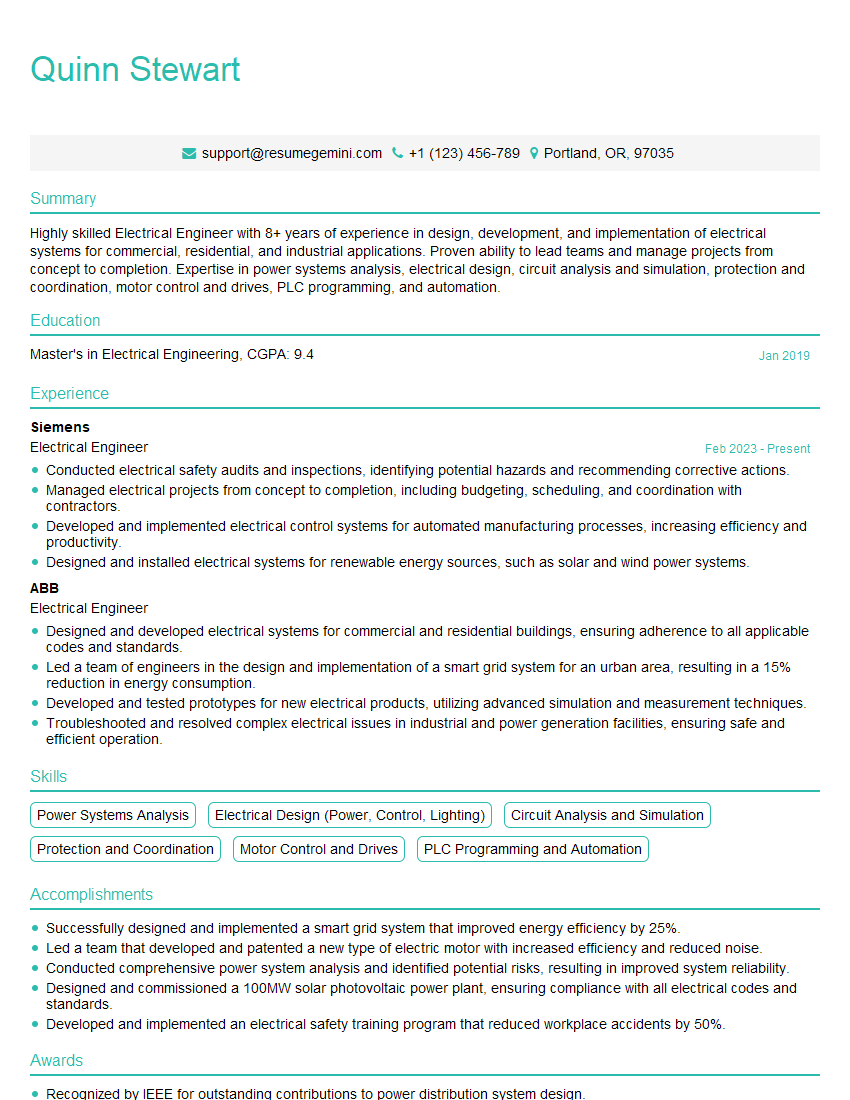
Electrical Engineer Resume Sample

Instrumentation Engineer Resume Sample

Power Systems Engineer Resume Sample

Circuit Design Engineer Resume Sample
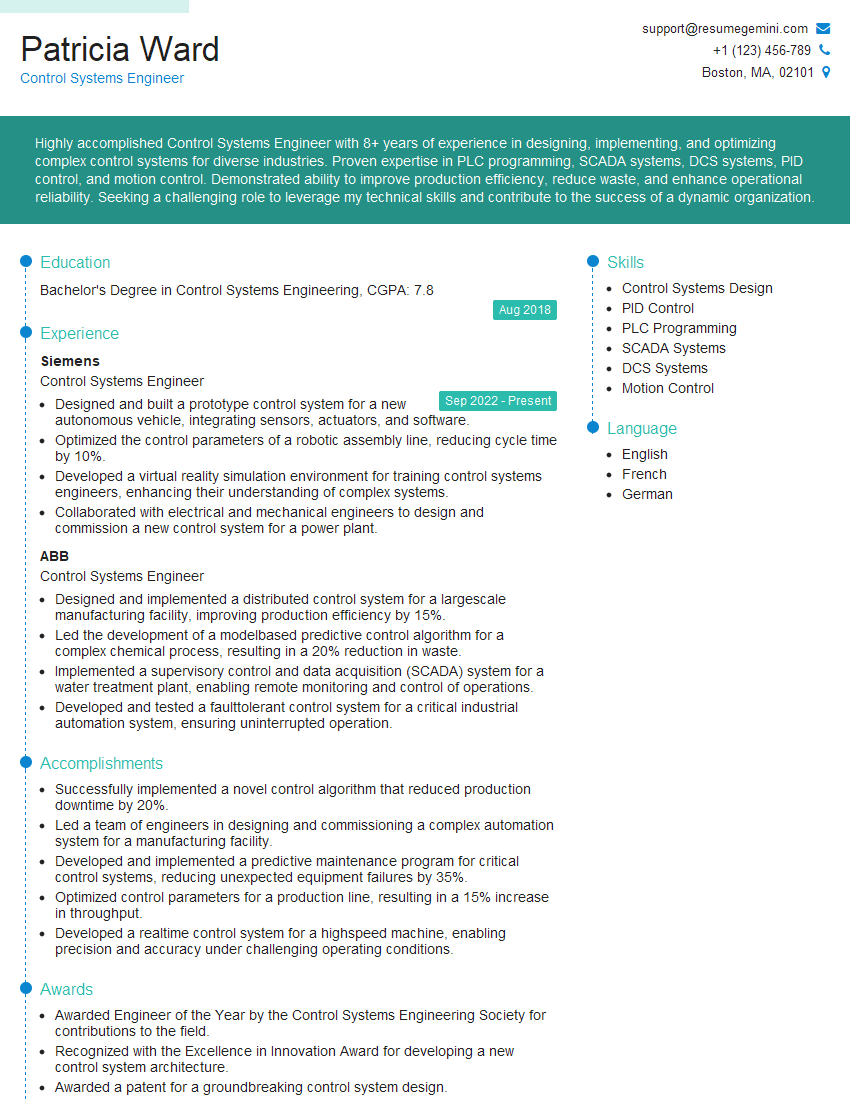
Control Systems Engineer Resume Sample

Microelectronics Engineer Resume Sample

Robotics Engineer Resume Sample

Electrical Technician Resume Sample
Explore more articles
Users Rating of Our Blogs
Share Your Experience
We value your feedback! Please rate our content and share your thoughts (optional).
What Readers Say About Our Blog
Really detailed insights and content, thank you for writing this detailed article.
IT gave me an insight and words to use and be able to think of examples