Unlock your full potential by mastering the most common Lampworking interview questions. This blog offers a deep dive into the critical topics, ensuring you’re not only prepared to answer but to excel. With these insights, you’ll approach your interview with clarity and confidence.
Questions Asked in Lampworking Interview
Q 1. What types of glass are commonly used in lampworking and what are their properties?
Lampworking utilizes various types of glass, each possessing unique properties that influence the final outcome of a piece. The choice of glass depends heavily on the desired color, transparency, and the specific techniques employed.
- Borosilicate Glass: This is a popular choice due to its low thermal expansion coefficient, meaning it withstands significant temperature changes without cracking. It’s known for its strength and durability, making it ideal for intricate designs and complex structures. Examples include commonly available brands like Northstar and Effetre.
- Soda-Lime Glass: This is a more readily available and often less expensive option. However, its higher thermal expansion coefficient requires more careful heating and cooling to prevent cracking. It’s frequently used for simple beads and projects where intricate manipulation isn’t required.
- Lead Crystal Glass: This type of glass offers exceptional brilliance and clarity, often used for creating stunningly sparkly effects. It’s heavier than borosilicate and requires experience to work with safely due to its higher lead oxide content. It tends to require specialized torches and techniques.
- Colored Glass: A vast array of colored glass is available, achieved through the addition of metallic oxides. The behavior of the glass during heating can vary depending on the colorant used; some colors may melt at different temperatures or react differently to the flame.
Understanding these properties is crucial for selecting the appropriate glass for a project and achieving the desired aesthetic and structural integrity.
Q 2. Describe your experience with different torch types and fuel sources.
My experience spans various torch types and fuels, each offering distinct advantages and disadvantages. Torch selection significantly impacts the control and precision achievable in lampworking.
- Handheld Torches: These offer the most control and are excellent for detailed work. I’ve worked extensively with both propane/oxygen and natural gas/oxygen torches. Propane provides a hotter flame, ideal for working with borosilicate glass, while natural gas offers a slightly softer flame suitable for more delicate glass types. The key difference lies in flame control and temperature regulation.
- Bench Torches: These larger torches provide a more stable and powerful flame, beneficial for larger projects or when working with thicker glass rods. They’re less maneuverable than handheld torches but offer improved heat consistency.
- Fuel Sources: Both propane and natural gas provide ample heat for lampworking. Oxygen is always necessary to achieve the required temperatures. I prefer propane for its higher temperature output, facilitating faster work and more efficient glass manipulation, especially with borosilicate. However, natural gas is more readily accessible and environmentally friendlier in some areas.
The choice of torch and fuel is often a matter of personal preference and the specific requirements of the project. I regularly switch between my handheld propane/oxygen and my bench torch depending on the complexity of what I’m making.
Q 3. Explain the process of creating a lampworked bead, from gathering glass to finishing.
Creating a lampworked bead is a multi-step process that demands precision and control. Let’s break down the steps:
- Gathering: Using the torch, I carefully heat the end of a glass rod until it softens, then gather a small amount of molten glass onto the end of a mandrel (a rod used as a shaping tool). This step requires a delicate touch to avoid bubbles or uneven gathering.
- Marvering: Once gathered, I roll the molten glass on a flat, heat-resistant surface to create a smooth, even surface. This removes any irregularities from the gathering process.
- Shaping: I use the torch to manipulate the molten glass, slowly building up the bead’s form. This involves carefully heating and stretching, shaping, and adding more glass as needed.
- Adding Color and Detail: Colored glass rods are added to introduce different colors and patterns. Various techniques like implosion, murrini, or stringer work can be used to add visual interest.
- Encasing: If desired, I can enclose the design within clear glass to protect it and give it more depth.
- Finishing: After the bead is cooled gradually, any imperfections are addressed. It is then often cleaned and polished, revealing the final creation.
Each step requires experience and a good understanding of glass properties to achieve the intended results. For instance, overheating can cause bubbles, while underheating can lead to cracks during the cooling process. Practice and patience are key.
Q 4. How do you control the temperature of your torch for different glass colors and effects?
Precise temperature control is essential for achieving desired results in lampworking, especially when working with different glass colors. Different glasses melt at different temperatures and some colors are more susceptible to bubble formation at higher temperatures than others.
- Flame Adjustment: I use the torch’s oxygen and fuel valves to adjust the flame’s size and intensity, controlling the heat applied to the glass. A smaller, more focused flame is suitable for delicate work, while a larger flame is used for heating larger volumes of glass.
- Glass Properties: I consider the specific melting point and thermal characteristics of each glass type and color. For example, some dark colors require higher temperatures to melt effectively.
- Observation: Observing the glass is paramount. The glass’s color and luminosity change as it heats; these cues guide me in controlling the temperature and preventing overheating or underheating.
- Temperature Monitoring Tools (Optional): Some artists use pyrometers to precisely measure glass temperature, but visual observation is primarily sufficient with enough experience.
Mastering temperature control takes time and practice. By paying close attention to the glass’s reaction to the flame and utilizing proper techniques, I can consistently achieve the desired results with various colors and effects.
Q 5. What are the common safety precautions when working with a torch and molten glass?
Safety is paramount when working with a torch and molten glass. Neglecting safety precautions can lead to serious injury.
- Eye Protection: Always wear safety glasses or a face shield to protect eyes from flying glass fragments or intense heat.
- Ventilation: Work in a well-ventilated area to avoid inhaling harmful fumes produced during the combustion process. A dedicated lampworking studio with a ventilation system is highly recommended.
- Heat Protection: Wear heat-resistant gloves and clothing to protect your skin from burns. Long sleeves and pants are preferred.
- Fire Safety: Keep a fire extinguisher nearby and be aware of potential fire hazards. Never leave a lit torch unattended.
- Work Surface: Use a heat-resistant work surface, such as a firebrick or ceramic tile, to protect your table from damage and prevent the accumulation of hot glass shards.
- First Aid: Have a first-aid kit readily available in case of minor injuries.
Safety should be ingrained in every step of the lampworking process. It is better to err on the side of caution to minimize any risk of accidents.
Q 6. Describe your experience with various lampworking techniques (e.g., implosion, murrini, fuming).
My experience encompasses various lampworking techniques, each adding unique visual and structural elements to my creations.
- Implosion: This involves creating a controlled collapse of a glass structure to create interesting internal textures and forms. It requires precise manipulation of the glass and a good understanding of its behavior under different temperatures.
- Murrini: Murrini are complex, intricately designed glass canes that are sliced and fused into beads or other forms. Creating murrini requires a high level of skill and patience in layering and fusing different glass colors.
- Fuming: This involves exposing molten glass to metallic fumes, creating beautiful iridescent and metallic effects. It’s a more advanced technique requiring specialized equipment and a controlled environment. Specific fume materials are crucial for achieving desired effects.
- Millefiori: Similar to Murrini, but creating intricate patterns from small canes. It requires precise placement and control during the fusing process.
- Stringer work: Adding thin strands of glass to add detailed patterns and embellishments.
Each technique adds a unique dimension to lampworking, and mastering them enhances creative capabilities. I frequently combine multiple techniques to generate complex and visually captivating designs.
Q 7. How do you troubleshoot common problems encountered during lampworking, such as bubbles or cracks?
Troubleshooting is an integral part of lampworking. Encountering bubbles or cracks is common, and understanding their causes is essential for preventing them in the future.
- Bubbles: Bubbles often result from trapped air during the gathering or shaping process. To minimize bubbles, ensure the glass is thoroughly heated before gathering, and avoid introducing air when working with molten glass. Sometimes, gentle reheating and manipulation can allow trapped air to escape but not all bubbles can be fixed.
- Cracks: Cracks usually occur due to rapid temperature changes or insufficient annealing. To prevent cracks, ensure the glass is heated and cooled slowly. Avoid sudden temperature fluctuations and always allow the piece to cool gradually after finishing.
- Inclusions: These are undesirable solid particles trapped in the glass. This can happen if the glass rod contains contaminants or if particles are introduced during the lampworking process. Using quality materials and a clean workspace prevents most inclusions.
- Devitrification: This is where the glass transitions from amorphous to crystalline structure. Slow cooling is key to avoiding devitrification.
Careful observation, attention to detail, and a systematic approach to problem-solving are key to overcoming these challenges. Understanding the cause of the problem is essential for effective troubleshooting.
Q 8. How do you design and plan a complex lampworked piece?
Designing a complex lampworked piece is like composing a symphony. It starts with a clear vision – a sketch, perhaps, or a detailed mental image. I begin by considering the overall form, thinking about the balance and flow of the piece. Then, I break down the design into smaller, manageable sections, like individual musical phrases. Each section might have its own color palette, texture, and techniques applied. I meticulously plan the order of application, considering how each layer interacts with the next, much like arranging instruments in an orchestra. For example, if I’m creating a complex multi-layered bead with intricate patterns, I’ll create a detailed diagram showing the order of color application and any special techniques like implosion or murrini.
I consider the technical feasibility of each step. Can I achieve the desired effect with my current skills and equipment? Sometimes, I create small test pieces to experiment with new techniques or color combinations before applying them to the final piece. This prevents costly mistakes and ensures a smooth workflow. Thorough planning is crucial in lampworking, as it’s a process that cannot easily be undone. A well-defined plan minimizes frustration and maximizes the chances of a successful outcome.
Q 9. What software or tools do you use for designing lampwork pieces?
While there aren’t dedicated software packages specifically designed for lampworking design like there are for 3D modeling, I rely heavily on a combination of tools. Sketching is paramount. I use both pencil and paper and digital drawing apps like Procreate or Adobe Fresco to create detailed sketches and explore different design ideas. These sketches help me visualize the piece in three dimensions and experiment with color palettes. I also frequently use photography and image editing software (Photoshop, GIMP) to manipulate images and create inspirational mood boards, collecting color schemes and textures that I might want to incorporate into my work. Taking photos of my previous projects also serves as a valuable reference library.
Q 10. Explain your process for annealing lampworked pieces.
Annealing is absolutely critical to prevent cracking or shattering of your lampwork pieces due to internal stresses created during the high-temperature forming process. It’s like slowly cooling down a piece of tempered glass to relieve tension. My annealing process begins with carefully placing the cooled-down piece into a kiln that’s already preheated to a specific temperature, generally around 900-950°F (482-500°C) for soft glass. The piece then slowly cools over several hours, typically according to a programmed cooling schedule. I carefully plan this schedule, aiming for a controlled and gradual decrease in temperature, to avoid rapid thermal shock. This gradual cooldown is essential. I use a kiln with programmable temperature controllers to ensure a precise and consistent cooling rate. This is often a multi-step process, with plateaus and slow decreases built into the schedule to minimize stress.
The duration of the annealing cycle depends on the size and thickness of the piece. Larger, thicker pieces require longer annealing times to allow for complete stress relief. After the annealing cycle is complete, the kiln is turned off and allowed to cool completely to room temperature before removing the pieces. I always double-check the cooling schedule to make sure it is appropriate for the size and type of glass being annealed.
Q 11. How do you maintain and clean your torch and equipment?
Maintaining my torch and equipment is as important as the creative process itself. Regular cleaning is essential to ensure optimal performance and longevity. After each lampworking session, I thoroughly clean my torch head, removing any built-up glass debris or soot using a specialized brush and a damp cloth. For my oxygen and propane tanks, I check the pressure gauges regularly and ensure they are securely connected. My workstation is cleaned daily to remove glass fragments which helps prevent accidental cuts and ensures a tidy workspace.
I regularly inspect the torch’s tip for any damage or wear and replace it as needed to maintain a consistent flame. For other tools, like mandrels (rods used to shape glass), I clean them thoroughly with isopropyl alcohol to remove any residue. Preventative maintenance, like lubricating moving parts on equipment as necessary, extends its lifespan. A well-maintained setup allows for better control, consistency, and overall safety. A clean work area prevents accidental contamination, which can impact the appearance and integrity of future work.
Q 12. Describe your experience working with different types of kilns for annealing.
My experience spans different kilns, each with its own characteristics. I’ve used both small, desktop kilns ideal for smaller lampwork projects and larger, industrial kilns capable of handling numerous pieces simultaneously. Desktop kilns are convenient for smaller batches or individual pieces, providing excellent control over the annealing process. Their smaller size makes them easier to manage and requires less energy. However, larger kilns are far more efficient for high-volume production, allowing for a larger capacity and potentially more even heating distribution, but often require more sophisticated controls and scheduling.
The key difference lies in the level of control and capacity. Regardless of the kiln size, I always carefully program the annealing schedule to accommodate the specific glass type and piece dimensions. A programmable controller, which includes a detailed log of temperatures over time, is essential to prevent any annealing errors, regardless of kiln type. Careful calibration and regular maintenance are essential for accurate temperature regulation in either scenario.
Q 13. How do you handle color mixing and blending in lampworking?
Color mixing and blending in lampworking is an art in itself. It’s like painting with fire, but with the added complexity of glass’s fluidity and how the heat affects its properties. I understand the properties of different glass colors and how they react at high temperatures. Some glasses are more transparent, while others are more opaque, and some have unique chemical compositions influencing the way colors interact.
I typically begin by experimenting with small test samples to explore the color combinations. I’ll layer different colored rods, marbling them together or creating gradual color transitions using various techniques, like pulling and layering multiple rods together to achieve the desired effect. There is a learning curve involved in understanding how the temperature affects the final result, Sometimes, it is necessary to adjust the torch temperature or the layering techniques to achieve precise color blending. Color charts and extensive documentation of previous experiments are invaluable resources in this process.
Q 14. What are your preferred methods for finishing and polishing lampworked pieces?
Finishing and polishing lampworked pieces enhances their visual appeal and adds a professional touch. After annealing, I carefully inspect the piece for any imperfections. I use different grades of sandpaper, starting with coarser grits to remove any major imperfections, then progressing to finer grits for a smoother surface. The process is gradual and requires patience, paying close attention to avoid scratching the delicate glass surface. Once the sanding is complete, I utilize a series of polishing compounds, applied with soft polishing pads, to create a high-gloss finish.
Sometimes, I’ll use specialized polishing tools such as a rotary tool with polishing bits for intricate details. The final polishing is done with a very fine compound, achieving a glass-like shine. For certain designs, I may opt for a satin finish instead of a high-gloss polish, depending on the desired aesthetic. The key is to maintain a steady, light pressure during the polishing process and to regularly change polishing compounds to avoid scratches. The choice of finishing technique ultimately depends on the artistic intent and the piece’s specific design.
Q 15. What are the different types of glass finishes you can achieve?
Achieving diverse glass finishes in lampworking is key to creating unique pieces. It’s all about controlling the glass’s surface tension and temperature during the process. The most common finishes include:
- High Gloss/Polished: This is achieved through careful annealing (slow cooling) and sometimes additional polishing with a fine abrasive. It results in a smooth, reflective surface.
- Matte/Frosted: A matte finish is created by either using specific glass types known for their matte properties or by applying a frosting agent during the process. This creates a diffused, non-reflective surface.
- Texture/Hammered: Using various tools like paddles, textured marbles, or even applying heat unevenly, you can create textured surfaces ranging from subtle ripples to dramatic hammered effects.
- Iridized: By adding metallic oxides (like gold or silver) to the glass during the melting process, you can achieve an iridescent effect that shifts colors depending on the light.
- Dichroic: This highly reflective finish employs thin layers of metallic coatings on the glass that produce brilliant, shifting colors.
- Frit/Millefiori: Incorporating small glass fragments (frit) or pre-made cane slices (Millefiori) adds depth and visual interest, creating textured and varied surfaces.
The exact finish depends on the type of glass used, the firing temperature, and the tools and techniques applied. For example, a highly polished finish demands precise annealing, while a textured finish necessitates targeted heat application and manipulation with tools.
Career Expert Tips:
- Ace those interviews! Prepare effectively by reviewing the Top 50 Most Common Interview Questions on ResumeGemini.
- Navigate your job search with confidence! Explore a wide range of Career Tips on ResumeGemini. Learn about common challenges and recommendations to overcome them.
- Craft the perfect resume! Master the Art of Resume Writing with ResumeGemini’s guide. Showcase your unique qualifications and achievements effectively.
- Don’t miss out on holiday savings! Build your dream resume with ResumeGemini’s ATS optimized templates.
Q 16. Describe your experience with creating custom designs from client specifications.
Collaborating with clients on custom designs is a significant part of my work. I start by having an in-depth consultation, understanding their vision, budget, and timeframe. We discuss materials, styles, and any specific details they have in mind, whether it’s a specific color palette, incorporating family heirlooms, or replicating a design they’ve seen.
I then create detailed sketches and sometimes digital renderings to visualize the final product. This iterative process ensures everyone is on the same page. Once the design is finalized, I provide a detailed quote and timeline. Throughout the creation process, I keep the client informed with updates and photos, ensuring transparency and addressing any concerns proactively. For example, I recently worked with a client who wanted a lampwork pendant incorporating her grandmother’s favorite colors and a small amethyst stone. The final piece was a testament to our collaborative effort and her joy in owning something both beautiful and personal.
Q 17. How do you estimate the time and materials required for a lampworking project?
Estimating time and materials is crucial for successful project management. My estimation process combines experience and a structured approach. First, I analyze the design’s complexity, considering the number of colors, techniques involved (e.g., intricate marvering, detailed sculpting), and the size of the piece.
For materials, I calculate the amount of glass rods, frit, and any other embellishments needed. I account for potential waste, considering factors like glass breakage and re-melting. For time, I estimate the number of hours needed for each stage: design, preparation, fabrication, annealing, and finishing. My estimation is based on my past projects; a complex piece may take several days of concentrated work, whereas a simpler one might only take a few hours. I always build in a buffer for unforeseen circumstances to ensure I meet the deadlines.
Q 18. How do you price your lampworked pieces?
Pricing my work is a careful balancing act, factoring in several key aspects. The most significant factor is the cost of materials; glass rods can be expensive, especially rare and high-quality colors. Next, I consider the time invested in the project. My hourly rate is established based on my experience and the market value of similar lampwork pieces. Finally, I incorporate the complexity of the design. Intricate techniques and unique embellishments significantly increase the value and therefore the price.
I always provide clients with a transparent breakdown of the pricing, clearly showing the cost of materials, labor, and any additional services. It’s about being fair while also reflecting the artistry, skill, and time invested.
Q 19. Describe your experience with marketing and selling your lampworked creations.
Marketing and selling my lampwork creations involve a multi-faceted approach. I maintain an online presence through an Etsy shop and a personal website showcasing my work. High-quality photography is essential in showcasing the brilliance and detail of each piece. I actively engage in social media marketing, sharing my creative process, showcasing finished pieces, and interacting with potential customers.
Participation in local art fairs and craft shows provides an opportunity to interact directly with customers, demonstrate my skills, and receive valuable feedback. Word-of-mouth referrals are also incredibly important. Building a strong reputation for quality and customer service helps create a loyal following. For example, positive reviews on Etsy have significantly increased my visibility and sales.
Q 20. What are your strengths and weaknesses as a lampworker?
My strengths lie in my technical proficiency and creative vision. Years of practice have honed my ability to execute complex designs with precision and control. I’m also adept at problem-solving, able to quickly adjust techniques when necessary. My weakness, if I had to pinpoint one, would be sometimes over-committing to projects. I’m passionate about my work and want to deliver the best possible result for every client, which occasionally leads to a heavier workload. I am actively working on improving my time management skills to balance my passion with a sustainable workflow.
Q 21. How do you stay updated with current trends and techniques in lampworking?
Staying updated is vital in any artistic field. I regularly attend workshops and conferences, both in person and online, to learn new techniques and explore new glass types and materials. I subscribe to lampworking magazines and follow influential artists on social media platforms. Online forums and communities are also excellent resources for sharing knowledge and collaborating with other artists. I actively seek feedback on my work and am always open to experimenting and pushing my creative boundaries.
Q 22. Describe a time you had to overcome a significant challenge in lampworking.
One of the biggest challenges I faced was mastering the intricate art of murrine making. Murrine are complex, pre-made canes of glass with intricate patterns, which are then incorporated into larger lampwork pieces. Initially, I struggled with achieving consistent, crisp patterns and preventing the canes from cracking or distorting during the fusing process. It’s like trying to bake a delicate cake while simultaneously juggling – demanding precision and patience.
To overcome this, I meticulously studied various techniques, experimenting with different glass compositions, fusing temperatures, and manipulation methods. I kept detailed notes of each attempt, documenting what worked and, more importantly, what didn’t. I also sought feedback from experienced lampworkers, attending workshops and studying their processes. Gradually, through persistent experimentation and analysis, I refined my technique, achieving consistently beautiful and intricate murrine canes.
This experience taught me the importance of meticulous planning, persistent experimentation, and the value of learning from others’ expertise. It’s a testament to the fact that even seemingly insurmountable challenges in lampworking can be overcome with dedication and a systematic approach.
Q 23. What is your experience with working independently versus collaboratively on projects?
I’m comfortable working both independently and collaboratively. Independent work allows for focused creativity and deep exploration of personal artistic vision. For instance, I recently completed a solo project creating a series of unique, intricately detailed pendants, each telling a miniature story through glass. This required intense focus and allowed me to fully develop my artistic expression without compromise.
However, collaborative projects bring a different set of advantages. Working with others fosters cross-pollination of ideas, leading to innovative designs and problem-solving approaches. I recently collaborated on a large-scale installation piece where each artist contributed specialized skills. I focused on creating the intricate glass components, while other artists handled aspects like framing and lighting. This collective expertise led to a more ambitious and impactful final product.
Ultimately, my preference depends on the project’s scope and objectives. I thrive in both environments, understanding the strengths and limitations of each approach.
Q 24. How do you manage your time and prioritize tasks in a studio setting?
Effective time management is crucial in a studio setting. I employ a combination of strategies to prioritize tasks and maintain productivity. I begin each week by creating a detailed schedule, breaking down large projects into smaller, manageable steps. This allows me to allocate specific time slots for various tasks, like glass preparation, lampworking, annealing, and finishing.
I use a Kanban board – a visual system for tracking project progress – to monitor the workflow. This helps me prioritize urgent tasks and maintain a clear overview of outstanding projects. I also set realistic deadlines and regularly review my progress, adjusting my schedule as needed. This prevents burnout and ensures a consistent flow of work.
Additionally, I dedicate specific times for cleanup and maintenance of my workspace, which enhances efficiency and prevents interruptions. This proactive approach ensures that my studio remains an organized and productive environment.
Q 25. What are your long-term goals as a lampworker?
My long-term goals involve expanding my artistic reach and sharing my passion for lampworking with a wider audience. I aspire to exhibit my work nationally and internationally, showcasing the beauty and versatility of this ancient art form. This includes participating in prestigious art shows and exploring opportunities for collaborative projects with other artists.
Beyond exhibition, I aim to establish a comprehensive online learning platform, providing high-quality tutorials and courses to aspiring lampworkers. I believe in democratizing access to this captivating craft, empowering others to discover and master its intricacies. Ultimately, I wish to contribute to the preservation and evolution of lampworking as a respected and vibrant art form.
Q 26. Describe your experience with different glass suppliers and their products.
Over the years, I’ve worked with several glass suppliers, each with its strengths and weaknesses. For example, I frequently use Bullseye Glass for its wide range of colors and consistent quality. Their dichroic glass, which exhibits stunning iridescent effects, is a favorite for my more experimental pieces. However, their pricing can be on the higher end.
I also utilize glass from North Star Glass, appreciating their affordability and extensive selection of frit (small, crushed glass particles). Frit is essential for creating textural effects and fine details in my work. However, the color consistency can be slightly less predictable compared to Bullseye. Lastly, I occasionally source specialty glasses from smaller, independent suppliers, seeking out unique colors and textures not readily available from the larger companies.
Choosing a supplier is a delicate balance between quality, price, and the specific needs of my projects. Each glass type necessitates understanding its characteristics to ensure optimal results.
Q 27. How do you maintain the cleanliness and organization of your workspace?
Maintaining a clean and organized workspace is paramount for both safety and efficiency. My daily routine includes clearing away excess glass scraps and dust using a HEPA filtered vacuum. I keep my tools meticulously organized in designated containers, ensuring easy accessibility and preventing accidental damage. I frequently wipe down work surfaces to prevent the build-up of glass dust, which is a respiratory irritant.
At the end of each working session, I conduct a thorough cleaning of the torch area, removing any residual glass debris. I also store my completed pieces in protective cases to prevent scratches and damage. This methodical approach not only maintains a safe and efficient working environment but also prolongs the life of my tools and ensures the integrity of my creations.
Q 28. What is your experience with repairing damaged lampwork pieces?
Repairing damaged lampwork pieces can be challenging, requiring a delicate touch and a keen understanding of glass properties. The approach depends heavily on the type and extent of the damage. For small chips or cracks, I often use fine-grain glass powder and a low-temperature torch to fuse the fragments back together, ensuring a seamless repair that maintains the integrity of the piece. This is analogous to patching a delicate ceramic item.
More significant damage, such as a large fracture, necessitates a more complex repair, potentially involving the addition of new glass to rebuild the structure. This may require rebuilding lost sections using appropriate colors and textures, matching the original piece as closely as possible. In such cases, patience and precision are crucial for an aesthetically pleasing and structurally sound repair. The goal is always to blend the repair seamlessly, maintaining the artistic integrity of the original piece.
Key Topics to Learn for Your Lampworking Interview
- Glass Properties & Selection: Understanding different glass types (borosilicate, soda-lime, etc.), their melting points, coefficients of thermal expansion, and suitability for various applications. Practical application: Explain your experience choosing the right glass for a specific project and why.
- Flame Control & Manipulation: Mastering the torch’s various flames (reducing, oxidizing), adjusting gas flow and pressure for different effects, and controlling the heat source for precise glass manipulation. Practical application: Describe your technique for achieving consistent results in shaping intricate designs.
- Glass Forming Techniques: Proficiency in implosion, encasement, murrini, and other relevant lampworking techniques. Practical application: Showcase your understanding of different techniques and their appropriate uses through specific examples from your portfolio.
- Safety Procedures & Studio Practices: Understanding and adhering to safety protocols in a lampworking studio, including proper ventilation, eye protection, and handling of hot glass. Practical application: Explain how you ensure a safe working environment for yourself and others.
- Troubleshooting & Problem Solving: Identifying and resolving common issues like devitrification, bubbles, cracks, and color inconsistencies. Practical application: Describe a time you encountered a technical challenge during lampworking and how you overcame it.
- Design & Aesthetics: Demonstrating an understanding of design principles, color theory, and the creation of aesthetically pleasing pieces. Practical application: Discuss your creative process and how you translate your ideas into finished work.
- Finishing & Post-Processing: Techniques for cleaning, annealing, and finishing your pieces to achieve a professional and high-quality final product. Practical application: Explain your preferred methods for achieving a polished finish.
Next Steps
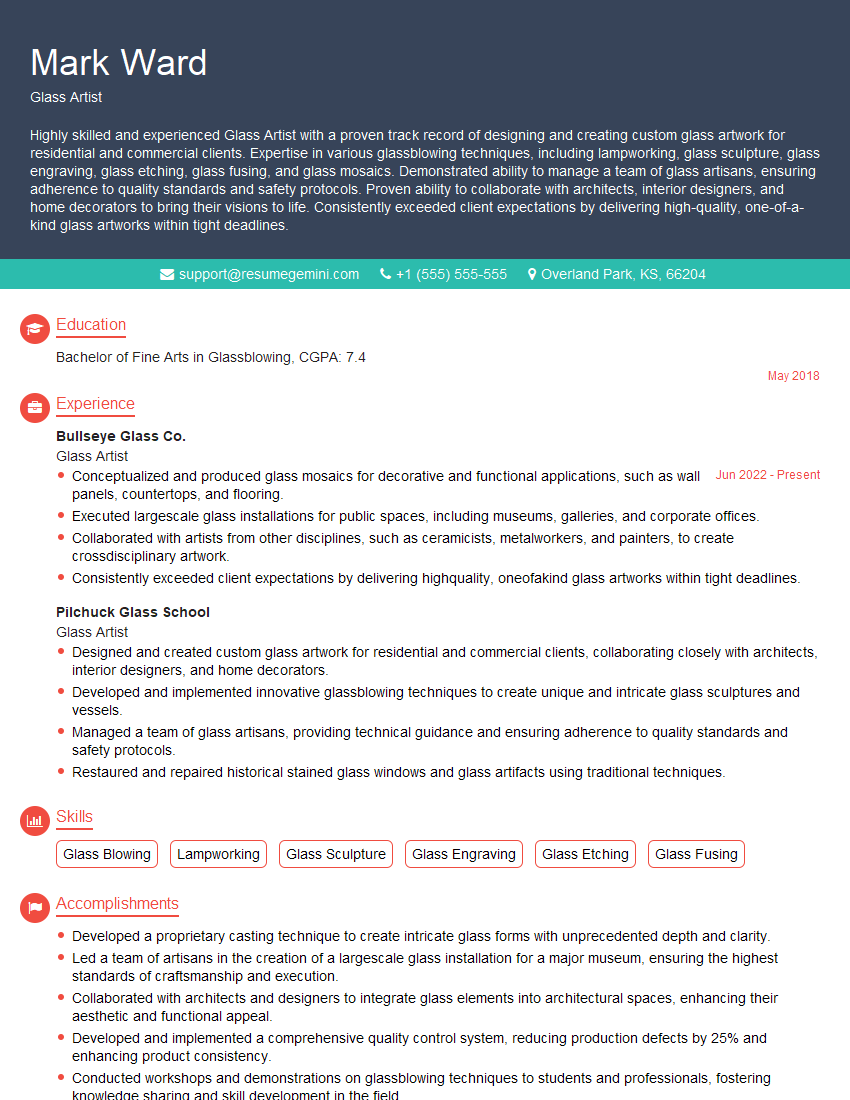
Mastering lampworking opens doors to a rewarding career filled with creativity and technical skill. To maximize your job prospects, creating a strong, ATS-friendly resume is crucial. ResumeGemini is a trusted resource that can help you build a professional and impactful resume, enhancing your chances of landing your dream lampworking job. Examples of resumes tailored specifically to the lampworking field are available to guide you.
Explore more articles
Users Rating of Our Blogs
Share Your Experience
We value your feedback! Please rate our content and share your thoughts (optional).
What Readers Say About Our Blog
Really detailed insights and content, thank you for writing this detailed article.
IT gave me an insight and words to use and be able to think of examples