Interviews are opportunities to demonstrate your expertise, and this guide is here to help you shine. Explore the essential Laser Automation interview questions that employers frequently ask, paired with strategies for crafting responses that set you apart from the competition.
Questions Asked in Laser Automation Interview
Q 1. Explain the different types of lasers used in industrial automation.
Industrial automation utilizes several laser types, each with unique properties best suited for specific tasks. The choice depends on factors like material to be processed, required precision, and desired speed.
- Fiber Lasers: Highly efficient and compact, these are commonly used for cutting, welding, and marking metals. Their high beam quality allows for fine detail and deep penetration. I’ve extensively used fiber lasers in automotive manufacturing for precise welding of sheet metal components.
- CO2 Lasers: These are excellent for processing non-metals like wood, plastics, and textiles due to their ability to efficiently absorb energy in this wavelength. I’ve worked with CO2 lasers for cutting intricate designs in acrylic sheets for signage applications.
- Nd:YAG Lasers: These solid-state lasers offer versatility and are used for various applications, including cutting, welding, and marking metals and some plastics. Their longer wavelength allows deeper penetration compared to fiber lasers in certain materials. During my time at a medical device company, we employed Nd:YAG lasers for precise micro-welding.
- UV Lasers: These lasers produce short wavelengths, offering high precision for micromachining and fine marking on various materials. Their ability to ablate materials without significant heat affected zones makes them ideal for delicate processes. I’ve used UV lasers for marking serial numbers onto microchips.
Understanding the nuances of each laser type is critical for optimal performance and efficiency in automation.
Q 2. Describe your experience with laser safety protocols and regulations.
Laser safety is paramount, and throughout my career, I’ve adhered strictly to all relevant regulations, including ANSI Z136.1 and ISO 11553. My experience includes developing and implementing comprehensive safety programs incorporating:
- Risk Assessments: Conducting thorough assessments to identify and mitigate potential hazards associated with laser operation. This includes identifying the laser’s class, calculating Nominal Ocular Hazard Distance (NOHD), and implementing control measures.
- Engineering Controls: Implementing safety features such as laser enclosures, interlocks, and beam shutters to prevent accidental exposure. For example, I oversaw the integration of an automated shutter system on a high-power laser system to ensure safe operation.
- Administrative Controls: Developing and enforcing safety procedures, training programs, and emergency response plans. I’ve trained numerous technicians on safe laser operation and emergency procedures.
- Personal Protective Equipment (PPE): Ensuring all personnel wear appropriate PPE, including laser safety eyewear specifically rated for the wavelength and power of the laser in use. Failure to utilize correct PPE can lead to serious eye injury.
Regular safety inspections and audits are crucial to maintain a safe working environment. Ignoring safety protocols can lead to severe injuries and legal repercussions.
Q 3. What are the common challenges in integrating laser systems into existing automation lines?
Integrating laser systems into existing automation lines presents several challenges:
- Integration Complexity: Laser systems often require specialized interfaces and control systems that need to be seamlessly integrated with existing PLCs and robotics. This involves careful planning, coordination, and specialized expertise.
- Safety Requirements: Ensuring compliance with laser safety standards within an existing facility can be complex, requiring modifications to the layout and safety systems.
- Space Constraints: Existing automation lines may have limited space, requiring careful consideration of the laser system’s footprint and beam path.
- Compatibility Issues: Ensuring compatibility between the laser system’s parameters (e.g., beam size, power, pulse duration) and the material being processed and the existing automation equipment requires careful selection and testing.
- Process Optimization: Optimizing the laser parameters (power, speed, focal point) for the desired process (cutting, welding, marking) while maintaining the required quality and throughput can be a time-consuming process that involves iterative adjustments.
Addressing these challenges requires careful planning, a deep understanding of both the laser system and the existing automation line, and a collaborative approach involving engineers from various disciplines.
Q 4. How do you troubleshoot laser system malfunctions?
Troubleshooting laser system malfunctions requires a systematic approach. I typically follow these steps:
- Safety First: Ensure the laser system is safely shut down before commencing any troubleshooting.
- Review Error Logs and Diagnostics: Check the laser system’s error logs and diagnostic messages for clues. Many systems provide detailed information about the nature of the malfunction.
- Visual Inspection: Carefully inspect the entire system, checking for loose connections, damaged components, or any obvious signs of malfunction (e.g., burnt parts, unusual noises).
- Power Supply and Connections: Verify that the laser system is receiving the correct power supply and that all connections are secure. A simple loose connection can disrupt the entire system.
- Beam Path Alignment: Ensure that the laser beam is properly aligned throughout the entire system. Misalignment can lead to reduced performance or damage to components.
- Component Testing: Systematically test individual components (e.g., laser head, optics, control electronics) to pinpoint the source of the problem. This may require specialized equipment and knowledge.
- Software and Control System Checks: Inspect the software and control system for any errors or configuration issues. This could involve checking PLC programs or laser control software parameters.
If the problem persists, consulting the manufacturer’s documentation or seeking assistance from technical support is essential.
Q 5. Explain your experience with different laser beam delivery methods.
Different laser beam delivery methods are crucial for optimizing laser processing. The method depends on factors like the application, material, and required precision.
- Free Space Beam Delivery: This involves directly transmitting the laser beam through air, often using mirrors and lenses to guide and focus the beam. I’ve used this method for large-scale laser cutting and welding applications, where the work area is accessible.
- Fiber Optic Beam Delivery: This uses optical fibers to transmit the laser beam, offering flexibility and protection from environmental factors. I’ve extensively used this approach for applications requiring precise positioning and protection from dust or debris, like in micro-machining.
- Scanning Systems: These systems use galvanometers or other scanning devices to rapidly deflect the laser beam across the work surface. This is essential for high-speed marking, engraving, and even cutting applications, allowing intricate patterns to be created.
- Articulated Arms: These robotic arms with integrated laser systems offer flexibility for reaching complex workpieces in various orientations. I’ve integrated articulated arms in robotic welding cells to allow for complex three-dimensional welding paths.
Choosing the appropriate beam delivery method is critical for achieving the desired level of accuracy, speed, and quality in laser processing.
Q 6. Describe your experience with PLC programming related to laser automation.
I have extensive experience with PLC programming related to laser automation, primarily using Siemens TIA Portal and Rockwell Automation Studio 5000. My expertise includes:
- Laser Control: Programming PLCs to control the laser’s parameters (power, pulse duration, frequency) based on the specific requirements of the application. This often involves using analog and digital I/O to interface with the laser control system. For example, I wrote a program to control the pulse width of a fiber laser based on the thickness of the material being welded.
- Motion Control: Integrating laser systems with robotic systems or other motion control devices to precisely position the workpiece or laser head. This involves using motion control libraries and coordinating the laser’s operation with the movement of the workpiece.
- Safety Interlocks: Programming safety interlocks and emergency stop functions to ensure the safe operation of the laser system. These safety measures are crucial for avoiding accidents.
- Data Acquisition and Monitoring: Developing programs to acquire data from the laser system (e.g., power, energy, process time) and store this data for analysis and quality control. I designed programs that collect data on the weld penetration depth and width to monitor process stability.
- HMI Development: Designing intuitive human-machine interfaces (HMIs) for easy operation and monitoring of the laser system. This includes creating user-friendly screens for parameter adjustments, status monitoring, and error handling.
Proficiency in PLC programming is indispensable for efficient and safe laser automation systems.
Q 7. How do you ensure the accuracy and precision of laser-based processes?
Ensuring the accuracy and precision of laser-based processes is critical for quality and efficiency. Several strategies are employed:
- Precise Beam Alignment: Regular and precise alignment of the laser beam is essential using high-quality optical components and alignment tools. Small misalignments can drastically affect accuracy.
- High-Quality Optics: Utilizing high-quality lenses and mirrors minimizes aberrations and ensures a well-defined and focused beam. Poor-quality optics can lead to reduced precision and inconsistent results.
- Calibration and Verification: Regular calibration of the laser system and verification of its performance using precision measurement techniques are essential for maintaining accuracy over time. This might involve using interferometry or other high-precision measurement techniques.
- Process Parameter Optimization: Careful optimization of laser parameters (power, speed, focal position) based on the material being processed and the desired outcome. This often involves experimentation and iterative adjustments.
- Feedback Control Systems: Implementing closed-loop feedback control systems to monitor and adjust the process in real-time, compensating for variations in material properties or environmental conditions. For example, sensor feedback can be used to adjust the laser power based on the thickness of the material.
- Automated Inspection Systems: Integrating automated inspection systems to verify the quality of the processed parts and identify any deviations from the specifications. This ensures consistent quality and immediate identification of any issues.
A multi-faceted approach incorporating these strategies is crucial to achieve and maintain the required accuracy and precision in laser-based manufacturing processes.
Q 8. What are the different types of laser sensors and their applications?
Laser sensors are crucial components in laser automation, providing feedback for precise control and process monitoring. They come in various types, each suited to specific applications.
- Fiber Optic Sensors: These use fiber optics to transmit and receive light, allowing for remote sensing and high precision. Applications include detecting the presence or absence of parts, measuring distances, and monitoring laser beam power. For instance, in a robotic welding cell, a fiber optic sensor might verify the proper placement of a part before the laser initiates the weld.
- Photodiodes and Phototransistors: These are semiconductor devices that convert light into an electrical signal. They’re relatively inexpensive and commonly used for simple on/off detection or intensity measurement. A common application is monitoring the laser’s output power to ensure consistency.
- Laser Displacement Sensors (Triangulation): These sensors use triangulation to measure the distance to an object. A laser beam is projected onto the surface, and the reflected light is analyzed to determine the distance. This is extensively used in laser cutting and marking applications to ensure accurate positioning and depth control. Imagine a laser cutting system needing precise depth control of the cut; this sensor would ensure the laser interacts with the material at the programmed depth.
- Time-of-Flight Sensors: These sensors measure the time it takes for a laser pulse to travel to a target and back, enabling accurate distance measurement over longer ranges. Applications include automated guided vehicles (AGVs) used in laser material processing facilities for efficient part handling.
The choice of sensor depends heavily on the application’s requirements, considering factors like accuracy, range, speed, and cost.
Q 9. Explain your experience with laser-based material processing techniques (e.g., cutting, welding, marking).
My experience spans various laser-based material processing techniques. I’ve worked extensively with laser cutting, welding, and marking, across diverse materials such as metals, polymers, and ceramics.
In laser cutting, I’ve focused on optimizing cutting speed, power, and assist gas parameters to achieve high-quality cuts with minimal heat-affected zones. One project involved optimizing the laser cutting process for thin stainless steel sheets, resulting in a 20% increase in throughput and a reduction in material waste.
Laser welding has been another key area of my expertise, particularly in applications requiring precision and repeatability. I’ve worked on projects involving the welding of intricate components using different laser modes (e.g., continuous wave, pulsed). This included developing strategies to manage heat input to prevent warping or distortion, even in challenging geometries.
Laser marking has involved the creation of high-contrast, durable markings on various materials. I’ve worked on optimizing laser parameters (pulse width, frequency, power) to create different types of marks, ranging from simple serial numbers to intricate logos. This often involved working closely with clients to define mark characteristics and material compatibility.
Throughout my career, I’ve consistently applied lean principles to optimize processes and minimize downtime in all these material processing techniques.
Q 10. How do you optimize laser processing parameters for different materials?
Optimizing laser processing parameters for different materials is a critical aspect of efficient and high-quality laser automation. It involves a systematic approach considering the material’s physical and thermal properties. This typically involves experimentation and iterative refinement.
First, we need to understand the material’s absorptivity at the laser wavelength. Different materials absorb laser energy differently, impacting the processing outcome. For example, metals generally absorb CO2 laser radiation more efficiently than plastics.
Next, we consider the thermal conductivity and melting point of the material. Materials with high thermal conductivity dissipate heat quickly, requiring higher laser power for efficient processing. Conversely, materials with lower melting points require lower power to prevent damage.
Process parameters are then adjusted based on these material properties and desired outcomes. These parameters include:
- Laser power: This determines the energy delivered to the material.
- Pulse duration (for pulsed lasers): This controls the heat input per pulse.
- Scan speed: This affects the energy density at the material surface.
- Focal position: This dictates the depth of penetration for cutting or welding.
- Assist gas type and pressure: This removes molten material and controls the cut or weld quality.
I usually employ Design of Experiments (DOE) methodologies to systematically explore the parameter space and identify the optimal settings. This often involves using statistical software to analyze the results and identify the combination of parameters that produce the desired results. Through this process, we can optimize for speed, quality, repeatability, and cost-effectiveness.
Q 11. Describe your experience with vision systems integrated with laser automation.
My experience with vision systems integrated with laser automation is extensive. Vision systems are essential for ensuring accurate part placement, orientation, and process monitoring. They provide critical feedback to the laser system, allowing for real-time adjustments and error correction.
I’ve worked on projects where vision systems are used for part recognition and localization. This is crucial for automated laser cutting and welding processes, ensuring the laser interacts with the correct location on the part. For example, in a project involving laser marking of circuit boards, a vision system identified the components and oriented the board before marking specific areas, eliminating the need for manual adjustments.
Another key application is process monitoring. Vision systems can analyze the laser processing outcome in real-time, detecting defects or inconsistencies. This allows for immediate adjustments to laser parameters or intervention if necessary. In a laser welding application, the vision system could detect a weld defect (e.g., incomplete penetration) and trigger an alarm or initiate corrective action.
Integrating vision systems requires expertise in both laser automation and machine vision. This includes selecting appropriate cameras, lenses, and lighting, developing algorithms for image processing and analysis, and integrating the vision system with the laser control system via communication protocols (e.g., Ethernet/IP, PROFINET).
Q 12. How do you perform preventative maintenance on laser systems?
Preventative maintenance is critical for ensuring the longevity, reliability, and safety of laser systems. My approach is proactive, following a structured maintenance schedule.
The schedule includes:
- Regular cleaning: This includes cleaning laser optics (mirrors, lenses), focusing lenses, and the work area to prevent dust and debris from interfering with the laser beam. Contamination of optical elements can significantly affect beam quality and processing results.
- Optical alignment checks: Periodic checks ensure the laser beam is properly aligned throughout the optical path. Misalignment can lead to reduced power at the workpiece and inconsistent processing results.
- Gas purity checks (if applicable): For laser systems requiring assist gas (e.g., cutting or welding), regular checks of gas purity are necessary. Impurities in the gas can impact cut or weld quality. This includes monitoring gas pressure and flow rates.
- Cooling system checks: Laser systems generate significant heat and rely on efficient cooling systems. Regular checks of the cooling system ensure proper operation and prevent overheating.
- Software and firmware updates: Staying up-to-date with software and firmware ensures optimal performance and avoids potential bugs or vulnerabilities.
- Documentation: Maintaining meticulous documentation of all maintenance activities, including dates, actions, and any findings, is crucial for tracking system performance and identifying potential issues early.
Beyond the scheduled maintenance, operators are trained to recognize potential problems early on, based on unusual sounds, laser power fluctuations, or processing inconsistencies. These procedures have proven effective in preventing major failures and improving the overall efficiency of the laser systems under my care.
Q 13. What are the key performance indicators (KPIs) you monitor in laser automation?
Key Performance Indicators (KPIs) in laser automation are carefully selected to monitor efficiency, quality, and safety. The specific KPIs depend on the application, but some common ones include:
- Throughput: Measured in parts per hour or minute, this reflects the processing speed and efficiency of the system.
- Uptime: The percentage of time the system is operational, indicating system reliability and minimizing downtime.
- Defect rate: The percentage of processed parts with defects, reflecting the quality of the processing. This KPI is often measured through manual or automated inspection.
- Material utilization: The amount of material used per processed part, optimizing material usage and reducing waste. This is especially important for expensive materials.
- Energy consumption: Monitoring energy usage helps reduce operational costs and improve environmental sustainability.
- Maintenance cost: Tracking maintenance costs helps optimize maintenance strategies and predict future maintenance needs.
- Safety incidents: Monitoring safety incidents ensures a safe working environment. This includes recording near misses and implementing corrective actions.
By regularly monitoring these KPIs, we can identify areas for improvement, optimize processes, and make data-driven decisions to enhance the overall effectiveness of the laser automation system.
Q 14. Explain your experience with laser beam quality analysis and control.
Laser beam quality is crucial for optimal laser processing. It’s characterized by parameters like beam diameter, divergence, and intensity profile. Analyzing and controlling beam quality ensures consistent and high-quality results.
I’ve used various techniques for beam quality analysis, including:
- Beam profiling cameras: These cameras capture the spatial intensity distribution of the laser beam, providing data on beam diameter, shape, and uniformity. This helps identify aberrations or inconsistencies in the beam profile.
- M2 measurement: This measures the beam quality factor (M2), quantifying the deviation of the beam from an ideal Gaussian beam. A lower M2 indicates higher beam quality.
- Wavefront sensors: These sensors measure the phase distortions in the laser beam, providing information about aberrations introduced by optical components. This is crucial for identifying and correcting optical imperfections.
Controlling beam quality involves optimizing the laser resonator, adjusting optical components (e.g., mirrors, lenses), and employing beam shaping techniques. For instance, I’ve worked on a project where implementing a beam expander improved the uniformity of the beam profile, resulting in a 15% improvement in cut quality.
In some cases, adaptive optics are used to dynamically correct for beam aberrations in real-time. This is particularly useful in applications requiring high precision and demanding beam quality, such as laser microsurgery or high-resolution laser marking.
Q 15. How do you handle laser system downtime and ensure minimal production disruptions?
Minimizing laser system downtime is crucial for maintaining productivity. My approach is multifaceted and focuses on proactive maintenance, rapid troubleshooting, and robust preventative measures.
- Predictive Maintenance: We utilize data from sensors embedded within the laser system to monitor key parameters like laser power stability, beam quality, and cooling system efficiency. Anomalies are flagged early, allowing for scheduled maintenance before failures occur. Think of it like getting your car serviced regularly to prevent major breakdowns.
- Rapid Troubleshooting: We employ a structured diagnostic process, using a combination of software diagnostics, visual inspection, and specialized test equipment. This allows us to quickly pinpoint the source of the problem, minimizing downtime. For instance, a sudden drop in laser power might be due to a simple power supply issue, easily rectified with a quick swap.
- Redundancy and Fail-safes: Critical components, where feasible, are duplicated or have built-in redundancy. This ensures that if one component fails, the system can continue operating, albeit potentially at reduced capacity. Imagine a backup generator for a data center – it kicks in if the main power fails.
- Remote Monitoring and Diagnostics: Many modern laser systems allow for remote monitoring, enabling proactive identification of potential problems and reducing the need for on-site visits. This is especially valuable for geographically dispersed systems.
By combining these strategies, we aim to achieve maximum uptime and minimize disruptions to the production process.
Career Expert Tips:
- Ace those interviews! Prepare effectively by reviewing the Top 50 Most Common Interview Questions on ResumeGemini.
- Navigate your job search with confidence! Explore a wide range of Career Tips on ResumeGemini. Learn about common challenges and recommendations to overcome them.
- Craft the perfect resume! Master the Art of Resume Writing with ResumeGemini’s guide. Showcase your unique qualifications and achievements effectively.
- Don’t miss out on holiday savings! Build your dream resume with ResumeGemini’s ATS optimized templates.
Q 16. Describe your experience with different laser control systems (e.g., analog, digital).
My experience spans both analog and digital laser control systems. Analog systems, while simpler in design, often lack the precision and flexibility of their digital counterparts.
- Analog Systems: These systems utilize analog signals to control laser parameters like power and beam modulation. They are typically less expensive and easier to implement, but are less precise and susceptible to noise and drift. I’ve worked with older CO2 laser cutting systems that used this technology.
- Digital Systems: Digital systems offer far greater precision, repeatability, and control over the laser beam. They use digital signals processed by microcontrollers or computers, enabling complex control algorithms and advanced features such as adaptive optics and beam shaping. My experience includes extensively working with modern fiber lasers controlled through sophisticated software interfaces offering precise control over pulse duration, repetition rate, and Q-switching.
The choice between analog and digital depends on the specific application requirements. High-precision applications, such as micromachining or laser marking, often demand the superior capabilities of digital control systems.
Q 17. What are the advantages and disadvantages of different types of laser scanners?
Laser scanners are essential for directing the laser beam across a work surface. Different types offer distinct advantages and disadvantages:
- Galvanometer Scanners: These use rotating mirrors to deflect the laser beam, offering high speed and precision. They’re excellent for applications requiring rapid scanning, such as laser marking or engraving. However, they can be more expensive and have limited field of view.
- Polygon Scanners: Employ a rotating polygon mirror to deflect the laser beam, providing a broader field of view than galvanometers. They are commonly used in laser printers and barcode scanners, but usually have lower precision and scanning speed than galvanometers.
- Resonant Scanners: Utilize a vibrating mirror to scan the laser beam, suitable for high-speed, repetitive tasks. Their speed is their advantage, but their precision is typically lower. This is often used in high-speed marking applications.
The optimal scanner type depends heavily on the specific application. A high-speed laser marking system might utilize galvanometer scanners for their precision, whereas a barcode scanner might employ a polygon scanner for its larger field of view.
Q 18. How do you ensure the safety of personnel working around laser systems?
Safety is paramount when working with lasers. Our approach is based on a multi-layered safety strategy incorporating engineering controls, administrative controls, and personal protective equipment (PPE).
- Engineering Controls: This includes using laser safety enclosures to prevent exposure to the beam, interlocks to ensure safe access, and beam shutoff mechanisms to halt operation in case of emergency. We also implement proper laser class labeling and warning signs.
- Administrative Controls: This involves establishing strict operating procedures, providing comprehensive laser safety training to personnel, implementing a permit-to-work system for high-risk operations, and regularly auditing safety protocols.
- Personal Protective Equipment (PPE): This includes laser safety eyewear appropriate for the specific laser wavelength and power level, as well as appropriate clothing to protect against potential hazards.
Regular safety inspections, emergency procedures, and ongoing training ensure the safety of all personnel interacting with laser systems. We treat laser safety as an ongoing priority.
Q 19. Describe your experience with robotic integration for laser applications.
Robotic integration significantly enhances the capabilities of laser systems, allowing for automated processing of complex geometries and high-throughput operations. My experience involves integrating industrial robots with various laser sources, including fiber lasers and CO2 lasers.
For example, I was involved in a project where we integrated a six-axis robot arm with a fiber laser to automate the precision cutting of intricate parts in the aerospace industry. The robot’s dexterity allowed for complex path following, while the laser’s precision ensured high-quality cuts. This significantly increased production speed and reduced labor costs.
The integration process typically involves developing custom software to coordinate the robot’s movements with the laser’s operation, ensuring precise positioning and synchronization. This often requires expertise in robot programming languages (like RAPID for ABB robots) and laser control software. Careful consideration of safety protocols is also critical in such integrations.
Q 20. How do you design and implement a laser-based automated system?
Designing and implementing a laser-based automated system involves a systematic approach:
- Needs Assessment: Clearly define the application requirements, including the material to be processed, desired precision, throughput, and safety considerations.
- System Design: Select appropriate laser source, scanner, optics, and robot (if needed). Design the system layout, considering factors like beam path, workspace, and safety enclosures.
- Software Development: Develop control software to coordinate the laser, scanner, and robot (if applicable), ensuring precise synchronization and control of all system parameters.
- Integration and Testing: Assemble and integrate the components, thoroughly test the system to ensure proper operation and safety, and calibrate all subsystems.
- Commissioning and Validation: Validate the system’s performance against the defined requirements, making necessary adjustments to ensure optimal functionality.
Each step requires careful planning and consideration of various technical and practical factors. Simulation software is often used to test designs and optimize system performance before physical implementation.
Q 21. Explain your experience with laser system calibration and alignment.
Laser system calibration and alignment are essential for ensuring optimal performance and accuracy. The process involves several steps, typically requiring specialized equipment and expertise.
- Beam Alignment: Precise alignment of the laser beam through the optical path is critical. This involves adjusting mirrors, lenses, and other optical components to ensure the beam is focused correctly onto the workpiece. This often involves the use of beam profiling tools to ensure proper Gaussian beam profile.
- Power Calibration: Accurately measuring and calibrating the laser power is essential for consistent processing. This may involve using power meters and other measurement instruments to verify power output and stability.
- Scanner Calibration: Precise calibration of the laser scanner is necessary to ensure the beam accurately covers the intended area. This often involves the use of precision targets and software to map the scanner’s movement and adjust accordingly.
- System Verification: After calibration, testing is crucial to verify system performance and accuracy. This might involve processing test samples and comparing the results to expected outcomes.
Regular calibration and alignment are crucial to maintaining the system’s accuracy and precision over time. The frequency of calibration depends on factors such as usage intensity and environmental conditions.
Q 22. What are the different types of laser safety eyewear and when are they needed?
Laser safety eyewear is crucial for protecting your eyes from the potentially harmful effects of laser radiation. Different types of eyewear offer varying levels of protection depending on the laser’s wavelength and power. The selection process isn’t arbitrary; it’s based on a careful assessment of the laser’s specifications and the potential risks.
- OD Rating (Optical Density): This number indicates how much light the eyewear blocks. A higher OD rating means greater protection. For example, OD 5 eyewear will reduce the laser’s intensity by a factor of 105.
- Wavelength Range: Eyewear is designed to protect against specific wavelengths. A laser operating at 1064 nm (Nd:YAG laser) requires eyewear specifically rated for that wavelength, while a laser operating at 532 nm (frequency-doubled Nd:YAG) requires different eyewear.
- Laser Class: The laser’s class (Class 1 through 4) determines the level of hazard and, consequently, the required level of eye protection. Class 4 lasers, the most powerful, demand the highest level of protection.
When is it needed? Whenever you’re operating, maintaining, or even in proximity to a laser system, appropriate eye protection is mandatory. This includes not only direct exposure to the laser beam but also reflected beams (which can be just as dangerous) and diffuse reflections from surfaces.
Example: In a laser cutting application using a 10.6 µm CO2 laser (Class 4), specialized eyewear with a high OD rating and protection against 10.6 µm radiation is essential for all personnel in the laser’s operational area.
Q 23. Describe your experience with different types of laser beam shaping optics.
My experience encompasses a range of beam shaping techniques using various optical elements. The goal is often to modify the laser beam’s spatial profile – its intensity distribution – to match the specific needs of the application.
- Aspheric Lenses: These lenses offer precise control over beam divergence and focal spot size, crucial for applications demanding high accuracy and uniformity, such as laser micromachining.
- Diffractive Optical Elements (DOEs): These advanced components can shape beams into complex patterns like Gaussian, flat-top, or even custom profiles. DOEs are particularly useful in applications requiring uniform energy distribution across a large area, such as laser material processing.
- Cylindrical Lenses: These lenses modify the beam in only one dimension, creating line beams, often employed in laser marking or scanning applications.
- Beam Expanders: These increase the beam diameter, reducing divergence and improving the focusing performance, essential in long-distance laser applications.
I’ve worked extensively with both off-the-shelf and custom-designed beam shaping optics. In one project, we used a DOE to generate a ring-shaped beam for laser annealing of semiconductors. The design and integration of these components demand a thorough understanding of both optical principles and the specific demands of the automated system.
Q 24. How do you select the appropriate laser for a specific application?
Selecting the right laser for an application is a multifaceted process, involving careful consideration of several key parameters.
- Wavelength: Different materials absorb light at different wavelengths. For example, CO2 lasers (10.6 µm) are excellent for cutting and engraving non-metals, whereas Nd:YAG lasers (1064 nm) are often used for metal processing.
- Power and Pulse Energy: The required power level depends on the material’s properties, thickness, and the desired processing speed. Pulse energy is critical for applications like micromachining, where precise control over the energy delivered to the material is vital.
- Beam Quality (M2): A lower M2 value indicates a higher-quality beam with better focusability, important for applications demanding high precision.
- Pulse Duration and Repetition Rate: Pulse duration influences the heat affected zone, while the repetition rate dictates the overall processing speed.
- Type of Laser (CW or Pulsed): Continuous-wave (CW) lasers provide constant power, while pulsed lasers deliver energy in short bursts. The choice depends on the specific needs of the application.
Example: For delicate micro-drilling in silicon, a pulsed UV laser with high peak power and short pulse duration might be the optimal choice, providing high precision without causing excessive heat damage.
Q 25. Explain your experience with laser system programming and software.
My experience with laser system programming and software spans various platforms and programming languages. I’m proficient in developing control software for automated laser systems, integrating motion control, sensor feedback, and laser control parameters.
- Motion Control Software: I’ve worked with various motion control platforms, integrating precise control of stages and robotic arms for complex tasks such as laser welding or cutting intricate shapes.
- Laser Control Software: I’m familiar with programming laser controllers to precisely manage parameters like power, pulse duration, and repetition rate, adapting them to the specific application.
- Vision Systems Integration: I have experience integrating vision systems to provide real-time feedback for tasks requiring accurate positioning or alignment, such as laser marking or part recognition.
- Programming Languages: My expertise includes programming languages like C++, Python, and LabVIEW, allowing me to develop custom software solutions tailored to specific project needs. I am also well-versed in utilizing various commercially available laser control software packages.
Example: In one project, I developed a Python script using OpenCV to process images from a vision system, guiding a robotic arm to precisely position a workpiece before laser welding. This ensured consistent and accurate welds even with variations in the workpiece’s position.
Q 26. How do you ensure the long-term reliability of laser automation systems?
Ensuring long-term reliability of laser automation systems requires a proactive approach, encompassing several key strategies.
- Regular Maintenance: Scheduled maintenance, including cleaning optical components, checking alignment, and verifying laser performance, is critical. This minimizes downtime and extends the system’s lifespan.
- Environmental Control: Maintaining a stable and controlled environment is vital. Factors like temperature, humidity, and dust can significantly impact the system’s performance and reliability. Proper environmental controls help minimize these effects.
- Redundancy: Incorporating redundant components, like backup power supplies or laser sources, minimizes the risk of unexpected downtime due to failures.
- Predictive Maintenance: Utilizing sensor data to monitor system performance and predict potential failures allows for proactive maintenance, preventing costly unscheduled downtime.
- Quality Components: Using high-quality components from reputable suppliers is crucial to system reliability. These components are often designed for extended operational lifespans, reducing the frequency of maintenance and replacements.
Example: In one project, we implemented a predictive maintenance system using sensors to monitor laser power output, cooling system temperature, and other critical parameters. This allowed us to identify potential issues before they caused system failures, thereby enhancing the overall uptime of the laser system.
Q 27. Describe a challenging project you faced in laser automation and how you overcame it.
One challenging project involved automating a high-speed laser marking system for intricate, high-precision parts. The initial setup struggled with inconsistent marking quality due to variations in part positioning and laser beam jitter.
The Challenge: The parts were small and delicate, requiring extremely precise positioning for consistent marking. The high speed of the process amplified the impact of even slight variations. Further complicating matters was the laser’s inherent beam jitter, causing inconsistencies in the markings.
The Solution: We implemented a multi-pronged approach:
- Improved Part Handling: We redesigned the part-handling mechanism to minimize vibrations and ensure accurate positioning. This involved upgrading to a more rigid and stable system.
- Advanced Vision System: We incorporated a high-resolution vision system to provide real-time feedback on part position and orientation. The system compensated for any minor misalignments, ensuring consistent placement before marking.
- Active Beam Stabilization: We integrated a laser beam stabilization system to mitigate the effects of beam jitter. This system actively corrects for any variations in the beam’s position, resulting in consistently accurate marking.
This combined approach significantly improved marking quality and consistency, exceeding the client’s expectations.
Q 28. What are your future goals in the field of laser automation?
My future goals in laser automation center around two key areas:
- Advanced Process Control: I’m interested in exploring and implementing more sophisticated control algorithms, leveraging AI and machine learning for real-time optimization of laser processing parameters. This can lead to increased efficiency, improved quality, and reduced waste.
- Sustainable Laser Technologies: I want to contribute to the development and implementation of more energy-efficient and environmentally friendly laser systems. This includes investigating and incorporating alternative laser technologies and exploring ways to reduce the overall environmental impact of laser-based manufacturing processes.
Ultimately, I aim to continue pushing the boundaries of laser automation, developing innovative solutions that improve efficiency, precision, and sustainability in various industries.
Key Topics to Learn for Laser Automation Interview
- Laser Fundamentals: Understanding laser types (e.g., CO2, fiber, solid-state), beam characteristics (wavelength, power, divergence), and safety protocols.
- Optical Systems: Knowledge of lenses, mirrors, beam expanders, and other optical components used in laser systems. Practical application: analyzing and troubleshooting optical alignment issues.
- Control Systems: Familiarity with PLC programming (e.g., Allen-Bradley, Siemens), motion control systems, and sensor integration (e.g., photodiodes, cameras) within laser automation setups.
- Automation Processes: Understanding different laser automation processes like laser cutting, welding, marking, and engraving. Practical application: optimizing process parameters for specific materials and applications.
- Robotics Integration: Experience with robotic arms and their integration into laser automation cells. Troubleshooting robotic path planning and accuracy issues.
- Laser Safety and Regulations: Comprehensive knowledge of laser safety standards and regulations, including appropriate safety measures and personal protective equipment (PPE).
- Quality Control and Measurement: Methods for ensuring consistent and high-quality results in laser automation processes, including statistical process control (SPC) techniques.
- Troubleshooting and Maintenance: Ability to diagnose and resolve common issues in laser automation systems, including preventative maintenance procedures.
- Advanced Concepts (Optional): Explore topics like adaptive optics, laser beam shaping, and advanced process control algorithms for more senior roles.
Next Steps
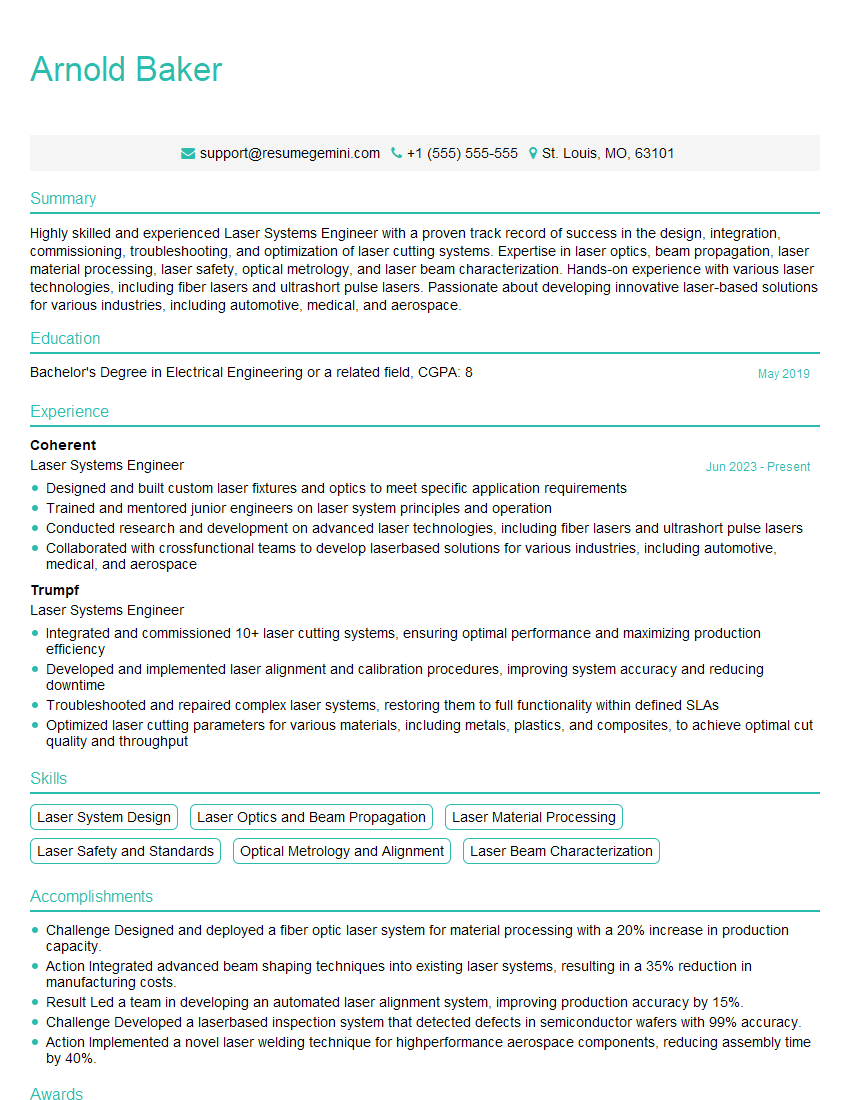
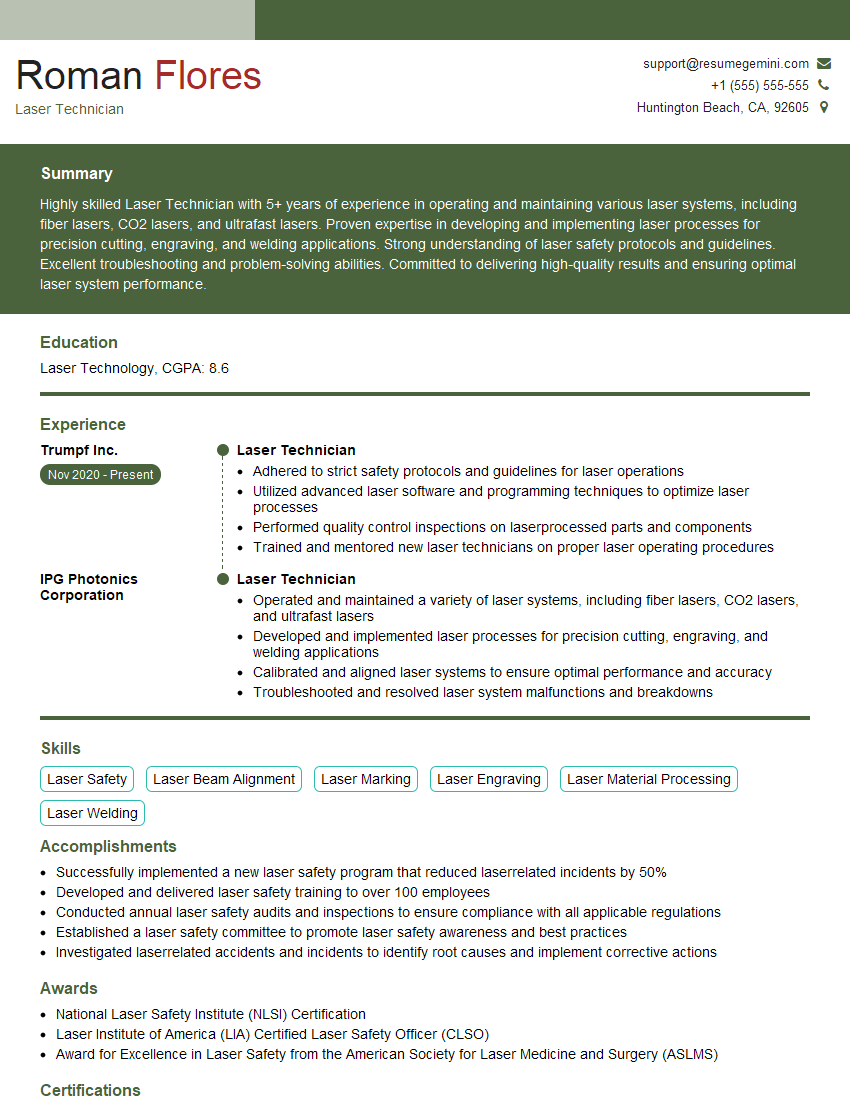
Mastering laser automation opens doors to exciting and high-demand careers in manufacturing, aerospace, and numerous other industries. To maximize your job prospects, creating a strong, ATS-friendly resume is crucial. ResumeGemini is a trusted resource to help you build a professional and impactful resume that highlights your skills and experience effectively. Examples of resumes tailored to Laser Automation are available to help you get started. Invest the time to craft a compelling resume – it’s your first impression and a key to unlocking your career potential in this exciting field.
Explore more articles
Users Rating of Our Blogs
Share Your Experience
We value your feedback! Please rate our content and share your thoughts (optional).
What Readers Say About Our Blog
Really detailed insights and content, thank you for writing this detailed article.
IT gave me an insight and words to use and be able to think of examples