The right preparation can turn an interview into an opportunity to showcase your expertise. This guide to Laser Inspection interview questions is your ultimate resource, providing key insights and tips to help you ace your responses and stand out as a top candidate.
Questions Asked in Laser Inspection Interview
Q 1. Explain the principles of laser triangulation.
Laser triangulation is a non-contact 3D measurement technique that leverages the principles of geometry to determine the distance to a surface. Imagine shining a laser onto an object; the laser spot’s position on the object will change depending on the object’s distance from the sensor. A camera, positioned at a known angle to the laser, captures the laser spot’s image. By knowing the angle of the laser, the camera’s position, and the location of the spot in the camera’s image, we can use simple trigonometry (specifically, triangulation) to calculate the distance to that point on the object’s surface. This process is repeated across multiple points, building a 3D profile of the object.
Think of it like this: you’re standing at a known distance from a wall, holding a laser pointer. The spot of the laser on the wall gives you one side of a triangle. The distance from you to the laser spot (known distance) forms another side. The angle at which you hold the laser pointer gives you the angle of the triangle. Using basic trigonometry, you can calculate the distance to the wall (the third side of the triangle). Laser triangulation uses a similar concept but with much higher precision and automation.
Q 2. Describe different types of laser scanners used in inspection.
Laser scanners used in inspection come in various types, each with its strengths and weaknesses. Common types include:
- Line Scanners: These project a line of laser light onto the surface. As the object moves or the scanner rotates, the line is scanned, creating a 2D profile that, when combined with movement data, produces a 3D model. They’re efficient for inspecting large, continuous surfaces.
- Point Scanners: These emit a single laser point, which is systematically moved across the object’s surface to create a point cloud of 3D data. This is ideal for complex shapes and intricate details, but can be slower than line scanning.
- Structured Light Scanners: These project a pattern of light, often a grid or stripes, onto the surface. The distortion of this pattern by the object’s shape allows for rapid and precise 3D data capture. This technique is excellent for high-speed inspection applications.
- Confocal Scanners: These use a pinhole aperture to filter out scattered light, improving the signal-to-noise ratio, which is useful for highly reflective or translucent surfaces. This offers superior depth resolution compared to other methods but tends to be more expensive and slower.
The choice of scanner depends heavily on the application’s requirements in terms of speed, accuracy, resolution, and the complexity of the object being inspected.
Q 3. What are the advantages and disadvantages of laser-based inspection compared to other methods?
Laser-based inspection offers several advantages over traditional methods like contact measurement (e.g., CMMs) or vision-based systems. These include:
- Non-contact measurement: Eliminates damage to delicate or fragile parts.
- High accuracy and precision: Capable of sub-micron level accuracy in many cases.
- High speed: Enables rapid inspection of numerous parts.
- Automation capability: Easily integrated into automated production lines.
However, there are disadvantages:
- Sensitivity to surface reflectivity: Highly reflective or highly absorptive surfaces can lead to measurement errors.
- Cost: Laser inspection systems can be expensive to purchase and maintain.
- Environmental sensitivity: Dust, vibration, and temperature fluctuations can affect measurement accuracy.
- Limited material suitability: Transparent or highly translucent materials can pose challenges.
The best method depends entirely on the specific application and the trade-offs between speed, accuracy, cost, and the nature of the parts being inspected.
Q 4. How do you calibrate a laser inspection system?
Calibrating a laser inspection system is crucial for ensuring accurate measurements. This usually involves a multi-step process:
- Reference Standard Calibration: Using a highly accurate reference standard, such as a precision ball or gauge block with known dimensions, the system’s measurements are compared to the known values. This establishes the relationship between the system’s readings and true dimensions.
- Optical Alignment: Ensuring the laser, camera, and object stage are properly aligned to minimize geometric errors. This often involves adjusting mirrors and lenses to optimize the triangulation geometry.
- Software Calibration: Adjusting system parameters within the software to correct for systematic errors identified during the reference standard calibration. This may include adjustments to compensate for lens distortion, temperature effects, or non-linearity in the sensor response.
- Environmental Compensation: If necessary, implementing software or hardware solutions to compensate for environmental factors like temperature and humidity changes that affect the system’s accuracy.
Regular calibration is essential, and the frequency depends on the system’s stability, usage, and the required level of accuracy. A well-maintained calibration schedule is paramount for trustworthy and repeatable results.
Q 5. Explain the concept of laser spot size and its impact on measurement accuracy.
Laser spot size is the diameter of the laser beam at the point of incidence on the object’s surface. A smaller spot size generally leads to higher measurement accuracy because it minimizes the uncertainty in pinpointing the exact location of the measurement. Think of it like trying to measure the height of a small object with a large ruler versus a small ruler – the smaller ruler gives a more precise measurement. Conversely, a larger spot size can blur the edges of features, resulting in lower resolution and potentially significant measurement errors, especially on parts with fine details.
For instance, when inspecting a microchip, a laser spot larger than the features of interest would produce inaccurate measurements, whereas a smaller spot size would enable precise characterization of even the smallest features. Therefore, selecting the appropriate spot size is crucial for achieving the desired level of measurement accuracy.
Q 6. How do you handle variations in surface reflectivity during laser inspection?
Variations in surface reflectivity are a common challenge in laser inspection. Highly reflective surfaces can cause specular reflections, leading to the laser beam being reflected away from the sensor, resulting in missed data points or inaccurate measurements. Conversely, highly absorptive surfaces may not reflect enough light to be detected properly. Several strategies address this issue:
- Using different wavelengths: Changing the laser wavelength can optimize the amount of light reflected from the surface. Some materials reflect certain wavelengths better than others.
- Adjusting laser power: Increasing laser power can enhance signal strength for weakly reflective surfaces, but it must be balanced to avoid damaging the part or overwhelming the sensor.
- Applying surface treatments: For highly reflective parts, a matte coating or diffusing agent can reduce specular reflections.
- Employing advanced algorithms: Software algorithms can compensate for varying reflectivity by analyzing the light intensity of the reflected beam and making corrections to the measurements.
- Using multiple light sources: Employing multiple lasers, possibly with varying wavelengths, can enhance the chances of obtaining reliable measurements from a wide range of surfaces.
Selecting the right strategy often involves considering the material properties, the complexity of the geometry, and the desired accuracy of the measurement.
Q 7. What are common sources of error in laser measurement systems?
Several sources can contribute to errors in laser measurement systems:
- Optical aberrations: Imperfections in lenses or mirrors can distort the laser beam, affecting the accuracy of triangulation.
- Environmental factors: Temperature fluctuations, vibrations, and air currents can all influence the laser beam path and the sensor readings.
- Surface imperfections: Scratches, roughness, and other surface defects can scatter the laser light, leading to inaccurate measurements.
- Calibration errors: Inaccurate calibration of the system can introduce systematic errors into all subsequent measurements.
- Signal noise: Noise in the sensor signal can affect the accuracy of the spot position detection.
- Software limitations: Deficiencies in the data processing algorithms can lead to measurement inaccuracies.
- Incorrect system setup: Improper alignment of the laser, camera, and object stage introduces significant geometrical errors.
Careful system design, regular calibration, and robust data processing techniques are essential to mitigate these error sources and ensure reliable measurements.
Q 8. Describe your experience with different types of laser safety measures.
Laser safety is paramount in my work. My experience encompasses a wide range of measures, from basic personal protective equipment (PPE) to sophisticated interlock systems. PPE includes laser safety eyewear specifically rated for the wavelength and power of the lasers used. The eyewear selection is critical; using the wrong eyewear can be dangerous. Beyond PPE, we employ various engineering controls. For instance, we use laser enclosures to contain the beam and prevent accidental exposure. These enclosures often incorporate interlocks that shut down the laser if the enclosure is opened. Furthermore, we utilize warning lights and signage to alert personnel to potential laser hazards. We also implement administrative controls, such as strictly controlled access to laser areas, comprehensive safety training programs for all personnel, and established operating procedures that prioritize safety at every stage of the inspection process. I’ve worked with Class 1, Class 2, Class 3R, and Class 4 lasers, and the safety protocols vary significantly depending on the class. For Class 4 lasers, the most powerful and potentially hazardous, the safety measures are significantly more stringent.
Q 9. How do you interpret laser inspection data and identify defects?
Interpreting laser inspection data involves a multi-step process. First, I carefully examine the raw data, often visualized as images or point clouds, looking for anomalies. These anomalies might manifest as variations in intensity, unexpected reflections, or deviations from a pre-defined profile. Next, I use image processing techniques, such as edge detection and feature extraction, to quantify these anomalies. This often involves utilizing software algorithms to isolate defects, measure their size and shape, and classify their type. For instance, in inspecting a semiconductor wafer, I might look for scratches, pits, or variations in thickness. The specific defects and their interpretation will greatly depend on the material being inspected and the application. Often, I compare the inspected data to a known good reference to highlight discrepancies. Finally, I create reports that summarize the findings, including the number, type, and location of defects. This data is often crucial for quality control and process improvement.
Q 10. What software packages are you proficient in for analyzing laser inspection data?
My proficiency extends to several software packages crucial for analyzing laser inspection data. I am highly skilled in using Matlab for image processing, data analysis and algorithm development. Its extensive libraries are invaluable for tasks like image filtering, feature extraction and statistical analysis. I am also proficient in Python with libraries like OpenCV and Scikit-learn, particularly for automating inspection routines and building machine learning models for defect classification. Furthermore, I’m experienced with specialized software provided by laser inspection equipment manufacturers, such as the proprietary software from Keyence or Cognex, which often provides tools tailored to specific equipment and applications. This allows for efficient data acquisition, processing, and reporting. I can also utilize data visualization tools such as Tableau to present the results in a clear and user-friendly manner.
Q 11. Explain your experience with statistical process control (SPC) in laser inspection.
Statistical Process Control (SPC) is fundamental to maintaining consistent product quality in laser inspection. I use SPC techniques to monitor the process capability and identify trends in the data. For example, I frequently employ control charts, such as X-bar and R charts, to track the average and range of key measurements over time. By monitoring these charts, we can quickly identify instances where the process is drifting outside of pre-defined control limits, signaling potential problems and the need for corrective actions. I have also used capability analysis to assess how well the process meets the specified requirements. Understanding Cp and Cpk values allows for objective evaluation of the process and identification of areas needing improvement. In my experience, consistently applying SPC has drastically reduced scrap rates and improved overall product consistency. A real-world example: On a project involving laser micromachining, implementing SPC allowed us to quickly detect a gradual change in laser power, which we could correct before it led to significant product defects.
Q 12. Describe your experience troubleshooting laser inspection equipment malfunctions.
Troubleshooting laser inspection equipment is a key part of my role. My approach is systematic, beginning with a visual inspection to check for obvious issues like loose connections or damaged components. If the issue persists, I move to a more methodical approach, checking the laser’s power output, the alignment of the optical components, and the integrity of the data acquisition system. I regularly consult the equipment’s manuals, and leverage diagnostic tools embedded within the system’s software. In situations where the issue is more complex, I use a combination of systematic testing procedures and knowledge of laser physics and optics to pinpoint the problem. For instance, I’ve experienced issues with drift in the laser beam position due to temperature fluctuations, necessitating adjustments to the cooling system. Another common issue is signal noise, which might require adjustments to the signal processing parameters or improvement in the shielding of the sensor. Thorough documentation and a log of troubleshooting steps are crucial for efficient problem-solving and prevent recurrence of similar issues.
Q 13. How do you ensure the repeatability and reproducibility of laser measurements?
Repeatability and reproducibility of laser measurements are crucial for reliable inspection. We achieve this through a combination of meticulous calibration, standardized operating procedures, and rigorous data analysis techniques. Regular calibration using traceable standards is essential to ensure accuracy. We follow strict protocols for setting up the equipment, including consistent positioning of the sample and precise alignment of the laser beam. To minimize the influence of environmental factors, we maintain a controlled environment, including stable temperature and humidity. Furthermore, we employ robust statistical methods to assess the repeatability and reproducibility of the measurements. For instance, we use gauge R&R studies to quantify the variability due to measurement error versus the variability within the sample itself. Employing these strategies ensures that the measurements taken are reliable and consistent over time and across different operators and equipment.
Q 14. What are the limitations of laser-based inspection?
While laser-based inspection offers many advantages, it’s essential to be aware of its limitations. One major limitation is the surface finish of the material being inspected. Highly reflective or transparent materials can cause significant scattering or refraction of the laser beam, leading to inaccurate measurements or a complete inability to measure. Also, laser inspection can be susceptible to environmental factors. Vibrations, temperature fluctuations, and air currents can all affect the accuracy of the measurements. The resolution of the system is another limitation. While lasers can offer high precision, there is a limit to the smallest feature size they can reliably detect. Finally, the cost of laser inspection equipment can be substantial, and specialized expertise is required for setup, operation, and data analysis. It’s important to carefully consider these limitations when determining the suitability of laser inspection for a particular application.
Q 15. Explain the difference between confocal and non-confocal laser microscopy.
The core difference between confocal and non-confocal laser microscopy lies in how they handle out-of-focus light. Think of it like this: imagine shining a flashlight on a stack of papers. Non-confocal microscopy is like looking at the entire stack at once – you see light from all the papers, blurring the details. Confocal microscopy, however, is like using a pinhole to only let light from one specific paper through. This significantly improves image resolution and clarity by eliminating out-of-focus light.
Non-confocal microscopy uses a single detector to collect light from the entire sample volume. This leads to lower resolution images, particularly with thicker samples, because the light from different depths is superimposed. It’s simpler and faster, often used for applications where high resolution isn’t critical.
Confocal microscopy uses a pinhole aperture in front of the detector to block out-of-focus light. Only light originating from a specific focal plane reaches the detector, resulting in higher resolution images with improved depth perception. It’s more complex, slower, and typically more expensive but delivers superior image quality for detailed surface analysis.
For example, in inspecting microelectronics, a confocal system would be ideal for identifying defects at different layers within a chip, while a non-confocal system might be sufficient for general surface inspection.
Career Expert Tips:
- Ace those interviews! Prepare effectively by reviewing the Top 50 Most Common Interview Questions on ResumeGemini.
- Navigate your job search with confidence! Explore a wide range of Career Tips on ResumeGemini. Learn about common challenges and recommendations to overcome them.
- Craft the perfect resume! Master the Art of Resume Writing with ResumeGemini’s guide. Showcase your unique qualifications and achievements effectively.
- Don’t miss out on holiday savings! Build your dream resume with ResumeGemini’s ATS optimized templates.
Q 16. How do you select the appropriate laser wavelength for a specific application?
Selecting the right laser wavelength is crucial for optimal laser inspection. The choice depends heavily on the material properties of the part being inspected and the type of defect you’re looking for. Consider these factors:
- Material Absorption: Different materials absorb light at different wavelengths. For example, silicon absorbs strongly in the infrared range, making infrared lasers ideal for silicon wafer inspection. Conversely, certain polymers may be more effectively inspected using visible lasers.
- Defect Type: Surface scratches might be readily visible with visible light, while subsurface defects might require longer wavelengths that penetrate deeper. For instance, measuring the thickness of transparent coatings often requires near-infrared wavelengths.
- Sensor Sensitivity: The sensitivity of your detector also plays a role. Some detectors are more sensitive to specific wavelength ranges. You need a good match between your laser, the material, and your detection system.
- Safety: Always consider the safety implications of the chosen wavelength. High-energy UV lasers, for example, are hazardous and require stringent safety protocols.
In practice, I often start with literature research on the material’s optical properties. Then, I might conduct preliminary tests with different wavelengths to determine which offers the best contrast and resolution for the specific defect I’m trying to detect. This iterative approach ensures optimal performance.
Q 17. Describe your experience with laser interferometry.
Laser interferometry has been a cornerstone of my work, particularly in high-precision dimensional metrology. I’ve extensively used it for applications ranging from measuring surface roughness and flatness to determining the displacement or vibration of components.
For example, in one project, we used laser interferometry to measure the minute deformation of a silicon wafer during thermal cycling. The accuracy provided by interferometry allowed us to identify critical stress points that could lead to failure under operational conditions. This type of precise measurement is impossible with many other techniques.
I’m experienced with both Michelson and Fizeau interferometers, understanding their respective strengths and limitations. Furthermore, I’m proficient in analyzing interferograms using software tools to quantify surface features with nanometer-level accuracy.
Q 18. What are your experiences with different types of laser sensors (e.g., line, point, structured light)?
My experience spans various laser sensor types, each with distinct advantages and disadvantages.
- Point sensors are excellent for precise distance measurements or identifying small features. Think of measuring the height of a bump on a surface; a point sensor is perfect.
- Line sensors, on the other hand, are ideal for profiling applications. Imagine needing to profile the edge of a cutting tool; a line sensor quickly creates a height profile along the entire length of the edge.
- Structured light sensors project a pattern of light (like stripes or dots) onto the part, and the distortion of this pattern is used to reconstruct the 3D surface. This is particularly useful for generating high-density 3D point clouds of complex geometries, for instance, in reverse engineering or inspection of freeform surfaces.
The selection of sensor type always depends on the specific application. Factors like the required accuracy, the size and shape of the parts, and the speed of the inspection process all influence this choice.
Q 19. How do you deal with ambient light interference during laser inspection?
Ambient light interference is a major challenge in laser inspection, especially in environments with fluctuating lighting conditions. Several strategies help mitigate this:
- Enclosures: The simplest approach is to isolate the inspection system within a light-tight enclosure. This effectively eliminates most ambient light.
- Narrowband Filters: Using narrowband optical filters in front of the detector allows the system to only detect light at the specific laser wavelength, effectively rejecting most of the ambient light. This is a cost-effective solution.
- Polarization Filters: By using polarized lasers and polarization filters, ambient light can be significantly reduced if the ambient light is unpolarized. This method leverages the fact that the scattered laser light will retain its polarization.
- Active Compensation: More sophisticated systems use active compensation techniques where a reference signal is measured and subtracted from the actual signal, thereby removing the influence of ambient light.
The optimal approach often involves a combination of these methods depending on the level of ambient light and the sensitivity of the application.
Q 20. Explain the importance of proper part fixturing in laser inspection.
Proper part fixturing is paramount in laser inspection for achieving repeatable and reliable results. Imagine trying to measure the dimensions of a small object held loosely in your hand—the measurement would vary drastically. Similarly, improper fixturing leads to inconsistent results.
A well-designed fixture ensures the part is held securely and consistently positioned for each measurement. This minimizes variations due to part movement or orientation, leading to improved repeatability and reduced measurement error. Key aspects include:
- Stability: The fixture must be rigid and stable enough to prevent vibrations or movement during the inspection process.
- Repeatability: The fixture should allow for consistent and repeatable part placement, ensuring that measurements are taken from the same location each time.
- Accessibility: The fixture should allow the laser sensor to access all necessary surfaces and features of the part.
- Material Compatibility: The fixture material should be chosen to avoid interference with the laser or damage to the part.
A poorly designed fixture can lead to inaccurate measurements, increased inspection time, and even damage to the part, which is why it’s one of the critical steps in laser inspection.
Q 21. How do you manage large datasets generated by laser inspection systems?
Laser inspection systems often generate massive datasets, especially when inspecting complex parts or performing high-resolution scans. Managing these large datasets efficiently requires a systematic approach.
Here’s how I address this:
- Data Compression: Employing suitable data compression techniques reduces storage requirements and speeds up data transfer. Lossless compression is preferred when accuracy is critical, while lossy compression might be suitable when some minor data loss is acceptable.
- Database Management: Storing the data in a well-structured database facilitates efficient retrieval and analysis. Relational databases are particularly suitable for organizing structured inspection data and metadata.
- Data Filtering and Reduction: Applying appropriate filters to extract relevant features and reduce the volume of unnecessary data improves analysis efficiency. This can include filtering out noise or irrelevant information.
- Cloud Storage: For very large datasets, cloud-based storage solutions offer scalability and ease of access for collaborative analysis.
- Parallel Processing: During data processing, leveraging parallel processing capabilities significantly accelerates analysis, particularly for computationally intensive tasks like 3D surface reconstruction or defect classification.
The specific techniques used often depend on the nature of the data and the available computing resources. Choosing the right combination of these strategies ensures efficient management and analysis of large laser inspection datasets.
Q 22. Describe your experience with automated laser inspection systems.
My experience with automated laser inspection systems spans over ten years, encompassing various industries such as automotive, aerospace, and electronics manufacturing. I’ve worked extensively with systems employing different laser types – from triangulation-based systems for dimensional measurements to confocal systems for surface roughness analysis and line scanning systems for detecting defects on production lines. My expertise includes not only operating these systems but also their programming, calibration, and troubleshooting. For instance, in a recent project involving automotive parts, I implemented a vision-guided laser system that dramatically improved the speed and accuracy of detecting minute surface imperfections, leading to a significant reduction in defect rates.
I’m proficient in integrating laser inspection systems with other automated processes using PLC programming and industrial communication protocols like Ethernet/IP and Profinet. This includes coordinating the laser scanning process with robotic handling systems and data analysis using statistical process control (SPC) software.
- Experience with various laser types (triangulation, confocal, line scanning)
- Proficiency in system programming, calibration, and troubleshooting
- Integration with robotic systems and SPC software
- Hands-on experience in diverse industry settings (automotive, aerospace, electronics)
Q 23. How do you validate the accuracy of a laser inspection system?
Validating the accuracy of a laser inspection system is crucial for ensuring reliable measurements and defect detection. This involves a multi-step process that combines traceable standards and statistical analysis. First, we use certified reference standards – artifacts with precisely known dimensions or surface properties – to calibrate the system. These standards are traceable to national or international metrology institutes. For example, for dimensional measurements, we might use gauge blocks or precision spheres.
Next, we perform repeatability and reproducibility studies. We repeatedly measure the same reference standard multiple times to assess the system’s inherent precision. Reproducibility is tested by multiple operators or on different days to check for consistency. The results are then analyzed statistically using methods like ANOVA (Analysis of Variance) to quantify the uncertainty associated with the measurements.
Finally, we compare the laser inspection system’s measurements with those obtained from a different, independent measurement method (e.g., a coordinate measuring machine (CMM)) on a sample of production parts. This cross-validation helps to assess the accuracy of the laser system in a real-world setting. Any discrepancies need to be investigated and addressed, possibly through recalibration or system adjustments.
Q 24. What is your experience with different types of laser safety eyewear?
My experience encompasses various types of laser safety eyewear, categorized by the laser wavelength and optical density (OD). I understand the importance of selecting the appropriate eyewear based on the specific laser being used in the inspection system. For example, working with a near-infrared (NIR) laser would necessitate eyewear with high OD ratings specifically designed for that wavelength. Similarly, working with visible lasers requires eyewear that filters the specific visible wavelength.
I’m familiar with different eyewear designs, including those with wraparound protection, side shields, and prescription lenses for users who wear glasses. I always emphasize regular inspection and maintenance of the eyewear to ensure they are in good condition and continue to provide the required level of protection. Damaged eyewear should be immediately replaced. I’m also trained to identify laser safety hazards and implement appropriate control measures.
Q 25. Describe your familiarity with laser safety regulations and standards.
I’m thoroughly familiar with laser safety regulations and standards, including ANSI Z136.1 (American National Standard for Safe Use of Lasers) and relevant international standards like IEC 60825. I understand the classification of lasers based on their potential hazard and the associated control measures, such as the use of laser safety eyewear, appropriate signage, and controlled access to laser areas. My experience also covers the creation and implementation of laser safety programs, including risk assessments, training of personnel, and emergency procedures.
For example, I’ve been involved in designing laser safety interlocks for automated systems and developing laser safety training materials for factory workers. Compliance with these standards is not simply a regulatory requirement but is essential for ensuring the safety and well-being of personnel and preventing accidents.
Q 26. How would you determine the optimal sampling strategy for laser inspection?
Determining the optimal sampling strategy for laser inspection is critical for balancing the need for accuracy with the cost and time constraints of inspection. The approach depends heavily on the application and the type of defects being detected. Statistical sampling methods are often employed.
For example, in a simple random sampling approach, each part has an equal chance of being selected for inspection. However, for more complex scenarios, stratified sampling might be more suitable. This involves dividing the population into subgroups (strata) based on characteristics relevant to defect occurrence (e.g., different production batches) and then sampling from each stratum proportionally.
The sample size is determined based on statistical considerations, such as the desired confidence level and acceptable error margin. Statistical process control (SPC) charts can help monitor the process and identify trends in defect rates. The optimal sampling strategy is often determined through a combination of statistical analysis and practical considerations, taking into account factors like production rate, defect density, and cost of inspection.
Q 27. How do you identify and mitigate the effects of thermal drift in laser measurement?
Thermal drift, the change in measurement due to temperature variations, is a significant challenge in precise laser measurement. It can lead to inaccurate results and affect the overall quality of the inspection process. Several strategies can mitigate its effects.
Firstly, environmental control is crucial. Maintaining a stable temperature in the inspection area minimizes fluctuations and reduces thermal drift. This might involve using climate-controlled rooms or enclosures. Secondly, the system itself can be designed to minimize thermal sensitivity. Using temperature-compensated components and materials can significantly reduce the impact of temperature variations. Regular calibration at different temperatures is another important aspect.
Finally, sophisticated algorithms and software can be employed to compensate for thermal drift. These algorithms use temperature sensors to monitor the system’s temperature and adjust the measurements accordingly, correcting for any observed drift. Regular system maintenance is vital to ensure the accuracy and reliability of the thermal compensation algorithms.
Q 28. Explain your experience with the integration of laser inspection into a larger manufacturing process.
Integrating laser inspection into a larger manufacturing process often involves careful planning and collaboration with various stakeholders. It requires a deep understanding of the entire production flow and how the laser inspection system fits into the overall scheme. This includes considerations for material handling, data acquisition, and data integration with other manufacturing systems.
For instance, in one project, I integrated a high-speed laser profiler into a roll-to-roll manufacturing line for flexible electronics. This involved designing custom fixturing for the material handling, creating a robust data acquisition system to handle the large amount of data generated by the profiler, and integrating the inspection results with the production control system to provide real-time feedback on product quality. The integration required expertise in automation, software programming, data analysis, and communication protocols. Effective communication and collaboration with engineers, technicians, and production staff are crucial to ensure successful integration and efficient operation.
Key Topics to Learn for Laser Inspection Interview
- Laser Fundamentals: Understanding laser types (e.g., HeNe, diode lasers), beam characteristics (wavelength, power, divergence), and safety precautions.
- Optical Systems: Familiarity with optical components (mirrors, lenses, beam splitters), optical alignment techniques, and the impact of optical aberrations on measurement accuracy.
- Measurement Techniques: Knowledge of various laser inspection methods such as triangulation, time-of-flight, and interferometry; understanding their respective strengths and limitations.
- Data Acquisition and Processing: Experience with data acquisition hardware and software, signal processing techniques (noise reduction, filtering), and data analysis methods for extracting meaningful results.
- Applications of Laser Inspection: Understanding practical applications in various industries, such as automotive, semiconductor, and aerospace; ability to discuss specific examples of quality control or dimensional measurement using laser technology.
- Troubleshooting and Calibration: Problem-solving skills related to laser system malfunctions, calibration procedures, and maintaining system accuracy and precision.
- Image Processing and Analysis: Experience with image processing algorithms and software for analyzing laser scan data, identifying defects, and generating reports.
- Automation and Robotics: Understanding the integration of laser inspection systems into automated manufacturing processes and robotic systems.
Next Steps
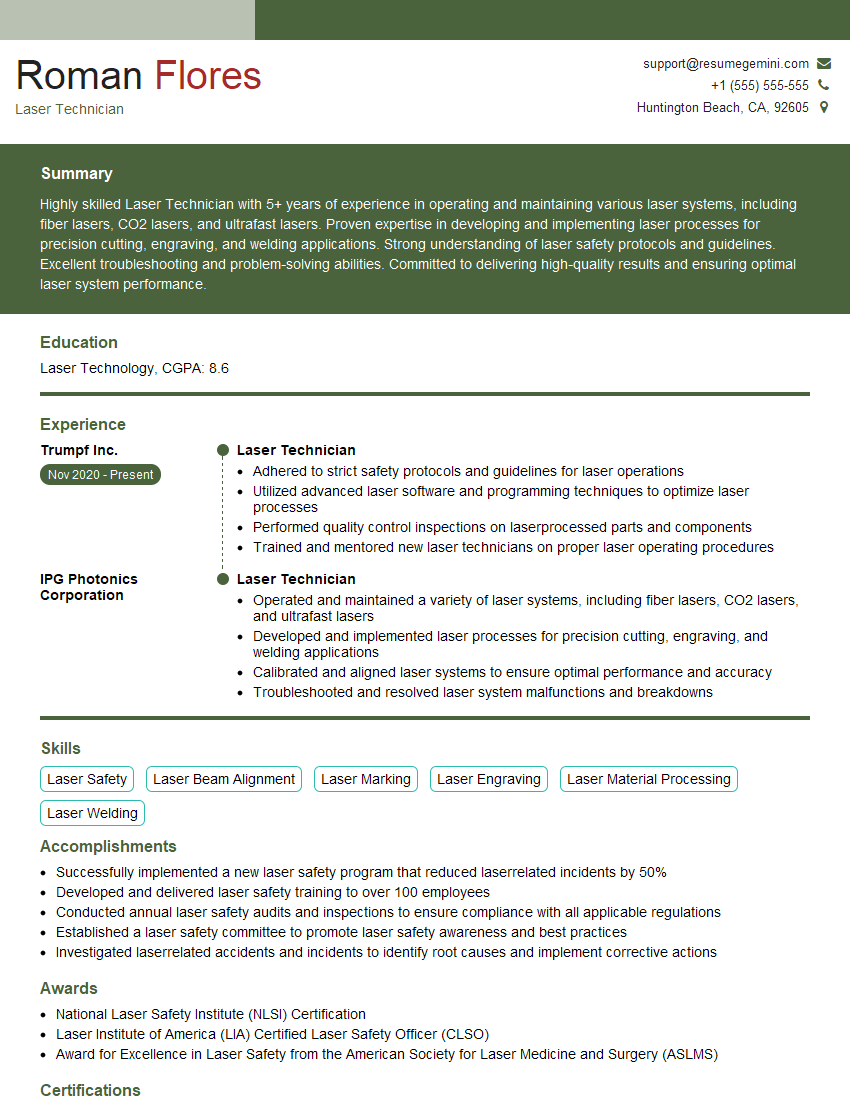
Mastering Laser Inspection opens doors to exciting and rewarding careers in advanced manufacturing, quality control, and research. A strong understanding of these principles significantly increases your chances of securing your dream role. To further enhance your job prospects, creating an ATS-friendly resume is crucial. A well-structured resume that highlights your skills and experience effectively increases your visibility to potential employers and gets you noticed. We recommend using ResumeGemini, a trusted resource for building professional resumes. ResumeGemini provides examples of resumes tailored to Laser Inspection to help you craft a compelling application that showcases your expertise. Invest the time to create a strong resume – it’s a key step in your career journey.
Explore more articles
Users Rating of Our Blogs
Share Your Experience
We value your feedback! Please rate our content and share your thoughts (optional).
What Readers Say About Our Blog
Really detailed insights and content, thank you for writing this detailed article.
IT gave me an insight and words to use and be able to think of examples