Are you ready to stand out in your next interview? Understanding and preparing for Laser Process Optimization interview questions is a game-changer. In this blog, we’ve compiled key questions and expert advice to help you showcase your skills with confidence and precision. Let’s get started on your journey to acing the interview.
Questions Asked in Laser Process Optimization Interview
Q 1. Explain the principles of laser-material interaction relevant to your expertise.
Laser-material interaction is fundamentally about how light energy from a laser source is absorbed, reflected, and transmitted by a target material. This interaction determines the outcome of the laser process, whether it’s cutting, welding, marking, or surface treatment. The key principles involve the material’s optical properties (absorption coefficient, reflectivity, refractive index), the laser’s characteristics (wavelength, pulse duration, power density), and the resulting thermal and mechanical effects.
For instance, a highly reflective material like polished aluminum will require significantly more laser power to achieve the same effect as a material with high absorption like black-painted steel. The wavelength of the laser is crucial; a CO2 laser (10.6 µm) is highly absorbed by many non-metals, while a fiber laser (1 µm) is better suited for metals. The laser’s pulse duration influences the depth of penetration and heat-affected zone, with short pulses leading to less heat spread.
Understanding these principles allows for precise control over the laser process. By adjusting laser parameters and material properties, we can achieve desired results, such as controlled depth of cut, precise weld penetration, or specific surface texture.
Q 2. Describe different types of lasers used in industrial processes and their applications.
Several laser types are used in industrial processes, each with specific advantages and applications:
- CO2 Lasers: These gas lasers emit infrared radiation (10.6 µm), making them ideal for cutting and engraving non-metallic materials like wood, plastics, and fabrics. Their high power capabilities are suitable for thick materials. I’ve used these extensively in textile processing and wood engraving.
- Fiber Lasers: These solid-state lasers operate in the near-infrared (typically 1 µm), offering high efficiency, excellent beam quality, and good fiber delivery capability. They are prevalent in metal cutting, welding, and marking applications, particularly in high-speed, high-precision operations. For example, I implemented a fiber laser system for automotive part welding, significantly improving both throughput and weld quality.
- Nd:YAG Lasers: These solid-state lasers (1.06 µm) are versatile and can be used in various applications, including marking, drilling, and welding. Frequency doubling allows for green light (532 nm) operation, useful for specific materials. We used an Nd:YAG laser for precision micro-machining on delicate electronic components.
- Ultrafast Lasers: These lasers produce extremely short pulses (femtoseconds or picoseconds), leading to minimal heat-affected zones and enabling precise micromachining of delicate materials. I’ve worked with these lasers in creating intricate surface textures on medical implants.
The selection of the laser type depends heavily on the material properties and the desired processing outcome. A detailed analysis of these factors is crucial for optimal performance.
Q 3. How do you determine the optimal laser parameters (power, speed, focus) for a specific material and application?
Determining optimal laser parameters is a crucial aspect of laser process optimization and involves a combination of theoretical understanding, experimental analysis, and process modeling. It’s an iterative process.
The process generally involves:
- Material Characterization: Understanding the material’s absorptivity, reflectivity, thermal conductivity, and mechanical properties at the chosen laser wavelength is the first step. This often involves testing with small samples.
- Preliminary Parameter Selection: Based on material characteristics and desired outcome, initial laser parameters (power, speed, focus diameter) are chosen using literature, simulations, or experience.
- Experimental Design: A systematic approach (e.g., Design of Experiments – DOE) is crucial to investigate the effect of parameters on the process. We would systematically vary power, speed, and focus to identify their individual and interactive effects on, for example, kerf width and depth of cut.
- Process Monitoring and Measurement: During experiments, process metrics (e.g., kerf width, surface roughness, heat-affected zone) are meticulously measured and analyzed. Techniques like optical profilometry, microscopy, and thermal imaging may be employed.
- Parameter Optimization: The data from the experiments is analyzed to identify the optimal combination of parameters that yields the best results with respect to desired quality and productivity. Statistical methods like Response Surface Methodology (RSM) are often used.
- Validation and Refinement: The optimized parameters are validated through further testing and iterative refinement to ensure consistent performance and robustness.
For example, in optimizing a laser cutting process for stainless steel, we might use a DOE to find the optimal combination of laser power, cutting speed, and assist gas pressure that minimizes kerf width and ensures smooth cut edges. This optimization process would result in improved throughput and part quality.
Q 4. What are the key performance indicators (KPIs) you use to measure the effectiveness of laser process optimization?
Key Performance Indicators (KPIs) for laser process optimization are crucial for evaluating the effectiveness of the process and driving continuous improvement. Some important KPIs include:
- Throughput: Number of parts produced per unit time, reflecting processing speed and efficiency. Improvements here directly affect production costs.
- Part Quality: Measured by various metrics depending on the application, e.g., surface roughness, kerf width (for cutting), weld strength (for welding), dimensional accuracy, and defect rate. Quality improvements reduce scrap and rework.
- Process Stability: The consistency of process output over time, indicating the robustness of the process. This is often monitored using SPC charts.
- Energy Efficiency: The ratio of useful work to the total energy consumed by the laser system. Reducing energy consumption lowers operating costs and environmental impact.
- Operational Costs: Includes laser system maintenance, material costs, labor, and energy consumption. Optimization efforts aim to minimize these costs.
Monitoring these KPIs, and using them to track progress and justify changes to the process, is vital for ensuring continual improvement in our laser processing operations.
Q 5. Explain your experience with statistical process control (SPC) in laser processing.
Statistical Process Control (SPC) is indispensable in laser processing for ensuring consistent part quality and identifying potential problems before they escalate. I’ve extensively used SPC methods like control charts (X-bar and R charts, p-charts, c-charts) to monitor key process variables like laser power, cutting speed, and part dimensions. These charts help visualize process variation and identify trends indicative of out-of-control situations. For instance, an increasing trend in kerf width on a control chart would indicate a potential problem with the laser cutting process, prompting investigation into the root cause.
Furthermore, capability analysis, using Cp and Cpk indices, is utilized to assess the ability of the process to meet specified tolerances. A low Cp or Cpk value would necessitate process optimization to improve its consistency and capability. Process capability studies ensure that the process consistently meets the required specifications, ultimately leading to fewer defects and reduced waste.
By integrating SPC into our laser processing workflow, we achieve enhanced process predictability, reduced variability, and improved overall quality. We can anticipate and resolve problems proactively rather than reactively, minimizing production downtime and ensuring consistent product quality.
Q 6. How do you identify and troubleshoot common laser process issues (e.g., inconsistent results, low throughput)?
Troubleshooting laser process issues requires a systematic approach. I typically follow these steps:
- Identify the Problem: Clearly define the issue, whether it’s inconsistent results, low throughput, poor part quality, or machine malfunction.
- Gather Data: Collect data related to the process parameters (laser power, speed, focus), material properties, and environmental conditions. Analyze process logs and inspect parts for defects.
- Check the Obvious: Verify proper laser alignment, gas flow (if applicable), focusing lens condition, and material handling. These are often overlooked but crucial.
- Investigate Potential Causes: Consider factors like material variation, laser system malfunctions, improper parameter settings, or environmental factors like temperature and humidity.
- Test and Verify Solutions: Implement corrective actions based on the identified root cause. This may involve adjustments to laser parameters, equipment maintenance, or changes in material handling.
- Document and Prevent Recurrence: Record the issue, root cause, and corrective actions taken. This helps prevent similar problems in the future and facilitates continuous improvement.
For instance, if inconsistent results are observed in laser welding, we might first check the laser beam quality, followed by the cleanliness of the welding area and the stability of the clamping system. If the problem persists, a more in-depth analysis may be necessary, involving process parameter optimization or equipment diagnostics.
Q 7. Describe your experience with different laser beam delivery systems (e.g., fiber optic, scanner).
Experience with various laser beam delivery systems is essential for efficient and precise laser processing. I have worked extensively with:
- Fiber Optic Delivery: This method is widely used due to its flexibility, efficiency, and ability to transmit high power lasers over considerable distances. Fiber optics are robust and allow for easy integration into automated systems. We use fiber delivery extensively for robotic laser welding applications.
- Scanner Systems: These systems use galvanometer scanners to direct the laser beam across the workpiece, enabling high-speed marking, cutting, and engraving, especially for complex geometries and patterns. I’ve leveraged scanner systems to create intricate designs on various materials, from metals to plastics.
- Articulated Arms: These offer great flexibility for accessing difficult-to-reach areas in larger workpieces. They are particularly useful in large-scale applications like shipbuilding or aerospace manufacturing where intricate welds in complex geometries are required.
- Fixed Optics Systems: These systems use a fixed optical path and are often used for simpler, high-throughput applications where precision alignment is critical.
The choice of delivery system depends greatly on the application’s specific requirements. For example, a fiber optic delivery system is suitable for high-power, long-distance applications such as cutting thick metal sheets, whereas a scanner system is often preferred for high-precision micromachining or marking.
Q 8. How do you ensure the safety of laser operations and comply with relevant safety regulations?
Laser safety is paramount. My approach is multi-faceted and starts with a thorough risk assessment, identifying all potential hazards associated with the specific laser system and its application. This involves considering factors like laser class, beam power, potential for eye or skin damage, fire hazards, and the presence of flammable materials. We then implement control measures based on a hierarchy of controls, prioritizing elimination, substitution, engineering controls, administrative controls, and lastly, personal protective equipment (PPE).
- Engineering Controls: This includes the use of laser enclosures, interlocks, beam shutters, and appropriate warning lights to prevent accidental exposure.
- Administrative Controls: These are procedural controls such as standardized operating procedures (SOPs), laser safety training for all personnel, regular equipment inspections and maintenance, and clearly defined emergency procedures.
- Personal Protective Equipment (PPE): This is the last line of defense and includes laser safety eyewear specific to the laser wavelength and power, as well as appropriate clothing to prevent burns and other injuries. For example, during high-power CO2 laser cutting, we’d use specialized protective eyewear and fire-resistant clothing.
Compliance with relevant safety regulations, such as those from OSHA (in the US) or similar bodies in other regions, is strictly followed. We maintain detailed records of safety inspections, training, and any incidents, ensuring full traceability and accountability.
Q 9. What is your experience with laser process modeling and simulation software?
I have extensive experience using laser process modeling and simulation software, primarily LAMBDA and COMSOL Multiphysics. These tools are invaluable for predicting the outcome of laser processes before physical experimentation. For example, in designing a laser welding process for joining two dissimilar metals, I would use COMSOL to model the heat transfer and material deformation, allowing optimization of parameters like laser power, scan speed, and focal position to achieve the desired weld quality and avoid issues such as cracking or porosity.
With LAMBDA, I have extensively modeled laser cutting processes, predicting kerf width, heat-affected zone, and material removal rates. This allows us to optimize parameters to minimize material waste, achieve desired surface finishes, and ensure consistent cut quality. The software’s ability to account for material properties, beam characteristics, and process parameters is crucial in achieving optimal results. I also use these models to investigate the effects of various process parameters on the final product quality and predict potential issues before they arise in the actual manufacturing process.
Q 10. Describe your experience in designing and implementing automated laser processing systems.
My experience in designing and implementing automated laser processing systems spans several projects. One significant project involved the development of a fully automated system for laser cutting of complex 3D components from sheet metal. This involved integrating a high-power fiber laser, a six-axis robotic arm, a vision system for part alignment and detection, and a sophisticated control system. The system significantly increased throughput and reduced production time compared to manual methods, while maintaining consistent quality.
The design process involved careful consideration of factors such as part fixturing, material handling, laser beam delivery, and safety protocols. The control system was designed to manage the robot’s movements, the laser parameters, and the vision system, providing a seamless automated process. A crucial aspect was developing robust error-handling and monitoring routines to ensure system reliability and prevent costly downtime. We also incorporated a data acquisition system for process monitoring and optimization, which allowed us to analyze the data and fine-tune parameters to further improve throughput and quality.
Q 11. How do you optimize laser processes for high throughput and efficiency?
Optimizing laser processes for high throughput and efficiency is a multifaceted challenge. It starts with selecting the appropriate laser source and processing parameters based on the material being processed and the desired outcome. For example, a high-power fiber laser is ideal for high-speed cutting of metals, while a CO2 laser might be better suited for cutting non-metals like wood or acrylics.
- Process Parameter Optimization: Careful experimentation and software simulation are used to find the optimal combination of laser power, pulse frequency (for pulsed lasers), scan speed, and focal position to achieve the desired outcome while minimizing processing time. This often involves using Design of Experiments (DOE) methodologies to systematically explore the parameter space.
- Material Handling and Automation: Automated material handling systems, such as robotic arms or conveyor belts, are crucial for increasing throughput and reducing manual handling. Efficient part fixturing and nesting algorithms further contribute to minimizing processing time and material waste.
- Process Monitoring and Control: Real-time process monitoring allows for immediate detection and correction of errors, ensuring consistent quality and minimizing downtime. Adaptive control systems can dynamically adjust process parameters based on real-time feedback, further enhancing efficiency and quality.
For instance, in a laser cutting application, implementing a vision system for part alignment and automated nesting can significantly reduce material waste and improve throughput. Employing adaptive control to compensate for variations in material thickness or laser power fluctuations maintains consistent cut quality, preventing scrap and reworks.
Q 12. Explain your experience with different laser cutting, welding, or marking techniques.
My experience encompasses a wide range of laser processing techniques. I’ve worked extensively with:
- Laser Cutting: Both pulsed and continuous-wave lasers for cutting various materials, including metals (steel, aluminum, stainless steel), polymers (acrylic, ABS), and wood. I have experience with different cutting strategies such as raster scanning and vector scanning, and am proficient in selecting appropriate parameters for achieving precise cuts with minimal heat-affected zones.
- Laser Welding: This includes deep penetration welding, keyhole welding, and conduction welding. I’ve worked with various laser sources such as Nd:YAG, fiber lasers, and CO2 lasers and am familiar with the nuances of each technique, understanding their strengths and limitations for various applications and materials. For example, deep penetration welding with a high-power fiber laser is ideal for high-throughput welding of thick metals, while conduction welding with a lower-power laser may be preferred for delicate components.
- Laser Marking: I have experience with both laser engraving and laser etching, utilizing various laser sources for marking various materials, achieving high-resolution and permanent markings while maintaining surface integrity.
The choice of technique depends heavily on the material’s properties, the desired outcome, and the throughput requirements. For example, laser welding of dissimilar metals requires careful consideration of material compatibility and process parameters to avoid defects.
Q 13. How do you evaluate the quality of laser-processed parts or materials?
Evaluating the quality of laser-processed parts is critical. My approach involves a combination of visual inspection, dimensional measurements, and material property analysis. Visual inspection checks for surface quality, such as the presence of spatter, discoloration, or defects. Dimensional measurements ensure the part meets specified tolerances. Material property analysis might involve hardness testing, metallurgical analysis, or tensile testing to ensure the material’s integrity after processing.
For laser cutting, we assess the kerf width, edge quality, and the presence of burrs or heat-affected zones. In laser welding, we check for weld penetration, bead shape, porosity, and the mechanical strength of the weld. For laser marking, we examine the depth, clarity, and uniformity of the markings. Modern techniques like automated optical inspection (AOI) can significantly improve the efficiency and objectivity of quality control.
Statistical Process Control (SPC) charts are employed to monitor process stability and identify potential problems early on. This proactive approach helps maintain consistent quality and minimize waste.
Q 14. Describe your experience with the selection and implementation of appropriate laser sources.
The selection of appropriate laser sources is crucial for optimizing laser processing. The choice depends on several factors including the material being processed, the desired outcome, and the throughput requirements. My experience covers various laser types, including:
- CO2 Lasers: Excellent for cutting and engraving non-metals such as wood, acrylics, and fabrics due to their high absorption in these materials.
- Nd:YAG Lasers: Versatile lasers suitable for cutting, welding, and marking various metals and some non-metals. Their high peak power makes them suitable for precise marking and deep penetration welding.
- Fiber Lasers: Highly efficient and reliable lasers widely used for cutting, welding, and marking metals due to their excellent beam quality and high power.
The implementation involves not only selecting the right laser but also optimizing the beam delivery system, including beam shaping optics, focusing lenses, and safety components. For example, when implementing a high-power fiber laser for cutting thick steel sheets, we must consider the appropriate beam delivery system to ensure the beam remains focused and maintains its quality over the large working distance.
The process also involves integrating the laser source into the overall processing system, considering factors like safety protocols, control systems, and automation. Selecting the right laser and integrating it effectively ensures optimal performance and efficiency.
Q 15. What are the challenges associated with scaling up laser processes for mass production?
Scaling up laser processes for mass production presents several significant challenges. The primary hurdle is maintaining consistent quality and throughput across a significantly increased production volume. What works flawlessly on a small scale might introduce inconsistencies at higher speeds and volumes.
- Uniformity and Repeatability: Ensuring each part receives the exact same laser treatment is crucial. Slight variations in laser power, focal position, or material properties can lead to defects. This requires robust process control and monitoring systems.
- Throughput and Speed: Increasing production necessitates higher processing speeds. However, this can negatively impact the quality of the laser-material interaction, leading to reduced precision and increased heat-affected zones. Optimizing laser parameters for higher speeds while maintaining quality is vital.
- System Complexity and Reliability: Larger-scale systems are inherently more complex, increasing the likelihood of downtime due to component failure. Robust design and redundancy are crucial to minimize production interruptions.
- Cost Optimization: Scaling up often involves significant capital investment in new equipment and infrastructure. Careful planning and cost analysis are necessary to ensure profitability.
- Material Handling and Automation: Efficient material handling and automated systems are crucial for maintaining high throughput. Integrating advanced robotics and automation solutions minimizes manual intervention and ensures consistent processing.
For example, in a project involving laser cutting of stainless steel sheets, we encountered challenges in maintaining consistent edge quality at high speeds. We addressed this by implementing a closed-loop control system that constantly monitored the laser power and cutting speed, automatically adjusting them based on real-time feedback from a vision system. This significantly improved the consistency of the cut edges while increasing throughput by 30%.
Career Expert Tips:
- Ace those interviews! Prepare effectively by reviewing the Top 50 Most Common Interview Questions on ResumeGemini.
- Navigate your job search with confidence! Explore a wide range of Career Tips on ResumeGemini. Learn about common challenges and recommendations to overcome them.
- Craft the perfect resume! Master the Art of Resume Writing with ResumeGemini’s guide. Showcase your unique qualifications and achievements effectively.
- Don’t miss out on holiday savings! Build your dream resume with ResumeGemini’s ATS optimized templates.
Q 16. How do you manage and reduce the cost of laser processing operations?
Reducing the cost of laser processing involves a multifaceted approach focusing on efficiency, material utilization, and process optimization. It’s not just about the laser itself; it’s the entire process chain.
- Optimize Laser Parameters: Fine-tuning laser parameters (power, pulse duration, scan speed) to minimize energy consumption while maintaining the desired outcome can significantly reduce operational costs. Simulation tools can be invaluable here.
- Improve Material Utilization: Careful nesting of parts during laser cutting minimizes material waste and lowers material costs. Software solutions can optimize part placement for maximum material utilization.
- Reduce Downtime: Preventative maintenance and robust system design significantly reduce downtime, maximizing productivity and lowering operational costs per unit.
- Energy-Efficient Equipment: Investing in energy-efficient lasers and auxiliary equipment directly reduces energy bills.
- Process Automation: Automation reduces labor costs and minimizes human error, resulting in higher efficiency and fewer rejects.
- Waste Management: Proper waste management strategies, including recycling of scrap materials, contribute to cost reduction.
In one project, we reduced the cost of laser marking on plastic parts by 25% by optimizing the laser parameters to use lower power settings while still achieving the required marking depth. This, combined with improved nesting of parts for laser cutting, reduced material waste by 15%, leading to substantial overall savings.
Q 17. How do you stay current with advancements in laser technology and processing techniques?
Staying abreast of advancements in laser technology is crucial for maintaining competitiveness. This requires a proactive approach involving several strategies.
- Industry Conferences and Trade Shows: Attending conferences and trade shows provides a firsthand look at the latest technologies and allows networking with experts.
- Technical Publications and Journals: Regularly reading industry publications, journals, and research papers keeps me updated on the latest research and development in the field.
- Online Resources and Webinars: Utilizing online resources, webinars, and educational platforms offers a flexible way to learn about new developments.
- Collaboration and Networking: Networking with colleagues, researchers, and vendors provides access to the latest information and insights.
- Vendor Collaboration: Maintaining close relationships with laser equipment manufacturers provides early access to new technologies and support.
For instance, I recently attended SPIE Photonics West, where I learned about advancements in ultrafast laser technology for micromachining. This knowledge directly informed a project involving the precise cutting of delicate microfluidic channels, significantly improving the quality of the final product.
Q 18. What is your experience with laser process monitoring and control systems?
My experience with laser process monitoring and control systems is extensive. I’ve worked with various systems, from basic power and speed monitoring to sophisticated closed-loop control systems incorporating vision systems and advanced sensors.
- Sensor Integration: Experience in integrating various sensors (e.g., power meters, thermocouples, vision systems) for real-time monitoring of key process parameters.
- Data Acquisition and Analysis: Proficient in using data acquisition systems and software for collecting and analyzing process data, identifying trends, and detecting anomalies.
- Closed-Loop Control Systems: Extensive experience designing and implementing closed-loop control systems to maintain consistent process quality despite variations in input parameters or material properties.
- Predictive Maintenance: Utilizing process monitoring data to predict potential equipment failures and implement preventive maintenance strategies to minimize downtime.
For example, in a laser welding project, we integrated a vision system that monitored the weld bead geometry in real-time. This system automatically adjusted the laser parameters to maintain consistent weld quality, even when variations in the materials’ thickness occurred. This significantly improved yield and reduced rework.
Q 19. Describe your approach to problem-solving in laser process optimization.
My approach to problem-solving in laser process optimization is systematic and data-driven. I employ a structured methodology based on the scientific method.
- Problem Definition: Clearly define the problem and its impact on the process.
- Data Acquisition: Gather relevant data through experimentation, process monitoring, and analysis.
- Hypothesis Formulation: Develop hypotheses regarding the root causes of the problem.
- Experimental Design: Design and conduct experiments to test the hypotheses, systematically varying key process parameters.
- Data Analysis: Analyze the experimental results to validate or refute the hypotheses.
- Solution Implementation: Implement the most effective solution and verify its effectiveness.
- Continuous Improvement: Continuously monitor and improve the process based on ongoing data analysis.
A recent example involved resolving inconsistencies in laser etching depth on a certain polymer. Through systematic experimentation, we discovered that slight variations in the material’s moisture content were the culprit. By implementing a controlled pre-processing step to regulate the material’s moisture content, we achieved consistent etching depth and improved product quality.
Q 20. Explain your experience working with different types of materials (e.g., metals, polymers, ceramics).
I have extensive experience working with a wide range of materials, including metals, polymers, and ceramics, each requiring a unique approach to laser processing optimization.
- Metals: Experience with laser cutting, welding, marking, and surface treatment of various metals (steel, aluminum, titanium). Understanding the interaction of the laser with the material’s properties (reflectivity, absorptivity, thermal conductivity) is critical.
- Polymers: Experience with laser cutting, marking, welding, and ablation of various polymers. Parameters need careful adjustment to avoid thermal degradation or unwanted chemical reactions.
- Ceramics: Experience with laser cutting, marking, and drilling of ceramics. Ceramics are brittle and require precise control to avoid cracking or fracturing.
For example, in a project involving laser cutting of thin titanium sheets, we had to carefully select the laser parameters to minimize heat-affected zones and avoid warping of the material. For laser marking on plastics, we focused on optimizing the laser power and pulse duration to achieve the desired contrast and avoid material discoloration.
Q 21. What are the key considerations for laser process optimization in different manufacturing environments?
Laser process optimization must consider the specific constraints and requirements of the manufacturing environment.
- High-Volume Manufacturing: Focus on automation, high throughput, robust process control, and minimal downtime.
- Low-Volume/Prototype Manufacturing: Emphasis on flexibility, rapid prototyping, and process adaptability. Experimentation and optimization are key.
- Cleanroom Environments: Consider the impact of the laser process on the cleanroom environment, minimizing particulate generation and adhering to strict cleanliness protocols.
- Safety Considerations: Implement appropriate safety measures to protect personnel from laser hazards (eye protection, laser safety enclosures).
- Regulatory Compliance: Ensure compliance with relevant safety and environmental regulations.
In a high-volume production setting, we prioritized automation by integrating a robotic system for material handling and part placement, ensuring consistent processing and minimizing labor costs. In contrast, for prototype development, we prioritized rapid prototyping and flexibility, using a more versatile, smaller-scale laser system that could be easily reconfigured for different tasks.
Q 22. Describe your experience with designing and implementing experiments for laser process optimization.
Designing and implementing experiments for laser process optimization is a crucial aspect of my work. It’s not simply about randomly changing parameters; it’s a systematic approach using Design of Experiments (DOE) methodologies. I typically begin with a thorough understanding of the process and its objectives, identifying key parameters like laser power, scan speed, focal position, and assist gas flow. Then, I choose an appropriate DOE methodology, such as a full factorial design or a fractional factorial design, depending on the number of parameters and the available resources. This allows me to efficiently investigate the interaction effects between parameters and find optimal settings. Software like Minitab or JMP is frequently used for analysis, allowing for visualization of results and statistical validation of findings.
For example, in optimizing a laser cutting process for stainless steel, I might use a 23 full factorial design to explore the effects of laser power, scan speed, and focal position on kerf width and edge quality. The results from the DOE are analyzed to determine the optimal settings that minimize kerf width and maximize edge quality. This data is then used to create a robust process window that accounts for variability in input parameters. This systematic approach ensures that the optimized process is not only efficient but also reproducible and reliable.
Q 23. How do you handle unexpected variations in material properties during laser processing?
Variations in material properties are an unavoidable reality in laser processing. To handle these, I employ a multi-pronged strategy. First, rigorous material characterization is essential. This involves careful analysis of the material’s composition, homogeneity, and relevant physical properties (thermal conductivity, reflectivity, etc.). Knowing the range of expected variation is key. Secondly, robust process design is critical. The experimental design itself should account for anticipated variability using techniques like robust design methodologies. The goal is to develop a process that is less sensitive to material fluctuations. Lastly, in-process monitoring and feedback control systems are incredibly useful. These systems can detect real-time variations in the laser-material interaction and adjust process parameters accordingly. This might involve using sensors to monitor the melt pool dynamics or the emitted light spectrum.
For instance, if I’m working with titanium alloys known for their compositional variations, I’d incorporate these variations into the DOE as a factor and analyze how the process responds. Real-time monitoring using a vision system would allow for adjustments to the laser parameters based on the observed melt pool characteristics. This adaptive approach mitigates the negative effects of material inconsistencies and ensures consistent results.
Q 24. What is your experience with laser-assisted additive manufacturing processes?
My experience with laser-assisted additive manufacturing (LAAM) processes is extensive. I have worked extensively with both powder bed fusion (PBF) and directed energy deposition (DED) techniques. In PBF, I’ve optimized laser parameters (power, scan speed, hatch spacing) for various metal powders, focusing on achieving high density, fine microstructure, and minimal defects. With DED, I’ve worked on controlling bead morphology and layer adhesion for different materials and geometries. The challenges in LAAM often involve complex interactions between the laser, the powder or wire feedstock, and the resulting melt pool, requiring precise control and careful monitoring.
A particular project involved optimizing the PBF process for Inconel 718. This material presents challenges due to its high reflectivity and tendency to crack. To address this, we employed a combination of techniques: carefully controlled pre-heating of the powder bed, optimized laser scanning strategies (e.g., using raster scanning with variable power), and post-processing techniques to minimize residual stresses. The result was a significant improvement in part density and reduction in cracking, leading to a more reliable and efficient LAAM process.
Q 25. How do you ensure consistent process quality across different laser systems or production lines?
Ensuring consistent process quality across different laser systems or production lines is paramount. It requires a standardized approach to process control and quality management. This involves creating detailed process specifications that include all relevant parameters, tolerances, and quality metrics. Regular calibration and validation of laser systems are crucial. This ensures that all systems operate within defined specifications and deliver consistent performance. Furthermore, robust quality control procedures, including statistical process control (SPC) methods, should be implemented to monitor and track process variations. Finally, operator training and standardized operating procedures are crucial for maintaining consistency across different personnel and production shifts. Regular audits of the process and equipment help ensure all standards are met.
For example, we utilize a standardized set of parameters for laser cutting across multiple production lines, ensuring that each line is regularly calibrated against a reference standard. SPC charts are used to monitor key process characteristics, such as kerf width, allowing for timely intervention should variations exceed acceptable limits. This multi-faceted approach ensures that parts produced on any line meet the specified quality standards.
Q 26. Explain your understanding of the environmental impact of laser processing and its mitigation strategies.
The environmental impact of laser processing is significant, primarily due to energy consumption and potential emissions of hazardous gases or particulate matter. Energy efficiency is a primary concern; optimizing laser parameters and utilizing energy-efficient laser sources directly reduce the carbon footprint. Furthermore, many laser processes generate fumes and particulate matter that can be harmful to the environment and human health. Mitigation strategies include implementing efficient fume extraction and filtration systems to capture and treat these emissions. Waste management practices for spent materials are also critical. The use of recycled or environmentally friendly materials can further minimize the impact. Life cycle assessments (LCAs) can quantify the overall environmental impact of laser processing, providing valuable data for optimizing processes and adopting greener technologies.
For example, we utilize low-power consumption fiber lasers in our processes, which reduce energy consumption compared to older CO2 lasers. We also implement closed-loop fume extraction systems with high-efficiency particulate air (HEPA) filters to remove hazardous fumes and particulate matter. Regular monitoring of emissions ensures compliance with environmental regulations.
Q 27. Describe a time you had to optimize a particularly challenging laser process. What was the outcome?
One particularly challenging project involved optimizing the laser marking of a medical implant made from a titanium alloy with a complex surface geometry. The challenge was achieving high-quality, consistent marking with minimal heat-affected zones (HAZ) to avoid compromising the implant’s integrity. Initial attempts resulted in inconsistent markings with visible HAZs. To address this, we implemented a multi-step optimization process. First, we used finite element analysis (FEA) to simulate the laser-material interaction and predict the temperature distribution during the marking process. This allowed us to identify areas most susceptible to HAZ formation. Then, we employed a variable-power laser scanning strategy to minimize peak temperatures while maintaining sufficient marking depth. Finally, we incorporated real-time process monitoring and feedback control, which enabled us to adjust laser parameters based on the measured temperature and marking quality. The outcome was a significant improvement in marking consistency, a reduction in HAZ size by over 60%, and elimination of inconsistent markings. This project demonstrated the effectiveness of combining computational modeling, advanced laser control, and real-time monitoring in optimizing complex laser processes.
Key Topics to Learn for Laser Process Optimization Interview
- Laser-Material Interactions: Understanding the fundamental physics behind how lasers interact with different materials (absorption, reflection, scattering) and how this impacts process efficiency and quality.
- Process Parameters Optimization: Mastering the control and optimization of laser parameters such as power, pulse duration, repetition rate, spot size, and scan speed to achieve desired results. Practical application: Analyzing experimental data to determine optimal settings for a specific material and application.
- Optical System Design and Alignment: Knowledge of beam delivery systems, including lenses, mirrors, and beam shaping optics, and their impact on beam quality and process precision. Practical application: Troubleshooting alignment issues in a laser processing system.
- Quality Control and Process Monitoring: Implementing methods for monitoring and controlling the laser process in real-time, including sensor integration and data analysis techniques. Practical application: Developing and implementing quality control procedures to minimize defects.
- Process Modeling and Simulation: Utilizing simulation software to predict and optimize laser process parameters before physical experimentation. Practical application: Using simulation to optimize laser cutting parameters for a complex geometry.
- Safety Procedures and Regulations: Understanding and adhering to all relevant safety protocols and regulations related to laser operation and safety. Practical application: Demonstrating knowledge of laser safety classifications and appropriate protective measures.
- Advanced Techniques: Explore advanced laser processing techniques such as laser ablation, laser micromachining, laser welding, and additive manufacturing. Consider the advantages and disadvantages of each in various applications.
Next Steps
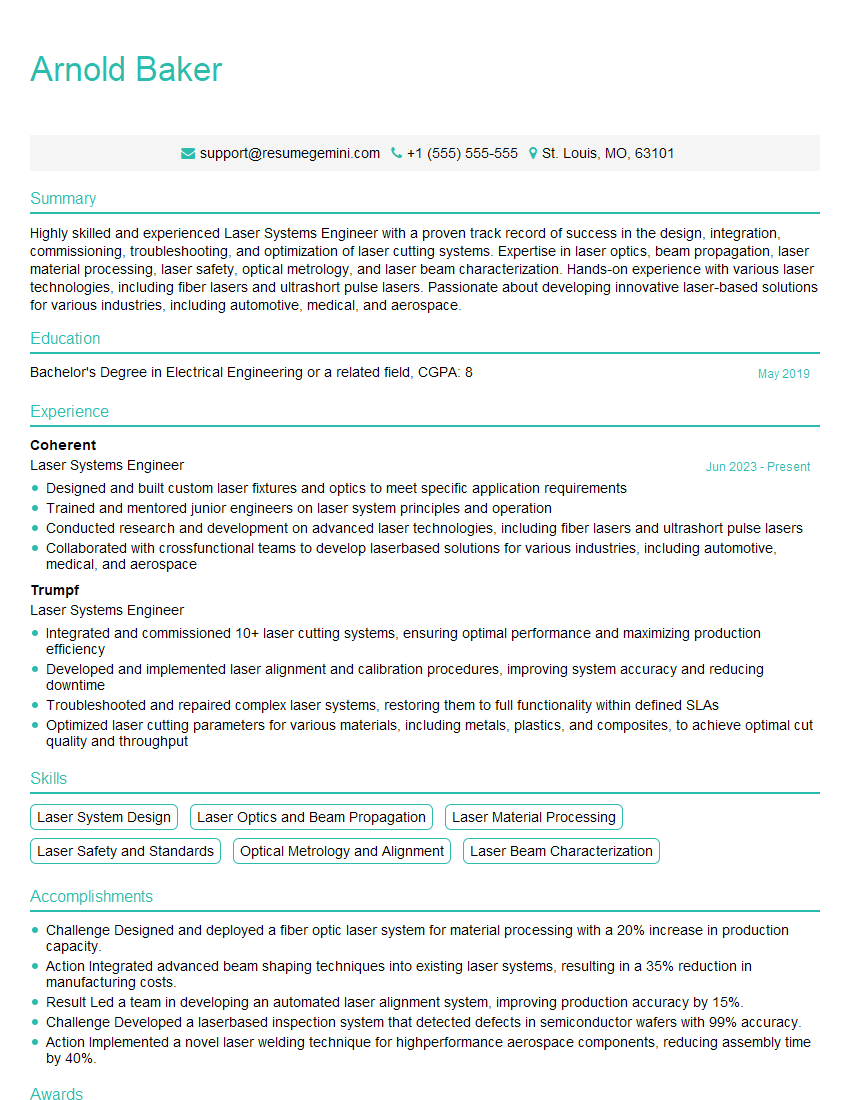
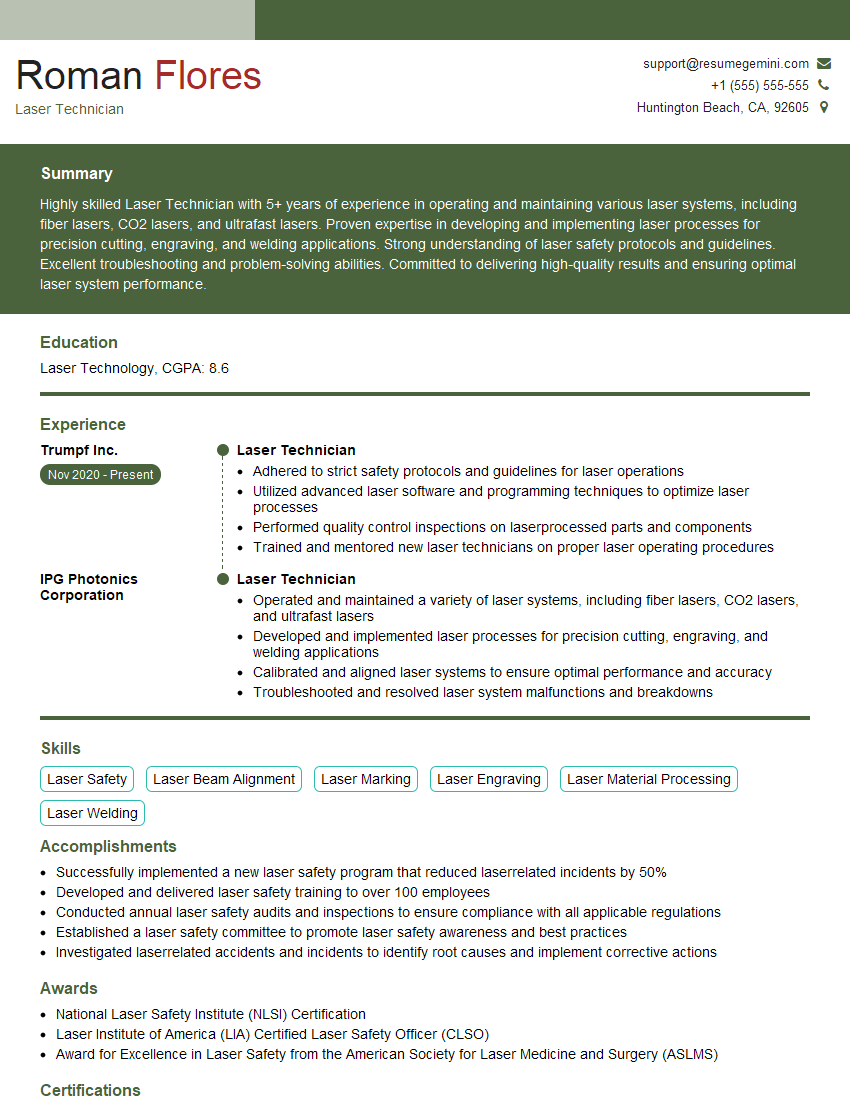
Mastering Laser Process Optimization is crucial for career advancement in advanced manufacturing, materials science, and related fields. A strong understanding of these principles will significantly enhance your job prospects and open doors to exciting opportunities. To maximize your chances, creating a compelling and ATS-friendly resume is essential. ResumeGemini is a trusted resource that can help you build a professional resume that showcases your skills and experience effectively. Examples of resumes tailored to Laser Process Optimization are available to help guide you in crafting your own impactful document.
Explore more articles
Users Rating of Our Blogs
Share Your Experience
We value your feedback! Please rate our content and share your thoughts (optional).
What Readers Say About Our Blog
Really detailed insights and content, thank you for writing this detailed article.
IT gave me an insight and words to use and be able to think of examples