Cracking a skill-specific interview, like one for Laser Troubleshooting, requires understanding the nuances of the role. In this blog, we present the questions you’re most likely to encounter, along with insights into how to answer them effectively. Let’s ensure you’re ready to make a strong impression.
Questions Asked in Laser Troubleshooting Interview
Q 1. Explain the different types of lasers and their applications.
Lasers are classified by their lasing medium, wavelength, and power output. Different types find applications in diverse fields.
- Gas Lasers (e.g., HeNe, CO2): These use a mixture of gases to create a lasing medium. HeNe lasers, known for their red light, are commonly used in barcode scanners and laser pointers. CO2 lasers, emitting infrared light, are powerful and used in industrial cutting and welding.
- Solid-State Lasers (e.g., Nd:YAG, Ruby): These use a solid crystal or glass doped with specific ions as the lasing medium. Nd:YAG lasers emit near-infrared light and are versatile, employed in medical procedures (like laser eye surgery) and materials processing. Ruby lasers, historically significant, emit red light and are less common now.
- Diode Lasers (e.g., Semiconductor Lasers): These are compact, energy-efficient lasers that use a semiconductor junction to produce light. They are prevalent in CD/DVD players, laser printers, and fiber optic communication systems. Their low cost and small size makes them ubiquitous.
- Fiber Lasers: These lasers use an optical fiber as the gain medium. The fiber’s geometry allows for high power and excellent beam quality, making them valuable in industrial applications such as cutting and marking.
- Excimer Lasers: These use a mixture of noble gas and halogen gas to produce ultraviolet light. Their high photon energy is useful in microfabrication and medical treatments such as LASIK eye surgery.
The choice of laser depends entirely on the application’s requirements for wavelength, power, beam quality, and cost.
Q 2. Describe the process of laser alignment and adjustment.
Laser alignment and adjustment are crucial for optimal performance and safety. The process typically involves:
- Initial Alignment: This often uses simple tools like alignment cards or screens to roughly position the laser beam along the optical axis. This involves adjusting mirrors or lenses to direct the beam.
- Fine Adjustment: This stage requires more precise instruments, often including power meters and beam profilers, to ensure the beam’s position, size, and shape meet specifications. Adjustments are made iteratively, monitoring the beam parameters with the instruments until optimal performance is achieved.
- Verification and Documentation: The final aligned state is verified through repeated measurements. Any adjustments or modifications are carefully documented to ensure reproducibility and maintenance consistency. This is especially important in industrial and medical applications where precision is paramount.
Think of aligning a laser as similar to aiming a rifle – a rough aim is initially established, then fine adjustments are made to ensure a precise hit on the target. The tools used become increasingly sophisticated based on how precise that hit needs to be. In lasers, precision translates to beam quality and consistency which impacts the application’s results.
Q 3. How do you troubleshoot a laser that is not emitting light?
Troubleshooting a non-emitting laser requires a systematic approach, starting with the simplest checks and progressing to more complex investigations.
- Power Supply: Verify that the laser is properly connected to the power source and that the power supply is functioning correctly. A simple check is to see if the power supply is delivering the correct voltage and current.
- Cooling System: Many lasers require adequate cooling. Check for proper cooling-water flow or fan function. Overheating can prevent lasing.
- Optical Alignment: Misalignment of the optical components can stop lasing. Examine the optical path for any misalignment, loose connections, or damage to optical components.
- Lasing Medium: Depending on the type of laser, problems with the lasing medium might be responsible. This may involve examining the gas pressure in gas lasers or checking the crystal quality in solid-state lasers. This is more advanced troubleshooting and often requires specialized equipment.
- Control Electronics: Examine the laser’s control system, including the power supply and any control circuitry. A malfunctioning controller may prevent lasing. Use a multimeter to check the output signals.
If the issue is not quickly identified, consulting the laser’s manual and potentially a service engineer may be necessary. Never attempt repairs beyond your skill level, particularly with high-power lasers.
Q 4. What safety precautions must be taken when working with lasers?
Laser safety is paramount. The precautions depend on the laser’s class (I-IV), with higher class lasers posing greater risk. Key safety measures include:
- Eye Protection: Always wear appropriate laser safety eyewear that is specifically rated for the laser’s wavelength and power. This prevents accidental eye damage from even short exposures.
- Enclosure and Beam Containment: High-power lasers should be housed in enclosures to prevent accidental exposure. The beam should be carefully directed and controlled, using beam stops or attenuators when necessary.
- Warning Signs: Clearly marked warning signs should be displayed in laser work areas, indicating the presence of lasers and the necessary safety precautions.
- Training and Procedures: All personnel working with lasers should receive adequate training on safe operating procedures and emergency protocols. Standard operating procedures should be established and followed rigorously.
- Regular Inspections: Regular inspection of laser systems for signs of damage or malfunction is essential for preventing accidents. Regular maintenance checks should be part of the safety protocol.
Laser safety is not just about avoiding injury – it’s about ensuring the reliable and consistent operation of your equipment. A well-maintained laser is a safe laser. Ignoring safety can lead to serious injury or permanent eye damage.
Q 5. Explain the concept of laser beam divergence and its impact on applications.
Laser beam divergence refers to the spreading of the laser beam as it propagates. It is typically expressed as an angle (milliradians or degrees). A smaller divergence angle indicates a more collimated (parallel) beam.
The impact of beam divergence varies based on the application. For applications like laser cutting or marking, a tightly focused beam (low divergence) is crucial to achieve high precision. In contrast, applications that need to cover a large area, such as laser scanning or illumination, may benefit from a wider beam (higher divergence).
Consider the example of a barcode scanner. It requires a relatively collimated beam to accurately read the barcodes from a certain distance. A highly divergent beam would make it difficult to precisely focus on the barcode. Conversely, a laser used in a light show might benefit from higher divergence, allowing the light to fill a larger area.
Q 6. How do you diagnose and resolve issues related to laser power instability?
Laser power instability can manifest as fluctuations in the laser’s output power. Troubleshooting this requires checking several potential sources.
- Power Supply: Ensure the power supply is stable and provides a consistent voltage and current. Fluctuations in the power supply are a common cause of unstable laser power. Check the power supply using a high-quality digital multimeter.
- Thermal Effects: Temperature changes can affect the laser’s performance. Make sure the cooling system (if any) is functioning correctly. Poor cooling can cause power fluctuations.
- Optical Components: Dust, debris, or damage to optical components within the laser cavity can cause power instability. Inspect and clean the optics (with the appropriate cleaning procedures and materials).
- Control Electronics: Examine the laser’s control circuitry for any malfunctions. This may involve reviewing the control system software or checking for faulty components.
- Lasing Medium: Issues within the lasing medium itself can also lead to power instability. This is a more advanced area requiring specialized knowledge and instrumentation.
Systematic checking and careful documentation are key to efficiently diagnosing and resolving power instability issues. If troubleshooting becomes complex, contacting a qualified service technician is advisable.
Q 7. Describe different methods for measuring laser beam parameters (e.g., power, diameter, divergence).
Measuring laser beam parameters is essential for characterizing laser performance and ensuring applications function optimally. Several methods exist:
- Power Measurement: Power meters, which convert optical power into an electrical signal, are commonly used. These range from simple handheld devices to sophisticated calorimeters for high-power lasers. Proper calibration and use according to manufacturer instructions are crucial for accurate measurements.
- Beam Diameter Measurement: Beam profilers using CCD cameras and software are the most common approach. These systems capture the beam’s intensity profile, from which the beam diameter (often defined as the 1/e2 diameter) can be calculated. Knife-edge scanning methods can also be employed.
- Beam Divergence Measurement: Measuring the beam diameter at several distances from the laser aperture allows for the calculation of divergence angle. This often involves a combination of power measurement and beam diameter measurement at various distances. Knowing the beam waist is essential for accurate calculation of the divergence.
Accurate measurement is crucial not just for characterizing the laser’s performance, but also for ensuring that it performs well in its specific application. Inaccurate measurements can lead to sub-optimal or even failed applications, especially in high-precision systems.
Q 8. What are common causes of laser misalignment and how do you rectify them?
Laser misalignment is a common issue leading to reduced power, poor beam quality, and even damage to optical components. It’s like trying to hit a target with a wobbly bow and arrow – you won’t be accurate! Several factors contribute to misalignment.
- Mechanical vibrations: External shocks or vibrations from machinery or even air currents can shift the laser’s position. Imagine a laser pointer mounted on a shaky table.
- Thermal effects: Temperature changes can cause components to expand or contract, altering the optical path. Think of a metal ruler expanding in the sun, changing its length.
- Improper mounting: Poorly secured optical mounts or components can lead to gradual or sudden misalignment. It’s like trying to build a house on shifting sand.
- Component wear: Over time, components might wear out or degrade, leading to misalignment. This is like the wear and tear on a car’s suspension affecting its alignment.
Rectification involves careful adjustments. We typically use alignment tools like beam profilers and autocollimators to precisely measure and correct the beam’s position. This often involves adjusting mirrors, lenses, or the entire laser mount. Sometimes, it requires replacing worn-out components. The process is iterative, requiring multiple measurements and adjustments until the desired alignment is achieved. Thorough documentation and careful adjustments are key to success.
Q 9. How do you identify and troubleshoot problems related to laser beam pointing stability?
Laser beam pointing stability is crucial for many applications, particularly in precision machining and scientific instrumentation. Instability manifests as beam wander or jitter – like trying to write with a shaky hand. We identify instability using techniques like:
- Real-time beam profiling: High-speed cameras and beam profilers capture the beam’s position and shape over time, revealing any drift or fluctuations.
- Long-term monitoring: We use automated systems that continuously monitor the beam’s position and record data over extended periods, allowing us to identify gradual drifts or trends.
Troubleshooting involves pinpointing the cause:
- Acoustic noise: Vibrations from fans or pumps can cause instability. We isolate the laser from these sources or use vibration dampening mounts.
- Thermal fluctuations: Temperature variations affect components’ dimensions. We use temperature-controlled enclosures or active cooling to stabilize the system.
- Power supply fluctuations: Changes in the power supply voltage can impact the laser’s output. Stable, regulated power supplies are essential.
- Feedback control: Advanced systems use feedback control loops to actively compensate for deviations in beam position, maintaining stability.
Q 10. Explain the different types of laser damage and their causes.
Laser damage is a serious concern, leading to reduced performance, safety hazards, and costly repairs. Several types exist:
- Optical damage: This occurs on optical components like mirrors and lenses. It’s caused by high laser intensities exceeding the material’s damage threshold. This is like repeatedly scratching a window with a sharp object; eventually, it’ll break.
- Thermal damage: Excessive heat generated by the laser beam can cause melting, cracking, or charring of materials. Think of the damage caused by a magnifying glass focusing sunlight.
- Photochemical damage: Laser light can cause chemical changes in certain materials, leading to degradation. Think of the fading of a painting exposed to intense sunlight.
- Dielectric breakdown: High laser intensities can lead to electrical breakdown within optical components, particularly in insulators, causing irreversible damage.
Causes include operating the laser beyond its specifications, poor beam quality, contaminants on optical surfaces, improper cooling, and even manufacturing defects. Prevention involves careful selection of materials, appropriate beam attenuation, rigorous cleaning procedures, and adherence to laser operating parameters.
Q 11. How do you perform preventative maintenance on a laser system?
Preventative maintenance is paramount for ensuring the longevity and reliability of a laser system. It’s like regular car servicing – preventing small problems from becoming major ones.
- Regular cleaning: Optical components need regular cleaning to remove dust, fingerprints, and other contaminants that can scatter or absorb the laser beam. Special cleaning procedures and materials are crucial to avoid scratching.
- Alignment checks: Periodic alignment checks ensure the beam remains properly focused and directed. It’s like adjusting your car’s headlights to avoid blinding oncoming traffic.
- Thermal management: Inspecting and cleaning cooling systems, maintaining proper airflow, and monitoring temperatures prevents overheating. This is analogous to checking your car’s coolant levels and radiator.
- Power supply checks: Regularly checking voltage stability, connections, and other parameters helps to prevent sudden power failures. It’s like checking your car’s battery.
- Component inspection: Periodically inspect components for wear, damage, or degradation, replacing them as needed.
- Safety checks: Regularly verifying the safety interlocks, warning lights, and emergency shut-off mechanisms are essential.
A well-defined maintenance schedule tailored to the specific laser system is crucial. Proper documentation helps track maintenance activities and identify potential problems early.
Q 12. Describe your experience with different laser control systems.
My experience encompasses a wide range of laser control systems, from simple analog controls to sophisticated digital systems with advanced feedback loops. I’ve worked with:
- Analog control systems: These use potentiometers and other analog devices to adjust laser parameters like power and modulation. They are simpler but less precise.
- Digital control systems: These utilize microcontrollers or computers for precise control and monitoring. They often incorporate feedback loops for better stability. I’ve used systems based on LabVIEW, MATLAB, and custom firmware.
- Proportional-Integral-Derivative (PID) control: This feedback mechanism is often used to precisely regulate laser parameters, compensating for variations and disturbances.
- Computer-Numerical-Control (CNC) integration: I have experience integrating lasers into CNC machining systems, allowing for precise control over laser position and beam parameters for complex processes.
In each case, a deep understanding of the system’s architecture, communication protocols (e.g., RS-232, Ethernet, USB), and safety protocols is essential for proper operation and troubleshooting.
Q 13. What are the common causes of laser noise and how do you reduce it?
Laser noise refers to unwanted fluctuations in the laser’s output power, beam profile, or frequency. It’s like static on a radio, obscuring the desired signal. Several causes exist:
- Power supply noise: Fluctuations in the power supply voltage can directly affect the laser’s output. Using high-quality, well-regulated power supplies is critical.
- Acoustic noise: Vibrations from pumps, fans, or external sources can cause mechanical disturbances impacting the laser’s stability. Vibration isolation measures are essential.
- Thermal noise: Temperature fluctuations cause changes in the refractive index of optical components, leading to noise in the output. Maintaining stable temperatures is key.
- Mode hopping: Changes in the laser’s resonant modes cause fluctuations in its output. This can be addressed using techniques to stabilize the laser cavity.
Reduction strategies include employing vibration isolation, temperature stabilization, high-quality power supplies, and active noise reduction techniques like feedback control systems. Proper shielding and careful system design are also important aspects.
Q 14. Explain your understanding of laser safety regulations and standards.
Laser safety is paramount. I’m thoroughly familiar with relevant regulations and standards, including ANSI Z136, IEC 60825, and local regulations. These standards cover classification of lasers based on their potential hazard (Class 1-4), specifying appropriate safety measures, such as:
- Laser safety eyewear: Appropriate eyewear must be worn to protect the eyes from potentially damaging laser radiation. The eyewear must be rated for the specific laser wavelength and power level.
- Beam enclosures and interlocks: Lasers should be enclosed to prevent accidental exposure, with interlocks to ensure the beam is blocked when the enclosure is opened.
- Warning signs and labels: Clear warning signs and labels are necessary to alert personnel to potential hazards.
- Control measures: Procedures for operating, maintaining, and aligning lasers must be in place to minimize risks.
- Emergency procedures: Emergency shut-off procedures and response plans must be established to handle accidental exposures.
Compliance is not merely a matter of following rules; it’s a commitment to the well-being of all personnel. A thorough understanding of laser safety principles and regulations is essential for responsible laser operation and maintenance.
Q 15. How do you troubleshoot a laser system experiencing thermal instability?
Thermal instability in a laser system manifests as fluctuations in output power, beam quality, or even component damage. It’s like trying to cook a delicate souffle in an oven with a faulty thermostat – inconsistent temperature ruins the result. Troubleshooting begins with identifying the source of the temperature variations.
- Check the cooling system: Is the coolant flowing properly? Are the cooling fans operating at the correct speed and efficiency? Are the heat sinks adequately sized and making good thermal contact? A clogged coolant channel or a failed fan can dramatically impact the laser’s operating temperature.
- Monitor environmental conditions: External factors, such as room temperature fluctuations or inadequate ventilation, can directly affect the laser’s internal temperature. I often check for drafts or excessive ambient heat near the laser system.
- Inspect laser components: Internal heating may be caused by inefficient optics, poorly aligned components, or even a faulty laser diode. Increased internal losses lead to excess heat generation. We use thermal imaging cameras to pinpoint hotspots within the laser cavity.
- Review the laser’s power supply: An unstable power supply can cause fluctuating current and therefore, fluctuating heat generation in the laser diode.
Once the source is identified, the solution might involve replacing a faulty component, improving cooling, or optimizing the laser’s operational parameters. For example, I once resolved thermal instability in a high-power fiber laser by simply replacing a clogged coolant filter – a seemingly small issue that had huge consequences.
Career Expert Tips:
- Ace those interviews! Prepare effectively by reviewing the Top 50 Most Common Interview Questions on ResumeGemini.
- Navigate your job search with confidence! Explore a wide range of Career Tips on ResumeGemini. Learn about common challenges and recommendations to overcome them.
- Craft the perfect resume! Master the Art of Resume Writing with ResumeGemini’s guide. Showcase your unique qualifications and achievements effectively.
- Don’t miss out on holiday savings! Build your dream resume with ResumeGemini’s ATS optimized templates.
Q 16. Describe your experience with different types of laser optics.
My experience encompasses a wide range of laser optics, from simple lenses and mirrors to complex components like diffraction gratings and acousto-optic modulators (AOMs).
- Lenses: I’ve worked extensively with various types of lenses, including plano-convex, biconvex, and aspheric lenses, each with specific applications based on their focal length and aberration characteristics. Choosing the right lens is crucial for achieving the desired beam size and focusing capabilities.
- Mirrors: From highly reflective dielectric mirrors to metallic mirrors, the selection depends on wavelength and required reflectivity. I’ve tackled issues related to mirror degradation due to high-power laser exposure, requiring careful cleaning or replacement.
- Diffraction gratings: These are essential in wavelength-selective applications. Troubleshooting often involves checking for damage or misalignment, which can lead to decreased efficiency and unwanted spectral broadening.
- Acousto-optic modulators (AOMs): These devices allow for fast and precise control of the laser beam. Troubleshooting typically involves inspecting the driving electronics and ensuring proper acoustic wave generation for efficient modulation.
My expertise extends to the alignment and testing of these optics, using techniques like interferometry to ensure optimal performance. For example, I had to realign a complex optical setup involving a series of mirrors and lenses for a high-precision laser marking system which was causing an off-center beam profile.
Q 17. How do you diagnose and repair problems related to laser cooling systems?
Laser cooling systems are critical for maintaining stable operation. Problems typically involve coolant flow issues, pump failures, or insufficient cooling capacity. Diagnosis involves a systematic approach:
- Check coolant flow: Inspect for blockages, leaks, or low coolant levels. We use pressure gauges and flow meters to assess the system’s performance.
- Inspect the pump: Listen for unusual noises indicating pump wear or failure. Measure pump pressure and flow rate to determine its efficiency.
- Check temperature sensors: Verify the accuracy of temperature readings. Inconsistent readings often point to faulty sensors.
- Examine heat exchangers: Assess the efficiency of heat exchange, looking for signs of scale buildup or other blockages that reduce heat dissipation.
- Analyze coolant composition: Inappropriate coolant, or coolant that has degraded over time, can reduce cooling efficiency.
Repairs might involve replacing faulty pumps, cleaning heat exchangers, or upgrading the cooling system for improved capacity. In one instance, I resolved an overheating issue in a medical laser system by simply adding an external chiller unit, providing extra cooling power during prolonged operation.
Q 18. Explain your experience with different laser modulation techniques.
Laser modulation techniques are used to control the laser’s output characteristics, such as power, intensity, and frequency. I have experience with several methods:
- Direct modulation: This involves directly varying the drive current to the laser diode. It’s simple but often results in lower bandwidth and increased noise.
- Electro-optic modulation: This uses electro-optic crystals to change the refractive index of the beam path, offering higher bandwidth and better linearity. We use Pockels cells and other electro-optic devices for precision control.
- Acousto-optic modulation: This utilizes acoustic waves to diffract and modulate the laser beam, providing flexibility in modulation frequency and depth.
- Q-switching: This involves rapidly changing the optical cavity’s losses, creating high-energy pulses. Troubleshooting often involves checking the Q-switch driver and the timing electronics.
Choosing the right modulation technique depends on the application’s requirements. For example, I implemented acousto-optic modulation in a high-speed laser scanning system, enabling precise control of the beam’s position and intensity during fast scans.
Q 19. How do you troubleshoot a laser system exhibiting unexpected output power?
Unexpected output power can stem from various factors. The troubleshooting process should follow a logical path:
- Verify the power supply: Is the voltage and current consistent with the laser’s specifications? Fluctuations in power supply voltage can greatly affect the laser output power.
- Check the laser diode: Is the diode still functioning within its operational parameters? Aging or damage can result in reduced output power.
- Inspect the optical components: Dirty or damaged lenses and mirrors lead to increased losses, causing lower output power. Alignment changes can also affect the efficiency of the laser cavity.
- Analyze the cooling system: Overheating can lead to decreased output power. The laser might be operating in a thermal protection mode.
- Review the control electronics: Malfunctioning control circuits might be sending incorrect signals to the laser, leading to unexpected output power changes.
In one project, I resolved a significant drop in output power by simply cleaning the optical components of a fiber laser—dust accumulation was the culprit!
Q 20. What is your experience with different types of laser detectors?
My experience with laser detectors encompasses a variety of technologies, each suited to different applications:
- Photodiodes: These are widely used for general-purpose laser power measurement. Their simplicity and wide range make them versatile, though sensitivity and speed vary significantly.
- Photomultiplier tubes (PMTs): These are extremely sensitive detectors, ideal for low-light applications, but require high voltage supplies. I have used them in applications requiring single-photon detection.
- Avalanche photodiodes (APDs): These offer high sensitivity and speed and are often used in optical communication and ranging systems. They are more complex to operate than photodiodes.
- Thermal detectors: Less sensitive but suitable for high-power lasers where photodiodes may be damaged, these detectors measure the heat generated by laser light.
Selection of the appropriate detector depends on the laser’s wavelength, power level, and the application’s requirements. For instance, I selected APDs for a high-speed optical communication system, leveraging their ability to detect fast changes in light intensity.
Q 21. Describe your troubleshooting methodology for complex laser systems.
My troubleshooting methodology for complex laser systems is a structured approach, combining systematic investigation with theoretical knowledge:
- Understand the system: Begin by thoroughly reviewing the system’s specifications, schematics, and operational procedures. This provides a baseline for comparison.
- Identify the problem: Precisely define the issue. Is the laser not lasing at all? Is the output power too low or unstable? Are there issues with beam quality?
- Isolate the source: Systematically check each component, using various diagnostic tools such as oscilloscopes, power meters, and spectrum analyzers. A ‘divide and conquer’ approach often helps pinpoint the faulty component.
- Test hypotheses: Based on initial observations, formulate hypotheses about the problem’s cause. Test these hypotheses through controlled experiments.
- Document findings: Maintain detailed records of observations, tests performed, and the results obtained. This is crucial for future reference and troubleshooting similar issues.
- Implement corrective actions: Once the fault is identified, implement the necessary corrective actions, which may involve component replacement, adjustments, or software updates.
This methodology, coupled with experience and a problem-solving mindset, ensures efficient and effective troubleshooting of complex laser systems. It’s like solving a complex puzzle, where each piece of information guides you towards the solution.
Q 22. How do you handle emergency situations related to laser malfunctions?
Emergency situations with lasers demand immediate, safe action. My first priority is always safety – ensuring the laser is shut down completely and the area is secured to prevent accidental exposure. This involves following established emergency procedures, which may include activating emergency power-off switches, deploying laser safety interlocks, and evacuating the immediate area.
Next, I assess the situation. What malfunction occurred? Are there any immediate hazards, such as fire or smoke? I use the laser’s diagnostic tools and log files to gain insights into the potential cause. For example, a sudden power surge might be indicated by a tripped circuit breaker and corresponding error messages in the system’s log. A cooling system malfunction could manifest as overheating warnings and unusual noise from the laser head.
Once the immediate danger is mitigated, I systematically troubleshoot the problem. This often involves checking power supplies, coolant flow, optical alignment, and the laser’s internal components. If the issue is beyond my immediate expertise, I escalate it to senior engineers or the manufacturer. Documentation is critical; I maintain a detailed record of the incident, including the steps taken to resolve it and any recommendations for preventing future occurrences.
Think of it like a fire drill. You have a plan, you know who to contact, and you act swiftly to ensure everyone’s safety first, then focus on the root cause.
Q 23. Explain your understanding of different laser beam shaping techniques.
Laser beam shaping is crucial for many applications, from material processing to optical communications. Different techniques are employed depending on the desired outcome.
- Spatial filtering: This removes higher-order modes from the beam, resulting in a cleaner, more Gaussian profile. It often involves using a pinhole to allow only the central portion of the beam to pass. Imagine it like sieving sand – you remove the larger particles to obtain finer sand.
- Diffractive optical elements (DOEs): These are patterned structures that diffract the laser light to create a specific intensity distribution, such as a flat-top beam, a line, or a complex pattern. Think of a prism splitting sunlight into a rainbow – DOEs do something similar but in a much more controlled fashion. They can create very specific and complex beam shapes.
- Axicons: These conical lenses create a long, non-diffracting beam, ideal for certain types of microscopy and material processing. It’s like creating a long, thin, stable line of light.
- Microlenses: Arrays of tiny lenses can be used to create multiple beams or to homogenize the laser intensity. Imagine a magnifying glass, but with many tiny ones to achieve a uniform effect.
The choice of technique depends on the application requirements. For instance, high-precision micromachining often needs a tightly focused Gaussian beam, while laser material processing might use a flat-top beam for even heat distribution.
Q 24. What software and tools are you familiar with for laser system control and diagnostics?
My experience spans various software and tools used for laser system control and diagnostics. I’m proficient in LabVIEW for custom control and data acquisition systems. It’s exceptionally versatile and allows for the creation of sophisticated monitoring and control interfaces. I can also work with MATLAB for data analysis and modeling, generating plots and reports to assess laser performance.
For specific laser systems, I’m familiar with the proprietary software provided by manufacturers like Coherent, Spectra-Physics, and Newport. These often include graphical user interfaces (GUIs) that allow for controlling laser parameters (power, wavelength, pulse duration), monitoring diagnostics data (beam profile, power stability, temperature), and storing operational logs.
My hardware experience includes the use of various optical power meters, beam profilers (both CCD and knife-edge based), and spectrum analyzers for characterizing laser output. Knowing how to properly use these instruments and interpret the data is crucial for effective laser system maintenance and troubleshooting.
Q 25. How do you interpret laser diagnostic data to pinpoint problems?
Interpreting laser diagnostic data requires a systematic approach. I start by examining the raw data from the monitoring system—this often involves looking at the laser’s power output, beam profile, wavelength stability, and any error logs.
For instance, a gradual decrease in laser power might indicate aging of the laser gain medium or a problem with the power supply. An irregular beam profile could point to misalignment within the optical cavity or contamination on optical components. Shifts in wavelength could suggest instability in the laser’s temperature control system. Error messages provide immediate clues to the issue.
I often employ statistical analysis techniques (e.g., calculating averages, standard deviations) to identify trends and patterns in the data. For instance, a consistent fluctuation in power might be caused by an external disturbance, such as a vibration affecting the laser’s optical cavity.
By cross-referencing data from multiple sources and combining my knowledge of the laser system’s design and operation, I can pinpoint the problem’s root cause and develop an effective solution. It’s akin to being a medical detective; you gather evidence from different tests to diagnose the patient.
Q 26. Explain your experience with laser spectroscopy and its applications.
Laser spectroscopy is a powerful technique used to study the interaction of light with matter. My experience involves using laser-based techniques such as absorption spectroscopy, fluorescence spectroscopy, and Raman spectroscopy for analyzing various materials and their properties.
For example, I’ve used absorption spectroscopy to measure the concentration of specific molecules in a sample, such as atmospheric pollutants or chemicals in solution. This involved using a tunable laser to scan through wavelengths that are absorbed by the target molecule and measuring the absorption signal. The strength of the absorption signal is directly related to the concentration of the molecule.
Fluorescence spectroscopy has been utilized to study the properties of various materials by exciting them with a laser and measuring the emitted fluorescence light. The characteristics of the emitted light (wavelength, intensity, lifetime) provide valuable information about the material’s structure and composition. Raman spectroscopy provides complementary information about molecular vibrational modes, which are useful for identification and quantification of substances. These techniques are particularly valuable in fields like environmental monitoring, medical diagnostics, and materials science.
Q 27. Describe your experience with different types of laser-based measurement systems.
I have extensive experience with various laser-based measurement systems, each tailored to specific applications. These include:
- Laser interferometry: This technique uses the interference of two laser beams to measure extremely small displacements with high precision. It’s used in applications like metrology, precision manufacturing, and gravitational wave detection.
- Laser Doppler velocimetry (LDV): LDV uses the Doppler effect of scattered laser light to measure the velocity of fluids or moving surfaces. It’s invaluable in fluid dynamics research and industrial process control.
- Laser triangulation: This involves projecting a laser beam onto a surface and measuring the position of the reflected spot to determine the surface’s three-dimensional profile. This is used in applications like 3D scanning and surface profilometry.
- Lidar (light detection and ranging): Lidar uses pulsed lasers to measure distances to remote objects, similar to radar but using light instead of radio waves. Applications include atmospheric remote sensing, autonomous vehicle navigation, and mapping.
My experience spans from setting up and calibrating these systems to analyzing the resulting data and interpreting the measurements. Understanding the underlying principles and potential sources of error is crucial for obtaining accurate and reliable results.
Q 28. How do you ensure the long-term reliability and performance of a laser system?
Ensuring the long-term reliability and performance of a laser system involves a multifaceted approach that begins with proper installation and continues throughout the system’s lifespan.
Firstly, it’s critical to follow the manufacturer’s guidelines for installation and operation. This includes proper environmental control (temperature, humidity, vibration) and regular maintenance checks, such as cleaning optical components, inspecting for any damage, and verifying the proper functionality of cooling systems.
Regular calibration and performance testing are essential. This involves measuring key parameters like laser power, beam profile, and wavelength to ensure they are within the specifications. Any deviation should trigger an investigation to identify and address the underlying cause.
Preventative maintenance is key. This includes regular cleaning of optical components, checking for any signs of wear and tear, and replacing components that are nearing the end of their lifespan. It’s better to replace parts proactively rather than react to failures. Think of it like regular car maintenance – it prevents larger problems down the road.
Finally, keeping detailed operational logs and maintenance records is essential for tracking performance trends and identifying potential problems early on. This data can be invaluable for predicting future maintenance needs and extending the life of the laser system.
Key Topics to Learn for Laser Troubleshooting Interview
- Laser Safety and Regulations: Understanding laser classifications, safety protocols, and regulatory compliance (e.g., ANSI, IEC standards).
- Optical Components and Systems: Familiarity with lasers (HeNe, diode, fiber, etc.), mirrors, lenses, beam splitters, and their potential failure modes.
- Laser Diagnostics and Measurement Techniques: Proficiency in using power meters, beam profilers, and other diagnostic tools to identify and quantify laser issues.
- Laser System Alignment and Adjustment: Hands-on experience aligning optical components, optimizing beam parameters, and troubleshooting misalignment problems.
- Electrical and Control Systems: Understanding the electrical circuits, control systems, and power supplies associated with lasers and their potential points of failure.
- Troubleshooting Methodologies: Applying systematic problem-solving techniques, including root cause analysis and fault isolation, to diagnose and repair laser system malfunctions.
- Common Laser System Failures: Knowledge of typical laser problems such as mode hopping, beam instability, power fluctuations, and component degradation.
- Preventative Maintenance: Understanding the importance of routine maintenance procedures to minimize downtime and extend the lifespan of laser systems.
- Data Acquisition and Analysis: Experience collecting and analyzing data from laser systems to identify trends and potential problems.
- Laser Applications and Technologies: Understanding the specific applications of lasers in your target industry (e.g., manufacturing, medicine, research) to relate troubleshooting skills to real-world scenarios.
Next Steps
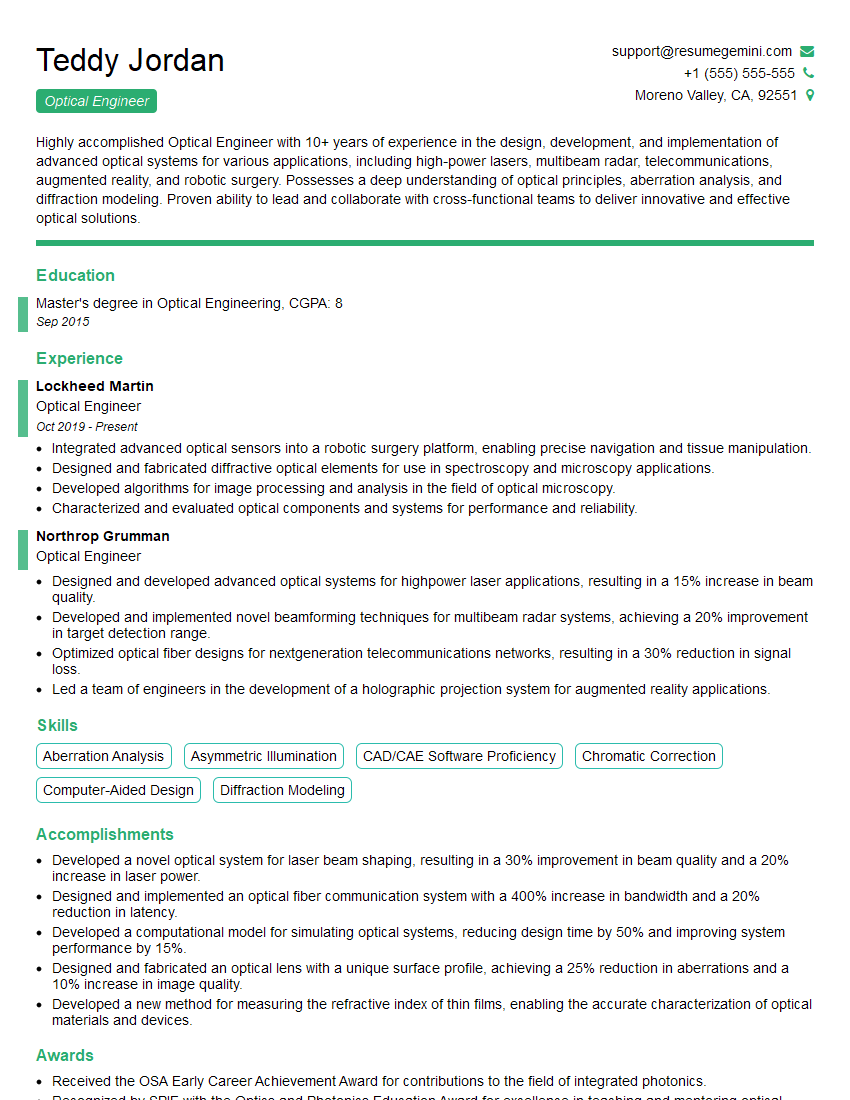
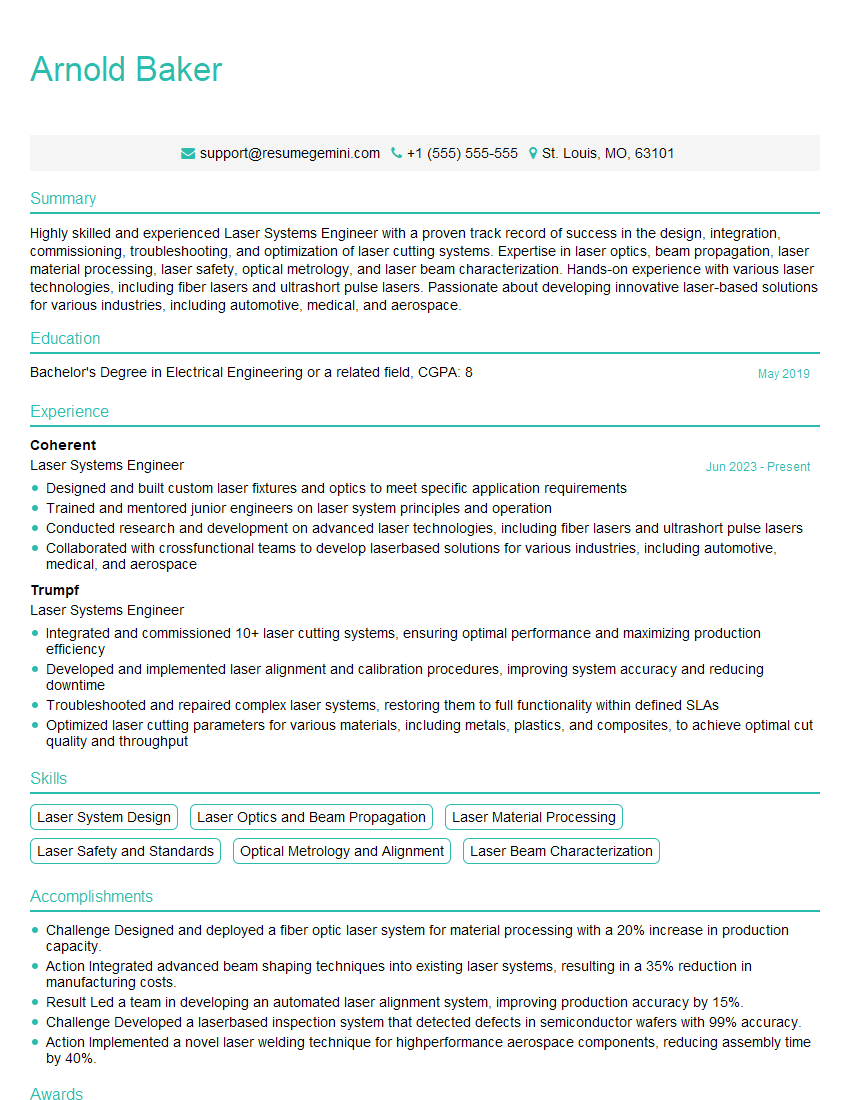
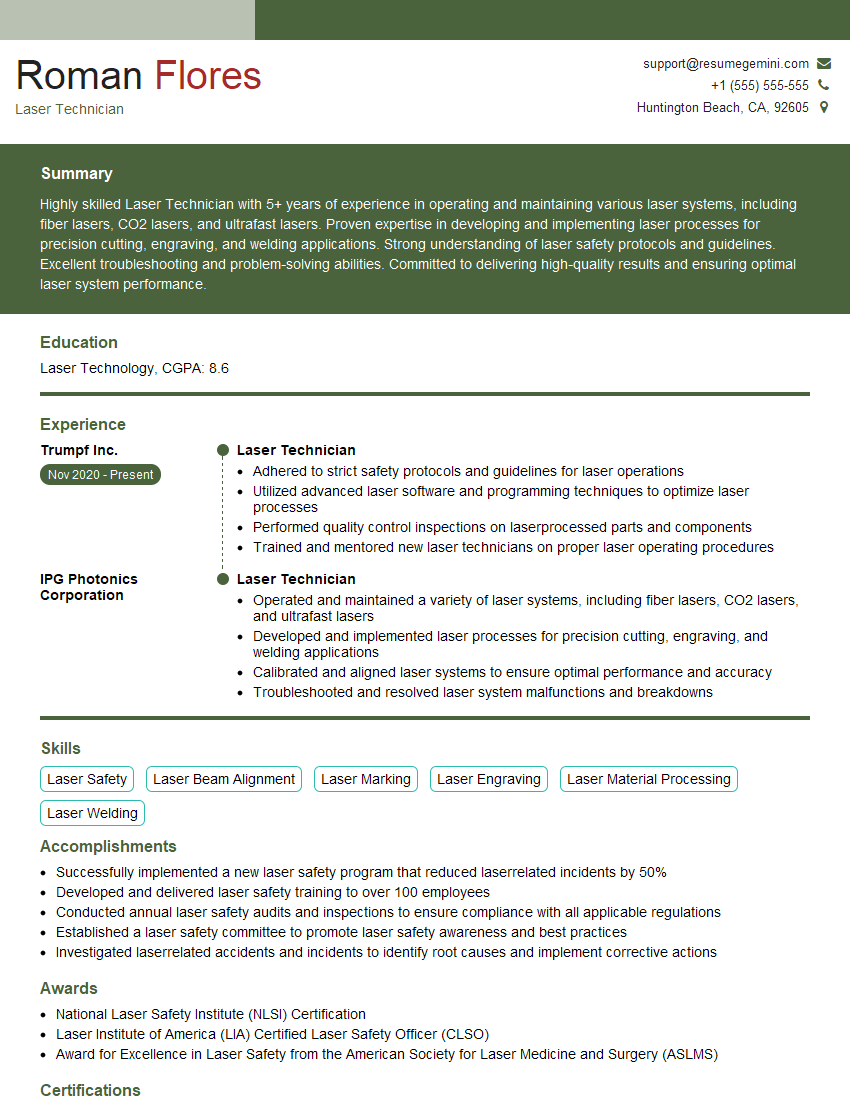
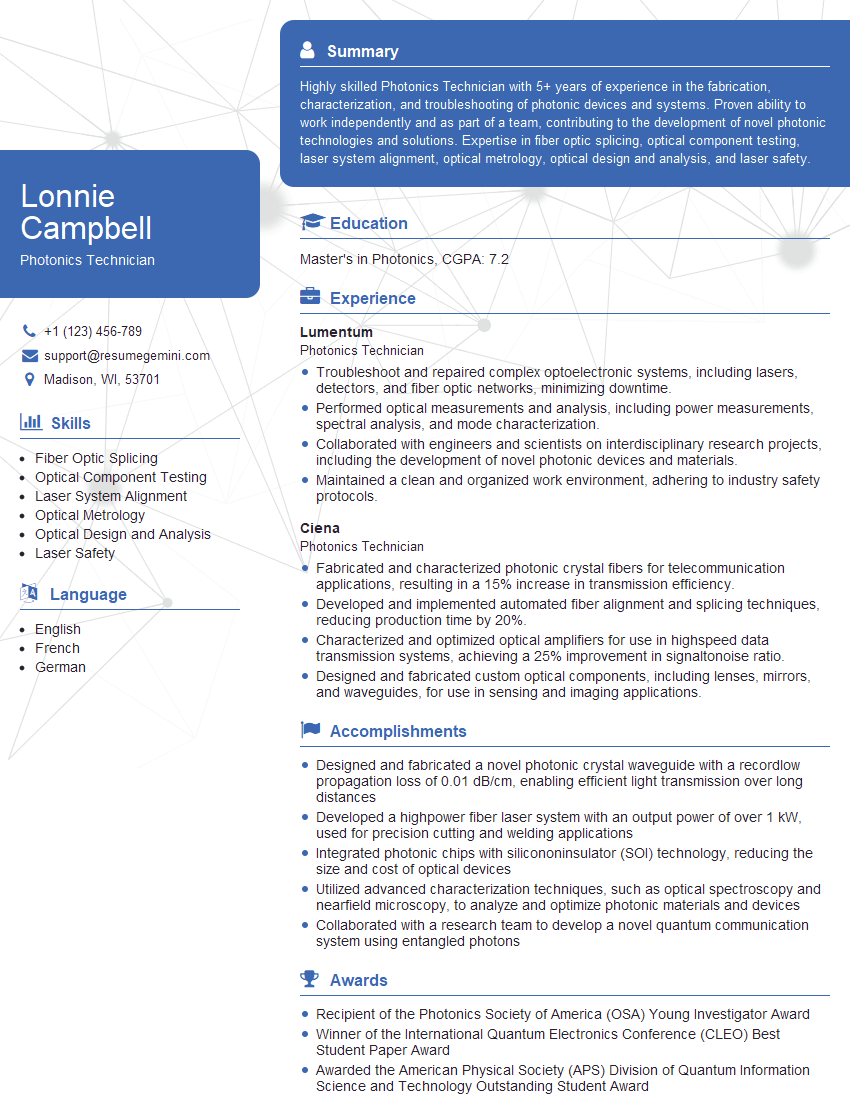
Mastering laser troubleshooting is crucial for advancing your career in a high-demand field. It showcases your technical expertise, problem-solving skills, and ability to handle complex systems. To maximize your job prospects, focus on creating an ATS-friendly resume that effectively highlights your skills and experience. ResumeGemini is a trusted resource that can help you build a professional and impactful resume. Examples of resumes tailored to Laser Troubleshooting are available to guide you through the process.
Explore more articles
Users Rating of Our Blogs
Share Your Experience
We value your feedback! Please rate our content and share your thoughts (optional).
What Readers Say About Our Blog
Really detailed insights and content, thank you for writing this detailed article.
IT gave me an insight and words to use and be able to think of examples