Are you ready to stand out in your next interview? Understanding and preparing for Lean Manufacturing and Continuous Improvement interview questions is a game-changer. In this blog, we’ve compiled key questions and expert advice to help you showcase your skills with confidence and precision. Let’s get started on your journey to acing the interview.
Questions Asked in Lean Manufacturing and Continuous Improvement Interview
Q 1. Define Value Stream Mapping and its key components.
Value Stream Mapping (VSM) is a lean manufacturing technique used to visually represent the flow of materials and information involved in bringing a product or service to the customer. It’s like creating a roadmap of your entire process, highlighting areas of efficiency and waste. The goal is to identify bottlenecks and areas for improvement.
- Customer Needs/Demand: Defines the starting point – what the customer wants and how much.
- Process Steps: Each step involved in creating the product or service, from raw materials to delivery.
- Data Flow: The flow of information (orders, production schedules, etc.) that supports the process.
- Inventory: The amount of raw materials, work-in-progress, and finished goods at each stage.
- Lead Time: The total time required to complete the entire process.
- Value-Added Time vs. Non-Value-Added Time: A critical distinction that highlights areas of waste.
Imagine creating a VSM for making pizza. You’d map out each step: receiving ingredients, preparing dough, adding toppings, baking, and delivering. The map would show where delays occur (e.g., waiting for the oven) and how long each step takes. This allows you to identify opportunities to speed up the process and reduce waste.
Q 2. Explain the 5S methodology and its practical application.
5S is a workplace organization methodology focused on creating a clean, efficient, and safe work environment. It’s an acronym for five Japanese words, each representing a step:
- Seiri (Sort): Eliminate unnecessary items from the workspace. Think of it as decluttering – get rid of anything not needed for the current process.
- Seiton (Set in Order): Arrange necessary items in a logical and easily accessible manner. Everything should have a designated place, improving workflow.
- Seiso (Shine): Clean the workspace thoroughly. This includes regular cleaning to prevent dirt and debris from accumulating and causing problems.
- Seiketsu (Standardize): Establish standards for maintaining the 5S practices. Make the procedures simple and easy to follow for all team members.
- Shitsuke (Sustain): Maintain the established standards and practices consistently. Make 5S a habit, not a one-time event.
A practical application in a manufacturing plant would involve organizing tools, eliminating unnecessary inventory, implementing regular cleaning schedules, and creating visual controls to maintain standards. Imagine a well-organized toolbox where each tool has its own place, making it easy to find and use, compared to a messy toolbox where you have to hunt for the right tool every time.
Q 3. Describe the PDCA cycle (Plan-Do-Check-Act).
The PDCA cycle (Plan-Do-Check-Act) is a four-step iterative process for continuous improvement. It’s a cycle that you repeat over and over again to refine your process.
- Plan: Define the problem, identify potential solutions, and develop a plan to implement a solution. This step involves setting clear objectives and outlining the steps required to achieve them.
- Do: Implement the plan on a small scale (pilot program) to test its effectiveness.
- Check: Analyze the results of the implementation. Did it work as planned? What were the outcomes, both positive and negative?
- Act: Based on the results, standardize the successful changes, or adjust the plan and repeat the cycle. If it didn’t work, learn from it and improve your plan.
Imagine you’re trying to reduce errors in a data entry process. You’d plan a new training program, implement it for a small group, check the error rates, and then either fully implement the program or revise it based on the results.
Q 4. What are the key principles of Lean Manufacturing?
Lean manufacturing focuses on eliminating waste and maximizing value for the customer. Key principles include:
- Value: Define value from the customer’s perspective. What are they willing to pay for?
- Value Stream: Identify all steps in the process, both value-added and non-value-added.
- Flow: Create a smooth and continuous flow of materials and information.
- Pull: Produce only what is needed, when it is needed (demand-pull system).
- Perfection: Continuously strive to improve processes and eliminate waste.
These principles work together to create a system focused on efficiency and customer satisfaction. It’s like a well-oiled machine, where every part works together seamlessly to produce a high-quality product efficiently.
Q 5. How do you identify and eliminate waste in a manufacturing process?
Identifying and eliminating waste is at the heart of Lean. Waste (Muda in Japanese) is anything that doesn’t add value from the customer’s perspective. Common types of waste include:
- Transportation: Unnecessary movement of materials or products.
- Inventory: Excess raw materials, work-in-progress, or finished goods.
- Motion: Unnecessary movement of people or equipment.
- Waiting: Delays in the production process.
- Overproduction: Producing more than is needed.
- Over-processing: Doing more work than necessary.
- Defects: Errors that lead to rework or scrap.
- Untapped Talent: Not using the skills and knowledge of employees effectively.
To eliminate waste, use tools like Value Stream Mapping to visualize the process, and then systematically address each type of waste. For example, if you identify excessive inventory, implement a Just-in-Time (JIT) system to reduce storage and improve flow.
Q 6. Explain the concept of Kaizen and provide a real-world example.
Kaizen, meaning “continuous improvement” in Japanese, is a philosophy that emphasizes incremental, ongoing improvements in processes and systems. It’s about making small, manageable changes over time, rather than large-scale overhauls. This fosters a culture of continuous improvement throughout the organization.
Real-world example: A manufacturing company notices a small delay in the assembly line due to the placement of a specific tool. Instead of a major overhaul, the team moves the tool closer to the assembly point, reducing the time spent retrieving it. This small change is a Kaizen event, leading to increased efficiency. This seemingly minor change, repeated across various processes, can dramatically improve overall productivity.
Q 7. What is the difference between Lean and Six Sigma?
While both Lean and Six Sigma aim to improve processes, they have different focuses:
- Lean: Focuses on eliminating waste and improving efficiency. It’s about making processes faster and simpler.
- Six Sigma: Focuses on reducing variation and defects. It aims for near-perfect quality and consistency.
Lean is often described as a journey, focusing on continuous incremental change, while Six Sigma can be approached as a more structured project-based methodology with defined metrics and goals. In many cases, companies will implement elements from both to improve productivity and quality.
Q 8. Describe your experience with Value Stream Mapping exercises.
Value Stream Mapping (VSM) is a Lean technique used to visualize the flow of materials and information in a process. It helps identify areas of waste and bottlenecks, paving the way for improvement. I’ve extensively used VSM in various settings, from manufacturing plants to office environments. My experience involves leading workshops with cross-functional teams to create current-state maps, meticulously documenting every step, including transportation, inventory, processing, waiting, and delays. We then use this current-state map as a baseline to collaboratively design a future-state map, identifying opportunities to streamline the process, reduce lead times, and eliminate non-value-added activities. For instance, in one project at a food processing plant, we identified a significant bottleneck in the packaging process due to inefficient equipment placement. The VSM clearly highlighted this problem, enabling us to propose a re-layout that significantly reduced cycle time and increased throughput.
- Current-State Mapping: Detailing the existing process, including all steps and their associated times.
- Future-State Mapping: Designing an improved process based on the identification of waste and bottlenecks in the current-state map. This often involves identifying areas for automation, process simplification, or improved workflow.
- Data Collection: Precise data collection is critical. We use timers, process observations, and data from existing systems (ERP, MES) to ensure accuracy.
- Team Collaboration: VSM is highly collaborative. Engaging all relevant stakeholders ensures buy-in and a more effective outcome.
Q 9. How would you measure the effectiveness of a Lean initiative?
Measuring the effectiveness of a Lean initiative requires a multifaceted approach, focusing on both qualitative and quantitative metrics. We need to go beyond simple cost reduction and look at the impact on lead times, quality, and employee morale.
- Quantitative Metrics: These might include reductions in lead time, inventory levels (WIP), defects, and cycle time. We often use key performance indicators (KPIs) like Overall Equipment Effectiveness (OEE) to measure improvements in manufacturing efficiency. Specific targets are set before the initiative to provide a benchmark.
- Qualitative Metrics: This includes assessing improvements in employee engagement, process flexibility, and customer satisfaction. Surveys, interviews, and observations are crucial here. Did the improvements foster a more collaborative and efficient work environment?
- Return on Investment (ROI): Ultimately, the financial impact is crucial. We calculate the ROI by comparing the cost of implementing the Lean initiative to the savings achieved in areas like reduced waste and improved productivity.
For example, if a Lean initiative aims to reduce lead time by 50%, we would track lead time before and after implementation and compare the results against the target. Concurrently, we’d assess employee feedback through surveys to ensure that the changes positively impact their work experience.
Q 10. What are some common barriers to Lean implementation?
Implementing Lean principles can face several barriers, often rooted in organizational culture, lack of understanding, and resource constraints.
- Resistance to Change: Employees may resist new methods if they’re not properly involved or trained. Fear of job loss or changes to established routines can be significant hurdles.
- Lack of Management Support: Lean initiatives require top-down support. Without commitment from leadership, it’s difficult to implement changes effectively.
- Insufficient Training and Education: Employees need proper training to understand and apply Lean principles. Without this, initiatives may fail due to a lack of understanding.
- Lack of Resources: Implementing Lean often requires investments in new equipment, technology, or training. Insufficient funding can severely limit progress.
- Poor Data Management: Lean relies heavily on data-driven decision making. Poor data collection and analysis can lead to ineffective improvements.
- Siloed Departments: Lean necessitates cross-functional collaboration. If departments operate in isolation, it’s difficult to achieve seamless process flow.
Addressing these barriers requires careful planning, effective communication, and a strong commitment to continuous improvement. Addressing employee concerns and providing adequate training are key to overcoming resistance to change.
Q 11. Explain your understanding of Poka-Yoke (error-proofing).
Poka-Yoke, or error-proofing, is a Lean manufacturing methodology aimed at preventing defects from occurring in the first place. It focuses on designing processes and systems that make it virtually impossible to make mistakes. Think of it as building safeguards into the process itself.
Poka-Yoke techniques can be broadly categorized as:
- Detection Methods: These methods detect errors after they occur, but before they cause problems. Examples include visual controls (color-coding, warning lights), limit switches, and counters.
- Prevention Methods: These methods prevent errors from happening in the first place. Examples include standardized procedures, jigs and fixtures that guide assembly, and the use of foolproof design elements.
A simple example is a washing machine that only starts if the door is securely closed – this prevents accidental operation and potential injuries. In a manufacturing setting, Poka-Yoke might involve using a jig to guide the placement of components, ensuring they are always correctly installed. This eliminates the possibility of human error leading to defects. Another example could be color-coding parts to ensure they are assembled in the correct order.
Q 12. How would you handle resistance to change during a Lean transformation?
Resistance to change is a common hurdle in Lean transformations. Addressing this requires a proactive and empathetic approach.
- Open Communication: Clearly communicate the goals, benefits, and process of the Lean initiative to all stakeholders. Address concerns and answer questions directly.
- Employee Involvement: Involve employees in the process. Their input and ideas are valuable, and participation fosters a sense of ownership and reduces resistance.
- Training and Education: Provide adequate training on the new methods and processes. Well-trained employees are more likely to embrace changes.
- Demonstrate Successes: Highlight early successes and celebrate milestones. This builds confidence and shows that the Lean initiative is yielding positive results.
- Address Concerns: Actively listen to and address employees’ concerns. Acknowledge their fears and offer solutions.
- Incentivize Change: Consider offering incentives or rewards for employees who embrace the Lean initiative and contribute to its success.
- Pilot Programs: Start with a pilot project to demonstrate the effectiveness of Lean before a full-scale implementation. This minimizes disruption and allows for adjustments based on feedback.
Remember, change management is as important as the Lean methodologies themselves. Focusing on people and their concerns is paramount.
Q 13. What is your experience with root cause analysis techniques?
Root cause analysis is crucial for identifying the fundamental causes of problems, preventing recurrence. I’m proficient in several techniques, including the 5 Whys, Fishbone diagrams (Ishikawa diagrams), and Fault Tree Analysis (FTA).
- 5 Whys: A simple yet effective technique. By repeatedly asking “Why?” after each answer, you delve deeper into the root cause. It helps to uncover the underlying issues behind a problem.
- Fishbone Diagram: A visual tool that categorizes potential causes of a problem. It helps to brainstorm systematically, considering various contributing factors. Categories can include people, methods, materials, machines, environment, and measurement.
- Fault Tree Analysis (FTA): A deductive technique that works backward from the undesired event to identify the root causes. It uses Boolean logic to determine the combination of events that lead to the failure.
In a recent project involving frequent machine downtime, we used the 5 Whys method. We discovered the root cause wasn’t a mechanical issue but improper maintenance procedures. This allowed us to focus our efforts on retraining maintenance staff and improving the maintenance schedule, resulting in a significant reduction in downtime.
Q 14. Describe a time you successfully implemented a Lean improvement project.
In a previous role at a packaging company, we experienced significant delays in order fulfillment due to inefficient material handling. Using Lean principles, I led a team to improve the situation. We started by conducting a Value Stream Map to identify bottlenecks and areas of waste.
The VSM revealed significant delays in the movement of materials between production and packaging. We implemented several improvements:
- Improved Layout: We reorganized the production floor to minimize material movement distance. This involved a simple re-arrangement of equipment and workstations.
- Kanban System: We introduced a Kanban system to manage material flow between different stages. This reduced inventory and ensured a smoother workflow.
- Standardized Work: We developed standardized work procedures for material handling. This improved efficiency and consistency.
These improvements resulted in a 30% reduction in order fulfillment lead time and a 15% increase in throughput. Moreover, employee morale improved significantly because the new system was more efficient and less physically demanding. The success was measured through reduced lead times, increased throughput, and positive employee feedback. This project demonstrated how Lean principles could be effectively applied to improve efficiency and employee satisfaction.
Q 15. What metrics would you use to track Lean performance?
Tracking Lean performance requires a balanced scorecard, moving beyond simple cost reduction. We need metrics that reflect improvements across the value stream. I’d focus on a few key areas:
- Lead Time Reduction: This measures the time it takes to deliver a product or service from order to delivery. A decrease indicates improved flow and efficiency. For example, reducing lead time from 10 days to 5 days shows a significant improvement.
- Inventory Reduction: Tracking work-in-progress (WIP) inventory, finished goods, and raw materials reveals inefficiencies in production flow. A lower inventory level suggests smoother processes and reduced waste.
- Defect Rate: Monitoring defects per unit identifies quality issues and helps pinpoint areas needing attention. For example, using a control chart to track the defect rate helps see trends and determine effectiveness of improvement efforts.
- Overall Equipment Effectiveness (OEE): This metric combines availability, performance, and quality rate to provide a holistic view of equipment utilization. A higher OEE indicates better machine efficiency and less downtime.
- Cycle Time Reduction: This measures the time it takes to complete a single process step. Reducing cycle time improves throughput and efficiency. Think about a manufacturing line – optimizing each step reduces the overall production time.
- Employee Engagement/Satisfaction: While seemingly less tangible, employee engagement directly impacts productivity and quality. Using surveys and feedback mechanisms can measure this.
The specific metrics chosen will vary based on the industry and the company’s goals. However, regularly monitoring these key performance indicators (KPIs) provides valuable insights into Lean initiatives’ effectiveness.
Career Expert Tips:
- Ace those interviews! Prepare effectively by reviewing the Top 50 Most Common Interview Questions on ResumeGemini.
- Navigate your job search with confidence! Explore a wide range of Career Tips on ResumeGemini. Learn about common challenges and recommendations to overcome them.
- Craft the perfect resume! Master the Art of Resume Writing with ResumeGemini’s guide. Showcase your unique qualifications and achievements effectively.
- Don’t miss out on holiday savings! Build your dream resume with ResumeGemini’s ATS optimized templates.
Q 16. Explain the concept of ‘takt time’.
Takt time is the pace of production needed to meet customer demand. It’s calculated by dividing the available production time by the customer demand. Think of it as the heartbeat of your production system.
Formula: Takt Time = Available Production Time / Customer Demand
For example, if a bakery has 8 hours (480 minutes) of production time per day and needs to bake 240 loaves of bread, the takt time is 2 minutes per loaf (480 minutes / 240 loaves = 2 minutes/loaf).
This means each step in the bread-making process needs to be completed within 2 minutes to meet customer demand without creating excess inventory. Any process exceeding the takt time represents a bottleneck and needs to be addressed.
Q 17. How do you prioritize improvement projects within a Lean framework?
Prioritizing improvement projects in a Lean environment often involves a combination of methods. I typically use a combination of the following:
- Value Stream Mapping (VSM): Identifying bottlenecks and areas with high waste provides a data-driven approach to prioritization. VSM visually represents the flow of materials and information, highlighting areas for improvement.
- Pareto Analysis (80/20 rule): Focusing on the 20% of issues causing 80% of the problems allows for rapid impact. This helps direct resources where they’ll have the most significant effect.
- A3 Problem Solving: Using a structured format to document the problem, its root cause, and the proposed solution fosters focused discussions and decision-making. It allows for a thorough analysis of each project.
- Urgency and Impact Matrix: Plotting projects based on their urgency and potential impact provides a clear visual of which projects need immediate attention and which can be planned for later.
Ultimately, the prioritization process should align with the overall business strategy, focusing on projects that deliver the highest value and quickest return on investment. Regular review of the prioritized projects ensures they continue to align with strategic goals.
Q 18. What are your strengths and weaknesses in Lean implementation?
My strengths lie in my ability to quickly grasp complex processes, identify waste, and facilitate collaborative problem-solving. I’m adept at explaining Lean principles in a way that resonates with people from diverse backgrounds and skill sets. My experience implementing Lean in various settings allows me to adapt quickly to different organizational structures and cultures. I am also very comfortable using and adapting Lean tools.
One area for development is deepening my knowledge of advanced statistical process control (SPC) techniques for more rigorous data analysis. While I understand the fundamentals, I can improve in applying advanced SPC methods for very complex processes.
Q 19. Describe your experience with different Lean tools (e.g., Kanban, 5 Why’s).
I have extensive experience with various Lean tools. My experience with Kanban involves designing and implementing Kanban systems in several organizations, improving workflow visibility and reducing lead times. I’ve used Kanban boards to manage projects, limit work in progress, and improve flow in software development and manufacturing environments. I have a strong understanding of the principles behind Kanban, including visualizing workflow, limiting WIP, managing flow, making process policies explicit, and implementing feedback loops.
The 5 Whys technique is a staple in my root cause analysis toolkit. I’ve used it effectively to uncover the underlying causes of problems, moving beyond superficial symptoms to address the root issue. For example, a high defect rate wasn’t just due to a faulty machine, but rather to insufficient operator training and a lack of preventative maintenance. The 5 Whys guided us to the real solution, resulting in a significant reduction in defects.
Other tools in my arsenal include Value Stream Mapping, Kaizen events, Poka-Yoke (error-proofing), and Gemba walks (going to the place where the work is done to observe and understand the process firsthand).
Q 20. How do you ensure employee engagement during a Lean transformation?
Ensuring employee engagement is critical for successful Lean transformation. It’s not just about implementing tools; it’s about empowering people. Here’s my approach:
- Education and Training: Clearly communicate the “why” behind Lean, emphasizing the benefits for both the company and employees. Provide training on Lean principles and tools, empowering employees to participate actively.
- Involve Employees in Problem-Solving: Create a culture where employees are encouraged to identify and solve problems. Use techniques like Kaizen events to foster collaboration and ownership.
- Recognize and Reward Contributions: Publicly acknowledge and reward employee contributions, fostering a culture of continuous improvement.
- Open Communication: Maintain open and transparent communication channels to keep employees informed of progress and address concerns.
- Empowerment and Autonomy: Give employees the autonomy to make decisions and improve their work processes, promoting ownership and engagement.
By creating a culture of respect, collaboration, and continuous learning, you can significantly enhance employee engagement and increase the chances of successful Lean implementation.
Q 21. Explain the concept of ‘andon’ and its importance.
Andon is a visual system used to signal problems or abnormalities in a production process. Think of it as a visual alarm system that immediately alerts relevant personnel to disruptions, preventing further defects and minimizing downtime.
Typically, an andon system consists of lights (often different colors to indicate different types of problems), buttons, or other signaling devices placed strategically on the production floor. When a problem occurs, the operator uses the andon system to signal it, halting the production line if necessary. This immediately draws attention to the issue and triggers a rapid response team to address the problem.
Its importance lies in its ability to:
- Prevent Defects: Early detection and correction of problems prevent defective products from moving further down the line.
- Reduce Downtime: Rapid response teams swiftly resolve issues, minimizing downtime and production losses.
- Improve Quality: By highlighting problems promptly, andon systems promote a culture of continuous improvement and quality.
- Enhance Teamwork: Andon systems foster collaboration among team members to address challenges collectively.
The immediate visibility and rapid response capability of an andon system are essential for maintaining efficient and high-quality production.
Q 22. How familiar are you with different inventory management systems?
Inventory management is crucial in Lean Manufacturing, aiming to minimize waste and optimize flow. I’m familiar with several systems, each with its strengths and weaknesses depending on the context. These include:
- Just-in-Time (JIT): This system focuses on receiving materials only when needed for production, minimizing storage costs and reducing the risk of obsolescence. I’ve successfully implemented JIT in a previous role, reducing our inventory holding costs by 15% within six months. It requires close collaboration with suppliers and precise demand forecasting.
- Kanban: A visual signaling system that manages the flow of materials between different stages of production. Kanban cards or electronic equivalents signal the need for replenishment. I’ve used Kanban to improve the responsiveness of our production line to changes in demand, reducing lead times significantly.
- Material Requirements Planning (MRP): A computer-based system that uses a bill of materials and master production schedule to plan material needs. While more complex than JIT or Kanban, MRP is essential for managing complex products with long lead times. I’ve used MRP in environments requiring more intricate production planning and forecasting.
- Vendor Managed Inventory (VMI): The supplier manages the inventory levels at the customer’s site. This necessitates a high level of trust and transparency, but can optimize inventory levels and free up internal resources. I’ve successfully negotiated VMI agreements with key suppliers, resulting in improved delivery reliability and reduced stock-outs.
The choice of system depends on factors like production complexity, supplier reliability, demand variability, and the overall cost structure. A hybrid approach, combining elements of different systems, often proves the most effective.
Q 23. Describe your experience with using data analytics in a Lean environment.
Data analytics is indispensable in a Lean environment. It allows us to move beyond gut feelings and make data-driven decisions to identify waste and improve processes. My experience includes using data to:
- Identify bottlenecks: Analyzing production data, such as cycle times and machine utilization, to pinpoint areas where production flow is constrained. For example, by analyzing machine downtime data, we identified a recurring problem with a specific machine, leading to proactive maintenance scheduling and a 10% increase in overall equipment effectiveness (OEE).
- Track key performance indicators (KPIs): Monitoring metrics like lead time, defect rate, and inventory turnover to measure the effectiveness of Lean initiatives. We used dashboards to visualize KPIs and make progress transparent for all stakeholders. This facilitated faster identification of deviations from targets and allowed for prompt corrective actions.
- Improve forecasting accuracy: Applying statistical methods to demand data to improve the accuracy of production planning, reducing waste due to overproduction or stockouts. I leveraged historical data and predictive modeling to enhance our demand forecasting capabilities, leading to a 5% reduction in inventory holding costs.
- Support continuous improvement initiatives: Using data from experiments (e.g., A/B testing) to evaluate the effectiveness of process changes and optimize workflows. We used data to objectively assess the impact of Kaizen events, demonstrating the value of these initiatives to management.
Tools like Statistical Process Control (SPC) and data visualization software are crucial for this process. The key is to focus on actionable insights – data that leads to tangible improvements in efficiency and effectiveness.
Q 24. How would you address a bottleneck in a manufacturing process?
Addressing a bottleneck requires a systematic approach. I typically follow these steps:
- Identify the bottleneck: This often involves analyzing process flow diagrams, observing the production line, and collecting data on cycle times and machine utilization. The bottleneck is usually the slowest step in the process that limits the overall output.
- Analyze the root cause: Why is this step the bottleneck? Is it due to equipment limitations, inadequate staffing, inefficient processes, or material shortages? We use tools like the 5 Whys to drill down to the fundamental cause.
- Develop solutions: Based on the root cause analysis, we brainstorm solutions. Options might include:
- Improving the efficiency of the bottleneck: This could involve upgrading equipment, improving process layout, or providing additional training to operators.
- Redesigning the process: Is there a better way to do things? Could we streamline the process, eliminate unnecessary steps, or automate parts of the process?
- Increasing capacity: Adding additional resources (equipment, personnel) to the bottleneck.
- Offloading work: Redistributing tasks or delegating them to other processes that have higher capacity.
- Implement and monitor: Select the best solution and implement it, ensuring careful monitoring to evaluate its effectiveness and identify any unforeseen issues. We track relevant KPIs to measure the impact of our changes.
- Standardize the improvement: Once the solution has proven effective, we standardize the improved process to prevent the bottleneck from recurring. This often involves documenting best practices and training employees on the new standard operating procedures.
The key is to focus on a holistic, data-driven approach, involving all relevant stakeholders in the process.
Q 25. What are your experience with different types of waste (Muda)?
My experience encompasses all seven types of Muda (waste) identified in Lean:
- Transportation: Unnecessary movement of materials or products. I’ve reduced transportation waste by implementing a more efficient material handling system in a previous project, significantly cutting down on travel times and associated costs.
- Inventory: Excess materials or finished goods. Implementing JIT inventory systems as described earlier dramatically reduced holding costs and obsolescence.
- Motion: Unnecessary movement of people or equipment. Lean principles like 5S can minimize this waste. I’ve implemented 5S to create more efficient workstations and minimize wasted movement.
- Waiting: Idle time in the production process. By addressing bottlenecks as discussed above, we can reduce waiting time.
- Overproduction: Producing more than needed. This ties closely to JIT principles. We improved forecasting to prevent overproduction, saving resources and reducing storage costs.
- Over-processing: Performing more work than required. Process simplification and value stream mapping helps eliminate unnecessary steps, and I’ve often lead workshops to this end.
- Defects: Products or services that do not meet quality standards. Implementing quality control measures at each stage and using techniques such as Poka-Yoke (error-proofing) reduce defects and rework.
Understanding these types of waste allows me to systematically identify and eliminate them, leading to improved efficiency and profitability. It’s crucial to look beyond the obvious and understand the underlying causes of the waste, rather than just addressing the symptoms.
Q 26. How do you ensure the sustainability of Lean improvements?
Sustaining Lean improvements requires more than just implementing changes; it requires embedding Lean principles into the culture of the organization. This involves:
- Leadership commitment: Sustained Lean improvement requires top-down support and commitment. Leaders must actively champion the Lean initiative and provide the necessary resources.
- Employee engagement: Involving employees in the improvement process is crucial. Kaizen events and suggestion systems empower employees to identify and implement improvements, fostering a culture of continuous improvement.
- Standard work: Documenting best practices and establishing standard operating procedures ensures consistency and prevents backsliding. Regular audits help maintain standards.
- Performance measurement: Tracking relevant KPIs and regularly reviewing progress provides visibility into the effectiveness of Lean initiatives and helps identify areas for further improvement. This also facilitates accountability.
- Training and development: Providing ongoing training to employees on Lean principles and tools ensures that they have the skills and knowledge to maintain the improvements.
- Continuous improvement culture: Embedding Lean thinking into the organization’s DNA means creating a culture where continuous improvement is an ongoing process. This is achieved through regular reviews, feedback mechanisms, and a focus on learning from mistakes.
Without these elements, Lean improvements are unlikely to be sustained. It’s an ongoing journey, not a destination.
Q 27. Explain your understanding of the Theory of Constraints.
The Theory of Constraints (TOC) focuses on identifying and addressing the single most significant constraint (bottleneck) that limits a system’s performance. It posits that optimizing individual parts of a system won’t necessarily optimize the whole system. The focus should be on improving the constraint.
The five focusing steps of TOC provide a structured approach:
- Identify the constraint: What is the single most limiting factor in the system? This could be a machine, a process, a policy, or a skill shortage.
- Exploit the constraint: Make the most of the constraint. This could involve optimizing its operation, scheduling its work carefully, or improving its maintenance.
- Subordinate everything else to the constraint: Align the rest of the system to support the constraint. This may involve adjusting schedules, work flows, or inventory levels.
- Elevate the constraint: If exploitation isn’t sufficient, consider ways to increase the capacity of the constraint. This could involve investing in new equipment, hiring additional staff, or redesigning the process.
- If the constraint is broken, go back to step 1: Once a constraint is addressed, a new constraint may emerge. The process is iterative and continuous.
TOC is valuable because it helps focus improvement efforts on the areas that will have the greatest impact on overall system performance. I’ve used TOC successfully in projects to identify and alleviate production bottlenecks, resulting in significant increases in throughput.
Key Topics to Learn for Lean Manufacturing and Continuous Improvement Interview
- Value Stream Mapping: Understanding the process of identifying and visualizing the flow of materials and information, eliminating waste, and optimizing processes. Practical application: Analyzing a current manufacturing process to identify bottlenecks and areas for improvement.
- Kaizen (Continuous Improvement): Mastering the philosophy of continuous improvement through small, incremental changes. Practical application: Leading or participating in Kaizen events to solve workplace problems and enhance efficiency.
- 5S Methodology: Understanding and implementing the 5S principles (Sort, Set in Order, Shine, Standardize, Sustain) to create a more organized and efficient workplace. Practical application: Leading a 5S initiative within a team or department.
- Waste Elimination (Muda): Identifying and eliminating the seven types of waste (Transportation, Inventory, Motion, Waiting, Overproduction, Over-processing, Defects). Practical application: Developing and implementing strategies to reduce waste in a specific manufacturing process.
- Lean Tools & Techniques: Familiarity with various lean tools such as Kanban, Poka-Yoke (error-proofing), and Six Sigma methodologies. Practical application: Explaining how a specific lean tool can be applied to a real-world scenario.
- Problem-Solving Methodologies: Understanding and applying structured problem-solving approaches like DMAIC (Define, Measure, Analyze, Improve, Control) or PDCA (Plan, Do, Check, Act). Practical application: Describing your experience in using a structured approach to solve a complex manufacturing problem.
- Metrics and KPIs: Understanding and interpreting key performance indicators (KPIs) relevant to Lean Manufacturing and Continuous Improvement, such as Overall Equipment Effectiveness (OEE) and cycle time. Practical application: Analyzing KPI data to identify areas for improvement and track progress.
Next Steps
Mastering Lean Manufacturing and Continuous Improvement principles is crucial for career advancement in today’s competitive manufacturing landscape. It demonstrates your commitment to efficiency, problem-solving, and a data-driven approach. To maximize your job prospects, it’s vital to present your skills effectively. Creating an ATS-friendly resume is key to getting your application noticed. ResumeGemini is a trusted resource that can help you build a compelling and effective resume, highlighting your Lean Manufacturing and Continuous Improvement expertise. Examples of resumes tailored to this field are available to help guide you.
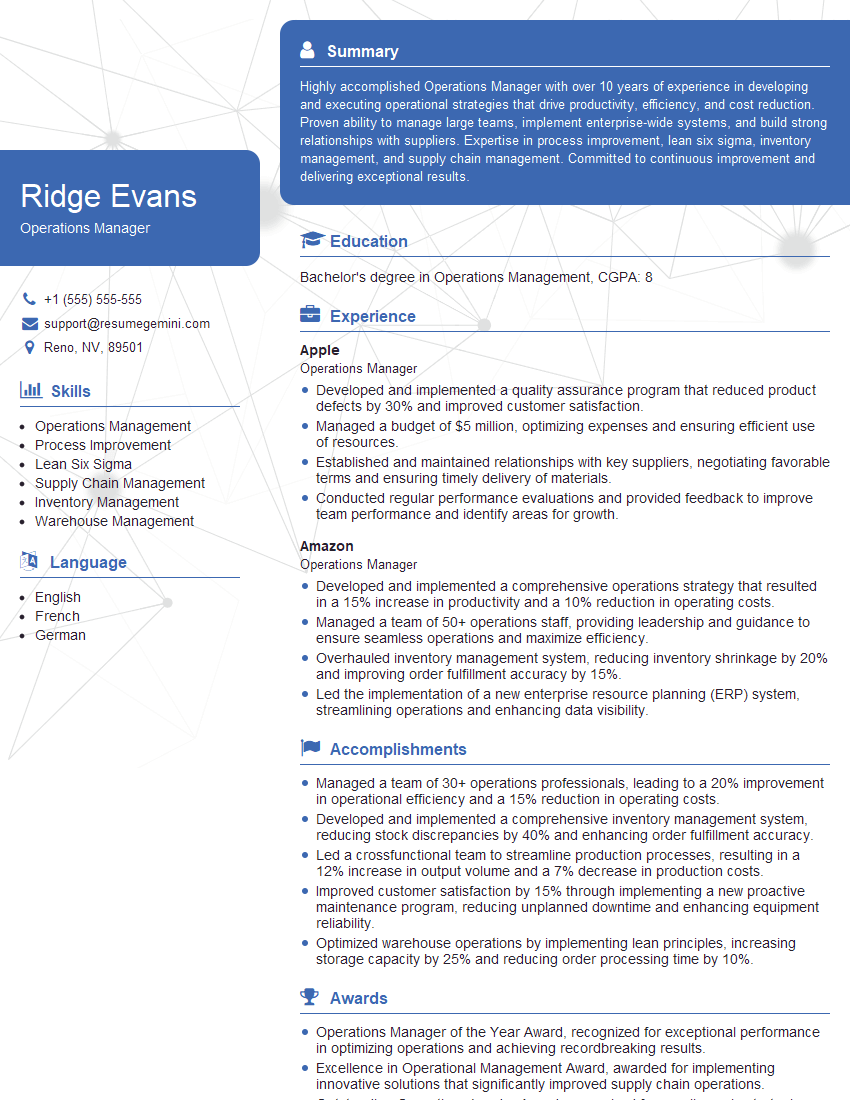
Operations Manager Resume Sample
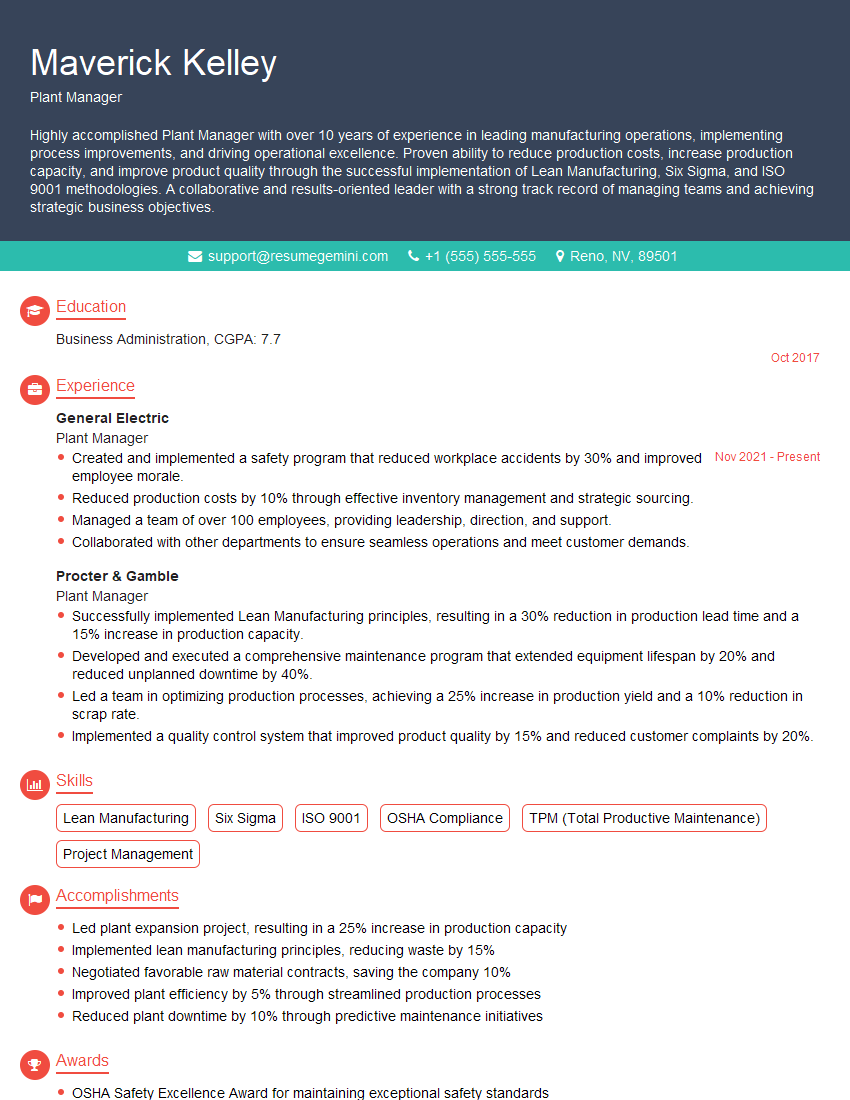
Plant Manager Resume Sample
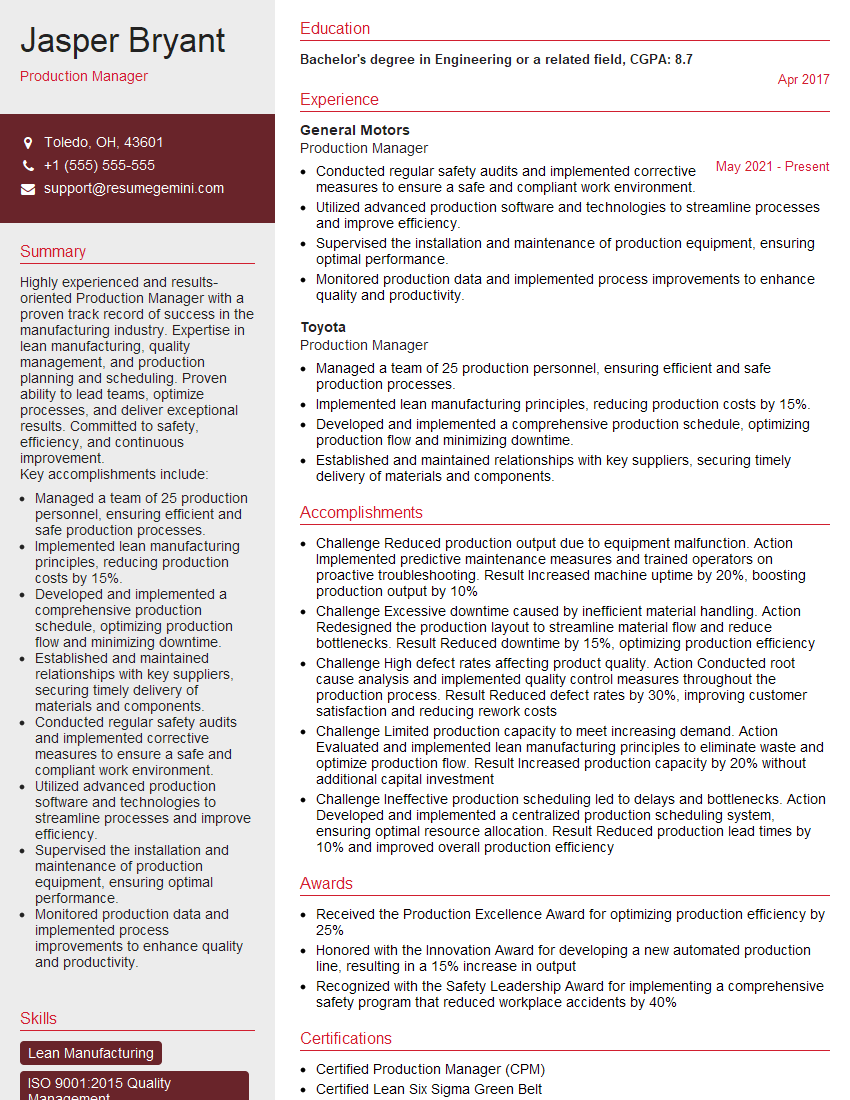
Production Manager Resume Sample
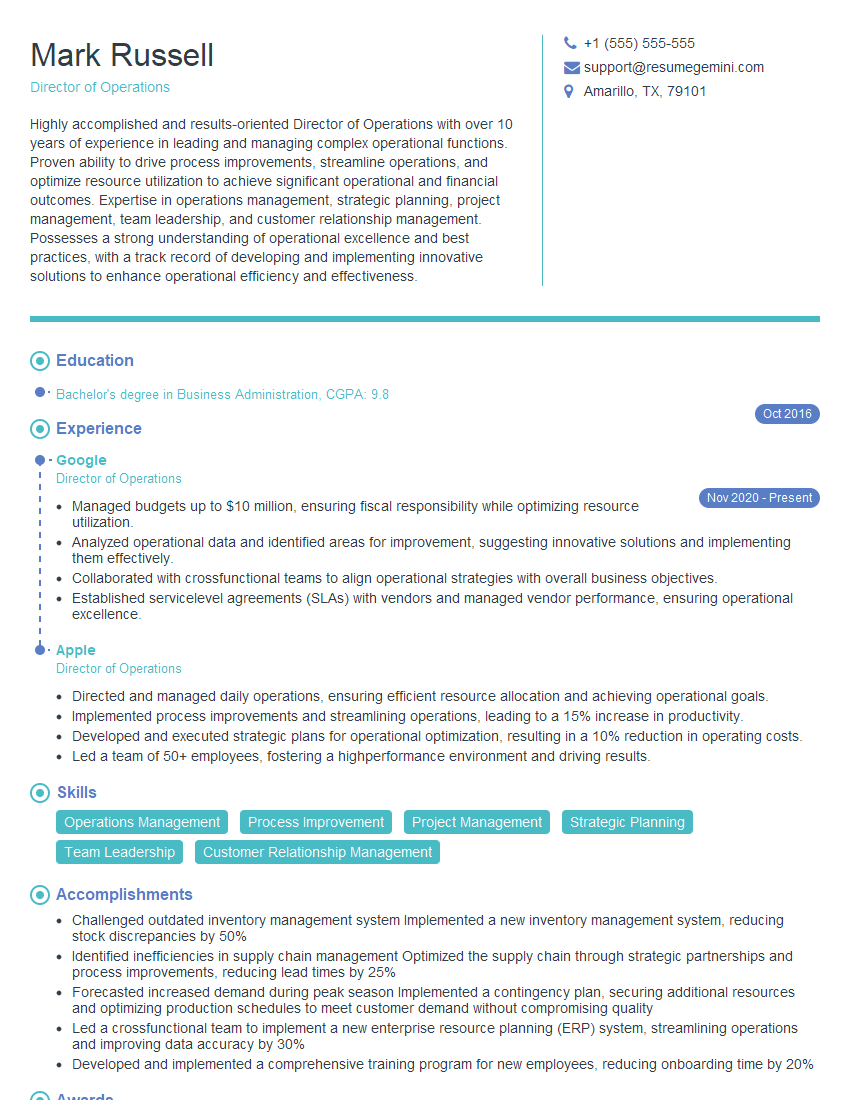
Director of Operations Resume Sample
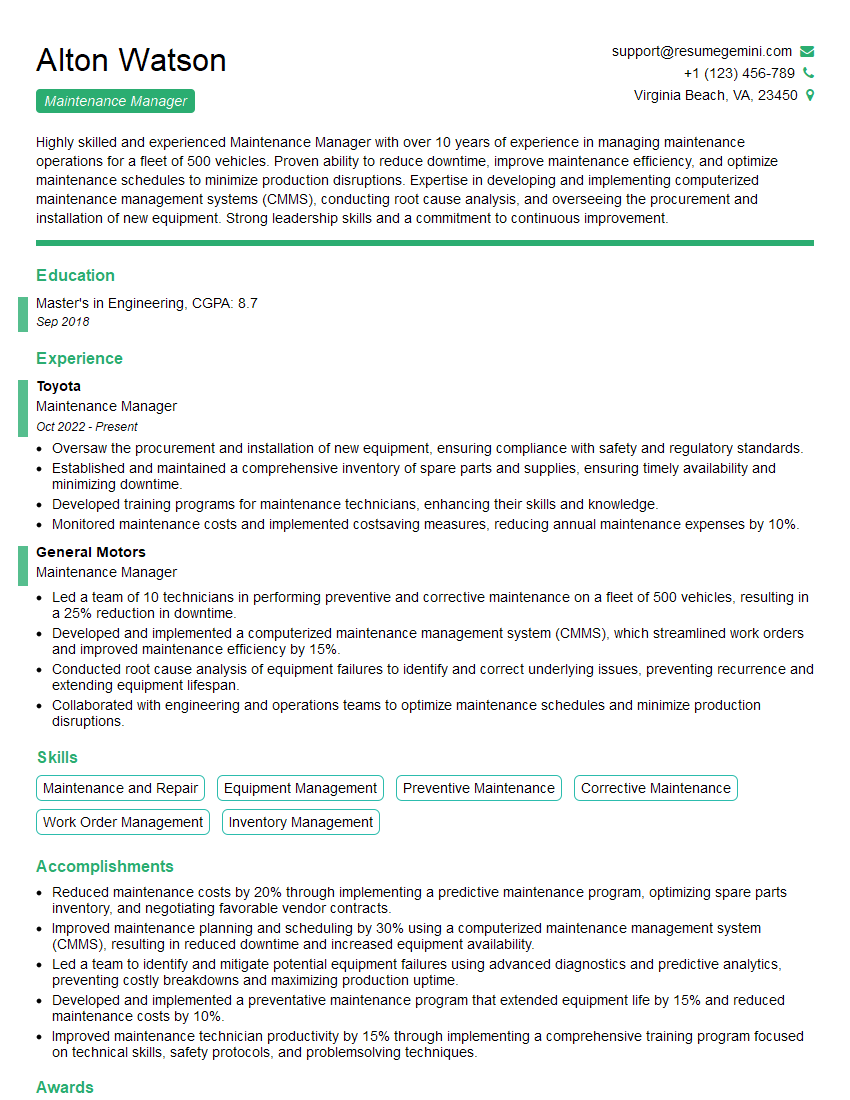
Maintenance Manager Resume Sample
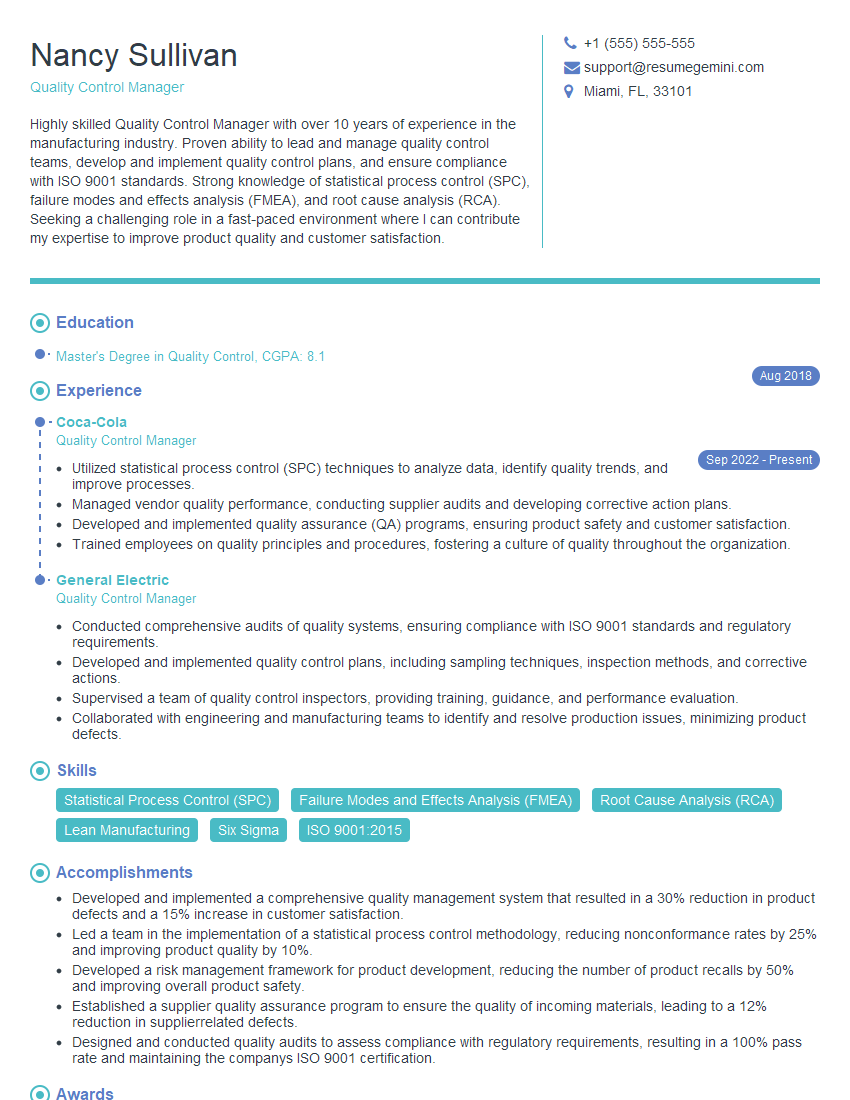
Quality Control Manager Resume Sample
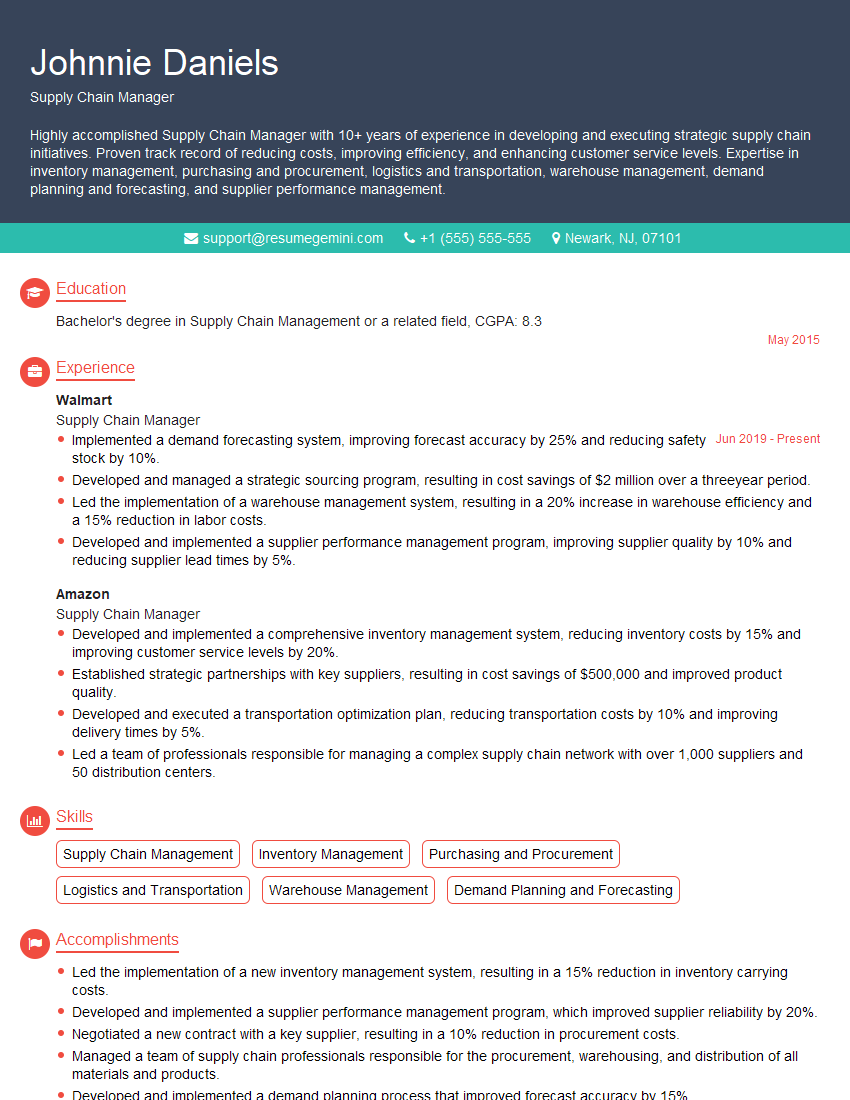
Supply Chain Manager Resume Sample
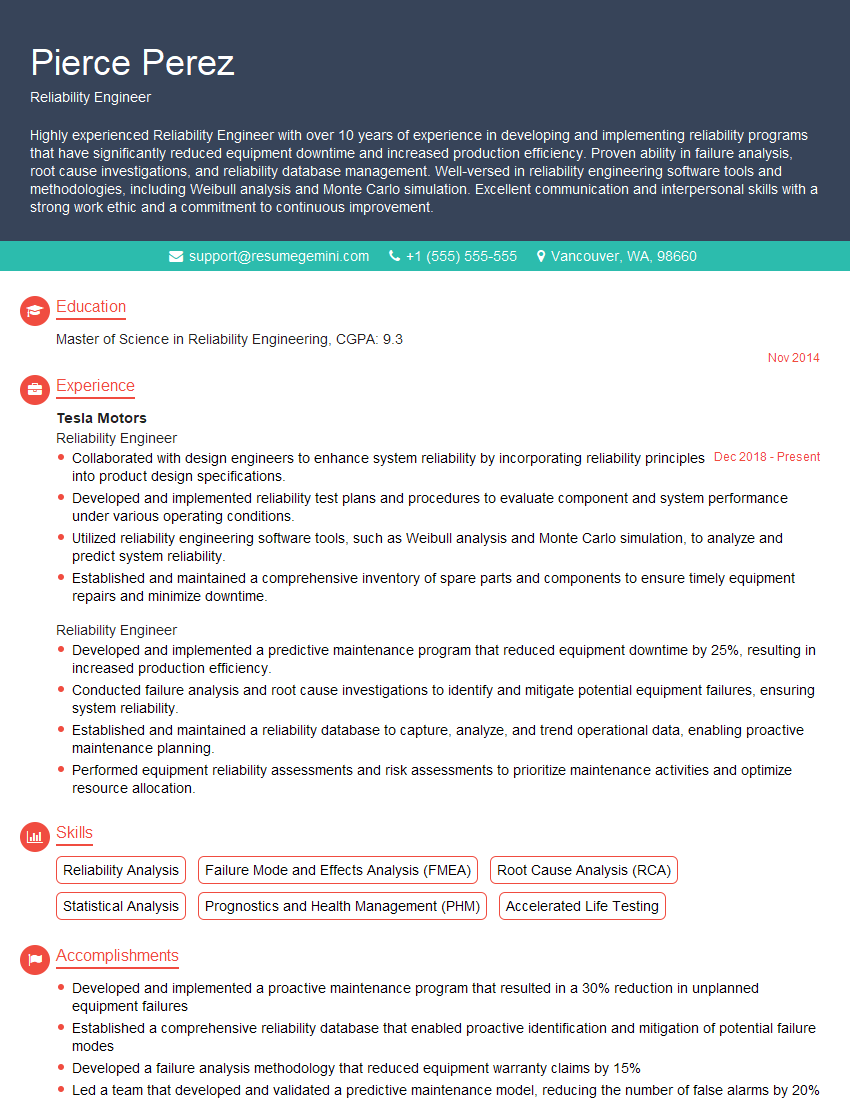
Reliability Engineer Resume Sample
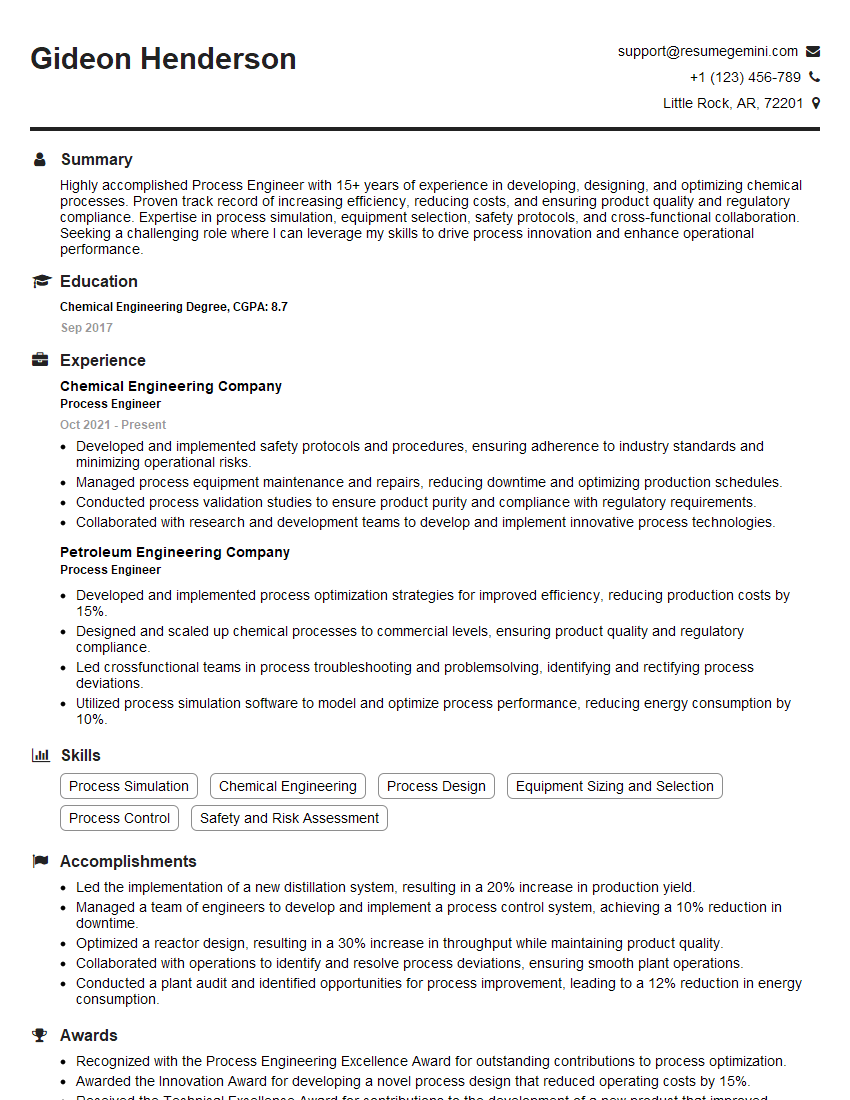
Process Engineer Resume Sample
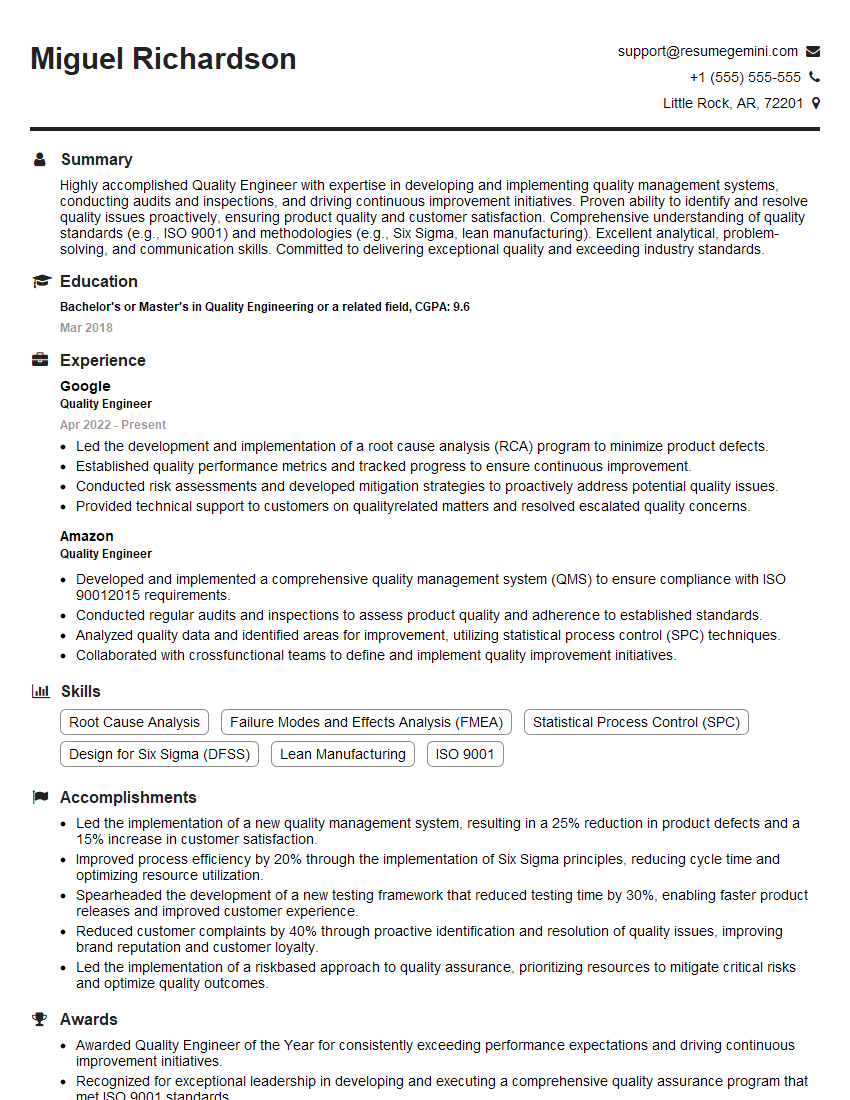
Quality Engineer Resume Sample
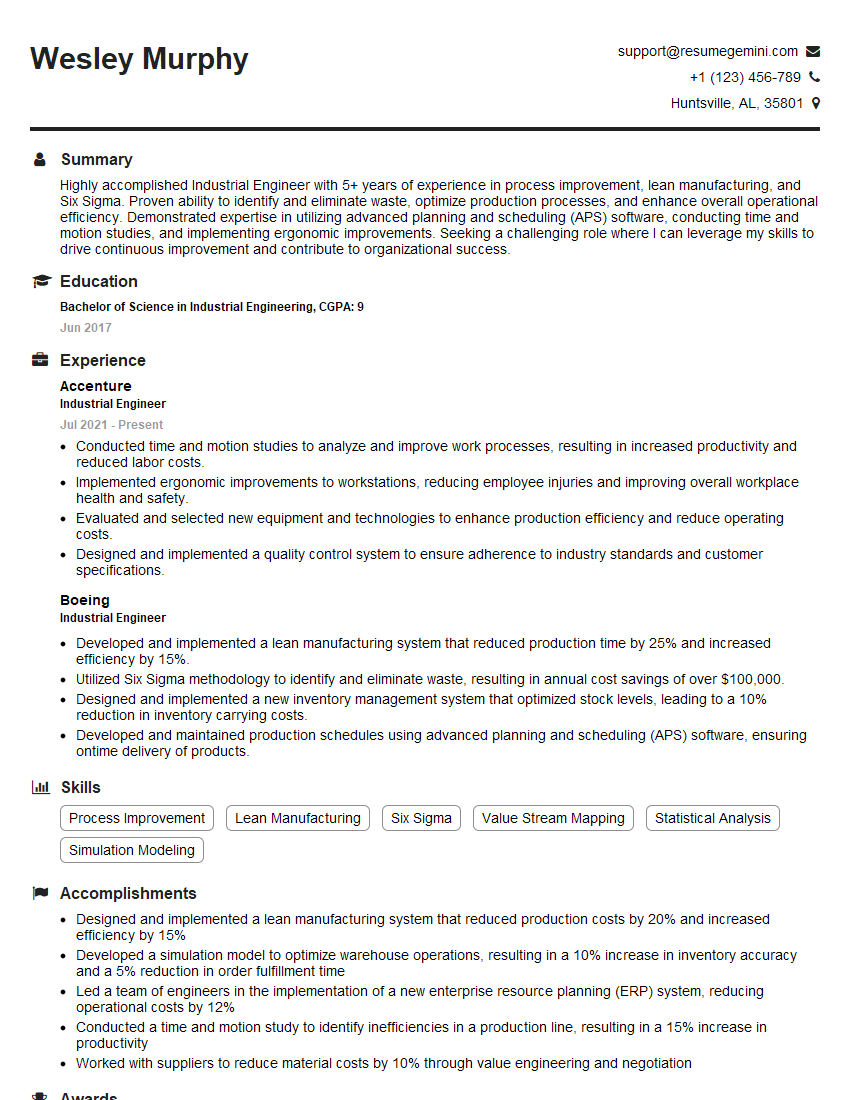
Industrial Engineer Resume Sample
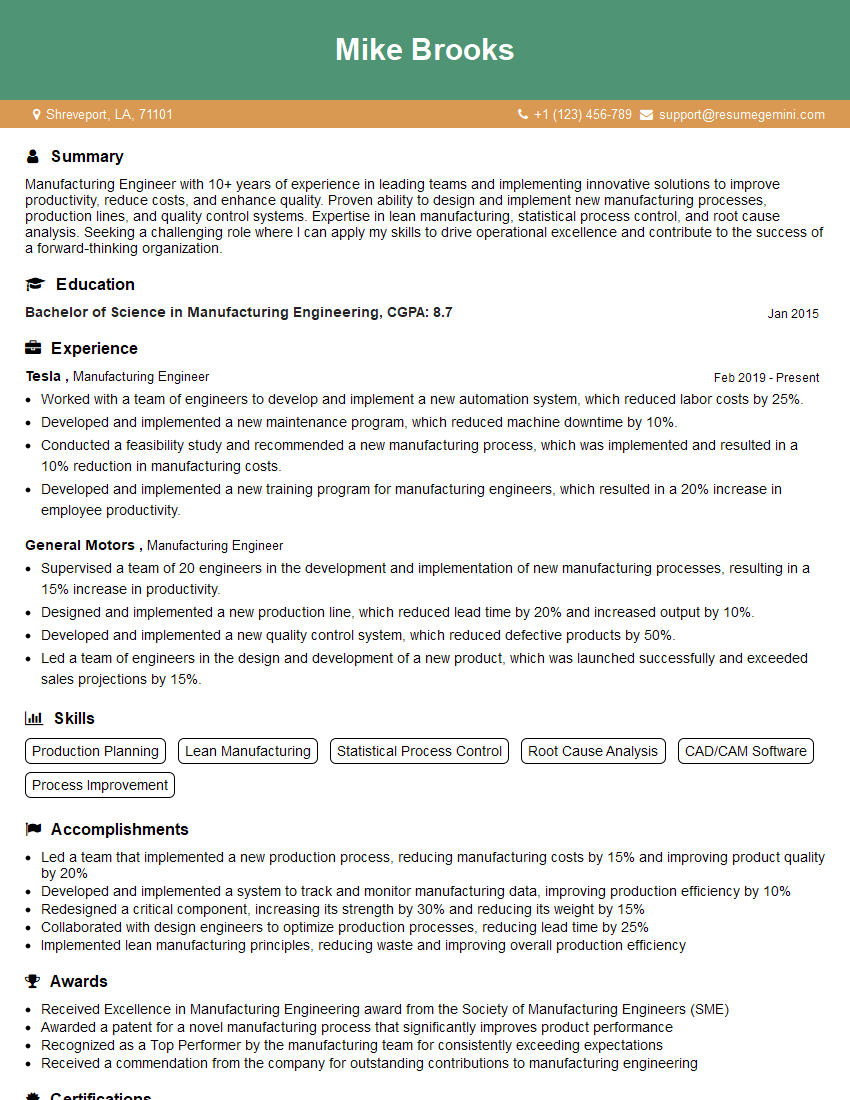
Manufacturing Engineer Resume Sample
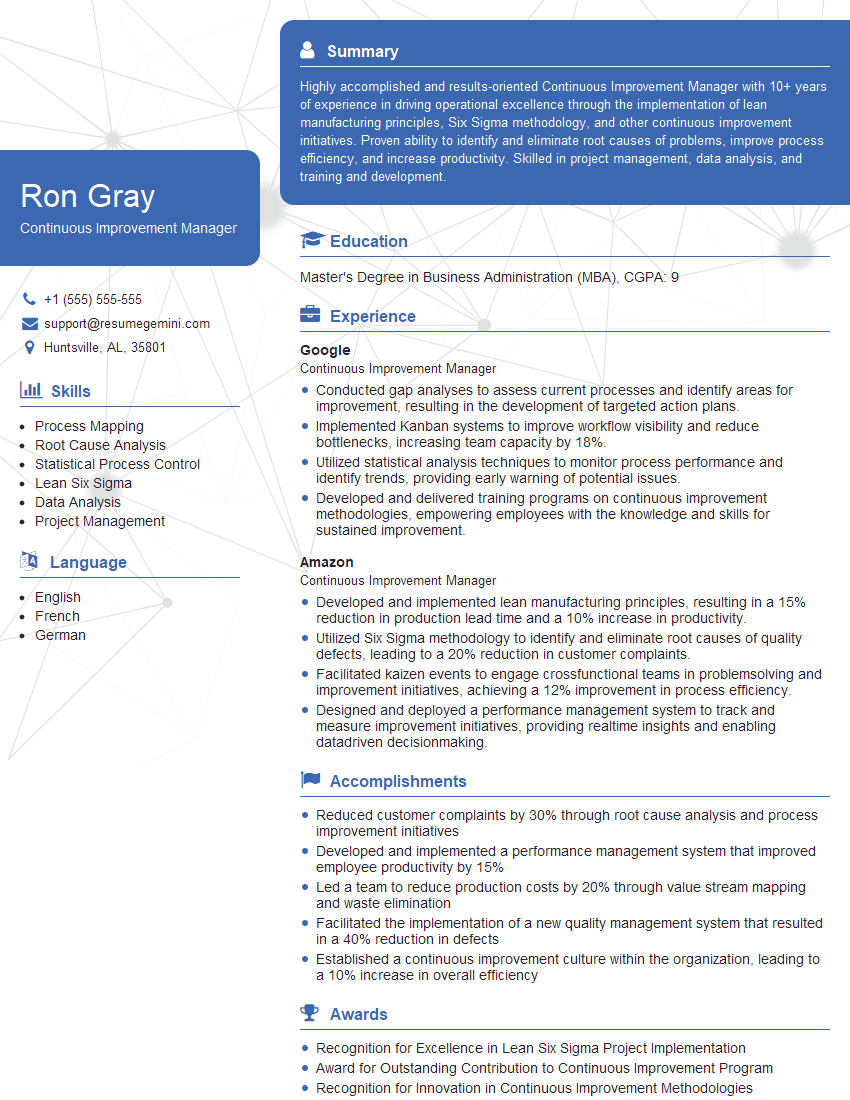
Continuous Improvement Manager Resume Sample
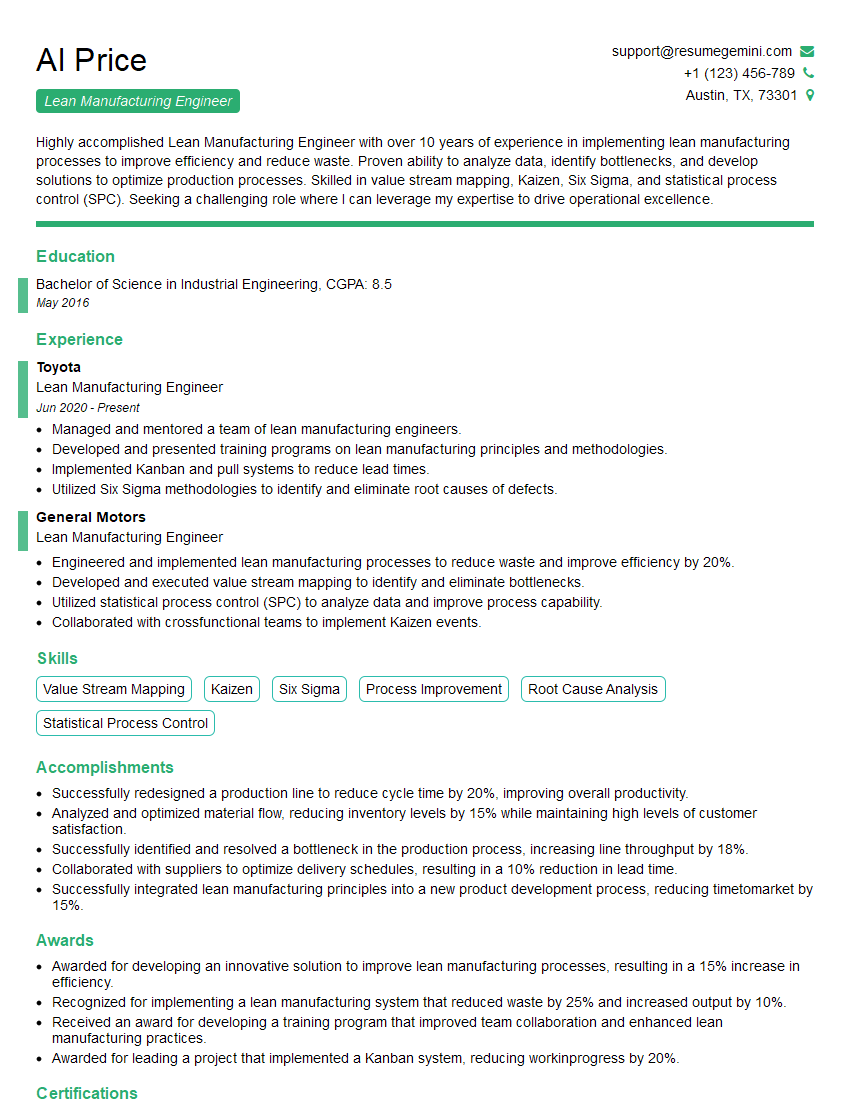
Lean Manufacturing Engineer Resume Sample
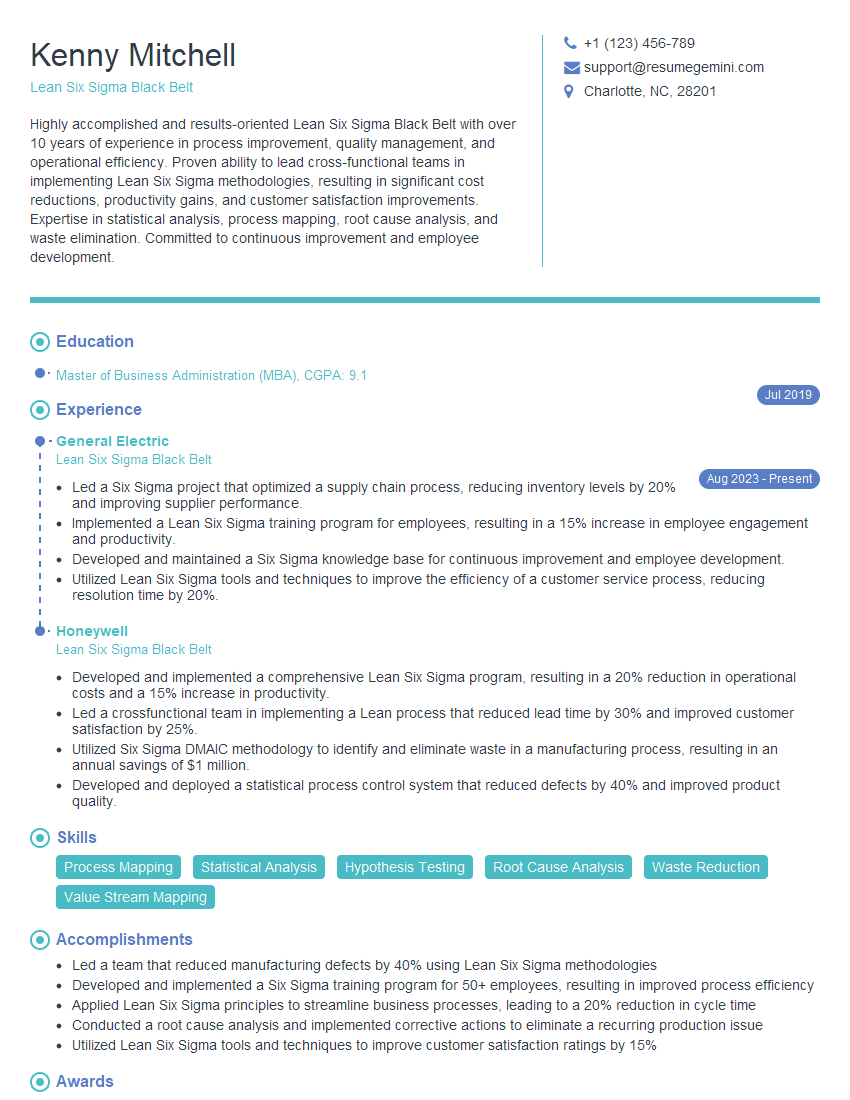
Lean Six Sigma Black Belt Resume Sample
- Operations Manager
- Plant Manager
- Production Manager
- Director of Operations
- Maintenance Manager
- Quality Control Manager
- Supply Chain Manager
- Reliability Engineer
- Process Engineer
- Quality Engineer
- Industrial Engineer
- Manufacturing Engineer
- Continuous Improvement Manager
- Lean Manufacturing Engineer
- Lean Six Sigma Black Belt
Explore more articles
Users Rating of Our Blogs
Share Your Experience
We value your feedback! Please rate our content and share your thoughts (optional).
What Readers Say About Our Blog
Really detailed insights and content, thank you for writing this detailed article.
IT gave me an insight and words to use and be able to think of examples