Cracking a skill-specific interview, like one for Load Calculation and Rigging Planning, requires understanding the nuances of the role. In this blog, we present the questions you’re most likely to encounter, along with insights into how to answer them effectively. Let’s ensure you’re ready to make a strong impression.
Questions Asked in Load Calculation and Rigging Planning Interview
Q 1. Explain the different types of slings and their applications.
Slings are the crucial components connecting the load to the lifting equipment. Choosing the right sling is paramount for safety and efficiency. Several types exist, each suited to specific applications:
- Polyester Slings: Known for their high strength-to-weight ratio, resistance to abrasion, and relatively low stretch. Ideal for general lifting applications where flexibility and durability are needed. Think of moving heavy machinery or construction materials.
- Nylon Slings: Similar to polyester, but with slightly higher stretch. This can be advantageous in certain applications where shock absorption is important, mitigating stress on the load and rigging equipment. Useful for delicate items or those prone to damage from sudden movements.
- Chain Slings: Extremely durable and suitable for heavy-duty lifting, particularly in harsh environments. Their metallic nature makes them resistant to cuts and abrasions, but they lack the flexibility of synthetic slings. They’re the go-to for lifting extremely heavy or irregularly shaped objects, like large steel plates or industrial components.
- Wire Rope Slings: Offer immense strength and are often used for very heavy loads in demanding conditions. However, they can be more susceptible to damage from sharp edges or kinking, requiring careful handling and regular inspection. You’d see these in bridge construction or heavy infrastructure projects.
- Round Slings: Offer a good balance of strength, flexibility and ease of use, making them common for many applications.
The selection depends critically on the load’s weight, shape, and material; the environment; and the lifting method. A lightweight, flexible polyester sling wouldn’t be suitable for lifting molten steel, while a chain sling might be overkill for transporting small boxes.
Q 2. Describe the process of calculating the safe working load (SWL) of a sling.
Calculating the Safe Working Load (SWL) of a sling is crucial for safety. It’s the maximum load a sling can safely support under specific conditions. The process isn’t overly complex but requires meticulous attention to detail:
- Identify the sling type and material: Each sling type (e.g., polyester, chain, wire rope) has a manufacturer-specified SWL. This information is usually found on a tag attached to the sling.
- Check the sling’s condition: Examine the sling for any signs of damage, such as cuts, fraying, or deformation. Any damage reduces the SWL, sometimes drastically. A damaged sling should never be used.
- Consider the sling angle: The SWL is typically specified for a vertical lift. If the sling is used at an angle, the SWL is reduced. A commonly used formula to calculate the adjusted SWL for a two-leg sling is:
Adjusted SWL = SWL x cos(angle/2)where the angle is the angle between the sling legs. - Apply appropriate safety factors: Regulations often mandate a safety factor to account for unforeseen circumstances. This factor (usually between 5 and 10) multiplies the calculated SWL, providing a substantial margin of safety.
- Account for environmental factors: Extreme temperatures or chemical exposure can weaken slings, requiring further reductions to the SWL based on the manufacturer’s guidelines or industry standards.
For instance, if a sling has a vertical SWL of 10,000 lbs and is used at a 60-degree angle, the adjusted SWL for a two-leg lift would be approximately 8660 lbs (10000 * cos(60/2)). Always err on the side of caution; if there is any doubt, do not use the sling.
Q 3. How do you determine the appropriate rigging hardware for a specific lift?
Selecting appropriate rigging hardware is crucial for a safe lift. The process involves several steps:
- Assess the load characteristics: Determine the weight, shape, size, and center of gravity of the load. Irregular shapes require special considerations for load distribution and stability.
- Choose the appropriate sling type: Based on the load’s weight, shape, material, and environmental conditions, select the sling type that meets the SWL requirements.
- Select the right shackles, hooks, and other hardware: Ensure the hardware is rated for a SWL exceeding the load weight, considering the sling angle and safety factors. The shackles, hooks, and other components must be compatible with the sling and other rigging equipment.
- Verify compatibility: Ensure all components are compatible in terms of material, size, and strength. Using mismatched hardware can lead to catastrophic failures.
- Inspect all hardware: Before each lift, thoroughly inspect all rigging hardware for any damage, such as cracks, bending, or wear. Damaged hardware should be immediately replaced.
For example, a heavy steel beam might necessitate the use of wire rope slings and heavy-duty shackles, whereas lighter loads could be handled with polyester slings and lighter shackles. Always consult manufacturer’s specifications and relevant safety regulations to ensure the right selection.
Q 4. What are the key considerations for planning a critical lift?
Planning a critical lift requires meticulous attention to detail and a proactive approach to safety. Key considerations include:
- Detailed lift plan: A comprehensive written plan outlining every step of the lift, including equipment specifications, personnel assignments, safety procedures, and contingency plans for potential problems.
- Risk assessment: A thorough assessment of all potential hazards, including those related to the load, the environment, and the equipment. This includes identifying potential failure points and developing mitigation strategies.
- Site survey: A complete survey of the lifting area, ensuring sufficient space, suitable ground conditions, and the absence of obstructions.
- Equipment selection and inspection: Careful selection of appropriate lifting equipment, ensuring that all equipment is in good working order and properly inspected before the lift.
- Competent personnel: Ensuring a properly trained and experienced team is responsible for the lift.
- Communication plan: A clear communication plan to ensure that all personnel involved in the lift are aware of the procedures and their roles.
- Emergency procedures: Detailed emergency procedures, including escape routes and contact information for emergency services.
A critical lift might involve lifting a nuclear reactor component, where a failure could have devastating consequences. In such scenarios, rigorous planning, multiple safety checks, and redundancy are critical.
Q 5. Explain the importance of load charts and how to interpret them.
Load charts are essential documents provided by manufacturers of lifting equipment. They illustrate the safe working loads (SWLs) for different configurations and conditions. Understanding and interpreting them is crucial for safe lifting operations.
Load charts typically show the SWL for various sling angles, types of slings, and numbers of legs. They also often indicate limitations due to environmental factors or sling wear. For instance, a load chart might show that a particular sling has a SWL of 10,000 lbs vertically, but only 8,000 lbs at a 30-degree angle.
Interpreting load charts involves carefully examining the chart’s legend, understanding the variables represented (sling angle, number of legs, type of sling), and identifying the specific SWL for the given lift configuration. It is crucial to select the lowest SWL among all factors to ensure safety.
Failure to understand and correctly use load charts can lead to using equipment beyond its capacity, resulting in accidents and injuries. Always cross-reference load chart information with other relevant safety guidelines.
Q 6. How do you account for environmental factors (wind, temperature) in load calculations?
Environmental factors such as wind and temperature significantly impact load calculations. These factors can reduce the strength of slings and affect the stability of the lift:
- Wind: High winds can exert substantial forces on the load, increasing the overall load on the lifting equipment. The effect of wind is particularly pronounced with large, high-surface-area loads. Wind speed and direction must be considered when calculating the overall load on the rigging system.
- Temperature: Extreme temperatures (both high and low) can affect the strength of slings. High temperatures can weaken synthetic slings, while low temperatures can embrittle metallic slings. Manufacturers often provide adjustments to SWL based on temperature, which should be applied to the calculations.
To account for these factors, use manufacturer’s guidelines and any applicable industry standards or regulations. You might need to reduce the calculated SWL to account for these environmental stressors. In cases of extreme weather, lifting operations should be postponed until conditions improve to avoid accidents. For example, a lift planned on a very windy day might necessitate a reduction in the load or the use of stronger equipment. In extreme heat, the SWL of nylon slings might need significant reduction.
Q 7. What are the common hazards associated with rigging operations?
Rigging operations present several inherent hazards:
- Falling loads: The most significant hazard, resulting from equipment failure, improper rigging, or unforeseen circumstances. This can cause serious injury or death to personnel or damage to property.
- Crushing injuries: Workers can be crushed by loads, particularly during lifting or lowering operations. Proper placement of personnel and use of barricades are essential.
- Struck-by hazards: Workers can be struck by swinging loads, falling objects, or equipment malfunction. Maintaining safe distances and using appropriate personal protective equipment (PPE) are crucial.
- Electrocution: Contact with energized power lines or electrical equipment during lifting operations can lead to electrocution. Ensuring sufficient clearance and using qualified personnel is critical.
- Sling failure: Improper use or damaged slings can result in sudden and catastrophic failure, leading to falling loads and injuries.
- Equipment malfunction: Malfunctioning cranes, hoists, or other lifting equipment can cause accidents. Regular maintenance and inspection of equipment are vital.
Rigorous adherence to safety regulations, thorough training, and the use of appropriate safety measures are crucial to mitigate these hazards. Remember, a proactive safety culture is paramount in preventing accidents.
Q 8. Describe your experience with different types of lifting equipment (cranes, hoists).
My experience with lifting equipment encompasses a wide range of cranes and hoists, from small chain hoists used in workshops to large tower cranes employed on construction sites. I’m proficient with various types, including:
- Tower Cranes: I have extensive experience planning lifts involving these, understanding their capacity limitations, jib lengths, and the impact of wind speeds on safe operation. For instance, I once worked on a project where careful planning was crucial to lift pre-fabricated sections of a building with a tower crane operating in strong winds. We implemented a rigorous wind monitoring system and adjusted lifting schedules as needed.
- Mobile Cranes: I’m familiar with various models, including rough-terrain, all-terrain, and crawler cranes. My expertise lies in selecting the right crane for specific job requirements based on lift capacity, reach, and ground conditions. A recent project involved using an all-terrain crane to lift heavy equipment into a tight urban area where a larger crane wouldn’t fit.
- Overhead Cranes: I’m experienced in operating and planning lifts using overhead cranes within industrial settings. This includes understanding the importance of load distribution and ensuring the crane’s structural integrity for the given load. A specific example is my work in a manufacturing plant where precise lifting of large machinery was required.
- Hoists (Chain, Electric, Air): From small manual chain hoists to larger electric and air-powered models, I’m well-versed in their safe and efficient operation. Regular maintenance checks and understanding their load limitations are key aspects of my approach.
This experience has equipped me with a comprehensive understanding of the capabilities, limitations, and safe operating procedures for a diverse range of lifting equipment.
Q 9. Explain the process of inspecting rigging equipment before a lift.
Inspecting rigging equipment before a lift is paramount for safety. It’s a methodical process that I follow rigorously. I use a checklist to ensure thoroughness and consistency. My inspection covers:
- Visual Inspection: I meticulously examine all components for any signs of damage like fraying, kinking, corrosion, or wear and tear on ropes, slings, shackles, and hooks. Any evidence of damage, even minor, results in immediate rejection and replacement.
- Load Capacity Verification: I always check the working load limit (WLL) of each component and ensure that the total load, including the weight of the rigging equipment itself, is well within these limits – always with a significant safety factor.
- Component Integrity: I check for proper function, ensuring that shackles are properly pinned, hooks are free from deformities, and all components are free of damage. I would also check the swivel action of any swivels included in the rigging.
- Documentation: I document the inspection findings with date, time, and any observed issues. This documentation serves as crucial evidence in case of an incident.
Think of it like pre-flight checks for an airplane; a thorough inspection is absolutely critical for ensuring safety and preventing accidents. Failure to do so can have catastrophic consequences.
Q 10. How do you develop a rigging plan for a complex project?
Developing a rigging plan for a complex project requires a systematic approach. It’s not just about lifting; it’s about planning every detail to ensure a safe and efficient lift. My approach involves:
- Site Survey: I begin with a thorough site survey to identify potential obstacles, access points, ground conditions, and any environmental factors that may affect the lift (wind, rain, etc.).
- Load Analysis: I meticulously determine the weight and center of gravity of the load, including the weight of the rigging equipment. This helps in determining the required capacity of the lifting equipment and the optimal rigging configuration.
- Equipment Selection: Based on the load analysis and site survey, I select the appropriate lifting equipment, including cranes, hoists, slings, and other components. This choice is critical for ensuring the chosen equipment is suitable for the specific requirements and load.
- Rigging Design: I design the rigging configuration considering factors such as load distribution, stability, and the best approach for the lift, taking into account any potential obstructions or confined spaces. This often involves the creation of detailed diagrams and specifications.
- Risk Assessment: A detailed risk assessment is done to identify and mitigate potential hazards throughout the lifting process. This helps prevent accidents and ensures everyone’s safety.
- Lift Procedure: I then develop a detailed step-by-step procedure for the lift, including communication protocols, emergency procedures, and responsibilities of the team involved.
- Documentation: Finally, I document the entire rigging plan comprehensively, including the chosen equipment, rigging configurations, load calculations, risk assessment findings, and lift procedures. This documentation is essential for the team and any future reference.
Creating a thorough rigging plan is akin to creating detailed architectural plans for a building; without it, the project is highly vulnerable to errors and safety risks.
Q 11. What are the different methods for load balancing?
Load balancing is crucial to ensure stability and prevent overloading of any single component during a lift. Here are some common methods:
- Multiple Slings: Using multiple slings at different angles to distribute the weight evenly across the load. This is common when lifting irregularly shaped objects.
- Bridle Hitch: A specialized rigging configuration using two or more slings attached to a single point on the load. This evenly distributes the weight.
- Spreaders: Using spreader beams or other devices to widen the base of the load and distribute the weight over a larger area. This is critical for wider, less concentrated loads.
- Load Equalizers: Mechanical devices that automatically adjust the load distribution among multiple slings, ensuring even tension irrespective of the load’s shape.
The selection of the optimal load balancing method depends on several factors, including the shape, size, and weight of the load, as well as the available equipment and the site conditions. Improper load balancing can lead to dangerous situations and equipment failure.
Q 12. Explain the concept of center of gravity and its significance in rigging.
The center of gravity (CG) is the point where the entire weight of an object is considered to be concentrated. In rigging, understanding the CG is critical because it directly affects the stability and balance during a lift. If the CG is not properly located and accounted for, the load could become unstable and tip over during the lift, leading to accidents.
Imagine lifting a large, irregularly shaped piece of metal. If you don’t know the CG, you might attach the slings in a way that causes the load to tilt, potentially leading to the load shifting or falling. Accurate determination of the CG is done through various methods, including calculation based on the object’s geometry and weight distribution, or through experimental methods using a balance beam.
Knowing the CG is essential for determining the best sling points, minimizing stresses on the slings, and maintaining stability during the lift. A proper understanding and consideration of the center of gravity significantly reduces the risks associated with lifting operations.
Q 13. How do you calculate the total load including the weight of the rigging equipment?
Calculating the total load, including the weight of the rigging equipment, is a fundamental aspect of safe rigging practices. Neglecting this can lead to overloading and catastrophic failure. The process involves:
- Determine the weight of the main load: This can be done through weighing scales, manufacturer’s specifications, or engineering calculations.
- Determine the weight of each rigging component: This includes the weight of slings, shackles, hooks, spreader beams, and any other equipment used in the lift. This information is usually found on the equipment’s data plates.
- Summation of weights: Add the weight of the main load and the weights of all rigging components to arrive at the total weight.
- Applying safety factors: Always apply an appropriate safety factor to the total weight. This factor accounts for unforeseen circumstances and ensures that the lifting equipment is not stressed beyond its safe operating limit.
For example: If the load weighs 10,000 lbs, and the rigging equipment (slings, shackles, etc.) weighs 500 lbs, the total load is 10,500 lbs. With a safety factor of 2, the lifting equipment must be rated for at least 21,000 lbs. Skipping this crucial step significantly increases the risk of accidents.
Q 14. Describe your experience with different types of hitches and knots.
My experience with hitches and knots is extensive and covers various applications in rigging. I’m proficient in a wide range, selecting the appropriate one based on specific needs, such as load type, required strength, and ease of unknotting. Some examples include:
- Bowline: A classic knot known for its strength and ease of tying, often used for creating a fixed loop at the end of a rope.
- Clove Hitch: A versatile and simple knot used for attaching a rope to a ring, hook, or other object, often used as a temporary attachment.
- Figure Eight Knot: A stopper knot primarily used to secure the end of a rope to prevent it from running through a system.
- Various Sling Hitches: Proficient in creating and selecting appropriate hitches for different types of slings, including choker hitches, basket hitches, and vertical hitches.
I understand the importance of using the correct knot and hitch for each specific application. Incorrect knot tying can lead to serious consequences, including equipment failure, and injuries. My knowledge extends to understanding the limitations of each knot in terms of load capacity and materials used. Just like a surgeon chooses the right instrument for each procedure, selecting the right knot or hitch is crucial for safety and success.
Q 15. What safety procedures do you follow during rigging operations?
Rigging safety is paramount. My procedures begin with a thorough pre-lift planning meeting, encompassing a detailed risk assessment. This involves identifying all potential hazards – from equipment malfunctions to environmental factors like weather conditions and ground stability. We then develop a comprehensive safety plan outlining mitigation strategies for each identified risk. This plan includes:
- Pre-lift inspection: A meticulous check of all equipment, including the crane, slings, shackles, and other rigging hardware, ensuring they are in good working order and properly rated for the load.
- Designated signal person: A qualified individual is assigned to communicate clearly and effectively with the crane operator, using standardized hand signals or a two-way radio system.
- Restricted area: A clearly defined and secured area around the lift zone ensures personnel are kept at a safe distance from the load and the crane’s operating radius.
- Personal Protective Equipment (PPE): Mandatory use of hard hats, safety glasses, gloves, and high-visibility clothing protects all personnel involved.
- Emergency procedures: Pre-determined emergency procedures, including communication protocols and evacuation plans, are established and practiced to ensure a swift and coordinated response to unforeseen events.
Following these procedures helps minimize risk and ensures a safe lifting operation.
Career Expert Tips:
- Ace those interviews! Prepare effectively by reviewing the Top 50 Most Common Interview Questions on ResumeGemini.
- Navigate your job search with confidence! Explore a wide range of Career Tips on ResumeGemini. Learn about common challenges and recommendations to overcome them.
- Craft the perfect resume! Master the Art of Resume Writing with ResumeGemini’s guide. Showcase your unique qualifications and achievements effectively.
- Don’t miss out on holiday savings! Build your dream resume with ResumeGemini’s ATS optimized templates.
Q 16. How do you handle unexpected situations during a lift?
Unexpected situations during a lift require immediate and decisive action. My approach centers on a calm, controlled response guided by established emergency procedures. For instance, if a sling fails during the lift (a terrifying but possible scenario), the immediate action is to signal the crane operator to lower the load slowly and carefully. Personnel need to be evacuated from the danger zone immediately. Then, a thorough investigation is conducted to determine the root cause of the failure, ensuring such incidents are avoided in the future. This might involve detailed inspection of the failed component, re-evaluation of the rigging plan and potentially changes to the lifting equipment used.
Another example: If the load shifts unexpectedly, the first step is to signal the crane operator to stop the lift. We carefully assess the situation, possibly requiring readjustment of slings or the use of additional support. Open communication between team members is critical to implement the corrective actions safely and effectively. Each situation is unique, demanding quick thinking and precise execution of established safety protocols.
Q 17. Explain the regulations and standards you adhere to in rigging (e.g., OSHA, ASME).
Adherence to relevant regulations and standards is non-negotiable. My work consistently complies with OSHA (Occupational Safety and Health Administration) standards for rigging and crane operations, as well as ASME (American Society of Mechanical Engineers) standards for cranes and related equipment. This includes understanding specific requirements for load calculations, equipment inspections, operator certifications, and safety protocols. For instance, OSHA regulations mandate regular inspections and maintenance of all lifting equipment, the use of qualified riggers and crane operators, and detailed documentation of all lift operations. ASME standards define safety factors, design criteria, and testing procedures for cranes and related hardware. Staying updated with the latest versions of these standards and incorporating them into all aspects of planning and execution is a continuous priority.
Q 18. How do you communicate effectively with crane operators and other team members?
Effective communication is the backbone of successful and safe rigging operations. I employ a multi-faceted approach. With crane operators, I use standardized hand signals and two-way radios to provide clear, concise instructions during the lift. Pre-lift briefings ensure everyone understands the plan and their roles. During the lift, we maintain constant communication, addressing any unexpected situations immediately. With the wider team, clear, written documentation of the rigging plan, including load calculations, equipment specifications, and safety procedures ensures everyone is on the same page. Regular meetings provide a platform for questions, concerns, and collaborative problem-solving. Open communication helps proactively identify and address potential issues before they escalate.
Q 19. What software or tools do you use for load calculations and rigging planning?
For load calculations and rigging planning, I utilize a combination of software and tools. Software packages like Rigging Software X (a hypothetical example representing industry-standard software) provide advanced features for load analysis, calculating center of gravity, and simulating lift scenarios. These tools help me determine the appropriate lifting equipment, sling angles, and safe working loads. In addition to software, I use spreadsheets for detailed calculations, documenting each step of the process. Physical tools like calibrated load cells and measuring tapes ensure accuracy in real-world measurements. The choice of tools depends on the project’s complexity and the specific requirements. Rigorous double-checking is always done to ensure accuracy and safety.
Q 20. Describe a challenging rigging project and how you overcame the obstacles.
One challenging project involved lifting a massive transformer into a tightly confined substation. The transformer was exceptionally heavy and its delicate internal components made precision critical. The major obstacle was the limited space, which restricted crane movement and the available rigging configurations. We overcame this by developing a multi-stage lifting plan involving precision maneuvering of the crane and use of specialized rigging hardware to create a tailored slinging configuration that accounted for the weight distribution and limited space. We utilized advanced software modeling to predict the load’s behavior and meticulously planned crane movements to avoid collisions with surrounding infrastructure. Detailed risk assessments and contingency plans were created for every step. By combining sophisticated planning with precise on-site execution, the lift was completed safely and successfully. Thorough documentation of every step and post-lift analysis were essential in ensuring lessons learned from this project were incorporated into future operations.
Q 21. How do you ensure the safety of personnel during rigging operations?
Ensuring personnel safety is my top priority. This begins with comprehensive training and certification for all personnel involved, including riggers, crane operators, and anyone within the lift zone. Strict adherence to safety regulations and procedures is mandatory. This includes pre-lift safety briefings, clear communication protocols, use of appropriate PPE, and establishment of controlled access zones. Regular inspections of equipment and thorough documentation of all operations help in identifying and mitigating potential hazards. Continual emphasis on awareness and communication helps foster a safe work environment. In essence, a proactive and layered safety approach encompassing planning, training, communication, and ongoing monitoring is critical to maintain a safe working environment during every rigging operation.
Q 22. What is your experience with risk assessments in rigging?
Risk assessment in rigging is paramount. It’s not just about identifying hazards; it’s about proactively mitigating them before they cause incidents. My approach involves a systematic process, starting with a thorough site survey. This includes identifying all potential hazards, such as ground conditions, overhead obstructions, weather conditions, and the specific characteristics of the load. I then analyze the risks associated with each hazard, considering factors like the likelihood of an incident and its potential severity. This leads to the development of a control plan, detailing the specific measures – like using additional rigging equipment, altering lifting methods, or implementing stricter safety protocols – to control those risks. For example, on a recent project involving a sensitive piece of equipment, I identified the risk of ground instability. My risk assessment led to the implementation of ground mats to distribute the load and prevent sinking, thus preventing potential damage and injury.
Following this, I document everything meticulously, including the identified hazards, risk levels, control measures, and responsibilities. This document serves as a vital reference throughout the project and aids in ongoing monitoring and review. Regular inspections and toolbox talks are critical for ensuring the effectiveness of the risk assessment and control measures.
Q 23. Explain your understanding of different types of crane configurations and their limitations.
Crane configurations are critical for safe and efficient lifting. The choice depends on the load, site constraints, and the required reach and lifting capacity. Common configurations include:
- Lattice Boom Cranes: These are known for their high lifting capacity and reach, often used for very heavy lifts. Limitations include slower setup and dismantle times and the need for significant space. Imagine constructing a tall building; a lattice boom crane is ideal for lifting heavy steel beams to higher floors.
- Truck-Mounted Cranes: Versatile and mobile, these are great for smaller to medium-sized lifts in various locations. Their reach and lifting capacity are comparatively lower. Think about a construction site where materials need to be lifted and moved around frequently; a truck-mounted crane is perfect.
- Tower Cranes: Fixed to a building, they are ideal for high-rise construction projects, offering significant reach and capacity, though they’re not very mobile. Their fixed nature requires careful planning of lift locations.
- Mobile Cranes (Crawler, All-Terrain, Rough-Terrain): These offer various levels of maneuverability depending on the terrain and requirements. Crawler cranes excel in very soft ground. All-terrain and rough-terrain cranes offer more mobility but have limitations in lifting capacity compared to lattice boom cranes.
Understanding the limitations is key. For instance, a truck-mounted crane might not have the reach to lift a load to a high point, while an all-terrain crane may not be suitable for extremely soft ground conditions. Overloading any crane is a serious risk and must be strictly avoided.
Q 24. How do you manage multiple lifts concurrently on a project site?
Managing concurrent lifts requires meticulous planning and coordination. It’s not just about having enough cranes; it’s about ensuring safe operating clearances and avoiding collisions. My approach involves:
- Detailed Lift Schedules: This meticulously outlines each lift, including the time, location, crane used, load details, and rigging plan.
- Clear Communication: Establishing a robust communication system between crane operators, riggers, and other personnel is critical, often using two-way radios. This helps prevent misunderstandings and ensures that everyone is aware of each other’s actions.
- Zone Control: Defining designated operating areas for each crane helps maintain safe clearances. This often involves physical barriers or signage to prevent encroachment.
- Qualified Personnel: Ensuring all personnel involved are fully qualified and experienced in their roles is vital.
- Site Supervision: A dedicated supervisor oversees all lifting activities to ensure that the plan is being followed and that safety procedures are being maintained.
I use software tools to create and manage these schedules and communications. For complex projects, simulation software can help visualize the operation and identify potential conflicts before they arise.
Q 25. What are your preferred methods for documenting rigging plans and procedures?
Rigging plans and procedures are crucial and require accurate documentation. I use a combination of methods to ensure clarity and accuracy:
- Detailed Drawings: These illustrate the rigging configuration, including the type and size of the lifting gear, the attachment points on the load, and the crane setup. Software like AutoCAD is commonly used for this purpose.
- Lift Plans: These provide detailed step-by-step procedures for each lift, including pre-lift checks, lifting operations, and post-lift checks.
- Checklists: These help ensure that all pre-lift checks are performed consistently and thoroughly, leaving no room for oversight.
- Photographs and Videos: These provide visual records of the rigging setup, the lift execution, and the overall site conditions.
- Digital Documentation: Storing all the documents electronically makes them easily accessible and allows for efficient version control and sharing with relevant personnel.
Every document is clearly labeled, dated, and signed by the responsible personnel. This ensures that a comprehensive and traceable record is maintained for auditing purposes and for future reference.
Q 26. How do you stay updated on the latest rigging techniques and safety standards?
Staying current is critical in this field. My approach is multi-faceted:
- Professional Organizations: Active membership in organizations like the Association of Crane & Rigging Professionals provides access to the latest safety standards, best practices, and training opportunities.
- Industry Publications and Journals: Regularly reading industry publications and journals keeps me abreast of new techniques and technologies.
- Conferences and Workshops: Attending conferences and workshops allows me to network with other professionals and learn from experts in the field.
- Manufacturer Training: Many equipment manufacturers offer specialized training programs on their equipment, enhancing my skills and knowledge.
- Online Resources: Staying informed about changes in regulations and updates through online resources such as official government websites.
Continuous learning ensures that my practices align with the latest safety standards and incorporate the most efficient and effective techniques.
Q 27. Describe your experience with specialized lifting techniques (e.g., heavy lifts, underwater lifts).
I have extensive experience in specialized lifting techniques. Heavy lifts often require advanced planning and the use of specialized equipment, including multiple cranes synchronized for a single lift or the use of strand jacks for precise control. For example, I worked on a project involving the lifting and placement of a massive transformer weighing over 500 tons. This required careful consideration of ground conditions, crane selection, and precise synchronization of multiple cranes. The meticulous planning, detailed risk assessment, and effective execution were key factors in the project’s success.
Underwater lifts require specialized equipment and techniques to manage buoyancy, underwater visibility, and the challenges of working in a submerged environment. I’ve participated in projects involving the recovery of submerged equipment, which involved careful buoyancy calculations, diver support, and the use of specialized lifting equipment designed for underwater operations.
Q 28. What is your approach to training and mentoring less experienced riggers?
Mentoring less experienced riggers is a crucial part of ensuring safety and the development of future professionals. My approach is based on:
- On-the-Job Training: Providing hands-on experience under close supervision, starting with simple tasks and gradually increasing complexity.
- Formal Training Programs: Encouraging participation in formal training courses to acquire certifications and standardized knowledge.
- Mentorship and Guidance: Providing regular feedback, answering questions, and sharing experiences and best practices.
- Safety Emphasis: Inculcating a strong safety culture, emphasizing the importance of adherence to safety procedures and regulations.
- Continuous Evaluation and Feedback: Regularly assessing the mentee’s progress and providing constructive criticism to improve their skills and knowledge.
I believe in a supportive and encouraging environment where learning is prioritized and mistakes are seen as opportunities for growth. By investing time and effort in training and mentoring, I help ensure the safety and competency of the team, ultimately improving the overall quality and safety of lifting operations.
Key Topics to Learn for Load Calculation and Rigging Planning Interview
- Center of Gravity and Load Distribution: Understanding how to accurately determine the center of gravity of a load and distribute weight evenly for safe rigging.
- Calculating Tensile and Compressive Loads: Applying theoretical knowledge to practical scenarios, such as calculating the load on individual ropes or structural members in a rigging system.
- Rigging Hardware Selection and Capacity: Choosing appropriate hardware (e.g., shackles, slings, hooks) based on load capacity, material properties, and safety factors. Understanding the limitations of each component.
- Risk Assessment and Safety Procedures: Developing and implementing comprehensive risk assessments for rigging operations, including identifying and mitigating potential hazards.
- Knots and Hitches: Mastering the practical application and limitations of various knots and hitches used in rigging. Understanding appropriate knot selection for specific loads and applications.
- Lifting Equipment and Machinery: Familiarizing yourself with different types of lifting equipment (cranes, hoists, etc.) and their operational parameters, including load charts and safety protocols.
- Regulatory Compliance and Standards: Understanding and adhering to relevant safety regulations and industry standards (e.g., OSHA, ASME) related to load calculations and rigging.
- Problem-Solving and Troubleshooting: Developing the ability to identify and solve potential problems in rigging plans, adapting to unexpected situations, and ensuring the safety of personnel and equipment.
- Documentation and Communication: Effectively communicating rigging plans and procedures to the team, and maintaining accurate records of inspections and load calculations.
Next Steps
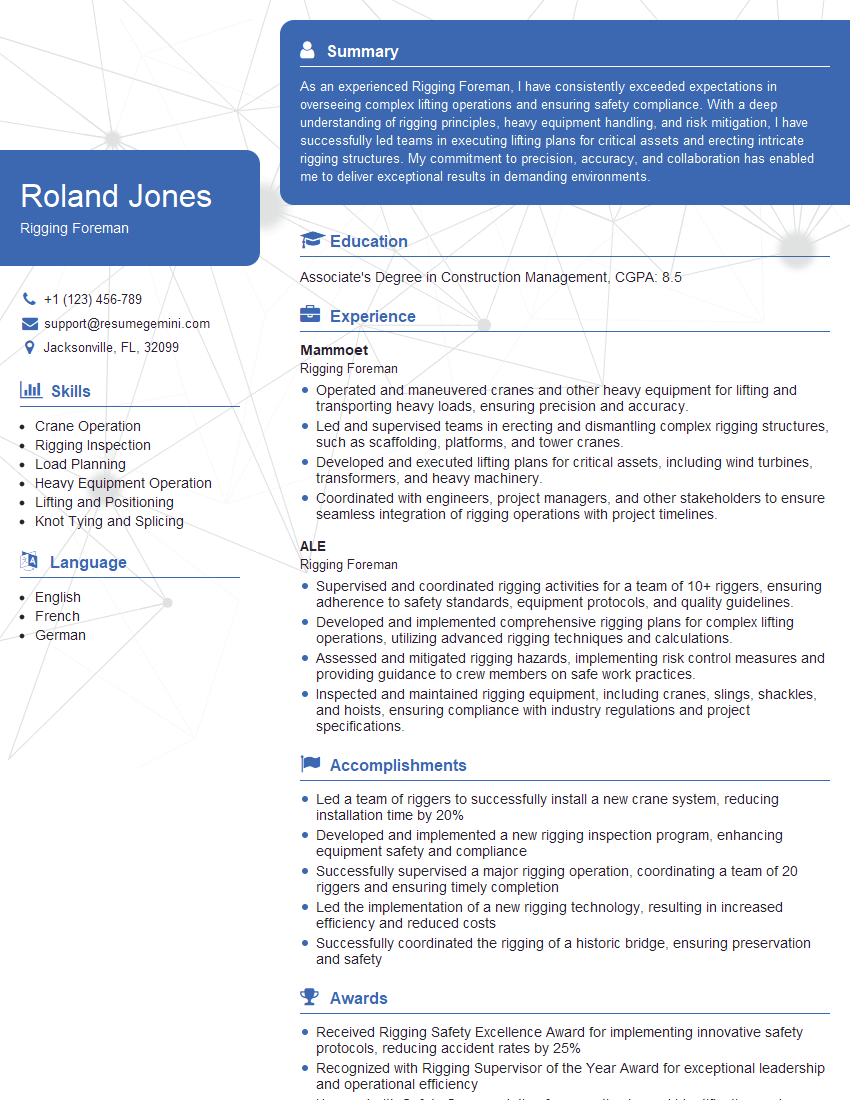
Mastering Load Calculation and Rigging Planning is crucial for career advancement in this specialized field. A strong understanding of these concepts demonstrates expertise and commitment to safety, leading to increased responsibility and higher earning potential. To boost your job prospects, focus on creating an ATS-friendly resume that effectively highlights your skills and experience. ResumeGemini is a trusted resource to help you build a professional resume that stands out. They provide examples of resumes tailored to Load Calculation and Rigging Planning, ensuring you present your qualifications in the most compelling way possible.


Explore more articles
Users Rating of Our Blogs
Share Your Experience
We value your feedback! Please rate our content and share your thoughts (optional).
What Readers Say About Our Blog
Really detailed insights and content, thank you for writing this detailed article.
IT gave me an insight and words to use and be able to think of examples