Are you ready to stand out in your next interview? Understanding and preparing for Loads Analysis interview questions is a game-changer. In this blog, we’ve compiled key questions and expert advice to help you showcase your skills with confidence and precision. Let’s get started on your journey to acing the interview.
Questions Asked in Loads Analysis Interview
Q 1. Explain the different types of loads encountered in structural analysis.
Structural analysis involves understanding how structures respond to various loads. These loads can be broadly categorized into:
- Dead Loads: These are permanent loads acting on a structure, such as the weight of the structure itself (beams, columns, walls, roofing materials), permanently installed equipment, and any fixed components. Imagine the weight of a building’s concrete floors; that’s a dead load.
- Live Loads: These are temporary or movable loads. Examples include furniture in a building, people, vehicles on a bridge, or snow on a roof. These loads vary in magnitude and position. Think of the weight of people in an office building – it changes depending on the number of people present.
- Environmental Loads: These loads originate from natural phenomena. This includes wind loads (force exerted by wind on buildings and structures), seismic loads (earthquake forces), snow loads, rain loads, and temperature loads (causing thermal expansion and contraction). Consider the impact of a hurricane’s wind on a coastal structure – a significant environmental load.
- Impact Loads: These are dynamic loads caused by sudden impacts or collisions. A falling object or a vehicle collision would generate an impact load. This type of load requires special consideration in structural design due to its high-magnitude and short duration.
- Imposed Loads: A general term often used to cover both live and environmental loads. It represents any load which is not a permanent dead load.
Understanding the type and magnitude of these loads is crucial for designing safe and efficient structures.
Q 2. Describe the process of performing a static load analysis.
Static load analysis assumes that loads are applied slowly and do not change with time. This allows us to use simpler equilibrium equations to determine the internal forces and stresses within the structure. The process generally follows these steps:
- Define the structure and geometry: This includes determining the dimensions, material properties, and boundary conditions (supports) of the structure.
- Identify and quantify the loads: Determine the magnitude, direction, and location of all dead, live, and environmental loads acting on the structure.
- Select an appropriate analysis method: Common methods include force methods (like the method of joints or method of sections for trusses) and displacement methods (like the stiffness method for more complex structures). The choice depends on the complexity of the structure and the desired level of accuracy.
- Solve the equilibrium equations: Applying the chosen method, solve the equations to determine the internal forces (axial forces, shear forces, and bending moments) in each member of the structure.
- Calculate stresses: Using the internal forces and the geometry of the members, calculate the stresses (normal stress, shear stress) in the structure.
- Check for failure: Compare the calculated stresses to the allowable stresses of the material to ensure that the structure is safe and will not fail under the applied loads.
For example, analyzing a simple beam with a concentrated load at its midpoint involves calculating the reaction forces at the supports, shear force and bending moment diagrams, and then determining the maximum bending stress in the beam.
Q 3. How do you handle dynamic loads in your analysis?
Dynamic loads are time-varying loads that change in magnitude and/or direction over time. Examples include earthquake excitations, wind gusts, and moving vehicles. These loads require more sophisticated analysis methods compared to static loads. We typically employ the following approaches:
- Modal Analysis: This method determines the natural frequencies and mode shapes of the structure. Knowing these helps understand how the structure will respond to dynamic loading, identifying potential resonance issues.
- Time-History Analysis: This method directly simulates the response of the structure to a time-varying load. It requires detailed knowledge of the load’s time history and can be computationally expensive. This is often used in earthquake engineering to model the effects of ground motion.
- Response Spectrum Analysis: This method uses a response spectrum to determine the maximum response of the structure to a dynamic load without requiring a full time-history analysis. This method simplifies the analysis and is less computationally expensive while still providing valuable information about potential peak responses.
- Equivalent Static Method: A simplified approach which converts dynamic loads into equivalent static loads. It is less accurate than the other methods but is computationally much more efficient.
The choice of method depends on the characteristics of the dynamic load, the complexity of the structure, and the required level of accuracy.
Q 4. What are the different methods used for fatigue analysis?
Fatigue analysis assesses a structure’s ability to withstand repeated cycles of loading and unloading. Failure under fatigue is not due to yielding or ultimate strength but due to the initiation and propagation of cracks over many cycles. Several methods are used:
- S-N Curve Method: This classical approach uses an S-N curve (stress amplitude vs. number of cycles to failure) for the material. If the calculated stress range falls below the curve for a given number of cycles, the structure is considered safe.
- Strain-Life Method: This method focuses on the strain range experienced by the material. It is more suitable for high-cycle fatigue.
- Fracture Mechanics Method: This advanced approach considers the crack initiation and propagation process explicitly, enabling better prediction of fatigue life, especially under low-cycle fatigue conditions.
- Finite Element Analysis (FEA) with fatigue capabilities: Modern FEA software packages offer fatigue analysis tools that integrate stress analysis results with material properties and fatigue life prediction algorithms. This is useful for complex geometries and loading scenarios.
Choosing the appropriate method depends on factors such as the material properties, the loading spectrum, and the required accuracy.
Q 5. Explain the concept of stress concentration and how it affects design.
Stress concentration refers to a localized increase in stress around geometric discontinuities, such as holes, fillets, notches, or abrupt changes in cross-section. These stress concentrations can significantly amplify the nominal stress (average stress) in the region, leading to premature failure, even if the average stress is well below the material’s yield strength.
The stress concentration factor (Kt) quantifies the degree of stress amplification. It is the ratio of the maximum stress to the nominal stress. For example, a Kt of 3 means that the maximum stress is three times the nominal stress.
In design, engineers address stress concentrations through several techniques:
- Avoiding sharp corners and abrupt changes in geometry: Smooth transitions and fillets reduce stress concentrations.
- Using larger radii at fillets and holes: Increasing the radius reduces the stress concentration factor.
- Optimizing the geometry using FEA: FEA can accurately predict stress concentrations and allow for design modifications to minimize their effects.
- Using stronger materials: Choosing a material with higher yield strength and fatigue strength can improve the structure’s tolerance to stress concentrations.
Ignoring stress concentration can lead to unexpected and catastrophic failures. Therefore, proper consideration of stress concentration is crucial for reliable and robust designs.
Q 6. What are the limitations of Finite Element Analysis (FEA)?
While Finite Element Analysis (FEA) is a powerful tool for structural analysis, it has certain limitations:
- Idealizations and Assumptions: FEA relies on simplifying assumptions, such as linear elastic material behavior, perfect boundary conditions, and simplified geometries. Deviations from these assumptions can impact accuracy.
- Mesh Dependency: The accuracy of FEA results can be influenced by the mesh size and element type. A very coarse mesh can lead to inaccurate results, while an excessively fine mesh increases computational cost.
- Material Model Limitations: The accuracy of FEA depends on the accuracy of the material models used. Complex material behavior (e.g., plasticity, viscoelasticity) can be challenging to model accurately.
- Human Error: Proper model creation, meshing, load application, and boundary condition definition require significant expertise. Errors in any of these steps can lead to inaccurate or misleading results.
It’s crucial to be aware of these limitations and to apply appropriate checks and validation techniques to ensure the reliability of the results.
Q 7. How do you validate your FEA results?
Validating FEA results is critical for ensuring the accuracy and reliability of the analysis. Several methods can be used:
- Comparison with Analytical Solutions: For simpler structures, the FEA results can be compared with analytical solutions or hand calculations to verify their accuracy.
- Mesh Convergence Study: Refining the mesh progressively and observing the change in results helps assess mesh dependency and confirm that the solution has converged.
- Experimental Validation: Comparing FEA results with experimental data (e.g., strain gauge measurements, load testing) is the most reliable way to validate the analysis. Physical testing offers ground truth data for comparison.
- Peer Review: Having other engineers review the FEA model, methodology, and results can help identify potential errors or overlooked issues.
- Sensitivity Studies: Performing sensitivity studies to assess how the results change with variations in input parameters (e.g., material properties, loads) helps understand the uncertainty in the results.
A combination of these validation techniques provides a comprehensive assessment of the reliability of the FEA results, allowing confident decision-making in design and engineering projects.
Q 8. Describe your experience with different FEA software packages (e.g., ANSYS, ABAQUS).
Throughout my career, I’ve extensively utilized several Finite Element Analysis (FEA) software packages, primarily ANSYS and ABAQUS. My experience encompasses the entire workflow, from model creation and mesh generation to solving the analysis and post-processing the results. In ANSYS, I’m proficient in using various solvers, including static, dynamic, and non-linear analyses. I’ve leveraged its APDL scripting capabilities for automating repetitive tasks and customizing workflows for complex simulations. With ABAQUS, I’ve focused on its strength in handling highly non-linear material behaviors and advanced contact definitions, crucial for accurate simulations of intricate mechanical systems. For instance, I used ABAQUS to model the complex contact interactions in a gear system undergoing high loads, accurately predicting wear and failure points. In both packages, I’m adept at mesh refinement techniques to ensure solution accuracy and efficiency, understanding the trade-off between computational cost and solution precision. I also have experience with pre- and post-processing tools like HyperMesh to improve model quality and visualize the results effectively.
Q 9. Explain the concept of buckling and how it’s addressed in design.
Buckling is a phenomenon where a structural member under compressive load suddenly loses its stability and undergoes a significant lateral deformation. Imagine a perfectly straight, slender column; if you apply enough axial compression, it will suddenly bend or buckle rather than simply compressing further. This occurs when the compressive stress exceeds the critical buckling stress. In design, we address buckling by several methods. First, we can increase the member’s cross-sectional area to increase its stiffness and its resistance to buckling. Secondly, we can shorten the length of the member, as a shorter member is inherently less susceptible to buckling. Thirdly, we can utilize structural shapes that inherently resist buckling better, such as I-beams or hollow sections which have a higher moment of inertia. Finally, FEA plays a vital role; it allows us to accurately predict the buckling load and design components to remain safely below that threshold. We often use eigenvalue buckling analysis in FEA to determine the critical buckling load.
Q 10. How do you account for material non-linearity in your analysis?
Material non-linearity refers to situations where the material’s stress-strain relationship is not linear. This can arise from various factors including plasticity (permanent deformation), creep (time-dependent deformation), and hyperelasticity (large deformations). Accounting for material non-linearity in FEA requires using appropriate material models within the chosen software. For instance, for plasticity, we might use the von Mises yield criterion and an appropriate hardening rule (e.g., isotropic or kinematic hardening) within ANSYS or ABAQUS. For creep, a time-dependent constitutive model would be necessary. These models incorporate material properties obtained from experimental testing or material data sheets. The solver will then iteratively adjust the stress and strain values throughout the simulation until convergence is achieved, ensuring accurate representation of the material’s non-linear response under load. For example, I used a non-linear elastic material model to analyze the deformation of a rubber seal under compression, which exhibited significant hyperelastic behavior.
Q 11. What are the different failure criteria used in load analysis?
Several failure criteria are employed in load analysis, each focusing on different aspects of material failure. The most common include:
- Von Mises Criterion: This criterion predicts yielding based on the distortion energy in the material. It’s widely applicable for ductile materials.
- Tresca Criterion: This criterion predicts yielding based on the maximum shear stress. It’s simpler than von Mises but less accurate for many materials.
- Maximum Shear Stress Criterion: This criterion predicts failure based on the maximum shear stress, useful for brittle materials.
- Maximum Principal Stress Criterion: This criterion predicts failure based on the maximum principal stress, often applicable to brittle materials prone to tensile failure.
- Mohr-Coulomb Criterion: This criterion is specifically designed for materials that fail under combined tensile and shear stresses, frequently used in geotechnical engineering.
The choice of failure criterion depends on the material properties, the type of loading, and the desired level of conservatism in the design. For instance, I’ve used the von Mises criterion for ductile metals and the Mohr-Coulomb criterion when analyzing soil stability in foundation design.
Q 12. How do you determine appropriate safety factors for design?
Determining appropriate safety factors involves considering various aspects, including material uncertainties, manufacturing tolerances, loading variations, environmental factors, and the consequences of failure. There is no single formula; it’s an engineering judgment call based on a risk assessment. Typically, safety factors range from 1.5 to 4 or higher, depending on the application’s criticality. For a low-consequence failure, a lower safety factor might be acceptable, but for critical applications like aerospace or nuclear engineering, significantly higher factors are employed. I usually refer to relevant industry codes and standards (like ASME or Eurocodes) for guidance in selecting appropriate safety factors and incorporate probabilistic methods whenever possible to quantify the uncertainty in the loads and material properties, using Monte Carlo simulations or similar techniques.
Q 13. Explain the difference between static and dynamic load analysis.
Static load analysis considers loads that are applied slowly and don’t change with time, leading to steady-state stress and deformation. Imagine placing a weight on a table – the load is applied gradually and remains constant. Dynamic load analysis, conversely, accounts for loads that vary with time, inducing inertial effects and dynamic responses. This is crucial when considering impacts, vibrations, or sudden loads. Examples include analyzing a bridge under earthquake loading or the impact force during a car crash. In dynamic analysis, we may employ techniques like modal analysis (determining natural frequencies and mode shapes), transient analysis (analyzing response to time-varying loads), or harmonic analysis (analyzing response to cyclic loads). The choice between static and dynamic analysis hinges on the nature of the loading conditions and the potential for dynamic effects to significantly influence the component’s response. Ignoring dynamic effects when appropriate can lead to inaccurate or unsafe predictions.
Q 14. Describe your experience with experimental verification of load analysis results.
Experimental verification is crucial for validating FEA results and building confidence in the model’s accuracy. My experience includes designing and executing experiments to measure stresses and deformations under various loading conditions. For instance, I’ve utilized strain gauges to measure strains on a component under load, comparing them to the FEA predictions. I’ve also used photoelasticity techniques to visualize stress distributions, comparing the experimental fringe patterns with the FEA-predicted stress contours. Other experimental methods I have utilized include digital image correlation (DIC) for full-field strain measurement and dynamic testing using impact hammers and accelerometers to measure frequency response functions. Discrepancies between the experimental and FEA results require careful investigation; this often leads to refining the FEA model by adjusting material properties, mesh density, or boundary conditions. This iterative process ensures that the FEA model accurately predicts the component’s behavior.
Q 15. What are the common sources of error in FEA?
Errors in Finite Element Analysis (FEA) can stem from various sources, broadly categorized into modeling errors, meshing errors, and solver errors. Modeling errors arise from simplifying assumptions about the structure’s geometry, material properties, or boundary conditions. For instance, neglecting a small hole in a component might lead to inaccurate stress predictions in that region. Meshing errors occur due to improper element size or type selection. A too-coarse mesh might miss critical stress concentrations, while a too-fine mesh can unnecessarily increase computation time. Solver errors, though less common with modern software, can result from numerical instability or insufficient iterative solutions. Identifying these errors requires careful model review, mesh refinement studies, and convergence checks.
- Example: In analyzing a car chassis, neglecting the weld details and simplifying it as a continuous surface would be a modeling error, potentially underestimating stress concentrations near the welds.
- Example: Using a very coarse mesh in a region with a sharp corner will likely result in underestimation of the stress concentration in that region.
Career Expert Tips:
- Ace those interviews! Prepare effectively by reviewing the Top 50 Most Common Interview Questions on ResumeGemini.
- Navigate your job search with confidence! Explore a wide range of Career Tips on ResumeGemini. Learn about common challenges and recommendations to overcome them.
- Craft the perfect resume! Master the Art of Resume Writing with ResumeGemini’s guide. Showcase your unique qualifications and achievements effectively.
- Don’t miss out on holiday savings! Build your dream resume with ResumeGemini’s ATS optimized templates.
Q 16. How do you handle uncertainty in load inputs?
Uncertainty in load inputs is a crucial aspect of robust FEA. We address this through probabilistic methods. Instead of using single deterministic values, we define load inputs as probability distributions (e.g., normal, uniform, or lognormal distributions). This allows us to consider the range of possible loads and their likelihoods. Software packages often have tools to perform probabilistic analysis, generating statistical outputs such as the mean, standard deviation, and percentiles of stress or displacement values. This provides a more realistic assessment of the structure’s performance under uncertainty, rather than relying on a single, potentially unrealistic, load scenario.
Example: For a bridge design, wind loads are highly uncertain. Instead of using a single, ‘design’ wind speed, we might model the wind speed as a probability distribution based on historical data, accounting for variations in direction and intensity. The FEA would then produce a range of responses, informing the design safety factors accordingly.
Q 17. Explain the concept of modal analysis and its importance in loads analysis.
Modal analysis is a crucial technique in loads analysis that determines the natural frequencies and mode shapes of a structure. A mode shape represents the structure’s deformation pattern at a particular natural frequency. These natural frequencies are important because if an external load’s frequency coincides or is close to a natural frequency, it can lead to resonance, causing excessive vibrations and potentially catastrophic failure.
Importance: Understanding the modal characteristics helps in designing structures to avoid resonance. This is crucial in many applications, such as designing tall buildings to withstand wind loads, designing aircraft wings to avoid fatigue from flutter, and even ensuring the proper functioning of machine components. By identifying the natural frequencies, we can adjust the design to shift the structure’s natural frequencies away from the expected excitation frequencies.
Example: Imagine a bridge. If the frequency of the wind gusts matches one of the bridge’s natural frequencies, the bridge could experience significant vibrations, potentially leading to damage or collapse. Modal analysis helps engineers determine these natural frequencies so they can design the bridge to avoid this resonance situation.
Q 18. Describe your experience with different load cases (e.g., dead load, live load, wind load).
My experience encompasses various load cases, including dead loads (self-weight of the structure), live loads (dynamic loads like traffic or occupancy), and wind loads (pressure and suction forces on the structure’s exterior). I’ve worked on projects where the accurate application of these load cases was critical.
- Dead Loads: These are relatively straightforward, calculated based on the material properties and geometry of the components.
- Live Loads: For live loads, I often utilize code-specified load factors or statistical methods based on occupancy or traffic patterns. These models sometimes incorporate dynamic effects for more accurate simulations.
- Wind Loads: Wind load analysis often involves considering wind speeds, building geometry, and surrounding terrain. I am familiar with using wind load standards and software to generate complex wind pressure distributions on the structure. This usually requires special considerations regarding the turbulent nature of the wind and its effects on the structure.
In all cases, I ensure the proper application of load combinations as dictated by relevant design codes to ensure the structural integrity under different loading conditions.
Q 19. How do you interpret FEA results to identify potential design flaws?
Interpreting FEA results involves a thorough examination of stress distributions, displacements, and reaction forces. I typically focus on areas of high stress concentration, large displacements, or unexpected reaction forces. These often point towards potential design flaws. For example, unusually high stress concentrations could indicate inadequate material thickness or inappropriate geometry in a particular region.
Step-by-step approach:
- Visual inspection: I visually inspect the deformed shape and stress contours to identify regions of concern.
- Data analysis: I quantitatively analyze stress, displacement, and reaction force values to identify values exceeding allowable limits.
- Comparison with allowable limits: I compare the calculated stresses and displacements to material yield strengths and allowable deflection limits, respectively, to determine the margin of safety.
- Detailed investigation: If potential issues are found, I conduct a detailed investigation of the area to determine the root cause, considering mesh density, material properties, boundary conditions, and loading conditions.
Example: If I see extremely high stresses concentrated at a particular weld in a structural member, that would prompt me to revisit the design of the weld geometry or consider changing the weld material or process.
Q 20. Explain your experience with optimization techniques in load analysis.
I have extensive experience with optimization techniques in load analysis, particularly topology optimization and size optimization. Topology optimization determines the optimal material layout within a given design space to minimize weight while meeting stress constraints. Size optimization adjusts the dimensions of existing structural members to optimize weight or stiffness. I use commercial FEA software that incorporates these optimization algorithms, usually through iterative loops where the FEA results feed back into the optimization algorithm until an optimal design is reached.
Example: In optimizing a car part, I might use topology optimization to reduce its weight while ensuring it can withstand the anticipated loads during a crash. This could involve removing unnecessary material from the part’s interior without compromising its overall strength.
Q 21. How do you handle complex geometries in your FEA models?
Handling complex geometries efficiently in FEA requires a strategic approach. Simply importing the geometry directly can lead to overly large meshes, resulting in computationally expensive simulations. Therefore, I employ several strategies:
- Geometry simplification: I might simplify the geometry by removing minor details that are unlikely to significantly impact the overall stress distribution. This reduces mesh size and computation time while maintaining accuracy.
- Mesh refinement: I use adaptive meshing techniques to refine the mesh only in critical areas where high stress concentrations are expected. This provides high accuracy in critical regions without sacrificing computational efficiency.
- Submodeling: For very complex components, I might use submodeling. This entails creating a highly refined mesh of a small critical region of the larger model, using the results from a coarser mesh simulation as boundary conditions for the submodel. This allows highly accurate local analysis without the high computational cost of meshing the entire geometry at high resolution.
- Appropriate Element Type Selection: Using appropriate element types tailored for the specific problem is vital. For instance, using shell elements for thin-walled structures is more computationally efficient than using solid elements.
The choice of strategy depends on the complexity of the geometry, the computational resources available, and the required accuracy. I aim for a balance between accuracy and computational efficiency.
Q 22. Describe your experience with meshing techniques in FEA.
Meshing is the foundational step in Finite Element Analysis (FEA), where we divide a complex geometry into smaller, simpler elements. The choice of meshing technique significantly impacts the accuracy and efficiency of the analysis. I have extensive experience with various techniques, including:
- Structured Meshing: This involves creating a regular grid of elements, often used for simple geometries. It’s computationally efficient but can be less accurate for complex shapes.
- Unstructured Meshing: This offers greater flexibility for complex geometries, allowing for varying element sizes and shapes. It adapts well to curved surfaces and intricate details, leading to higher accuracy but requiring more computational resources.
- Adaptive Meshing: This technique dynamically refines the mesh in areas of high stress or strain gradients during the analysis. This improves accuracy where it’s most needed, optimizing computational efficiency. I’ve used this extensively in stress concentration analysis.
- Hybrid Meshing: Combining structured and unstructured meshes to leverage the strengths of both. This allows for efficient meshing of both simple and complex parts of a model.
For example, in analyzing a turbine blade, I would use unstructured meshing to capture the complex aerodynamic profile accurately, potentially incorporating adaptive meshing in the areas around leading and trailing edges where stress concentrations are expected. In contrast, for a simple beam under uniform loading, a structured mesh would suffice.
Q 23. What are the key considerations when choosing a mesh density for FEA?
Choosing the right mesh density is crucial for achieving accurate and efficient FEA results. Too coarse a mesh leads to inaccurate results due to insufficient resolution of stress gradients, while too fine a mesh increases computation time and resources without significant gains in accuracy. Key considerations include:
- Geometry Complexity: Complex geometries require finer meshes in areas with sharp corners, curves, or small features.
- Expected Stress Gradients: Areas anticipated to experience high stress concentrations (like holes or notches) need much finer meshes than regions under uniform stress.
- Element Type: Different element types have different capabilities. Higher-order elements can generally achieve the same accuracy with coarser meshes compared to lower-order elements.
- Accuracy Requirements: The desired level of accuracy dictates the mesh density. Higher accuracy demands finer meshes, but often with a proportional increase in computation time.
- Computational Resources: Available computational power (RAM, CPU cores) limits the maximum mesh density that can be practically handled.
A practical example: When analyzing a weld joint, I would use a very fine mesh around the weld to accurately capture the stress concentrations, while a coarser mesh could be used for the regions farther away from the weld. I often perform mesh convergence studies to ensure the results are independent of mesh density – meaning further refinement doesn’t significantly alter the results.
Q 24. Explain your understanding of boundary conditions in FEA.
Boundary conditions define the constraints and loads applied to the FEA model, representing how the physical structure interacts with its environment. They are essential for realistic simulation. Common boundary conditions include:
- Fixed Support (Constraint): Represents a completely fixed point, preventing any movement in any direction (
x,y, andz). Think of a component bolted rigidly to a wall. - Hinge Support: Allows rotation about an axis but prevents translation. A door hinge is a good example.
- Roller Support: Prevents translation in one direction but allows movement in another and rotation. A wheel on a rail is a typical analogy.
- Pressure Load: Represents a distributed force acting perpendicular to a surface. Think of internal pressure in a pipe.
- Force Load: A concentrated force applied at a specific point. Imagine pushing on a lever.
- Temperature Load: Specifies temperature distribution across the model, leading to thermal stresses and strains. A heated component is a perfect example.
Incorrectly defined boundary conditions can lead to completely inaccurate or unrealistic results. Careful consideration and validation are crucial steps in FEA.
Q 25. How do you account for thermal loads in your analysis?
Thermal loads are incorporated into FEA by specifying temperature distributions across the model. This leads to thermal expansion or contraction, causing thermal stresses and strains. The process generally involves:
- Defining Temperature Fields: This can be done by specifying constant temperatures on surfaces, applying temperature gradients, or importing temperature data from other simulations or experiments.
- Material Properties: The analysis requires accurate material properties, including the coefficient of thermal expansion (CTE), which describes how much a material expands or contracts with temperature changes.
- Solving the Thermal Analysis: Often, a separate thermal analysis is performed first to determine the temperature distribution in the model. This temperature distribution is then used as input for the structural analysis.
- Coupled Thermo-Mechanical Analysis: In more complex scenarios, a coupled thermo-mechanical analysis can be performed, where thermal and mechanical effects are solved simultaneously.
For example, in designing a heat exchanger, I would specify the inlet and outlet temperatures of the fluids, allowing the software to calculate the temperature distribution within the heat exchanger. This information is then used to determine the resulting thermal stresses and ensure the design can withstand these stresses without failure.
Q 26. Describe your experience with load monitoring and instrumentation.
Load monitoring and instrumentation involve measuring real-world loads on structures or components. This experimental data is crucial for validating FEA models and improving design accuracy. My experience includes:
- Strain Gauge Installation and Data Acquisition: I’ve used strain gauges to measure strain on various structures, providing direct data on stress distribution. This data is vital for comparing to FEA results.
- Load Cells: Load cells accurately measure applied forces. This is essential for validating the accuracy of loads applied in the FEA model.
- Accelerometers: These devices measure acceleration, allowing for the determination of dynamic loads. This is crucial for analyzing structures subject to vibration or impact.
- Data Analysis and Interpretation: I have extensive experience analyzing data from various sensors, identifying trends and correlations to improve the reliability of load estimations.
For example, in a bridge design project, I collaborated with engineers to install strain gauges and load cells to measure the actual stress and load conditions on the bridge under traffic. This data was then used to validate and refine the FEA model, improving the accuracy of the design.
Q 27. Explain how you would approach a loads analysis problem for a novel design.
Approaching loads analysis for a novel design requires a systematic approach. I typically follow these steps:
- Conceptual Design Review: Understanding the intended function, anticipated loads, and design constraints is paramount. This involves thorough discussions with design engineers.
- Load Identification and Quantification: This is a critical step, requiring identification of all potential loads (static, dynamic, thermal, etc.). This often involves estimations based on engineering principles and standards, potentially incorporating experimental data or previous experience with similar designs.
- FEA Model Creation: A realistic FEA model is built, including accurate geometry, material properties, and boundary conditions. Meshing strategy is crucial here, balancing accuracy and computational cost.
- Load Application and Analysis: The identified loads are applied to the FEA model, and the analysis is performed, producing results for stress, strain, displacement, and other relevant parameters.
- Results Interpretation and Validation: The results are carefully reviewed and validated, often compared against experimental data or simplified analytical calculations. This ensures the accuracy and reliability of the analysis.
- Design Iteration and Optimization: Based on the analysis, the design is iterated and optimized to meet the required safety and performance criteria.
For example, when designing a novel type of aircraft wing, I’d consider aerodynamic loads, inertial loads during maneuvers, thermal loads from air friction, and fatigue loads from repeated cycles. This would involve a combination of analytical estimations, CFD (Computational Fluid Dynamics) simulations for aerodynamic loads, and extensive FEA to analyze the structural integrity under the combined loading conditions.
Key Topics to Learn for Loads Analysis Interview
- Static Loads Analysis: Understanding the principles of equilibrium, free body diagrams, and methods for determining reactions and internal forces in static structures. Practical application: Analyzing the load distribution in a simple beam.
- Dynamic Loads Analysis: Exploring concepts like inertia, damping, and natural frequencies. Practical application: Modeling the response of a bridge to seismic activity.
- Finite Element Analysis (FEA): Gaining familiarity with meshing techniques, element types, and solving procedures used in FEA software for load analysis. Practical application: Simulating the stress distribution in a complex component.
- Load Combinations and Factors of Safety: Mastering the application of load combinations according to relevant codes and standards (e.g., ASCE 7) and determining appropriate factors of safety. Practical application: Designing a structure to withstand various loading scenarios.
- Material Properties and Constitutive Models: Understanding the behavior of different materials under load, including linear and nonlinear material models. Practical application: Selecting appropriate materials for a specific application based on load requirements.
- Failure Theories: Learning about various failure criteria (e.g., maximum shear stress, von Mises) to predict the failure load of structural components. Practical application: Ensuring the safe operation of a pressure vessel.
- Software Proficiency: Demonstrating familiarity with industry-standard software packages for loads analysis (mentioning specific software is generally best left to a resume, but implying familiarity is valuable).
Next Steps
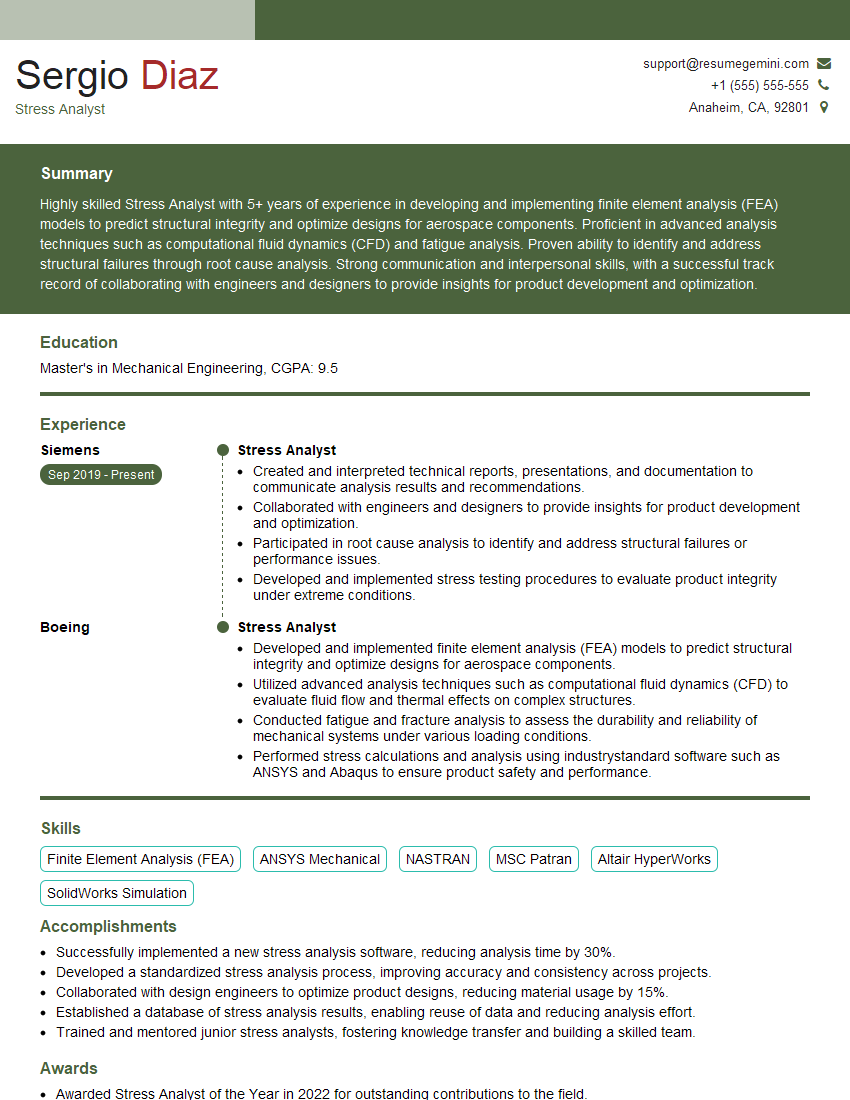
Mastering Loads Analysis opens doors to exciting career opportunities in structural engineering, design, and analysis. A strong understanding of these principles is highly sought after by employers. To maximize your chances of landing your dream role, crafting a compelling and ATS-friendly resume is crucial. ResumeGemini is a trusted resource that can help you create a professional resume that highlights your skills and experience effectively. Examples of resumes tailored to Loads Analysis professionals are available to help you get started. Invest the time in creating a polished and targeted resume – it’s your first impression with potential employers.
Explore more articles
Users Rating of Our Blogs
Share Your Experience
We value your feedback! Please rate our content and share your thoughts (optional).
What Readers Say About Our Blog
Really detailed insights and content, thank you for writing this detailed article.
IT gave me an insight and words to use and be able to think of examples