Preparation is the key to success in any interview. In this post, we’ll explore crucial Marine Chart Interpretation interview questions and equip you with strategies to craft impactful answers. Whether you’re a beginner or a pro, these tips will elevate your preparation.
Questions Asked in Marine Chart Interpretation Interview
Q 1. Explain the different types of marine charts and their applications.
Marine charts come in various types, each designed for specific purposes. The most common are:
- Paper Charts: Traditional nautical charts printed on paper. These are invaluable for situations where electronic systems may fail and offer a tactile understanding of the area. They often provide a broader overview of a region.
- Electronic Navigational Charts (ENCs): Digital charts containing vector-based data. ENCs are used with Electronic Chart Display and Information Systems (ECDIS). They offer dynamic features like overlaying GPS data and automatic route planning. Think of them as interactive, updatable paper charts.
- Raster Navigational Charts (RNCs): Digital charts that are essentially scanned images of paper charts. While offering a familiar visual representation, they lack the dynamic capabilities of ENCs.
- Pilot Charts: These charts focus on weather patterns, currents, and other navigational considerations relevant to specific regions and seasons. They are crucial for voyage planning and optimizing routes.
The application depends on the situation. A coastal vessel might rely on paper charts for a better understanding of local landmarks, while a deep-sea cargo ship would likely use an ECDIS with ENCs for precise navigation and route optimization. Pilot charts would be consulted by both to assess weather conditions and plan accordingly.
Q 2. Describe the components of a standard nautical chart.
A standard nautical chart is packed with information. Key components include:
- Chart Title and Number: Uniquely identifies the chart and its area of coverage.
- Date of Issue and Edition: Shows when the chart was created and updated, crucial for accuracy.
- Scale: Indicates the relationship between distances on the chart and actual distances on the water. For example, a 1:100,000 scale means 1 cm on the chart represents 1 km on the water.
- Depth Contours: Lines connecting points of equal depth, usually shown in fathoms or meters.
- Soundings: Individual depth measurements shown as numbers.
- Aids to Navigation (ATONs): Symbols representing buoys, lighthouses, beacons, etc.
- Topography: Shows land features such as hills, buildings, and shorelines.
- Magnetic Variation: The difference between true north and magnetic north.
- Chart Legend/Symbols: A key explaining the meaning of various symbols used on the chart.
Think of it as a detailed map, but specifically designed for safe and efficient navigation at sea, taking into account the unique challenges of a three-dimensional environment.
Q 3. How do you identify and interpret depth contours on a chart?
Depth contours are lines connecting points of equal depth. They’re typically shown in fathoms (6 feet) or meters, and the closer the lines are together, the steeper the seabed. For example, closely spaced contours indicate a steep drop-off, while widely spaced contours show a gentle slope.
Interpretation involves understanding the depth values and the spacing of the contours. A vessel’s draft (depth below the waterline) must always be considered. If a contour line indicates a depth of 10 meters, and your vessel has a draft of 5 meters, you should avoid navigating closer than 5 meters from that line to avoid running aground.
A seasoned mariner will quickly recognize potential hazards, like shallow areas or steep drop-offs, by observing the contour patterns. It’s about reading the ‘landscape’ of the seabed as shown by the contours.
Q 4. What are the different types of aids to navigation depicted on charts?
Aids to Navigation (ATONs) are crucial for safe navigation. Charts depict various types, including:
- Buoys: Floating markers, identified by shape, color, and light characteristics. For example, a red buoy with a conical top usually marks the port (left) side of a channel.
- Beacons: Fixed structures, often lighted, that provide navigational guidance.
- Lighthouses: Tall structures with powerful lights that can be seen from a considerable distance.
- Lightships: Vessels anchored at specific locations, acting as floating lighthouses.
- Radiobeacons: Transmit radio signals to aid in navigation.
Each ATON has a specific meaning, and understanding these symbols is fundamental for safe navigation. Failure to properly interpret these could lead to dangerous situations.
Q 5. Explain the meaning of various chart symbols and abbreviations.
Chart symbols and abbreviations are essential for conveying vast amounts of information concisely. Each symbol represents a specific feature or characteristic. For instance, a small triangle might represent a danger area, while a circle might indicate a wreck. Abbreviations might show details such as the type of bottom (e.g., ‘S’ for sand, ‘R’ for rock), or the nature of a light (e.g., ‘Fl’ for flashing).
The chart’s legend provides a complete key to these symbols and abbreviations. It’s vital to familiarize oneself with the legend before using the chart. Misinterpreting a symbol can have serious consequences, so careful and thorough understanding is key.
Imagine trying to navigate using only written descriptions—the symbols streamline the process and provide a quick visual reference crucial for fast decision-making under pressure.
Q 6. How do you calculate distances and bearings using a chart and parallel rules?
Parallel rules are used to measure distances and bearings on charts. To measure distance, place one rule along the start point and the other along the end point, keeping them parallel. The distance between the rules along the chart’s scale provides the actual distance.
To find a bearing, align one rule along the vessel’s position and the other along the target. Using the compass rose on the chart, the angle between the rules represents the bearing (direction). For example, a bearing of 090° indicates east.
Accurate use of parallel rules requires practice and attention to detail. Slight errors in alignment can lead to significant discrepancies, particularly at larger scales. This is a basic but critical skill for every navigator.
Q 7. How do you determine a vessel’s position using GPS and a chart?
Determining a vessel’s position using GPS and a chart is a two-step process. First, the GPS receiver provides latitude and longitude coordinates. Second, these coordinates are plotted on the chart. This is done by locating the latitude and longitude lines that intersect at the given coordinates.
The intersection of these lines represents the vessel’s position. Many modern charts have a plotting sheet to make this easier. It is common practice to take several GPS readings and plot them to get a more accurate position, and to compare that against other navigational cues to ensure the correctness of the GPS position.
Always consider the potential for GPS errors. It’s good practice to cross-check your position using other navigational methods, like visual landmarks or celestial navigation, to ensure redundancy and safety. GPS is a valuable tool, but it shouldn’t be relied on exclusively.
Q 8. Describe the process of correcting a chart using Notices to Mariners.
Correcting a chart using Notices to Mariners (NOTAMs) is crucial for maintaining its accuracy and ensuring safe navigation. NOTAMs are official publications issued by maritime authorities detailing changes affecting charts, such as newly constructed structures, shifted buoys, or altered depths. The process involves systematically applying these corrections to your chart.
- Obtain the relevant NOTAMs: Regularly check for NOTAMs affecting your planned voyage area. These are usually available online through the relevant hydrographic office’s website or via specialized maritime information services.
- Locate the affected area on your chart: Use the chart’s geographical coordinates and details provided in the NOTAM to pinpoint the exact location of the change.
- Understand the correction: Carefully read the NOTAM to fully comprehend the nature and extent of the change. Pay close attention to the type of correction (e.g., addition, deletion, alteration), the coordinates, and any associated diagrams or sketches.
- Apply the correction: This might involve adding new information directly onto the chart (using a pencil or a special chart correction pen), removing obsolete information, or making alterations to existing features. Always follow the instructions provided in the NOTAM precisely.
- Date and initial the correction: After applying the correction, note the date and your initials next to the change, ensuring a clear record of the update. This allows you to easily trace the corrections applied to the chart.
- Maintain a log of corrections: Keep a detailed log of all NOTAMs applied to each chart. This is invaluable for auditing purposes and helps to maintain the integrity of your chart collection.
Example: A NOTAM might state that a new wreck has been discovered at position 34°15’N, 118°30’W. You would locate this position on your chart and add a wreck symbol with the necessary details, ensuring the appropriate markings are made, noting the date and source of the information.
Q 9. How do you use a chart to plan a voyage?
Chart-based voyage planning is a systematic process involving several key steps. It’s like planning a road trip, but on the water, and with significantly higher stakes.
- Determine the route: Identify your departure and destination points, selecting a safe and efficient route based on water depths, navigation hazards, and prevailing weather conditions. Consider factors like shipping lanes, restricted areas, and potential obstructions.
- Check depths and clearances: Ensure that your vessel’s draft (the depth of the vessel below the waterline) is sufficient for the planned route. Pay attention to charted depths and any depth contours indicating shallow water.
- Identify potential hazards: Carefully examine the chart for hazards such as rocks, shoals, wrecks, restricted areas, and navigational aids. Note their positions and characteristics.
- Plan waypoints: Establish intermediate waypoints along your route. This will help you maintain your position and make course corrections as necessary. These points should ideally be easily identifiable features on the chart.
- Account for tidal currents and other factors: Consider the effects of tidal currents, wind, and sea state on your vessel’s progress. Adjust your planned time of arrival to account for these factors.
- Review the chart information: Examine any specific notations or warnings on the chart relevant to your route, such as compass roses, magnetic variation information, and local regulations.
- Consider alternative routes: Have backup plans in case of unexpected events or navigational challenges. Having alternative routes plotted is critical for emergency situations.
Example: Planning a coastal voyage, you might plot a route using waypoints such as prominent headlands, navigational buoys, or even GPS coordinates tied to easily identifiable features on the chart. You’d note tidal current information at various points and adjust your estimated time of arrival accordingly.
Q 10. What are the safety considerations when using a chart for navigation?
Safety is paramount when using charts for navigation. Mistakes can have severe consequences. Here are critical safety considerations:
- Chart currency: Ensure your charts are up-to-date, incorporating all relevant Notices to Mariners. Outdated charts can lead to dangerous miscalculations.
- Proper chart handling: Keep your charts clean, dry, and free from damage. Use protective overlays or plotting sheets to avoid marking the chart itself.
- Understanding chart symbols: Develop a thorough understanding of all chart symbols and abbreviations. This ensures correct interpretation and avoids misidentification of hazards.
- Utilizing multiple sources of navigation: Don’t rely solely on charts. Integrate them with GPS, radar, and other navigational instruments for redundancy and enhanced situational awareness. GPS, for example, can aid in determining a vessel’s position in real time, but charts give crucial context and detail.
- Safe navigation practices: Maintain a proper lookout, monitor weather forecasts, and be prepared for unexpected events. Always consider the prevailing conditions and their impact on your navigation.
- Awareness of limitations: Understand that charts are not always perfectly accurate and that errors might exist. Be cautious and maintain a healthy margin for error.
Example: If a chart shows a depth of 10 meters but your vessel’s draft is 11 meters, using that route would lead to grounding. Combining chart information with a depth sounder is crucial to avoid such scenarios.
Q 11. Explain the concept of tidal currents and how they are depicted on charts.
Tidal currents are the horizontal movement of water caused by the rise and fall of tides. They are distinct from the general ocean currents. Understanding and accounting for them is critical for safe navigation, especially in shallow or confined waters.
Charts depict tidal currents in several ways:
- Tidal current atlases: These provide detailed information on current speed and direction at various locations and times.
- Tidal current vectors: These are arrows on the chart showing the direction and speed of the current at specific points and times. The length of the arrow often represents the speed, with a key provided to translate arrow length to speed.
- Tidal current diagrams: These diagrams depict the speed and direction of the current over a tidal cycle, usually at specific locations. This helps to show the changing nature of the current over time.
- Streamlines: These show the paths of the tidal current, illustrating how the current flows through an area. They are like a map of the current’s movement.
Example: A chart might show tidal current vectors indicating a 2-knot current flowing to the northeast at a particular location at high tide. A navigator needs to factor this current into their calculations for course and speed to reach their destination accurately and safely. Ignoring this can significantly impact vessel positioning and lead to inaccurate arrival times.
Q 12. How do you interpret magnetic variation and deviation on a chart?
Magnetic variation and deviation are crucial corrections applied to compass readings to determine true north. Understanding them is crucial for accurate navigation.
- Magnetic Variation: This is the angular difference between true north (the geographic North Pole) and magnetic north (the direction a compass needle points). This difference varies geographically and is due to the Earth’s magnetic field being uneven. Charts show this variation using isogonic lines (lines connecting points with the same variation).
- Deviation: This is the error caused by magnetic influences on board a vessel (e.g., metal objects, electrical equipment). Deviation differs from one vessel to another and is dependent on the vessel’s heading. Deviation is determined using a deviation table or card, which typically forms part of the vessel’s navigational documentation. It often changes according to the magnetic field strength and the vessel’s position.
Interpreting them on a chart: The chart will usually have a compass rose that displays the magnetic variation for that particular chart area. You’ll find an isogonic line passing through the area to determine the magnetic variation. This variation, along with the deviation from your deviation table, needs to be applied to your compass heading to get true bearing.
Example: If your compass shows a heading of 090° (east), the magnetic variation is +10° (east), and your deviation is -2° (west), your true heading is calculated as follows: 090° + 10° – 2° = 098°. This is crucial to accurately steer your vessel toward your destination.
Q 13. How do you use a chart to identify potential hazards to navigation?
Identifying potential hazards to navigation using a chart is a crucial skill. The chart acts as a visual representation of potential dangers. To do this effectively, look for:
- Depth contours: Shallow water areas are indicated by closely spaced depth contours. These indicate potential grounding hazards. Observe your vessel’s draft to avoid running aground.
- Obstructions: Look for symbols representing rocks, wrecks, reefs, and other underwater or surface obstructions. Note their locations and characteristics and plan your route to avoid them.
- Navigation aids: Identify buoys, beacons, and lighthouses. Understand their meanings and how they relate to your route. These aids guide safe passage through channels and warn of dangers.
- Restricted areas: Charts will indicate areas with restrictions, such as military zones, cable crossings, or fishing grounds. Avoid entering these restricted areas unless specifically authorized.
- Other hazards: Be aware of symbols representing ice, strong currents, and other potential hazards that are specific to the region. This is where familiarity with chart symbology is key.
Example: While planning a passage through a narrow channel, you would use the chart to identify the channel’s boundaries, note any shoals or obstructions within it, and then plan the most suitable route to ensure safe passage while maintaining awareness of the water depth.
Q 14. Explain the differences between electronic and paper charts.
Paper charts and electronic charts (ECDIS) both serve the purpose of navigation, but they differ significantly in their functionality and characteristics.
- Paper charts: These are traditional nautical charts printed on paper. They offer a static representation of a region and require manual updates using Notices to Mariners. They are prone to damage and wear, and their use necessitates physical handling and often requires manual plotting.
- Electronic Charts (ECDIS): These are digital charts displayed on a computer screen. ECDIS systems are much more dynamic than paper charts; they receive automatic updates from navigational services. They provide sophisticated functions, including route planning, collision avoidance, and integration with other navigation equipment. ECDIS often feature automatic alarms and notifications concerning dangerous situations and deviations from the planned route, enhancing safety.
Key Differences Summarized:
| Feature | Paper Chart | Electronic Chart (ECDIS) |
|---|---|---|
| Update Method | Manual (NOTAMs) | Automatic (usually) |
| Functionality | Static | Dynamic, interactive |
| Durability | Susceptible to damage | More durable |
| Portability | Easily portable, but bulky for extensive use | Generally less portable initially, but may have mobile access options |
| Integration | Limited | High degree of integration with other navigational systems |
Ultimately, the choice between paper and electronic charts depends on individual preferences, the complexity of the voyage, and available resources. Many vessels utilize both methods for redundancy and increased safety.
Q 15. Describe the limitations of electronic charts (ECDIS).
Electronic Chart Display and Information Systems (ECDIS) are powerful tools, but they’re not without limitations. One major limitation is their dependence on power. A power failure renders the system useless, unlike paper charts which remain available. Another key limitation is the reliance on the accuracy and up-to-dateness of the chart data itself. If the data is incorrect or outdated, the ECDIS will reflect that, potentially leading to navigational errors. Furthermore, ECDIS functionality can be affected by software glitches, requiring familiarity with troubleshooting and backups. Finally, over-reliance on the ECDIS can lead to a decrease in traditional navigational skills, increasing vulnerability in the event of a system failure.
Imagine a scenario where your vessel encounters a sudden power outage in a challenging navigational environment. Without a paper chart as a backup, you’ll be significantly hampered. Similarly, if your ECDIS software malfunctions due to a bug, having a solid understanding of traditional chart reading is crucial.
Career Expert Tips:
- Ace those interviews! Prepare effectively by reviewing the Top 50 Most Common Interview Questions on ResumeGemini.
- Navigate your job search with confidence! Explore a wide range of Career Tips on ResumeGemini. Learn about common challenges and recommendations to overcome them.
- Craft the perfect resume! Master the Art of Resume Writing with ResumeGemini’s guide. Showcase your unique qualifications and achievements effectively.
- Don’t miss out on holiday savings! Build your dream resume with ResumeGemini’s ATS optimized templates.
Q 16. How do you handle conflicting information between different chart sources?
Conflicting information between chart sources is a serious issue that demands careful consideration. The primary approach is to prioritize official sources, namely charts published by the relevant hydrographic office (like the NOAA in the US or the UKHO). These charts undergo rigorous quality control and are regularly updated. If discrepancies exist between the official chart and another source, such as a privately published chart or even a pilot’s guide, the official chart always takes precedence. Any doubts should be resolved through consultation with port authorities or by cross-referencing with other reliable sources before making critical navigational decisions. You should record your decision-making process and the reasons for selecting a particular course of action. Detailed log entries are paramount.
For example, if a privately published chart shows a different depth than the official chart, you should always use the official chart’s depth information. Thorough investigation to verify the source of the discrepancy should follow.
Q 17. How do you determine the appropriate scale for a chart for a specific voyage?
Selecting the correct chart scale is crucial for safe navigation. The scale dictates the level of detail shown on the chart. Large-scale charts (e.g., 1:50,000) provide more detail and are ideal for coastal navigation or navigating confined waters. Small-scale charts (e.g., 1:1,000,000) cover larger areas and are suitable for open ocean passages. For a specific voyage, you need to choose a scale that provides sufficient detail for the anticipated navigation challenges. Consider factors like the vessel’s draft, the complexity of the route (e.g., presence of reefs, shallow waters), and the accuracy of the positioning systems. You might use a large-scale chart for coastal approaches and transition to a smaller scale for open ocean transit.
Think of it like choosing a map for a road trip: you wouldn’t use a world map to navigate a city; you’d need a detailed city map. Similarly, a large-scale chart is essential for navigating a narrow channel, while a smaller-scale chart suffices for crossing the open ocean.
Q 18. What are the implications of using an outdated chart?
Using an outdated chart carries significant risks. Charts are updated frequently to reflect changes in water depths, the locations of hazards, and navigational aids. An outdated chart might show a safe channel that has since silted up, a cleared wreck that has reappeared, or a navigational aid that has been moved or decommissioned. This can lead to grounding, collision, or other serious incidents. It’s vital to ensure that charts are up-to-date and comply with the latest corrections issued by the relevant hydrographic office. Checking for Notice to Mariners (Navtex, etc.) is essential before and during any voyage.
Imagine relying on a chart that shows a perfectly safe passage through a reef, only to discover upon arrival that the reef has grown and now obstructs the passage. The consequences of using outdated information can be catastrophic.
Q 19. Explain the process of using a chart to calculate ETA.
Calculating an Estimated Time of Arrival (ETA) using a chart involves determining the distance to be covered and dividing it by the vessel’s speed. First, measure the distance on the chart using the chart’s scale and a pair of dividers or a ruler. Convert this measurement to nautical miles. Next, determine the vessel’s speed in knots (nautical miles per hour). Finally, divide the distance (in nautical miles) by the speed (in knots) to get the ETA in hours. Account for any anticipated current or tidal effects that may affect the vessel’s speed. Remember that this is an estimate, and you should always allow for a safety margin.
For instance, if the distance is 50 nautical miles and your speed is 10 knots, the ETA is 5 hours (50nm / 10kts = 5 hours). However, a strong headwind might slow you down, necessitating a revised ETA.
Q 20. How do you use a chart to determine the safe navigable depth for a vessel?
Determining safe navigable depth requires careful consideration of several factors. The chart will display depths, but these are often charted depths, meaning the depth might be less than what is indicated. You need to account for the vessel’s draft (the depth of the hull below the waterline), any anticipated tidal changes, and the vessel’s under keel clearance (UKC). The UKC is a safety margin added to the draft to avoid grounding. Always ensure that the charted depth plus any anticipated tidal changes is sufficient to provide adequate UKC for your vessel. It’s crucial to consult tide tables and make necessary adjustments.
For example, if your vessel has a draft of 10 meters, you need a minimum depth of 12 meters (allowing a 2-meter UKC) to navigate safely. If the chart shows a depth of 11 meters at high tide and the low tide is 2 meters lower, then navigation is only safe at high tide.
Q 21. Describe how to use a chart to determine a safe course to avoid potential hazards.
Planning a safe course to avoid hazards is a fundamental aspect of chart interpretation. Identify potential hazards on the chart such as rocks, shoals, wrecks, or restricted areas. Assess their positions and distances from your planned route. Consider the vessel’s maneuverability and the prevailing conditions (wind, current, visibility). Plot a course that provides adequate clearance from all hazards while adhering to any navigational rules or regulations. Regularly check your position using GPS or other navigational aids to ensure you stay on course. Use a parallel index line to keep track of your progress. If you encounter unexpected changes in conditions, adjust your course accordingly.
Imagine a situation where a strong current is pushing your vessel toward a rocky coastline. By carefully analyzing the chart, you can identify a safer route that avoids the hazards and compensates for the current’s influence, perhaps by taking a wider turn.
Q 22. Explain the importance of proper chart maintenance and updating.
Proper chart maintenance and updating are paramount for safe navigation. Charts are dynamic documents; waterways change constantly due to dredging, construction, new hazards, or even natural events like storms. An outdated chart can lead to grounding, collision, or other serious incidents.
Maintaining your charts involves:
- Regularly checking for Notices to Mariners (NOTAMs): These are official updates issued by hydrographic offices, detailing changes to charts. Ignoring NOTAMs is a serious navigational error.
- Using a chart correction service: Many services provide updated chart data digitally, ensuring your charts reflect the most recent information. This reduces the risk of manual errors when applying corrections.
- Careful correction application: When applying corrections manually, use a sharp pencil or pen to avoid obscuring existing information. Always clearly cross out obsolete data and clearly add the new details, indicating the NOTAM number and date applied.
- Storing charts properly: Protect your charts from water damage, tears, and excessive sunlight. A damaged chart is an unreliable chart.
- Regularly reviewing your charts: Familiarize yourself with the area of operation before departure, not only to plot your route but also to anticipate potential hazards and changes.
Imagine navigating a channel marked as 10 meters deep on an outdated chart, only to find it’s been dredged down to 5 meters – a potentially disastrous situation if your vessel draws more than 5 meters.
Q 23. How do you use a chart to identify restricted areas or prohibited zones?
Nautical charts clearly delineate restricted areas and prohibited zones using various symbols and markings. Identifying these areas is crucial for safe navigation and compliance with maritime regulations.
Look for:
- Shading or color-coding: Specific colors or patterns often indicate prohibited anchoring, restricted speed zones, or military exercise areas.
- Labels and abbreviations: Charts employ abbreviations and labels like “DANGER AREA,” “MILITARY EXERCISE,” “NO ANCHORING,” or specific symbols, such as a crossed anchor for anchoring restrictions.
- Depth contours: Shallow water areas might be designated as restricted areas, especially for vessels with significant drafts.
- Navigation warnings: NOTAMs frequently highlight temporary restrictions or hazards in specific zones. These may include temporary dredging operations or underwater cables.
For instance, a shaded area marked “Firing Range” clearly indicates an area to be avoided. Failing to recognize and respect these markings can lead to serious consequences such as damage to your vessel or even legal repercussions.
Q 24. Describe the process of transferring a fix from a GPS receiver to a chart.
Transferring a fix from a GPS receiver to a chart involves accurately plotting your vessel’s position on the chart. This process is fundamental for safe navigation.
The steps are:
- Obtain GPS coordinates: Your GPS receiver will display latitude and longitude. Note these coordinates precisely.
- Locate the relevant area on your chart: Use the chart’s latitude and longitude lines to find the approximate location corresponding to your GPS coordinates.
- Use dividers or a parallel rule (for more accuracy): If available, these tools can help accurately measure distances on the chart.
- Plot your position: Place the point representing your GPS coordinates on the chart. Consider using a pencil to avoid permanent marks, especially when working with several fixes.
- Mark the fix with the date and time: This timestamp is essential for tracking your progress and understanding your vessel’s movement over time.
Remember to account for potential errors in your GPS coordinates. For instance, a poor GPS signal can lead to an inaccurate fix. Always cross-reference your GPS data with other navigational aids (such as visual bearings or range measurements) to ensure accuracy and safeguard navigation.
Q 25. What are some common mistakes made in chart interpretation?
Many common mistakes arise from improper chart interpretation. Here are a few frequent errors:
- Misinterpreting chart symbols and abbreviations: A lack of thorough understanding of chart symbology can lead to misjudgment of water depths, hazards, or navigational aids.
- Ignoring NOTAMs: Failure to check for and apply updates from NOTAMs can result in navigating hazardous areas believing they are safe.
- Incorrectly plotting positions: Errors in transferring GPS data or using other navigational aids can lead to inaccurate positioning, resulting in navigational miscalculations.
- Failing to account for tidal currents and water levels: Ignoring these factors can result in running aground in areas that appear to have sufficient depth on the chart. Chart depths are often stated as chart datum (lowest astronomical tide).
- Overreliance on electronic charts (ECDIS) without understanding the chart data: An ECDIS is a great tool, but it shouldn’t replace understanding how to use a paper chart.
For example, mistaking a symbol representing a submerged wreck for a safe passage could have catastrophic results. Always double-check and be certain of what you are seeing on your chart.
Q 26. How would you respond to an emergency situation requiring immediate chart interpretation?
Responding to an emergency requiring immediate chart interpretation demands calm, swift, and accurate action. Speed is of the essence, but accuracy cannot be compromised.
My response would involve:
- Assessing the emergency: What is the nature of the emergency? Grounding? Collision threat? Engine failure?
- Identifying the immediate area on the chart: Quickly locate your vessel’s approximate position using any available navigational aids.
- Looking for safe water and refuge options: Examine the chart for alternative routes, nearby anchorages, or safe havens, considering the constraints of your situation.
- Considering environmental factors: Take into account currents, winds, and visibility when planning an escape route.
- Communicating with other vessels and authorities: Immediately issue a distress call (Mayday) if necessary and inform relevant authorities and nearby vessels of your situation.
- Executing the escape plan: Follow the chosen escape plan meticulously, constantly reassessing and adapting to changing conditions.
In a real-life scenario, I once assisted a vessel with engine failure near a rocky coastline. By quickly analyzing the chart, we were able to identify a small, sheltered bay to anchor in before nightfall, preventing a potentially hazardous situation.
Q 27. How do you ensure that your chart interpretation skills are up-to-date?
Maintaining up-to-date chart interpretation skills requires continuous learning and practice. This involves:
- Regularly attending refresher courses: Many maritime organizations offer courses focused on chart interpretation, incorporating the latest techniques and updates.
- Staying abreast of technological advancements: ECDIS systems and other electronic navigational tools are constantly evolving, so understanding their capabilities is vital.
- Practicing chartwork regularly: Even experienced navigators should dedicate time to practicing chart interpretation, preferably in simulated or real-world navigation exercises.
- Participating in workshops or seminars: These events frequently address new regulations, technological developments, and best practices in chart interpretation.
- Networking with fellow navigators: Sharing experiences and best practices with other professionals helps in identifying and avoiding common mistakes.
I regularly participate in online forums and attend conferences to remain updated with the latest navigational best practices, ensuring my skills remain current and relevant.
Q 28. Explain the different projections used in nautical charts and their implications.
Nautical charts utilize various map projections, each with its strengths and limitations. The choice of projection depends on the scale and area covered by the chart.
Common projections include:
- Mercator Projection: This projection shows lines of latitude and longitude as straight lines, making it easy to plot courses. However, it distorts areas, especially at higher latitudes. It’s excellent for navigation at lower latitudes along rhumb lines (lines of constant bearing).
- Lambert Conformal Conic Projection: This projection minimizes distortion within a limited area, making it suitable for charts covering relatively small regions. Areas near the central meridian are accurately represented.
- Gnomonic Projection: This projection accurately depicts great circles (the shortest distance between two points on a sphere) as straight lines. It’s useful for planning long-distance voyages. However, it’s unsuitable for small-scale charts because it heavily distorts areas away from the center point.
The implications are that choosing the wrong projection can lead to inaccurate measurements of distances, bearings, or areas. Understanding the characteristics of each projection and its limitations is essential for accurate navigation. For example, a long voyage plotted on a Mercator chart will appear shorter at higher latitudes than it actually is, requiring adjustments in navigation planning.
Key Topics to Learn for Marine Chart Interpretation Interview
- Chart Symbols and Abbreviations: Understanding the meaning and application of all symbols found on nautical charts, including buoys, lights, depths, and navigational hazards. Practical application: Accurately interpreting chart symbols to plan a safe and efficient voyage.
- Chart Datum and Depths: Understanding chart datum (reference level for depths), soundings, and how to calculate depth relative to the keel of a vessel. Practical application: Determining safe water depths for navigation in various conditions.
- Navigation Aids and Systems: Knowledge of various navigational aids (GPS, radar, etc.) and how their data relates to chart information. Practical application: Integrating electronic navigational information with chart information for improved situational awareness.
- Tidal Currents and Predictions: Interpreting tidal information and its impact on navigation, including current direction and speed. Practical application: Planning a voyage considering the influence of tides and currents.
- Geographic Coordinates and Projections: Understanding latitude, longitude, and chart projections, and how to use them for accurate positioning. Practical application: Determining a vessel’s position and plotting a course on a nautical chart.
- Safety Contours and Regulations: Identifying and understanding the significance of safety contours, restricted areas, and navigational regulations depicted on charts. Practical application: Planning a voyage that complies with all applicable regulations and avoids hazards.
- Electronic Chart Systems (ECS): Familiarity with the use and limitations of electronic chart systems. Practical application: Efficiently utilizing ECS for route planning and monitoring vessel position.
- Chart Corrections and Updates: Understanding the importance of chart corrections and how to apply them. Practical application: Ensuring the use of the most up-to-date and accurate chart information for safe navigation.
Next Steps
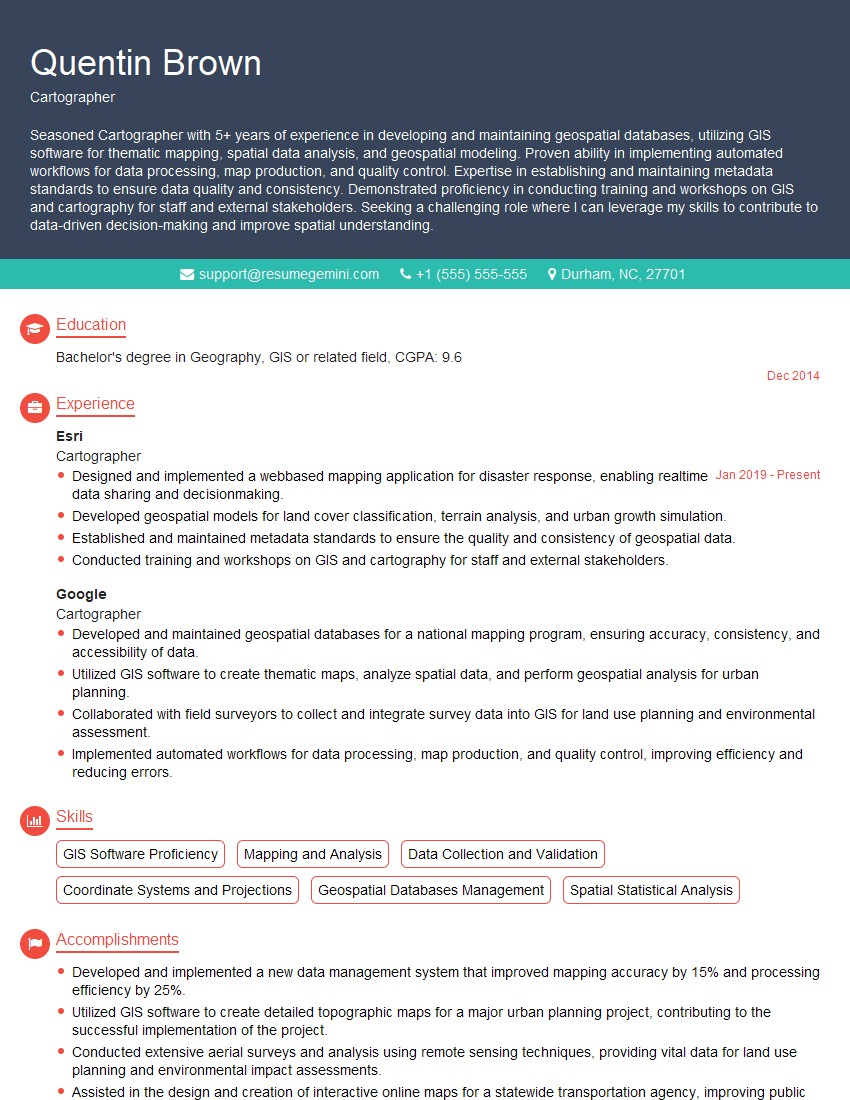
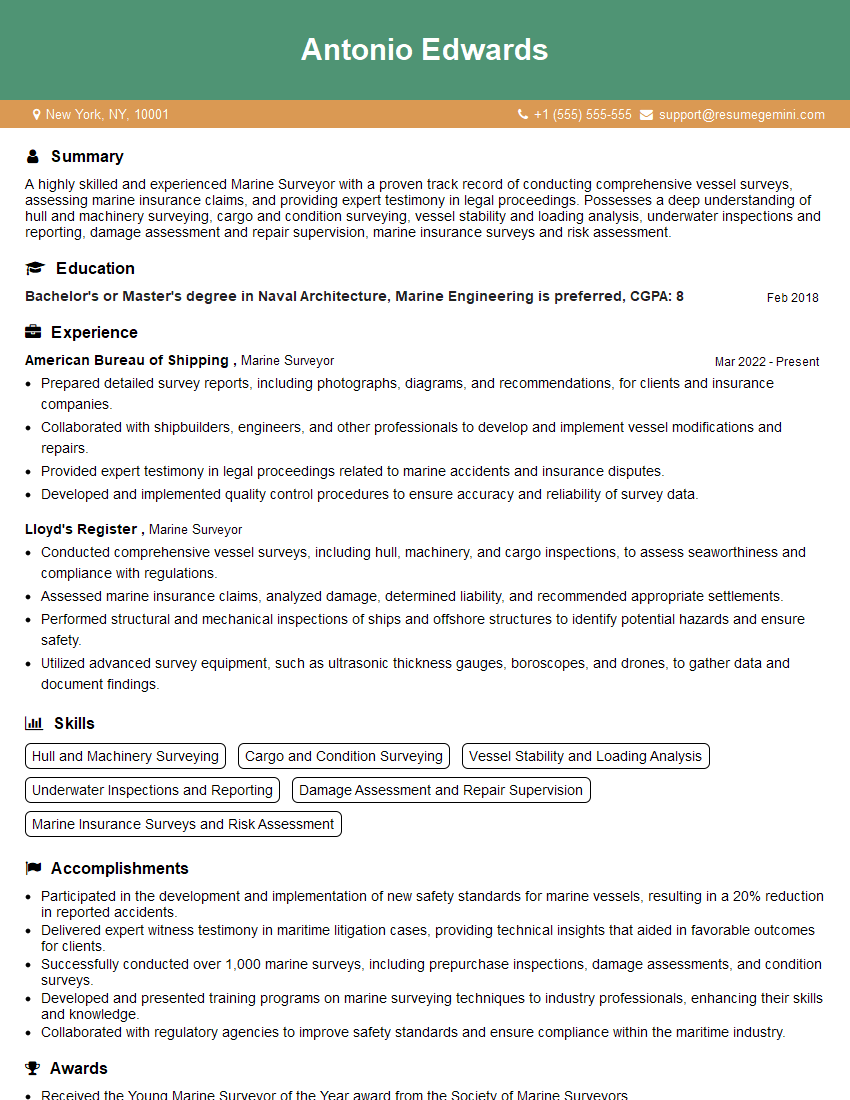
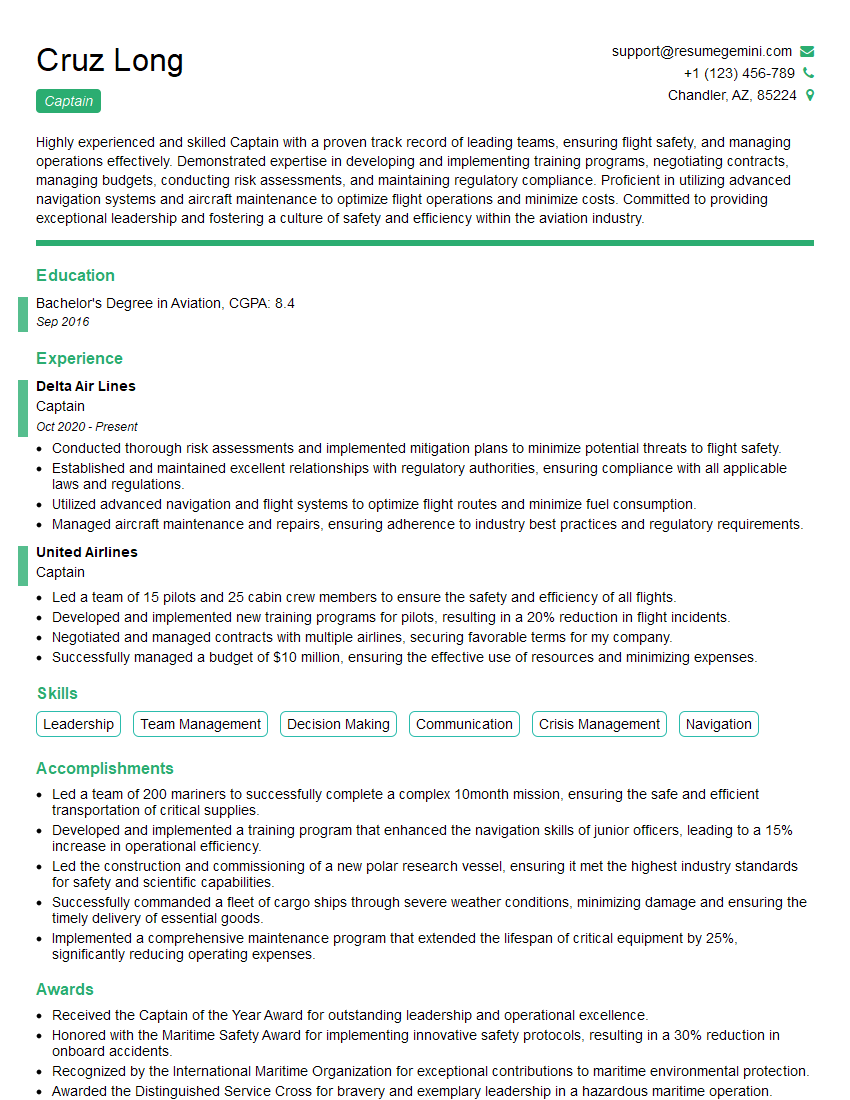
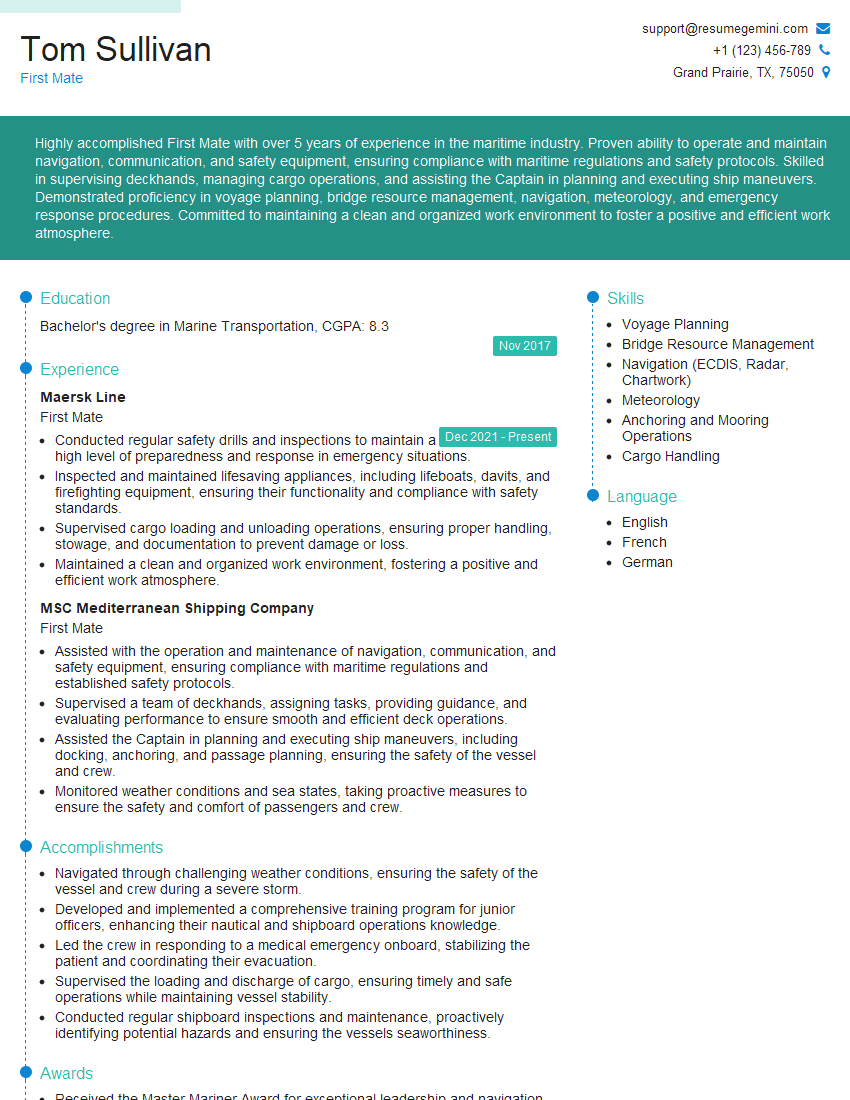
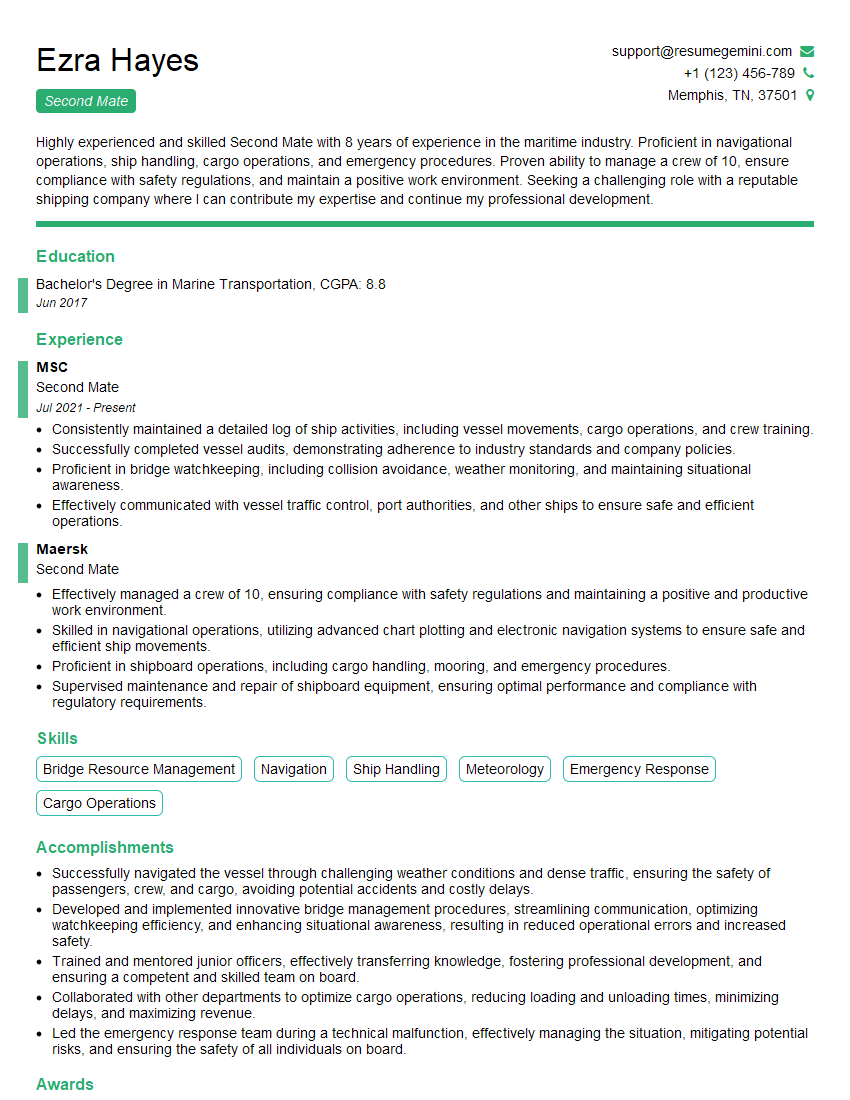
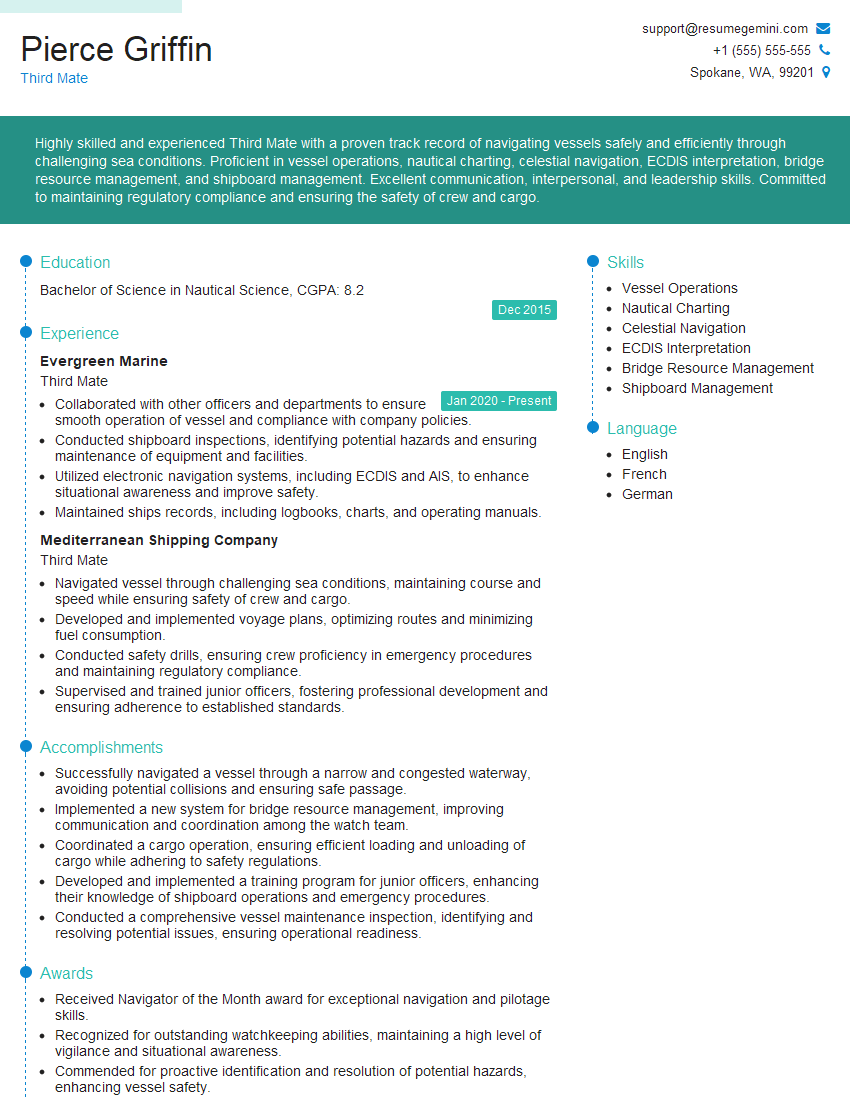
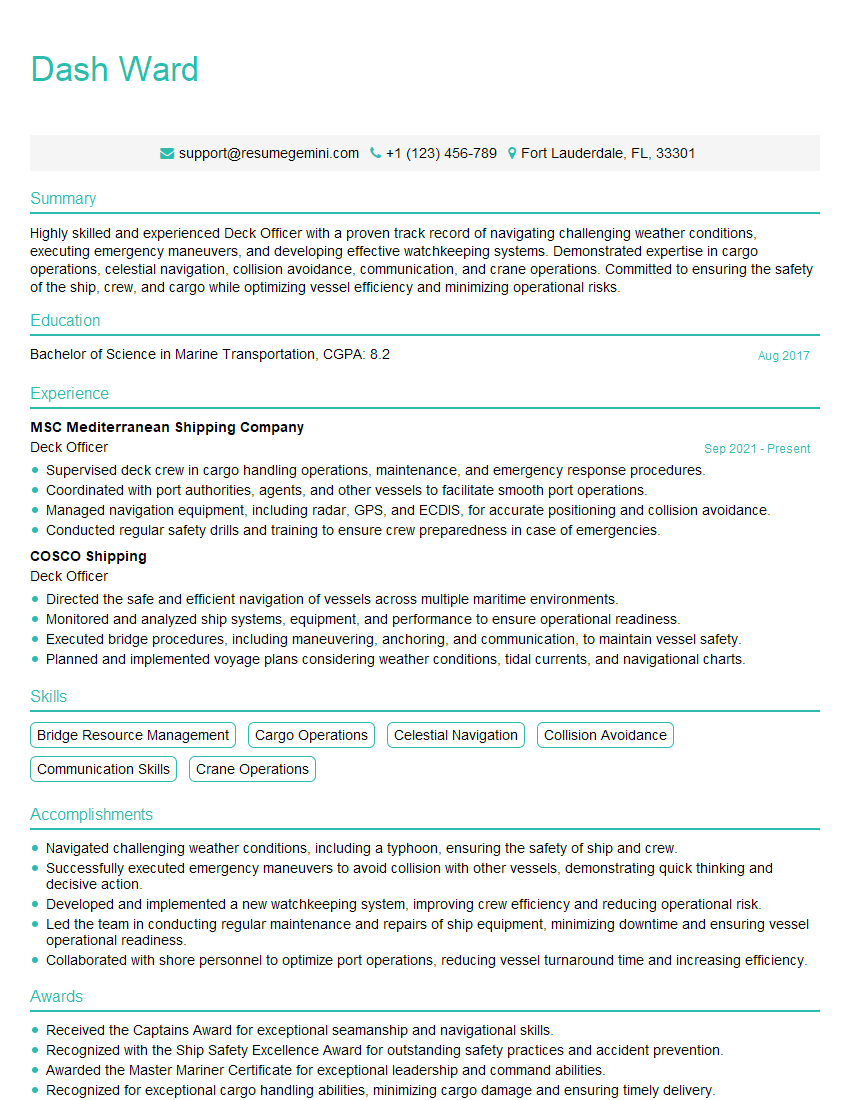
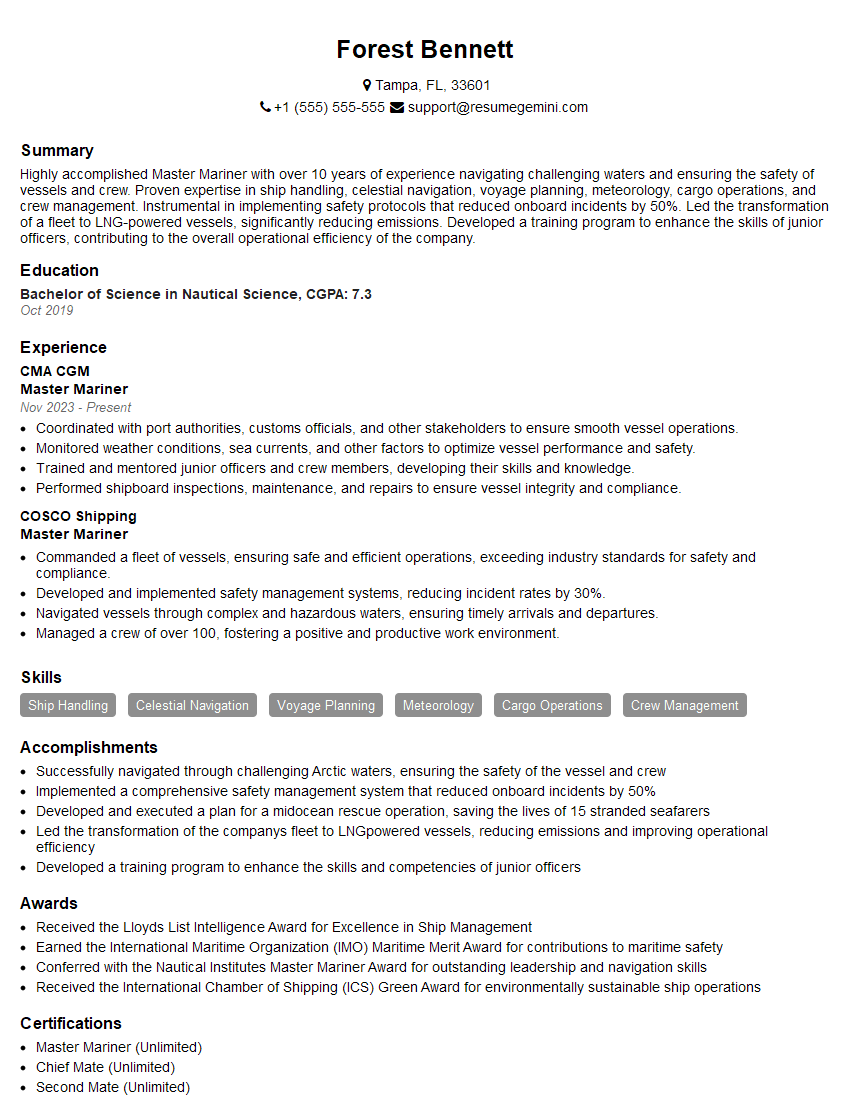
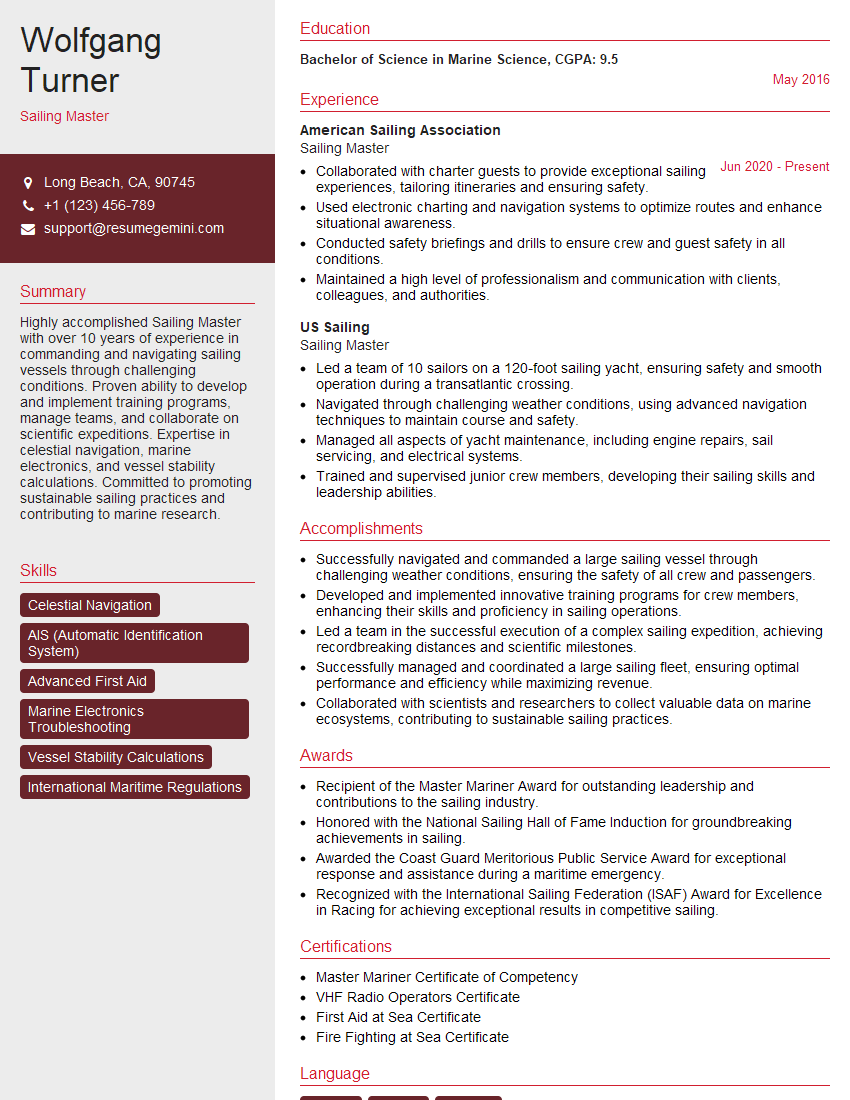
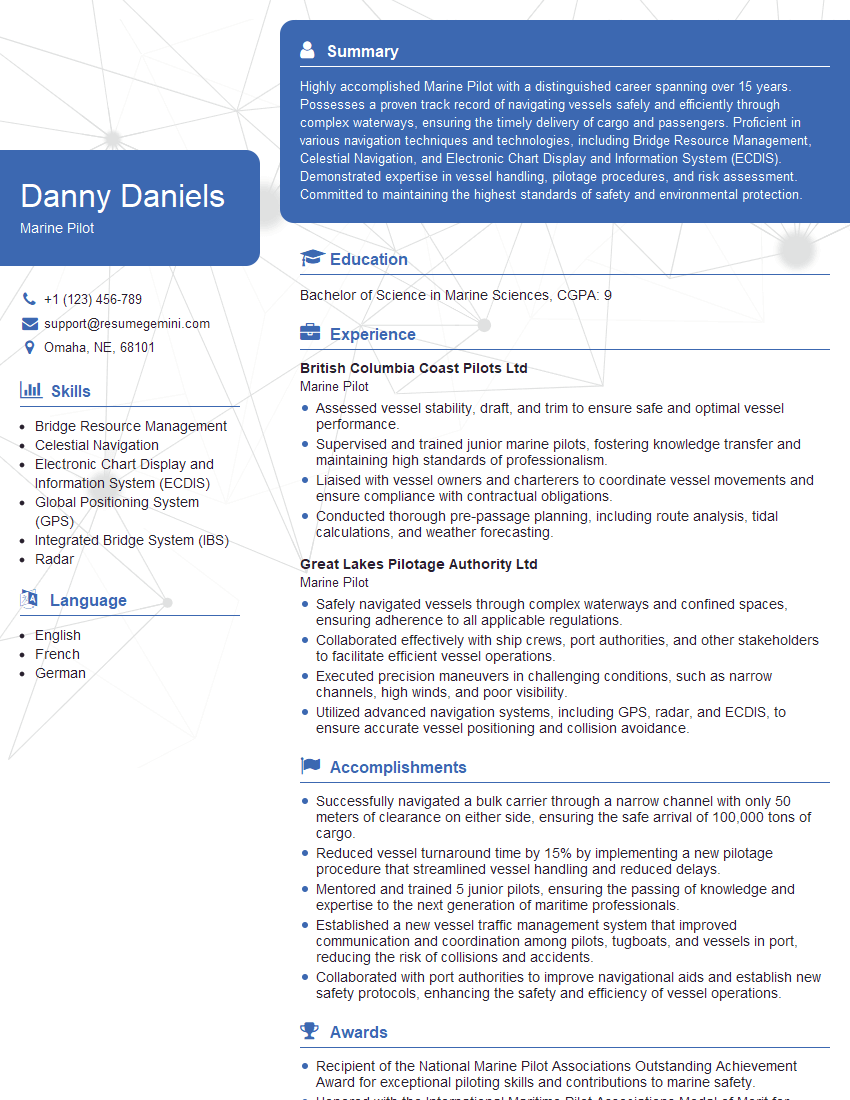
Mastering Marine Chart Interpretation is crucial for advancement in any maritime career, significantly increasing your safety awareness and navigational capabilities. A strong understanding of chart interpretation is highly valued by employers and is essential for safe and efficient operations. To maximize your job prospects, creating an ATS-friendly resume is key. ResumeGemini is a trusted resource to help you build a professional and effective resume that highlights your skills and experience. Examples of resumes tailored to Marine Chart Interpretation are available to help you get started.
Explore more articles
Users Rating of Our Blogs
Share Your Experience
We value your feedback! Please rate our content and share your thoughts (optional).
What Readers Say About Our Blog
Really detailed insights and content, thank you for writing this detailed article.
IT gave me an insight and words to use and be able to think of examples