Preparation is the key to success in any interview. In this post, we’ll explore crucial Marine Navigation and Charting interview questions and equip you with strategies to craft impactful answers. Whether you’re a beginner or a pro, these tips will elevate your preparation.
Questions Asked in Marine Navigation and Charting Interview
Q 1. Explain the process of correcting paper charts.
Correcting paper charts involves updating the chart with the latest Notices to Mariners (NTMs). NTMs are publications issued by hydrographic offices detailing changes to navigational information, such as new obstructions, altered depths, or changes to aids to navigation. The process is crucial for safe navigation as charts can become outdated quickly due to dynamic coastal environments and human activity.
Acquire NTMs: Obtain the latest NTMs for the relevant geographical area. These are typically available online or through subscription services.
Identify Applicable Corrections: Carefully read each NTM and identify corrections that apply to your specific chart. Note the chart number and the location described in the NTM.
Locate the Affected Area on the Chart: Using the chart’s latitude and longitude coordinates, find the exact location mentioned in the NTM.
Apply Corrections: Depending on the nature of the correction, this might involve adding new information (e.g., a new buoy), deleting outdated information, or making alterations (e.g., correcting a depth sounding). Use a pencil to make these corrections so that they can be easily erased and updated later.
Record Corrections: Keep a record of all corrections made, including the NTM number and date of application. This is important for tracking chart accuracy and in case of any discrepancies.
Review and Verify: Before using the corrected chart, thoroughly review all corrections to ensure accuracy and consistency.
For example, if an NTM announces the removal of a wreck, you would carefully erase the wreck symbol from your chart and note the correction in your log.
Q 2. Describe your experience with Electronic Chart Display and Information Systems (ECDIS).
I have extensive experience with ECDIS, having used various systems on different vessels for over 10 years. My experience spans both installation and operational aspects. I am proficient in using ECDIS for route planning, monitoring vessel position, and handling various navigational tasks. I’m familiar with the different functionalities, including chart management, safety contour settings, and various alarms. I understand the importance of regularly updating the chart data and ensuring the system is functioning correctly. I’m also experienced in troubleshooting common ECDIS issues and performing backups and system checks. In my previous role, I was responsible for training junior officers in safe and efficient ECDIS operation. I am familiar with various ECDIS manufacturers and their specific features. A key aspect of my experience involves understanding the importance of maintaining both paper and electronic charts in compliance with SOLAS regulations for redundancy.
For instance, during a recent voyage, the ECDIS experienced a temporary power failure. Following my established procedures, I immediately switched to my backup ECDIS system and then confirmed our position using conventional means like GPS and celestial navigation until power was restored and the integrity of the primary system could be verified.
Q 3. How do you handle a GPS malfunction during navigation?
A GPS malfunction during navigation is a serious issue requiring immediate action. The priority is to maintain safe navigation and prevent a collision or grounding. My response would involve a series of actions:
Confirm the Malfunction: First, I would verify that the GPS malfunction is genuine by checking other navigation receivers if available.
Utilize Backup Systems: Switch to secondary navigation systems such as a Loran-C (if applicable in the area), another GPS receiver (if available), or other terrestrial or celestial navigation aids.
Switch to Dead Reckoning: In the interim, initiate dead reckoning navigation, calculating position based on course, speed, and time elapsed since the last known good position. This provides a temporary estimate of the vessel’s position.
Use Other Aids to Navigation: Employ all available navigational aids, such as visual bearings on landmarks, range markers, and electronic aids to navigation like radar and Automated Identification System (AIS).
Reduce Speed: Reduce speed to a safe level and maintain a sharp lookout to avoid collision.
Inform the Bridge Team: Communicate the situation to the bridge team and follow established procedures for reporting navigation system failures.
Attempt GPS Repair: After safety is ensured, try to diagnose and fix the GPS receiver, if possible.
Log the Event: Record the details of the malfunction, actions taken, and subsequent repair procedures.
The specific actions would depend on the context of the situation. For example, if the malfunction occurs in a busy traffic separation scheme, immediate and decisive action is paramount to ensure the safety of the vessel and other vessels.
Q 4. Explain the concept of dead reckoning.
Dead reckoning (DR) is a method of estimating a vessel’s position by advancing a known position along a course and speed over a period of time. It’s a fundamental navigational technique, used especially when other position-fixing methods are unavailable or unreliable. Think of it as estimating where you are based on how far and in what direction you’ve traveled. It is not a precise method and accumulated errors over time must be considered.
It relies on three fundamental pieces of information:
Course: The vessel’s heading and compass deviation.
Speed: The vessel’s speed over ground.
Time: The duration of the voyage since the last known position.
For instance, if you’re at position A (latitude and longitude known) heading due north at 10 knots for 2 hours, DR would estimate your position after that time to be 20 nautical miles north of A. However, this assumes constant course, speed, and no currents or wind affecting your actual motion.
Important Note: DR is highly susceptible to errors accumulating from inaccurate speed, course changes, and the influence of currents and winds. DR is therefore always used in conjunction with other means of position fixing. It’s a reliable backup but not a primary position fixing method.
Q 5. What are the different types of navigational aids and their limitations?
Navigational aids are crucial for safe and efficient navigation. They provide information about a vessel’s position, the surrounding environment, and potential hazards. Different types have their limitations:
Visual Aids: Lights, buoys, beacons, and daymarks. Limitations include limited range (visibility affected by weather), potential obstruction by other vessels or land features, and the possibility of misidentification.
Electronic Aids: GPS, Radar, ECDIS, and AIS. Limitations include potential equipment failure (as discussed previously), interference (e.g., GPS jamming or multipath errors), and the need for accurate calibration and maintenance. GPS signals can be weakened or blocked by atmospheric conditions or physical obstructions.
Radio Aids: VHF radio, Loran-C (where still operational), and various other radio navigation systems. Limitations include signal propagation issues (distance and atmospheric conditions), potential interference from other transmissions, and the requirement for specialized equipment and operator expertise.
For example, relying solely on visual aids in fog would be dangerous, highlighting the importance of using multiple navigational aids and employing backups in case of failure or limitations.
Q 6. How do you calculate the speed of current using a current triangle?
A current triangle is a graphical method used to determine the speed and direction of a current. It uses the vessel’s speed through the water (STW), the vessel’s speed over ground (SOG), and the vessel’s heading (true) and course (true).
The process involves:
Draw the Current Triangle: Draw a triangle with one side representing the SOG vector (speed and direction over ground). Another side is the STW vector (speed and direction through the water). The third side, which closes the triangle, represents the current vector (speed and direction of the current).
Scale: Select an appropriate scale to represent speed (e.g., 1 cm = 1 knot).
Plot the Vectors: Accurately plot the SOG vector and the STW vector based on their known values.
Close the Triangle: Draw the third side to complete the triangle. This side represents the set and drift of the current.
Measure the Current Vector: Measure the length and direction of the current vector. The length, converted using the scale, gives the speed of the current. The direction is the direction of the current.
Example: If a vessel’s STW is 10 knots on a heading of 000 degrees and its SOG is 9 knots on a course of 350 degrees, the current vector is found by completing the triangle. Measuring the current vector would give its speed and direction.
Q 7. Describe your understanding of tidal streams and their influence on navigation.
Tidal streams are the horizontal movement of water caused by the rise and fall of tides. Understanding tidal streams is critical for safe navigation, particularly in coastal areas and narrow channels. They significantly affect a vessel’s speed and course over ground.
Influence on Navigation:
Increased or Decreased Speed: Tidal streams can either increase or decrease a vessel’s speed over ground depending on whether the stream is assisting or opposing the vessel’s course.
Course Changes: Tidal streams can cause a vessel to deviate from its intended course, requiring adjustments to the vessel’s heading to compensate. This is often known as ‘set’ (the direction of the current) and ‘drift’ (the speed of the current).
Timing of Voyages: Navigators carefully consider tidal streams when planning voyages, especially when navigating through narrow channels or areas with strong currents. This involves selecting optimal times to transit such areas, taking advantage of favorable currents and avoiding strong opposing currents.
Safety: In strong tidal streams, vessels need to be aware of increased risk of collisions with other vessels and potential grounding in shallow areas.
Tidal stream information is found in nautical charts and tidal stream atlases. These tools allow navigators to accurately predict current speed and direction for a specific time and location, enhancing safety and operational efficiency.
Q 8. Explain the principles of celestial navigation.
Celestial navigation relies on the precise measurement of the altitudes of celestial bodies – primarily the sun, moon, planets, and stars – to determine a vessel’s latitude and longitude. It’s essentially using the heavens as a giant, natural coordinate system. The principle rests on the understanding of spherical trigonometry and the predictable movements of these celestial bodies, whose positions are detailed in nautical almanacs.
Here’s a simplified breakdown:
- Sight Reduction: You measure the altitude of a celestial body using a sextant. This altitude, along with the body’s declination (celestial latitude) and Greenwich Hour Angle (GHA – celestial longitude), is then used in calculations (often done with pre-computed tables or modern calculators) to determine your position line (Line of Position or LOP).
- Multiple LOPs: Taking sights of at least two celestial bodies (ideally three for better accuracy) generates intersecting LOPs. The intersection of these lines represents your vessel’s position.
- Nautical Almanac: This is a crucial reference document that provides the precise declination and GHA of celestial bodies at specific times. Without it, celestial navigation is impossible.
Imagine a giant sphere (the Earth) with a smaller sphere (the celestial sphere) surrounding it. By measuring the angles to stars on that celestial sphere, we can accurately determine our location on Earth. While less frequently used now with the advent of GPS, celestial navigation remains a vital backup system and a fundamental skill for experienced mariners.
Q 9. How do you identify and interpret different types of marine charts?
Marine charts are categorized based on their scale, purpose, and the area they cover. Identifying them correctly is crucial for safe navigation. Key aspects to look for include:
- Scale: Larger scale charts (e.g., 1:50,000) show greater detail and are used for coastal navigation, while smaller scale charts (e.g., 1:1,000,000) are used for ocean passages.
- Chart Number: Every official chart has a unique identifier, allowing easy reference and updating.
- Projection: Charts are based on different map projections (Mercator, Lambert Conformal Conic, etc.), each with its own properties and potential for distortion. Understanding the projection helps in interpreting distances and bearings.
- Chart Symbols and Abbreviations: Charts are packed with symbols denoting depths, hazards, aids to navigation (ATONs), etc. Understanding these symbols is paramount. They are explained in a legend on each chart.
- Types of Charts: Examples include general charts, harbor charts, approach charts, and special-purpose charts (e.g., pilot charts, sailing directions).
For instance, a harbor chart will have far more detail about buoys, berths, and depths than a general chart of the same area. Misinterpreting a chart can have severe consequences, so careful examination and understanding of the chart’s symbology and scale are essential.
Q 10. What are the different methods for determining a vessel’s position?
There are several methods for determining a vessel’s position, ranging from ancient techniques to modern technology:
- GPS (Global Positioning System): The most common method, offering highly accurate position fixes through satellite signals. It’s crucial to note that GPS reliability can be affected by atmospheric conditions and signal interference.
- Celestial Navigation (explained above): Uses the positions of celestial bodies to determine latitude and longitude.
- Loran-C: (Loran is largely obsolete now) A radio-navigation system that provided position fixes based on the time difference between signals from multiple transmitters.
- Visual Bearings and Range Finding: Using landmarks (e.g., lighthouses, buoys), compasses, and range finders to determine position through triangulation. This method requires good visibility.
- Electronic Chart Display and Information System (ECDIS): Combines electronic charts with GPS data and other navigational sensors (e.g., radar, AIS) to provide integrated position information and warnings.
- Dead Reckoning (DR): An estimated position based on the vessel’s last known position, course, speed, and time. DR is never a reliable position but helpful for monitoring progress between accurate fixes.
The optimal method depends on the circumstances, equipment available, and level of accuracy required. Often, a combination of methods is used to ensure redundancy and accuracy.
Q 11. Explain the importance of proper chart maintenance.
Proper chart maintenance is crucial for safe navigation, because outdated or damaged charts can lead to serious errors. This involves:
- Regular Updates: Charts need to be updated with the latest Notices to Mariners (NavWarnings), which announce changes like new hazards, altered depths, or changes to ATONs.
- Correcting Notices to Mariners: These updates need to be meticulously applied to the chart using appropriate correction methods.
- Physical Condition: Charts should be kept clean, dry, and free from tears or creases. Any damage can affect their readability and accuracy.
- Storage: Proper storage in a chart case protects charts from damage and deterioration.
- Regular Inspection: Before each voyage, charts must be carefully checked for updates and any potential damage.
Imagine a chart showing a safe passage that has been recently dredged or has new underwater obstructions. An outdated chart might lead a vessel into danger. Chart maintenance isn’t just about tidiness; it’s about safety and preventing costly accidents.
Q 12. How do you plan a voyage using electronic charts and other navigational tools?
Voyage planning with electronic charts and other navigational tools is a systematic process:
- Route Planning: Using ECDIS or other electronic chart systems, plot the intended route, considering factors like depths, currents, tides, weather forecasts, and traffic density.
- Check for Restrictions: Identify and take note of restricted areas, traffic separation schemes (TSS), and other navigational hazards.
- Determine Waypoints: Set waypoints along the route for reference and monitoring progress. Waypoints should be placed at significant navigational points.
- Consider Tide and Current Data: Account for the effects of tides and currents on the vessel’s speed and course. The tidal information provided by the charts and tide books is essential for accurate position prediction and passage planning.
- Weather Routing: Incorporate weather forecasts to avoid adverse conditions. Modern weather routing systems can optimize routes based on wind and sea state predictions.
- Contingency Planning: Develop alternative routes and plans to handle unexpected events (e.g., equipment failure, bad weather).
- Pre-Voyage Briefing: A thorough briefing should be conducted to ensure all crew members understand the voyage plan, their roles, and the use of navigational equipment.
ECDIS simplifies this process by integrating various data sources, providing alerts for navigational warnings and potential hazards, automating some of the calculations, and providing visual representations that aid in route planning and monitoring. Using paper charts in conjunction with ECDIS is a good safety practice.
Q 13. What are the safety precautions you take when approaching restricted waters?
Approaching restricted waters requires heightened vigilance and adherence to strict safety measures. This includes:
- Thorough Chart Preparation: Detailed examination of charts and publications concerning the specific area, noting all restrictions, hazards, and ATONs.
- Reduced Speed: Slowing down significantly reduces the risk of collision and allows for better maneuvering.
- Careful Navigation: Paying close attention to vessel position, course, and speed, using all available navigational tools including radar.
- Traffic Separation Schemes (TSS): Adhering to TSS rules and regulations is crucial to avoid conflicts with other vessels.
- Communication: Maintaining communication with other vessels and harbor authorities, particularly in congested areas.
- Additional Lookout: Increasing the vigilance of the lookout to detect other vessels or potential hazards.
- Knowledge of Local Regulations: Understanding any special rules or regulations that apply to the restricted waters.
Restricted waters are often crowded and have many potential hazards (shallow water, wrecks, etc.). Overconfidence and a lack of preparation can easily lead to an accident. A methodical and cautious approach is paramount.
Q 14. Describe your experience with using radar for navigation.
Radar is an invaluable navigational tool, particularly in low visibility conditions. My experience encompasses using both conventional and modern radar systems for a variety of navigational tasks:
- Collision Avoidance: Radar effectively detects other vessels, even in fog or heavy rain, allowing for early collision avoidance maneuvers. By monitoring the range and bearing of other vessels, I can predict their courses and take appropriate action.
- Navigation in Restricted Waters: Radar aids in navigating narrow channels or harbors, identifying potential hazards like shoals or wrecks that might not be visible to the naked eye.
- Landfall in Low Visibility: Radar can help in identifying landmarks and the coastline in poor weather conditions, guiding a safe approach to land.
- Sea State Assessment: Some radar systems can provide information on sea state, wave height, and direction, aiding in weather forecasting and route planning.
- Target Identification: Interpreting radar returns is crucial. Experience allows recognizing differences between other ships, landmasses, and weather phenomena. Modern systems have improved target identification capabilities.
I’m proficient in interpreting radar displays, understanding range and bearing, and using the various radar functions to enhance situational awareness. I’ve had experience troubleshooting radar equipment and ensuring its reliable operation.
Q 15. How do you use range and bearing to determine a vessel’s position?
Range and bearing are fundamental methods for fixing a vessel’s position at sea. A range is the distance from a known point, while a bearing is the direction to that point. By obtaining ranges from two or more points, or a range and a bearing from a single point, we can pinpoint our location on a chart. Think of it like triangulation – if you know you’re a certain distance from two landmarks, your position is at the intersection of those distances.
Using Range and Bearing:
- Two ranges: If you know you are 5 nautical miles from Buoy A and 7 nautical miles from Buoy B, you draw circles on your chart with radii of 5 and 7 nautical miles centered on the respective buoys. The intersection of these circles represents your position (there will typically be two possible positions, easily identified by considering your overall location).
- Range and bearing: If you know you are 3 nautical miles from Lighthouse C on a bearing of 060°, you draw a line from Lighthouse C at a bearing of 060° (using your parallel rule or protractor), then draw a circle with a radius of 3 nautical miles. Your position is where the circle and line intersect.
Real-world Application: This method is commonly used in coastal navigation, particularly when using readily identifiable landmarks or aids to navigation (ATONs). During restricted visibility, using radar ranges and bearings can help establish your position.
Career Expert Tips:
- Ace those interviews! Prepare effectively by reviewing the Top 50 Most Common Interview Questions on ResumeGemini.
- Navigate your job search with confidence! Explore a wide range of Career Tips on ResumeGemini. Learn about common challenges and recommendations to overcome them.
- Craft the perfect resume! Master the Art of Resume Writing with ResumeGemini’s guide. Showcase your unique qualifications and achievements effectively.
- Don’t miss out on holiday savings! Build your dream resume with ResumeGemini’s ATS optimized templates.
Q 16. Explain your understanding of COLREGs (International Regulations for Preventing Collisions at Sea).
COLREGs, or the International Regulations for Preventing Collisions at Sea, are a set of rules designed to prevent collisions and ensure safe navigation. They cover everything from the use of lights and shapes to the actions of vessels in various situations, like crossing, overtaking, and restricted visibility.
Key Aspects of COLREGs:
- Rules of the Road: These rules dictate the actions vessels must take to avoid collisions based on their relative positions and courses.
- Navigation Lights and Shapes: Vessels use specific lights and shapes to indicate their type, course, and maneuverability at night and in reduced visibility, helping other vessels understand their intentions.
- Sound Signals: Various sound signals are used to warn of a vessel’s presence, especially in fog or restricted visibility.
- Responsibilities: The rules define the responsibilities of vessels to avoid collision, emphasizing the principle of ‘give-way’ and ‘stand-on’ vessels.
Importance: Adherence to COLREGs is crucial for safety at sea. Failure to comply can lead to accidents, loss of life, and property damage. Mastering COLREGs is a fundamental aspect of seamanship.
Q 17. What actions do you take in the event of a navigation emergency?
Navigational emergencies can range from equipment failure to collisions and groundings. The response will vary according to the specifics, but a structured approach is essential.
Immediate Actions in a Navigation Emergency:
- Assess the situation: Determine the nature of the emergency and the immediate danger.
- Take corrective action: This might involve changing course, speed, or deploying safety equipment (life rafts, EPIRB).
- Inform relevant authorities: Contact the Coast Guard or other maritime rescue services using VHF radio or other available communication channels. Report your position, the nature of the emergency, and the number of people on board.
- Maintain a lookout: Continue monitoring your surroundings for potential hazards.
- Implement damage control measures: If there’s damage to the vessel, try to mitigate the extent of damage and prevent further problems.
Example: If you run aground, immediately try to assess the extent of damage and the immediate danger. Contact the Coast Guard, provide your position and the nature of the grounding, and attempt to refloat the vessel if possible, while taking safety precautions.
Q 18. Describe your understanding of gyrocompass principles and potential errors.
A gyrocompass uses the Earth’s rotation to determine true north. It’s a sophisticated instrument based on the principle of gyroscopic inertia: a spinning rotor tends to maintain its orientation in space. This property allows the gyrocompass to align itself with the Earth’s rotational axis.
Gyrocompass Principles:
- Spinning Rotor: A rapidly spinning rotor is housed within gimbals to allow freedom of movement.
- Earth’s Rotation: As the Earth rotates, the gyrocompass’s rotor attempts to maintain its orientation, leading to a precessional force.
- Damping System: A damping system reduces oscillations and helps the rotor settle onto true north.
Potential Errors:
- Lubber’s Line Error: Misalignment between the lubber’s line (the reference mark indicating the gyro’s heading) and the gyro’s axis.
- Latitude Error: At latitudes other than zero, there’s an error due to the convergence of meridians.
- Speed Error: Changes in the vessel’s speed can cause transient errors.
- Gimbal Lock: A rare but critical failure where the gimbals become locked, preventing the gyro from functioning.
Real-world application: Gyrocompasses are critical for accurate navigation, especially during long voyages where magnetic compasses might be less reliable due to magnetic anomalies.
Q 19. How do you account for magnetic variation and deviation when using a compass?
Magnetic variation (also called magnetic declination) is the angle between true north and magnetic north, while magnetic deviation is the error caused by the vessel’s magnetic fields affecting the compass needle. Both must be accounted for to obtain true heading.
Accounting for Variation and Deviation:
- Variation: This is obtained from nautical charts – it varies geographically and over time. It is applied by adding or subtracting it to the magnetic heading depending on whether it’s east or west variation.
- Deviation: This is determined by swinging the ship – comparing the compass heading with a known true heading (e.g., using a gyrocompass) at various headings. Deviation is usually tabulated and provided as a correction for each compass heading.
Example: If the magnetic heading is 300°, variation is 5° East, and deviation at 300° is 2° West, then: True Heading = Magnetic Heading + Variation – Deviation = 300° + 5° – 2° = 303°
Practical Importance: This compensation is essential for accurate navigation. Failing to account for variation and deviation leads to significant errors in determining a vessel’s course, especially in high-latitude regions or near sources of magnetic interference.
Q 20. Explain the difference between true, magnetic, and compass courses.
These three terms represent different reference points for a vessel’s heading:
- True Course: The direction of motion of a vessel measured clockwise from true north (000°).
- Magnetic Course: The direction of motion of a vessel measured clockwise from magnetic north (000°).
- Compass Course: The direction indicated by the magnetic compass. This can differ from the magnetic course due to deviation.
Relationship: True Course = Magnetic Course ± Variation ± Deviation
Example: A vessel with a magnetic course of 180° in an area with 10°W variation and 2°E deviation would have a true course of 180° – 10° + 2° = 172°
Importance: Understanding the difference is crucial for proper navigation. For safety, all calculations should ideally use true north as a reference and necessary corrections for magnetic variation and deviation should be applied accurately.
Q 21. How do you interpret weather forecasts for navigational planning?
Weather forecasts are crucial for safe and efficient navigation. They provide information on wind speed and direction, wave height and period, visibility, and sea state, all impacting vessel handling and safety.
Interpreting Weather Forecasts:
- Wind: Consider wind speed and direction, especially during strong winds or when sailing small vessels.
- Waves: Pay attention to wave height and period as they dictate vessel motion and affect stability. High seas can affect maneuvering and even structural integrity.
- Visibility: Reduced visibility (fog, heavy rain, snow) mandates reduced speed and increased vigilance, possibly requiring use of radar or other navigational aids.
- Sea State: The overall condition of the sea surface – calm, moderate, rough, or very rough – impacts vessel performance and comfort.
- Currents: Information on currents allows for course correction to compensate for drift. Strong currents can drastically alter vessel position.
- Significant Weather: Pay close attention to severe weather warnings (storms, hurricanes, cyclones), potentially requiring alteration of plans or seeking shelter.
Practical Application: By carefully analyzing forecasts, the navigator can plan a route that avoids adverse weather conditions, adjusts speed and course to accommodate sea state, and takes necessary precautions to mitigate risks.
Example: A forecast predicting strong headwinds and high seas might lead a navigator to choose a longer route that offers better shelter or postpone sailing until conditions improve.
Q 22. What are the different types of tides and how do they affect navigation?
Tides are the rise and fall of sea levels caused primarily by the gravitational forces of the moon and sun. Understanding tides is crucial for safe navigation, as water depths and currents change significantly. There are several types:
- Spring Tides: Occur when the sun, moon, and Earth are aligned (new or full moon). The combined gravitational pull creates exceptionally high high tides and low low tides – a large tidal range. Navigating shallow waters during spring high tides might be possible but could be extremely hazardous during spring low tides, exposing hazards not visible at high tide.
- Neap Tides: Occur when the sun and moon are at right angles to each other (first and third quarter moons). Their gravitational forces partially cancel each other out, resulting in smaller tidal ranges – moderate high and low tides. While generally safer than spring tides in shallow waters, careful attention to the predicted water levels is still necessary.
- Diurnal Tides: One high tide and one low tide per day. Relatively simple to predict.
- Semi-diurnal Tides: Two high tides and two low tides per day, approximately equal in height. This is the most common tidal pattern.
- Mixed Tides: A combination of diurnal and semi-diurnal tides, with two unequal high tides and two unequal low tides daily. This pattern is complex and requires careful tide prediction.
The impact on navigation is significant. Knowing the tidal range allows mariners to determine safe water depths for their vessel. Incorrect estimations can lead to grounding, especially in areas with shallow water or significant tidal currents. Tidal currents, influenced by the tides, can significantly affect a vessel’s speed and course, requiring adjustments to the planned route.
Q 23. Describe your experience with using Automated Identification Systems (AIS).
I have extensive experience using Automated Identification Systems (AIS). AIS is a crucial tool for collision avoidance and improved situational awareness. I’ve used it on various vessels, from small yachts to larger commercial ships. My experience includes:
- Monitoring other vessels: AIS displays the position, course, speed, and other vital information of nearby vessels, allowing for proactive collision avoidance.
- Voyage planning: I integrate AIS data into my passage planning to identify potential traffic congestion and adjust my route accordingly.
- Search and rescue operations: AIS assists in locating vessels in distress by quickly identifying their position and other relevant data.
- Port entry and departure: AIS provides real-time traffic information for safe navigation in busy harbors and waterways.
For instance, during a passage through a busy shipping lane, AIS alerted me to an approaching vessel on a collision course. This allowed me to take timely evasive action, preventing a potential accident. I regularly check the AIS for any potential hazards and use this data to brief the bridge team and ensure everyone is aware of the immediate shipping traffic. It’s an invaluable safety tool that has dramatically improved navigation safety.
Q 24. Explain your understanding of different types of buoys and their markings.
Buoys are floating navigational aids that provide information about channels, hazards, and other important features. Their markings are standardized internationally using the IALA (International Association of Marine Aids to Navigation and Lighthouse Authorities) system. There are many types of buoys, categorized by shape, color, and light characteristics.
- Lateral Buoys: Mark the sides of a channel. In the IALA Region A system (used in the Americas and parts of Asia), red buoys are on the port side (left) when entering from seaward, and green buoys are on the starboard (right) side. The opposite is true in IALA Region B (Europe, Africa, Australia, etc.).
- Cardinal Buoys: Indicate the bearing to a hazard. They are identified by their shape and color: North (black with a yellow topmark), East (black with a band of yellow), South (black with a yellow cross), West (black with a yellow triangle).
- Safe Water Marks: Indicate that there is safe water all around the buoy. They are typically conical (with a cone shape) and white or with vertical black stripes.
- Special Marks: Used to mark specific features like wrecks, obstructions, or regulatory areas. Their shape, color, and light characteristics vary depending on the specific purpose.
Understanding buoy markings is critical for safe navigation, ensuring vessels avoid hazards and transit channels correctly. Failing to correctly interpret buoy markings can lead to serious consequences such as grounding, collision, or entering restricted areas.
Q 25. How do you calculate the safe speed for a vessel in restricted visibility?
Calculating safe speed in restricted visibility, such as fog, is crucial for preventing collisions. The COLREGs (International Regulations for Preventing Collisions at Sea) recommend a speed that allows the vessel to stop within half the distance of visibility. This is a simplified approach, and the actual calculation is more complex and depends on several factors:
- Visibility: The distance at which objects can be seen. This is usually determined visually and can be influenced by weather conditions.
- Vessel’s characteristics: The vessel’s speed, maneuverability, and stopping distance.
- Environmental conditions: Currents, winds, and sea state all affect a vessel’s speed and handling.
While there isn’t a single formula, the principle remains: the lower the visibility, the slower the speed should be. A practical approach involves reducing speed gradually as visibility decreases and maintaining a speed that allows sufficient time to take evasive action if an obstacle is detected. Many modern vessels use sophisticated navigation systems and Electronic Chart Display and Information Systems (ECDIS) to provide recommendations based on vessel characteristics and environmental factors. However, the final decision rests with the Officer of the Watch.
Q 26. What is your experience with passage planning and its different components?
Passage planning is a systematic process of planning a voyage to ensure safe and efficient navigation. My experience involves all its components:
- Route planning: Selecting the most suitable route, considering factors like weather, tides, currents, traffic density, and navigational hazards.
- Position fixing: Accurately determining the vessel’s position using various methods such as GPS, radar, and celestial navigation.
- Contingency planning: Developing alternative plans for unexpected situations, such as bad weather or equipment failure.
- Navigation documentation: Maintaining proper documentation, including charts, publications, and voyage plans.
- Dead reckoning: Estimating a position without external aids, using course and speed data. This provides a backup if primary systems fail.
For example, during a transatlantic voyage, I meticulously planned the route, factoring in predicted weather patterns and currents. I prepared alternative routes in case of unforeseen circumstances, such as a sudden storm. Throughout the voyage, I regularly checked our position, comparing it to the planned route and making necessary adjustments based on actual conditions. This detailed planning ensures both a safe and timely arrival, saving time and reducing the risk of incident or delay.
Q 27. Explain your understanding of the International Maritime Organization (IMO) standards.
The International Maritime Organization (IMO) sets international standards for the safety, security, and environmental protection of shipping. My understanding encompasses several key areas:
- SOLAS (Safety of Life at Sea): This convention mandates minimum safety standards for ships, including life-saving appliances, fire protection, and radio communications.
- MARPOL (Marine Pollution): This convention regulates the discharge of pollutants from ships, protecting the marine environment.
- STCW (Standards of Training, Certification and Watchkeeping): This convention establishes minimum standards for the training, certification, and watchkeeping of seafarers.
- ISM Code (International Safety Management Code): This code requires companies to establish and maintain a safety management system on board their vessels.
Compliance with IMO standards is critical for ensuring safe and responsible shipping practices. These regulations are constantly updated to reflect advancements in technology and maritime safety best practices. As a navigator, I am acutely aware of these regulations and ensure that my work conforms to them, always maintaining the highest possible standards.
Q 28. How do you ensure chart corrections are up to date and applied correctly?
Keeping charts up-to-date is paramount for safe navigation. I follow a rigorous process:
- Regularly checking for Notices to Mariners (NMs): These publications announce corrections and updates to charts and other navigational publications. I meticulously review NMs regularly and apply corrections immediately.
- Using ECDIS (Electronic Chart Display and Information System): ECDIS automatically incorporates updates from electronic chart service providers, minimizing the risk of errors and ensuring up-to-date information.
- Verifying corrections: After applying corrections, I double-check to ensure accuracy. This involves comparing corrected sections of the charts and publications against original versions.
- Maintaining a correction log: I keep a detailed record of all applied corrections, including the date, NM number, and description of the change. This allows traceability of chart corrections.
Failure to keep charts up-to-date could lead to hazardous situations, such as grounding on a newly charted shoal or misjudging the position of a navigation aid. Therefore, maintaining current charts is non-negotiable and critical to the safe operation of any vessel.
Key Topics to Learn for Marine Navigation and Charting Interview
- Chart Work and Interpretation: Understanding various chart types (paper and electronic), symbols, and notations. Practical application includes accurately plotting positions, planning routes, and identifying potential hazards.
- Navigation Techniques: Mastering piloting, celestial navigation, electronic navigation systems (GPS, ECDIS), and dead reckoning. Practical application involves calculating courses, speeds, and estimated times of arrival (ETAs) under various conditions.
- Safety at Sea: Knowledge of collision regulations (COLREGs), search and rescue procedures, and emergency response protocols. Practical application includes safe navigation practices and decision-making in challenging situations.
- Meteorology and Oceanography: Understanding weather patterns, tides, currents, and their impact on navigation. Practical application involves route planning considering weather forecasts and optimizing vessel performance.
- Position Fixing and Error Analysis: Accurate determination of vessel position using various methods and understanding the sources and impact of navigational errors. Practical application includes evaluating the reliability of position fixes and taking corrective actions.
- Electronic Chart Display and Information Systems (ECDIS): Proficiency in using ECDIS software, including chart management, route planning, and alarm management. Practical application encompasses safe and efficient navigation using electronic charts.
- Regulations and Procedures: Familiarity with relevant international maritime regulations and standard operating procedures. Practical application involves compliance with safety regulations and best practices.
Next Steps
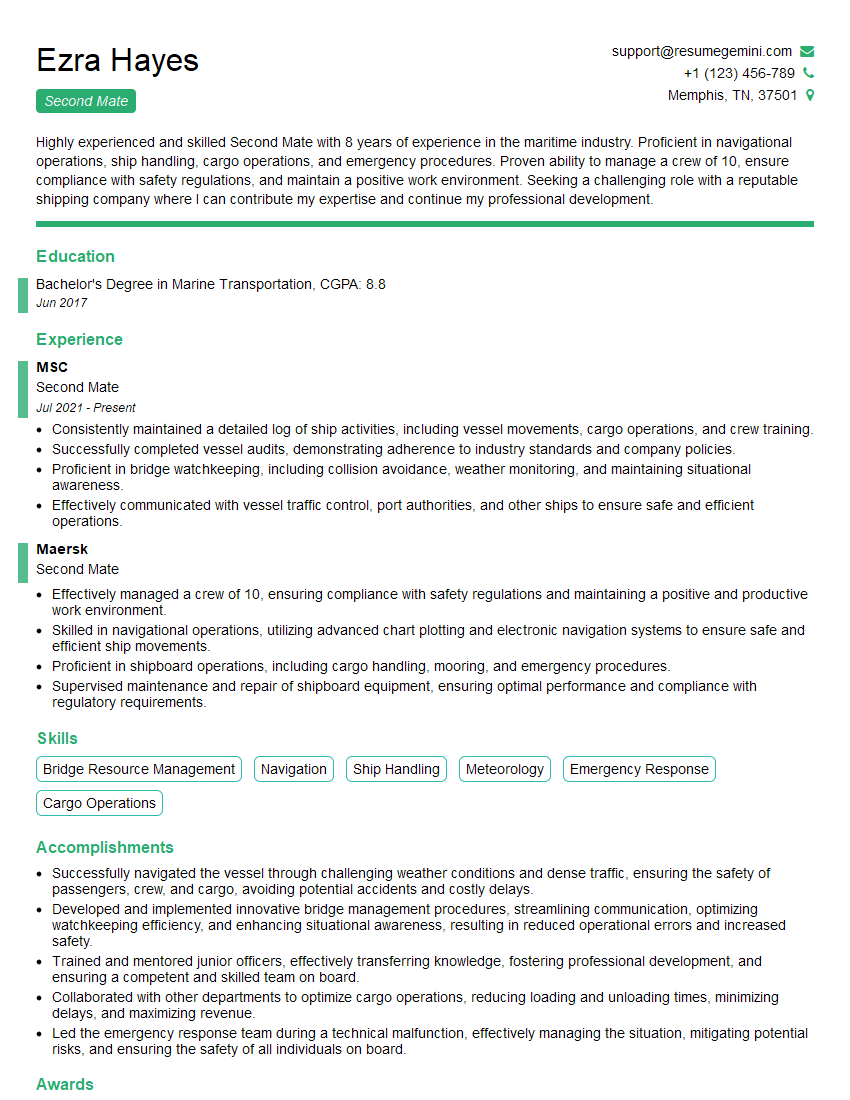
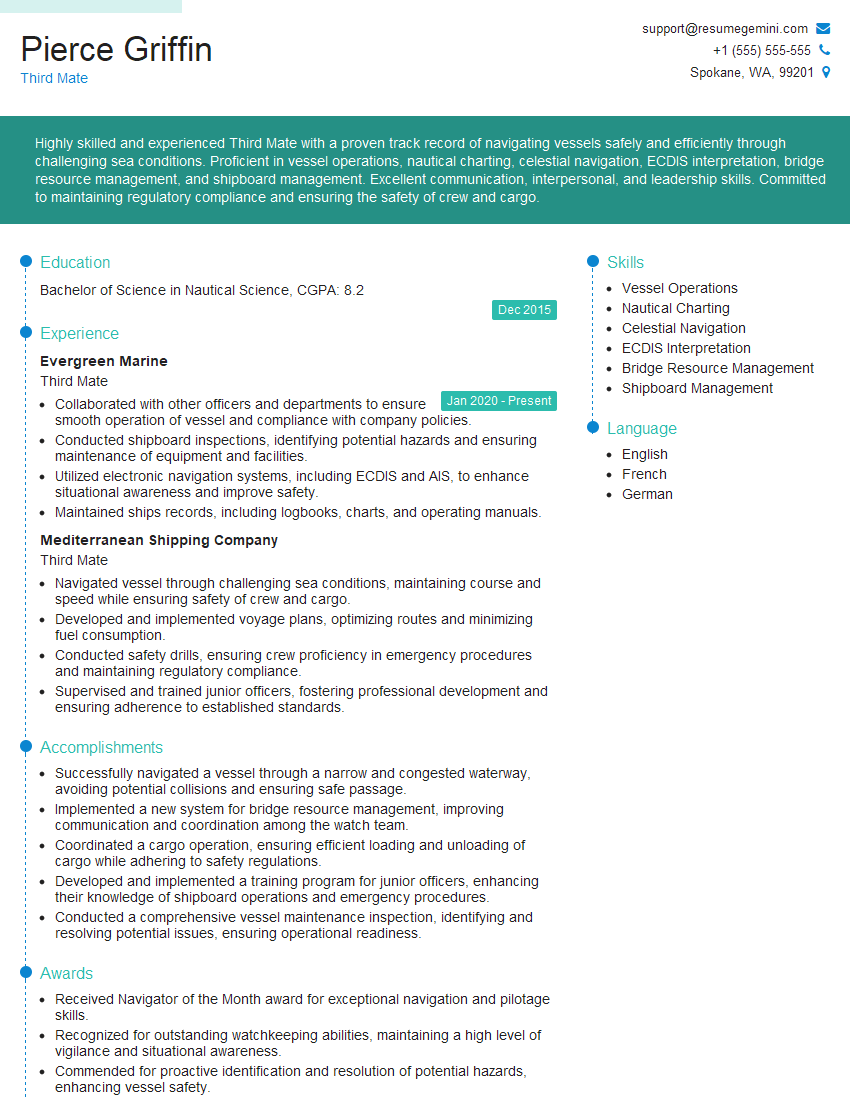
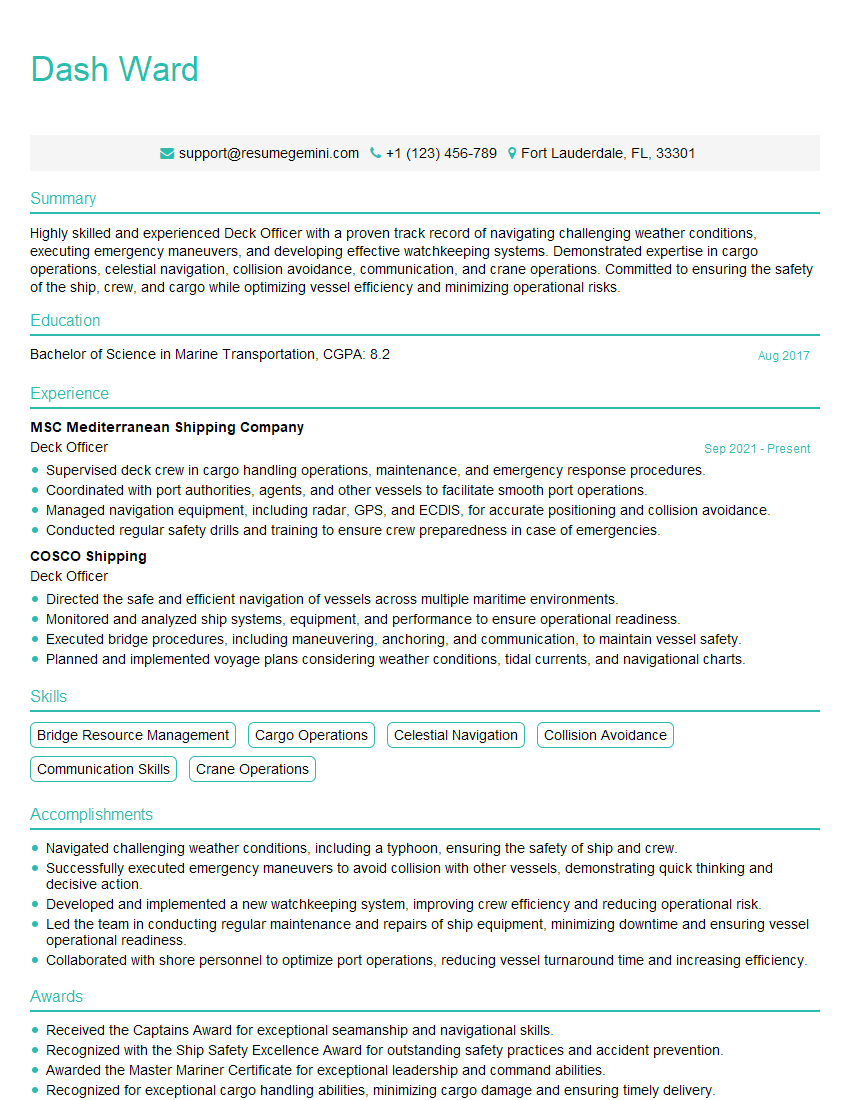
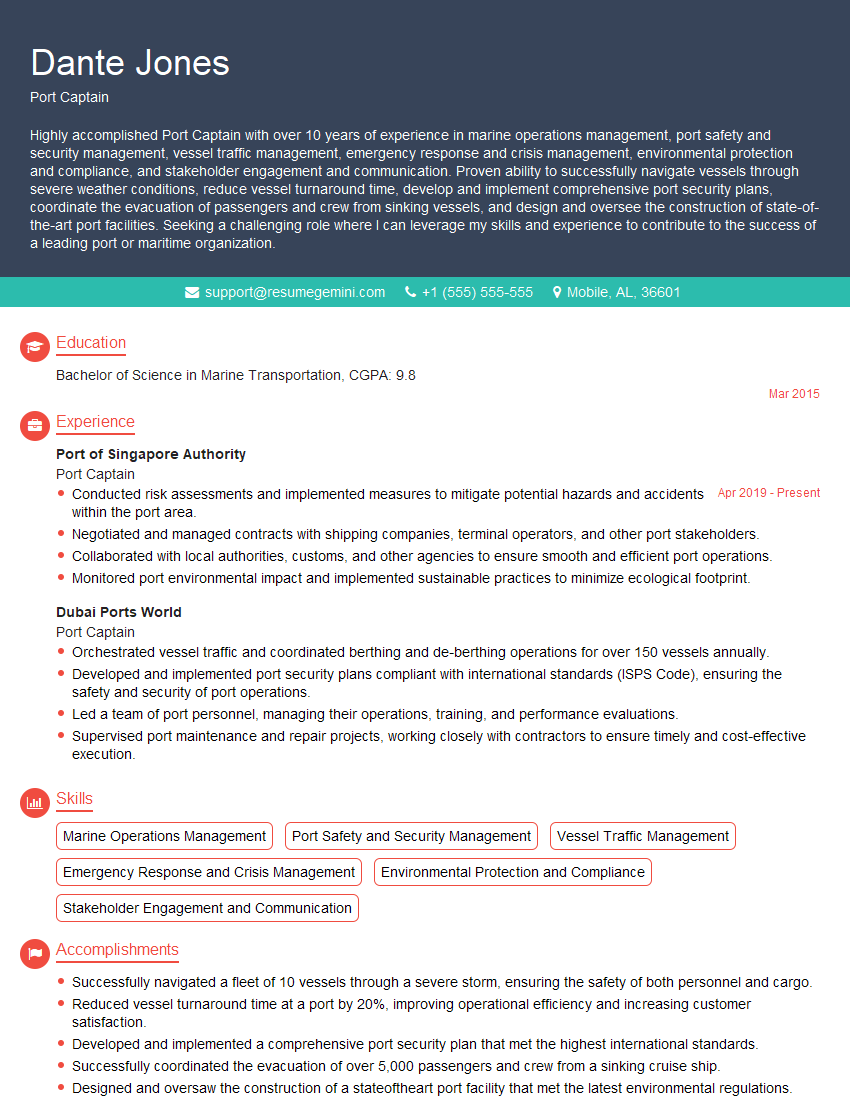
Mastering Marine Navigation and Charting opens doors to exciting and rewarding careers in the maritime industry, offering opportunities for professional growth and advancement. A strong resume is crucial for showcasing your skills and experience to potential employers. Creating an ATS-friendly resume significantly increases your chances of getting noticed by recruiters. ResumeGemini is a trusted resource to help you build a professional and effective resume. They provide examples of resumes tailored to Marine Navigation and Charting, ensuring your application stands out. Take the next step towards your dream career today!
Explore more articles
Users Rating of Our Blogs
Share Your Experience
We value your feedback! Please rate our content and share your thoughts (optional).
What Readers Say About Our Blog
Really detailed insights and content, thank you for writing this detailed article.
IT gave me an insight and words to use and be able to think of examples