Are you ready to stand out in your next interview? Understanding and preparing for Microarray Analysis interview questions is a game-changer. In this blog, we’ve compiled key questions and expert advice to help you showcase your skills with confidence and precision. Let’s get started on your journey to acing the interview.
Questions Asked in Microarray Analysis Interview
Q 1. Explain the principle behind microarray technology.
Microarray technology is a powerful tool for measuring the expression levels of thousands of genes simultaneously. Imagine it like a grid, where each spot represents a specific gene. We label RNA extracted from a sample (e.g., cells from a tumor) with a fluorescent dye. This labeled RNA then binds (hybridizes) to its complementary DNA sequence on the microarray. The intensity of the fluorescence at each spot reflects the abundance of the corresponding mRNA, indicating the level of gene expression. Higher fluorescence means higher expression.
Essentially, it allows us to create a snapshot of the gene activity within a sample, giving insights into biological processes like disease mechanisms or drug responses. This high-throughput approach vastly improves our understanding of complex biological systems compared to analyzing single genes in isolation.
Q 2. Describe different types of microarray platforms (e.g., cDNA, oligonucleotide).
There are several types of microarray platforms, each with its own strengths and weaknesses:
- cDNA microarrays: These are made by spotting cDNA clones onto a solid surface. They are relatively inexpensive to produce but can suffer from cross-hybridization (where a probe binds to unintended targets) and inconsistencies in spot size and quality. Think of it as a more ‘handmade’ approach.
- Oligonucleotide microarrays: These use short, synthetic DNA sequences (oligonucleotides) representing specific genes. They are more precisely manufactured, leading to better sensitivity, specificity, and reproducibility compared to cDNA microarrays. They provide more accurate and reliable measurements.
- In situ synthesized microarrays: These microarrays use photolithography to synthesize oligonucleotides directly on the surface, further enhancing the precision and control over probe placement and density. This is a more automated and controlled process, leading to high quality.
The choice of platform depends on factors such as budget, desired sensitivity, and the specific research question.
Q 3. What are the advantages and disadvantages of microarrays compared to other gene expression profiling methods (e.g., RNA-Seq)?
Microarrays and RNA-Seq are both powerful gene expression profiling methods, but they have distinct advantages and disadvantages:
- Microarrays:
- Advantages: Mature technology, relatively inexpensive, readily available, established analysis pipelines.
- Disadvantages: Limited dynamic range, prone to cross-hybridization, can’t detect novel transcripts or splice variants.
- RNA-Seq:
- Advantages: Higher dynamic range, detects novel transcripts and splice variants, allows for more comprehensive gene expression analysis.
- Disadvantages: More expensive, requires greater bioinformatics expertise, data analysis can be more complex.
In essence, microarrays are like taking a well-established photograph – providing a good overview, but potentially missing some finer details. RNA-Seq is more akin to filming a high-definition video, offering greater depth and resolution, but requiring more sophisticated equipment and analysis. The best choice depends on the specific research goals and available resources.
Q 4. Explain the process of microarray sample preparation and hybridization.
Microarray sample preparation and hybridization involve several key steps:
- RNA Extraction and Purification: High-quality RNA is crucial. This involves extracting total RNA from the sample using various methods, followed by purification to remove contaminating DNA and other molecules.
- cDNA Synthesis and Labeling: The RNA is reverse transcribed into cDNA, which is then labeled with fluorescent dyes (typically Cy3 and Cy5 for two-color microarrays). This allows us to distinguish between the expression levels in two different samples (e.g., treated vs. untreated).
- Hybridization: The labeled cDNA is then hybridized to the microarray. This involves incubating the cDNA with the microarray under controlled conditions, allowing the cDNA probes to bind to their complementary sequences on the array.
- Washing and Scanning: After hybridization, unbound cDNA is washed away. The microarray is then scanned using a laser scanner, measuring the fluorescence intensity at each spot. This data reflects the amount of cDNA bound to each probe and thus the level of gene expression.
Think of it like a detective carefully collecting evidence (RNA), marking it with unique identifiers (fluorescent dyes), then matching it to a database (microarray) to reveal the identity of the suspects (genes).
Q 5. How do you perform quality control (QC) checks on microarray data?
Quality control (QC) is essential for reliable microarray data. Key QC checks include:
- RNA quality assessment: Checking RNA integrity using methods like the RNA integrity number (RIN) or agarose gel electrophoresis ensures high-quality starting material.
- Labeling efficiency: Assessing the efficiency of the cDNA labeling process ensures sufficient signal for accurate measurements.
- Hybridization quality: Evaluating the overall hybridization process, including background noise and spot uniformity, identifies any issues during the hybridization step.
- Data inspection: Visual inspection of microarray images and quality metrics (e.g., signal-to-noise ratio, spot morphology) flags potential problems.
- Background subtraction and normalization: Using appropriate algorithms to account for non-specific binding and other systematic errors.
QC is performed at each step of the experiment to identify potential problems and prevent them from affecting the final results. It’s like regularly checking your equipment during a complex surgery to ensure a successful outcome.
Q 6. Describe normalization techniques used in microarray data analysis.
Microarray data often suffers from systematic variations between arrays, requiring normalization. Common normalization techniques aim to remove these biases:
- Global normalization: Scales the entire array to a specific value, such as the median or mean intensity. This corrects for overall differences in signal intensity.
- Quantile normalization: Distributes the intensities across all arrays to match the same distribution. It aligns the data across different arrays to account for technical variations.
- Loess normalization (locally weighted scatterplot smoothing): Adjusts the intensities based on local regression. It considers the relationship between the intensities of the two channels (e.g., Cy3 and Cy5) to adjust for non-linear variations.
The choice of normalization method depends on the specific experimental design and the nature of the observed variations. Incorrect normalization can lead to misleading conclusions, therefore selecting the appropriate method is critical.
Q 7. What are background correction methods used in microarray analysis?
Background correction methods adjust for non-specific binding of probes and other sources of noise. This is crucial for accurately estimating true signal intensities:
- Subtraction methods: Simply subtract a background intensity value from each spot intensity. This is a simple but potentially inaccurate approach.
- Non-linear methods: Use more sophisticated models to account for the relationship between the background and foreground intensities. These are generally more robust.
- Robust multiarray average (RMA): A popular method that incorporates background correction, normalization, and summarization into a single algorithm. It combines background adjustment with quantile normalization, offering a comprehensive approach.
Choosing the appropriate background correction method depends on the microarray platform and the characteristics of the data. Incorrect background correction can lead to significant errors in gene expression estimates. It’s like filtering out noise from a radio signal to clearly hear the intended broadcast.
Q 8. What are common statistical methods used for analyzing microarray data (e.g., t-tests, ANOVA)?
Microarray data analysis heavily relies on statistical methods to identify meaningful changes in gene expression. Two of the most common approaches are t-tests and ANOVA.
t-tests: These are used to compare the means of gene expression levels between two groups (e.g., treated vs. untreated cells). A significant t-test result indicates a statistically significant difference in gene expression between the groups. For example, we might use a t-test to see if a particular gene is upregulated in cancer cells compared to normal cells.
ANOVA (Analysis of Variance): ANOVA extends the t-test to handle comparisons between three or more groups. For instance, we could use ANOVA to analyze gene expression across different drug treatment doses to see which dose elicits the strongest response.
Beyond these, other methods like linear models, particularly in cases with multiple covariates or experimental factors, are also frequently employed. These methods allow for controlling for confounding variables and providing more nuanced insights into gene expression patterns.
Q 9. Explain the concept of false discovery rate (FDR) and its importance in microarray analysis.
The False Discovery Rate (FDR) is crucial in microarray analysis because it helps control the number of false positives we find when identifying differentially expressed genes. Imagine you’re sifting through thousands of genes, and you declare many as ‘differentially expressed’ based on some statistical threshold. Some of these declarations might be wrong simply due to chance variations in the data – these are false positives.
The FDR is a statistical measure that helps us control the proportion of these false positives among all the genes we identify as differentially expressed. A low FDR (e.g., 5%) means that we’re confident that only a small percentage of the genes we’ve declared as differentially expressed are actually false positives. Methods like the Benjamini-Hochberg procedure are commonly used to calculate and control the FDR.
Without controlling for FDR, we could easily be overwhelmed by a large number of false positives, leading to inaccurate biological conclusions. For example, if we’re researching a disease and discover many supposedly significant genes without FDR correction, we might invest time and resources in studying genes that have no actual biological relevance to the disease.
Q 10. How do you identify differentially expressed genes using microarray data?
Identifying differentially expressed genes (DEGs) involves a multi-step process. First, the raw microarray data is pre-processed, which may include background correction, normalization, and transformation to stabilize variance and ensure comparability across samples. Then, statistical tests (like t-tests or ANOVA, as discussed earlier) are performed to compare gene expression levels between experimental groups. Genes exceeding a pre-defined significance threshold (often adjusted for FDR) are deemed differentially expressed.
For example, let’s say we compare gene expression in cancer cells versus normal cells. After preprocessing, we perform t-tests for each gene, looking for genes with significant differences in mean expression. We might then use a cutoff such as a p-value <0.05 after adjusting for FDR. Genes meeting this criterion are then flagged as DEGs – potentially playing a crucial role in cancer development.
Software packages like R with Bioconductor provide tools to perform these analyses efficiently. The choice of statistical method and significance threshold depends on the specific experimental design and the desired level of stringency.
Q 11. Explain hierarchical clustering and its application in microarray data analysis.
Hierarchical clustering is a powerful technique used to group genes or samples based on their similarity in gene expression profiles. Imagine you have a large collection of genes; hierarchical clustering helps organize these into groups (clusters) of genes with similar expression patterns. This helps uncover functional relationships and potential co-regulation of genes.
There are two main types: agglomerative (bottom-up) and divisive (top-down). Agglomerative starts with each gene as a separate cluster and iteratively merges the most similar clusters until all genes are in one large cluster. The process is visualized as a dendrogram (tree-like diagram), showing the relationships between the clusters.
In microarray analysis, hierarchical clustering can help identify groups of co-regulated genes, giving us insights into biological pathways or processes. For example, we might find a cluster of genes all involved in immune response that are upregulated in response to an infection. This allows us to prioritize further analysis on biologically meaningful groups rather than thousands of genes individually.
Q 12. What is a heatmap, and how is it used to visualize microarray data?
A heatmap is a graphical representation of data where the values are represented by colors. In microarray analysis, a heatmap typically shows the expression levels of genes (rows) across different samples (columns). Each cell’s color intensity corresponds to the gene expression level in that particular sample. Red might indicate high expression, green low expression, and black or white might represent intermediate or baseline expression.
Heatmaps are useful for visually identifying patterns in gene expression. For instance, if several genes consistently show high expression in one group of samples (e.g., diseased tissue), it suggests these genes might be involved in the disease process. Clustering is often combined with heatmaps; genes within clusters can be grouped in the same way as above and displayed side-by-side in the heatmap to allow for quick pattern recognition.
In essence, heatmaps provide a quick, intuitive way to visualize large datasets and identify patterns and relationships not readily apparent in spreadsheets of numerical data.
Q 13. Describe different methods for gene ontology (GO) enrichment analysis.
Gene Ontology (GO) enrichment analysis helps identify the biological processes, molecular functions, and cellular components that are significantly enriched among a set of differentially expressed genes. It essentially helps us understand the biological meaning of the changes we see in gene expression.
Several methods are used. The most common approaches rely on statistical tests such as the hypergeometric test or Fisher’s exact test to compare the observed number of genes associated with a specific GO term in our DEGs list with the expected number based on the entire genome. Tools like GOseq also take into account the length of genes when calculating enrichment, avoiding bias against long genes.
For instance, if we find that many of our differentially expressed genes are associated with the GO term ‘immune response’, this suggests that our experimental treatment or condition has a significant impact on the immune system. The significance level, commonly the adjusted p-value after correcting for multiple testing, is crucial for interpreting the results and identifying enriched GO terms.
Q 14. How do you interpret and report microarray data?
Interpreting and reporting microarray data requires careful consideration of multiple aspects. The report should include a detailed description of the experimental design, data preprocessing steps, statistical methods used, and the results obtained. Visualizations like heatmaps, clustering dendrograms, and volcano plots are essential for clear communication of findings.
The interpretation should focus on the biological implications of differentially expressed genes, supported by GO enrichment analysis and potentially literature reviews. The limitations of the study, including potential biases and confounding factors, should also be discussed. For example, if a particular gene consistently appears as differentially expressed across multiple studies, its potential biological role in the phenomenon studied is higher. Reporting also includes the specific statistical tests used, parameters, and thresholds selected – e.g., p-value and FDR cutoffs. Concise and well-organized tables summarizing differentially expressed genes, their expression changes, and associated GO terms make the results easily accessible and understandable.
Finally, the findings should be interpreted within the context of existing knowledge and future research directions proposed to confirm and expand upon the observations.
Q 15. What are the potential sources of error or bias in microarray experiments?
Microarray experiments, while powerful, are susceptible to various sources of error and bias that can significantly impact the results. These can be broadly categorized into experimental design flaws, technical artifacts, and biological variability.
- Experimental Design Flaws: Insufficient sample size, inadequate randomization, and poorly defined experimental groups can lead to unreliable conclusions. For example, if you only have three samples per group, the inherent biological variation between individuals may overshadow any true treatment effect.
- Technical Artifacts: These are errors introduced during the experiment itself.
- Labeling Bias (Two-color arrays): In two-color experiments, unequal dye incorporation can artificially inflate or deflate the measured ratio, falsely suggesting differential expression. Careful dye-swap experiments are crucial to mitigate this.
- Background Noise: Non-specific binding of probes to the microarray can lead to elevated signal intensities, affecting the accuracy of measurements. Stringent washing protocols are vital.
- Cross-hybridization: Probes might bind to sequences other than their target, leading to false-positive results. Careful probe design, including sequence specificity checks, is essential.
- Array Manufacturing Variations: Differences in the manufacturing process across different arrays (even from the same batch) can create systematic variations in signal intensities.
- Biological Variability: Differences in the biological material itself, such as variations in age, sex, or genetic background of the samples, can confound the results. Proper normalization and statistical methods are necessary to account for these variations.
Addressing these biases necessitates careful experimental design, rigorous quality control measures, and appropriate statistical analysis, ensuring robust and reliable results.
Career Expert Tips:
- Ace those interviews! Prepare effectively by reviewing the Top 50 Most Common Interview Questions on ResumeGemini.
- Navigate your job search with confidence! Explore a wide range of Career Tips on ResumeGemini. Learn about common challenges and recommendations to overcome them.
- Craft the perfect resume! Master the Art of Resume Writing with ResumeGemini’s guide. Showcase your unique qualifications and achievements effectively.
- Don’t miss out on holiday savings! Build your dream resume with ResumeGemini’s ATS optimized templates.
Q 16. How do you address batch effects in microarray data?
Batch effects are systematic variations in gene expression data arising from differences in the processing of samples across different batches or experimental runs. These can mask true biological differences and lead to false conclusions. Imagine comparing gene expression in two groups of patients, but one group’s samples were processed on a different day with different reagents – this could easily create a batch effect overshadowing any real disease-related differences.
Several methods effectively address batch effects:
- ComBat: This popular method in the R package
svauses an empirical Bayes approach to adjust for batch effects while preserving biological variation. It models the batch effects as hidden variables and then removes them from the data. - Surrogate Variable Analysis (SVA): SVA identifies surrogate variables that capture the unwanted variation caused by batch effects. These variables are then included as covariates in subsequent analyses.
- Removing Batch Specific Effects from the Design Matrix: If the batch effect is known, it can be directly incorporated into the statistical model as a factor variable. This method assumes a simple additive effect of the batch on gene expression.
Choosing the right method depends on the nature and extent of the batch effect and the specific research question. It is always recommended to assess the presence of batch effects prior to any downstream analysis using methods like PCA (Principal Component Analysis). Visual inspection of PCA plots can reveal batch effects as distinct clusters of samples.
Q 17. What software packages are you familiar with for microarray data analysis (e.g., R, Bioconductor)?
My experience in microarray data analysis heavily relies on the R programming language and the Bioconductor project. Bioconductor provides a comprehensive suite of packages specifically designed for the analysis of high-throughput genomic data, including microarrays.
I’m proficient in using various Bioconductor packages such as:
affy: For the analysis of Affymetrix microarray data, including background correction, normalization, and summarization.limma: A powerful package for differential expression analysis, particularly effective in handling complex experimental designs and multiple testing corrections.edgeRandDESeq2: Packages designed for analyzing count data from RNA-Seq experiments but also applicable to normalized microarray data. They offer sophisticated statistical models for differential expression analysis.ggplot2: For creating publication-quality visualizations of microarray data, such as heatmaps, volcano plots, and MA plots.
Q 18. Describe your experience with specific microarray analysis tools (e.g., limma, affy)?
I have extensive experience with both affy and limma. affy is my go-to for processing Affymetrix data. I regularly utilize its functionalities for background correction methods (like RMA, MAS5), normalization (quantile normalization), and probe-level summarization to generate reliable expression values.
limma is indispensable for differential expression analysis. I frequently use its linear modeling capabilities to identify genes differentially expressed between experimental groups, accounting for multiple testing corrections (like Benjamini-Hochberg) to control the false discovery rate. I’ve used limma in numerous projects involving various experimental designs, including paired and unpaired comparisons, and complex factorial designs.
For example, in a study investigating the effect of a drug on gene expression, I used affy to preprocess the raw data and limma to perform differential expression analysis, identifying hundreds of genes significantly altered by the treatment. The results were validated using quantitative PCR.
Q 19. Explain your experience with data visualization tools for microarray data (e.g., ggplot2)?
ggplot2 in R is my preferred package for visualizing microarray data. Its grammar of graphics allows for creating highly customizable and informative plots. I routinely create:
- Heatmaps: To visualize the expression patterns of genes across different samples or experimental conditions.
- Volcano plots: To identify differentially expressed genes based on their fold change and statistical significance.
- MA plots: To assess the quality of normalization and detect systematic biases.
- Box plots: To compare the distribution of gene expression levels between different groups.
The flexibility of ggplot2 is invaluable for communicating complex data effectively. For example, I once used ggplot2 to generate a heatmap showing the co-expression patterns of a set of genes involved in a specific pathway, clearly demonstrating their coordinated regulation.
Q 20. Have you worked with different experimental designs in microarray studies (e.g., two-color, one-color)?
Yes, I have substantial experience with both two-color and one-color microarray platforms. Two-color microarrays, like those from Agilent, allow for direct comparison of two samples (e.g., treated vs. control) on a single array. This design is cost-effective but requires careful attention to dye bias.
One-color microarrays, such as Affymetrix arrays, require separate arrays for each sample. While more expensive, one-color designs eliminate dye bias and often offer better sensitivity and dynamic range. The choice between two-color and one-color depends on factors like budget, sample availability, and the specific research question. My analytical approach adapts to the specific platform and experimental design, utilizing appropriate normalization and statistical methods.
Q 21. Explain the concept of probe design in microarrays.
Probe design is the crucial first step in microarray technology. Probes are short, single-stranded DNA sequences (oligonucleotides) designed to hybridize specifically to complementary sequences on the target cDNA or cRNA. The quality of the probe design directly impacts the accuracy and reliability of the microarray experiment.
Key considerations in probe design include:
- Sequence Specificity: Probes must be designed to bind uniquely to their target sequence, minimizing cross-hybridization with other sequences in the genome. This often involves using bioinformatic tools to assess sequence similarity and identify potential cross-hybridizing sequences.
- Probe Length and Tm (Melting Temperature): The length of the probe and its Tm determine the stringency of hybridization. Optimal length and Tm ensure specific binding and minimize non-specific interactions.
- GC Content: The GC content of the probe should be balanced to prevent biased hybridization.
- Position on the Gene: Probes are often designed to target regions of the gene with high sequence uniqueness and minimal secondary structure.
- Number of Probes per Gene: Multiple probes per gene are usually employed to improve the accuracy and reliability of measurements.
Poor probe design can lead to false-positive or false-negative results. Therefore, careful consideration of these factors is essential to ensure the success of the microarray experiment.
Q 22. How do you handle missing values in microarray datasets?
Missing values in microarray datasets are a common challenge, often arising from various factors like poor spot quality, insufficient hybridization, or background noise. Ignoring them can lead to biased results and inaccurate conclusions. Effective handling necessitates a thoughtful strategy.
My approach involves a multi-step process: First, I carefully investigate the reasons for missingness. Is it random (Missing Completely at Random or MCAR), or does it depend on other variables (Missing at Random or MAR)? Understanding this helps determine the appropriate imputation method. For MCAR, simple methods like k-Nearest Neighbors (k-NN) imputation or replacing with the mean/median of the gene across all samples can be sufficient. However, for MAR, more sophisticated methods are needed. These often include model-based imputation techniques like singular value decomposition (SVD) imputation or probabilistic methods like multiple imputation. The choice depends on the characteristics of the dataset and the potential impact on downstream analysis.
For example, if missingness is correlated with low expression levels, simple mean imputation might severely underestimate the true variance. In such a case, a more robust approach such as k-NN imputation, which considers the gene expression profile of similar samples, would be preferable. Finally, I always assess the impact of the imputation method on the downstream analysis and perform sensitivity analyses to ensure robustness of the findings.
Q 23. Describe your experience with data management and organization of large microarray datasets.
Managing large microarray datasets requires a robust and organized workflow. My experience involves utilizing relational databases (like MySQL or PostgreSQL) for structured data storage, with each gene represented as a row and each sample as a column. This allows efficient querying and data manipulation. I extensively use R and Bioconductor packages (such as affy, limma, and edgeR) for data preprocessing, normalization, and statistical analysis. For visualization and exploration, I frequently employ tools like R’s ggplot2 library or specialized bioinformatics visualization platforms.
To ensure data integrity, I implement version control using Git to track changes, and meticulous documentation of each step, including preprocessing methods, normalization strategies and parameters is crucial. I have experience working with datasets exceeding 100,000 probes and hundreds of samples, necessitating high-performance computing techniques for tasks like normalization and differential expression analysis. Parallel processing in R or leveraging cloud computing resources like Amazon Web Services (AWS) or Google Cloud Platform (GCP) are essential for efficiency.
Q 24. What are your experiences with microarray data validation methods (e.g., qPCR)?
Microarray data validation is critical to ensure the reliability of results. I have extensive experience using qPCR (quantitative polymerase chain reaction) as a gold standard validation method. qPCR allows targeted, quantitative measurement of gene expression, providing independent confirmation of microarray findings.
In my workflow, I carefully select a subset of genes identified as differentially expressed by the microarray analysis, including both up- and down-regulated genes, and then design and perform qPCR experiments for those specific targets. The qPCR data are then compared to the microarray data. Strong concordance between both data types increases confidence in the microarray results; significant discrepancies require further investigation, possibly exploring systematic errors in either technique. I carefully document both the microarray and qPCR methodologies to ensure reproducibility and transparency.
Q 25. Explain your understanding of the limitations of microarray technology.
While microarray technology has been transformative, it’s crucial to acknowledge its limitations. A major constraint is the relative lack of sensitivity compared to RNA sequencing (RNA-Seq). Microarrays are limited by the probes present on the chip; if a transcript isn’t represented by a probe, its expression level can’t be measured. This can lead to missing data and potentially biased conclusions.
Furthermore, microarrays can struggle to detect low-abundance transcripts, and background noise can affect accuracy. Cross-hybridization, where probes bind non-specifically to similar sequences, is also a concern. Finally, the dynamic range of microarray measurements is less extensive than RNA-Seq, limiting the detection of very large expression changes. These limitations must be carefully considered during experimental design, data analysis and interpretation.
Q 26. Describe a challenging microarray analysis project you have worked on and how you overcame the challenges.
One challenging project involved analyzing microarray data from a time-course experiment examining the response of cancer cells to a novel drug. The dataset was large (500 samples across 8 time points) and exhibited significant batch effects between different experimental runs. This complicated the detection of true treatment effects.
To overcome these challenges, I first employed robust batch correction techniques, such as ComBat, to mitigate the systematic biases introduced by batch variations. I then applied rigorous statistical modeling using the limma package in R, accounting for the time-course nature of the data with appropriate linear mixed-effects models. I performed extensive quality control checks at each step to validate the integrity of the data and the methods. Finally, I conducted thorough pathway analysis using tools like DAVID and GOseq to interpret the biological significance of the identified differentially expressed genes, providing a comprehensive understanding of the drug’s mechanism of action despite the initial complexities.
Q 27. How do you stay updated with the latest advancements in microarray technology and analysis?
Staying updated is crucial in this rapidly evolving field. I regularly read journals such as Nucleic Acids Research, Genome Biology, and Bioinformatics. I also actively participate in online communities and forums, attend conferences like the ISMB (Intelligent Systems for Molecular Biology) conference, and follow leading researchers and institutions in the field on social media platforms like Twitter and ResearchGate. Furthermore, I regularly consult databases such as Gene Expression Omnibus (GEO) to examine current research trends and methodologies.
Q 28. What are your salary expectations?
My salary expectations are commensurate with my experience and expertise in microarray analysis, and are within the competitive range for a senior bioinformatician with my qualifications. I am open to discussing a specific salary range based on the details of the position and benefits offered.
Key Topics to Learn for Microarray Analysis Interview
- Experimental Design & Data Acquisition: Understanding different microarray platforms (cDNA, oligo), experimental design considerations (e.g., sample size, replicates), and data acquisition processes.
- Data Preprocessing & Normalization: Mastering techniques like background correction, normalization (e.g., RMA, quantile), and quality control checks to ensure reliable downstream analysis.
- Statistical Analysis & Differential Expression: Proficiency in identifying differentially expressed genes using statistical methods (e.g., t-tests, ANOVA, linear models) and understanding the concepts of p-values, false discovery rates (FDR), and multiple testing correction.
- Clustering & Classification: Familiarity with various clustering algorithms (e.g., hierarchical, k-means) and classification methods (e.g., support vector machines, decision trees) for grouping genes or samples based on expression patterns.
- Pathway Analysis & Functional Enrichment: Understanding how to interpret results in the context of biological pathways using tools like GO analysis and KEGG pathway enrichment to gain insights into biological processes affected by changes in gene expression.
- Data Visualization & Interpretation: Ability to create and interpret various visualizations (e.g., heatmaps, volcano plots, scatter plots) to effectively communicate findings and draw meaningful conclusions.
- Practical Applications: Understanding the applications of microarray analysis in various fields like cancer research, drug discovery, toxicology, and agricultural science. Being able to discuss specific use cases and their implications.
- Troubleshooting & Problem Solving: Ability to identify and troubleshoot common issues encountered during microarray analysis, such as batch effects, outliers, and limitations of the technology.
Next Steps
Mastering microarray analysis opens doors to exciting and impactful careers in biotechnology, pharmaceuticals, and academia. To maximize your job prospects, it’s crucial to present your skills effectively. Building an ATS-friendly resume is key to getting your application noticed. ResumeGemini is a trusted resource that can help you craft a compelling resume highlighting your microarray analysis expertise. Examples of resumes tailored to microarray analysis positions are available to guide you. Invest in your professional presentation – it’s an investment in your future.

Laboratory Manager Resume Sample

Regulatory Affairs Specialist Resume Sample

Biostatistician Resume Sample

Clinical Research Associate Resume Sample

Quality Control Specialist Resume Sample
Pharmaceutical Scientist Resume Sample

Molecular Biologist Resume Sample

Bioinformatics Scientist Resume Sample

Computational Biologist Resume Sample
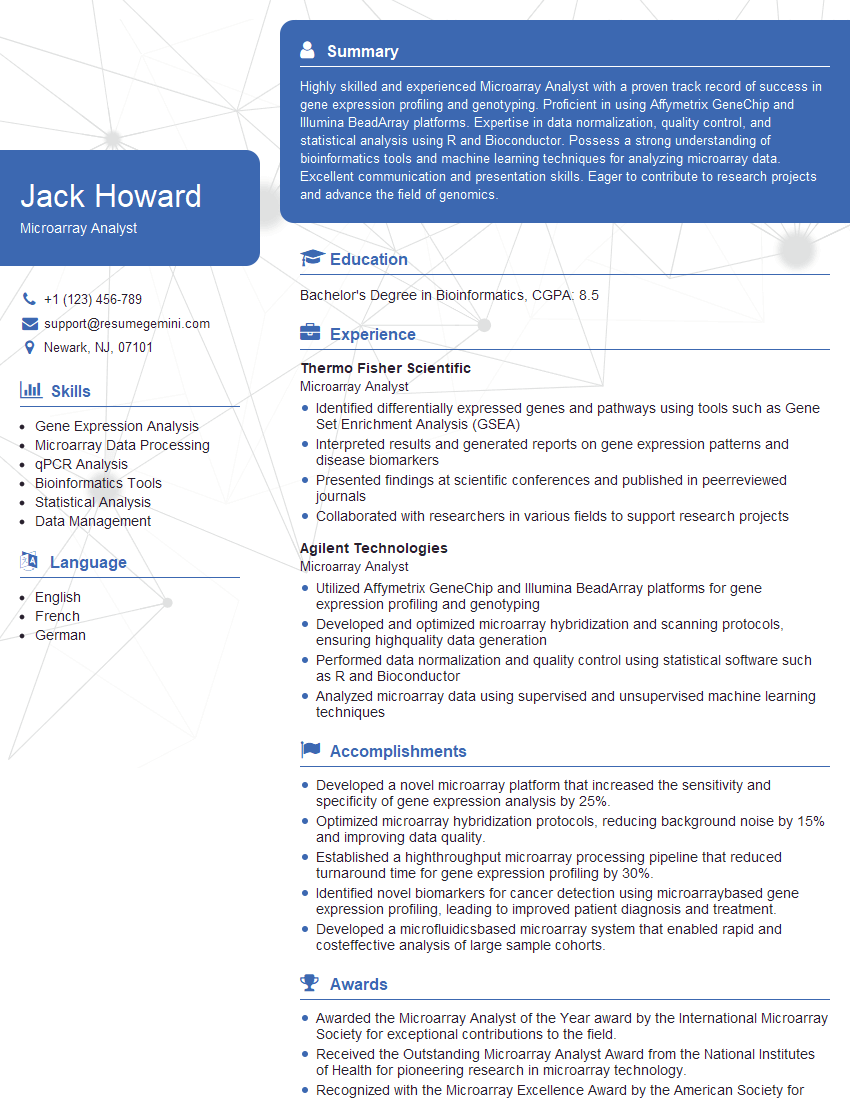
Microarray Analyst Resume Sample

Geneticist Resume Sample

Principal Scientist Resume Sample

Scientific Writer Resume Sample
Explore more articles
Users Rating of Our Blogs
Share Your Experience
We value your feedback! Please rate our content and share your thoughts (optional).
What Readers Say About Our Blog
Really detailed insights and content, thank you for writing this detailed article.
IT gave me an insight and words to use and be able to think of examples