Are you ready to stand out in your next interview? Understanding and preparing for Network Monitoring and Performance Analysis interview questions is a game-changer. In this blog, we’ve compiled key questions and expert advice to help you showcase your skills with confidence and precision. Let’s get started on your journey to acing the interview.
Questions Asked in Network Monitoring and Performance Analysis Interview
Q 1. Explain the difference between active and passive network monitoring.
Active and passive network monitoring are two fundamental approaches to observing network behavior. Think of it like this: active monitoring is like a detective actively questioning suspects (network devices), while passive monitoring is like a silent observer watching the crime scene (network traffic) unfold.
Active Monitoring: This method involves sending probes or requests to network devices to check their status and performance. Tools send pings, run traceroutes, or poll devices for specific metrics (CPU utilization, memory usage, etc.). It’s proactive, allowing you to identify problems before they significantly impact users. For example, a tool might ping a server every minute; if the ping fails, it alerts the administrator.
Passive Monitoring: This approach involves analyzing network traffic as it flows past a monitoring point – a network tap or SPAN port. You don’t initiate any requests; instead, you observe the existing network communication. This is ideal for capturing a comprehensive picture of overall network activity, including traffic volume, protocol distribution, and potential security threats. NetFlow, for example, is a passive monitoring technology.
Key Differences Summarized:
- Initiation: Active monitoring initiates communication; passive monitoring observes existing communication.
- Impact: Active monitoring has a small impact on network performance; passive monitoring generally has minimal impact.
- Scope: Active monitoring focuses on specific devices; passive monitoring captures overall network traffic.
Q 2. Describe your experience with various network monitoring tools (e.g., Nagios, Zabbix, PRTG).
I’ve had extensive experience with several network monitoring tools, each with its strengths and weaknesses. My experience includes:
- Nagios: I used Nagios extensively in a previous role to monitor a large enterprise network. It excels at providing comprehensive alerting and reporting on a wide range of devices and services. I configured it to monitor servers, network devices, applications, and even website availability. Its plugin architecture allowed for customization to meet specific monitoring needs. However, it can become complex to manage in very large environments.
- Zabbix: Zabbix is another robust monitoring system known for its flexibility and scalability. I used Zabbix to monitor a geographically dispersed network, leveraging its distributed monitoring capabilities. Its auto-discovery features significantly reduced the initial configuration overhead. The extensive range of metrics it can collect provided deep insight into system performance.
- PRTG: PRTG offered a more user-friendly interface, ideal for smaller networks or environments where ease of use is prioritized over extreme customization. I employed PRTG for monitoring a smaller branch office network, appreciating its intuitive dashboard and quick setup. While powerful, its scalability might be limited compared to Nagios or Zabbix for very large networks.
My experience spans both configuring and troubleshooting these tools, handling alerts, analyzing reports, and optimizing their configurations for efficiency and accuracy.
Q 3. How do you troubleshoot network latency issues?
Troubleshooting network latency involves a systematic approach. Imagine you’re investigating a delay in a package delivery; you need to trace the package’s journey to pinpoint the bottleneck.
- Identify the affected users/applications: Determine who or what is experiencing latency. Is it widespread or isolated?
- Gather initial data: Use ping, traceroute (tracert on Windows), and MTR (a more advanced traceroute) to pinpoint where latency is occurring. These tools show response times and potential points of failure.
- Analyze network performance metrics: Use monitoring tools to check CPU utilization, memory usage, and bandwidth consumption on critical devices like routers and switches. Look for high CPU usage or saturated links that could cause delays.
- Check for packet loss: If packets are being lost, it indicates a potential connectivity issue. Analyze the output of tools like ping to identify packet loss.
- Investigate potential bottlenecks: Common culprits include:
- Congestion: High network traffic exceeding available bandwidth.
- Hardware failure: Faulty network interfaces, cables, or devices.
- Routing issues: Incorrect routing tables or routing loops.
- Application-level problems: Inefficient applications consuming excessive resources.
- DNS resolution issues: Slow DNS lookups.
- Implement solutions: Based on the root cause identified, implement solutions such as increasing bandwidth, replacing faulty hardware, optimizing routing, improving application performance, or resolving DNS issues.
- Monitor and verify: After implementing a fix, monitor the network to ensure the latency issue is resolved and does not recur.
Q 4. What are common network performance bottlenecks and how do you identify them?
Network performance bottlenecks are like traffic jams on a highway; they restrict the flow of data. Identifying these bottlenecks requires a multi-faceted approach.
Common Bottlenecks:
- Insufficient bandwidth: The most common bottleneck. If the network’s capacity is exceeded, performance suffers.
- Overloaded devices: Routers, switches, and servers can become overwhelmed by excessive traffic, leading to delays.
- Slow hard drives or storage: Slow storage systems can significantly impact application performance, especially for applications relying heavily on disk I/O.
- Network congestion: Excessive traffic on specific links or segments causes delays.
- Inefficient network design: Poorly designed networks lack proper segmentation or utilization of bandwidth.
- Application performance issues: Inefficiently written applications can consume excessive resources.
- Security appliances: Firewalls and intrusion detection/prevention systems can cause delays if not properly sized or configured.
Identifying Bottlenecks:
I use a combination of tools and techniques to identify bottlenecks, including:
- Network monitoring tools (Nagios, Zabbix, PRTG): To monitor bandwidth utilization, CPU usage, and other key metrics.
- Packet sniffers (Wireshark): To analyze network traffic at a granular level to identify slow applications or protocols.
- Performance monitoring tools: For measuring application response times.
- Network flow analysis (NetFlow): To understand traffic patterns and identify high bandwidth consumers.
By analyzing data from these sources, I can pinpoint the specific location and cause of the bottleneck, allowing me to implement appropriate solutions.
Q 5. Explain the concept of NetFlow and its applications in network monitoring.
NetFlow is a powerful network traffic accounting and analysis technology developed by Cisco Systems. Imagine it as a sophisticated traffic counter that keeps detailed logs of network conversations. It doesn’t monitor individual packets but rather aggregates them into flows, providing a high-level view of traffic patterns.
How it Works: Routers and switches, configured with NetFlow, export data about network traffic flows to a collector. Each flow is characterized by parameters like source and destination IP addresses, port numbers, protocol, and byte count. This data is then used for traffic analysis.
Applications in Network Monitoring:
- Traffic analysis: Identify top talkers, bandwidth hogs, and unusual traffic patterns.
- Capacity planning: Predict future bandwidth needs based on historical traffic data.
- Security monitoring: Detect suspicious activities, such as port scans or intrusions.
- Performance optimization: Identify network bottlenecks and optimize network configurations.
- Application performance monitoring: Analyze the network performance of specific applications.
Example: A NetFlow collector might show that a particular application is consuming a disproportionate amount of bandwidth during peak hours. This information allows network administrators to optimize the application’s performance or allocate more bandwidth to that application.
Q 6. How do you analyze network traffic patterns?
Analyzing network traffic patterns is like studying a city’s traffic flow. You need to understand where the congestion is, the peak hours, and the typical routes.
My approach involves using a combination of tools and techniques:
- Network monitoring tools: These tools provide an overview of network traffic, including bandwidth utilization, top talkers, and error rates.
- Packet capture and analysis (Wireshark): For a detailed view of individual network packets, allowing for investigation of specific protocols and traffic patterns.
- NetFlow/sFlow: Provides aggregated traffic data, allowing for identification of high bandwidth consumers and traffic trends.
- Visualization tools: Tools that graphically display network traffic patterns, allowing for easier identification of anomalies or bottlenecks.
Analysis Techniques:
- Identifying peak hours: Understanding when network traffic is at its highest helps in capacity planning and resource allocation.
- Analyzing traffic distribution: Identifying which protocols and applications are consuming the most bandwidth.
- Identifying top talkers: Pinpointing the devices or applications that are sending or receiving the most data.
- Detecting anomalies: Identifying unexpected or unusual traffic patterns that might indicate a security breach or a performance issue.
By combining these tools and techniques, I can create a comprehensive picture of network traffic patterns, identify potential issues, and proactively optimize network performance.
Q 7. Describe your experience with SNMP and its role in network monitoring.
SNMP, or Simple Network Management Protocol, is a cornerstone of network monitoring. Think of it as a standardized language for network devices to communicate their status and performance metrics. It’s like having a universal translator for all your network devices.
How it Works: A network management system (NMS) sends SNMP requests (queries) to network devices (agents). The devices respond with data about their current state – CPU utilization, memory usage, interface statistics, etc. The NMS collects this data, analyzes it, and displays it in a user-friendly interface. The data transfer is usually encrypted to protect sensitive information.
SNMP’s Role in Network Monitoring:
- Real-time monitoring: Provides immediate insight into the health and performance of network devices.
- Alerting: Can trigger alerts based on predefined thresholds, such as high CPU usage or interface errors.
- Configuration management: Allows administrators to remotely configure network devices.
- Troubleshooting: Provides essential data for troubleshooting network problems.
Example: An SNMP request might query a router for its CPU utilization. If the utilization exceeds a defined threshold (e.g., 90%), the NMS will generate an alert, notifying the administrator of a potential problem.
My experience with SNMP includes configuring SNMP agents on various network devices, setting up SNMP traps, and using SNMP data to develop custom monitoring scripts and dashboards. It’s a fundamental protocol in my network monitoring toolkit.
Q 8. How do you monitor network security events?
Monitoring network security events involves a multi-layered approach, combining various tools and techniques to detect and respond to threats. Think of it like having a security detail for your network. You need multiple guards (tools) looking at different things.
Intrusion Detection/Prevention Systems (IDS/IPS): These systems analyze network traffic for malicious activity, such as port scans, denial-of-service attacks, or malware infections. They’re like the first line of defense, constantly watching for suspicious behavior. An example is Snort, a widely used open-source IDS.
Security Information and Event Management (SIEM): SIEM systems collect and correlate security logs from various sources, including firewalls, routers, and servers. They provide a centralized view of security events, helping identify patterns and potential threats. Imagine SIEM as the central command center, analyzing all the reports from individual guards.
Network Flow Monitoring: This involves analyzing network traffic patterns to identify anomalies. Unusual spikes in traffic or communication with known malicious IP addresses can indicate a security breach. It’s like looking at the overall flow of people in a building to spot any unusual crowds or suspicious movements.
Vulnerability Scanners: These tools automatically scan systems and applications for known vulnerabilities. They help proactively identify weaknesses before they can be exploited. This is like conducting regular security audits to ensure all doors and windows are properly locked.
Log Analysis: Manually reviewing logs from various devices can reveal valuable insights. While time-consuming, it can uncover subtle indicators that automated systems might miss. It’s similar to having a detective carefully examine crime scene evidence.
The combination of these tools allows for a comprehensive approach to network security monitoring, ensuring proactive detection and timely response to threats.
Q 9. What are the key performance indicators (KPIs) you monitor in a network?
Key Performance Indicators (KPIs) for network monitoring depend on the specific goals and infrastructure, but some common ones include:
Bandwidth Utilization: This shows how much of your network’s capacity is being used. High utilization can indicate bottlenecks or the need for increased bandwidth. Imagine this like the number of cars on a highway – if it’s always congested, you need more lanes.
Latency: This measures the delay in data transmission. High latency can impact application performance and user experience. This is like the travel time on the highway – the longer it takes, the slower your journey.
Packet Loss: This measures the percentage of data packets that don’t reach their destination. High packet loss indicates network problems, such as faulty hardware or congestion. This is like packages being lost in the mail – you want to ensure everything arrives safely.
Jitter: This is the variation in latency, affecting real-time applications like voice and video conferencing. It’s like inconsistent traffic on the highway – it makes the journey unpredictable and frustrating.
CPU and Memory Utilization on Network Devices: High utilization on routers and switches can indicate overload and potential performance issues. This is similar to keeping an eye on the engine of your car – if it’s overheating, you have a problem.
Uptime: This measures the percentage of time a network is operational. High uptime is essential for business continuity. Think of this as the reliability of your transportation – the more often it’s available, the better.
Monitoring these KPIs provides a holistic view of network health and performance, enabling proactive identification and resolution of issues.
Q 10. How do you use network monitoring data to improve network performance?
Network monitoring data is crucial for improving network performance. By analyzing trends and identifying bottlenecks, we can implement targeted solutions. It’s like having a doctor use diagnostic tools to pinpoint the exact problem.
Identifying Bottlenecks: High bandwidth utilization on specific links or devices points to bottlenecks. Solutions include upgrading hardware, optimizing network configurations, or implementing QoS (Quality of Service) policies to prioritize critical traffic. Imagine removing roadblocks on a highway to improve traffic flow.
Optimizing Network Configuration: Analyzing routing tables, ACLs (Access Control Lists), and other configurations helps identify areas for improvement. This could involve simplifying routing, reducing unnecessary ACL entries, or implementing better traffic management strategies. This is like tuning a car’s engine for optimal performance.
Capacity Planning: Monitoring historical data helps predict future needs and plan for capacity upgrades. This ensures the network can handle growing demands without performance degradation. Imagine expanding the highway to accommodate more vehicles.
Troubleshooting Performance Issues: Investigating unusual spikes in latency, packet loss, or jitter reveals the root cause of performance problems. This could be anything from faulty hardware to software bugs. It’s like a mechanic using diagnostics to pinpoint the problem in your car.
By proactively addressing these issues based on data analysis, we ensure optimal network performance and a positive user experience.
Q 11. Explain the concept of Mean Time To Repair (MTTR) and its importance.
Mean Time To Repair (MTTR) is the average time it takes to restore a failed component or system to full operation. It’s a crucial metric for measuring the efficiency of incident response and overall system reliability. Imagine it as the time it takes for a mechanic to fix your car after a breakdown.
Importance of MTTR:
Minimizes Downtime: Lower MTTR means less disruption to services, reducing potential financial losses and impacting user productivity negatively.
Improves Efficiency: Tracking MTTR identifies areas for improvement in incident management processes. For instance, better documentation, improved troubleshooting procedures, or more readily available spare parts can reduce this time significantly.
Enhanced Service Level Agreements (SLAs): MTTR is often a key metric in SLAs, measuring the provider’s ability to meet agreed-upon service levels.
By focusing on reducing MTTR, organizations can significantly improve the reliability and availability of their network infrastructure.
Q 12. How do you handle network outages and incidents?
Handling network outages and incidents requires a structured approach. It’s akin to having a well-rehearsed emergency response plan.
Incident Identification and Escalation: Quickly identify the nature and scope of the outage. Escalate the issue to the appropriate teams based on defined escalation paths. This initial response is crucial in containing the issue.
Diagnosis and Troubleshooting: Use monitoring tools and logs to pinpoint the root cause. This may involve analyzing network traffic, checking device status, or testing connectivity. Thorough diagnosis is critical for a swift resolution.
Resolution and Recovery: Implement the necessary repairs or workarounds to restore service. This could range from rebooting a device to replacing a faulty component or even rolling back a software change.
Post-Incident Review: After resolution, conduct a thorough review to understand the cause, identify weaknesses in the system, and implement preventative measures to avoid future occurrences. This is important to learn from mistakes and strengthen the overall system’s resilience.
A robust incident management process, well-defined roles, and adequate documentation are essential for efficient outage handling.
Q 13. Describe your experience with capacity planning for network infrastructure.
Capacity planning involves predicting future network demands and ensuring sufficient infrastructure resources are available to meet those needs. Think of it like urban planning – predicting future population growth and adjusting infrastructure accordingly.
My experience includes:
Forecasting Network Growth: Analyzing historical data on bandwidth usage, number of devices, and application traffic to extrapolate future requirements. This involves using statistical models and taking into account factors like business growth and technological changes.
Resource Dimensioning: Determining the necessary capacity for various network components, including routers, switches, and links. This requires detailed analysis of network traffic patterns and potential bottlenecks.
Technology Selection: Evaluating different hardware and software solutions based on cost, performance, and scalability. The goal is to select the optimal solution for current and future needs.
Implementation and Monitoring: Implementing the chosen capacity upgrades and monitoring the performance of the upgraded infrastructure. Post-implementation monitoring ensures the improvements are effective and the new capacity meets the expected demand.
Effective capacity planning prevents performance bottlenecks, ensures adequate resources are available, and minimizes disruption to services.
Q 14. What are your preferred methods for visualizing network performance data?
Visualizing network performance data is crucial for quick understanding and effective decision-making. Different tools and techniques offer various perspectives.
Dashboards: Centralized dashboards provide a real-time overview of key KPIs, using charts, graphs, and maps. They offer a quick snapshot of the network’s overall health. Imagine a control panel in a spaceship providing real-time status updates.
Network Maps: Visual representations of the network topology, showing the interconnection of devices and links. These provide a clear overview of the network infrastructure, helping identify potential issues easily.
Graphs and Charts: Line graphs showing bandwidth utilization over time, bar charts showing device CPU utilization, and pie charts illustrating traffic distribution are very useful for identifying trends and patterns.
Heatmaps: Heatmaps visually represent network congestion by color-coding links or devices based on utilization levels. This helps quickly spot heavily loaded parts of the network. Imagine a weather map, but for your network’s traffic.
Geographic Maps (for WAN): For visualizing Wide Area Networks (WANs), geographic maps are used to display the location of network devices and show connections across different geographical locations.
The choice of visualization method depends on the specific information to be presented and the audience. The key is clarity and quick comprehension.
Q 15. How do you correlate network performance data with application performance data?
Correlating network and application performance data is crucial for identifying bottlenecks and performance issues. It’s like investigating a car’s poor performance: you wouldn’t just look at the engine (application) without considering the fuel delivery system (network). We need to understand how network latency, bandwidth, and packet loss affect application response times and user experience.
This correlation is achieved by using monitoring tools that integrate network and application performance metrics. For instance, we might monitor network latency using tools like SolarWinds or PRTG, simultaneously tracking application response times using Application Performance Monitoring (APM) tools such as Dynatrace or New Relic. By comparing timestamps and correlating specific network events (e.g., high latency on a particular link) with application slowdowns, we can pinpoint the root cause.
Example: Imagine an e-commerce website experiencing slow loading times. Network monitoring might reveal high latency between the web server and the content delivery network (CDN). The APM tool would confirm that this network latency directly translates to increased page load times, impacting the user experience. This allows us to focus our remediation efforts on improving the network connection between the server and the CDN, rather than investigating application code for potential issues.
Effective correlation often requires custom dashboards and alerts to highlight critical relationships. We use tools that allow us to create visual representations of these correlations, showing the interplay between network metrics and application performance indicators. This holistic view allows for more effective troubleshooting and problem-solving.
Career Expert Tips:
- Ace those interviews! Prepare effectively by reviewing the Top 50 Most Common Interview Questions on ResumeGemini.
- Navigate your job search with confidence! Explore a wide range of Career Tips on ResumeGemini. Learn about common challenges and recommendations to overcome them.
- Craft the perfect resume! Master the Art of Resume Writing with ResumeGemini’s guide. Showcase your unique qualifications and achievements effectively.
- Don’t miss out on holiday savings! Build your dream resume with ResumeGemini’s ATS optimized templates.
Q 16. Explain your experience with network automation tools.
I have extensive experience with network automation tools, primarily focusing on Ansible, Python scripting, and NetConf/Yang. Automation is essential for managing large and complex networks efficiently and consistently.
In a previous role, I used Ansible to automate the configuration of hundreds of routers and switches across multiple data centers. This involved creating playbooks to manage tasks such as deploying IOS images, configuring interfaces, and implementing security policies. This automated process reduced deployment time significantly, minimizing human error and ensuring consistency across the network infrastructure.
Example Ansible task:- name: Configure interface GigabitEthernet1/1
- command: interface GigabitEthernet1/1
- command: description 'Connection to Server Farm'
- command: ip address 192.168.1.1 255.255.255.0
This snippet shows a simple Ansible task that configures an interface on a network device using CLI commands.
Furthermore, I’ve utilized Python to create custom scripts for network monitoring and troubleshooting. These scripts integrated with various network devices’ APIs (e.g., SNMP) to collect performance data, automate report generation, and trigger alerts based on predefined thresholds. My experience with NetConf/Yang allows for a more structured and programmatic approach to network configuration and management, improving scalability and maintainability.
Q 17. Describe your experience with different network protocols (TCP/IP, BGP, OSPF).
My understanding of network protocols is fundamental to my work. TCP/IP, BGP, and OSPF are core protocols I use daily.
TCP/IP: This is the foundation of the internet. I understand its layered architecture (from the physical layer to the application layer), the difference between TCP (reliable, connection-oriented) and UDP (unreliable, connectionless) and how these choices impact application design. For example, I know that applications requiring reliable data transfer, such as file transfers (FTP), use TCP, while applications that prioritize speed over reliability, such as streaming video, often use UDP.
BGP (Border Gateway Protocol): This is the routing protocol of the internet. I’m experienced in configuring BGP for routing between autonomous systems (ASes), understanding concepts such as AS numbers, path selection algorithms, and policy-based routing. Troubleshooting BGP issues, including route flapping and convergence problems, is a key skill I possess. For example, I’ve worked extensively with BGP communities to influence route selection based on organizational policies.
OSPF (Open Shortest Path First): This is a link-state routing protocol commonly used within an autonomous system. I am familiar with its intricacies, including area configurations, routing summarization, and handling of routing loops. I have used OSPF in numerous network designs to optimize intra-domain routing. I’ve also experienced using OSPF’s features to create Virtual Links to connect different areas effectively.
Q 18. How do you handle network security alerts and incidents?
Handling network security alerts and incidents requires a structured approach. My process involves several key steps:
- Detection: Utilizing Security Information and Event Management (SIEM) systems and network intrusion detection/prevention systems (IDS/IPS) to detect suspicious activities and alerts.
- Analysis: Analyzing the alerts for their severity, source, and impact. This includes correlating events across different security tools to gain a comprehensive understanding of the incident.
- Containment: Taking immediate action to contain the incident, such as blocking malicious IP addresses, isolating infected systems, or disabling compromised accounts.
- Eradication: Removing the root cause of the incident. This might involve removing malware, patching vulnerabilities, or resetting compromised credentials.
- Recovery: Restoring systems and data to their normal operational state.
- Post-incident review: Documenting the incident, analyzing its causes, and implementing preventive measures to avoid similar incidents in the future.
I utilize tools like Splunk and QRadar for log analysis and incident response. The key is to have a well-defined incident response plan that outlines roles and responsibilities, communication procedures, and escalation paths. Regular security audits and penetration testing are also crucial for proactively identifying vulnerabilities before they can be exploited.
Q 19. Explain your experience with log analysis for network troubleshooting.
Log analysis is essential for network troubleshooting. It’s like having a detailed record of every event on the network, allowing us to reconstruct what happened and pinpoint the source of a problem.
I typically use log aggregation and analysis tools like Splunk or ELK stack (Elasticsearch, Logstash, Kibana) to collect and analyze logs from various sources, including network devices, servers, and security tools. I am adept at filtering, searching, and correlating log data to identify patterns, anomalies, and potential issues.
Example: When troubleshooting connectivity problems, I would search the logs for error messages related to DNS resolution, routing issues, or firewall rules. I’d look for patterns in timestamps, IP addresses, and error codes to pinpoint the source of the problem. If I see multiple devices reporting DNS failures at the same time, I know to investigate the DNS server itself, rather than individual devices.
Beyond simple searches, I utilize advanced techniques like regular expressions to create complex search queries for more precise results. The ability to effectively use log analysis tools for root cause analysis is paramount in my troubleshooting methodology.
Q 20. What are your strategies for optimizing network bandwidth?
Optimizing network bandwidth involves a multi-faceted approach that focuses on both efficient utilization and eliminating bottlenecks.
- Identify Bottlenecks: The first step is to identify where the bandwidth is being consumed the most and where the bottlenecks lie. This requires careful monitoring of network traffic using tools like Wireshark, SolarWinds, or PRTG. Analyzing traffic patterns will show which applications or users are consuming the most bandwidth.
- Quality of Service (QoS): Implementing QoS policies to prioritize critical traffic, such as VoIP calls or video conferencing, over less critical traffic, such as file downloads. This ensures that critical applications receive adequate bandwidth even during periods of high traffic.
- Network Upgrades: If bandwidth is consistently insufficient, upgrading network infrastructure components, such as routers, switches, and fiber optic cables, might be necessary.
- Traffic Shaping/Policy-Based Routing: To prevent congestion, traffic shaping can be employed to limit the bandwidth used by specific applications or users. Policy-Based Routing can help direct traffic to optimized paths.
- Network Segmentation: Dividing the network into smaller, more manageable segments can improve performance by reducing traffic congestion in each segment.
- Optimize Application Design: Poorly designed applications can consume excessive bandwidth. Working with developers to optimize applications can significantly reduce bandwidth usage.
For instance, in one project, we identified that a particular application was generating excessive broadcast traffic, consuming significant bandwidth. By implementing traffic shaping and working with developers to optimize the application, we significantly reduced bandwidth consumption and improved overall network performance.
Q 21. How do you ensure network availability and redundancy?
Ensuring network availability and redundancy is critical for maintaining business operations. This is achieved through a combination of techniques and technologies:
- Redundant Hardware: Implementing redundant hardware components, such as routers, switches, and servers, to prevent single points of failure. If one device fails, another automatically takes over, ensuring minimal disruption.
- Redundant Links: Utilizing multiple network links between critical devices and locations. This provides alternative paths for traffic if one link fails, preventing network outages.
- Load Balancing: Distributing network traffic across multiple servers or devices to prevent overload on any single component.
- Failover Mechanisms: Implementing mechanisms to automatically switch over to backup systems in case of failure. This could involve using technologies such as HSRP (Hot Standby Router Protocol) or VRRP (Virtual Router Redundancy Protocol) for router redundancy, or clustering for server redundancy.
- Geographic Redundancy: Having geographically diverse data centers or cloud infrastructure to protect against regional outages.
- Regular Maintenance and Monitoring: Proactive maintenance and continuous monitoring of network devices and systems are crucial for identifying and addressing potential problems before they lead to outages.
A good example is a system with a primary and secondary web server. If the primary server fails, the load balancer automatically redirects traffic to the secondary server, guaranteeing continuous service. Careful planning and design are key to building a robust and resilient network.
Q 22. Describe your experience with network segmentation.
Network segmentation is the practice of dividing a network into smaller, isolated segments. Think of it like creating separate rooms within a large house, each with its own purpose and access controls. This significantly enhances security and improves performance by reducing broadcast domains and isolating potential problems.
In my experience, I’ve implemented segmentation using VLANs (Virtual LANs), firewalls, and routing protocols. For example, I segmented a large enterprise network into separate VLANs for different departments (marketing, finance, IT). This ensured that if a security breach occurred in one department, it wouldn’t easily spread to others. Another project involved implementing a DMZ (Demilitarized Zone) using firewalls to isolate public-facing servers from the internal network, minimizing the risk of external attacks. I also leveraged access control lists (ACLs) on routers and firewalls to meticulously control traffic flow between segments.
- Improved Security: Limits the impact of security breaches.
- Enhanced Performance: Reduces network congestion and broadcast storms.
- Simplified Troubleshooting: Isolates problems to specific segments.
- Compliance Adherence: Helps meet regulatory requirements for data segregation.
Q 23. How do you use network monitoring data to predict future performance issues?
Predicting future performance issues relies heavily on analyzing historical network monitoring data. It’s like being a detective, piecing together clues to anticipate future crimes. I use a combination of techniques, including trend analysis, anomaly detection, and capacity planning.
Trend analysis involves identifying patterns in key metrics over time, such as bandwidth usage, latency, and packet loss. For instance, if bandwidth usage consistently increases by 10% each month, we can project that it will reach capacity in six months, allowing us to proactively upgrade infrastructure. Anomaly detection uses algorithms to identify unusual deviations from established baselines. A sudden spike in CPU utilization on a server, for example, could signal a problem needing immediate attention. Capacity planning involves forecasting future network demands based on growth projections and anticipated workloads. This helps ensure that the network has the resources to handle future needs. Tools like machine learning are increasingly employed to enhance the accuracy of these predictions.
Q 24. Explain the importance of network baselining.
Network baselining is the process of establishing a known good state for network performance. It’s like taking a snapshot of your network’s health at its optimal performance. This baseline provides a benchmark against which future performance can be measured, allowing for easy identification of anomalies and degradation. Without a baseline, it’s difficult to differentiate between normal fluctuations and actual problems.
Establishing a baseline involves collecting comprehensive network data over a period of time, typically a few weeks, under normal operating conditions. Key metrics to include are bandwidth utilization, latency, packet loss, CPU and memory usage of network devices, and application performance. Once a baseline is established, it’s regularly monitored and updated to reflect changes in network usage and configuration. This allows for proactive identification of performance issues before they significantly impact users or applications. Deviations from the baseline trigger alerts, enabling timely intervention.
Q 25. Describe your experience with cloud network monitoring.
My experience with cloud network monitoring involves leveraging the monitoring tools and services provided by cloud providers like AWS, Azure, and GCP, as well as third-party solutions. These platforms offer comprehensive visibility into network performance, security, and compliance. This contrasts with on-premises monitoring, which typically requires more manual configuration and integration. Cloud-native monitoring solutions often provide automated alerts, detailed dashboards, and advanced analytics.
For example, in a recent project involving migrating an application to AWS, I utilized Amazon CloudWatch to monitor network traffic, latency, and instance health. CloudWatch’s automated alerting system promptly notified us of any performance issues, allowing for swift remediation. I also integrated CloudWatch with other AWS services, such as Amazon SNS (Simple Notification Service), to send alerts through various channels (email, SMS). In another project, I used Azure Monitor to track network performance within an Azure environment, benefiting from its built-in integration with other Azure services.
Q 26. How do you handle conflicting priorities in network monitoring and incident response?
Handling conflicting priorities in network monitoring and incident response requires a well-defined prioritization framework. It’s like being an air traffic controller, guiding multiple aircraft safely through busy airspace. I use a combination of factors to determine the urgency of issues, including impact, likelihood, and business criticality. A critical application outage will naturally take precedence over a minor performance degradation.
I employ a prioritization matrix that considers the severity and urgency of incidents. This matrix guides the allocation of resources, ensuring that critical issues are addressed promptly. Communication is key; I keep stakeholders informed of the situation and projected resolution times. Prioritization also necessitates robust escalation procedures. When confronted with multiple high-priority issues, a clear escalation path ensures that experienced personnel can address the most critical problems quickly. This systematic approach is essential for minimizing downtime and maintaining overall network stability.
Q 27. Explain your experience with using network monitoring to support compliance requirements.
Network monitoring plays a crucial role in supporting compliance requirements, acting as a form of audit trail and evidence for regulatory compliance. For example, PCI DSS (Payment Card Industry Data Security Standard) necessitates rigorous monitoring of network security events. Similarly, HIPAA (Health Insurance Portability and Accountability Act) mandates stringent security measures for protecting sensitive patient data. In both cases, comprehensive network monitoring provides the necessary audit logs and performance data to demonstrate compliance.
My experience includes configuring network monitoring systems to capture and retain data required for specific compliance audits. This involves defining retention policies, configuring logging mechanisms, and establishing alerts for security events. For PCI DSS, I’ve implemented intrusion detection systems (IDS) and security information and event management (SIEM) systems to monitor for malicious activity and ensure that appropriate security controls are in place. For HIPAA compliance, I’ve focused on monitoring network access controls and ensuring the confidentiality, integrity, and availability of protected health information (PHI).
Q 28. How do you stay updated on the latest network monitoring technologies and trends?
Staying updated in the dynamic field of network monitoring requires a multi-pronged approach. It’s like keeping your finger on the pulse of a rapidly evolving technology landscape. I regularly attend industry conferences, webinars, and training sessions. I also actively participate in online communities and forums, engaging with other professionals and sharing knowledge. Reading industry publications, blogs, and white papers helps me keep abreast of the latest technologies and best practices. Additionally, I dedicate time to hands-on experimentation with new tools and technologies to gain practical experience.
Specific examples include attending conferences like Gartner Symposium/ITxpo and subscribing to publications such as Network World and Network Computing. I actively participate in online forums like Reddit’s r/networking and follow industry influencers on social media platforms such as LinkedIn and Twitter. I also leverage online learning platforms like Coursera and Udemy to deepen my understanding of emerging technologies like network automation and AI-powered monitoring solutions.
Key Topics to Learn for Network Monitoring and Performance Analysis Interview
- Network Topologies and Protocols: Understanding various network architectures (LAN, WAN, cloud) and protocols (TCP/IP, BGP, OSPF) is fundamental. Be prepared to discuss their strengths, weaknesses, and practical implications.
- Monitoring Tools and Technologies: Gain familiarity with industry-standard monitoring tools like Nagios, Zabbix, Prometheus, and Grafana. Practice using these tools to analyze network performance data and identify bottlenecks.
- Performance Metrics and Analysis: Master key performance indicators (KPIs) such as latency, throughput, packet loss, and jitter. Understand how to interpret these metrics and diagnose network issues based on the data collected.
- Troubleshooting Network Problems: Develop your ability to systematically troubleshoot common network problems. This includes using diagnostic tools, interpreting logs, and implementing effective solutions.
- Security Considerations: Discuss network security best practices within the context of monitoring and performance analysis. Understand the role of security tools and how they impact performance.
- Cloud Networking Monitoring: Explore the unique challenges and approaches to monitoring and analyzing performance in cloud environments (AWS, Azure, GCP).
- Data Analysis and Visualization: Practice visualizing network performance data using charts and graphs to effectively communicate insights to stakeholders.
- Automation and Scripting: Demonstrate your ability to automate repetitive monitoring tasks using scripting languages like Python or Bash.
Next Steps
Mastering Network Monitoring and Performance Analysis is crucial for career advancement in the dynamic field of IT. It opens doors to highly sought-after roles with excellent growth potential and competitive salaries. To maximize your job prospects, a well-crafted, ATS-friendly resume is essential. ResumeGemini is a trusted resource that can help you create a professional and impactful resume tailored to highlight your skills and experience. Examples of resumes specifically tailored for Network Monitoring and Performance Analysis roles are available to guide you through the process. Take the next step towards your dream career – build a compelling resume that showcases your expertise!

Security Analyst Resume Sample

Network Administrator Resume Sample
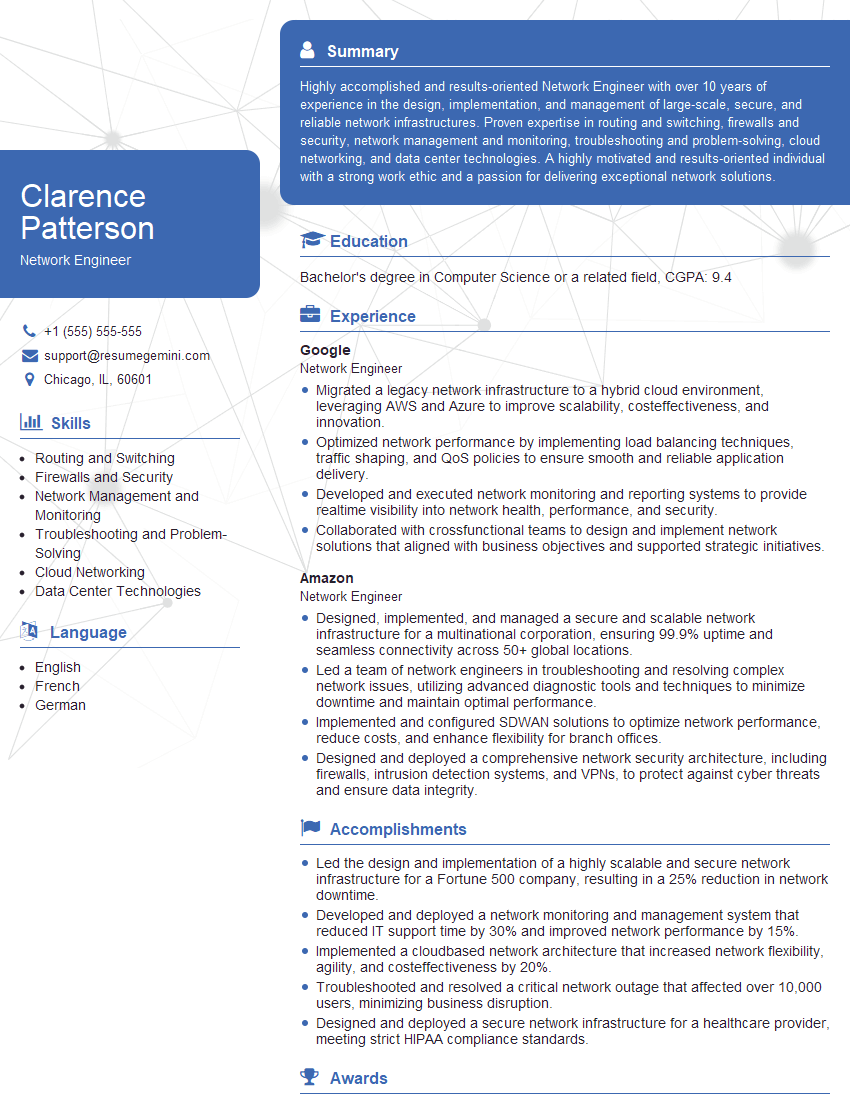
Network Engineer Resume Sample

Network Security Engineer Resume Sample
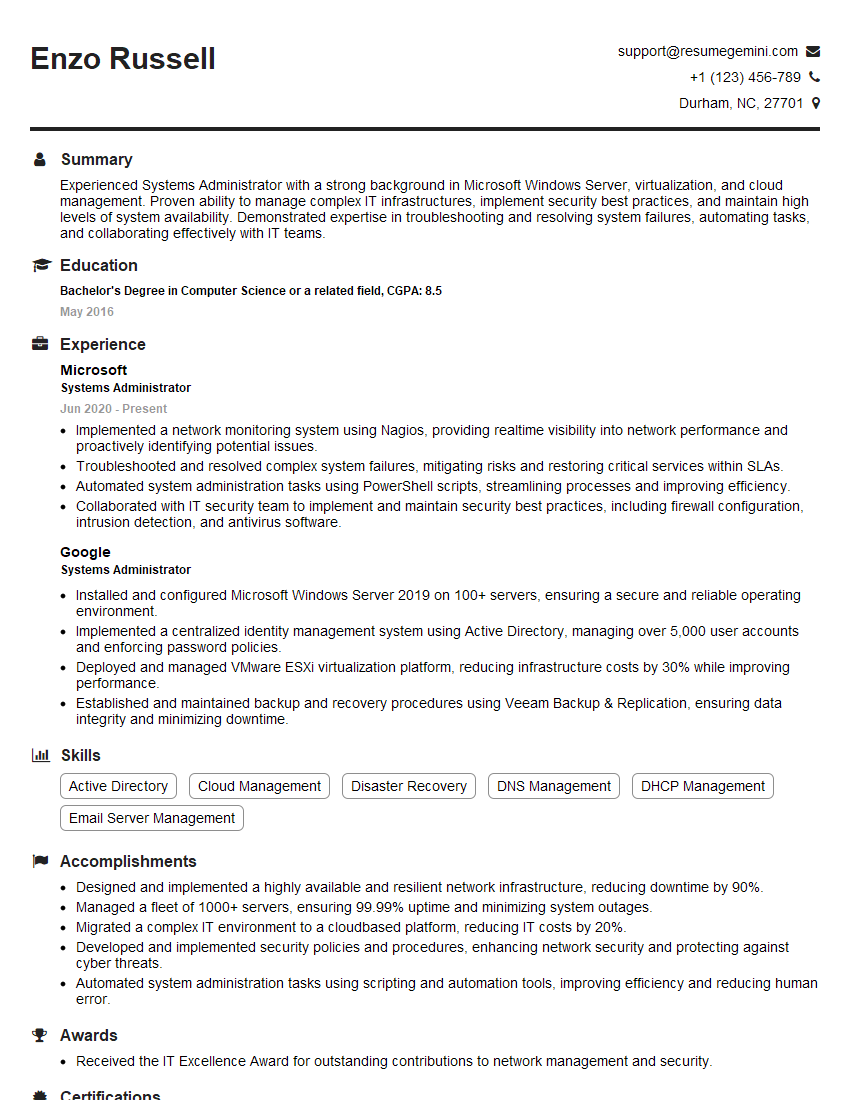
Systems Administrator Resume Sample
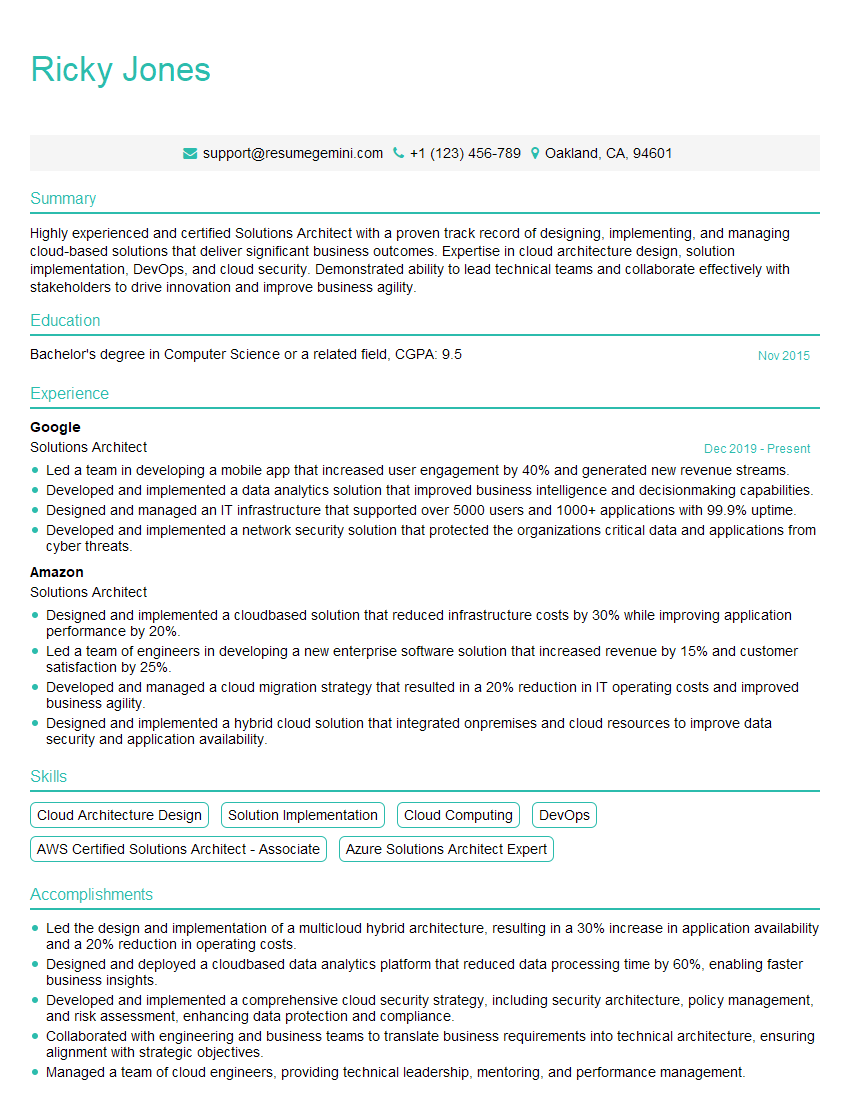
Solutions Architect Resume Sample

Infrastructure Engineer Resume Sample
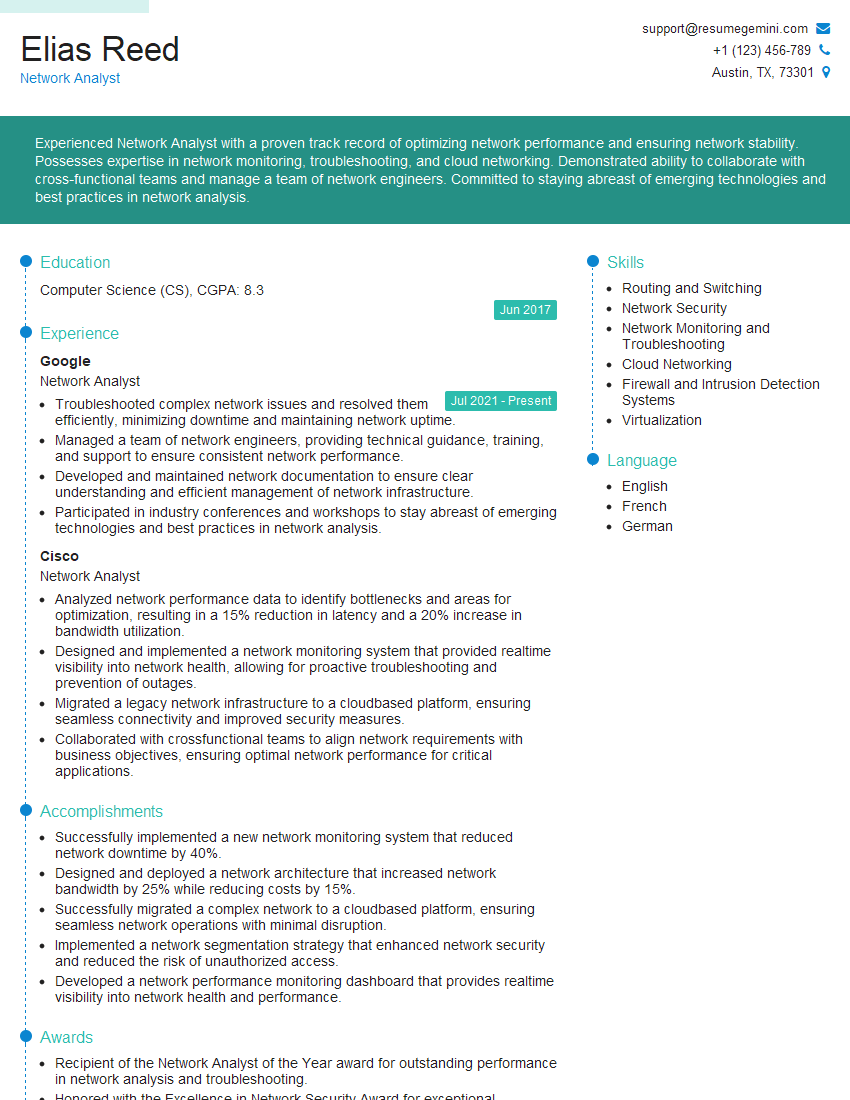
Network Analyst Resume Sample
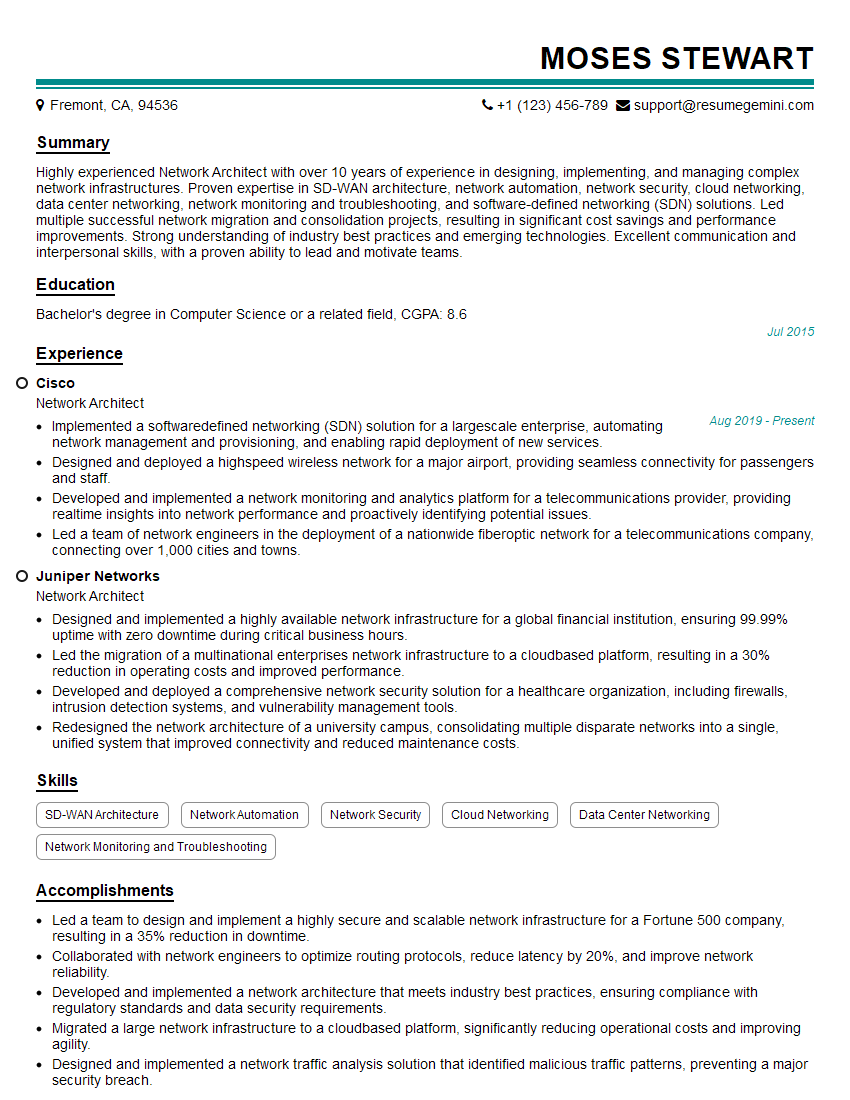
Network Architect Resume Sample
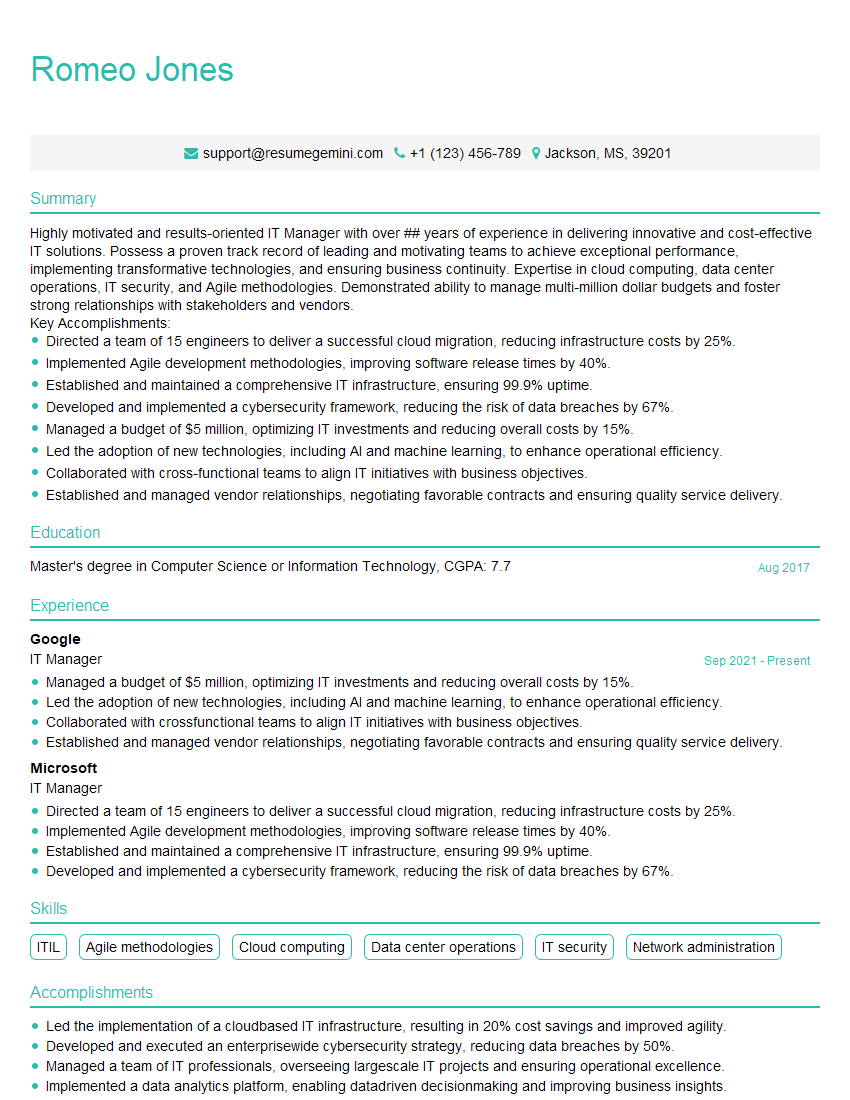
IT Manager Resume Sample
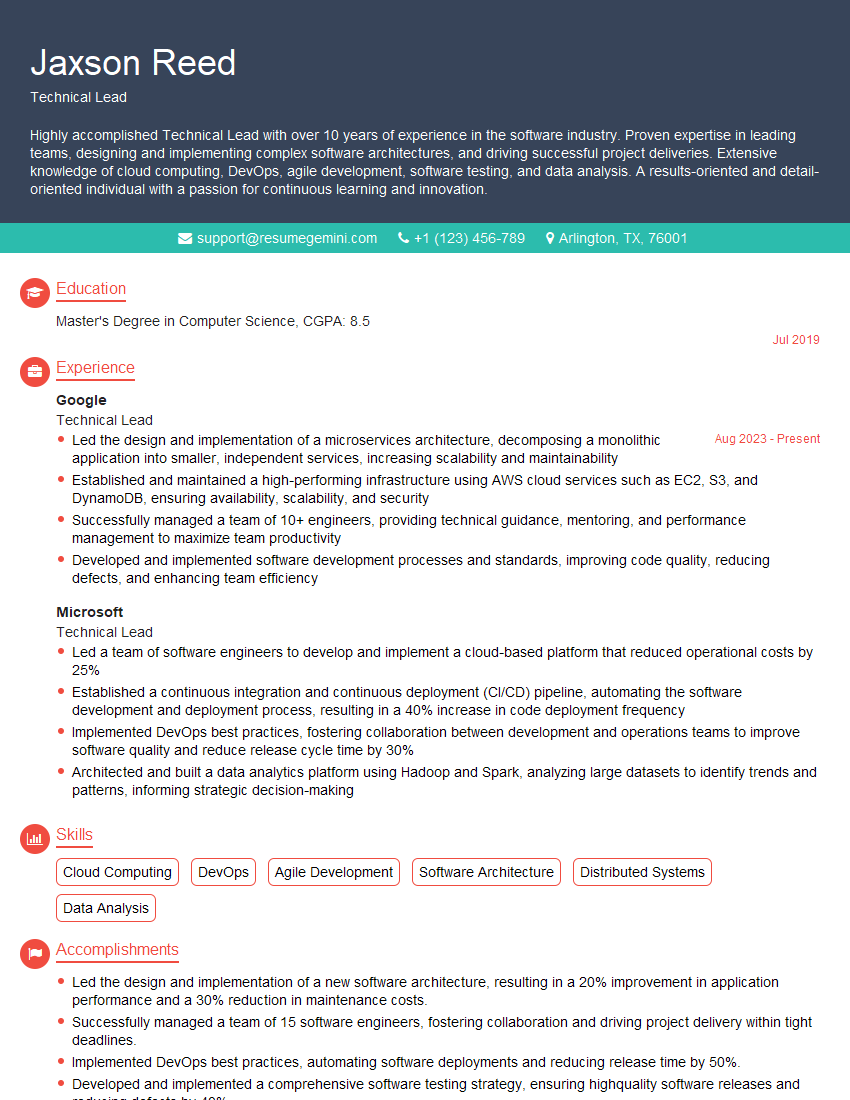
Technical Lead Resume Sample
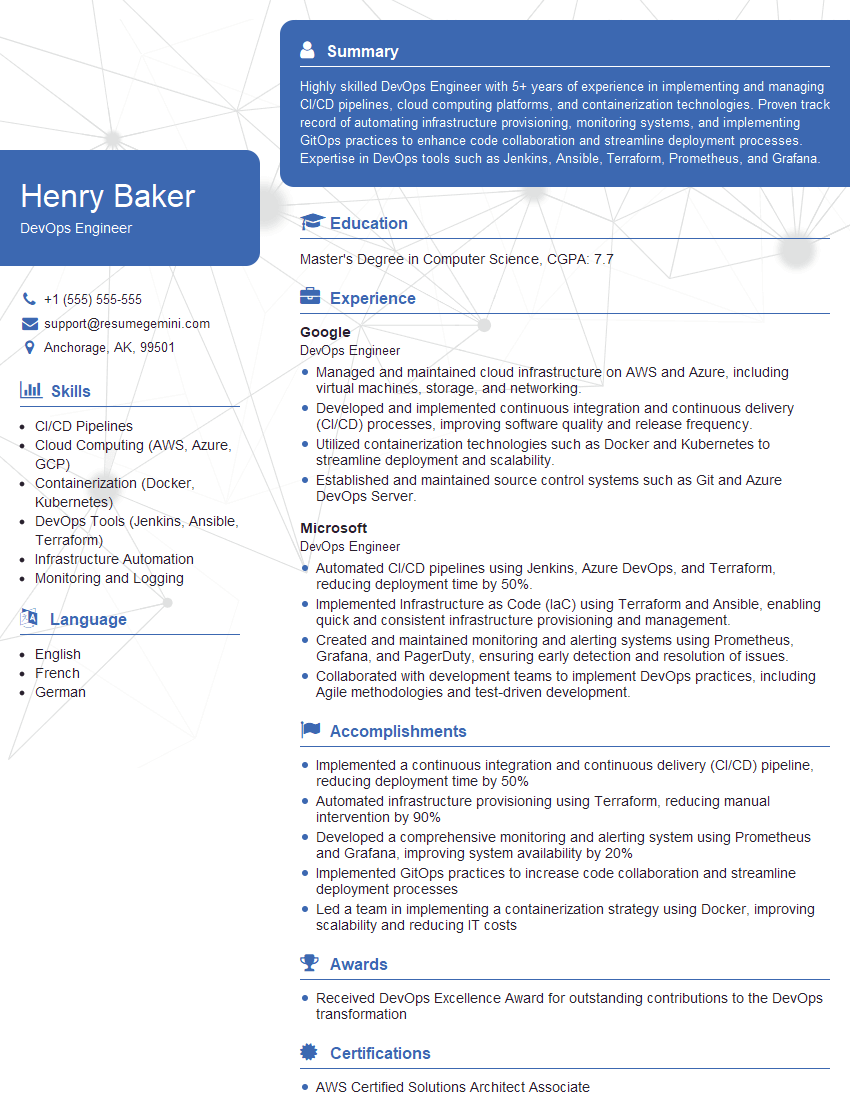
DevOps Engineer Resume Sample
Explore more articles
Users Rating of Our Blogs
Share Your Experience
We value your feedback! Please rate our content and share your thoughts (optional).
What Readers Say About Our Blog
Really detailed insights and content, thank you for writing this detailed article.
IT gave me an insight and words to use and be able to think of examples