Every successful interview starts with knowing what to expect. In this blog, we’ll take you through the top NVMe over Fabrics (NVMe-oF) interview questions, breaking them down with expert tips to help you deliver impactful answers. Step into your next interview fully prepared and ready to succeed.
Questions Asked in NVMe over Fabrics (NVMe-oF) Interview
Q 1. Explain the difference between NVMe and NVMe-oF.
NVMe (Non-Volatile Memory Express) is a high-performance interface for accessing solid-state drives (SSDs). It’s optimized for speed and low latency, directly connecting the SSD to the host system’s PCIe bus. Think of it as a super-fast, direct lane for data between your computer and your storage. NVMe-oF (NVMe over Fabrics) extends this high-speed interface beyond the PCIe bus, allowing you to access NVMe storage over a network. Instead of a direct physical connection, you use a network fabric like Ethernet or Fibre Channel. It’s like building a high-speed data highway connecting multiple servers and storage devices, all leveraging the speed and efficiency of NVMe.
Q 2. Describe the various NVMe-oF transport protocols (e.g., RDMA, TCP).
NVMe-oF uses various transport protocols to carry NVMe commands and data across a network. The most common are:
- RDMA (Remote Direct Memory Access): This offers the lowest latency and highest performance. RDMA bypasses the operating system’s kernel, allowing direct memory-to-memory data transfer between the host and the storage target. Think of it as a dedicated express lane, bypassing traffic jams. It’s often used with RoCE (RDMA over Converged Ethernet) or iWARP (Internet Wide Area RDMA Protocol).
- TCP (Transmission Control Protocol): This is a widely used, reliable transport protocol, offering more robust error handling than RDMA. While not as performant as RDMA in terms of sheer speed, its reliability makes it suitable for certain applications. However, it adds some overhead.
Choosing the right protocol depends on the specific requirements of the application, balancing performance needs with factors like reliability and network infrastructure.
Q 3. What are the key benefits of using NVMe-oF over traditional storage protocols?
NVMe-oF offers several key advantages over traditional storage protocols like iSCSI or Fibre Channel:
- Higher Performance: NVMe-oF leverages the low latency and high throughput of NVMe, resulting in significantly faster I/O operations. This is crucial for applications demanding speed, such as databases and high-performance computing.
- Scalability: NVMe-oF can scale to support a large number of clients and storage devices, making it ideal for large data centers and cloud environments.
- Simplified Management: NVMe-oF’s standardized architecture simplifies management and provisioning of storage resources.
- Reduced Costs: While initial investment might be higher, NVMe-oF can offer long-term cost savings through improved efficiency and reduced infrastructure needs.
Imagine a large online retailer; NVMe-oF would drastically improve their order processing speed and customer response time compared to older storage technologies.
Q 4. Explain the concept of NVMe-oF namespaces and how they are managed.
An NVMe-oF namespace represents a logical view of storage capacity. It’s like a partition on a hard drive, but at the network level. Each namespace can be independently managed, providing flexibility and isolation. For example, one namespace could be used for databases, another for backups, and so on. Namespaces are managed through NVMe commands issued over the network fabric. This includes creating, deleting, and modifying namespaces; controlling access through security measures; and managing their capacity and performance characteristics. Think of it as creating different folders or containers on a network drive, allowing you to organize and access data effectively. This is managed via tools and APIs provided by the NVMe-oF controller and storage array.
Q 5. Discuss the performance characteristics of NVMe-oF compared to other storage protocols.
NVMe-oF significantly outperforms traditional storage protocols like iSCSI and Fibre Channel in many aspects:
- Lower Latency: NVMe-oF boasts drastically lower latency, leading to faster response times.
- Higher Throughput: It enables much higher throughput, meaning more data can be transferred per unit of time.
- Improved IOPS (Input/Output Operations Per Second): NVMe-oF provides significantly higher IOPS, beneficial for applications with many small I/O operations.
This superior performance is mainly due to NVMe’s efficiency and the capabilities of RDMA. However, the actual performance depends on various factors like the network infrastructure, storage hardware, and the specific NVMe-oF implementation.
Q 6. What are the challenges associated with implementing and managing NVMe-oF?
Implementing and managing NVMe-oF presents several challenges:
- Network Infrastructure Requirements: NVMe-oF requires a high-performance network infrastructure capable of handling the high bandwidth and low latency requirements. This can be a significant investment.
- Complexity: The technology is relatively new and complex, requiring specialized expertise for implementation and management.
- Security Concerns: Securing NVMe-oF networks is crucial to protect sensitive data. Robust security measures must be implemented.
- Interoperability: Ensuring interoperability between different vendors’ NVMe-oF products can be challenging.
Careful planning, vendor selection, and ongoing monitoring are essential for successful NVMe-oF deployment.
Q 7. Describe the role of NVMe-oF controllers and target devices.
In an NVMe-oF environment, controllers and target devices play critical roles:
- NVMe-oF Controllers: These are the software and hardware components in the host system that manage the connection to the NVMe-oF storage. They handle the translation of NVMe commands into the network protocol and vice versa. Think of them as translators and traffic managers for the network storage.
- NVMe-oF Target Devices: These are the storage devices (usually SSDs) that present NVMe namespaces to the initiators (clients). They receive and process NVMe commands from controllers and return data accordingly. These are the actual storage units accessible via the network.
Together, these components form the foundation for accessing and managing NVMe storage over a fabric.
Q 8. How does NVMe-oF address latency challenges in storage access?
NVMe-oF significantly reduces latency in storage access primarily by leveraging the speed and efficiency of the NVMe protocol over various fabrics like Ethernet, Fibre Channel, and InfiniBand. Unlike traditional storage protocols like iSCSI or Fibre Channel, NVMe-oF bypasses many layers of software abstraction, resulting in a more direct path between the host and the storage device. This direct path minimizes processing overhead and reduces the number of protocol translations needed.
Imagine sending a letter: Traditional protocols are like sending it via a series of intermediaries – each adds delay. NVMe-oF is like sending it directly to the recipient via express mail. This direct communication dramatically improves the speed of data transfer and reduces response time, making it ideal for applications demanding low latency, such as databases, high-frequency trading, and virtual desktop infrastructure (VDI).
Q 9. Explain the importance of security considerations in NVMe-oF deployments.
Security is paramount in NVMe-oF deployments, as it deals with high-speed access to critical data. Robust security measures are essential to protect against unauthorized access, data breaches, and denial-of-service attacks. Key security considerations include:
- Authentication and Authorization: Implementing strong authentication mechanisms like Kerberos or certificates to verify the identity of initiators and targets is crucial. Authorization controls then determine which initiators have access to specific storage resources.
- Data Encryption: Encrypting data both in transit (using TLS/SSL or similar protocols) and at rest (using encryption capabilities of the storage devices or the fabric) safeguards sensitive information. This is crucial for compliance with regulations like GDPR and HIPAA.
- Network Security: Protecting the underlying network infrastructure through firewalls, intrusion detection/prevention systems, and access control lists (ACLs) is essential to prevent unauthorized access to the NVMe-oF environment.
- Secure Boot and Firmware Updates: Ensuring the integrity of the firmware on both the host and the storage devices is critical. This helps mitigate risks from malicious code and ensures that only authorized firmware updates are applied.
For example, a financial institution deploying NVMe-oF for transaction processing would require stringent security measures to protect sensitive financial data. Failing to address security properly could lead to significant financial losses and reputational damage.
Q 10. Discuss different NVMe-oF topologies and their advantages/disadvantages.
NVMe-oF supports various topologies, each with its own advantages and disadvantages:
- RDMA over Converged Ethernet (RoCE): Utilizes Ethernet networks and RDMA (Remote Direct Memory Access) for high-speed, low-latency communication. It’s cost-effective and widely adopted, but can be complex to configure and requires RDMA-capable network adapters.
- Fibre Channel (FC): A mature, reliable technology offering high bandwidth and low latency. It’s well-suited for demanding storage environments, but can be more expensive than Ethernet-based solutions. It also often requires specialized hardware and expertise.
- InfiniBand: A high-performance interconnect designed for HPC and data center environments. It offers exceptionally high bandwidth and low latency, but it’s generally more expensive than Ethernet and requires specific hardware and expertise.
- NVMe/TCP: This uses standard TCP/IP networking, making it easy to deploy and integrate but offering lower performance compared to RoCE or FC. This is a great option for simpler deployments that don’t require the highest speeds.
The choice of topology depends on factors like budget, performance requirements, existing network infrastructure, and expertise. A high-performance computing cluster might benefit from InfiniBand’s superior speed, whereas a smaller enterprise might find RoCE over Ethernet more cost-effective and manageable.
Q 11. How does NVMe-oF handle error handling and recovery?
NVMe-oF employs robust error handling and recovery mechanisms to ensure data integrity and availability. These mechanisms include:
- Command Completion with Status Codes: Every NVMe command returns a status code indicating success or failure. This allows the initiator to identify and handle errors promptly.
- Error Recovery Mechanisms: NVMe-oF defines mechanisms for handling various errors, such as data corruption, communication failures, and device failures. These mechanisms often involve retries, error logging, and potentially switching to a backup path or device.
- Hardware and Software RAID: Many NVMe-oF deployments utilize hardware or software RAID (Redundant Array of Independent Disks) to protect against disk failures and ensure data availability. RAID technologies can provide data redundancy and improve performance.
- End-to-End Data Integrity Checksums: NVMe commands often include checksums to detect data corruption during transmission. This ensures data integrity across the entire path from initiator to target.
For instance, if a network error occurs during a write operation, the NVMe-oF protocol will detect the error, potentially retry the operation, and log the event for later analysis. This ensures data consistency and minimizes service disruptions.
Q 12. What are the key performance metrics to monitor in an NVMe-oF environment?
Key performance metrics to monitor in an NVMe-oF environment include:
- Latency: Measures the time it takes for a request to be completed. Low latency is crucial for performance-sensitive applications.
- Throughput: Measures the amount of data transferred per unit of time. High throughput is important for maximizing data transfer rates.
- IOPS (Input/Output Operations Per Second): Measures the number of I/O operations completed per second. High IOPS are essential for applications with many small I/O operations.
- Queue Depth: Represents the number of outstanding I/O requests. Monitoring queue depth helps identify potential bottlenecks.
- Error Rates: Tracking error rates (e.g., CRC errors, communication failures) is essential to ensure data integrity and identify potential problems.
- Resource Utilization: Monitoring CPU, memory, and network utilization helps to identify performance bottlenecks.
Regular monitoring of these metrics using tools like Prometheus, Grafana, or vendor-specific monitoring solutions is crucial for identifying potential issues, optimizing performance, and ensuring the stability of the NVMe-oF environment.
Q 13. Explain the concept of QoS in NVMe-oF.
Quality of Service (QoS) in NVMe-oF is the ability to prioritize and manage traffic to guarantee performance levels for specific applications or workloads. This is crucial in multi-tenant environments or when dealing with applications with varying performance needs.
Imagine a data center hosting multiple virtual machines, some running databases and others running less demanding applications. QoS allows you to allocate more resources (bandwidth, IOPS) to the database VMs, ensuring their performance isn’t impacted by the less demanding workloads. This is achieved through various mechanisms, including:
- Traffic Prioritization: Assigning different priorities to different traffic flows based on application requirements.
- Bandwidth Limits: Setting limits on the bandwidth allocated to specific applications or VMs to prevent them from consuming excessive resources.
- IOPS Limits: Similarly, setting limits on the number of IOPS an application or VM can consume.
- Flow Control: Mechanisms that regulate traffic flow to prevent congestion and ensure fair resource allocation.
QoS ensures fair resource allocation and prevents performance degradation for critical applications, making NVMe-oF suitable for diverse workloads within a single infrastructure.
Q 14. How does NVMe-oF differ from Fibre Channel over Ethernet (FCoE)?
While both NVMe-oF and Fibre Channel over Ethernet (FCoE) aim to provide high-speed storage access, they differ significantly in their approach:
- Protocol: NVMe-oF uses the NVMe protocol directly over various fabrics, while FCoE encapsulates Fibre Channel frames within Ethernet packets. This fundamental difference leads to varying levels of performance and complexity.
- Performance: NVMe-oF generally offers significantly better performance than FCoE due to its reduced overhead and more efficient protocol. NVMe is designed from the ground up for flash storage, whereas FCoE is an adaptation of Fibre Channel for Ethernet.
- Complexity: NVMe-oF, especially over RoCE, can be simpler to deploy and manage than FCoE, which often requires specialized Fibre Channel switches and expertise.
- Adoption: NVMe-oF is rapidly gaining adoption as a modern, high-performance storage protocol, while FCoE has seen slower adoption and is considered more of a legacy technology.
Essentially, NVMe-oF is a modern, efficient protocol built for the latest flash-based storage, offering significant performance and simplicity advantages over FCoE, which is an older technology that attempts to adapt older protocol designs to modern Ethernet networks.
Q 15. What are some common troubleshooting techniques for NVMe-oF issues?
Troubleshooting NVMe-oF issues requires a systematic approach, combining network diagnostics with storage-specific analysis. Think of it like diagnosing a car problem – you need to check various systems to pinpoint the issue.
Network Connectivity: Start by verifying basic network connectivity. Check cable connections, network switches, and port configurations. Tools like
pingandtracerouteare invaluable here. If you’re seeing high latency or packet loss, this points towards a network issue.Driver and Firmware Versions: Ensure your NVMe controller, host adapter drivers, and NVMe-oF target firmware are up-to-date. Outdated components can introduce compatibility problems and performance bottlenecks. Check vendor websites for the latest versions.
NVMe-oF Target Health: Monitor the health of your NVMe-oF target using the management tools provided by your storage vendor. Look for errors, alerts, and performance metrics like IOPS and latency. This can highlight issues with the storage array itself.
Resource Utilization: High CPU utilization on the host or target can severely impact performance. Monitor CPU, memory, and I/O usage to identify bottlenecks. Using system monitoring tools will help pinpoint resource exhaustion.
Protocol Analyzers: For deeper investigation, use protocol analyzers (like Wireshark) to capture and analyze NVMe-oF traffic. This lets you identify specific protocol-level errors or performance issues not easily visible through other methods. For example, you might find dropped packets or slow response times.
Log Analysis: Examine logs on both the host and the NVMe-oF target for error messages. These logs provide valuable clues about the root cause of the problem. They are your detective’s notebook in troubleshooting.
Remember to isolate the problem by systematically checking each component. For example, if you suspect a network issue, try connecting to the NVMe-oF target from a different host. If the problem persists, the issue is likely with the storage array or its configuration; if it’s resolved, the problem lies with the original host’s network or configuration.
Career Expert Tips:
- Ace those interviews! Prepare effectively by reviewing the Top 50 Most Common Interview Questions on ResumeGemini.
- Navigate your job search with confidence! Explore a wide range of Career Tips on ResumeGemini. Learn about common challenges and recommendations to overcome them.
- Craft the perfect resume! Master the Art of Resume Writing with ResumeGemini’s guide. Showcase your unique qualifications and achievements effectively.
- Don’t miss out on holiday savings! Build your dream resume with ResumeGemini’s ATS optimized templates.
Q 16. Describe your experience with NVMe-oF deployment and management tools.
My experience encompasses a wide range of NVMe-oF deployment and management tools, from vendor-specific solutions to open-source options. In a recent project, we utilized a combination of tools to manage a large-scale NVMe-oF deployment in a virtualized environment.
Vendor Management Tools: Many storage vendors offer their own management interfaces, often web-based, to manage NVMe-oF targets. These tools typically provide performance monitoring, capacity management, and firmware updates. One example is the management console of a Pure Storage FlashArray, which provides granular control over NVMe-oF connectivity and performance.
Open-Source Tools: Tools like Open-Chroma provide monitoring and analysis of NVMe-oF traffic. They can be especially useful in identifying performance bottlenecks or network issues. Open-source tools often require more technical expertise to configure and use.
SNMP: Simple Network Management Protocol (SNMP) is used to collect performance data and system status from the NVMe-oF targets. This provides a centralized view of the storage infrastructure and facilitates automated alerts.
My experience also involves scripting and automation using tools like Ansible and Python to streamline deployment and configuration tasks. Automating these processes significantly reduces manual effort and minimizes the risk of human error, which is crucial in managing large and complex NVMe-oF deployments. For example, I developed an Ansible playbook to automate the discovery, configuration, and zoning of NVMe-oF targets across a large cluster of servers.
Q 17. Explain the concept of NVMe/TCP and its limitations.
NVMe/TCP uses the familiar TCP/IP protocol to transport NVMe commands and data over Ethernet networks. Think of it as using a standard delivery truck (TCP/IP) to transport high-speed NVMe packages. While this provides broad compatibility, it comes with limitations.
Overhead: TCP introduces overhead in the form of headers, acknowledgments, and error correction, impacting performance compared to RDMA-based NVMe-oF transports.
CPU Utilization: TCP relies heavily on CPU processing for data handling, making it less efficient than RDMA, which offloads much of the processing to network interface cards (NICs).
Latency: The added overhead can lead to higher latency compared to RDMA, especially in latency-sensitive applications like databases.
NVMe/TCP is suitable for environments where RDMA is unavailable or impractical. However, for optimal performance, especially in high-throughput, low-latency applications, RDMA-based transport is strongly preferred. An example is using NVMe/TCP for a smaller scale deployment where cost and ease of setup are prioritized over extreme performance.
Q 18. What are the different types of NVMe-oF fabrics?
NVMe-oF utilizes various fabrics to transport NVMe commands and data. Each fabric offers a different set of trade-offs in terms of performance, cost, and complexity.
Ethernet (RoCE, iWARP, TCP): Ethernet is the most prevalent fabric for NVMe-oF. RoCE (RDMA over Converged Ethernet) offers the best performance, but requires RDMA-capable NICs. iWARP (Internet Wide Area RDMA Protocol) provides RDMA functionality over standard Ethernet without requiring RDMA-capable NICs, but with lower performance. NVMe/TCP, as mentioned before, uses TCP/IP and offers broad compatibility but lower performance.
Fibre Channel (FC): Fibre Channel remains a viable option, particularly in enterprise environments already heavily invested in FC infrastructure. It’s known for its reliability and high performance.
Infiniband (IB): Infiniband is a high-performance interconnect primarily used in high-performance computing (HPC) and data centers requiring extremely low latency and high bandwidth. It provides a robust and efficient transport for NVMe-oF.
The choice of fabric depends on specific requirements. For instance, RoCE over Ethernet is a popular choice in many data centers due to its excellent performance and widespread Ethernet infrastructure. Meanwhile, Fibre Channel remains relevant in legacy environments, and Infiniband finds its niche in extremely demanding applications.
Q 19. How does NVMe-oF integrate with virtualization technologies?
NVMe-oF integrates seamlessly with virtualization technologies, enabling virtual machines (VMs) to access NVMe-based storage directly. This provides significant performance improvements compared to traditional virtual disk solutions that rely on shared storage. Think of it like giving each VM its own dedicated, high-speed storage lane.
Direct-Attached Storage to VMs: NVMe-oF allows a virtual machine to directly access an NVMe drive over the network, effectively creating a direct-attached storage (DAS) experience in a virtualized environment. This eliminates the performance bottleneck caused by virtualized storage solutions that involve a hypervisor-mediated data path.
SR-IOV (Single Root I/O Virtualization): SR-IOV allows multiple VMs to share a physical network adapter, giving each VM its own virtual network interface. This improves the efficiency of network resource utilization in virtualized environments accessing NVMe-oF storage.
VMware vSphere and Hyper-V: Major virtualization platforms such as VMware vSphere and Microsoft Hyper-V have excellent support for NVMe-oF, providing integration features for management and provisioning of NVMe-oF storage to VMs.
By providing low-latency, high-throughput storage to VMs, NVMe-oF improves application performance in virtualized environments. This is crucial for database applications, virtual desktops, and other performance-sensitive workloads.
Q 20. Discuss the future trends and advancements in NVMe-oF technology.
The future of NVMe-oF is bright, driven by the relentless demand for faster and more efficient storage solutions. Several key trends are shaping its evolution:
Enhanced Security: Increased focus on security features, such as end-to-end data encryption and secure authentication mechanisms, to protect data in transit and at rest.
Advanced Fabrics: Continued adoption of higher-speed fabrics like 400GbE and beyond, coupled with advanced RDMA technologies, will further boost performance.
AI and Machine Learning Integration: Leveraging AI and ML for proactive performance management, predictive maintenance, and intelligent resource allocation within NVMe-oF deployments.
Composable Infrastructure: NVMe-oF is a key enabler of composable infrastructure, allowing dynamic resource allocation and configuration to meet changing needs.
Cloud-Native Integration: Seamless integration with cloud-native architectures and orchestration tools will improve scalability and management in cloud environments.
NVMe-oF over 5G and other wireless technologies: Extending NVMe-oF to wireless environments for remote access and edge computing.
These advancements will enable new possibilities, from high-performance computing and AI/ML workloads to efficient cloud storage and next-generation data centers, pushing the boundaries of what’s possible with storage technology.
Q 21. Explain the concept of NVMe-oF zoning and its importance.
NVMe-oF zoning is a crucial aspect of security and management, especially in multi-tenant environments. Think of it as dividing a highway into separate lanes for different vehicles to prevent collisions and maintain efficiency. It logically segregates the network into different zones.
Logical Segmentation: Zoning divides the fabric into separate zones, limiting access to NVMe-oF targets. Only initiators within the same zone can communicate with targets in that zone. This isolates storage resources and enhances security.
Security Enhancement: By restricting access based on zoning, you prevent unauthorized access to sensitive data. This is especially important in multi-tenant data centers where multiple customers share the same infrastructure.
Simplified Management: Zoning simplifies management by providing a way to logically group and manage storage resources. This is crucial in large-scale NVMe-oF deployments.
Fabric Providers and Zoning: The specific implementation of zoning depends on the fabric used (Ethernet, Fibre Channel, Infiniband) and the underlying networking technology. Each fabric has its own mechanism for configuring and managing zones.
For example, in a data center with multiple clients, zoning allows you to create separate zones for each client, ensuring that each client can only access its allocated storage resources. This prevents data leakage and unauthorized access, maintaining data security and operational efficiency.
Q 22. How does NVMe-oF handle data integrity and protection?
NVMe-oF prioritizes data integrity through several mechanisms inherited from NVMe and enhanced by the fabric transport layer. At the NVMe level, end-to-end data protection relies heavily on the use of checksums and error correction codes. Every NVMe command includes a crucial CRC (Cyclic Redundancy Check) to detect data corruption during transmission. If a CRC mismatch occurs, the command is rejected, preventing corrupted data from being written or read. Furthermore, many NVMe devices employ internal error correction techniques like Reed-Solomon codes to silently correct minor errors without requiring retransmission.
The fabric layer (like Fibre Channel, RDMA over Converged Ethernet, or iSCSI) adds its own protection mechanisms. These protocols utilize various techniques to ensure reliable data delivery. For instance, they often employ error detection and correction schemes such as frame check sequences (FCS) at the link layer. Moreover, they may implement sophisticated flow control and acknowledgment mechanisms that confirm successful data transmission and retransmit lost or corrupted packets.
In essence, NVMe-oF employs a layered approach to data integrity. Each layer contributes its own protective measures, creating a robust defense against data corruption. Think of it like a multi-layered security system – one layer might miss something, but the others are there to catch it.
Q 23. Describe your experience with NVMe-oF performance tuning and optimization.
My experience with NVMe-oF performance tuning involves a multifaceted approach. It begins with understanding the overall system architecture, identifying potential bottlenecks, and focusing on optimizing each component. This includes careful selection of hardware (e.g., NVMe drives, network adapters, switches), configuration of the NVMe-oF target and initiator, and fine-tuning the operating system parameters.
One crucial aspect is network optimization. Network congestion can severely impact performance. Therefore, tuning network parameters such as MTU (Maximum Transmission Unit) size, QoS (Quality of Service) policies, and flow control is crucial. I’ve worked on several projects where adjusting the MTU to maximize network efficiency resulted in significant performance improvements. In one specific case, increasing the MTU from 1500 bytes to 9000 bytes on a RoCE network reduced latency by 30%.
Furthermore, efficient queue management on both the host and the target is paramount. Properly sizing the number of NVMe queues and the depth of each queue can dramatically affect throughput and latency. I regularly leverage performance monitoring tools to analyze queue depths and identify potential bottlenecks. Finally, optimizing the workload itself is equally important. This may involve adjusting block sizes, I/O patterns, and the application’s I/O scheduling strategy.
Q 24. What are the key considerations for choosing an NVMe-oF solution?
Selecting an NVMe-oF solution requires careful consideration of several key factors:
- Performance Requirements: Latency, throughput, and IOPS (Input/Output Operations Per Second) needs are paramount. Consider the application’s demands and the scale of the deployment. High-performance applications will require low-latency, high-throughput solutions.
- Scalability: How much storage capacity and how many hosts will the solution need to support? Choose a solution that can scale to meet future needs.
- Protocol Choice: Different NVMe-oF protocols (FC, RoCE, iSCSI) offer different trade-offs in terms of performance, security, and cost. FC is known for its high reliability and performance but is generally more expensive, while RoCE provides excellent performance on Ethernet infrastructure. iSCSI remains widely used, providing a more budget friendly solution but may lack some of the performance characteristics of FC or RoCE.
- Vendor Support and Ecosystem: Choose vendors with strong reputations, proven track records, and readily available support. A healthy ecosystem of compatible hardware and software is also critical.
- Security: Consider data security and authentication mechanisms. Robust security features are crucial in a data center environment.
- Management and Monitoring: Easy-to-use management and monitoring tools simplify deployment and troubleshooting. A solution that facilitates effective performance monitoring and management capabilities is essential for proactive issue detection.
Q 25. Discuss the role of NVMe-oF in modern data center architectures.
NVMe-oF plays a pivotal role in modern data center architectures by enabling high-performance, shared storage access. It moves beyond the limitations of traditional storage protocols like iSCSI and SAS, offering significantly lower latency and higher throughput. This is particularly crucial for applications like AI/ML, big data analytics, and high-frequency trading, where milliseconds matter.
In a typical modern data center, NVMe-oF allows for the creation of highly scalable and flexible storage solutions. It can be used to build shared storage pools accessed by multiple servers, virtual machines, or containers. This enables efficient resource utilization and reduces the need for direct-attached storage, simplifying data center management and improving overall efficiency. Moreover, NVMe-oF’s shared storage nature facilitates easier data sharing and collaboration among different applications and workloads, enhancing agility and efficiency.
The combination of NVMe’s speed and efficiency with the flexibility of fabrics like Ethernet or Fibre Channel enables the creation of composable infrastructure that adapts to evolving needs. This flexibility is critical in today’s dynamic data center environments.
Q 26. Explain the concept of NVMe-oF multipathing and its benefits.
NVMe-oF multipathing involves configuring multiple paths between a host and an NVMe-oF target. This approach uses redundant network paths or connections to enhance availability and performance. If one path fails, traffic seamlessly switches to another available path, minimizing downtime and maintaining data access. This contrasts with single-path configurations, where a single point of failure can disrupt access to the storage.
The primary benefits of NVMe-oF multipathing include:
- High Availability: Redundant paths ensure continued access to data even if one path fails. This is particularly beneficial for mission-critical applications where downtime is unacceptable.
- Improved Performance: Load balancing across multiple paths can improve throughput and reduce latency by distributing I/O requests. It prevents congestion on a single path, increasing overall efficiency.
- Increased Bandwidth: Multipathing aggregates the bandwidth of all available paths, potentially resulting in higher aggregate bandwidth for data transfer.
Implementing multipathing requires careful consideration of path selection policies and failure detection mechanisms. The system needs to detect failures swiftly and automatically switch to a working path without data loss.
Q 27. How does NVMe-oF contribute to improving application performance?
NVMe-oF significantly contributes to improving application performance by reducing latency and increasing bandwidth. The low latency nature of NVMe, combined with the efficiency of fabric technologies, translates to faster application response times. This is especially noticeable in applications that demand high IOPS, such as databases, virtual desktop infrastructure (VDI), and high-performance computing (HPC).
Consider a database application: the ability to rapidly access and retrieve data from storage is critical to its overall performance. NVMe-oF, with its low latency and high throughput, can greatly reduce the time it takes to execute database queries, resulting in faster transaction processing and improved user experience. Similarly, in VDI, fast storage access ensures responsive virtual desktops, providing a seamless user experience.
The higher bandwidth offered by NVMe-oF also allows for the efficient handling of large datasets. Applications dealing with big data or high-resolution media processing benefit from this increased bandwidth, enabling them to process information faster and more effectively.
Q 28. What are some of the industry standards and specifications relevant to NVMe-oF?
Several industry standards and specifications are relevant to NVMe-oF. The most fundamental are those defined by the NVMe and SCSI standards organizations:
- NVM Express (NVMe) specifications: These define the NVMe protocol itself, including the command set, data structures, and error handling mechanisms. These are the bedrock upon which NVMe-oF is built.
- SCSI standards: Although NVMe is distinct from SCSI, some aspects of SCSI management and error handling influenced NVMe-oF development. The history and learnings from SCSI management practices contribute to a more robust ecosystem.
- Transport protocols: Several transport protocols are used with NVMe-oF, each with its own specifications. These include Fibre Channel (FC), RDMA over Converged Ethernet (RoCE), and iSCSI. Understanding the nuances of each protocol is crucial for proper implementation and optimization.
- SNIA (Storage Networking Industry Association): This organization plays a key role in developing and promoting standards and best practices related to storage networking, including NVMe-oF.
Staying current with these standards is essential for anyone working with NVMe-oF to ensure interoperability and leverage the latest advancements in the technology.
Key Topics to Learn for NVMe over Fabrics (NVMe-oF) Interview
- Fundamentals of NVMe: Understand the core principles of NVMe, including its architecture, commands, and performance advantages over traditional storage protocols.
- NVMe-oF Protocols: Become proficient in the different transport protocols used with NVMe-oF, such as RDMA over Converged Ethernet (RoCE), Fibre Channel (FC), and iSCSI. Compare and contrast their performance characteristics and suitability for different use cases.
- Namespaces and Addressing: Grasp the concept of NVMe namespaces and how they are mapped and accessed over the fabric. Understand the implications for performance and management.
- Security Considerations: Familiarize yourself with the security features of NVMe-oF, including authentication, authorization, and data encryption. Be prepared to discuss potential vulnerabilities and mitigation strategies.
- Performance Optimization: Learn how to optimize NVMe-oF performance, including techniques for reducing latency, maximizing throughput, and managing resource contention.
- Practical Applications: Explore real-world applications of NVMe-oF, such as high-performance computing (HPC), cloud storage, and virtualized environments. Be ready to discuss the benefits and challenges of using NVMe-oF in these contexts.
- Troubleshooting and Diagnostics: Understand common issues encountered in NVMe-oF deployments and how to troubleshoot and diagnose them. Familiarize yourself with relevant tools and techniques.
- Management and Monitoring: Learn about the tools and techniques used to manage and monitor NVMe-oF deployments. Understand how to ensure system health and performance.
Next Steps
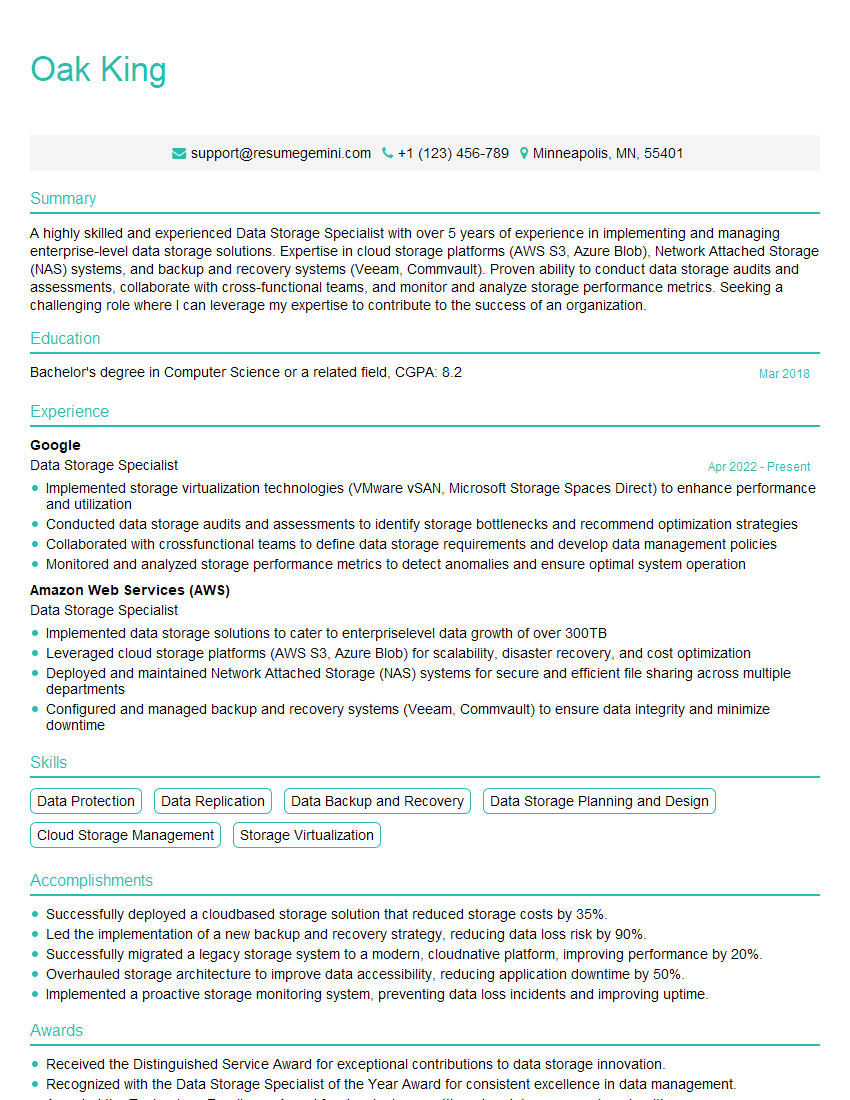
Mastering NVMe-oF significantly enhances your career prospects in the rapidly growing field of high-performance computing and data storage. This expertise positions you for exciting roles with leading technology companies. To maximize your chances of landing your dream job, it’s crucial to present your skills effectively. Creating an ATS-friendly resume is key to ensuring your application gets noticed. ResumeGemini is a trusted resource to help you craft a compelling and effective resume that highlights your NVMe-oF knowledge and experience. We offer examples of resumes tailored specifically to NVMe-oF roles to inspire your own creation. Take the next step towards a successful career in NVMe-oF – build your best resume yet with ResumeGemini.
Explore more articles
Users Rating of Our Blogs
Share Your Experience
We value your feedback! Please rate our content and share your thoughts (optional).
What Readers Say About Our Blog
Really detailed insights and content, thank you for writing this detailed article.
IT gave me an insight and words to use and be able to think of examples