Interviews are opportunities to demonstrate your expertise, and this guide is here to help you shine. Explore the essential On-Set Script Supervision interview questions that employers frequently ask, paired with strategies for crafting responses that set you apart from the competition.
Questions Asked in On-Set Script Supervision Interview
Q 1. What software are you proficient in for script supervision?
My proficiency in script supervision software is extensive. I’m highly skilled in industry-standard programs like Final Draft for script management and its invaluable revision tracking features. I also utilize ShotGrid and StudioBinder for collaborative scene logging, continuity tracking, and efficient communication with the rest of the crew. These tools are vital for maintaining organization across a complex production. For example, Final Draft allows me to quickly compare different script versions, highlighting changes and ensuring everyone’s working from the latest approved version. StudioBinder helps me create detailed scene breakdowns, including props, costumes, and actor notes, which can be easily accessed by the entire team on set.
Q 2. Describe your process for logging scene takes and maintaining continuity.
My process for logging takes and maintaining continuity is meticulous and systematic. It starts before filming even begins – I meticulously review the script, creating a detailed shot list that includes anticipated problems or continuity challenges. On set, I use my chosen software to log each take, noting the scene, shot number, timecode, and any deviations from the script. I make careful observations about actor positions, props, wardrobe, and set dressings. Think of it like a detailed detective’s log. Every detail matters. For instance, if a coffee cup changes position between two shots, I document it immediately. Later, I’ll review all takes, cross-referencing notes and ensuring consistency between scenes. I consider this a preventative approach – catching small errors early prevents larger headaches in post-production.
Q 3. How do you handle discrepancies between the script and what’s being filmed?
Handling script discrepancies requires a calm and collaborative approach. My first step is to confirm the discrepancy – did the actor improvise, was there a directorial choice, or was it an oversight? I then immediately communicate the issue to the director and relevant department heads (costume, props, etc.). We discuss the best solution. For example, if an actor added a line that enhances the scene, we might choose to keep it and adjust the script. If it’s a significant deviation from the narrative, we might choose to reshoot. Documenting everything is key – I always add a note in my log explaining the change and the rationale behind it, preserving a clear record for post-production.
Q 4. Explain your method for tracking props, costumes, and set dressings for continuity.
Tracking props, costumes, and set dressings is critical for maintaining visual continuity. I work closely with the prop master and costume designer to create a detailed inventory list. I’ll often take photographs throughout the day to document their placement and condition. This visual record is invaluable for confirming continuity across various scenes. I use a combination of software logging and photographic evidence. For example, a crucial necklace may have to be tracked throughout various scenes, and I would document which character is wearing it in each shot. A detailed spreadsheet or a feature within the chosen software makes this easier. If an item is misplaced or changes, I immediately flag the discrepancy, and coordinate with the appropriate department to remedy it quickly.
Q 5. How do you maintain accurate timecodes and scene slates?
Maintaining accurate timecodes and scene slates is paramount for seamless post-production. I verify the timecode sync between the camera and sound recordings frequently. Scene slates are meticulously checked for accuracy—scene number, take number, and roll number must all be correct. Any discrepancies are reported immediately to the camera department and the assistant director. Imagine if a critical scene’s timecode was off – the entire editing process could be compromised. This meticulous attention to detail is crucial for ensuring the smooth flow of the entire process.
Q 6. Describe your experience with digital script supervision tools.
My experience with digital script supervision tools is extensive and continues to evolve as technology improves. I’ve used several platforms, including the previously mentioned ShotGrid and StudioBinder, as well as smaller, specialized apps. These tools have revolutionized the process, providing streamlined workflows, real-time collaboration, and centralized data storage. They enable quick access to critical information from any device, simplifying complex continuity tracking and enhancing communication with the crew. The key benefit is the ability to quickly identify potential continuity problems and resolve them proactively, saving time and resources throughout the production.
Q 7. How do you collaborate effectively with the director and other crew members?
Effective collaboration is the cornerstone of successful script supervision. I maintain open and proactive communication with the director, discussing potential challenges and offering solutions. Regular meetings with the camera, sound, props, costume, and art departments ensure everyone is on the same page regarding continuity. I frequently share my logs and notes with these departments, fostering a collaborative environment where everyone understands the importance of continuity. Building trust and rapport with the crew is essential—it allows for a smoother process and empowers everyone to contribute to achieving a consistent and professional final product. A simple approach like a brief morning meeting to discuss the day’s shots ensures everyone is aligned.
Q 8. How do you handle actor blocking changes and their impact on continuity?
Actor blocking changes are a common occurrence on set, and managing their impact on continuity is crucial. My approach involves a three-step process: documentation, communication, and adaptation.
First, documentation is key. I meticulously record the original blocking in my script notes, including precise details like actor positions relative to props and set pieces. When a change occurs, I immediately note it, specifying the scene, take, and the nature of the alteration. For instance, I might write: “Scene 3, Take 2 – Actor A moved 2 feet to the left of the table.” This level of detail prevents confusion.
Next comes communication. I inform the director, cinematographer, and other relevant crew members of the change, highlighting potential continuity issues that might arise. For example, if the change affects a shot with a specific camera angle, we need to adjust camera placement or potentially reshoot parts of the scene to maintain consistency. Clear and concise communication ensures everyone is aware of the changes and can proactively adjust their work.
Finally, adaptation is crucial. Sometimes, minor blocking changes can easily be accommodated. However, more significant changes might require a revised shot list or even a slight adjustment to the script. My experience allows me to assess the impact quickly and suggest solutions that minimize disruption while maintaining continuity.
For instance, I’ve had instances where an actor’s shift in position meant a previously visible prop was now partially obscured. By communicating this to the art department, we could subtly reposition the prop without breaking the scene’s flow.
Q 9. What is your experience working with multiple cameras?
Working with multiple cameras is standard practice on many productions, and I’m highly proficient in managing the continuity challenges it presents. The key is meticulous organization and clear communication. I employ a system of color-coded notes and detailed shot descriptions. Each camera gets a distinct color-coded identifier in my script notes.
For example, I might use red for Camera A, blue for Camera B, and green for Camera C. Alongside each camera’s designation, I note the shot type (wide, medium, close-up), and any significant action details relevant to that particular camera angle. This allows me to quickly reference which camera captured which specific moment, making it easier to maintain continuity across different shots.
Moreover, before shooting commences, I ensure I understand the director’s vision and the intended relationship between each camera’s coverage. This proactive understanding allows me to anticipate and mitigate any potential continuity problems before they arise. I might even suggest camera setups that better accommodate the scene’s narrative flow and simplify the process of maintaining continuity across different shots.
Q 10. How do you manage a large volume of information while maintaining accuracy?
Managing a large volume of information accurately requires a combination of organizational skills and technological tools. I rely on a digital system that allows me to maintain a centralized, easily searchable database of scene information, including detailed notes on costumes, props, set dressing, actor blocking, and camera setups.
I utilize a combination of software applications such as dedicated script annotation software and cloud-based collaboration tools. These tools allow me to update and share information instantly with other crew members, preventing inconsistencies and maintaining everyone’s awareness of the current scene status. The key is to maintain a system that allows for efficient search and retrieval of information when needed. For instance, if a question arises about a specific prop’s position in a particular scene, I can quickly access this information without sifting through volumes of paper notes.
Beyond technological solutions, a structured approach is essential. I create detailed checklists and utilize color-coding to quickly identify important information at a glance. Regular review and cross-referencing of my notes help identify potential inaccuracies and inconsistencies before they become bigger problems. Accuracy is paramount in script supervision, and this multi-faceted approach ensures I maintain that crucial precision.
Q 11. Describe a situation where you had to solve a continuity problem quickly and efficiently.
During a fast-paced shoot for a period drama, we were filming a ballroom scene with multiple extras. In one take, an extra accidentally knocked over a valuable antique candlestick. The director initially wanted to keep the take due to the excellent performance from the lead actors. However, the candlestick’s position was crucial to maintaining continuity across several shots.
Rather than reshooting the entire scene, I quickly proposed a simple solution. The art department carefully repositioned the candlestick in the exact position it was originally in before the accident, while the extras were refocused on their dialogue. We were able to preserve the original take, saving valuable time and production costs. Communicating the situation and the quick fix to the director, cinematographer, and art department ensured minimal disruption to the schedule, which showcased the importance of quick-thinking problem-solving on set.
Q 12. Explain your process for creating a daily continuity report.
My daily continuity report is a comprehensive document summarizing the day’s filming activities and highlighting any continuity issues or potential problems for the upcoming day. The report generally includes:
- Scene summary: A brief description of each scene filmed, including the takes completed and any significant events or changes.
- Continuity notes: Detailed notes on any continuity discrepancies or potential problems that need addressing. This includes notes on costumes, props, hair, makeup, and set dressing.
- Photographs: Relevant photos capturing key scenes, camera angles, and prop placements for easy reference.
- Next day prep: A section anticipating potential continuity issues for the upcoming scenes, based on the shooting schedule and planned camera setups.
- Action items: A list of specific tasks that need to be completed or addressed before the next day’s shooting (e.g., fixing a continuity issue, checking a prop).
I use a standardized format to make the report clear and easy to read for the director and other crew members. Using clear, concise language and visually organized layouts such as tables and bullet points are very important.
Q 13. What is your understanding of the differences between shooting out of sequence and in sequence?
Shooting in sequence means filming scenes chronologically as they appear in the script. This is the ideal scenario, as it makes continuity simpler, allowing actors to stay in character and flow through emotions seamlessly. It also minimizes the risk of continuity errors, such as changes in hair, makeup, or wardrobe.
Shooting out of sequence, on the other hand, is more common due to logistical constraints like actor availability, location limitations, or lighting conditions. While it offers scheduling flexibility, it significantly increases the complexity of managing continuity. I need to meticulously track the scene order, costumes, props, hair, and makeup for every actor, noting any changes that occur between scenes to ensure they remain consistent across all takes despite the non-chronological shooting order.
The difference between shooting in and out of sequence fundamentally shapes my approach. With in-sequence shooting, my focus is on smooth workflow and minor adjustments. Out of sequence, it becomes a detailed tracking operation requiring rigorous documentation and proactive problem-solving.
Q 14. How familiar are you with various types of camera shots and their impact on continuity?
Understanding various camera shots and their impact on continuity is fundamental to my role. Different shots – wide, medium, close-up, extreme close-up, etc. – dictate what details are visible onscreen. I must ensure consistent visibility or invisibility of details across all shots. For instance, if a character has a coffee cup in a medium shot, it must be consistently present or absent in subsequent close-ups to maintain continuity.
Furthermore, camera movement affects continuity. A tracking shot, for example, must maintain consistent background elements to avoid jarring transitions. Similarly, any changes in lighting or the character’s position from one shot to another must be carefully considered and managed to preserve the integrity and seamlessness of the narrative. The interplay between shot types, lighting, and action dictates my detailed notes and proactive approach to continuity management.
I’m proficient in identifying potential problems, like a character’s watch changing between a wide and close-up shot, or a background element appearing and disappearing unexpectedly between a series of shots. My expertise allows me to anticipate these issues and ensure a seamless viewing experience for the audience.
Q 15. How do you ensure continuity of character actions, props and dialogue from one scene to the next?
Ensuring continuity is the backbone of script supervision. It’s about meticulously tracking every detail – character actions, prop placement, dialogue, and even the weather – from shot to shot and scene to scene. This prevents jarring inconsistencies that can break the viewer’s immersion.
My approach is multifaceted:
- Detailed Script Annotation: I meticulously mark my script, noting every detail relevant to continuity – character positions, clothing, props, and even the time of day.
- On-Set Observation: I’m constantly observing, paying attention to even minor changes. For instance, if a character is holding a coffee cup in one shot, I make sure it’s still there (and at the same level of fullness) in subsequent shots.
- Photography Reference: I utilize still photography or video playback to confirm continuity. This is particularly useful for complex setups or action scenes.
- Communication: Constant communication with the director, actors, and other crew members (e.g., costume and prop departments) is crucial. Any changes must be communicated and documented immediately.
For example, if a character is wearing a watch in Scene 1, I ensure that watch is present and in the same position on their wrist in Scene 2, even if the scenes are filmed days apart. I make a note of the specific type and position of the watch in my script annotations.
Career Expert Tips:
- Ace those interviews! Prepare effectively by reviewing the Top 50 Most Common Interview Questions on ResumeGemini.
- Navigate your job search with confidence! Explore a wide range of Career Tips on ResumeGemini. Learn about common challenges and recommendations to overcome them.
- Craft the perfect resume! Master the Art of Resume Writing with ResumeGemini’s guide. Showcase your unique qualifications and achievements effectively.
- Don’t miss out on holiday savings! Build your dream resume with ResumeGemini’s ATS optimized templates.
Q 16. How do you handle errors in continuity discovered during post-production?
Discovering continuity errors in post-production is unfortunately common. The key is a systematic approach to resolving them, balancing cost and time against maintaining narrative integrity.
- Identify the Problem: Pinpoint the exact nature and location of the error within the scene and its relation to other scenes.
- Assess the Severity: Determine whether the error is minor (easily overlooked by the audience) or significant (severely impacting the narrative flow).
- Evaluate Solutions: Options range from simple digital fixes (adjusting a prop’s position in post) to more complex solutions, such as reshooting parts of the scene or employing VFX.
- Prioritize and Implement: Prioritize fixes based on their severity and cost-effectiveness. The aim is the most impactful fix with minimal disruption to the post-production schedule.
- Documentation: Meticulously document all changes made, including the nature of the error, the solution employed, and who authorised the fix. This is invaluable for future reference.
A practical example: If a character’s hair is slightly different between two shots, a subtle digital fix might be sufficient. However, if a prop disappears completely from one shot to another, it might require a reshoot.
Q 17. How do you maintain accuracy when working with stunt doubles or other stand-ins?
Working with stand-ins and stunt doubles requires precise attention to detail. Continuity is paramount, even when the principal actor isn’t present.
- Detailed Briefing: I meticulously brief the stand-in or stunt double on the specific details of the shot, including precise body language, posture, and even hand gestures. I use reference photos and video from previous takes to ensure similarity.
- Matching Points: I identify key matching points, focusing on visually prominent elements like the actor’s height, build, and hairstyle. I ensure that the stand-in’s placement within the shot is identical to that of the principal actor.
- Careful Monitoring: I carefully monitor the performance to ensure consistency with the principal actor. Minor adjustments to posture, hand position, or body language are often necessary.
- Clear Communication: Constant communication with the director, stunt coordinator, and the stand-in/stunt double is crucial to clarify expectations and avoid misunderstandings.
Imagine a scene involving a close-up on a character’s hand. If a stunt double is used for a risky action sequence, precise matching of hand size, shape, and even jewelry placement becomes crucial. I meticulously note these features to ensure seamless transition between the principal actor and their double.
Q 18. What is your experience with creating and maintaining a shot log?
Creating and maintaining a shot log is a fundamental aspect of script supervision. It’s a comprehensive record of every shot filmed, providing invaluable reference for continuity during post-production.
My shot log typically includes:
- Scene Number and Shot Number: Clear identification of each shot.
- Take Number: Recording of different attempts at a single shot.
- Description of the Shot: Brief description of the shot (e.g., “WIDE SHOT of the main character entering the room”).
- Camera Angle and Movement: Detailed information about the camera setup.
- Timecode: Precise timecode referencing the shot.
- Notes on Continuity: Specific notes related to costumes, props, character actions, etc.
I maintain the log electronically using specialized software or spreadsheets. This allows for easy searching and filtering, essential for resolving continuity issues during post-production. Using a consistent and well-organized shot log ensures clarity and efficiency, saving time and preventing errors.
Q 19. How would you approach a situation where a significant wardrobe or prop change necessitates adjustments to continuity?
Significant wardrobe or prop changes can be problematic for continuity. My approach involves proactive communication and a flexible strategy.
- Immediate Communication: I immediately inform the director, costume department, and prop master about the change. This ensures everyone is aware of the potential impact on continuity.
- Replanning Shots: If the change is substantial, it may require replanning some shots. This might involve re-shooting some scenes or making adjustments to the shooting schedule.
- Visual Consistency: I focus on maintaining visual consistency by identifying key elements that must remain constant. For instance, even with a wardrobe change, I may aim for consistency in the colour palette or texture to ensure a smooth transition.
- Documentation: I meticulously document the change, including the reason, the nature of the adjustment, and the impact on continuity. This is essential for tracking the changes made.
For example, if a character’s outfit needs to change unexpectedly during a scene, I would work with the costume department to find a solution that maintains visual consistency, possibly using quick edits in post or ensuring the transition is brief and unobtrusive.
Q 20. How do you handle situations where a scene needs to be reshot after a significant delay?
Reshooting a scene after a significant delay requires meticulous attention to detail to maintain continuity. This is where the importance of my detailed script annotations and shot log comes into play.
- Review Documentation: I thoroughly review my script annotations, shot logs, and any previous photographic references to ensure I capture the original details as accurately as possible.
- Communicate with the Cast and Crew: I work closely with actors to ensure they recapture their original performance and with the crew to replicate the original setup.
- Identify Changes: I carefully compare the reshoot to the original footage, identifying any discrepancies and finding solutions to resolve them (hair, makeup, etc.).
- Flexibility: I’m prepared to be flexible, realizing that some adjustments might be necessary due to unforeseen circumstances. The goal is to create continuity that seamlessly blends the reshoot with the existing footage.
A practical example is a scene requiring a specific lighting condition. After a significant delay, we might encounter different weather conditions. I’d work with the lighting department to achieve the closest match possible to the original scene lighting, while documenting the changes made.
Q 21. Describe your experience working within the limitations of tight shooting schedules.
Working under tight shooting schedules requires efficiency and adaptability. My experience shows that proactive planning and detailed organization are key.
- Proactive Planning: I thoroughly prepare beforehand, meticulously reviewing the script and creating detailed continuity plans, anticipating potential issues.
- Prioritization: I prioritize continuity elements based on their impact on the narrative flow. I focus on the most important aspects first, ensuring they are addressed before moving on to minor details.
- Efficiency: I develop efficient systems for tracking and managing continuity information. Digital tools and well-organized spreadsheets are critical here.
- Adaptability: I’m prepared to adapt to changing circumstances. I can quickly make decisions and solve problems while keeping the overall continuity in mind.
On a fast-paced shoot, I might not have time to review every single frame. My ability to prioritize based on context and rapidly make informed decisions on continuity is critical. The key is to maintain a balance between speed and accuracy, ensuring that the most important aspects of continuity are preserved.
Q 22. How do you communicate technical issues and continuity problems effectively to the crew?
Communicating technical issues and continuity problems effectively requires a clear, concise, and proactive approach. I prioritize direct communication, using a combination of verbal and written methods, depending on the urgency and complexity of the issue.
For instance, if a camera malfunctions mid-take, I’d immediately alert the First Assistant Director (1st AD) and the Director of Photography (DP), providing specifics like the camera number, the problem experienced (e.g., ‘Camera 3 is experiencing intermittent power failure’), and its impact on shooting (‘This means we can’t complete this take, and we’ll lose continuity with the previous shot’).
For continuity problems—like an actor’s hair being different between shots—I’d quietly approach the appropriate department head (e.g., hair and makeup) and explain the issue, showing them side-by-side stills if necessary. Then, I’d document the discrepancy in my script notes, including which takes are affected, and solutions implemented.
After the day’s shoot, I compile a comprehensive report for the director and 1st AD, detailing all continuity discrepancies, and technical issues encountered, with suggested solutions for future takes. This ensures everyone’s informed and proactive problem-solving is prioritized.
Q 23. How do you manage your workload effectively, particularly under pressure?
Managing my workload, especially under pressure, relies on meticulous organization, prioritization, and strong time management skills. I use a combination of digital and physical tools to stay organized.
Before shooting begins, I carefully review the daily call sheets, script breakdowns, and production schedules to create a detailed shot list that integrates continuity notes. On-set, I maintain a comprehensive log of all shots completed, along with notes on relevant details, such as actor’s costumes, set dressings, and props.
Prioritization is key. I prioritize scenes that are crucial to the narrative and address continuity challenges that are more difficult to fix later. For instance, I might focus first on ensuring continuity for a close-up shot that could be difficult to match in post-production, compared to a wider shot with more room for error.
Finally, I anticipate problems. By constantly reviewing my notes and cross-referencing them with what’s happening on set, I can often proactively address issues before they escalate into major continuity problems. For example, noting if a background element shifts significantly between takes.
Q 24. What is your familiarity with different shooting formats (e.g., film, digital)?
I’m proficient in both film and digital shooting formats. The fundamental principles of script supervision remain consistent regardless of the format, but there are key differences in how I approach the work.
With film, the focus is on meticulous planning and execution because each shot is finite and costly. This involves meticulous tracking of every detail on set, since reshoots are expensive and time-consuming. I have extensive experience working with film stock, ensuring proper processing and handling procedures are adhered to.
Digital shooting offers more flexibility with immediate playback and review. This allows for quicker adjustments and immediate feedback, but it demands vigilance to ensure that despite the ease of reshoots, continuity is maintained. I’m fluent in various digital workflows, including the use of digital slate-based systems for logging and tracking.
In both instances, my goal remains the same: precise record keeping to guarantee seamless continuity and efficient workflow.
Q 25. What are your strategies for proactively identifying potential continuity issues?
Proactive identification of potential continuity issues is crucial, preventing costly reshoots and maintaining narrative flow. My strategies involve a multi-layered approach.
- Detailed Script Breakdown: I meticulously break down the script, identifying potential problems in advance, such as changes in character appearance, setting details, or props.
- Pre-Production Meetings: I actively participate in pre-production meetings to discuss potential continuity issues with the director, production designer, and other key departments.
- On-Set Observation: I pay close attention to every detail during filming, noting any changes or inconsistencies that might affect continuity.
- Image Comparison: I utilize stills, video playback, and digital tools to compare shots and identify subtle changes in costumes, hairstyles, or background details.
- Communication: I maintain open and continuous communication with the various departments, alerting them promptly to any potential continuity issues.
For example, if a scene involves a character drinking from a glass of water, I would note the level of water in the glass throughout the scene to ensure it’s consistent. Such seemingly small details contribute greatly to the overall believability of the film.
Q 26. How familiar are you with different types of scripts and their formatting?
I’m well-versed in various script formats, including standard screenplay format, and have experience with different shooting scripts, including scene breakdowns and daily call sheets. I understand the importance of different formatting elements such as scene headings, action lines, dialogue, and character names.
My experience extends to working with various script annotations and revisions, which are crucial for continuity management. I can easily navigate revisions by noting the specific changes made and their implications on the continuity across different versions of the script. The ability to track revisions through different versions of the script prevents me from referencing outdated information.
Understanding these different script formats ensures that I can efficiently extract all relevant information and create my own detailed continuity logs, ensuring consistent and accurate documentation.
Q 27. Describe your experience collaborating with the editor after principal photography has concluded.
Collaboration with the editor post-principal photography is an integral part of the script supervision process. My role extends beyond the set; I provide the editor with essential information and resources for a smooth post-production process.
This typically involves supplying the editor with my detailed script notes, which include comprehensive logs of each take, along with any identified continuity discrepancies. I also provide the editor with photographic references (still images) of crucial scenes, highlighting specific continuity aspects.
Furthermore, I’m often available for consultations to discuss any continuity-related questions or issues the editor encounters while assembling the film. This might involve clarifying ambiguous notes, providing context, or even revisiting certain takes to verify specific details.
This collaborative approach ensures the editor has all the necessary information to maintain continuity throughout the editing process, resulting in a more cohesive and believable final product.
Q 28. How comfortable are you working independently and as part of a team?
I’m highly comfortable working both independently and as part of a team. Script supervision demands both skills. The independent aspect involves meticulous record-keeping, script analysis, and proactive problem-solving; requiring self-motivation and organizational prowess.
However, the role also requires seamless teamwork. Effective communication with the director, 1st AD, DP, and various department heads is fundamental. Collaboration is key to proactively identify and resolve continuity problems before they become significant issues. For instance, working with the costume department to ensure consistent wardrobe, or liaising with the props team to maintain accurate prop placement across scenes.
My experience working on diverse productions has strengthened my ability to adapt to different team dynamics, effectively contributing both individually and collaboratively to successful productions.
Key Topics to Learn for On-Set Script Supervision Interview
- Understanding the Script: Mastering scene breakdown, continuity, and identifying potential logistical challenges before they arise on set.
- On-Set Procedures: Familiarizing yourself with the daily workflow, communication protocols with the director, and collaboration with other departments (camera, AD, etc.).
- Continuity & Accuracy: Developing strategies for meticulous tracking of script changes, prop continuity, and maintaining accurate scene records – including understanding the various methods for recording and logging this information.
- Problem-Solving & Adaptability: Preparing for unexpected changes on set, thinking on your feet, and devising solutions to continuity issues and script discrepancies efficiently and calmly.
- Technical Proficiency: Demonstrating understanding of various script notations, software tools used for script supervision (e.g., shot logging software), and file management best practices.
- Communication & Teamwork: Highlighting your ability to effectively communicate with the crew, maintain professionalism under pressure, and contribute positively to the overall team dynamic.
- Legal & Ethical Considerations: Understanding copyright issues related to script material, and maintaining professional boundaries and confidentiality on set.
Next Steps
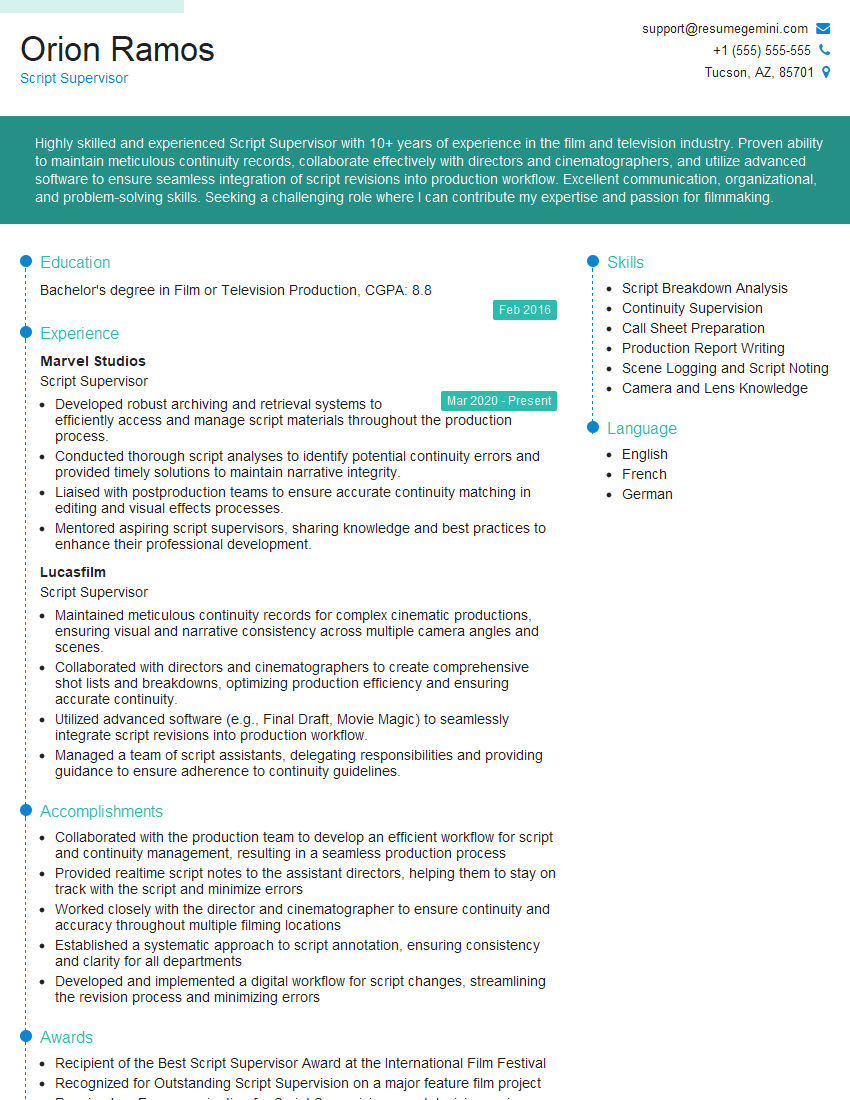
Mastering On-Set Script Supervision opens doors to exciting opportunities in film and television, leading to fulfilling careers with increasing responsibility and creative input. To maximize your job prospects, crafting a strong, ATS-friendly resume is crucial. ResumeGemini can significantly enhance your resume-building experience, helping you present your skills and experience effectively. We provide examples of resumes tailored specifically to On-Set Script Supervision to guide you. Invest in your future – create a resume that showcases your potential and lands you that dream interview!
Explore more articles
Users Rating of Our Blogs
Share Your Experience
We value your feedback! Please rate our content and share your thoughts (optional).
What Readers Say About Our Blog
Really detailed insights and content, thank you for writing this detailed article.
IT gave me an insight and words to use and be able to think of examples