Are you ready to stand out in your next interview? Understanding and preparing for Optical Measurements interview questions is a game-changer. In this blog, we’ve compiled key questions and expert advice to help you showcase your skills with confidence and precision. Let’s get started on your journey to acing the interview.
Questions Asked in Optical Measurements Interview
Q 1. Explain the principles of interferometry.
Interferometry is a powerful technique that exploits the wave nature of light to make incredibly precise measurements. At its core, it involves the superposition of two or more light waves, creating an interference pattern – a variation in intensity due to constructive and destructive interference. This pattern is highly sensitive to changes in the optical path length of the interfering waves, allowing for the detection of minute displacements, refractive index changes, and surface irregularities.
Imagine dropping two pebbles into a still pond. The resulting ripples interfere, creating areas of high and low wave amplitude. Interferometry is analogous, but with light waves. The interference pattern, often visualized as bright and dark fringes, provides information about the optical path difference between the interfering beams.
There are various types of interferometers, each designed for specific applications. Michelson interferometers are widely used for measuring wavelengths and refractive indices. Fabry-Perot interferometers are known for their high spectral resolution, enabling precise measurement of spectral line widths. Mach-Zehnder interferometers find applications in optical sensing and fiber optic communication.
Q 2. Describe different types of optical sensors and their applications.
Optical sensors utilize light to detect and measure physical, chemical, or biological parameters. A vast array of these sensors exist, each with specific applications:
- Photodiodes: Convert light intensity into an electrical signal. Widely used in light meters, optical power meters, and various imaging systems.
- Phototransistors: Similar to photodiodes but with internal amplification, making them sensitive to low light levels. Used in optical switches and proximity sensors.
- Fiber Bragg Grating (FBG) sensors: Changes in temperature or strain alter the Bragg wavelength of the grating, which can be measured using a spectrometer. Applications include structural health monitoring and pipeline monitoring.
- Optical Fiber Sensors (various types): Leverage changes in light propagation within optical fibers to sense physical quantities like temperature, pressure, and strain. Used in diverse applications from medical diagnostics to environmental monitoring.
- Surface Plasmon Resonance (SPR) sensors: Detect changes in the refractive index near a metal surface, which is highly sensitive to molecular binding events. Crucial in biosensing and medical diagnostics.
The choice of sensor depends entirely on the application. For instance, a simple photodiode would suffice for measuring light intensity, whereas an FBG sensor would be better suited for distributed temperature sensing along a long cable.
Q 3. How does a spectrometer work, and what are its limitations?
A spectrometer is an instrument that separates and measures the intensity of light at different wavelengths. This allows us to analyze the spectral composition of light sources, providing crucial information about the material properties and chemical composition of the light source.
Spectrometers typically employ a dispersive element (like a prism or diffraction grating) to spatially separate the wavelengths. A detector array then measures the intensity at each wavelength. The resulting spectrum, a plot of intensity versus wavelength, is analyzed to identify the components present.
Limitations include:
- Resolution: The ability to distinguish between closely spaced wavelengths is limited by the spectrometer’s design. Higher resolution requires more sophisticated and often more expensive instruments.
- Sensitivity: The minimum detectable signal strength is limited by noise and detector sensitivity. Weak signals can be challenging to measure accurately.
- Dynamic Range: The range of intensity levels a spectrometer can accurately measure is limited. Strong and weak signals might require different settings or even different instruments.
- Wavelength Range: Different spectrometers are designed for different wavelength ranges. Choosing the appropriate spectrometer for the specific application is crucial.
For example, Raman spectroscopy uses spectrometers to analyze the vibrational modes of molecules, providing valuable information about their structure and composition. This has profound applications in various fields, including chemistry, material science, and medicine.
Q 4. What are the different types of optical fibers and their properties?
Optical fibers are thin, flexible, transparent fibers used to transmit light over long distances with minimal loss. Different types exist, categorized by their construction and properties:
- Single-mode fibers: Support only one propagation mode of light, enabling long-distance transmission with minimal signal distortion. Ideal for high-bandwidth applications like telecommunications.
- Multi-mode fibers: Support multiple propagation modes, leading to greater signal dispersion over long distances, limiting their bandwidth capabilities. Often used in shorter-distance applications and industrial settings.
- Step-index fibers: Have a sharp change in refractive index at the core-cladding boundary. Simple to manufacture but suffer from higher dispersion.
- Graded-index fibers: The refractive index gradually decreases from the core center to the cladding. This reduces modal dispersion, making them suitable for intermediate distances.
- Plastic optical fibers (POF): Made from polymer materials, offer advantages like flexibility and ease of handling, but typically have higher attenuation compared to glass fibers.
The properties that differentiate these fibers include numerical aperture (NA), which determines the light-gathering ability, and attenuation, representing the signal loss per unit length. Selecting the appropriate fiber type is crucial for optimizing signal transmission in various applications.
Q 5. Explain the concept of optical resolution and its importance.
Optical resolution refers to the ability of an optical system to distinguish between two closely spaced points or lines. It’s often expressed as the minimum separation between two points that can be resolved as distinct entities.
Imagine trying to read text from a distance. As you move further away, the letters become blurry and eventually indistinguishable. The limit at which you can still distinguish individual letters represents the resolution of your eyes (or the optical system in this case). Similarly, in microscopy, a higher resolution allows for the visualization of finer details within a sample.
Optical resolution is determined by factors such as the wavelength of light used and the numerical aperture (NA) of the optical system. The Rayleigh criterion provides a quantitative measure of the minimum resolvable distance. A higher resolution is crucial in applications like microscopy, astronomy, and lithography, where resolving fine details is paramount. For example, in medical imaging, higher resolution allows for more accurate diagnosis.
Q 6. How do you calibrate optical instruments?
Calibrating optical instruments is essential for ensuring accuracy and reliability. The process involves comparing the instrument’s readings to known standards and adjusting the instrument to minimize discrepancies.
The specific calibration procedure depends on the type of instrument. For instance, calibrating a spectrometer might involve using a light source with known spectral lines. The instrument’s readings are then compared to the known values, and adjustments are made to the instrument’s settings to correct any deviations. Similarly, optical power meters are calibrated using traceable power standards. A step-by-step approach typically includes:
- Establishing traceability: Linking the calibration to national or international standards ensures the accuracy and reliability of the results.
- Using standard references: Employing certified reference materials or standards is crucial for accurate calibration.
- Performing adjustments: Adjusting instrument parameters (e.g., gain, offset) based on comparisons to the standards.
- Documenting the process: Maintaining a detailed record of the calibration procedure, including dates, results, and any adjustments made, is essential for quality control.
Regular calibration is essential for maintaining the accuracy of optical instruments and ensuring reliable results. The frequency of calibration depends on the instrument’s usage and the required accuracy level.
Q 7. Describe different methods for measuring optical power.
Measuring optical power involves determining the amount of light energy flowing through an optical system. Several methods exist, each with advantages and disadvantages:
- Thermal detectors: Measure the heating effect of light, relying on the conversion of light energy into heat. These are relatively simple and inexpensive, but slower response times limit their suitability for high-speed measurements.
- Photodetectors: Convert light energy into an electrical signal. These include photodiodes, phototransistors, and photomultiplier tubes (PMTs). Photodiodes are widely used for their wide dynamic range and good linearity, while PMTs offer excellent sensitivity for low-light applications. The choice depends on the power level and required speed.
- Power meters: Combine photodetectors with signal processing electronics to directly measure and display the optical power. They are available in various forms, from basic units for measuring laser power to sophisticated systems capable of measuring optical power over a broad wavelength range.
- Calorimetric methods: Extremely precise techniques that measure the heat generated by the absorbed light. While highly accurate, they are usually complex and slower compared to other methods.
The selection of a suitable method depends on the specific application requirements, such as the wavelength of light, the power level being measured, the required accuracy, and the speed of measurement. For example, a simple photodiode-based power meter is suitable for many routine laboratory measurements, while a calorimetric method would be preferred for high-accuracy measurements in metrology.
Q 8. What is the significance of the Abbe number in optical design?
The Abbe number, also known as the V-number, is a crucial parameter in optical design that quantifies the dispersion of an optical material. It represents the material’s ability to separate different wavelengths of light. A higher Abbe number indicates lower dispersion, meaning the material refracts different wavelengths more similarly. This is vital because chromatic aberration, a blurring effect caused by different wavelengths focusing at different points, is directly related to dispersion.
Imagine a prism: Highly dispersive materials (low Abbe number) will spread the light into a wide rainbow, while materials with a high Abbe number will produce a more compact spectrum. In lens design, we often choose materials with high Abbe numbers for achromatic lenses – lenses designed to minimize chromatic aberration. For example, a typical crown glass might have an Abbe number around 60, while a flint glass used in conjunction might have an Abbe number around 35. The combination allows for the correction of chromatic aberration. Choosing appropriate materials based on their Abbe number is essential for achieving high image quality in optical systems.
Q 9. How do you handle stray light in optical measurements?
Stray light, or unwanted light, significantly degrades the quality of optical measurements by introducing noise and reducing contrast. Handling it effectively is crucial for accurate results. Several strategies are employed:
- Baffles and light traps: These physical obstructions strategically placed within the optical path block stray light from reaching the detector.
- Apertures and spatial filtering: These limit the acceptance angle of the optical system, reducing the amount of off-axis light entering the system.
- Black coatings: Applying absorptive black coatings to internal surfaces minimizes reflections and scattering of light.
- Careful environmental control: Minimizing ambient light sources in the measurement environment is essential.
- Software correction: Advanced image processing techniques can sometimes compensate for stray light, but this is typically less effective than preventative measures.
For instance, in astronomical imaging, stray light from the sun or moon can significantly impact the ability to detect faint celestial objects. Careful baffling and the use of specialized coatings are critical in these applications.
Q 10. Explain the concept of diffraction and its effect on optical systems.
Diffraction is a wave phenomenon where light bends around obstacles or spreads out after passing through an aperture. This bending is not a result of refraction (change of speed when passing between media), but rather a fundamental property of waves. In optical systems, diffraction limits the achievable resolution and introduces artifacts in the image.
Think of throwing a ball through a small hole: it won’t go straight through; it will spread out slightly. Similarly, light passing through a lens aperture or around a small object diffracts, creating a characteristic diffraction pattern. This pattern consists of a central bright spot (Airy disk) surrounded by weaker concentric rings. The size of the Airy disk determines the minimum resolvable distance in an optical system, defining the diffraction limit. The smaller the aperture, the larger the diffraction effect and the lower the resolution. Therefore, the design of optical systems involves a balance between minimizing diffraction effects (by using larger apertures) and managing other aberrations (like spherical aberration).
Q 11. Describe different techniques for measuring refractive index.
Several techniques exist for measuring the refractive index (n), a material property indicating how much light slows down when passing through it. These include:
- Refractometry: This is a widely used method employing a refractometer, an instrument that measures the critical angle of total internal reflection of light at the interface between the material and a known medium (e.g., air). The refractive index is then calculated from Snell’s law.
- Interferometry: This technique uses interference patterns to determine the optical path length through the material. By comparing the path length in the material to that in a known medium, the refractive index can be determined with high precision.
- Ellipsometry: This technique measures the change in polarization of light upon reflection from a material’s surface. This change is sensitive to the refractive index and thickness of the material, allowing for simultaneous measurement of both.
- Prism coupler methods: These methods involve coupling light into a thin film or waveguide of the material and measuring the coupling angle. The refractive index can then be calculated based on the coupling angle and the geometry of the setup.
The choice of method depends on the material’s properties, the required precision, and the available resources. For instance, refractometry is a simple and widely available technique suitable for many applications, while interferometry offers higher precision for demanding applications.
Q 12. How do you characterize the performance of an optical lens?
Characterizing the performance of an optical lens involves evaluating several key parameters. These parameters depend on the specific application but often include:
- Focal length: The distance between the lens and its focal point.
- f-number (f/#): The ratio of the focal length to the effective aperture diameter. It indicates the light-gathering ability and depth of field.
- Spot size and Modulation Transfer Function (MTF): These describe the image resolution and sharpness. A smaller spot size and higher MTF generally imply better resolution.
- Distortion: Measures how much the image is geometrically deformed (e.g., barrel or pincushion distortion).
- Chromatic aberration: Evaluates the presence of color fringing caused by dispersion.
- Transmission: Indicates the percentage of light that passes through the lens.
These parameters are often measured using specialized instruments like interferometers, optical benches, and MTF measurement systems. For example, in camera lens design, high resolution, low distortion, and minimal chromatic aberration are crucial parameters.
Q 13. What are the common sources of error in optical measurements?
Several sources of error can affect optical measurements. These include:
- Environmental factors: Temperature fluctuations, vibrations, and air currents can all introduce errors.
- Instrument limitations: The precision and accuracy of the measuring instrument itself are crucial. Calibration and regular maintenance are essential.
- Alignment errors: Improper alignment of optical components can significantly impact the results.
- Wavelength dependence: Optical properties can vary with the wavelength of light, requiring careful consideration.
- Scattering and absorption: Light scattering and absorption within the optical components or the sample can lead to inaccuracies.
- Operator error: Human error in measurement, data recording, or instrument operation can affect the results.
For example, in microscopy, thermal drift can cause sample movement and blurring, while incorrect lens alignment can lead to focusing errors.
Q 14. How do you mitigate the effects of environmental factors on optical measurements?
Mitigating the effects of environmental factors on optical measurements is crucial for achieving high accuracy. Several strategies can be employed:
- Temperature control: Maintaining a stable temperature using temperature-controlled chambers or enclosures helps minimize thermal drift and variations in material properties.
- Vibration isolation: Using vibration isolation tables or systems minimizes vibrations that can affect the alignment and stability of the optical setup.
- Airflow control: Minimizing air currents within the measurement environment reduces disturbances caused by variations in refractive index.
- Enclosure design: Designing enclosures that shield the optical system from external light sources and environmental changes is vital.
- Active stabilization systems: Sophisticated systems can actively compensate for environmental fluctuations by adjusting the optical setup in real-time.
For example, in precision interferometry, vibration isolation is particularly important as even minute vibrations can introduce significant errors in the measurement of optical path differences. A well-designed enclosure with temperature and airflow control is often essential.
Q 15. Explain different methods for measuring optical scattering.
Measuring optical scattering involves quantifying the amount of light deviated from its original path due to interactions with a medium. Several methods exist, each suited to different scattering strengths and sample types.
Nephelometry: This technique measures the intensity of scattered light at a specific angle, typically 90 degrees. It’s widely used for measuring relatively strong scattering, such as in turbid solutions or suspensions. Imagine shining a flashlight into a cloudy glass of water; nephelometry measures the light scattered sideways.
Turbidimetry: This method measures the reduction in transmitted light intensity caused by scattering. It’s suitable for samples with moderate to strong scattering. Think of shining a flashlight through the same cloudy water – turbidimetry measures how much light makes it through.
Dynamic Light Scattering (DLS): DLS analyzes the fluctuations in scattered light intensity due to Brownian motion of particles in a solution. This allows for the determination of particle size and size distribution. It’s excellent for characterizing nanoparticles or macromolecules in solution.
Static Light Scattering (SLS): SLS measures the time-averaged intensity of scattered light at various angles to determine the molecular weight, size, and conformation of macromolecules in solution. It provides complementary information to DLS.
Angular-resolved scattering: This involves measuring the scattered light intensity over a range of angles. This provides detailed information about the size, shape, and internal structure of scattering particles. It’s frequently used in characterizing surfaces and thin films.
The choice of method depends heavily on the sample properties and the desired information. For example, nephelometry is simple and fast, while angular-resolved scattering provides more detailed structural information but requires more complex instrumentation.
Career Expert Tips:
- Ace those interviews! Prepare effectively by reviewing the Top 50 Most Common Interview Questions on ResumeGemini.
- Navigate your job search with confidence! Explore a wide range of Career Tips on ResumeGemini. Learn about common challenges and recommendations to overcome them.
- Craft the perfect resume! Master the Art of Resume Writing with ResumeGemini’s guide. Showcase your unique qualifications and achievements effectively.
- Don’t miss out on holiday savings! Build your dream resume with ResumeGemini’s ATS optimized templates.
Q 16. What is the difference between coherent and incoherent light sources?
The key difference between coherent and incoherent light sources lies in the relationship between the phases of the emitted electromagnetic waves.
Coherent Light Sources: Emit light waves with a fixed phase relationship. This means the waves maintain a consistent relationship between their crests and troughs over time and space. Lasers are the quintessential example of coherent light sources. Their highly organized waves enable phenomena like interference and holography.
Incoherent Light Sources: Emit light waves with random phase relationships. The crests and troughs of the waves are not synchronized. Incandescent light bulbs and LEDs are examples of incoherent light sources. The lack of phase correlation limits interference effects.
Consider this analogy: a coherent light source is like a well-drilled marching band, where all the musicians step in perfect unison. An incoherent source is more like a crowd cheering – each person’s actions are independent and uncoordinated.
The choice of light source dramatically impacts the performance of optical systems. Coherent sources are essential for applications like interferometry and holography, while incoherent sources are suitable for applications where spatial coherence isn’t crucial, such as microscopy.
Q 17. Describe the principles of optical microscopy.
Optical microscopy relies on the principles of light refraction and magnification to visualize objects that are too small to be seen with the naked eye. Different types of optical microscopes utilize various techniques to enhance contrast and resolution.
Basic Principle: A light source illuminates the sample. The light then passes through a series of lenses (objective and eyepiece) that magnify the image of the sample. The objective lens forms a real, inverted image, which is further magnified by the eyepiece to create a virtual image for the observer.
Resolution: The ability to distinguish between two closely spaced objects is determined by the wavelength of light used and the numerical aperture (NA) of the objective lens. Higher NA objectives provide better resolution.
Contrast Enhancement Techniques: Several techniques enhance contrast, making features more visible. These include bright-field, dark-field, phase-contrast, and differential interference contrast (DIC) microscopy. Each method manipulates the light path to highlight different aspects of the sample.
For instance, bright-field microscopy uses direct transmitted light, while dark-field microscopy uses scattered light to enhance contrast. Phase-contrast microscopy utilizes differences in refractive index to visualize transparent samples. DIC microscopy enhances contrast by highlighting variations in refractive index gradients.
Optical microscopy finds extensive applications in biology, materials science, and various other fields, providing crucial insights into the microstructure of materials and biological specimens.
Q 18. Explain the concept of polarization and its importance in optical measurements.
Polarization refers to the orientation of the electric field vector of an electromagnetic wave. Unpolarized light has electric field vectors vibrating in all directions perpendicular to the direction of propagation. Polarized light has its electric field vector oscillating predominantly in a single direction.
Types of Polarization: Linear polarization (electric field oscillates along a single line), circular polarization (electric field vector rotates in a circle), and elliptical polarization (electric field vector traces an ellipse).
Importance in Optical Measurements: Polarization plays a crucial role in many optical measurements because it allows for the selective manipulation of light.
Applications: Polarization is utilized in stress analysis (photoelasticity), where birefringent materials under stress exhibit polarization changes. It’s also fundamental in ellipsometry, a technique used to measure the thickness and refractive index of thin films. Polarized light microscopy enhances contrast and provides information about the anisotropic properties of samples.
Imagine light as a rope vibrating. Unpolarized light is like a rope shaking chaotically in all directions. Polarized light is like a rope shaking only up and down.
By controlling the polarization state, we can enhance signal-to-noise ratio, eliminate unwanted reflections, and gain specific information about the sample’s optical properties, making it an essential tool in a broad range of optical measurements.
Q 19. How do you align optical components in an optical system?
Aligning optical components is crucial for optimal performance and minimizing aberrations in an optical system. The process involves carefully positioning and orienting components to ensure light travels along the desired path.
Collimation: The process of making light rays parallel. This is often the first step, using lenses or collimators.
Spatial Alignment: Positioning components on the optical axis (the central path of light). This often involves mechanical adjustments, using translation stages and mounts.
Angular Alignment: Ensuring the proper orientation of components to minimize misalignment of the optical beam. This is done using tilt stages and precise angular adjustments.
Techniques: Several techniques are used, including using a laser pointer to trace the light path, employing autocollimators for precise angular alignment, and using beam profilers to analyze beam quality.
Aligning an optical system is like building a precise track for a train. Each component must be positioned correctly, ensuring the train (light) follows the designated path.
Careful alignment is critical for achieving the desired optical performance. Misalignment can lead to reduced intensity, increased aberrations, and inaccurate measurements. Precision alignment often involves iterative adjustments and the use of specialized tools.
Q 20. What are the common types of optical filters and their applications?
Optical filters selectively transmit or block specific wavelengths or polarization states of light. Various types cater to diverse applications.
Bandpass Filters: Transmit light within a specific wavelength range and block light outside this range. These are frequently used in spectroscopy and fluorescence microscopy to isolate specific emission wavelengths.
Longpass Filters: Transmit light above a certain cutoff wavelength and block light below it. These are commonly used to remove unwanted short-wavelength radiation.
Shortpass Filters: Transmit light below a certain cutoff wavelength and block light above it. These are used to remove unwanted long-wavelength radiation.
Neutral Density (ND) Filters: Attenuate light intensity across a broad spectral range without significantly altering the spectral distribution. These are used to control light levels in optical systems.
Polarizing Filters: Transmit light of a specific polarization state and block light of orthogonal polarization. These are used to control polarization in optical systems and eliminate unwanted reflections.
Consider a color filter on a camera lens; this is a simple bandpass filter allowing only certain wavelengths to pass. Similarly, polarizing sunglasses act as polarizing filters, reducing glare.
The choice of filter depends heavily on the application. Spectroscopy often requires narrow bandpass filters for high spectral resolution, while microscopy may use longpass filters to isolate fluorescence emission.
Q 21. Describe different methods for measuring optical losses.
Optical losses refer to the reduction in light intensity as it propagates through an optical system. Several methods exist to measure these losses.
Power Meter Measurements: A simple and direct method, measuring the optical power before and after a component or system. The difference represents the loss.
Cutback Method: Involves measuring the power transmitted through a fiber optic cable of a known length, then cutting back a section and measuring again. The difference provides the loss per unit length.
Optical Time-Domain Reflectometry (OTDR): This technique uses backscattered light to measure the location and magnitude of losses along an optical fiber. It provides detailed information about loss profiles and fault locations.
Insertion Loss Measurements: Involves measuring the transmitted power with and without the component inserted into the optical path. The difference represents the insertion loss.
Scatterometry: Measures the light scattered from a surface to assess losses caused by scattering. This technique is particularly useful for characterizing surface roughness and its contribution to optical losses.
Imagine a water pipe – optical loss is like the leakage of water along the pipe. Power meters directly measure the remaining water, while the cutback method assesses the leakage rate.
The method selected will depend on the specific scenario. For simple systems, a power meter is sufficient. For complex systems or fiber optics, OTDR is a more powerful and versatile technique.
Q 22. Explain the concept of optical coherence tomography (OCT).
Optical Coherence Tomography (OCT) is a non-invasive imaging technique that uses low-coherence interferometry to obtain high-resolution cross-sectional images of internal microstructure. Think of it like an ultrasound, but using light instead of sound waves. A light source emits a broad spectrum of light, which is then split into two beams: one that reflects off a reference mirror, and another that reflects off the sample being imaged. The reflected beams are then recombined, and the interference pattern created is analyzed to reconstruct the sample’s structure.
The key here is the ‘low coherence’. This means that the light source only interferes constructively when the path lengths of the two beams are nearly identical. This allows for precise depth resolution, making it possible to image the internal structures of translucent or transparent samples. Different wavelengths of light provide various penetration depths and resolutions.
OCT is widely used in ophthalmology to image the retina and optic nerve, in cardiology to image coronary arteries, and in dermatology to image skin lesions. The high resolution and non-invasive nature make it a valuable tool in various medical fields.
Q 23. How do you analyze data obtained from optical measurements?
Analyzing data from optical measurements often involves several steps, beginning with data acquisition and preprocessing. Preprocessing might involve noise reduction techniques like averaging or filtering. We then move to feature extraction, which can involve extracting relevant parameters from the raw data, such as intensity, phase, or polarization. This is often highly dependent on the specific measurement type and the information you are seeking. For example, if we were analyzing data from a spectrometer, we might extract peak positions and intensities. Finally, data interpretation involves relating these extracted features to physical properties. This might involve comparing measured values to theoretical models or calibrated standards, or applying statistical analysis to assess significance and reliability. Visualisation through plotting and image processing can significantly aid in this stage.
Sophisticated algorithms, often implemented in specialized software, are used in this process. For instance, Fourier transforms are fundamental in analyzing interferometric data from techniques like OCT and Michelson interferometry. Curve fitting and regression techniques are used for calibrations and extracting parameters from spectral data.
Q 24. What software packages are you familiar with for optical simulations and analysis?
I’m proficient in several software packages for optical simulations and analysis. These include:
- MATLAB: A powerful platform with extensive toolboxes for signal processing, image processing, and numerical computation, vital for analyzing data and creating custom algorithms.
- COMSOL Multiphysics: Excellent for complex simulations involving light propagation in various media, helpful for designing and optimizing optical systems.
- Zemax OpticStudio: A dedicated optical design software, useful for simulating optical systems, including designing lenses and other optical components.
- LabVIEW: Ideal for instrument control and data acquisition, particularly for automated optical measurement systems. It allows for user-friendly graphical programming of complex experiments.
My experience encompasses using these packages to simulate, model and analyze diverse types of optical experiments and data.
Q 25. Describe a challenging optical measurement problem you have solved.
One challenging problem involved measuring the extremely low reflectivity of a novel metamaterial. The reflectivity was several orders of magnitude lower than the noise floor of our initial measurement setup. To overcome this, we implemented several strategies. Firstly, we improved the stability of our laser source and minimized environmental noise affecting the system. Secondly, we employed a lock-in amplifier to selectively amplify the weak signal from the metamaterial, isolating it from the background noise. This involved modulating the incident light and detecting the corresponding modulated component in the reflected signal, enhancing the signal-to-noise ratio dramatically. Finally, we carefully calibrated our system using known highly reflective standards, accounting for any systematics. Through a combination of meticulous experimental design and advanced signal processing techniques, we successfully measured the reflectivity with acceptable precision and accuracy.
Q 26. How do you ensure the accuracy and precision of optical measurements?
Ensuring accuracy and precision in optical measurements requires a multi-pronged approach. Firstly, meticulous calibration is crucial. We use traceable standards to calibrate our instruments and regularly check for drifts or inconsistencies. Secondly, environmental control plays a significant role; temperature fluctuations, vibrations, and air currents can all introduce errors. We carefully control these environmental factors to minimize their effects. Thirdly, proper error analysis is essential. We propagate uncertainties through our calculations, quantifying the uncertainty associated with each measurement and the final results. We also use statistical methods like least-squares fitting to analyze data and estimate parameters. Lastly, employing rigorous quality control procedures is essential to ensure the reliability and consistency of our measurements, which includes regularly checking the functionality and accuracy of all equipment.
Q 27. Explain the principle of operation of a Michelson interferometer.
The Michelson interferometer is a classic device used to measure the wavelengths of light or small distances with high precision. A beam of light is split by a beam splitter into two beams that travel different paths. One beam travels to a fixed mirror, while the other travels to a movable mirror. These beams are then recombined by the same beam splitter, and an interference pattern is observed. The interference pattern’s contrast depends on the difference in the path lengths traveled by the two beams. If the path lengths are equal, constructive interference leads to bright fringes, while unequal path lengths result in destructive interference and dark fringes. By carefully controlling the distance of the movable mirror, and observing changes in the interference pattern, one can measure small displacements with extreme accuracy.
Think of it like two synchronized waves on a lake. If they arrive at the same point at the same time, they reinforce each other (constructive interference). If they arrive at slightly different times, they might cancel each other out (destructive interference). The Michelson interferometer uses this principle with light waves to achieve incredibly accurate measurements.
Q 28. What are the advantages and disadvantages of different optical measurement techniques?
Different optical measurement techniques each have their own advantages and disadvantages. For example, consider:
- Spectroscopy: Provides information about the material’s composition and its chemical and physical properties. However, it might not provide spatial resolution.
- Interferometry: Offers high precision measurements of distance and shape, but is sensitive to environmental conditions and can be complex to implement.
- Scatterometry: Useful for measuring surface roughness and other microstructural features, but it can be less sensitive than other techniques.
- Ellipsometry: Precisely measures the optical properties of thin films. It is very sensitive to surface conditions, but data analysis can be complex.
The choice of technique depends heavily on the specific application and the type of information required. There’s no universally ‘best’ technique; the optimal choice involves careful consideration of factors like required resolution, measurement speed, sensitivity, system complexity, and cost.
Key Topics to Learn for Optical Measurements Interview
- Fundamentals of Light and Optics: Understanding wave-particle duality, Snell’s Law, reflection, refraction, diffraction, and interference is crucial. Consider exploring polarization and coherence as well.
- Optical Instruments and Techniques: Familiarize yourself with the principles and applications of various instruments like spectrophotometers, interferometers, ellipsometers, and microscopes. Be prepared to discuss their operational principles and limitations.
- Optical Fiber Communications: Understand the principles of light propagation in optical fibers, including attenuation, dispersion, and various types of optical fibers. This is particularly relevant for many optical measurement roles.
- Spectroscopy and its Applications: Learn about different spectroscopic techniques (UV-Vis, IR, Raman) and their uses in material characterization, chemical analysis, and biological imaging.
- Laser-Based Measurements: Become comfortable with laser principles and their use in various applications, such as laser distance measurement, laser velocimetry, and laser-induced breakdown spectroscopy.
- Image Processing and Analysis: Many optical measurement techniques involve image acquisition and analysis. Develop an understanding of basic image processing techniques relevant to your specific area of interest.
- Data Analysis and Interpretation: Mastering data analysis techniques, including error analysis and statistical methods, is essential for interpreting results from optical measurements accurately.
- Problem-Solving and Troubleshooting: Prepare to discuss your approach to solving practical problems encountered in optical measurement setups and experiments. Highlight your ability to identify and resolve issues effectively.
Next Steps
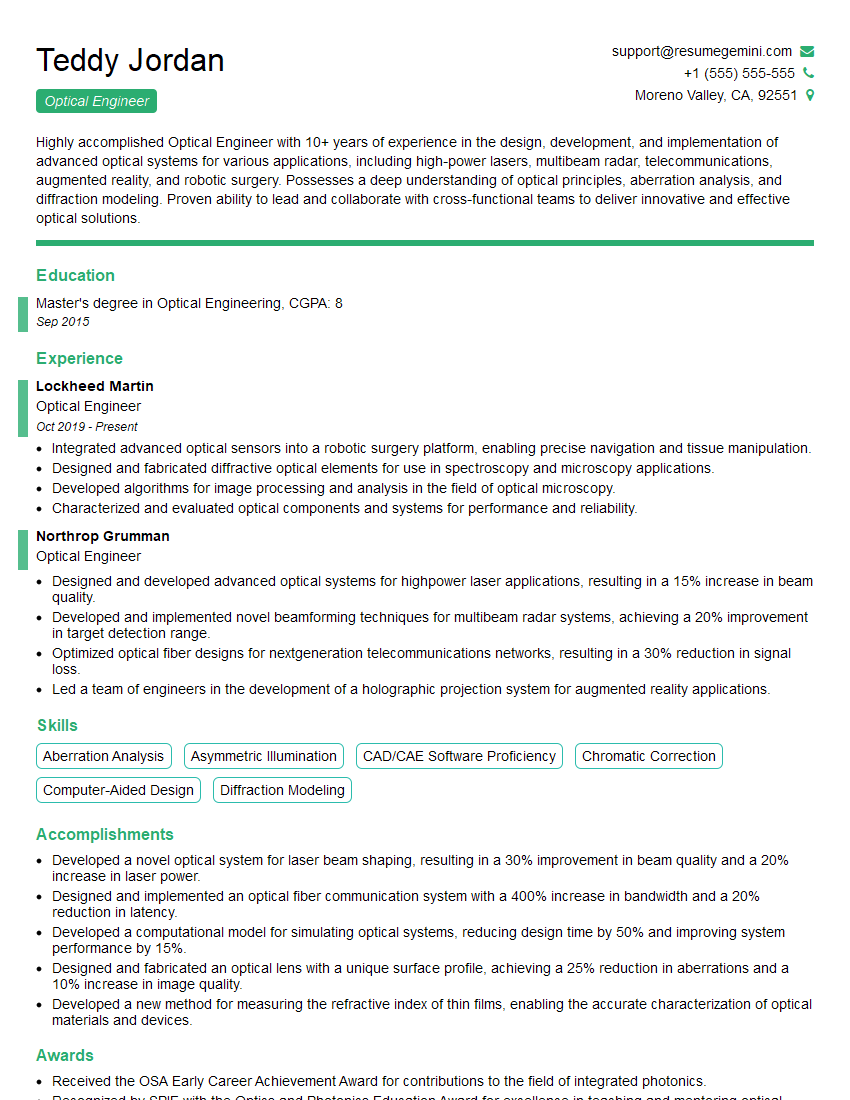
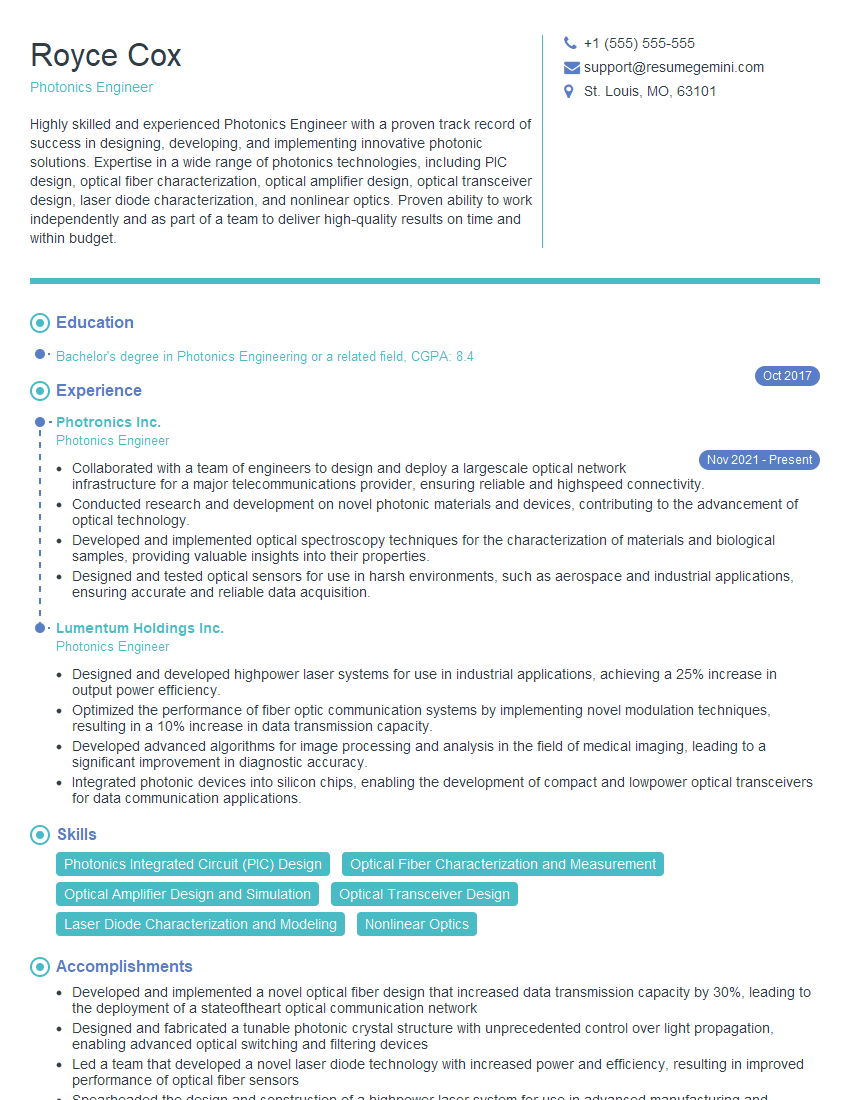
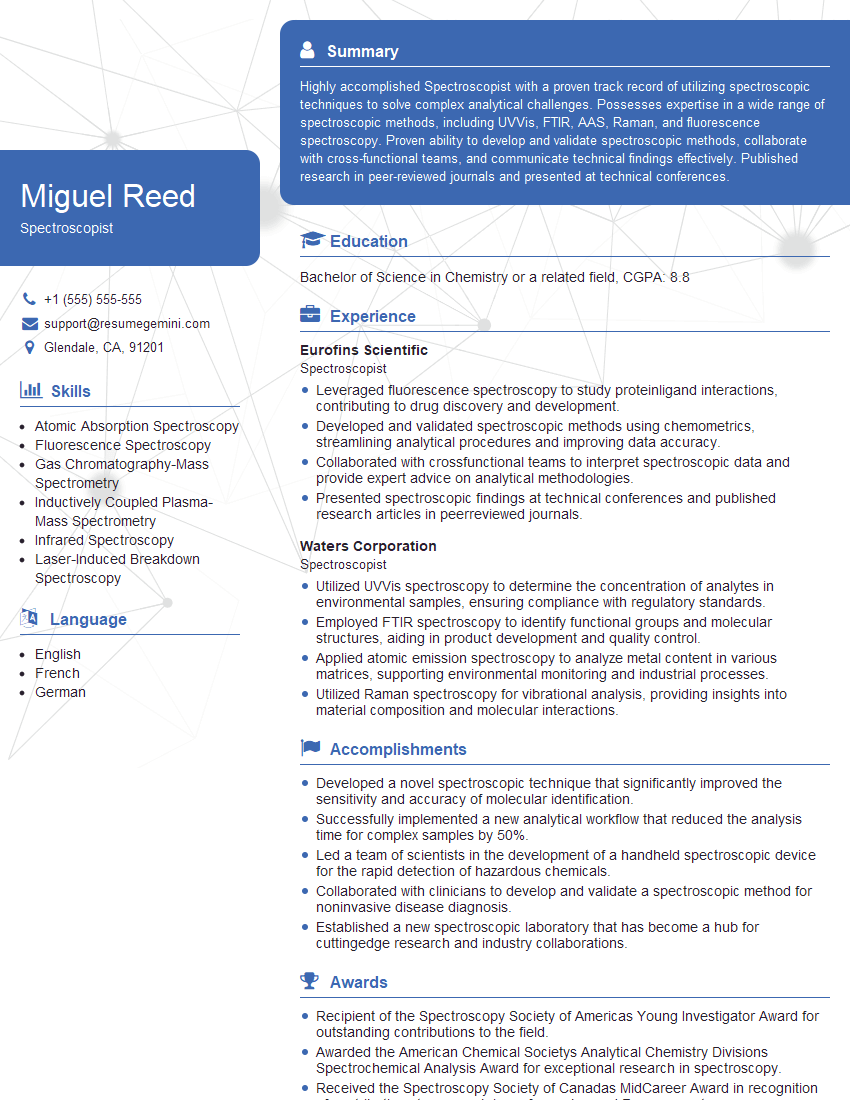
Mastering optical measurements opens doors to exciting careers in diverse fields, offering significant growth potential and opportunities for innovation. To maximize your job prospects, creating a compelling and ATS-friendly resume is essential. ResumeGemini can be a trusted partner in this process, helping you build a professional resume that showcases your skills and experience effectively. Examples of resumes tailored to Optical Measurements are available to help you get started. Invest time in crafting a strong resume – it’s your first impression on potential employers.


Explore more articles
Users Rating of Our Blogs
Share Your Experience
We value your feedback! Please rate our content and share your thoughts (optional).
What Readers Say About Our Blog
Really detailed insights and content, thank you for writing this detailed article.
IT gave me an insight and words to use and be able to think of examples