Cracking a skill-specific interview, like one for Paper Hanging, requires understanding the nuances of the role. In this blog, we present the questions you’re most likely to encounter, along with insights into how to answer them effectively. Let’s ensure you’re ready to make a strong impression.
Questions Asked in Paper Hanging Interview
Q 1. What types of wallpaper have you worked with (e.g., vinyl, fabric, grasscloth)?
Over my years as a professional paperhanger, I’ve worked extensively with a wide variety of wallpapers. This includes the most common types like vinyl, known for its durability and washability, making it ideal for high-traffic areas like hallways or kitchens. I’ve also had significant experience with fabric wallpapers, which offer a luxurious look and feel, but require more delicate handling. These can range from lightweight linen-look to heavier, more textured options. Grasscloth wallpaper, a natural fiber wallpaper, presents a unique challenge due to its texture and often requires specialized techniques. Finally, I’ve worked with non-woven wallpapers, which are becoming increasingly popular due to their ease of installation; the paste is applied directly to the wall, eliminating the need to paste the paper itself. Each type demands a slightly different approach, from paste selection to application techniques.
Q 2. Describe your experience with different paste applications.
Paste application is crucial for a successful wallpaper installation. I’m proficient in various methods. For pre-pasted wallpapers, I’m well-versed in the activation process, ensuring the paper is properly hydrated before application to prevent tearing or bubbling. With traditional paste, I meticulously apply a consistent layer using a paste brush or roller, avoiding excess to prevent seepage or staining. I’ve also used different types of paste depending on the wallpaper material, for example, a heavier paste for grasscloth to provide better support. The key is always to follow the manufacturer’s instructions specific to the type of wallpaper being used. A good paste application ensures a smooth, wrinkle-free finish and a long-lasting result.
Q 3. How do you prepare a wall for wallpaper installation?
Wall preparation is the foundation of a professional wallpaper job. I start by thoroughly cleaning the walls to remove any dust, dirt, grease, or loose paint. This might involve washing with a TSP solution (trisodium phosphate) followed by a thorough rinsing. Any imperfections, such as holes or cracks, need to be repaired using filler and sanded smooth. Uneven surfaces should be addressed with skim coating to create a flat, stable base. For previously painted walls, checking for flaking or peeling paint is essential – removing these areas is crucial to prevent problems with adhesion. This meticulous preparation ensures proper adhesion of the wallpaper and prevents future issues like bubbling or peeling.
Q 4. What tools and materials are essential for efficient paperhanging?
Having the right tools is essential for efficiency and a quality finish. My essential toolkit includes a measuring tape, plumb bob or level, utility knife with sharp blades, smoothing brush, seam roller, sponge, paste brush or roller, paste bucket, and a drop cloth to protect the floor. For more intricate work, I might also use a seam scraper and a wallpaper scoring tool. Choosing high-quality tools is an investment that pays off in terms of both ease of use and the final result. For example, a sharp utility knife makes precise cuts, crucial for pattern matching. Similarly, a good quality smoothing brush avoids damaging delicate wallpapers.
Q 5. Explain your process for measuring and cutting wallpaper.
Accurate measuring and cutting are vital for minimizing waste and ensuring a professional look. I start by meticulously measuring the wall height and width, taking into account any windows, doors, or obstacles. I then add extra length to account for pattern matching and waste. For patterned wallpapers, I create a template to ensure consistent pattern placement across the walls. When cutting, I use a sharp utility knife and a straight edge for clean, precise cuts. It’s important to cut the wallpaper slightly larger than needed for easier positioning on the wall, making adjustments as needed. I always double-check measurements before cutting, especially with expensive or unique papers, to avoid costly mistakes.
Q 6. How do you handle matching patterns in wallpaper installation?
Matching patterns is a critical skill in paperhanging. I begin by carefully examining the wallpaper roll to understand the repeat pattern – how often the pattern repeats itself. This information helps me determine how much wallpaper to cut for each strip and how much excess length to add. I then meticulously align the pattern on adjacent strips, ensuring a seamless transition and avoid visible seams. This might involve hanging test strips to confirm the pattern alignment and make any necessary adjustments. For complex patterns, I use a template to precisely mark the pattern alignment on the strips, and I hang the strips slightly overlapping until the alignment is perfect before pressing down firmly to set the adhesive. The attention to detail is key for a flawless finished product.
Q 7. How do you deal with difficult wall surfaces (e.g., textured walls, uneven surfaces)?
Dealing with textured walls or uneven surfaces requires careful planning and execution. For textured walls, I may use a lightweight wallpaper that conforms to the texture more easily. Prepping textured walls properly is crucial. I fill any gaps or holes, sand thoroughly, and may use a lining paper to create a smoother base. For uneven surfaces, a skim coat of joint compound is usually needed to create a uniform surface. This ensures proper adhesion and prevents the wallpaper from highlighting the wall’s imperfections. In some cases, using a heavier wallpaper might actually help to mask minor irregularities. Thorough preparation is key to overcoming the challenges posed by less-than-perfect walls. Remember patience and attention to detail is key here!
Q 8. Describe your experience with removing old wallpaper.
Removing old wallpaper can be a surprisingly challenging task, but with the right approach, it’s manageable. The process depends heavily on the type of wallpaper and the condition of the wall underneath. For vinyl wallpaper, which is very common, I typically start by scoring the surface with a scoring tool to loosen the paper. This helps the water penetrate and break down the adhesive. Then, I apply a wallpaper remover solution, letting it soak in according to the manufacturer’s instructions – usually a few minutes. I then use a scraper, starting at a corner and working my way down, gently peeling back the layers. Sometimes, stubborn sections require a second application of remover and perhaps the use of a steamer to further soften the adhesive. For textured wallpapers, the process can be even more involved, often requiring multiple applications of remover and more aggressive scraping. I always take care to avoid damaging the drywall underneath, using plastic scrapers where necessary to protect the surface. Finally, I clean the wall thoroughly to remove any remaining adhesive residue, often using a suitable cleaning solution and sponge.
For example, on a recent project, a client had several layers of old wallpaper, including some highly textured paper. It took several hours and multiple applications of remover and steaming to get it all off, but the result was worth it: a smooth, clean surface ready for the new wallpaper.
Q 9. What safety precautions do you take during paperhanging?
Safety is paramount in my work. I always wear appropriate personal protective equipment (PPE), including safety glasses to protect my eyes from flying debris, a dust mask to prevent inhaling wallpaper dust and adhesive fumes, and work gloves to protect my hands from chemicals and sharp tools. Proper ventilation is also crucial; I often use fans to help circulate the air and remove fumes, especially when using strong chemicals. When working with ladders or elevated platforms, I ensure they are stable and secure, adhering to all safety regulations. Additionally, I take care to properly store and dispose of all chemicals and materials, ensuring that I follow all local environmental regulations.
For example, I remember a job where I was working with a very strong wallpaper remover. The fumes were potent, so I ensured I had excellent ventilation and wore a respirator to protect my lungs. This was an extra precaution, but it’s better to be safe than sorry.
Q 10. How do you ensure precise alignment and seamless transitions between wallpaper strips?
Precise alignment is key to a professional-looking wallpaper job. I begin by establishing a plumb line on the wall, using a level to ensure it’s perfectly vertical. This acts as my guide for the first strip, guaranteeing that subsequent strips will line up accurately. I use a measuring tape and pencil to carefully mark the placement of each strip, paying close attention to the pattern repeat of the wallpaper. For patterned papers, this is especially crucial. I carefully match the pattern at the seams, overlapping the edges slightly before trimming them for a seamless appearance (depending on the type of seam chosen). Using a seam roller helps to firmly press the edges together, ensuring a strong bond and minimizing the visibility of the seam. A sharp utility knife is essential for precise trimming, minimizing gaps or overlaps. For particularly challenging patterns, I may use a template to aid in precise alignment.
For instance, when working with a damask pattern, matching the pattern repeat requires precision and patience. A slight misalignment can make the entire wall look off-kilter.
Q 11. What are the common challenges you face during paperhanging, and how do you overcome them?
Challenges are common in paperhanging. Uneven walls are a frequent problem. I address this by using a smoothing tool and a wallpaper paste that offers good flexibility and hiding power. Sometimes, I may need to add extra paste to fill minor imperfections or use a lightweight lining paper before hanging the final wallpaper layer. Another common challenge is matching complex patterns, as mentioned earlier. Careful planning and precise measuring help overcome this. Wallpaper that’s prone to shrinkage or expansion can also be tricky. I address this by allowing the wallpaper to acclimatize to the room temperature before hanging and following the manufacturer’s recommendations. Sometimes, the wallpaper itself might be damaged. This requires careful inspection and selection of the best pieces to ensure a flawless result. Persistent adhesive residue from old wallpaper can also pose problems, but as mentioned in the first question, thorough cleaning before starting the new job solves this.
For example, one client had a wall with several imperfections that were noticeable even after using spackle. I tackled this by using a slightly heavier, textured wallpaper that better concealed the wall’s flaws, achieving a beautiful finish.
Q 12. Describe your experience with different types of seams (e.g., butt seams, overlap seams).
Different types of seams offer unique aesthetic results. Butt seams, where the edges of adjacent strips meet precisely, are common for solid-colored wallpapers, creating a clean, minimalist look. Overlap seams, where one strip slightly overlaps the previous one, are more suited to patterned wallpapers; they tend to camouflage any minor misalignments. The choice of seam depends on the wallpaper type, its pattern, and the desired aesthetic. My approach to each is tailored to achieve the best possible result, taking into account how the wall will look from different angles and lighting conditions. Accurate measuring and cutting are critical regardless of the seam type.
For instance, a modern, minimalist space might call for butt seams, whereas a room with a more traditional design aesthetic might work better with the softer look of overlap seams.
Q 13. How do you calculate the amount of wallpaper needed for a project?
Accurately calculating wallpaper is essential to avoid costly mistakes. I start by precisely measuring the height and width of each wall to be papered. I then add up the total square footage of all walls. Next, I account for door and window openings, subtracting their areas from the total. It is crucial to check the wallpaper’s roll dimensions and pattern repeat. The pattern repeat determines how much extra wallpaper is needed to accommodate pattern matching. A large pattern repeat will necessitate more rolls than a small one, as more waste is produced when matching the design. Finally, I add a 10-15% buffer to account for any errors, pattern matching waste, or unexpected issues. This ensures that I have sufficient material for the job.
For example, if a wall measures 10ft by 8ft, that’s 80 square feet. If the roll is 50 square feet and the pattern repeat requires an additional 5ft of material, this would need to be taken into account when calculating the total number of rolls required.
Q 14. Explain your process for cleaning up after a paperhanging job.
Cleaning up after a paperhanging job is as crucial as the hanging itself. My process begins with removing all tools and equipment from the work area. Next, I thoroughly sweep or vacuum the floor, removing any loose debris, like scraps of wallpaper or paste residue. I then wipe down the walls with a damp cloth to remove any excess paste or adhesive. All leftover paste, chemicals, and other materials are properly disposed of according to environmental regulations. Any spilled paste is cleaned up immediately to prevent it from drying and becoming difficult to remove. Finally, I do a final inspection, double checking the whole area for any missed spots or remaining debris before I leave the site.
For example, leftover wallpaper paste can be exceptionally sticky. It’s crucial to clean it promptly before it sets to avoid leaving a sticky residue on the floor or any other surfaces.
Q 15. What is your experience with border installation?
Border installation is a specialized aspect of paperhanging that demands precision and attention to detail. It involves carefully measuring, cutting, and applying decorative borders to walls, often complementing a larger wallpaper design or adding a unique accent. My experience encompasses a wide range of border types, from delicate paper borders to thicker vinyl ones, each requiring a slightly different approach.
For example, I’ve worked on projects where intricate floral borders needed meticulous alignment to create a seamless and visually stunning effect. In other projects, I’ve used wider, more robust borders to define specific areas of a room, such as above chair rails or around archways. I am proficient in various techniques, including mitering corners for a clean, professional finish, and handling intricate patterns requiring careful matching.
I’m adept at dealing with challenging situations such as uneven walls or tricky curves, ensuring the border installation remains aesthetically pleasing and structurally sound.
Career Expert Tips:
- Ace those interviews! Prepare effectively by reviewing the Top 50 Most Common Interview Questions on ResumeGemini.
- Navigate your job search with confidence! Explore a wide range of Career Tips on ResumeGemini. Learn about common challenges and recommendations to overcome them.
- Craft the perfect resume! Master the Art of Resume Writing with ResumeGemini’s guide. Showcase your unique qualifications and achievements effectively.
- Don’t miss out on holiday savings! Build your dream resume with ResumeGemini’s ATS optimized templates.
Q 16. How do you manage the time efficiently in a paperhanging project?
Efficient time management in paperhanging is critical for meeting deadlines and maintaining profitability. My approach involves a multi-stage process beginning with meticulous planning. This includes a thorough assessment of the space, precise measurements, and a realistic estimation of the time needed for each stage – prepping the walls, cutting and matching wallpaper, and finally, the application and drying time.
I always prioritize careful preparation. This minimizes time-consuming corrections later on. I also employ efficient cutting techniques and utilize tools that accelerate the process, such as a proper pasting table and a quality wallpaper smoothing tool. Communication with the client is key—managing expectations concerning any delays due to unforeseen circumstances such as wall imperfections or difficult-to-match patterns. Finally, maintaining a clean and organized workspace minimizes wasted time searching for materials or tools.
For instance, on a recent large-scale project, detailed planning and efficient techniques allowed us to finish ahead of schedule, exceeding client expectations and boosting our reputation.
Q 17. Describe your experience with working from blueprints or specifications.
I have extensive experience working directly from blueprints and specifications. This involves carefully reviewing the provided documentation to understand the design layout, the type of wallpaper specified, and any unique challenges the project may present. I am comfortable interpreting architectural drawings and translating them into practical, on-site actions.
For example, I’ve worked on projects where the blueprints specified specific wallpaper placement around windows, doors, and architectural features. Accurate interpretation of these details is essential for a seamless final result. I’m adept at working collaboratively with architects and interior designers to ensure the final installation accurately reflects their vision. I always confirm measurements on-site to ensure accuracy and account for any discrepancies between the blueprints and the actual space.
My ability to accurately interpret and execute based on blueprints has consistently led to projects completed on time and to the exact client specifications.
Q 18. How do you handle customer concerns or complaints during or after a job?
Handling customer concerns and complaints is paramount in providing excellent service. My approach is centered on active listening and empathy. I start by patiently hearing the client’s concerns, asking clarifying questions, and acknowledging their feelings. Then, I collaboratively identify the root cause of the issue, whether it’s a minor imperfection or a more significant problem.
For example, if a client is concerned about a slight misalignment in a pattern, I might explain the challenges involved with matching complex patterns on uneven walls and offer solutions like minor adjustments or a partial re-application. However, if the issue is more significant, I take ownership of the problem and outline a course of action to resolve it efficiently and effectively, focusing on restoring the client’s trust and satisfaction. My goal is always to find a fair and mutually acceptable solution, even if it means additional work or adjustments on my end.
Open communication and a commitment to finding a resolution build positive relationships with clients even when faced with challenges.
Q 19. What is your experience with using different types of adhesives?
My expertise spans a wide range of adhesives, each with its unique properties and application methods. I’m proficient in using both pre-pasted and unpasted wallpapers, understanding the nuances of each. Pre-pasted wallpapers offer convenience but require careful activation according to manufacturer’s instructions. Unpasted wallpapers, while requiring more manual preparation, offer greater control and are often preferred for more delicate or specialized papers.
I understand the importance of selecting the right adhesive for the specific wallpaper type and the wall surface. For example, heavy vinyl wallpapers require stronger adhesives than lighter paper options. Moreover, I’m knowledgeable about adhesives suitable for various wall surfaces, including drywall, plaster, and even textured surfaces. My experience allows me to choose the optimal adhesive to ensure a long-lasting, secure bond, preventing bubbling, peeling, or other common issues.
My selection and application of the right adhesive directly contribute to the quality and longevity of the paperhanging work.
Q 20. Explain your understanding of different wallpaper materials and their properties.
Understanding different wallpaper materials and their properties is crucial for successful paperhanging. My knowledge encompasses various types, including vinyl, non-woven, fabric, grasscloth, and natural fibers. Each material possesses distinct characteristics impacting its application and longevity.
For instance, vinyl wallpapers are durable, washable, and easy to clean, making them ideal for high-traffic areas. Non-woven wallpapers are easier to install because the adhesive is applied directly to the wall, not the wallpaper itself. Fabric wallpapers offer a luxurious texture but require specialized handling and adhesives. Grasscloth wallpapers add a natural, textured look but are more delicate and require a skilled hand. Natural fiber wallpapers bring unique aesthetics but can be more susceptible to damage from moisture.
I carefully assess the client’s needs and the room’s environment to recommend the most appropriate wallpaper material, ensuring both aesthetic appeal and practical suitability. This includes considering factors such as light exposure, humidity, and the level of maintenance required.
Q 21. How do you maintain the quality of your workmanship?
Maintaining the quality of my workmanship is a top priority. It involves a commitment to precision at every stage of the process, from meticulous preparation and measurement to careful application and finishing. I use high-quality tools and materials, ensuring that the job is done to the highest standard.
Before starting, I always thoroughly prepare the walls, addressing any imperfections, cleaning the surface, and ensuring it’s completely dry. Careful cutting and matching are essential to prevent inconsistencies and ensure a seamless finish. I pay close attention to detail during application, using specialized tools to smooth out air bubbles and ensure the wallpaper adheres properly. Finally, I meticulously clean up the workspace, leaving the area neat and tidy.
Regularly reviewing my work and seeking feedback from clients allows continuous improvement and refinement of my techniques. My commitment to quality is reflected in the lasting beauty and durability of my installations.
Q 22. What is your experience with different types of wall preparation techniques?
Proper wall preparation is the cornerstone of any successful wallpaper installation. It ensures the wallpaper adheres properly and lasts for years. My experience encompasses a range of techniques, tailored to the specific wall type and condition.
- Removing old wallpaper: This often involves steaming the paper to soften the adhesive, then carefully scraping it off using a variety of tools, from putty knives to specialized wallpaper scrapers. I always prioritize minimizing wall damage. Stubborn remnants might require a chemical wallpaper remover, applied according to manufacturer instructions. I’ve dealt with everything from single layers of delicate vintage paper to multiple layers of stubborn vinyl.
- Repairing damaged walls: Before hanging wallpaper, I meticulously assess the wall for imperfections. This includes filling holes and cracks with spackle, sanding smooth, and applying primer to ensure a uniform surface. I’ve successfully repaired significant damage, ranging from small nail holes to larger cracks, ensuring a flawless finish.
- Cleaning and priming: After repairs, the walls need a thorough cleaning to remove dust and debris. Priming is crucial; it creates an even surface for the wallpaper to adhere to, preventing uneven absorption of paste and ensuring color consistency. I select primers based on the wall type and wallpaper material—for example, an oil-based primer for glossy surfaces or an alkali-resistant primer for porous plaster.
- Dealing with different wall types: My experience covers diverse wall types, including drywall, plaster, concrete, and even textured surfaces. Each requires a slightly different approach to preparation. For example, plaster often requires extra attention to ensure it’s sound and free of loose material. Textured walls might require a specialized primer to ensure smooth adhesion.
Q 23. Describe your understanding of the building codes related to paperhanging.
Building codes related to paperhanging are primarily concerned with safety and fire protection. I’m well-versed in these codes and ensure all my work complies. These codes often cover aspects such as:
- Fire-resistant materials: In certain areas (e.g., hallways, stairwells), codes might mandate fire-resistant wallpaper. I’m familiar with identifying and using such materials.
- Proper ventilation: Adequate ventilation is crucial during the application of wallpaper paste and the drying process, especially in confined spaces. I always ensure proper ventilation to prevent the build-up of harmful fumes.
- Accessibility: In commercial settings, codes often relate to accessibility requirements for individuals with disabilities. For example, the placement of wallpaper in relation to fixtures and accessibility features needs to be considered.
- Lead paint: Older buildings may contain lead-based paint, which requires special handling and disposal. I am trained in the safe removal and disposal of lead paint according to environmental regulations.
I always consult the relevant building codes before starting a project, and I maintain detailed records of all materials used to ensure compliance.
Q 24. What is your experience with working on large commercial projects?
Yes, I have extensive experience with large commercial projects. This involves managing larger teams, coordinating with other trades, adhering to strict deadlines, and working within larger budgets. I’ve been involved in projects ranging from hotels and office buildings to restaurants and retail spaces. For example, on one recent project in a large hotel, we wallpapered over 200 guest rooms within a tight timeframe, maintaining consistent quality and adhering to the hotel’s brand guidelines. This required meticulous planning, efficient team management, and a focus on timely completion.
My experience includes:
- Project planning and scheduling: Successfully managing large projects necessitates meticulous planning to ensure efficient workflow and timely completion.
- Team management: Leading and coordinating teams of paperhangers to achieve project goals.
- Budget management: Effectively managing project costs and resources within budget constraints.
- Client communication: Maintaining clear and effective communication with clients to manage expectations and address any concerns.
Q 25. Describe your proficiency in using specialized paperhanging tools.
Proficiency with specialized tools is essential for quality paperhanging. My tool kit includes a variety of items tailored for different tasks and wallpaper types:
- Seam rollers: Used to create smooth, seamless transitions between wallpaper strips.
- Paste brushes and rollers: Different brushes are used for different types of paste and application techniques.
- Measuring tapes and plumb bobs: Ensuring accurate measurements and vertical alignment.
- Utility knives and snips: For precise cutting of wallpaper.
- Sponges and cloths: For cleaning excess paste and smoothing out bubbles.
- Seam scrapers and smoothing tools: To address imperfections.
- Scaffolding and lifts: For accessing high ceilings and difficult-to-reach areas.
I’m adept at using these tools to achieve a precise and professional finish. My experience encompasses various types of wallpaper, each demanding different techniques and tool applications.
Q 26. How do you deal with damaged or mismatched wallpaper rolls?
Dealing with damaged or mismatched wallpaper rolls requires careful planning and creative problem-solving. My approach involves:
- Assessing the damage: Carefully evaluating the extent and nature of the damage to determine the best course of action. Minor tears or scratches can often be repaired with matching paper scraps and careful blending. Larger damages might require replacing the entire roll.
- Matching patterns and colors: When mismatched rolls occur, I prioritize matching patterns and colors as closely as possible. This often involves careful planning, re-ordering matching rolls, or in some cases, utilizing the available paper creatively to minimize discrepancies.
- Creative solutions: Sometimes, mismatched rolls can be strategically incorporated into the design to minimize the visible differences. This might involve using a border or additional design elements to mask the transition.
- Communication with clients: Open communication with clients is essential. I explain the options, including potential costs and time implications, to ensure they are fully informed.
My experience allows me to assess the situation, provide practical solutions, and work within the client’s budget and preferences to achieve the best possible outcome.
Q 27. Explain your experience with working in confined spaces or on high ceilings.
Working in confined spaces or on high ceilings requires specialized skills and safety precautions. I’m comfortable and proficient in both:
- Confined spaces: This may involve working in closets, hallways, or other narrow areas. I use specialized tools and techniques to navigate these spaces efficiently while minimizing damage and ensuring safety.
- High ceilings: For high ceilings, I utilize appropriate scaffolding, lifts, or extendable tools to ensure safe and efficient work. Safety is always my top priority, and I always comply with all relevant safety regulations. I have experience with various types of scaffolding and lifting equipment to ensure efficient work practices.
One memorable instance involved wallpapering a high-ceilinged atrium. We carefully planned the scaffolding setup, ensuring all safety protocols were followed. This meticulous planning ensured both efficiency and a completely safe working environment for my team.
Q 28. How do you ensure the longevity and durability of your wallpaper installations?
Ensuring longevity and durability involves meticulous attention to detail at every stage. My approach includes:
- Proper surface preparation: As discussed earlier, thorough wall preparation is fundamental to a lasting installation. This includes cleaning, repairing imperfections, and applying the appropriate primer.
- High-quality materials: I use only high-quality wallpaper and paste, selected based on the environment and intended use. For example, vinyl wallpapers are more durable and washable than paper wallpapers, making them ideal for high-traffic areas.
- Precise application: Careful application, ensuring proper alignment and avoiding bubbles or creases, is key. I use specialized tools to achieve smooth seams and prevent lifting.
- Post-installation care: I provide clear instructions to clients on how to care for their newly installed wallpaper, including cleaning and maintenance tips.
By following these steps, I ensure wallpaper installations remain beautiful and intact for many years. I always go above and beyond to provide detailed post-installation care information tailored to the type of wallpaper and the specific conditions of the space. This ensures long-term satisfaction for my clients.
Key Topics to Learn for Your Paper Hanging Interview
- Surface Preparation: Understanding different wall types (plaster, drywall, etc.), identifying and addressing imperfections, and applying appropriate primers and sealers.
- Wallpaper Selection & Handling: Knowing various wallpaper types (vinyl, non-woven, grasscloth), matching patterns, calculating quantities, and properly storing and handling rolls to avoid damage.
- Measuring & Cutting: Accurately measuring walls and calculating the correct amount of wallpaper needed, precisely cutting wallpaper to fit, and managing waste efficiently.
- Paste Application & Hanging Techniques: Understanding different pasting methods (pre-pasted, paste-the-wall), using appropriate tools and techniques for smooth application, and correctly hanging wallpaper to avoid bubbles, creases, and misalignment.
- Seaming & Finishing: Creating seamless transitions between wallpaper strips, trimming excess wallpaper accurately, and achieving a professional, high-quality finish.
- Troubleshooting Common Issues: Identifying and resolving problems such as bubbling, peeling, mismatched patterns, and uneven seams. This demonstrates practical problem-solving skills.
- Health & Safety: Understanding and adhering to relevant health and safety regulations, using appropriate personal protective equipment (PPE), and handling materials responsibly.
- Tools & Equipment: Familiarity with common tools used in paper hanging (e.g., paste brushes, smoothing tools, measuring tapes, utility knives) and their proper use.
Next Steps
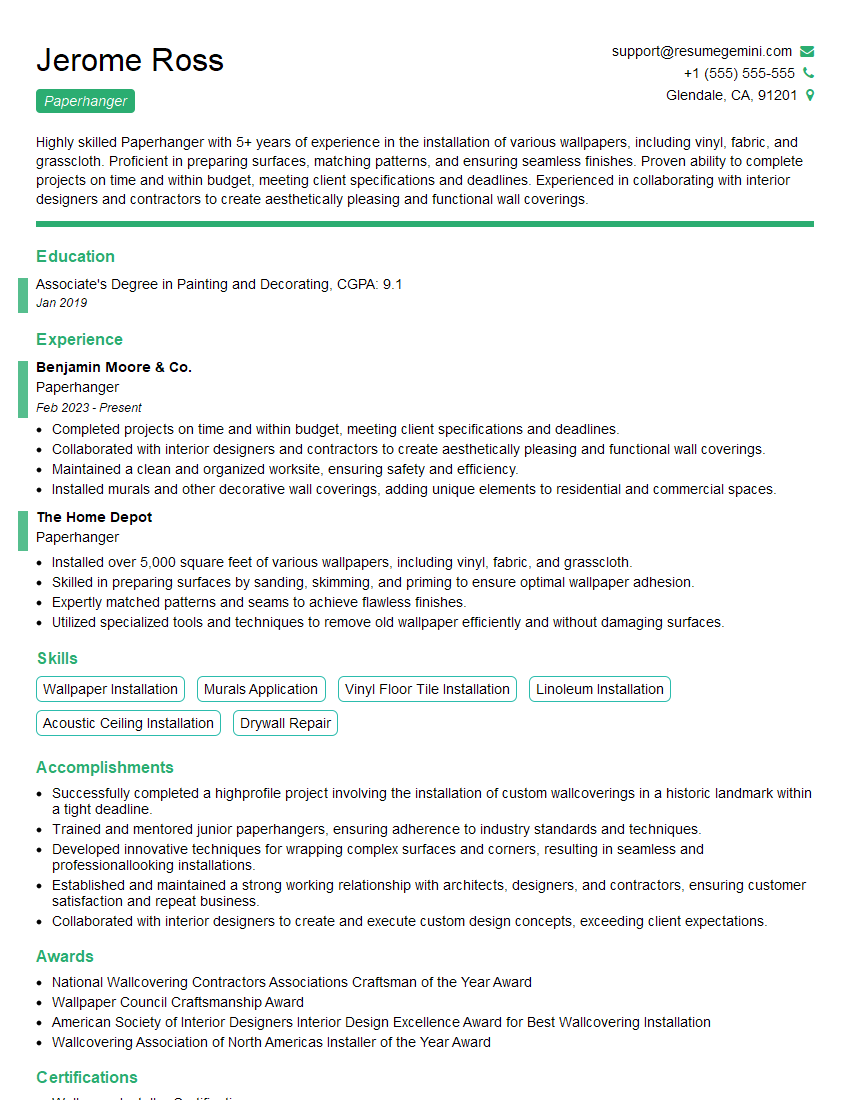
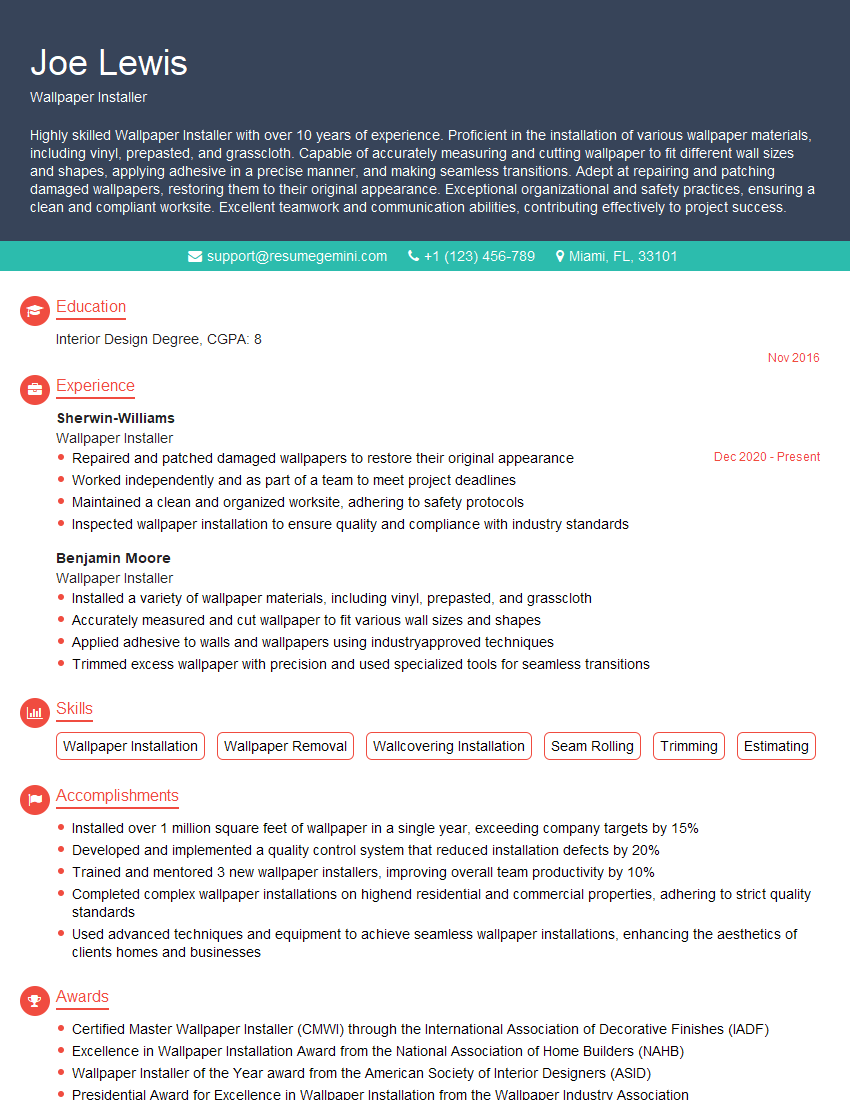
Mastering paper hanging opens doors to a rewarding career with diverse opportunities for growth, from residential projects to commercial installations. To maximize your job prospects, it’s crucial to present your skills effectively. Creating an ATS-friendly resume is vital in today’s job market; it ensures your application gets noticed by recruiters and hiring managers. We highly recommend using ResumeGemini to build a professional and impactful resume. ResumeGemini offers a user-friendly platform and provides examples of resumes tailored to the paper hanging profession to help you get started.
Explore more articles
Users Rating of Our Blogs
Share Your Experience
We value your feedback! Please rate our content and share your thoughts (optional).
What Readers Say About Our Blog
Really detailed insights and content, thank you for writing this detailed article.
IT gave me an insight and words to use and be able to think of examples