Feeling uncertain about what to expect in your upcoming interview? We’ve got you covered! This blog highlights the most important Pipe Fitting and Brazing interview questions and provides actionable advice to help you stand out as the ideal candidate. Let’s pave the way for your success.
Questions Asked in Pipe Fitting and Brazing Interview
Q 1. Explain the different types of pipe fittings.
Pipe fittings are essential components that connect, terminate, change direction, or branch pipe sections. They come in various types, each designed for specific applications and pipe materials. Think of them as the connectors and adapters in a plumbing or piping system.
- Elbows: Used to change the direction of a pipe. They come in various angles, like 45-degree and 90-degree elbows.
- Tees: Allow for the branching of a pipe into two directions. They can be equal or unequal in size.
- Couplings: Join two pipes of the same diameter end-to-end.
- Reducers/Adapters: Connect pipes of different diameters.
- Unions: Allow for easy disconnection and reconnection of pipes without disturbing the rest of the system. They’re incredibly handy for maintenance.
- Caps: Seal the end of a pipe.
- Flanges: Large, flat surfaces used to connect pipes with bolts. These are often used in high-pressure applications where a stronger connection is crucial.
- Nipples: Short pipe sections used as connectors.
The choice of fitting depends on factors like the pipe material, pressure rating, application, and accessibility.
Q 2. Describe the brazing process, including safety precautions.
Brazing is a joining process that uses a filler metal with a lower melting point than the base metals being joined. The filler metal flows into the joint by capillary action, creating a strong metallurgical bond. It’s different from welding, which melts the base metals themselves.
The process typically involves:
- Cleaning: Thoroughly cleaning the joint surfaces to remove any dirt, grease, or oxides is paramount for a strong braze. We use wire brushes, solvents, and sometimes even specialized fluxes.
- Flux Application: Applying flux, which prevents oxidation and helps the filler metal flow, is key. The type of flux depends on the materials being brazed.
- Heating: Heating the joint to a temperature above the filler metal’s melting point but below the melting point of the base materials. A torch is typically used, and precise temperature control is crucial.
- Filler Metal Application: Feeding the filler metal into the heated joint as it melts and flows.
- Cooling: Allowing the joint to cool slowly to avoid cracking.
Safety Precautions:
- Eye Protection: Always wear safety glasses or a face shield to protect your eyes from flying sparks and spatter.
- Respiratory Protection: Use appropriate respirators to prevent inhaling fumes from the flux and filler metals.
- Gloves: Wear heat-resistant gloves to protect your hands.
- Ventilation: Work in a well-ventilated area to minimize exposure to fumes.
- Fire Safety: Ensure that flammable materials are kept away from the work area.
- Proper Training: Always receive proper training before brazing.
I’ve personally experienced the consequences of neglecting safety precautions – a minor burn once taught me a valuable lesson about the importance of careful work.
Q 3. What are the different types of brazing filler metals and their applications?
Brazing filler metals are alloys designed to melt at temperatures lower than the base metals. Their composition determines their melting point and properties. Here are some common types:
- Silver Brazing Alloys: These are strong, corrosion-resistant, and offer excellent ductility. They’re commonly used for joining copper, brass, and steel.
- Copper Brazing Alloys: These are less expensive than silver alloys but have lower strength and corrosion resistance. They are often used for less demanding applications.
- Brass Brazing Alloys: These alloys are also relatively inexpensive and used in applications requiring moderate strength and corrosion resistance.
Applications: The choice of filler metal depends on the base materials being joined, the application’s required strength, and the operating temperature and environment. For instance, silver brazing is often preferred for high-pressure systems where reliability is paramount, while copper brazing might suffice for lower-pressure applications.
In one project, selecting the right silver brazing alloy was critical for ensuring the integrity of a high-pressure refrigeration system. The wrong choice could have resulted in leaks and potential damage.
Q 4. How do you identify different pipe materials?
Pipe materials are identified through a combination of visual inspection, markings, and sometimes testing. Visual inspection helps in identifying the material’s color, texture, and presence of any markings or coatings.
- Markings: Most pipes have markings stamped or printed on their surface indicating the material type (e.g., copper, steel, PVC), size, and sometimes even manufacturer. These markings are crucial for identification.
- Color and Texture: Copper pipes have a reddish-brown color, while galvanized steel pipes have a silvery-grey color with a somewhat rougher texture than black iron pipe. PVC is white or another color depending on its additives.
- Testing: In some cases, more rigorous methods like spark testing or chemical analysis might be necessary to definitively identify the material, particularly when dealing with less common alloys or unusual coatings.
For instance, I once encountered a pipe that lacked clear markings, and I had to rely on a combination of color, texture, and spark testing to confirm it was galvanized steel.
Q 5. Explain the importance of proper pipe support and alignment.
Proper pipe support and alignment are critical for preventing stress, vibration, and potential leaks or failures. Think of it like building a sturdy bridge; without proper support, it would collapse.
Importance:
- Stress Reduction: Supports distribute the weight of the pipe system, minimizing stress on the joints and preventing premature failure.
- Vibration Dampening: Proper support reduces vibrations from pumps, compressors, or other equipment connected to the system, preventing fatigue failures.
- Leak Prevention: Alignment ensures that joints are properly seated and prevent leaks. Misalignment can cause stress on the connections, leading to leaks over time.
- Thermal Expansion Accommodation: Supports must accommodate the thermal expansion and contraction of the pipe material due to temperature changes.
In a real-world example, insufficient pipe support in a large industrial piping system could lead to catastrophic failures, costing significant time and money in repairs. Proper alignment is just as critical, as misaligned pipes can cause leaks and create points of stress.
Q 6. Describe your experience with different types of pipe cutting tools.
I have experience with various pipe cutting tools, each suited for different pipe materials and diameters. The selection depends on factors like material, diameter, and required cut precision.
- Hand Saw: Suitable for smaller diameter pipes, especially when precise cuts aren’t critical. It’s simple, but labour-intensive.
- Hacksaw: Versatile for a wide range of pipe materials and sizes, and provides reasonably precise cuts. Still needs some muscle power.
- Pipe Cutter (Wheel Cutter): Efficient for cutting metal pipes with clean, precise cuts. It’s faster than hacksaws, but is only for metal pipes.
- Power Saw (Reciprocating Saw/Chop Saw): Faster than manual cutting for metal or plastic pipes; however, it requires more care and safety precautions.
- Tube Cutter: Specifically designed for cutting thin-walled tubes, producing clean, square cuts without damaging the tube.
For example, when working with thin-walled copper tubing in a plumbing project, using a tube cutter ensures a clean cut, which is essential for creating a leak-free brazed joint. Using the wrong tool could easily crush or damage the tube.
Q 7. How do you ensure proper joint cleanliness before brazing?
Proper joint cleanliness is paramount for achieving a strong and leak-free brazed joint. Impurities prevent the filler metal from properly wetting the surfaces, weakening the bond and potentially leading to leaks.
Methods for Ensuring Cleanliness:
- Mechanical Cleaning: Using wire brushes, scrapers, or abrasive pads to remove any dirt, grease, paint, or other foreign matter from the pipe surfaces inside the joint area.
- Chemical Cleaning: Using solvents, such as acetone or MEK, to remove grease and oils. This is followed by thorough rinsing and drying.
- Fluxing: While flux also cleans to an extent, it’s a secondary process after mechanical and chemical cleaning. It helps to remove surface oxides that might remain.
- Visual Inspection: After cleaning, a visual inspection is essential to ensure the surfaces are clean, shiny, and free from any visible contaminants.
In practice, I usually employ a combination of mechanical and chemical cleaning, followed by a thorough visual check before applying the flux. A careless approach here could directly compromise the entire joint, even if my brazing technique is perfect.
Q 8. What are the signs of a faulty brazed joint?
A faulty brazed joint can manifest in several ways, often indicating a critical flaw in the process. Visual inspection is key. Look for:
Porosity: Small holes or voids on the surface of the joint, indicating incomplete fusion of the filler metal and base metal. Think of it like tiny air bubbles trapped in the weld. This weakens the joint significantly.
Cracks: These are visible fissures in the brazed area. They represent stress fractures, often caused by insufficient brazing temperature, improper filler metal selection, or excessive stresses placed on the joint after brazing.
Lack of Fusion: Sections where the filler metal hasn’t properly bonded with the base metal. You might see a distinct line of demarcation between the two, indicating incomplete heat transfer during the brazing process.
Burn-through: This is a more serious defect where the filler metal has melted through the base metal, creating a hole. This usually stems from overheating.
Discoloration: Unusual coloration might suggest overheating or incorrect flux usage. For instance, excessive oxidation can lead to a darker, less uniform appearance.
Beyond visual inspection, a faulty joint might also exhibit leakage under pressure testing, demonstrating a failure to achieve a proper seal.
Q 9. How do you troubleshoot common brazing problems?
Troubleshooting brazing problems is a systematic process. It begins with careful observation of the faulty joint to identify the defect type (as described above). Then, the process can be reviewed step by step:
Insufficient Heat: If you suspect this, ensure you are using the correct brazing temperature for the filler metal and base metals involved. Consider using a thermocouple to verify your torch temperature, especially with larger joints.
Improper Flux: Inadequate or incorrect flux can prevent proper wetting and fusion. Ensure you are using the correct flux for the metals and properly applying it to clean, dry surfaces. Reapplication might be necessary for larger or more complex joints.
Contamination: Oil, grease, or oxides on the base metals can prevent proper bonding. Thorough cleaning with a suitable solvent and wire brush is essential before brazing. Proper preheating is also crucial for driving out moisture and other contaminants.
Incorrect Filler Metal: Selecting a filler metal with incompatible properties or an incorrect melting point can result in a weak joint. Carefully review the manufacturer’s guidelines to match the filler metal to the base materials.
Joint Design: An improperly designed joint, such as one with insufficient clearance or an awkward geometry, can make even proper brazing techniques challenging. Review the joint design to determine whether it’s suitable for brazing.
Often, a combination of these factors contributes to the problem. A systematic approach, coupled with experience, enables efficient troubleshooting.
Q 10. What safety measures do you take while working with brazing torches?
Safety is paramount when working with brazing torches. My safety practices include:
Eye Protection: Always wear safety glasses or a face shield to protect against UV radiation, sparks, and molten metal spatter. The intense heat and bright light can cause serious eye damage.
Respiratory Protection: Brazing fumes can be hazardous. I always use a respirator approved for brazing fumes, especially in poorly ventilated areas.
Protective Clothing: I wear flame-resistant clothing, including gloves and long sleeves, to protect my skin from burns and sparks. Durable work boots provide foot protection.
Fire Prevention: The work area must be clear of flammable materials, and a fire extinguisher must be readily accessible. A fire blanket is also a wise addition. I always ensure adequate ventilation to prevent the buildup of flammable gases.
Proper Handling of Cylinders: Compressed gas cylinders require careful handling. I always secure them properly, ensure they’re kept upright, and never use them near open flames or sparks. I use appropriate regulators and hoses designed for the gases used.
First Aid Awareness: I’m familiar with basic first aid procedures for burns and other injuries that could occur during brazing and have a well-stocked first aid kit readily available.
Regular safety checks and training reinforce these practices, ensuring a safe work environment.
Q 11. Explain the difference between brazing and soldering.
Brazing and soldering are both joining processes that use a filler metal to bond base metals, but they differ significantly in the melting point of the filler metal and the resulting joint strength.
Brazing: The filler metal melts at a temperature above 450°C (842°F). It flows into the joint by capillary action, creating a strong, high-temperature bond. Brazed joints are considerably stronger and more resistant to high temperatures than soldered joints.
Soldering: The filler metal melts at a temperature below 450°C (842°F). This lower melting point allows for easier joining of metals, but the resulting joint is weaker and has lower heat resistance. Soldering is often used for electrical connections or less demanding applications.
Think of it like this: brazing is like welding with a lower-temperature filler metal, suitable for high-strength applications; soldering is more like gluing, creating a weaker but still useful bond.
Q 12. Describe your experience with different pipe threading techniques.
My experience with pipe threading techniques encompasses several methods, each suited to different pipe materials and applications:
Hand Threading: This traditional method uses dies and taps to create threads manually. It’s suitable for smaller diameter pipes and requires skill and precision. I’ve used this extensively for repairs and smaller installations.
Machine Threading: Power-driven machines significantly increase efficiency for threading larger diameter pipes. I am proficient in operating various threading machines and selecting the appropriate dies and lubricants based on pipe material.
Roll Threading: This process forms the threads by rolling the pipe material, leaving the metal intact unlike cutting methods. This results in a stronger, more durable thread compared to cutting, and I use this on applications where pipe integrity is critical.
Each technique requires expertise in selecting the appropriate tools, lubricants, and dies to prevent damage to the pipe and ensure a clean, accurate thread. My experience covers working with various pipe materials, including steel, copper, and PVC, using the most suitable threading technique for each material.
Q 13. How do you interpret blueprints and schematics for pipefitting?
Interpreting blueprints and schematics for pipefitting is a crucial skill. It involves understanding the symbols, dimensions, specifications, and overall layout to accurately install the piping system.
Symbol Recognition: I am familiar with the standard symbols used to represent different pipe types, fittings, valves, and other components. This allows me to quickly identify the required materials and their configuration.
Dimensional Accuracy: The blueprints provide precise dimensions for pipe lengths, angles, and distances. Accurate measurement and cutting are critical to ensure proper alignment and functionality.
Material Specifications: Blueprints specify the pipe material (e.g., steel, copper, PVC), diameter, wall thickness, and pressure ratings. This information guides the material selection process.
Layout Understanding: The schematic shows the overall piping layout, indicating the flow direction, branching points, and connections between various components. Understanding the layout is essential for planning the installation sequence.
Isometric Drawings: Isometric drawings provide a three-dimensional view of the piping system, which aids in visualizing the spatial arrangement and potential obstacles during installation.
I use a combination of my blueprint reading skills, practical experience, and available tools to accurately install piping systems following the precise specifications outlined in the blueprints and schematics. Any ambiguities are always clarified before proceeding.
Q 14. What is the importance of proper flux application in brazing?
Proper flux application is crucial for successful brazing. Flux serves several key functions:
Cleaning: Flux removes oxides and contaminants from the base metal surfaces, allowing for proper wetting by the filler metal. Without clean surfaces, the filler metal will not adhere correctly.
Wetting: Flux improves the flow and spread of the filler metal onto the base metal, ensuring complete joint penetration and capillary action.
Protection: Flux protects the heated base metals from oxidation during the brazing process, maintaining a clean surface for the filler metal to bond with.
Improper flux application can lead to poor wetting, incomplete fusion, weak joints, and ultimately, joint failure. I carefully apply the flux evenly to the joint surfaces using a brush or other appropriate tool, ensuring complete coverage of the area to be brazed. The type of flux is critical and must be chosen according to the metals being brazed. Using the wrong flux can severely compromise the brazing process.
Q 15. Explain the process of pressure testing a pipe system.
Pressure testing a pipe system is crucial for ensuring its integrity and leak-free operation before it goes into service. It involves filling the system with a pressurized fluid, typically water or air, and monitoring for any pressure drops, which indicate leaks. The process involves several key steps:
- System Preparation: Thoroughly inspect the entire pipe system for any visible flaws before pressurizing. Ensure all valves are closed except for the test valve.
- Pressurization: Gradually introduce the test fluid, slowly increasing the pressure to the specified test pressure. This pressure is usually higher than the system’s operating pressure to account for safety factors.
- Pressure Holding: Maintain the pressure for a predetermined amount of time (usually specified in relevant codes or standards). This allows time for leaks to become evident.
- Leak Detection: Monitor the pressure gauge closely for any significant drops. A gradual pressure drop could indicate a slow leak, while a sudden drop might point to a major leak. Use leak detection tools like pressure gauges, leak detectors, or even soapy water to pinpoint leak locations.
- Leak Repair: If leaks are detected, carefully repair them, and repeat the pressure test.
- Documentation: Maintain a detailed record of the test, including the test pressure, holding time, date, and any observed leaks.
For example, in a newly installed HVAC system, we might pressure test the refrigerant lines with nitrogen gas to a pressure exceeding the operating pressure by a specific factor (e.g., 1.5 times) to ensure that no leaks exist. A pressure drop indicates a leak, and the location can be identified with soapy water.
Career Expert Tips:
- Ace those interviews! Prepare effectively by reviewing the Top 50 Most Common Interview Questions on ResumeGemini.
- Navigate your job search with confidence! Explore a wide range of Career Tips on ResumeGemini. Learn about common challenges and recommendations to overcome them.
- Craft the perfect resume! Master the Art of Resume Writing with ResumeGemini’s guide. Showcase your unique qualifications and achievements effectively.
- Don’t miss out on holiday savings! Build your dream resume with ResumeGemini’s ATS optimized templates.
Q 16. How do you select the appropriate brazing temperature for different metals?
Selecting the appropriate brazing temperature depends heavily on the metals being joined. Brazing is a joining process where a filler metal with a lower melting point than the base metals is used to create a strong bond. Each metal has a specific melting point and temperature range suitable for brazing. Using an incorrect temperature can result in poor joints, weakened materials, or even damage.
I use brazing charts and material specifications to determine the correct temperature. These charts specify the ideal temperature range for various metal combinations. For example, brazing copper requires a much lower temperature than brazing stainless steel. Overheating copper leads to weakening, whereas stainless steel needs higher temperatures to ensure proper filler metal flow. It’s crucial to use a thermometer (preferably a digital pyrometer) to precisely monitor the brazing temperature during the process.
Think of it like baking a cake – each ingredient has an ideal baking temperature. Deviate from that, and you’ll ruin the cake. Similarly, using the wrong brazing temperature will compromise the integrity of the joint.
Q 17. Describe your experience with different types of pipe insulation.
My experience includes working with various pipe insulation materials, each with its own advantages and disadvantages. Common types include:
- Fiberglass insulation: Cost-effective, readily available, but can be irritating to handle.
- Mineral wool insulation: Excellent thermal performance, fire-resistant, but more expensive than fiberglass.
- Cellular Polyurethane Foam (PUF) insulation: High R-value (measure of thermal resistance), easy to install, but can degrade over time in high UV environments.
- Polyisocyanurate (PIR) foam insulation: Similar to PUF but has improved thermal performance and is more moisture resistant.
- Calcium Silicate Insulation: Excellent for high-temperature applications and fire protection.
The selection of insulation depends on factors such as operating temperature, environmental conditions, budget, and required thermal performance. For example, in a chilled water line, PUF might be suitable, while high-temperature steam lines would require calcium silicate insulation for safety.
Q 18. How do you handle different types of pipe bends and offsets?
Handling pipe bends and offsets requires precision and understanding of the different methods employed. Several techniques are used to create these changes in pipe direction:
- Factory-made bends: These are pre-fabricated bends with consistent radii, often used for larger pipe sizes and to maintain uniformity.
- Field bends: These are bends formed on-site, typically using a bender (manual or hydraulic) for smaller pipe sizes. The bending process requires care to avoid kinks or flattening of the pipe.
- Offsets: Changes in direction achieved through the use of multiple fittings (e.g., elbows and tees). This method is often preferred for tighter spaces and allows for greater flexibility in design.
Accurate measurements and appropriate tools are essential to avoid errors. When working with factory bends, it’s crucial to select the correct radius and orientation. Field bends require attention to avoid over-bending or damaging the pipe. Offsets require careful layout and selection of the appropriate fittings to achieve the desired offset. I always double-check my measurements and use appropriate tools like pipe benders, level, and measuring tapes for precision.
Q 19. What are the common causes of pipe leaks?
Pipe leaks can stem from a variety of issues:
- Poor workmanship: Improper installation, inadequate joint preparation (e.g., for welding or brazing), or insufficient tightening of fittings are common culprits.
- Corrosion: Over time, corrosion can weaken pipe walls and lead to leaks, especially in pipes made of susceptible materials like steel.
- Material defects: Flaws in the pipe itself, such as cracks or pinholes, can be a source of leaks.
- External damage: Physical impacts, ground movement, or rodent activity can damage pipes, causing leaks.
- Thermal expansion and contraction: Significant temperature changes can cause pipes to expand and contract, potentially stressing joints and leading to leaks, particularly if expansion loops are not properly installed.
- Freezing: Water expands when it freezes, putting immense pressure on pipes and potentially causing them to burst.
Identifying the root cause is key to effective repair and prevention. For example, a leak at a threaded joint might indicate improper tightening, while a leak along the pipe wall could indicate corrosion.
Q 20. How do you prevent overheating during brazing?
Overheating during brazing is detrimental, weakening the base metal and potentially causing damage to the surrounding components. Preventing overheating involves a multi-pronged approach:
- Proper torch technique: Use a controlled flame, avoiding direct prolonged heating of one spot. Keep the flame moving to ensure even heating.
- Correct brazing filler metal: Using a filler metal with a melting point appropriate for the base metals prevents overheating. Choosing the right flux is equally important.
- Temperature monitoring: Use a pyrometer (infrared thermometer) to precisely monitor the temperature of the joint. This allows for precise control and prevents accidental overheating.
- Proper joint preparation: Clean surfaces ensure optimal capillary action and reduce the required heating time, minimizing overheating.
- Appropriate brazing equipment: Using correctly sized torches and the appropriate amount of flux prevents overheating and ensures even heat distribution.
Think of it like cooking – if you apply excessive heat, you’ll burn the food. In brazing, overheating can lead to similar negative consequences. Careful monitoring and appropriate techniques are essential to avoid this.
Q 21. Describe your experience with different types of pipe hangers and supports.
My experience encompasses a wide range of pipe hangers and supports, each designed for specific applications and pipe sizes:
- Rigid hangers: Provide fixed support, ideal for short spans and vertical runs.
- Spring hangers: Compensate for thermal expansion and contraction, crucial for long pipe runs.
- Constant support hangers: Maintain a consistent load despite pipe movement. These are used to maintain a set pipe elevation despite any movement.
- Variable spring hangers: Allow for adjustment of pipe support based on load requirements.
- Trapeze hangers: Support multiple pipes and reduce vibration. These are especially relevant in piping systems with larger pipe runs.
The selection depends on factors such as pipe size, weight, material, operating temperature, and anticipated movement. For example, a long steam line would require spring hangers to accommodate thermal expansion. Improper selection of hangers can lead to pipe stress, vibration, and potential failure. The proper calculation of load-bearing capacity is crucial.
Q 22. How do you determine the proper size of pipe for a specific application?
Determining the proper pipe size involves considering several factors, primarily the flow rate required and the pressure drop allowed. Think of it like choosing the right size hose for watering your garden; a tiny hose will take forever, while one too large might be unwieldy. We use established engineering equations and standards, such as those found in the ASME B31.1 code for power piping, to calculate the necessary diameter. Key parameters include the fluid’s viscosity, density, and the length and roughness of the pipe. For example, a high-flow application like a main water supply line to a building will require a much larger diameter pipe than a small branch line supplying a single fixture. Specialized software can greatly simplify these calculations, taking into account fittings, valves, and other components that impact pressure drop. Ultimately, the goal is to select a pipe size that efficiently transports the fluid while minimizing energy losses and cost.
Q 23. Explain the importance of using the correct size and type of brazing rod.
Using the correct brazing rod is crucial for a strong, leak-free joint. The filler metal must be compatible with the base metals being joined – using an incorrect rod will lead to weak joints prone to failure. Furthermore, the rod’s diameter should be appropriate for the joint gap; a rod too small won’t fill the gap properly, while one too large can cause excessive fillet buildup, leading to stress concentrations and potential cracking. The filler metal’s melting point must also be suitable for the application – it should flow freely at the brazing temperature but not melt prematurely. For instance, using a silver brazing rod for copper pipes ensures good flow and a strong bond, whereas using a lower-melting-point rod might result in a weak connection that fails under pressure. The flux used with the brazing rod is also critical. It removes oxides from the base metal surfaces to allow for proper wetting and fusion.
Q 24. What is the difference between capillary action and gravity feed in brazing?
Capillary action and gravity feed are two ways filler metal flows during brazing. Capillary action relies on the surface tension of the molten filler metal to draw it into the joint. Imagine water creeping up a thin straw – the same principle applies here. This is ideal for narrow joint clearances. Gravity feed, on the other hand, relies on the force of gravity to pull the molten filler metal down into the joint. This works well for wider joints or applications where capillary action alone is insufficient. A successful brazing process often uses a combination of both; capillary action initiates the filling, and gravity can assist with larger volume joints. In practice, proper joint preparation with the correct gap is vital for both methods to function effectively. The joint design must allow for the efficient flow of molten filler metal.
Q 25. How do you ensure proper ventilation while brazing?
Proper ventilation during brazing is essential to protect the welder from harmful fumes and gases produced during the process. Brazing fluxes and filler metals often contain chemicals that can be toxic when inhaled. Always work in a well-ventilated area, preferably outdoors or in a shop with a robust ventilation system. If working indoors, use local exhaust ventilation directly at the point of brazing to capture fumes at their source. Respiratory protection, such as a respirator with appropriate cartridges, is also strongly recommended. Additionally, eye protection is crucial to prevent eye injuries from the intense light and potential spatter from the molten metal. Neglecting proper ventilation can result in serious health issues in the long run, so it’s a safety precaution that should never be ignored.
Q 26. Describe your experience with different types of pipe joining methods (e.g., welding, threading, flanging).
My experience encompasses a wide range of pipe joining methods, including welding (both arc and TIG), threading, and flanging. Welding offers high-strength joints suitable for high-pressure applications, but requires specialized equipment and skill. I’ve extensively used both arc welding and TIG welding on various pipe materials. Threading is a simpler technique for smaller pipes, often preferred for low-pressure applications, but is more time-consuming and susceptible to leaks if not done precisely. Flanging is common for larger pipes and systems needing frequent disassembly, allowing for easy connection and disconnection, but it is also more complex, requiring specialized tools and gaskets to ensure a leak-tight seal. The choice of method depends heavily on the application’s pressure, temperature, accessibility, and cost considerations. For instance, I’ve used welding on a high-pressure steam line and threading for a low-pressure water supply to a sprinkler system.
Q 27. How do you interpret welding symbols and procedures related to pipefitting?
Interpreting welding symbols and procedures is a critical skill in pipefitting. Welding symbols convey crucial information about the type of weld, its dimensions, location, and other specifics. They follow standardized conventions as defined in the AWS (American Welding Society) D1.1 structural welding code. I am proficient in understanding symbols indicating the weld type (e.g., fillet, groove, plug), the size and length of the weld, the surface condition, and any special requirements. Furthermore, I’m familiar with various welding procedures, including pre-weld and post-weld heat treatments. For example, a symbol might show a groove weld with a specific size and a reference to a specific welding procedure specification document. Correct interpretation is necessary to ensure the weld is executed to the required quality standard.
Q 28. What are your troubleshooting skills related to pipe fitting and brazing?
My troubleshooting skills cover a broad range of issues in pipefitting and brazing. For example, I’ve successfully addressed leaks by identifying the cause – whether it’s a faulty weld, incorrect threading, or a problem with the brazing process. My systematic approach involves careful visual inspection, pressure testing, and sometimes the use of specialized leak detection equipment. I’ve also dealt with issues related to improper pipe alignment, inadequate heat during brazing, and the use of incorrect materials. A recent example involved a recurring leak in a brazed joint; through careful inspection, I found that the joint gap was too large, leading to insufficient filler metal penetration. By re-preparing the joint and using a proper brazing technique, the leak was resolved. My approach emphasizes thorough analysis to pinpoint the root cause of the problem before attempting a solution.
Key Topics to Learn for Your Pipe Fitting and Brazing Interview
- Blueprint Reading and Interpretation: Understanding schematics, isometric drawings, and specifications to accurately plan pipe layouts and installations.
- Pipe Measurement and Cutting Techniques: Mastering accurate measurements, utilizing various cutting tools (e.g., pipe cutters, saws), and ensuring precise cuts for optimal fitting.
- Pipe Fitting Methods: Proficiency in various joining methods (e.g., threaded, flanged, socket weld, butt weld) and understanding the applications and limitations of each.
- Brazing Techniques and Safety: Safe handling and application of brazing materials, understanding heat control, flux application, and achieving strong, leak-free joints.
- Material Selection and Properties: Familiarity with various pipe materials (e.g., copper, steel, PVC), their properties, and appropriate applications for different systems.
- Troubleshooting and Problem-Solving: Identifying and resolving common issues like leaks, misaligned joints, and material defects. Developing effective strategies for diagnosing and repairing problems efficiently.
- Safety Regulations and Procedures: Adherence to relevant safety standards and best practices, including proper use of personal protective equipment (PPE) and understanding hazard recognition and control.
- Industry Codes and Standards: Knowledge of relevant industry codes (e.g., ASME, ANSI) and understanding their importance in ensuring quality and safety.
- Welding (if applicable): If the role requires welding skills, demonstrate knowledge of various welding techniques, including arc welding and their applications in pipe fitting.
Next Steps: Level Up Your Career
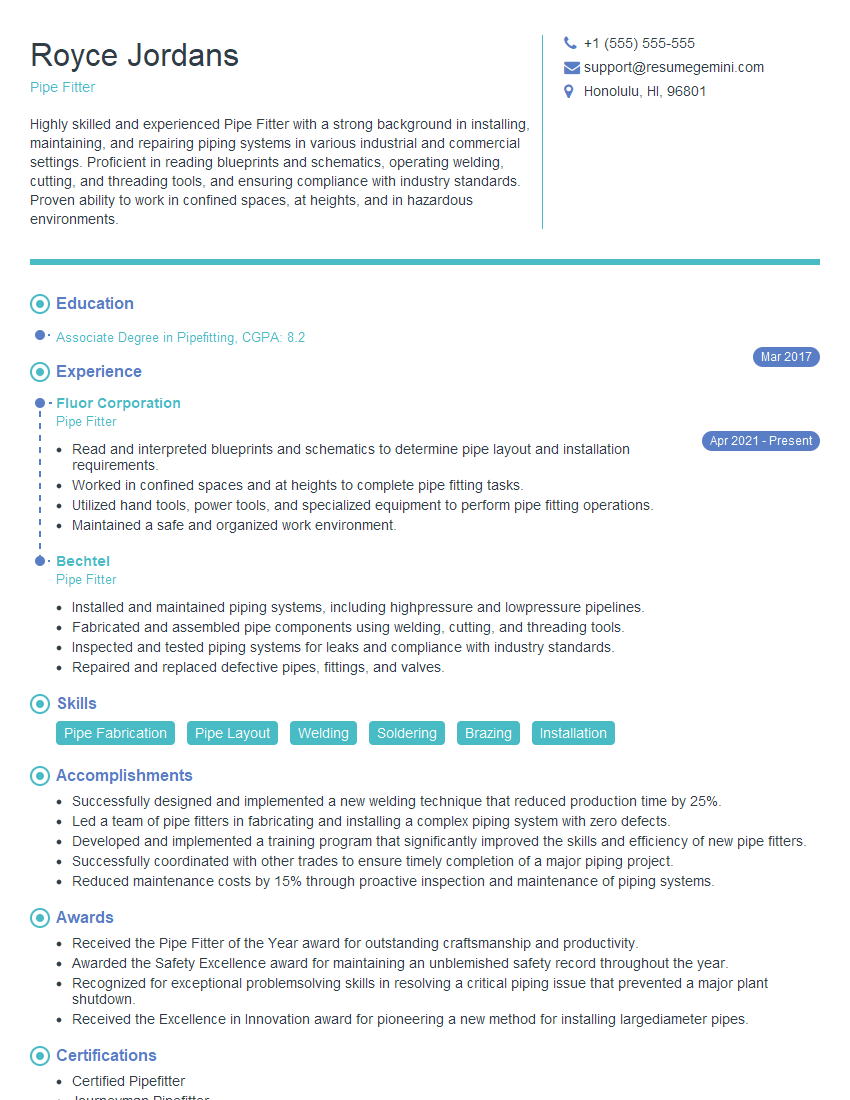
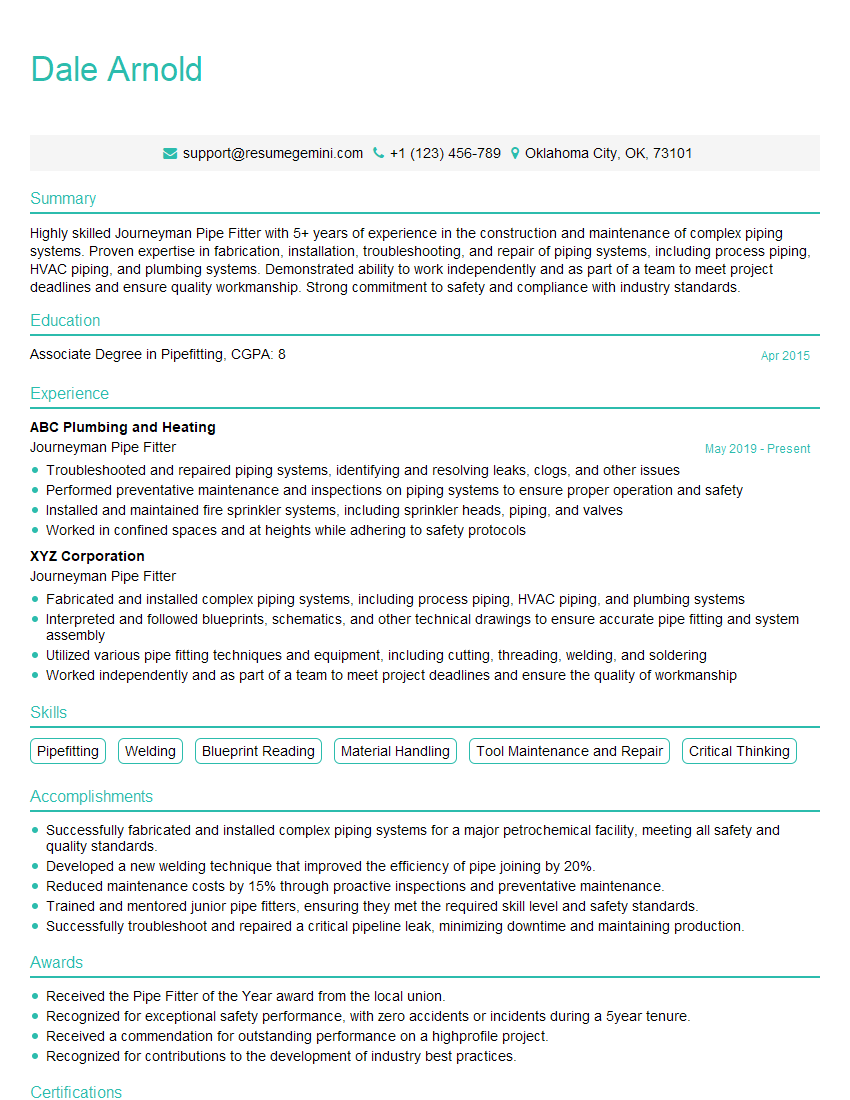
Mastering pipe fitting and brazing opens doors to rewarding and stable careers in various industries, from construction and manufacturing to HVAC and energy. To maximize your job prospects, it’s crucial to present your skills effectively. Creating an ATS-friendly resume is paramount. This ensures your qualifications are recognized by applicant tracking systems, significantly increasing your chances of landing an interview.
We highly recommend using ResumeGemini to build a powerful, ATS-optimized resume that showcases your expertise. ResumeGemini provides a user-friendly platform and offers examples of resumes tailored specifically to Pipe Fitting and Brazing roles. Take the next step towards your dream job – build a winning resume today!
Explore more articles
Users Rating of Our Blogs
Share Your Experience
We value your feedback! Please rate our content and share your thoughts (optional).
What Readers Say About Our Blog
Really detailed insights and content, thank you for writing this detailed article.
IT gave me an insight and words to use and be able to think of examples