Unlock your full potential by mastering the most common Tank Troubleshooting interview questions. This blog offers a deep dive into the critical topics, ensuring you’re not only prepared to answer but to excel. With these insights, you’ll approach your interview with clarity and confidence.
Questions Asked in Tank Troubleshooting Interview
Q 1. Describe your experience with different types of tank failures.
Tank failures can be broadly categorized into structural failures, corrosion failures, and failures related to operational issues. Structural failures often involve cracks, dents, or complete breaches in the tank shell, typically due to overloading, improper installation, or ground settlement. I’ve encountered instances where aging tanks, especially those made of older materials, succumbed to stress cracking after years of exposure to fluctuating temperatures and pressure. Corrosion failures, on the other hand, are insidious and often lead to leaks or even catastrophic tank collapse. These are most common in tanks storing corrosive materials. Operational failures encompass issues such as faulty valves, pump malfunctions, and overfilling leading to spills or leaks. For instance, I investigated a case where a faulty pressure relief valve caused an over-pressurization event resulting in a tank rupture.
- Structural Failures: Cracks, dents, buckling, weld failures
- Corrosion Failures: Pitting, general corrosion, stress corrosion cracking, galvanic corrosion
- Operational Failures: Overfilling, improper venting, valve malfunctions, pump failures
Q 2. Explain your process for diagnosing a leaking tank.
Diagnosing a leaking tank requires a systematic approach. Safety is paramount; always ensure the area is properly secured and personnel are wearing appropriate protective equipment. My process typically begins with visual inspection, looking for obvious signs of leakage such as visible streams or pooling liquid. Then, I’ll use non-destructive testing (NDT) methods such as ultrasonic testing (UT) or magnetic particle inspection (MPI) to identify the location and extent of the leak. For underground tanks, we might employ specialized leak detection equipment like electronic leak detectors or soil vapor monitoring. I always document all findings meticulously, including photographs, sketches, and measurements to provide a clear picture of the situation. If the leak is suspected to be related to the tank’s connections or appurtenances (valves, nozzles, etc.), this is often the area of focus, and individual components will undergo thorough inspection and testing.
For example, in one instance, a visual inspection revealed wet ground around an underground storage tank. Further investigation with a leak detection probe pinpointed a leak near the tank’s weld seam, which was confirmed by ultrasonic testing.
Q 3. How do you troubleshoot pressure issues in a storage tank?
Troubleshooting pressure issues in a storage tank starts with identifying the type of pressure problem – overpressure or underpressure. Overpressure could be due to several causes: a faulty pressure relief valve, a blocked vent, excessive filling, or even a chemical reaction within the tank if it’s storing reactive substances. Underpressure might indicate a leak, a faulty vacuum breaker, or insufficient supply pressure. I typically begin by checking pressure gauges, safety valves, and associated instrumentation to ensure they are functioning properly. Inspecting the tank’s ventilation system is crucial, as blockages can easily lead to pressure build-up. Careful review of operational logs and records helps understand the pressure trends before the issue arose. Then, it is often necessary to perform a pressure test of the system to verify the integrity of the tank and its associated piping and fittings. Any significant deviation from expected behavior indicates a potential problem that needs closer attention.
For example, a sudden increase in tank pressure could be caused by a malfunctioning pressure relief valve that is failing to open, prompting immediate action to relieve the excess pressure in a safe manner.
Q 4. What are the common causes of tank corrosion and how do you mitigate them?
Tank corrosion is a major concern, significantly impacting tank lifespan and safety. Common causes include exposure to moisture, oxygen, and corrosive chemicals. Different types of corrosion exist: general corrosion is a uniform thinning of the tank material; pitting corrosion forms localized holes; and galvanic corrosion occurs when dissimilar metals are in contact. The stored content itself can be highly corrosive. For instance, storage of saltwater or acidic materials can rapidly accelerate corrosion. Mitigating corrosion involves several strategies: selecting appropriate materials resistant to the stored substance, applying protective coatings (e.g., epoxy, polyurethane), implementing cathodic protection (using sacrificial anodes or impressed current systems), and regularly inspecting the tank for signs of corrosion.
For example, lining a tank with a corrosion-resistant material is a highly effective preventative measure, particularly when dealing with corrosive liquids. Regular inspections and prompt repairs can prolong the tank’s life and prevent further damage.
Q 5. Describe your experience with tank level gauging systems and troubleshooting related problems.
Tank level gauging systems are critical for monitoring inventory and preventing overfilling. Common systems include float gauges, ultrasonic level sensors, radar level sensors, and hydrostatic level sensors. Troubleshooting these systems usually involves checking sensor calibration, signal integrity, and power supply. I’ve dealt with instances where a faulty float switch caused inaccurate level readings, leading to near-overfilling incidents. Other common problems involve wiring issues, interference from other equipment, or sensor fouling (e.g., build-up on ultrasonic sensors). Systematic testing of the entire system, often involving signal tracing and calibration checks, is crucial for identifying the root cause. In some cases, the control system itself may require attention, needing to be re-programmed or have its settings adjusted.
For example, I once encountered an issue where inaccurate level readings were attributed to a buildup of sediment on the ultrasonic sensor, highlighting the importance of regular cleaning and maintenance.
Q 6. How do you identify and address safety hazards related to tank maintenance?
Safety is paramount in tank maintenance. Hazards include confined space entry, exposure to hazardous materials, fire and explosion risks, and the potential for injuries from falling objects or equipment. My approach to addressing these hazards always prioritizes risk assessment. This includes identifying potential hazards, assessing their severity and likelihood, and establishing control measures. Before any maintenance, a thorough permit-to-work system is implemented, outlining procedures and precautions. Confined space entry requires proper ventilation, atmospheric monitoring, and use of safety harnesses and respirators. When dealing with flammable materials, explosion-proof equipment and proper grounding are essential. Adequate training for personnel is paramount to ensuring that everyone understands the potential risks and safety procedures.
For instance, before entering a tank for inspection, we always test the atmosphere for oxygen deficiency, flammability, and toxicity to ensure the safety of workers.
Q 7. What are the different methods for cleaning and inspecting tanks?
Cleaning and inspecting tanks involves various methods depending on the tank’s size, material, and the stored content. For small tanks, manual cleaning with brushes and detergents might suffice. Larger tanks often require specialized cleaning methods such as high-pressure water jetting, steam cleaning, or chemical cleaning to remove residues and contaminants. Inspection methods range from simple visual inspections to sophisticated NDT techniques. Internal inspections often require confined space entry, necessitating proper safety protocols. Visual inspections check for corrosion, leaks, and damage to the tank structure and appurtenances. NDT methods like ultrasonic testing (UT), magnetic particle inspection (MPI), and radiographic testing (RT) provide more detailed information about the tank’s condition and can detect internal flaws that are not visible externally.
For example, after cleaning an industrial storage tank, a thorough visual inspection would be followed by ultrasonic testing to assess the tank’s wall thickness and detect any hidden corrosion or thinning.
Q 8. Explain your understanding of tank overfill prevention systems.
Tank overfill prevention systems are crucial for safety and environmental protection. They’re designed to prevent tanks from exceeding their maximum capacity, avoiding potential spills and hazardous situations. These systems typically involve a combination of high-level alarms, automatic shut-off valves, and redundant safety measures.
- High-level alarms: These audible and visual alarms alert operators when the tank level approaches a pre-determined threshold. Think of it like a car’s fuel gauge warning light, but with much higher stakes.
- Automatic shut-off valves: These valves automatically stop the flow of liquid into the tank once the high-level alarm is triggered, preventing further filling. This is the main fail-safe mechanism.
- Redundant systems: Multiple independent systems are often implemented to ensure that even if one component fails, the others provide backup protection. This might involve having two separate high-level sensors and shut-off valves.
- Overfill protection devices: These can include devices like positive displacement meters that accurately measure the amount of liquid added, or pressure-based sensors that detect when the tank is nearing full.
For example, I once worked on a project where we implemented a triple-redundant overfill prevention system for a large chemical storage tank. This included two independent level sensors, two independent shut-off valves, and a pressure-based overfill protection device. This layered approach ensured maximum safety and compliance.
Q 9. How do you troubleshoot issues with tank ventilation systems?
Troubleshooting tank ventilation systems requires a systematic approach. Proper ventilation is essential to prevent the buildup of flammable or hazardous vapors. Issues can range from simple blockages to more complex problems with the ventilation equipment itself.
- Visual inspection: Start by visually inspecting the entire ventilation system for any obvious blockages, damage, or corrosion. Look at vents, pipes, and fans.
- Pressure checks: Use a manometer or pressure gauge to measure the pressure inside the tank and compare it to the ambient pressure. Significant pressure differences indicate a ventilation problem. A negative pressure could indicate insufficient venting.
- Flow rate measurement: Measure the airflow rate using an anemometer to determine if it’s within the design specifications. Low flow rates suggest a blockage or malfunction.
- Equipment checks: Inspect fans and other mechanical components for proper operation. Check for wear and tear, broken parts, or power supply issues.
- Leak detection: Check for leaks in the system using specialized leak detection equipment. These leaks can cause pressure imbalances and safety hazards.
For instance, I once diagnosed a problem in a tank’s ventilation system where a bird’s nest had blocked the vent pipe, causing a buildup of pressure inside the tank. A simple removal of the nest solved the problem, highlighting the importance of regular inspections.
Q 10. Describe your experience with different types of tank coatings and their applications.
Tank coatings play a vital role in protecting the tank structure from corrosion and contamination. The choice of coating depends on factors like the stored material, environmental conditions, and the tank’s construction material.
- Epoxy coatings: Excellent chemical resistance and good mechanical strength. Commonly used for tanks storing aggressive chemicals.
- Polyurethane coatings: Offer good abrasion resistance and flexibility, suitable for tanks subject to impact or temperature fluctuations.
- Vinyl ester coatings: High chemical resistance and good UV resistance, ideal for outdoor tanks.
- Phenolic coatings: Excellent resistance to acids and alkalis.
- Furol coating: Is a type of coal tar epoxy, known for its high resistance to corrosion in aggressive environments.
My experience includes specifying and overseeing the application of epoxy coatings for a series of water storage tanks in a challenging coastal environment. The choice of epoxy was critical to provide long-term corrosion protection against saltwater exposure. The project also involved rigorous quality control during the coating process to ensure the integrity of the finished surface.
Q 11. What are the regulatory compliance requirements for tank storage and maintenance?
Regulatory compliance for tank storage and maintenance is paramount to ensure safety and environmental protection. Specific regulations vary by location and the type of material stored, but common requirements include:
- Spill prevention, control, and countermeasures (SPCC) plans: These plans detail procedures for preventing and responding to spills, especially for regulated substances.
- Environmental protection agency (EPA) regulations: These regulations cover air emissions, wastewater discharge, and hazardous waste management related to tank storage.
- Occupational safety and health administration (OSHA) regulations: These regulations address worker safety around tanks, including confined space entry procedures and personal protective equipment (PPE) requirements.
- Local fire codes: These specify requirements for fire prevention and protection measures around tanks, including fire suppression systems and emergency response plans.
- Regular inspections and maintenance: Scheduled inspections and maintenance are often legally mandated to identify and address potential issues before they lead to accidents or environmental damage.
Compliance is often achieved through meticulous record-keeping, regular inspections and maintenance, and proper training for personnel involved in tank operation and maintenance. Failure to comply can lead to severe penalties.
Q 12. How do you perform a root cause analysis of a tank failure?
Performing a root cause analysis (RCA) of a tank failure involves systematically investigating the event to identify the underlying causes and prevent future occurrences. The ‘5 Whys’ technique is a helpful starting point, but a comprehensive approach is crucial.
- Gather data: Collect all relevant information, including inspection reports, maintenance records, operating data, and witness accounts.
- Identify the failure mode: Precisely describe what failed and how.
- Develop a timeline: Chronologically sequence the events leading up to the failure.
- Apply RCA techniques: Use methods like the ‘5 Whys,’ fishbone diagrams, or fault tree analysis to delve into the root causes, moving beyond immediate symptoms.
- Develop corrective actions: Based on the root cause analysis, define specific and effective solutions to prevent recurrence.
- Implement and verify corrective actions: Put the solutions into practice and monitor their effectiveness. This involves documenting the changes and tracking results.
For instance, I investigated a tank failure where the initial finding pointed to corrosion. Through the ‘5 Whys’ process, we discovered that inadequate cathodic protection, coupled with delayed maintenance, led to the corrosion that ultimately caused the tank failure. Corrective actions included improved cathodic protection and a revised maintenance schedule.
Q 13. Describe your experience with tank instrumentation and calibration procedures.
Tank instrumentation is vital for monitoring and controlling the tank’s operation. This includes level sensors, temperature sensors, pressure sensors, and flow meters. Accurate calibration is essential for reliable data and safe operation.
- Level sensors: Various types exist, including float switches, ultrasonic sensors, radar level sensors, and pressure sensors. Calibration involves checking against a known standard (e.g., a calibrated dipstick) or using a calibration loop.
- Temperature sensors: Thermocouples, resistance temperature detectors (RTDs), and thermistors are common types. Calibration involves comparing readings against a calibrated reference source.
- Pressure sensors: These monitor tank pressure, crucial for safety and preventing over-pressurization. Calibration usually involves comparing measurements against a known pressure source.
- Flow meters: These measure the flow rate of liquids into or out of the tank. Calibration involves checking flow rate against a known standard using a calibrated volumetric device.
- Calibration procedures: Typically involve following manufacturer’s instructions, using specialized equipment, and documenting all calibration steps and results.
In my work, I regularly calibrate level sensors in large storage tanks. This includes documenting the calibration procedure, verifying accuracy, and maintaining detailed calibration records, ensuring compliance with safety and operational regulations.
Q 14. What are your experiences using tank monitoring software and data analysis?
Tank monitoring software and data analysis provide valuable insights into tank operations, allowing for proactive maintenance, improved efficiency, and enhanced safety. This involves collecting data from various tank instruments and utilizing software to interpret and analyze that data.
- Data acquisition: Software collects data from various sensors and instruments, often using SCADA (Supervisory Control and Data Acquisition) systems.
- Data visualization: Software displays the data in user-friendly formats such as charts, graphs, and dashboards, providing a clear overview of tank conditions.
- Data analysis: Algorithms and analytical tools identify trends, anomalies, and potential problems before they escalate. This could include predictive maintenance alerts based on sensor data patterns.
- Reporting and documentation: The software generates reports summarizing tank operations and maintenance activities, which is helpful for regulatory compliance.
- Remote monitoring: Many modern systems allow for remote monitoring of tanks, providing real-time data access regardless of location.
I have extensive experience using tank monitoring software to analyze data from a network of fuel storage tanks. The software’s predictive maintenance features helped us anticipate and prevent equipment failures, minimizing downtime and maximizing efficiency. The real-time data visualization allowed for immediate responses to any unexpected changes in the tank conditions.
Q 15. How do you ensure the safety of personnel during tank maintenance operations?
Safety during tank maintenance is paramount. We employ a multi-layered approach, beginning with thorough risk assessments specific to each tank and its contents. This involves identifying potential hazards like flammable vapors, toxic materials, or confined space entry risks. Next, we implement comprehensive safety protocols, including:
- Lockout/Tagout (LOTO) procedures: This ensures complete isolation of energy sources (electricity, steam, etc.) before any work begins. For example, before cleaning an internal tank component, the power to associated pumps and agitators will be locked out and tagged to indicate that the system is inactive and under maintenance.
- Permit-to-work systems: Formal authorization processes are utilized, documenting all hazards, safety precautions, and personnel involved. This ensures accountability and a clear understanding of the job scope.
- Personal Protective Equipment (PPE): Appropriate PPE, including respirators, protective clothing, and safety eyewear, is mandated based on the specific hazards. Workers are thoroughly trained on PPE use and fit-testing procedures.
- Confined space entry procedures: Strict procedures are followed for confined space entry, including atmospheric monitoring for oxygen levels, flammables, and toxins before and during entry. Experienced personnel and standby attendants are always present. For instance, if a worker needs to enter a large storage tank, we will have a team member outside monitoring their conditions.
- Emergency response plan: A comprehensive emergency response plan is in place, clearly outlining procedures in case of incidents, including emergency contacts and evacuation routes. This includes regular drills and training for everyone involved.
Regular safety audits and training sessions reinforce safe practices and ensure compliance with all relevant regulations and best practices. I believe in a culture of safety where every team member feels empowered to stop work if they have any safety concerns.
Career Expert Tips:
- Ace those interviews! Prepare effectively by reviewing the Top 50 Most Common Interview Questions on ResumeGemini.
- Navigate your job search with confidence! Explore a wide range of Career Tips on ResumeGemini. Learn about common challenges and recommendations to overcome them.
- Craft the perfect resume! Master the Art of Resume Writing with ResumeGemini’s guide. Showcase your unique qualifications and achievements effectively.
- Don’t miss out on holiday savings! Build your dream resume with ResumeGemini’s ATS optimized templates.
Q 16. Explain your familiarity with different tank materials (steel, fiberglass, etc.) and their properties.
My experience encompasses a wide range of tank materials. Each has distinct properties influencing their suitability for specific applications.
- Carbon Steel: This is the most common material due to its strength, weldability, and relatively low cost. However, it’s susceptible to corrosion, especially in harsh environments, requiring regular inspection and potentially protective coatings. I’ve worked extensively with various grades of carbon steel, choosing the appropriate one based on factors like the stored liquid, pressure, and temperature.
- Stainless Steel: Offers superior corrosion resistance, making it ideal for handling corrosive chemicals. Different stainless steel grades (e.g., 304, 316) provide varying degrees of resistance. I’ve worked on projects involving stainless steel tanks for food-grade products and aggressive chemicals.
- Fiberglass Reinforced Plastic (FRP): Lightweight and corrosion-resistant, FRP is suitable for applications requiring high corrosion resistance but lower strength compared to steel. The selection depends on the specific resin and reinforcement used, and I consider factors like UV resistance, chemical compatibility, and the mechanical strength required. I have experience troubleshooting issues like delamination and fiber degradation in FRP tanks.
- Concrete: Often used for large-capacity, ground-level storage tanks, especially for water or less aggressive liquids. Considerations here include permeability, reinforcement, and the potential for cracking. I am familiar with the inspection and repair techniques for concrete tanks to ensure structural integrity.
Material selection requires careful consideration of the stored product’s properties, environmental conditions, and regulatory requirements. A wrong choice can lead to premature tank failure, leakage, and even catastrophic events.
Q 17. What is your experience with emergency shutdown procedures for tank systems?
Emergency shutdown procedures are crucial for tank systems to prevent accidents and contain potential releases. My experience covers various scenarios and systems. Procedures typically involve:
- Emergency Shut-Off Valves (ESOVs): Quick-acting valves strategically located to isolate sections of the system or the entire tank in case of an emergency. Regular testing and inspection of these valves are critical.
- Automatic Shutdown Systems: These incorporate sensors (level, pressure, temperature, flow) that trigger automatic shutdowns if parameters exceed pre-set limits. For instance, a high-level alarm might automatically close a valve to prevent overfilling. Regular calibration and testing are essential to ensure the system’s reliability.
- Alarm Systems: Effective alarm systems provide visual and audible warnings of potential hazards, enabling prompt response. These should be easily audible and visible even from a distance.
- Emergency Response Team: Designated personnel trained to respond to specific emergencies. Regular drills ensure coordinated and effective responses.
I have firsthand experience in troubleshooting malfunctioning emergency systems, identifying the root cause of failures, and implementing corrective actions. One example involves fixing an issue where a faulty pressure sensor was triggering false alarms in a chemical storage tank—a situation that was quickly resolved after identifying the faulty sensor.
Q 18. How do you troubleshoot problems with tank heating or cooling systems?
Troubleshooting tank heating or cooling systems requires a systematic approach. It often starts with understanding the system’s design and operation.
My process typically involves:
- Inspecting the system: Checking for visual signs like leaks, damaged insulation, or corrosion. For instance, looking for visible cracks in heating coils or signs of frost build up in a cooling system.
- Checking the control system: Verifying that thermostats, sensors, and controllers are functioning correctly by comparing readings with expected parameters. This can often pinpoint the problem if the heating or cooling elements are working correctly but the controls aren’t regulating them effectively.
- Testing the heating/cooling elements: Using appropriate instruments to test the functionality of heating elements (e.g., checking for continuity) or cooling units (e.g., checking refrigerant levels and pressure). I would use a multimeter to check the resistance of heating elements, verifying they are operating within their design parameters.
- Analyzing process data: Reviewing historical data (temperature, pressure, flow) to identify trends or anomalies that might indicate the problem’s source. This can often help determine if the issue is intermittent or consistent.
- Checking auxiliary equipment: Examining pumps, valves, and other associated components that might affect the heating or cooling process. A faulty pump could lead to insufficient circulation, causing uneven heating or cooling.
I often use diagnostic software to analyze data from programmable logic controllers (PLCs) to identify subtle issues in the control system. The problem-solving approach is always based on safety first, followed by identifying the root cause and taking corrective actions to prevent recurrences.
Q 19. Describe your experience with tank automation and control systems.
I have extensive experience with tank automation and control systems, ranging from simple level controls to sophisticated SCADA (Supervisory Control and Data Acquisition) systems. This experience spans multiple platforms, including PLC-based systems and distributed control systems (DCS).
My skills encompass:
- Programming and configuration of PLCs: I am proficient in programming PLCs using various languages like Ladder Logic, Structured Text, and Function Block Diagram to implement automated control strategies. This has included everything from simple level control algorithms to complex systems managing multiple tanks with interlinked processes. For example, I have programmed systems that automatically adjust the tank heating based on the liquid level, ensuring efficient operation.
- SCADA system integration: I have worked with different SCADA platforms to monitor and control tank operations remotely. This allows for real-time data acquisition, visualization, and alarming, providing better oversight and facilitating remote troubleshooting. I have experience configuring SCADA systems to display real time process data and alarms, ensuring operators have the appropriate information during normal operations and emergencies.
- Network communication protocols: I understand various communication protocols used in industrial automation, such as Modbus, Profibus, and Ethernet/IP. This knowledge is critical to designing robust, reliable, and secure communication networks for automated tank systems. I have experience troubleshooting communication network problems when the system isn’t able to adequately communicate with the controllers or operator interfaces.
- Data analysis and reporting: I use data analysis tools to extract information from the control system, enabling process optimization and preventive maintenance scheduling. This is essential to optimize energy usage, maintain tank integrity, and improve the overall efficiency of the storage and handling process.
I pride myself on designing systems that are not only functional but also user-friendly and maintainable, thereby minimizing downtime and maximizing operational efficiency.
Q 20. What is your approach to preventive maintenance of storage tanks?
Preventive maintenance is crucial for extending the lifespan of storage tanks and preventing costly failures. My approach is proactive and systematic, involving:
- Regular inspections: Scheduled inspections, often following a checklist, to visually assess the tank’s condition, checking for corrosion, leaks, damage, and signs of degradation. The frequency of these inspections varies depending on factors such as tank material, stored contents, and environmental conditions.
- Internal inspections: Periodic internal inspections, which may involve confined space entry, allow for a more thorough examination of the tank’s internal condition. These inspections can often reveal issues not visible from the outside.
- Non-destructive testing (NDT): Employing NDT techniques such as ultrasonic testing or magnetic particle inspection to detect internal flaws or weaknesses in the tank structure without damaging it. This is particularly important for tanks storing hazardous materials.
- Cleaning and maintenance: Regular cleaning of the tank interior to remove sediments and prevent corrosion. Depending on the stored materials, this might include specialized cleaning techniques to avoid contamination.
- Calibration and testing: Regular calibration of level sensors, pressure gauges, and other instrumentation. Testing of safety systems and emergency shutdown devices is also done to ensure readiness in case of emergencies.
- Documentation: Maintaining comprehensive records of all inspections, maintenance activities, and repairs to track the tank’s history and anticipate future needs.
A well-planned preventive maintenance program significantly reduces the likelihood of unexpected failures, minimizes downtime, and ensures the safe and efficient operation of the tanks.
Q 21. How do you handle unexpected tank maintenance issues?
Handling unexpected tank maintenance issues requires a swift and effective response. My approach involves:
- Immediate Assessment: Rapidly assessing the situation to determine the nature and severity of the problem. This might involve reviewing alarm logs, checking sensor readings, and conducting a visual inspection.
- Safety First: Prioritizing safety by implementing emergency shutdown procedures if necessary and ensuring the safety of personnel. If there is a leak or potential for a spill, the first step is to contain it and mitigate the risk.
- Root Cause Analysis: Once the immediate threat is mitigated, investigating the root cause of the issue through systematic troubleshooting to prevent recurrence. This may involve consulting technical manuals, reviewing maintenance logs, and possibly engaging specialized consultants.
- Temporary Repairs: If possible, implementing temporary repairs to restore partial or full functionality while awaiting permanent solutions. Temporary fixes are only put in place for a short term, ensuring they don’t compromise safety.
- Permanent Repairs: Planning and executing permanent repairs, involving sourcing necessary parts and materials, scheduling the required work, and ensuring that the repairs adhere to all relevant safety and regulatory requirements.
- Post-Incident Review: After repairs are completed, conducting a post-incident review to determine what went wrong, how it could have been prevented, and what improvements can be made to future procedures or equipment. This helps prevent similar issues in the future.
I’ve successfully managed several unexpected situations, from minor leaks to more serious structural issues, always prioritizing safety and ensuring a timely resolution. Effective communication with relevant stakeholders is also crucial during these events.
Q 22. Describe your experience with tank repair techniques (welding, patching, etc.).
My experience encompasses a wide range of tank repair techniques, primarily focusing on the safe and effective restoration of damaged storage tanks. This involves both in-situ repairs and workshop-based refurbishment. Welding is a core competency, with proficiency in various techniques including shielded metal arc welding (SMAW), gas metal arc welding (GMAW), and gas tungsten arc welding (GTAW), selected based on the tank material (steel, stainless steel, aluminum) and the specific repair needed. Patching, often employed for smaller leaks or surface damage, utilizes specialized epoxy resins and composite materials for a durable and chemically compatible seal. I’m experienced in preparing the surface for welding or patching, ensuring proper cleaning, grinding, and pre-heating to achieve optimal results. I also have extensive knowledge of structural reinforcement techniques for tanks that have experienced significant damage or degradation. For example, I’ve successfully repaired a large propane tank that had suffered significant corrosion using a combination of GMAW to address the through-wall holes and structural reinforcement plates to restore the tank’s integrity.
Q 23. What is your experience with leak detection technologies?
Leak detection is crucial in tank maintenance. My experience includes utilizing a variety of methods, starting with visual inspections for obvious leaks or signs of distress like corrosion or bulging. More sophisticated techniques include: pressure testing, where the tank is pressurized and leak locations are identified by pressure drop and the use of leak detection fluids; ultrasonic testing, which uses sound waves to detect internal flaws and leaks; vacuum box testing, effective for pinhole leaks; and dye penetrant testing to reveal surface cracks. For larger tanks or underground tanks, I’ve used acoustic leak detection equipment that can pinpoint the source of leaks with remarkable accuracy even within the surrounding soil. The choice of method depends greatly on the tank’s size, material, contents, and the suspected location and severity of the leak.
Q 24. How do you determine the appropriate repair method for a damaged tank?
Determining the appropriate repair method is a systematic process. It begins with a thorough assessment of the damage, considering factors like:
- Type of damage: Corrosion, punctures, cracks, bulging.
- Location of damage: Above ground, below ground, submerged.
- Severity of damage: Minor surface defects versus major structural compromise.
- Tank material: Steel, stainless steel, aluminum, fiberglass, etc.
- Tank contents: Hazardous materials necessitate specialized safety precautions and repair techniques.
Based on this assessment, I select the optimal repair strategy. For instance, a small corrosion pit on a steel tank might be addressed with patching, while a significant crack requires welding and potentially structural reinforcement. A large hole in a double-walled tank might necessitate localized replacement of the damaged section. The goal is always to ensure the repair is durable, safe, and restores the tank to its original structural integrity and functionality, complying with all relevant safety codes and regulations.
Q 25. Describe your experience with working with different types of pumps used in tank systems.
My experience encompasses a broad range of pumps used in tank systems, including centrifugal pumps, positive displacement pumps (such as piston, gear, and diaphragm pumps), and submersible pumps. I understand the operational principles of each, their suitability for different fluids and pressures, and their maintenance requirements. I’m also familiar with various pump control systems, including variable frequency drives (VFDs) for precise flow rate control. For example, I’ve worked with centrifugal pumps in large water storage tanks, where efficient energy consumption and reliable operation are critical, and also with positive displacement pumps in applications requiring precise metering of viscous fluids. Troubleshooting pump issues involves analyzing factors like flow rate, pressure, vibration, motor current, and temperature to pinpoint the cause of malfunctions – whether it’s a mechanical issue, electrical problem, or a problem with the piping system.
Q 26. How do you manage tank maintenance schedules and prioritize tasks?
Tank maintenance scheduling is crucial for preventing costly repairs and ensuring safe operation. I use a combination of preventive maintenance and predictive maintenance strategies. Preventive maintenance involves regularly scheduled inspections, cleaning, and lubrication according to manufacturer recommendations and best practices. This includes visual inspections, pressure tests, and checks of all associated equipment like pumps and valves. Predictive maintenance utilizes techniques like vibration analysis and ultrasonic testing to detect potential issues before they become major problems. Prioritization is based on risk assessment, prioritizing components with higher failure rates or those with potential for catastrophic failure, and considering the impact of downtime.
Q 27. How do you document and report on tank maintenance activities?
Documentation is essential for accountability and traceability. I meticulously document all tank maintenance activities using digital maintenance management systems. This includes detailed records of inspections, repairs, parts replacements, and associated costs. Digital photography and videography are utilized to capture before-and-after images of repairs. Each entry specifies the date, time, location, personnel involved, actions taken, and any observations or findings. These records are essential for complying with safety regulations, tracking maintenance history for future reference, and identifying trends or patterns that may indicate underlying issues. Regular reports summarizing maintenance activities and highlighting significant findings are generated and submitted to relevant stakeholders.
Q 28. Describe a challenging tank troubleshooting experience and how you overcame it.
One particularly challenging experience involved troubleshooting a leak in an underground fuel storage tank. Initial leak detection methods proved inconclusive. The tank was large and buried deep, making access difficult. After exhaustive investigation using a combination of acoustic leak detection, soil analysis, and advanced ground penetrating radar, we pinpointed the leak to a previously undetected weld defect at the base of the tank. The challenge was repairing it without fully excavating the tank, which would have been extremely expensive and disruptive. We developed a specialized repair plan involving inserting a flexible liner into the tank from an access point, creating a temporary seal around the leak area, then filling the gap between the liner and the tank with a high-strength epoxy compound. This method successfully sealed the leak, minimizing environmental impact and avoiding the extensive excavation. This experience highlighted the importance of persistence, adaptability, and combining multiple diagnostic techniques when dealing with complex tank issues.
Key Topics to Learn for Tank Troubleshooting Interview
- Tank System Diagnostics: Understanding pressure gauges, level indicators, temperature sensors, and their role in identifying potential issues.
- Leak Detection & Repair: Methods for identifying leaks (visual inspection, pressure testing, acoustic detection), and applying appropriate repair techniques based on tank material and leak severity.
- Safety Procedures & Regulations: Familiarity with relevant safety protocols, confined space entry procedures, and handling of hazardous materials within tank environments.
- Troubleshooting Common Issues: Diagnosing problems such as pump failures, valve malfunctions, corrosion, and contamination, including understanding root cause analysis.
- Preventive Maintenance: Implementing scheduled inspections, cleaning procedures, and repairs to prevent major failures and extend tank lifespan.
- Instrumentation and Control Systems: Understanding the principles of PLC’s, SCADA systems, and their application in monitoring and controlling tank systems.
- Emergency Response Procedures: Knowledge of emergency shutdown procedures, spill response plans, and communication protocols in case of a tank failure.
- Material Compatibility: Understanding the compatibility of stored materials with tank construction materials to prevent corrosion and chemical reactions.
- Data Analysis and Reporting: Collecting and interpreting data from tank monitoring systems to identify trends and predict potential problems.
- Regulations and Compliance: Understanding and adhering to relevant environmental regulations and industry best practices related to tank storage and handling.
Next Steps
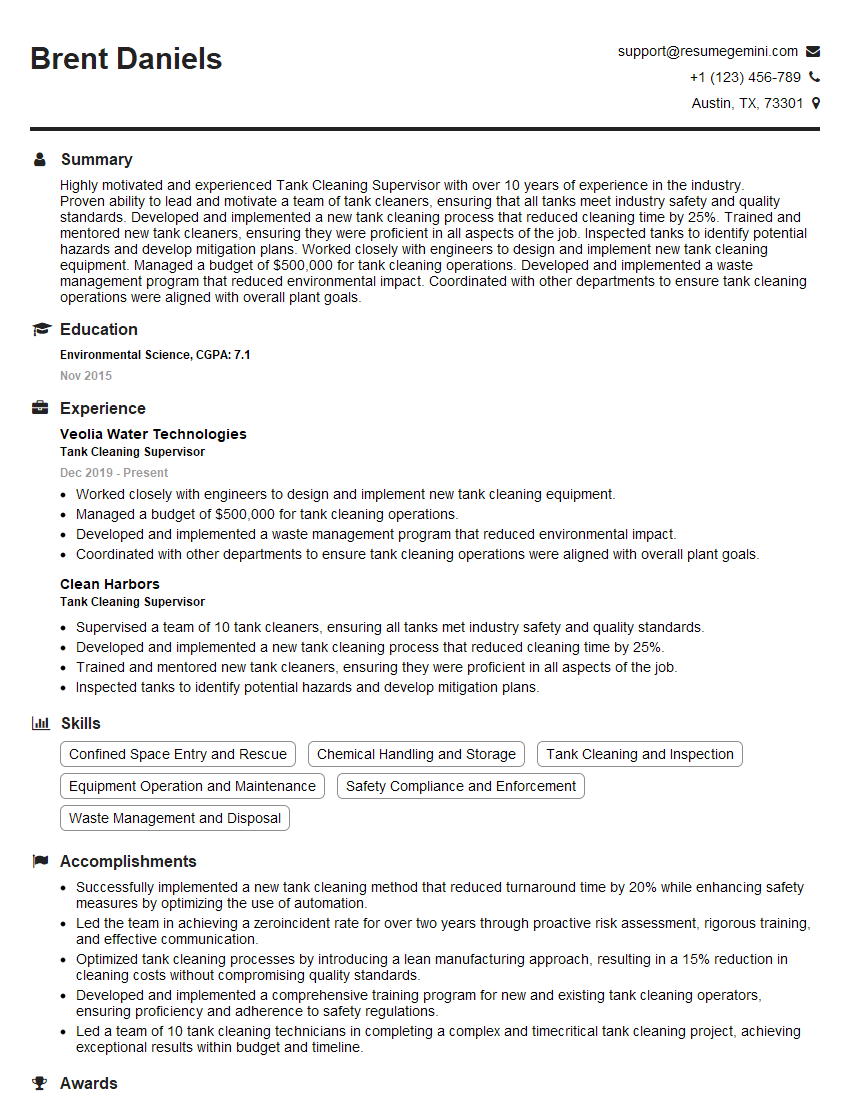
Mastering Tank Troubleshooting opens doors to rewarding and challenging career opportunities within the industrial sector. Your expertise in this critical area will significantly increase your value to potential employers. To maximize your job prospects, focus on building a compelling and ATS-friendly resume that showcases your skills and experience effectively. ResumeGemini is a trusted resource that can help you craft a professional resume tailored to the specific requirements of Tank Troubleshooting roles. Examples of resumes optimized for this field are available, providing you with valuable templates and guidance.

Explore more articles
Users Rating of Our Blogs
Share Your Experience
We value your feedback! Please rate our content and share your thoughts (optional).
What Readers Say About Our Blog
Really detailed insights and content, thank you for writing this detailed article.
IT gave me an insight and words to use and be able to think of examples