The right preparation can turn an interview into an opportunity to showcase your expertise. This guide to Pre-Press Production interview questions is your ultimate resource, providing key insights and tips to help you ace your responses and stand out as a top candidate.
Questions Asked in Pre-Press Production Interview
Q 1. Explain the process of color separation in pre-press.
Color separation is the process of breaking down a full-color image into its individual CMYK (Cyan, Magenta, Yellow, and Key/Black) components. Think of it like separating the layers of a cake – each layer represents a different color plate used in the printing process. This is crucial because printing presses use separate plates for each color, and by separating the image into these channels, we ensure accurate color reproduction.
The process typically involves using specialized software. The software analyzes the image and assigns color values to each channel. For example, a bright red might be composed of 0% Cyan, 100% Magenta, 100% Yellow, and 0% Black. Each channel then generates a separate image file, ready to be used to create printing plates.
Historically, this was done manually through techniques like camera-based separation, but today digital methods using software such as Adobe Photoshop or specialized pre-press applications are the standard.
Q 2. What are the different types of image file formats used in pre-press and their suitability?
Several image file formats are used in pre-press, each with its own strengths and weaknesses:
- TIFF (Tagged Image File Format): A highly versatile and lossless format ideal for high-resolution images. It’s widely supported in pre-press workflows and supports various color spaces. I frequently use TIFFs for high-quality images requiring precise color reproduction, such as photographs.
- JPEG (Joint Photographic Experts Group): A lossy format commonly used for photographs due to its smaller file sizes. However, the compression can lead to some quality loss, making it less suitable for critical pre-press applications where fine details are essential. I might use JPEGs for lower-resolution images, such as web images which are not directly used in print.
- PDF (Portable Document Format): Excellent for preserving document layout and fonts. PDFs are commonly used for sending final files to the printer, ensuring the intended layout is maintained. I often use PDFs for packaging final files for printing, especially for complex layouts.
- EPS (Encapsulated PostScript): A vector-based format suitable for illustrations and graphics with sharp lines and curves. This format is crucial for maintaining the sharpness of logo design and similar elements within a print project. It works well with vector-based illustrations.
The choice of format depends largely on the image content, quality requirements, and the specific software used. For example, when working on a high-end magazine project with high-resolution images, I’d always prioritize TIFF to avoid any potential loss of information during compression.
Q 3. Describe your experience with color management systems (e.g., ICC profiles).
Color management systems, specifically ICC profiles, are indispensable in ensuring consistent color across different devices and stages of the pre-press workflow. An ICC profile is like a digital fingerprint of a device – printer, monitor, scanner – describing its color capabilities. It acts as a translator, allowing different devices to understand and interpret colors accurately.
My experience involves using ICC profiles extensively in workflows. I ensure that all images are assigned with the correct profiles based on the printer’s requirements. I routinely check for color inconsistencies by comparing soft proofs (on-screen representation of the final print) against hard proofs (actual prints). If discrepancies occur, I adjust the profiles or color settings to ensure accuracy. For instance, I might adjust the gamut mapping to avoid out-of-gamut colors, which could lead to unexpected results on the print.
Q 4. How do you ensure the accurate imposition of pages for printing?
Accurate imposition, the arrangement of pages on a printing sheet, is crucial for efficient printing and minimizing waste. I use dedicated imposition software to create imposition layouts. This software allows me to precisely position pages considering factors like bleed, margins, and the orientation of the printing sheet.
My process involves first understanding the page count and the type of press being used. This determines the best way to arrange pages to minimize sheet waste. I then use the imposition software to create a layout that considers these factors. For example, a 32-page booklet might be imposed across multiple sheets based on the press’s sheet size, and the imposed sheets are reviewed carefully to ensure all pages are arranged correctly.
A key component is pre-flighting the imposed file to ensure correct page order, alignment and overall accuracy before sending to the printing plate maker, catching any errors before they reach the press.
Q 5. What is trapping and why is it important in pre-press?
Trapping is a critical pre-press technique used to prevent gaps between colored areas during printing. Imagine two adjacent shapes – one red and one blue. Due to the slight misregistration (imperfect alignment) that can occur during the printing process, there might be a small white gap visible between them. Trapping compensates for this by slightly overlapping the colors to ensure the gap is hidden.
There are two main trapping methods: spread trapping (expanding the lighter color into the darker) and choke trapping (reducing the darker color into the lighter). The choice of trapping method depends on the colors and the printing process. Inaccurate trapping can result in visible gaps or unwanted color bleeds, affecting the overall quality. I use trapping software to create trap settings, which automatically applies appropriate trapping to the document according to the printing settings and color specifications.
Q 6. What are common pre-flight checks you perform?
Pre-flight checks are essential for identifying potential problems before printing. It’s like conducting a final inspection before launching a rocket! My typical pre-flight checks include:
- Color Space Consistency: Ensuring all images are in the correct color space (e.g., CMYK for print).
- Resolution Checks: Verifying image resolutions meet the required standards for the printing process.
- Font Embedding: Checking all fonts are embedded to prevent font issues on the printing device.
- Bleed and Margins: Confirming correct bleed and margins to avoid printing issues.
- Image Compression: Ensuring images are not over-compressed, leading to quality loss.
- Imposition Verification: Double-checking the accuracy of the imposed pages.
- Trap Checks: Inspecting the automatic trapping created by the software for accuracy and efficiency.
I use automated pre-flight tools combined with manual inspection to ensure a thorough check. Catching errors at this stage prevents costly reprints and delays.
Q 7. Explain your experience with different platemaking technologies (e.g., CTP).
I have extensive experience with Computer-to-Plate (CTP) technologies, the modern standard for platemaking. CTP eliminates the need for film, streamlining the workflow and improving efficiency. I’m proficient in various CTP systems, working with different plate types and resolutions, based on client specifications.
My experience encompasses working with various RIP (Raster Image Processor) software to process and output files for CTP devices. I understand the implications of different settings within the RIP software, such as screening angles and dot gain compensation, which are crucial for consistent color reproduction. I’m also familiar with troubleshooting issues related to CTP output, such as plate defects or registration problems, and use my knowledge to correct those problems before they affect the printing process. Furthermore, I am well versed with the different plate technologies available, including thermal, violet, and UV-curable plates and select the most appropriate ones based on the job requirements and press capabilities.
Q 8. How do you handle color discrepancies between the digital proof and the final print?
Color discrepancies between digital proofs and final prints are a common challenge in pre-press. This often stems from differences in how color is represented on screen (RGB) versus how it’s reproduced on press (CMYK). The key to minimizing these discrepancies lies in a robust color management system.
My approach involves several steps. First, I meticulously profile both the monitor and the printing press using a spectrophotometer to ensure accurate color representation. This creates ICC profiles that translate colors consistently between devices. Second, I work in a designated color space, usually CMYK, throughout the pre-press workflow to avoid unnecessary color conversions. Third, I always request a press proof – a physical print from the press itself – to verify color accuracy before a large-scale print run. Any small discrepancies detected can be adjusted using color correction techniques before committing to the full print job. For example, if the blues are slightly off, I might adjust the cyan and magenta values in the CMYK profile to achieve the desired result. Finally, I maintain clear communication with the printer throughout the process to identify and resolve any arising issues promptly.
Q 9. Describe your experience with workflow software (e.g., MIS systems).
I’ve extensive experience with various workflow software, including MIS (Management Information Systems) like PrintSmith Vision and Tharstern. These systems are crucial for streamlining pre-press operations. In my previous role, we used PrintSmith Vision to manage job estimations, scheduling, and tracking, ensuring seamless communication between different departments – from sales to pre-press and finishing. The software’s automated features, like generating job tickets and tracking progress, significantly improved efficiency and reduced manual errors. I’m proficient in using these systems to track deadlines, manage client communications, and generate comprehensive reports for various stakeholders. For example, I’ve used the reporting features to analyze production bottlenecks and optimize workflows, leading to cost savings and improved turnaround times.
Q 10. What is your experience with PDF workflows and the different PDF standards?
PDF workflows are the backbone of modern pre-press. My expertise encompasses various PDF standards, including PDF/X-1a, PDF/X-4, and PDF/X-5. I understand the nuances of each standard and select the appropriate one based on the printing process and client requirements. For example, PDF/X-1a is suitable for simple jobs with spot colors, while PDF/X-4 is better for more complex projects with embedded fonts and images. PDF/X-5 offers additional features like transparency support and enhanced color management. My workflow always involves preflighting the PDF to ensure it meets the chosen standard – this identifies potential issues such as missing fonts, embedded low-resolution images, or color profile inconsistencies which are tackled before progressing. The ability to reliably create and manage various PDF versions ensures high quality consistent output.
Q 11. How do you manage high-resolution images in a pre-press workflow?
Managing high-resolution images is critical for achieving high-quality prints. Overly large files can slow down the workflow and potentially cause issues during processing. My strategy involves optimizing images without compromising print quality. First, I ensure that images are supplied in appropriate formats like TIFF or PSD. Then, I use image editing software like Adobe Photoshop to resize and compress images to the necessary resolution for the specific print job. I ensure that images are not over-sharpened which can lead to artifacts in the final print. I generally aim for a resolution of 300 DPI (dots per inch) for most print projects. If the image needs to be scaled up, I always work with the highest resolution image possible to minimize the appearance of pixelation. The process involves a balance between image quality and file size optimization, improving overall workflow efficiency.
Q 12. How do you ensure the quality and accuracy of print files before sending them to press?
Ensuring print file quality and accuracy before sending them to press is paramount. My process involves a rigorous preflighting and proofing procedure. I use software like Acrobat Pro with preflight profiles to automatically check for a wide range of issues: missing fonts, embedded low-resolution images, color profile inconsistencies, and overset text. This automated checking is complemented by manual review which identifies more subtle potential problems. After preflighting, I create soft proofs using a calibrated monitor and compare them against the client’s provided digital assets or a proof. This allows for detection of any visual discrepancies and immediate corrections. For critical jobs, I always recommend a contract proof – a proof produced by the printer – to further verify color accuracy and other aspects of the final output. This multi-layered approach minimizes errors and ensures the final print product meets client expectations.
Q 13. What are some common issues encountered during pre-press production and how have you resolved them?
Common pre-press issues include missing or incorrect fonts, low-resolution images, color profile mismatches, and overset text. For instance, I once encountered a job with missing fonts, resulting in unexpected character substitutions in the final print. I resolved this by carefully identifying the missing fonts, obtaining them from the client, and reinstalling them within the document. Another challenge involved a client supplying low-resolution images. In this case, I worked with the client to source high-resolution replacements and meticulously managed the image optimization process. I have developed strategies for resolving common issues – a thorough preflight check, regular communication with clients, and collaboration with the printing team ensures we proactively address potential problems before they impact the final print.
Q 14. Describe your experience with different types of printing processes (e.g., offset, digital).
I have experience with both offset and digital printing processes. Offset printing offers high-quality results, particularly for large print runs. I understand the intricacies of preparing files for offset printing, including considerations for color separations, imposition, and platemaking. Digital printing, on the other hand, offers advantages for smaller runs and faster turnaround times. My experience includes preparing files for various digital printing methods, understanding their unique color profiles and resolutions. The choice between offset and digital printing depends on the job’s size, budget, and turnaround requirements. I can provide expertise and guidance in choosing the most appropriate printing method based on project specifics, resulting in optimal results for the clients.
Q 15. How familiar are you with Pantone Matching System (PMS)?
The Pantone Matching System (PMS) is an internationally recognized color matching system used to ensure consistent color reproduction across different printing processes. Think of it as a universal color language. Each PMS color has a unique number, guaranteeing that a specific shade of, say, Pantone 18-1664 TCX (a vibrant orange), will look identical whether it’s printed on a business card in New York or a poster in Tokyo. This is crucial for maintaining brand consistency and accuracy in printed materials.
My familiarity extends to practical application in pre-press. I regularly use PMS color specifications provided by clients to accurately create color separations in my design software, ensuring the final printed output matches their expectations. I understand the limitations of PMS colors, specifically their lack of exact representation on screen and the need to convert to CMYK or other process color systems for optimal printing.
Career Expert Tips:
- Ace those interviews! Prepare effectively by reviewing the Top 50 Most Common Interview Questions on ResumeGemini.
- Navigate your job search with confidence! Explore a wide range of Career Tips on ResumeGemini. Learn about common challenges and recommendations to overcome them.
- Craft the perfect resume! Master the Art of Resume Writing with ResumeGemini’s guide. Showcase your unique qualifications and achievements effectively.
- Don’t miss out on holiday savings! Build your dream resume with ResumeGemini’s ATS optimized templates.
Q 16. Explain your experience with proofing methods (e.g., soft proof, contract proof).
Proofing is a critical stage, verifying the accuracy of the design before the actual printing begins. Soft proofs are digital representations viewed on a calibrated monitor, simulating the final printed product. Contract proofs offer a physical representation printed on the same type of paper and using the same printing method as the final job. They are legally binding.
My experience includes both soft and contract proofing. For soft proofs, I utilize calibrated monitors and software that accurately renders CMYK and spot colors. This involves checking color accuracy, image resolution, text clarity, and proper imposition. With contract proofs, I collaborate closely with the printer to ensure the selected proof type meets industry standards and client requirements. I know to review the proofs for any discrepancies against the approved design files, paying close attention to subtle color variations and registration issues.
Q 17. What is your understanding of bleed and how do you account for it in the design process?
Bleed refers to the extra area of an image or design that extends beyond the trim line of the final product. This is crucial because printing presses don’t always cut to the exact dimensions, and bleed prevents unsightly white margins from appearing on the finished piece. Imagine trying to cut a perfectly straight line along the edge of a photograph – there’s always a slight chance of imperfections.
In my workflow, I always account for bleed. For standard printed materials, I add a minimum of 3mm bleed around all sides of the artwork. This 3mm extension ensures that even with slight trimming inaccuracies, the intended image or design will reach the edge of the printed product without showing any white gaps. This is applied within the design software before the file is sent to the printer. This is especially critical for designs that use full-bleed images or patterns.
Q 18. How do you manage different file formats and versions in a collaborative pre-press environment?
Managing multiple file formats and versions in a collaborative environment requires a robust system. I typically utilize a version control system (like a cloud-based storage with version history), clearly labeled files with version numbers (e.g., design_v3.indd), and well-defined naming conventions. This helps everyone stay on the same page.
Furthermore, I establish clear communication protocols. All team members are aware of the accepted file formats (e.g., PDF/X-1a, AI, InDesign), latest versions, and the designated central repository for file access. This prevents confusion, ensures everyone works with the same files, and avoids accidental overwriting of crucial design files.
Q 19. How do you troubleshoot technical issues related to image processing or software glitches?
Troubleshooting technical issues requires a systematic approach. When encountering problems, I begin by identifying the specific error message or visible issue. Then I follow a process of elimination to find the source. This could involve checking file compatibility, verifying color profiles, ensuring software updates are current, or reviewing the image resolution and its suitability for the intended print process.
For instance, if an image appears pixelated, I would check the image resolution and verify it meets the required DPI for print. If I’m facing a software glitch, I might try restarting the application, checking for updates, or consulting online resources and forums for solutions. If the problem persists, I’d seek assistance from other team members or technical support.
Q 20. What software applications are you proficient in (Adobe Creative Suite, etc.)?
I’m highly proficient in the Adobe Creative Suite, including:
- Adobe InDesign: For page layout and complex document design.
- Adobe Photoshop: For image editing and manipulation.
- Adobe Illustrator: For vector graphics and logo design.
- Adobe Acrobat Pro: For creating and managing PDF files, ensuring print-readiness.
My skills extend to working with other relevant software like preflight tools for pre-press quality control.
Q 21. Describe your experience with quality control processes in pre-press.
Quality control is paramount in pre-press. My QC process starts with preflight checks using dedicated software that automatically identifies potential issues, such as low-resolution images, missing fonts, or color profile inconsistencies before the file is sent to print.
After the preflight, I conduct a thorough manual review, verifying every aspect of the design—color accuracy against the Pantone specifications, proper bleed and trim marks, correct font usage, image sharpness, and text readability. I also carefully check the imposition (arrangement of pages for printing) for any errors. Finally, I review the final PDF proof again in consultation with the client before proceeding to the printing stage. This multi-layered approach ensures a high-quality and error-free final product.
Q 22. What are your methods for optimizing files for different printing processes?
Optimizing files for different printing processes is crucial for achieving the desired print quality and avoiding costly reprints. This involves understanding the specific requirements of each process – offset, digital, large format, etc. – and preparing the files accordingly.
- Resolution: Offset printing generally requires higher resolutions (300 DPI or more) than digital printing (often 150-300 DPI). For large format, the resolution needs to be adjusted based on viewing distance. I always check and adjust the resolution to match the print method’s specifications.
- Color Mode: Offset printing usually uses CMYK (Cyan, Magenta, Yellow, Black), while digital printing might accept RGB (Red, Green, Blue) depending on the machine. I ensure the correct color mode is selected and implement color management profiles (like ICC profiles) to maintain color consistency.
- File Format: PDF/X-1a is a widely accepted standard for offset printing, ensuring predictable color and font embedding. For digital printing, PDFs or high-resolution TIFF files often work well. I carefully select the appropriate file format to eliminate potential compatibility issues.
- Image Compression: While compression saves file size, it can reduce image quality. I use lossless compression (like TIFF or PNG) for images critical for print quality and lossy compression (like JPEG) judiciously where the image detail is less important.
- Fonts: Always embed or outline fonts to prevent font substitution issues on the printing press. This ensures that the final product looks exactly as it was designed.
For example, preparing a file for a high-end brochure printed using offset lithography requires meticulous attention to detail, ensuring the highest resolution images, accurate color profiles, and a properly structured PDF/X-1a file. In contrast, files for a quick print job using digital printing might allow for slightly lower resolution, provided the quality remains acceptable.
Q 23. How do you handle urgent jobs with tight deadlines?
Handling urgent jobs requires a calm, organized approach and prioritization. I follow a structured process:
- Immediate Assessment: I quickly evaluate the job requirements, deadlines, and existing workload. This determines the urgency and resource allocation.
- Team Communication: I immediately communicate with the client and relevant team members (designers, printers) to clarify specifications, potential challenges, and expectations.
- Prioritization & Resource Allocation: I adjust my workflow and prioritize the urgent job, potentially re-allocating resources (e.g., utilizing overtime) or delegating tasks.
- Process Optimization: I might streamline the pre-press process (e.g., skipping certain steps if acceptable) to accelerate the workflow without sacrificing print quality. For example, if minor edits are needed, I might communicate them directly to the designer via an online proofing system.
- Regular Communication & Status Updates: I keep the client regularly updated on progress, addressing any concerns or unforeseen issues promptly. Transparency keeps everyone informed and builds trust.
Once, we had a client requiring 5000 brochures within 24 hours due to an unforeseen marketing event. By streamlining the process and working late into the night, we successfully completed the job, highlighting the importance of clear communication, proactive problem-solving, and a collaborative team environment.
Q 24. Explain your experience with different types of paper and their impact on the printing process.
Different papers significantly impact the printing process and the final product’s look and feel. Understanding paper properties is fundamental to successful pre-press production.
- Paper Weight (GSM): GSM (Grams per Square Meter) influences the paper’s thickness and durability. Heavier papers are more substantial but might require adjustments to the printing process.
- Paper Type: Coated papers provide a smooth surface for vibrant colors and sharp images, while uncoated papers offer a more natural texture. Coated papers are ideal for high-quality images and text, while uncoated papers are preferred for a more rustic or eco-friendly aesthetic.
- Paper Finish: Glossy, matte, and textured finishes affect how light interacts with the printed surface. A glossy finish enhances vibrancy, whereas a matte finish minimizes glare.
- Paper Color: Using off-white or cream-colored papers can affect the perceived colors of the printed image, requiring adjustments to the color profiles. We might need to perform color calibration to accurately reflect the intended color on the chosen paper stock.
For example, a high-quality photo book will benefit from using thick, glossy coated paper to achieve the most vibrant colors and image clarity, while a rustic wedding invitation would likely utilize a thicker, uncoated stock for a more elegant and textured feel. Choosing the correct paper is a significant step in assuring the successful outcome of any print project.
Q 25. How familiar are you with print finishing techniques (e.g., binding, folding)?
I’m highly familiar with various print finishing techniques, which significantly enhance the final product’s presentation and functionality.
- Binding: I’m experienced with different binding methods, including saddle-stitch (stapling), perfect binding (gluing), wire-o binding (spiral), and case binding (for hardcover books). The choice of binding depends on the document’s length, budget, and desired aesthetic.
- Folding: I understand various folding patterns (e.g., half-fold, letter fold, roll fold), crucial for creating brochures, leaflets, and other multi-page documents. Incorrect folding can result in misaligned content, so careful planning during the pre-press stage is crucial.
- Die-Cutting & Embossing: I understand the process of creating custom shapes and textures using die-cutting and embossing, adding unique tactile elements to enhance the overall presentation.
- Laminating: I’m familiar with different lamination types (gloss, matte, UV) providing added protection and enhancing the visual appeal of printed materials. This protects the print from scratching and water damage.
The choice of finishing technique directly impacts the final product’s presentation and longevity. For instance, a high-end annual report would benefit from perfect binding and perhaps UV coating, while a simple flyer would only require folding and possibly lamination.
Q 26. Describe your experience with large format printing and the specific challenges it presents.
Large format printing presents unique challenges compared to standard print jobs. The scale necessitates careful attention to details like resolution, color management, and media handling.
- Resolution & Image Quality: Maintaining high-resolution images is critical, especially for large prints where imperfections are more noticeable. The appropriate resolution will depend on the final print size and viewing distance. I carefully assess this requirement for each project.
- Media Handling: Large format printing often involves various substrates (vinyl, canvas, fabric) requiring different handling techniques. Knowing the media’s properties and adjusting the printing parameters accordingly is crucial to prevent issues like media jams or color inconsistencies.
- Color Consistency: Maintaining color consistency across large prints can be challenging. Proper color profiling and calibration are crucial to prevent banding or color shifts. I usually conduct test prints to ensure consistency before beginning a large-scale production run.
- File Size Management: Large format files can be exceptionally large, demanding robust file management and efficient workflows. I use appropriate software and hardware to handle such large files efficiently.
I once worked on a large-scale project printing a mural for a major event. The client required high-fidelity color reproduction across multiple panels. To manage this, I created high-resolution tiles of the artwork and ensured meticulous color calibration to maintain visual consistency across the assembled panels, resulting in a flawless and impactful mural.
Q 27. How do you stay updated with the latest trends and technologies in pre-press production?
Staying current in the rapidly evolving field of pre-press production is paramount. I utilize several methods:
- Industry Publications & Websites: I regularly read trade journals and visit websites specializing in pre-press technology and trends. This allows me to see the latest trends in hardware and software.
- Conferences & Workshops: Attending industry conferences and workshops allows for networking and learning about the newest developments from industry leaders and experts.
- Online Courses & Tutorials: I actively engage in online courses and tutorials, improving my skills on various software and technologies.
- Professional Networks: I maintain connections with other pre-press professionals through online communities and professional organizations, exchanging insights and learning from their experiences.
- Software Updates & Training: I stay updated on the newest versions of software crucial for pre-press operations, taking advantage of training and support provided by software vendors. This guarantees that I’m using the most efficient and effective tools available.
This continuous learning keeps my skills sharp and ensures I’m employing the latest technologies and best practices in my daily work.
Q 28. Describe a situation where you had to solve a complex pre-press problem. What was your solution?
We had a project where the client provided files with embedded color profiles that were incompatible with our printing equipment. This resulted in significant color discrepancies between the proof and the final print.
My solution involved a multi-step process:
- Identify the Problem: We first identified the incompatibility between the client’s color profiles and our printing equipment’s color space.
- Communication with Client: I communicated the issue with the client, explaining the need for revised files with compatible color profiles.
- Color Profile Conversion: We attempted converting the color profiles using color management software to match our equipment’s specifications. This involved several test prints to achieve accurate color matching.
- Collaboration with the Designer: As a workaround, we collaborated directly with the original designer to re-export the files using a color space compatible with our printing system.
- Final Proofing: We performed a rigorous final proofing process to ensure color accuracy and consistency before proceeding with the full print run.
This situation highlighted the importance of clear communication with clients, a strong understanding of color management, and the ability to find effective workarounds to address unexpected problems. We successfully resolved the issue, delivering a product that matched the client’s expectations.
Key Topics to Learn for Pre-Press Production Interview
- Color Management: Understanding color spaces (CMYK, RGB, Pantone), color profiles, and color separations. Practical application: Troubleshooting color inconsistencies between digital and printed outputs.
- File Preparation & Imposition: Preparing files for different printing methods (offset, digital, large format). Practical application: Creating efficient imposition layouts to minimize paper waste and maximize print speed.
- Proofing & Quality Control: Understanding different proofing methods (soft proof, contract proof, press proof) and identifying potential print issues before they reach the press. Practical application: Performing thorough quality checks on files to ensure accuracy and consistency.
- Pre-flighting & Trapping: Utilizing pre-flight tools to identify potential problems in artwork files. Understanding and implementing trapping techniques to prevent color gaps during printing. Practical application: Troubleshooting pre-flight errors and adjusting trapping settings for optimal print results.
- Image Editing & Retouching: Basic image manipulation skills for correcting flaws and preparing images for print. Practical application: Optimizing image resolution and file size for efficient printing.
- PDF Workflow: Creating press-ready PDFs using industry-standard settings and understanding PDF/X standards. Practical application: Ensuring that generated PDFs are compatible with various printing systems and workflows.
- Print Production Software: Familiarity with industry-standard software such as Adobe Acrobat, InDesign, Illustrator, and Photoshop. Practical application: Demonstrating proficiency in using these tools to prepare files for print.
- Problem-Solving & Troubleshooting: Analyzing and resolving common pre-press production challenges, such as color discrepancies, file format issues, and print defects. Practical application: Developing effective strategies for identifying and resolving print-related problems efficiently.
Next Steps
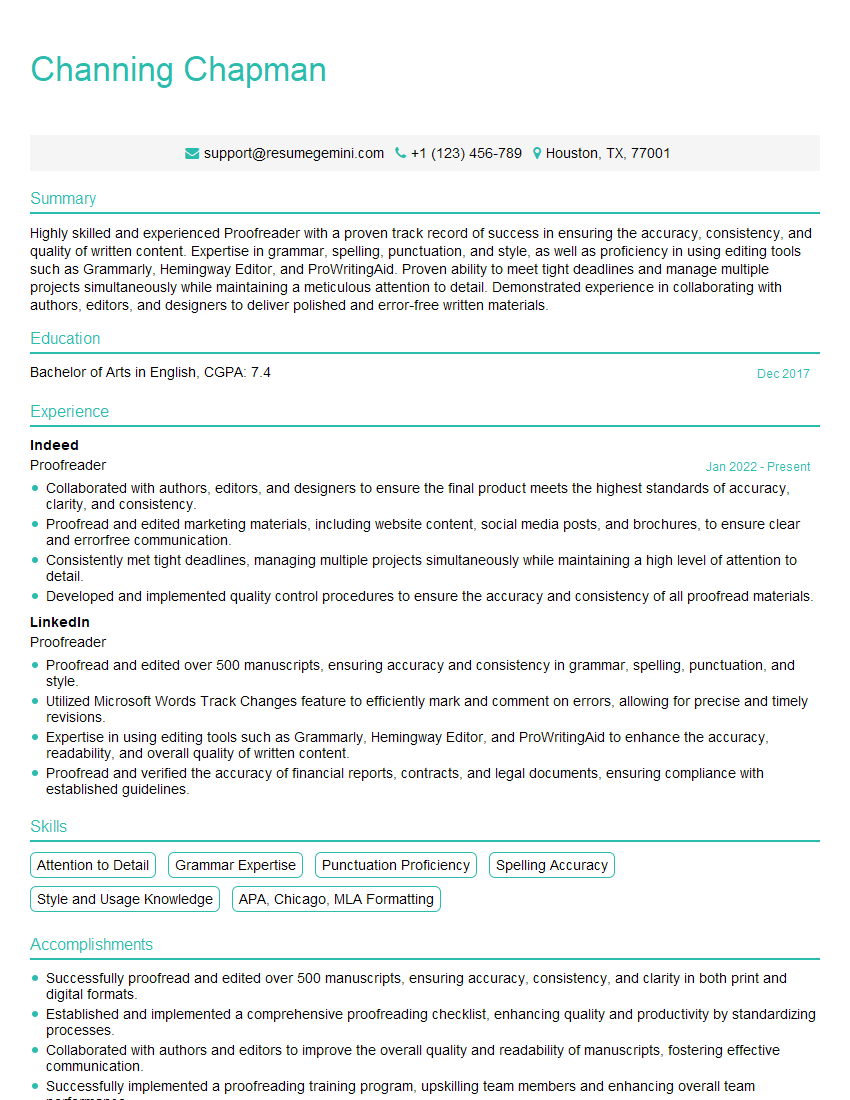
Mastering Pre-Press Production opens doors to exciting career opportunities in the graphic arts industry, offering diverse roles and excellent growth potential. A strong resume is crucial for showcasing your skills and experience to potential employers. Creating an ATS-friendly resume is key to ensuring your application gets noticed. To enhance your resume and increase your chances of landing your dream job, leverage the power of ResumeGemini. ResumeGemini provides a trusted platform for building professional resumes, and we offer examples of resumes tailored to Pre-Press Production to guide you.

Explore more articles
Users Rating of Our Blogs
Share Your Experience
We value your feedback! Please rate our content and share your thoughts (optional).
What Readers Say About Our Blog
Really detailed insights and content, thank you for writing this detailed article.
IT gave me an insight and words to use and be able to think of examples