The right preparation can turn an interview into an opportunity to showcase your expertise. This guide to Quilt Construction interview questions is your ultimate resource, providing key insights and tips to help you ace your responses and stand out as a top candidate.
Questions Asked in Quilt Construction Interview
Q 1. Describe your experience with various quilting techniques (e.g., piecing, appliqué, free-motion quilting).
My quilting journey has encompassed a wide range of techniques, each offering unique creative possibilities. Piecing, the foundation of many quilts, involves sewing together various fabric shapes to create larger designs. I’m proficient in both traditional piecing methods, like using a quarter-inch seam allowance for accuracy, and more modern techniques like foundation paper piecing for intricate designs. Appliqué, the art of applying fabric shapes onto a background, allows for stunning detail and customization. I’m comfortable with various appliqué methods, including machine appliqué, which provides speed and precision, and needle-turn appliqué, which offers a beautifully hand-stitched look. Finally, free-motion quilting, where the fabric is guided freely under the needle, allows for expressive quilting designs and fills the quilt with texture. I’ve mastered various free-motion techniques, from swirling patterns to stippling, adapting my style to complement the quilt’s design.
For example, recently I completed a large sampler quilt that combined traditional piecing with intricate machine appliqué. The piecing was done with precise quarter-inch seams ensuring the blocks were uniformly sized. Each block displayed a different appliqué design, some requiring needle-turn appliqué for that hand-stitched look while others were quickly completed using machine appliqué.
I always consider the overall design and desired aesthetic when choosing the quilting technique. A simple, geometric design might pair perfectly with straight-line quilting, while a more complex design may benefit from free-motion quilting to emphasize the detail.
Q 2. Explain the importance of accurate fabric cutting in quilt construction.
Accurate fabric cutting is paramount in quilt construction. Inaccurate cutting leads to mismatched seams, uneven blocks, and ultimately, a distorted final product. Think of it like building a house – if your foundation isn’t square, the entire structure will be off. Even a slight deviation in a single piece can become magnified as you piece together more blocks.
I utilize a rotary cutter and cutting mat for precision. Marking the fabric accurately with a ruler and marking pen helps maintain straight lines. I always double-check my measurements and use a sharp rotary cutter to ensure clean, accurate cuts. Investing in quality cutting tools is an important aspect to consistent, precise cutting and avoiding frustration. I often pre-wash my fabrics to account for shrinkage before cutting to prevent unevenness and distortion after washing the finished quilt.
For instance, a 1/8-inch error in cutting a single square in a quilt block can accumulate to a noticeable difference by the time the block is complete and especially if that block is repeated multiple times. This leads to unevenness and a potentially sloppy-looking quilt.
Q 3. How do you choose appropriate fabrics for different quilt projects?
Fabric selection is a crucial step, profoundly impacting the final quilt’s look, feel, and longevity. Factors such as fiber content (cotton, linen, silk), weight, and print must be considered in relation to the project’s design and intended use.
For a baby quilt, soft, lightweight cotton is ideal. For a heavier, more durable quilt intended for everyday use, a heavier weight cotton might be preferable. Considering the print is also important; bold prints paired with subtle solids can create a visually interesting contrast.
I often explore fabric collections designed to coordinate, ensuring a cohesive aesthetic. However, I also enjoy experimenting with contrasting colors and patterns to create a unique, personalized design. I always pre-wash fabrics to prevent shrinkage and ensure colorfastness to ensure the finished quilt will retain its original shape and vibrancy.
For example, a quilt with a complex free-motion quilting pattern might benefit from a softer, less textured fabric to highlight the delicate stitching. Conversely, a quilt with a simpler, bolder pattern might be better suited to a fabric with a more substantial hand.
Q 4. What are your preferred methods for pattern construction and scaling?
My approach to pattern construction and scaling emphasizes accuracy and flexibility. I primarily use digital design software for pattern creation and scaling. This allows for precise adjustments and easy replication of blocks, reducing the risk of errors and saving time.
For scaling, I use the software’s built-in functions to enlarge or reduce patterns proportionally, maintaining the integrity of the design. I also utilize mathematical formulas to calculate the necessary adjustments if I’m working with a paper pattern. When necessary, I’ll create a test block to ensure that the scaled pattern will work properly. It allows for adjustments before committing to cutting the final pieces.
For example, I recently designed a quilt pattern digitally. The software allowed me to easily adjust the size of individual blocks and the overall quilt dimensions without compromising the design’s integrity.
Q 5. Describe your process for selecting and using quilting batting.
Choosing the right batting is essential to a quilt’s drape, warmth, and overall quality. I consider factors like the quilt’s purpose, the weight of the fabrics, and the desired loft.
For a warm winter quilt, I might opt for a thicker, high-loft batting like cotton batting or wool batting. For a lighter, summer quilt, a thinner batting, such as a bamboo or polyester batting might be more appropriate. The batting’s loft also affects the quilt’s texture and drape. A higher loft batting will give a more plush feel, while a lower loft batting results in a flatter, more structured quilt.
I also consider the batting’s fiber content. Cotton batting is a popular choice for its breathability and softness. Polyester batting is more affordable and durable, and wool batting offers exceptional warmth and drape. Before selecting a batting, I would often read reviews to ensure the batting matches its description. I’ve learned that different brands will offer varying lofts and textures for the same type of batting. Therefore, comparing the batting’s features is important before making a selection.
Q 6. How do you ensure the accuracy and evenness of quilting stitches?
Achieving accurate and even quilting stitches is key to a professional-looking finish. This involves careful preparation and attention to detail throughout the quilting process. I start by carefully basting the quilt layers together, ensuring even tension to prevent puckering or shifting. I use a walking foot or even feed system on my machine to maintain consistent feed of all three layers and avoid puckering.
For free-motion quilting, I maintain a consistent speed and pressure on the foot pedal, avoiding jerky movements that could distort the stitches. I use a variety of quilting rulers to guide my stitching if I want consistent patterns and lines. Marking guidelines on the quilt top with a water-soluble marker is also helpful. It aids in creating straight lines and following specific patterns.
Regularly checking the tension of the machine and adjusting it as needed is critical. I practice maintaining consistent needle penetration and stitch length. This helps ensure an even look across the quilt. I also utilize a variety of quilting techniques depending on the desired aesthetic. Straight-line quilting is easy to maintain consistent stitching, while free-motion quilting takes more practice and concentration.
Q 7. Explain your experience with different types of quilting machines.
My experience spans a variety of quilting machines, each offering unique features and capabilities. I’ve worked with both domestic and long-arm quilting machines. Domestic machines are excellent for smaller projects and offer great versatility for a variety of techniques. However, they are limited in the size of quilts they can handle.
Long-arm machines, on the other hand, are ideal for larger projects and allow for more complex quilting patterns. They offer greater speed and efficiency for large quilts. They typically also provide a wider range of quilting options and accessories. I prefer the long-arm machine for large projects because it provides great versatility and reduces strain on my body.
Regardless of the machine type, I prioritize regular maintenance to ensure optimal performance. This includes cleaning, lubrication, and timely replacement of needles. The right machine for a project depends heavily on the size and complexity of the quilt and the quilter’s experience level. I often choose the machine that best suits the task at hand, considering factors such as the quilt’s size, the type of quilting design, and my personal comfort level with each machine.
Q 8. What are some common challenges in quilt construction, and how do you address them?
Quilt construction presents several challenges, but with experience and planning, they’re manageable. One common issue is fabric distortion. This can occur due to uneven cutting, pre-washing inconsistencies, or the fabric’s inherent properties. I address this by meticulously pre-washing all fabrics in a similar manner, using a rotary cutter and cutting mat for precise cuts, and employing techniques like careful pressing and using a walking foot on my machine to prevent stretching during piecing.
Another challenge is accurate piecing. Slight inaccuracies in seam allowances accumulate, leading to mismatched blocks. To overcome this, I always use a 1/4 inch seam allowance and employ consistent techniques like chain-piecing to maintain accuracy. A good quality ruler and cutting mat are essential tools. I also use a seam guide on my sewing machine to improve accuracy.
Finally, maintaining consistent quilting density can be tricky. This affects the quilt’s drape and overall look. I tackle this by using a quilting ruler and marking my quilting lines precisely. I also vary my quilting density depending on the quilt’s design and the fabric’s weight.
Q 9. How do you manage time and resources effectively during a large quilting project?
Managing time and resources for large quilting projects requires careful planning. I start by creating a detailed project plan, breaking down the project into smaller, manageable tasks. This includes fabric selection, cutting, piecing, quilting, and binding. I assign timeframes to each task, factoring in potential delays. I maintain a dedicated workspace, keeping all materials organized to minimize wasted time searching for supplies.
Resource management involves a clear inventory of fabrics, threads, batting, and other necessities. I always purchase extra fabric to allow for mistakes and ensure I have enough of matching thread. I often create a cutting plan to minimize fabric waste. I also utilize efficient techniques, like chain piecing, to speed up the process without compromising quality.
For example, on a recent king-sized quilt, I created a detailed spreadsheet tracking my progress, material usage, and time spent on each stage. This allowed me to monitor my progress and adjust my schedule as needed.
Q 10. Describe your experience with different types of quilt finishes (e.g., binding, quilting).
I’m experienced with various quilt finishes, with binding being my preferred method. Binding is both practical and aesthetically pleasing, offering a clean finish to the quilt edges. I use different techniques depending on the quilt’s style: mitered corners for a more refined look or simple straight seams for quicker projects. I pay close attention to consistent seam allowances and accurate matching of fabric patterns in the binding. My goal is always a neat, professional finish that protects the quilt’s edges.
Regarding quilting techniques, I’m proficient in free-motion quilting, which allows for creative designs and custom stitching. I also utilize straight-line quilting for a more structured, traditional look and can incorporate echo quilting or stippling depending on the design. I choose the quilting style and density based on the quilt’s weight and fabric. For instance, a dense quilting pattern would suit a heavier fabric, while a lighter quilt might require less dense quilting.
Q 11. How do you maintain the quality and consistency of your work?
Maintaining quality and consistency requires attention to detail at every stage. I begin with careful fabric selection, ensuring that the fabrics complement each other in color, texture, and weight. Precise cutting and accurate seam allowances are crucial for maintaining straight lines and consistent block sizes. Consistent pressing throughout the process helps to maintain the quilt’s shape and avoid distortion.
During the quilting process, I maintain consistent tension and stitch length to ensure even stitching and avoid puckering. I use quality thread and needles suitable for the fabric weight. Regular cleaning and maintenance of my sewing machine are vital. I always inspect my work before moving to the next step, correcting any imperfections immediately. Before binding, I square up the quilt to ensure all sides are even. A final pressing helps to maintain a crisp, professional look. I consider consistent quality an integral part of my brand and reputation.
Q 12. What are your preferred methods for designing quilt patterns?
My quilt pattern designs are inspired by a variety of sources, including traditional patterns, nature, and even abstract art. I often start with sketching ideas on paper, experimenting with different block arrangements and color palettes. I use design software to refine my sketches, creating accurate block templates and visualizing the finished quilt.
I frequently utilize online resources and books for inspiration and to learn about different quilting techniques. Sometimes, I’ll even adapt existing patterns to create my own unique designs. A recent project involved designing a quilt based on the fractal patterns found in nature, using mathematical principles to create a complex and visually interesting design.
Q 13. Describe your experience with working with different types of sewing machines.
My experience encompasses various sewing machine types, from basic domestic machines to long-arm quilting machines. I’m comfortable using machines with different features, such as adjustable stitch length and width, needle position, and feed dogs. My expertise extends to understanding the specific capabilities and limitations of each machine type and selecting the most appropriate machine for each project.
For smaller projects or when working with delicate fabrics, I prefer using a domestic sewing machine with precise control over stitch settings. For large quilts, the long-arm quilting machine is invaluable, allowing for efficient and consistent quilting over large areas. I’m adept at adjusting machine settings based on fabric type and quilting design.
Q 14. Explain your experience with troubleshooting sewing machine problems.
Troubleshooting sewing machine problems is a crucial skill. I approach it systematically, starting with the most basic checks. For example, if the machine isn’t stitching, I’ll check the needle for damage, ensure the bobbin is properly wound and inserted, and verify the thread is correctly threaded through the machine. I’ll also check the tension settings and clean the bobbin area for lint build-up.
If the problem persists, I might refer to the machine’s manual or consult online resources for more specific troubleshooting guidance. I’m also familiar with common maintenance procedures, such as cleaning and lubricating the machine to prevent future problems. For complex issues, I know when to seek professional help from a qualified technician. I consider preventative maintenance and problem-solving skills to be essential for maintaining efficiency in my work.
Q 15. How do you handle client requests and feedback during custom quilt projects?
Client communication is paramount in custom quilt projects. I begin by having an in-depth consultation to understand their vision, including desired size, color palette, fabric preferences, and overall aesthetic. I use visual aids like mood boards or fabric swatches to ensure we’re on the same page. Throughout the process, I provide regular updates with photos or videos showcasing progress. Feedback is actively solicited and incorporated; I see it as a collaborative process. For example, if a client expresses concern about a certain color combination, I’ll happily create alternative options and discuss them until they are satisfied. If significant changes are requested after the design is finalized, I clearly outline any adjustments to the timeline or budget. Ultimately, my goal is to exceed client expectations and deliver a quilt they’ll treasure for years to come.
Career Expert Tips:
- Ace those interviews! Prepare effectively by reviewing the Top 50 Most Common Interview Questions on ResumeGemini.
- Navigate your job search with confidence! Explore a wide range of Career Tips on ResumeGemini. Learn about common challenges and recommendations to overcome them.
- Craft the perfect resume! Master the Art of Resume Writing with ResumeGemini’s guide. Showcase your unique qualifications and achievements effectively.
- Don’t miss out on holiday savings! Build your dream resume with ResumeGemini’s ATS optimized templates.
Q 16. What software or tools do you use for quilt design and pattern creation?
While traditional paper and pencil are still valuable for sketching initial ideas, I primarily utilize Electric Quilt 8 (EQ8) for digital quilt design. EQ8 allows me to experiment with various block arrangements, color palettes, and fabric choices virtually before committing to any cutting or sewing. It provides accurate measurements, helping to prevent costly errors. I also use Adobe Photoshop for manipulating images and creating custom fabric prints if the client desires a unique pattern. For example, EQ8 helps me precisely plan the layout of a complex medallion quilt, ensuring the pattern flows seamlessly and accurately calculates the required fabric yardage. This software significantly enhances efficiency and precision in the design phase.
Q 17. Describe your experience with working with various types of fabrics.
My experience encompasses a wide range of fabrics, from delicate silks and linens to durable cottons, flannels, and even wool. I’m adept at handling different weights, textures, and drape. I understand the unique properties of each fabric and select them based on the quilt’s intended purpose and the client’s preferences. For example, a baby quilt would call for soft, breathable cotton, while a heavier wool might be more suitable for a winter throw. I’m also knowledgeable about fabric blends and their characteristics, understanding how, for instance, a cotton-linen blend offers both softness and durability. This knowledge ensures that I choose the most suitable fabric for the client’s needs and the overall aesthetic of the quilt.
Q 18. How do you ensure the durability and longevity of your quilts?
Durability and longevity are central to my approach. I begin with careful fabric selection, choosing high-quality materials known for their strength and resistance to wear and tear. Precision cutting and accurate piecing are critical; I use a rotary cutter and cutting mat for consistent cuts to minimize fraying and ensure straight seams. I use high-quality thread and employ appropriate sewing techniques, like using a walking foot for even feeding of multiple layers. Finally, I always pre-wash fabrics to prevent shrinkage and color bleeding, adding a crucial step to prevent future issues. Proper quilting techniques, ensuring even stitch density and appropriate batting selection, contribute to the quilt’s long-term integrity. For example, careful attention to seam allowances, combined with precise quilting, prevents the seams from stretching or ripping under pressure.
Q 19. Explain your understanding of color theory and its application in quilt design.
Color theory is fundamental to effective quilt design. I utilize the color wheel to create harmonious and visually appealing palettes. Understanding analogous colors (colors next to each other on the wheel), complementary colors (opposite each other), and triad colors (equally spaced) helps create diverse and balanced quilt designs. For example, a quilt using analogous colors like blues and greens can create a calming, serene feel, whereas a complementary combination of oranges and blues would offer a more vibrant and dynamic contrast. I consider the client’s preferences, the overall mood they wish to evoke, and the room the quilt is intended for when creating a color scheme. Beyond simple color choices, I also consider value (lightness and darkness) and saturation (intensity) for creating depth and visual interest.
Q 20. What are some common design principles used in quilt making?
Several design principles guide my work. Repetition, using similar patterns or blocks, creates rhythm and visual unity. Balance, distributing elements equally, ensures a visually harmonious result – symmetrical or asymmetrical. Contrast, using opposing colors or textures, creates visual interest and dynamism. Emphasis, highlighting a central element (like a striking block), draws the viewer’s attention. Unity ties all elements together for a cohesive design. For instance, a quilt might use repetition of a specific block pattern, balanced with contrasting colors to create visual interest, with a central medallion acting as an emphasis point. These principles work together to form a visually appealing and balanced design.
Q 21. How do you ensure proper fabric pre-washing and preparation?
Pre-washing is non-negotiable. I always wash all fabrics before beginning a project, regardless of the fabric type. This process removes sizing (a finishing agent applied to fabrics during manufacturing), which can interfere with sewing and cause inconsistent results and potential shrinking later. I wash the fabrics in cold water with a mild detergent, then dry them on a low setting or air dry to minimize shrinkage. This prevents any surprises later in the process and guarantees the quilt maintains its size and shape after washing by the client. For delicate fabrics like silks, I hand-wash and air dry to prevent damage. Proper pre-washing guarantees a high-quality, long-lasting finished product.
Q 22. What are your methods for creating a consistent seam allowance?
Maintaining a consistent seam allowance is crucial for accurate quilt construction and a professional finish. Inconsistent seam allowances lead to distorted blocks and a messy overall appearance. My method relies on a combination of techniques for accuracy and speed.
Using a Seam Allowance Guide: I always use a quarter-inch seam allowance foot on my sewing machine. This ensures consistent 1/4” seams every time, minimizing the need for manual measuring. If I’m hand-sewing, I use a seam guide marked on my cutting mat or a ruler to maintain consistency.
Pre-pressing Seams: Before assembling blocks, I press all seams open or to one side, depending on the block pattern’s instructions. This creates a flat, stable foundation for accurate seam joining. This reduces bulk and ensures clean, crisp seams.
Chain Piecing: For efficiency, especially when working with many small pieces, I use chain piecing. This involves sewing multiple seams together in one continuous line, reducing the number of times I have to start and stop the machine. It’s important to note that chain piecing requires additional attention to ensure consistent seam allowance.
Regular Checking: I regularly check my seam allowances throughout the process by periodically measuring with a ruler to catch any inconsistencies early on. This preventative measure saves significant time and effort later.
By combining these methods, I ensure my seam allowances remain consistently accurate, leading to beautifully crafted quilts.
Q 23. Describe your experience with different types of quilt blocks.
My experience encompasses a wide range of quilt blocks, from simple squares and rectangles to complex geometric shapes and intricate pieced designs. I’m comfortable working with traditional blocks like:
Nine Patch: A classic and versatile block that forms the basis for many larger patterns.
Log Cabin: Known for its radiating strips, it allows for creative use of fabrics and color combinations.
Dresden Plate: An elegant block featuring curved piecing that requires precision and attention to detail.
Ohio Star: A visually striking block made of diagonal piecing and triangles.
Beyond these, I have extensive experience with more modern and contemporary block designs, including those incorporating negative space, non-traditional shapes, and innovative piecing techniques. I’m always eager to learn and incorporate new blocks into my repertoire. The ability to adapt and precisely construct a variety of blocks contributes greatly to the versatility and design possibilities of my quilt projects.
Q 24. How do you handle large-scale quilt projects?
Managing large-scale quilt projects requires meticulous planning and efficient workflow. My approach involves several key strategies:
Breaking Down the Project: I start by dividing the quilt into manageable sections or smaller blocks. This makes the overall task less daunting and allows for easier progress tracking.
Creating a Detailed Plan: This involves accurately calculating fabric requirements, creating a cutting plan, and sketching out the overall layout. This organized approach reduces errors and saves time later.
Working in Stages: I complete each stage of the project sequentially – cutting, piecing, assembling blocks, assembling the quilt top, quilting, and binding – focusing on one step at a time.
Utilizing Space Efficiently: For large quilts, I use wall space and design a system of organized storage to avoid fabric tangles and ensure quick access to pieces.
Taking Breaks: Working on a large quilt for extended periods can be tiring. I incorporate regular breaks into my process to maintain focus and prevent errors. This also allows for stepping away from the project to gain a fresh perspective.
By employing these methods, I can effectively and efficiently manage large-scale quilt projects with minimal stress and maintain the highest level of quality.
Q 25. What is your experience with hand-quilting techniques?
Hand-quilting is a time-consuming yet rewarding technique that allows for intricate designs and a uniquely personal touch. My experience includes various hand-quilting methods, including:
Running Stitch: A simple and versatile stitch suitable for both straight lines and curves. I find it excellent for filling large areas.
Outline Stitch: Ideal for outlining appliqué shapes or highlighting design features; it creates a decorative border.
Echo Quilting: This involves stitching parallel lines around a motif or pattern element, producing a visual texture. This is a technique I frequently use to emphasize features in a quilt.
Free-Motion Quilting: While technically done on a machine, this requires specific skills and practice in guiding the fabric and controlling stitch size to achieve a variety of textures. This technique is an advanced way to achieve both texture and patterns.
I adapt my hand-quilting style based on the quilt’s overall design and fabric choice. It’s essential to select the appropriate needle and thread to complement both the style and the fabric. My hand-quilting emphasizes careful stitch consistency and attention to detail to achieve a high-quality finish.
Q 26. Describe your knowledge of different types of quilt patterns.
My knowledge of quilt patterns is extensive, covering various styles and techniques. I’m familiar with both traditional and modern patterns:
Traditional Patterns: These include classic block-based designs like Log Cabin, Grandmother’s Flower Garden, and variations of the Star pattern. They often emphasize symmetry and repeating motifs. This category covers a wide variety of shapes, colors and piecing styles.
Modern Patterns: These often incorporate asymmetrical designs, improvisation, and unconventional piecing methods. Modern patterns frequently push boundaries with color choices, texture, and the incorporation of unexpected elements.
Scrappy Patterns: These embrace a combination of various fabrics, colors, and patterns for a uniquely eclectic look, usually built around simple block patterns.
Appliqué Patterns: These patterns involve attaching fabric shapes to a background, adding another layer of complexity and artistic expression.
My understanding extends beyond just recognizing patterns; I can adapt and modify existing patterns, create my own designs, and choose patterns appropriate to the fabric selection and skill level. This knowledge enables me to create unique and personalized quilts.
Q 27. Explain your experience with working with different types of needles and thread.
Selecting the right needles and thread is paramount for successful quilt construction. The choice depends on the fabric type and the sewing technique. My experience includes working with a variety of needles and threads, understanding their characteristics and suitability for different applications:
Needles: I use universal needles for general sewing, microtex needles for fine fabrics, and topstitching needles for thicker fabrics or when sewing through multiple layers. The needle size is adjusted according to fabric weight. For hand-quilting, I use sharp needles of appropriate size based on thread thickness.
Threads: I’m familiar with various thread types, including cotton, polyester, and rayon. Cotton thread is a popular choice for quilting due to its strength and colorfastness. Polyester thread offers durability and is suitable for machine quilting. Rayon thread provides a softer, more luxurious feel. I always select thread that complements both the fabric and the project’s overall aesthetic and functional needs.
Selecting the appropriate needle and thread ensures smooth sewing, prevents fabric damage, and contributes to the overall quality and longevity of the finished quilt.
Q 28. What safety precautions do you take while using sewing machines?
Safety is my top priority when using sewing machines. My safety precautions include:
Proper Machine Maintenance: I regularly clean and maintain my sewing machine to ensure it’s functioning correctly. This prevents unexpected malfunctions that could cause injury.
Correct Needle and Thread Usage: I always use the correct needle size for the fabric and ensure the thread is properly threaded and wound to prevent breakage and injury.
Finger Placement: I keep my fingers away from the needle and presser foot while the machine is running to prevent needlesticks.
Proper Use of Attachments: When using attachments like walking feet or seam guides, I ensure they are correctly attached and functioning properly to avoid jams or injuries.
Electrical Safety: I unplug the machine before cleaning, making adjustments, or replacing needles. I also ensure the area is well-lit and the machine is placed on a stable surface.
Appropriate Attire: I never wear loose clothing or jewelry that could get caught in the machine.
By consistently adhering to these safety measures, I create a safe and efficient sewing environment for myself and avoid potential accidents.
Key Topics to Learn for Quilt Construction Interview
- Fabric Selection and Properties: Understanding different fabric types (cotton, silk, wool, etc.), their drape, weight, and suitability for various quilt designs. Practical application: Choosing appropriate fabrics for a specific quilt project based on its intended use and aesthetic.
- Cutting and Piecing Techniques: Mastering accurate fabric cutting methods and various piecing techniques (e.g., seam allowances, accurate matching of points and seams). Practical application: Constructing precise and well-aligned quilt blocks with minimal fabric waste.
- Quilt Layering and Basting: Understanding the importance of proper layering (backing, batting, and top) and effective basting techniques to prevent shifting during quilting. Practical application: Creating a smooth, even surface for consistent quilting stitches.
- Quilting Methods and Designs: Familiarity with different quilting styles (e.g., straight-line, free-motion, stippling) and their visual impact. Practical application: Selecting and executing quilting patterns that complement the quilt’s design and enhance its overall look.
- Binding and Finishing Techniques: Understanding the various binding methods and their impact on the quilt’s durability and appearance. Practical application: Creating a professional and durable finish that protects the quilt edges.
- Troubleshooting and Problem-Solving: Identifying and resolving common issues encountered during quilt construction (e.g., uneven seams, puckering, fabric distortion). Practical application: Adapting techniques and applying creative solutions to overcome challenges during the quilting process.
- Understanding Quilt Design Principles: Knowledge of color theory, pattern design, and composition as they apply to quilt making. Practical application: Creating visually appealing and balanced quilt designs.
Next Steps
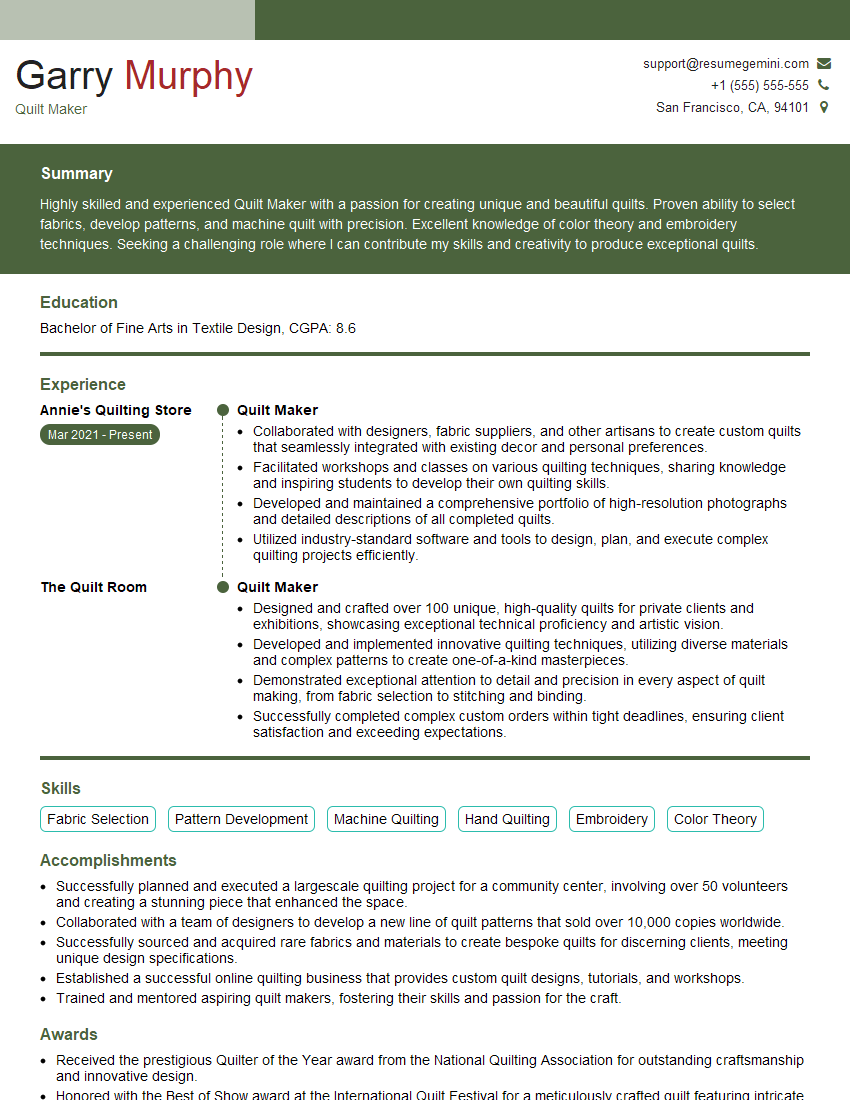
Mastering quilt construction opens doors to exciting career opportunities in the textile arts, offering diverse roles from crafting unique pieces to teaching and designing. To maximize your job prospects, create a compelling and ATS-friendly resume that highlights your skills and experience. ResumeGemini is a trusted resource that can help you build a professional resume that showcases your abilities effectively. Examples of resumes tailored specifically to the quilt construction industry are available to help guide you. Take this opportunity to craft a resume that truly reflects your passion and expertise.
Explore more articles
Users Rating of Our Blogs
Share Your Experience
We value your feedback! Please rate our content and share your thoughts (optional).
What Readers Say About Our Blog
Really detailed insights and content, thank you for writing this detailed article.
IT gave me an insight and words to use and be able to think of examples